Posts Tagged ‘Mauveine’

The history of Alizarin (and madder).

Thursday, October 18th, 2018

The Royal Society of Chemistry historical group (of which I am a member) organises two or three one day meetings a year. Yesterday the October meeting covered (amongst other themes) the fascinating history of madder and its approximately synthetic equivalent alizarin. Here I add a little to the talk given by Alan Dronsfield on the synthesis of alizarin and the impact this had on the entire industry.

Although William Perkin famously (and accidentally) produced the first synthetic chemical dye in 1856 (Mauveine), the industry at that time was both large and dominated by dyes from natural products. Mauve was something of a niche colour; far more important was alizarin, both as a red dye (for cotton) and a red pigment (in painting) and up to 1869 it was sourced from the roots of the madder plant (which was difficult to farm) and from insects (which could be farmed). It was nonetheless expensive to produce it from either and so a race started to create it synthetically. Famously, two groups submitted patents for such a synthesis in 1869, William Perkin himself and two scientists working in BASF, Carl Graebe and Carl Liebermann.[1],[2] The latter were the winners (by one day) and they are now famed for their work (what a difference one day can make; Perkin is known for his other work, but not as much for the synthesis of alizarin). As with mauveine, the structures of these dyes were not known with certainty (or for mauveine even approximately) at the time, but Graebe and Liebermann had managed to prove that alizarin was derived from anthracene by reducing the former to the latter using zinc dust. Trouble was, the structure of anthracene itself was not certain in 1869! There were two probable candidates, (a) and (b) below.
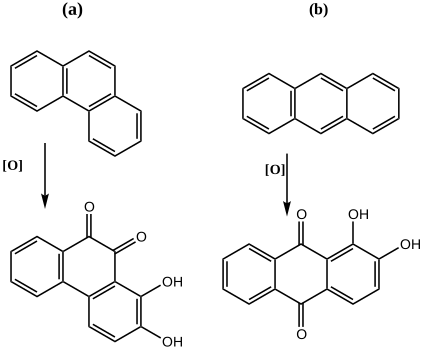
Alan told us how Graebe and Liebermann favoured structure (a), now known as phenanthrene, rather than (b), which we recognize as anthracene. A full story is told in this PhD thesis, written in 1919 and published in 1921[3] and I can only tell a tiny bit of it here. Essentially (a) was preferred over (b) because the former could sustain three aromatic (benzene-like) rings, whereas the latter only two (p 3 of the thesis above). Years later in 1972, this concept emerged as the Clar π-sextet rule, but the idea was already more than 100 years old by then! And indeed thermodynamically, phenanthrene is more stable than anthracene. By 1872, circumstantial evidence was accumulating that in fact alizarin was derived from (b), largely via attempts to synthesize the molecule by various reactions. These often were performed at high temperatures (red-hot tubes), and we now know that many complex rearrangements can occur at such temperatures. In 1889[4], Armstrong was quoting the structure of anthracene with no doubts about its structure. However, it took another 30 years or so for an entirely unambiguous total synthesis of anthracene to be devised.[3] Also around that time the first structures based on crystallography were emerging (by William Bragg) that supported this hypothesis. Even so, the first modern crystal structure had to wait until 1950.[5]

We learn from this story that many chemical structures established during the 19th century were largely based on (admittedly a large) body of circumstantial evidence. A wonderful example of how a systematic rather than a circumstantial proof of the structure of naphthalene was established using chemical synthesis and degradations alone can be found here in the work by Armstrong. Evidence obtained from instruments was largely restricted to techniques such as thermochemistry and polarimetry in the 19th century and for the first twenty years of the 20th to e.g. infra-red spectroscopy.[6] It is remarkable then that actually, most 19th century structures have stood the test of time. Moreover, not knowing the precise structure did not prevent the processes for making them to be patented. Nowadays of course, a simple crystal structure can often be solved in a few minutes and NMR spectroscopy takes a similar amount of time. We are no longer used to waiting for years or indeed decades for structural proof!


This synthesis proved to be very expensive (requiring a step using bromine and then a second step to remove it). But shortly after, a much more efficient synthesis which dispensed with the bromine brought the cost of the dye down dramatically. The madder industry never really recovered from this blow.

References

  1. C. Graebe, and C. Liebermann, "Ueber künstliche Bildung von Alizarin", Berichte der deutschen chemischen Gesellschaft, vol. 2, pp. 14-14, 1869. https://doi.org/10.1002/cber.18690020106
  2. C. Graebe, and C. Liebermann, "Ueber künstliches Alizarin", Berichte der deutschen chemischen Gesellschaft, vol. 2, pp. 332-334, 1869. https://doi.org/10.1002/cber.186900201141
  3. C.W. Colver, and W.A. Noyes, "SYNTHESIS OF ANTHRACENE<sup>1</sup> FROM NAPHTHALENE.", Journal of the American Chemical Society, vol. 43, pp. 898-905, 1921. https://doi.org/10.1021/ja01437a023
  4. "Proceedings of the Chemical Society, Vol. 6, No. 85", Proceedings of the Chemical Society (London), vol. 6, pp. 95, 1890. https://doi.org/10.1039/pl8900600095
  5. A. McL Mathieson, J.M. Robertson, and V.C. Sinclair, "The crystal and molecular structure of anthracene. I. X-ray measurements", Acta Crystallographica, vol. 3, pp. 245-250, 1950. https://doi.org/10.1107/s0365110x50000641
  6. W.W. Coblentz, "Infra-red Absorption Spectra: I. Gases", Physical Review (Series I), vol. 20, pp. 273-291, 1905. https://doi.org/10.1103/physrevseriesi.20.273

The colour of purple is … not orange but mauve?

Wednesday, October 26th, 2011

My previous post on the topic of mauveine left the outcome dangling. Put simply, λmax is measured at about 549nm for mauveine A, but was calculated at about 440nm using a modern method for predicting colour (TD-DFT). According to the colour table below, that would make it orange, not mauve. Can the theoretical prediction be out by 110nm, or might it be the structure of the molecule itself that has been wrongly described?
colour table

A new idea struck me, summarised below. No crystal structure of a mauveine has ever been reported, and so the position of the N-H groups is not determined. It is normally drawn as tautomer 1, but what about tautomers 2-4?

Tautomers of mauveine.

Following the principle of completeness, it is important to include a counterion. And because the colour mauve is recorded in methanol solutions (i.e. it is unlikely to be due to aggregation), we will include some explicit solvent (water) as well. To illustrate the model, I show the geometries calculated for two counter-ion isomers of tautomer 4 using ωB97XD/6-311G(d,p)/SCRF=water.

Tautomer 4. Click for 3D.

Tautomer 4, with different arrangement of Chloride. Click for 3D.

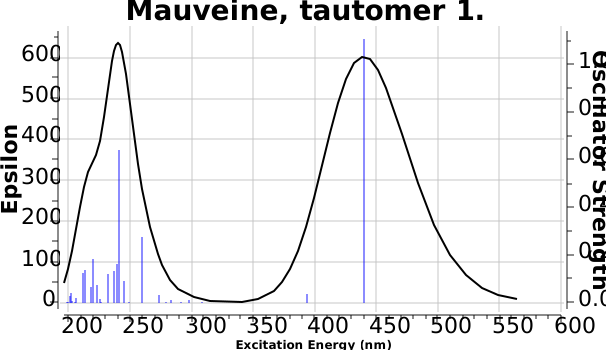
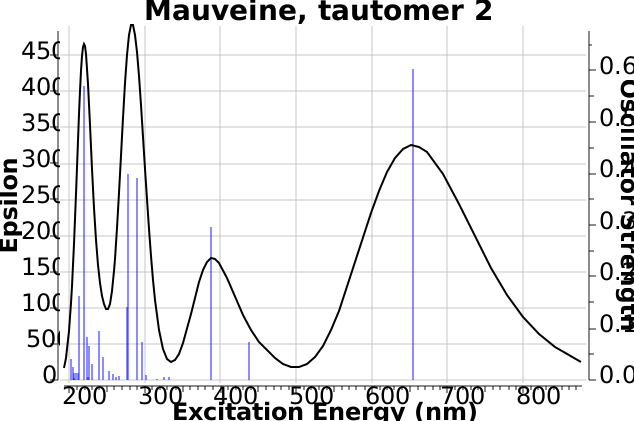
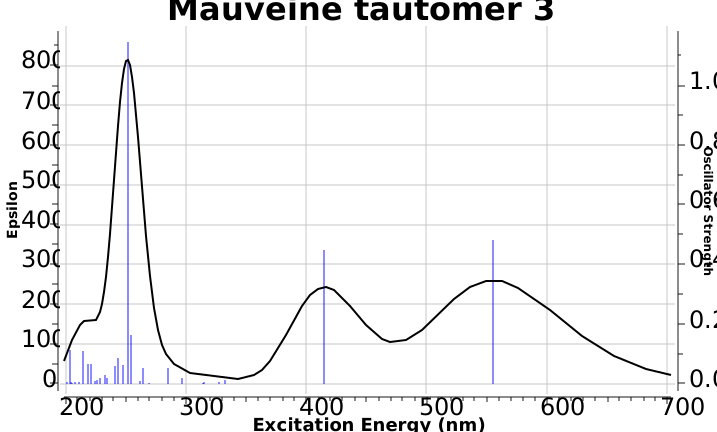
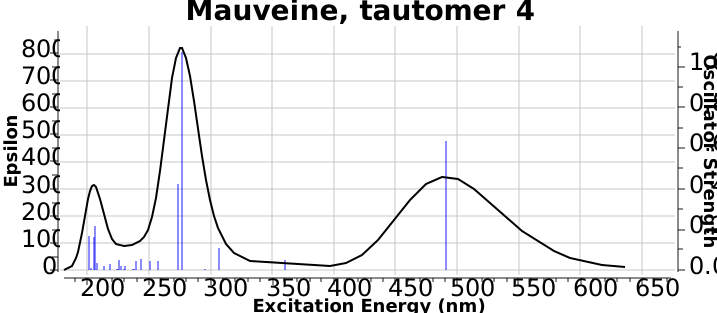
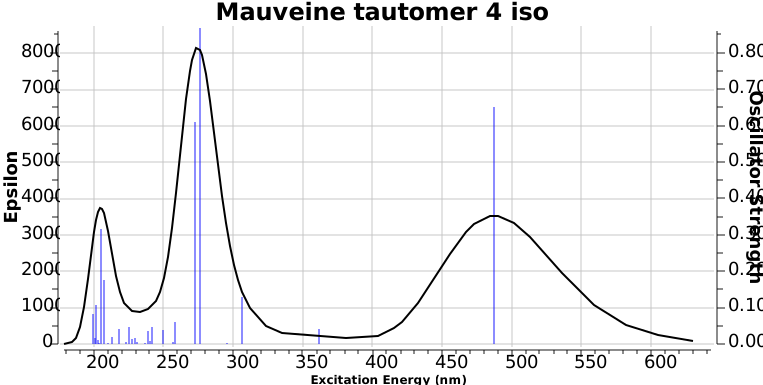
The predicted UV/Visible spectra are shown below (ωB97XD/6-311++G(d,p)/SCRF=water model), and  λmax ranges from 440 to 655nm simply by moving one proton around! The spectrum that matches the measured best corresponds to tautomer 4. Unfortunately, it is calculated to be about 15 kcal/mol higher in energy than tautomer 1, which is the lowest in energy.

λmax 440 λmax 655
colour table colour table
λmax 555 λmax 490
colour table colour table
λmax 487
colour table

So one step forward, and one back. A better colour match can be obtained by modelling a different tautomer of mauveine, but this now leaves the energy unexplained. I think perhaps a determined effort to get mauveine itself to form good crystals and to analyse those to confirm where the three exchangeable hydrogens reside would be well worth the effort. Even then, that will not necessarily tell us what is happening in solution. Such an old, and famous molecule, and still there is a mystery.

The colour of purple

Thursday, February 24th, 2011

One of my chemical heroes is William Perkin, who in 1856 famously (and accidentally) made the dye mauveine as an 18 year old whilst a student of August von Hofmann, the founder of the Royal College of Chemistry (at what is now  Imperial College London). Perkin went on to found the British synthetic dyestuffs and perfumeries industries. The photo below shows Charles Rees, who was for many years the Hofmann professor of organic chemistry at the very same institute as Perkin and Hofmann himself, wearing his mauveine tie. A colleague, who is about to give a talk on mauveine, asked if I knew why it was, well so very mauve. It is a tad bright for today’s tastes!

Charles Rees, wearing a bow tie dyed with (Perkin original) mauveine and holding a journal named after Perkin.

The first thing to note about mauveine is that it is not a single compound; actual samples can contain up to 13 different forms! These all vary in the number of methyl groups present which range from none up to four, in various positions. These compounds all have absorption maxima λmax in the range 540-550nm, the colour of purple. The structure of one of these, known as mauveine A, is shown below.

Mauveine A. Click to load 3D

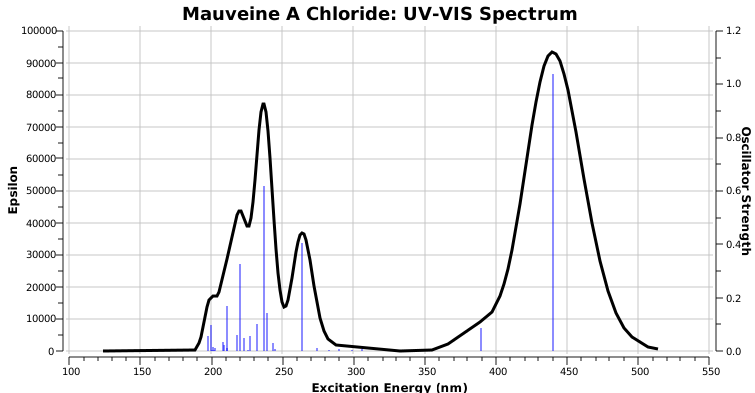
You can see from this that something is missing. The so-called chromophore is a cation, and an anion needs to be provided to balance the charge. We will now attempt to predict the color of purple using purely the power of quantum mechanics (for many years, accurate prediction of colour was a holy grail amongst dye chemists for obvious reasons). The anion can be chloride, and the colour is often measured in methanol as solvent. So the first task is to calculate this ion-pair. This used to be easier said than done (and in the past, the anion was often simply neglected). But using the ωB97XD density functional procedure (to get the van der Waals interactions modelled correctly) and a 6-311++G(d,p) basis set, coupled with a smoothed-cavity continuum solvation procedure, and two molecules of water (standing in for methanol, which is a bit bigger) as explicit solvent molecules, we get the structure apparent when you click on the diagram above (DOI: 10042/to-7320). Application of time-dependent density function theory (TD-DFT) gives a measure of the UV-optical spectrum (below, loaded as a scaleable SVG image. If you are using a modern browser, it should display. If not, try the latest FireFox, Chrome, Safari etc).


This has several noteworthy aspects.

  1. The visible (right hand side) part of the spectrum is very monochromatic, with λmax ~440nm. In other words, mauveine has a pure and intense colour.
  2. This λmax is hardly affected by the presence of the counterion.
  3. The electronic transition responsible for this band is a simple HOMO (highest-occupied-molecular-orbital) to LUMO (lowest-unoccupied-molecular-orbital) excitation of an electron.
  4. These orbitals are shown below.
    LUMO HOMO

    Mauveine A. LUMO. Click for 3D

    Mauveine A. HOMO. Click for 3D

  5. Note how the excitation involves the central region of the molecule, and one of the pendant aryl groups, but not the other. One might presume that tuning the colour would only work if changes are made to the first of these aryl groups.
  6. There is a real mystery about the calculated value of λmax, which differs from the observed value by about 100nm (the wrong colour, making mauveine orange rather than purple). Normally, this sort of time dependent density functional theory has errors no greater than 15-20nm. The calculated value of λmax is not sensitive to the basis set, or the presence or not of the counter ion and solvent. Clearly, a discrepancy of this magnitude must have some other explanation. Watch this space!

So this post ends with a bit of a mystery. The fanciest most modern computational theory gets the colour of mauveine wrong by ~100nm. Why?