Posts Tagged ‘August von Hofmann’

Historical detective stories: colourful crystals.

Friday, October 21st, 2011

Organic chemists have been making (more or less pure) molecules for the best part of 180 years. Occasionally, these ancient samples are unearthed in cupboards, and then the hunt for their origin starts. I have previously described tracking down the structure of a 120 year-old sample of a naphthalene derivative. But I visited a colleague’s office today, and recollected having seen a well-made wooden display cabinet there on a previous visit. Today I took a photo of one of the samples:

One of the "Hofmann" collection.

No date, no name, but a structure! As I noted before, when it comes to structures, you have to research the conventions (and numbering) used at the time. Thus note the apparent cyclohexane rings, the N(Me)2 group and the lack of stereochemistry around the alkenes. The former dates the sample to before 1950, whilst the use of Me to mean methyl puts it in the 20th century. Which is shame, since it had been known as the “Hofmann” collection, meaning some sort association with August von Hofmann, the first professor of organic chemistry in the UK, who occupied that position from 1845-1864. Samples that old are very rare. The one above by the way is very deep green (the photo does not do it justice), and very crystalline! Tracing the history of where the display cabinet might have been did indeed reveal that it probably started its life at the same institute as Hofmann was working in (and where I now work), but little more than this was known about it.

A search of the Beilstein database (nowadays known as Reaxys) revealed a collection of samples corresponding to the above structure (with benzenes of course, not cyclohexanes), but co-crystallised with different molecules, and dating from 1921. These were known as the Heilbron collection, and this was encouraging, since Heilbron was indeed a successor to Hofmann, being active in the 1920s. During his career, he and his students probably made 100s, if not 1000s of compounds, so why did they go to the considerable expense of having beautiful wooden cases built to house these particular samples? Probably because the basic colour varied from yellow to black (perhaps 400nm difference in λmax) and for which they had no explanation! So, much like some people are cryofrozen in the hope an advanced civilisation might bring them back to life in the future, these samples were mounted in a display cabinet in the hope that someone would find out the origins of their variable colour.

Well, in 1984 (some 63 years after the event) researchers in the Technion-lsrael Institute of Technology, Haifa, came upon the 1921 article (but not the samples; if they read this they might be amazed that these still exist!), repeated (most of the) syntheses, and determined the crystal structure of three of the molecules (but conspicuously not the one above). One 3D structure is shown below. The colours were ascribed to charge-transfer interactions between the components of the molecules.

DADZIR. Click for 3D

As I noted previously, it is well worth preserving chemical samples for future generations (and sometimes that generation is 120 years in the future!). Sadly, health and safety aspects (real or imagined) mean that such collections are being lost to posterity at an every increasing rate. Soon, there may be no collections of old chemicals left. That would be indeed a loss to science. So if you know of a lovingly preserved case of old chemicals, go take a look at it. And if it’s in danger of being put in the skip, then rescue it. There is no telling what may be scientifically interesting about it.

The colour of purple

Thursday, February 24th, 2011

One of my chemical heroes is William Perkin, who in 1856 famously (and accidentally) made the dye mauveine as an 18 year old whilst a student of August von Hofmann, the founder of the Royal College of Chemistry (at what is now  Imperial College London). Perkin went on to found the British synthetic dyestuffs and perfumeries industries. The photo below shows Charles Rees, who was for many years the Hofmann professor of organic chemistry at the very same institute as Perkin and Hofmann himself, wearing his mauveine tie. A colleague, who is about to give a talk on mauveine, asked if I knew why it was, well so very mauve. It is a tad bright for today’s tastes!

Charles Rees, wearing a bow tie dyed with (Perkin original) mauveine and holding a journal named after Perkin.

The first thing to note about mauveine is that it is not a single compound; actual samples can contain up to 13 different forms! These all vary in the number of methyl groups present which range from none up to four, in various positions. These compounds all have absorption maxima λmax in the range 540-550nm, the colour of purple. The structure of one of these, known as mauveine A, is shown below.

Mauveine A. Click to load 3D

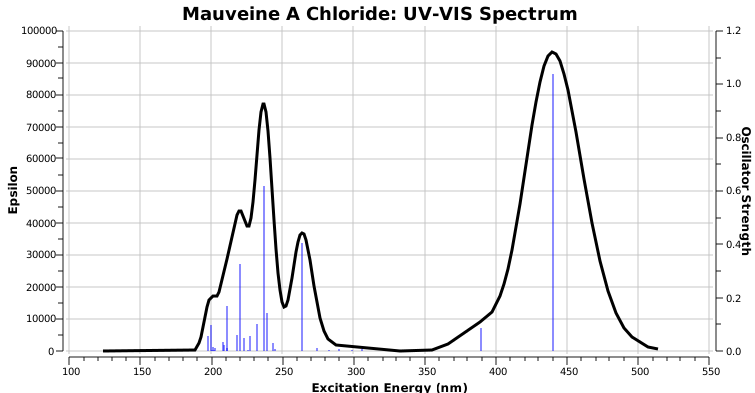
You can see from this that something is missing. The so-called chromophore is a cation, and an anion needs to be provided to balance the charge. We will now attempt to predict the color of purple using purely the power of quantum mechanics (for many years, accurate prediction of colour was a holy grail amongst dye chemists for obvious reasons). The anion can be chloride, and the colour is often measured in methanol as solvent. So the first task is to calculate this ion-pair. This used to be easier said than done (and in the past, the anion was often simply neglected). But using the ωB97XD density functional procedure (to get the van der Waals interactions modelled correctly) and a 6-311++G(d,p) basis set, coupled with a smoothed-cavity continuum solvation procedure, and two molecules of water (standing in for methanol, which is a bit bigger) as explicit solvent molecules, we get the structure apparent when you click on the diagram above (DOI: 10042/to-7320). Application of time-dependent density function theory (TD-DFT) gives a measure of the UV-optical spectrum (below, loaded as a scaleable SVG image. If you are using a modern browser, it should display. If not, try the latest FireFox, Chrome, Safari etc).


This has several noteworthy aspects.

  1. The visible (right hand side) part of the spectrum is very monochromatic, with λmax ~440nm. In other words, mauveine has a pure and intense colour.
  2. This λmax is hardly affected by the presence of the counterion.
  3. The electronic transition responsible for this band is a simple HOMO (highest-occupied-molecular-orbital) to LUMO (lowest-unoccupied-molecular-orbital) excitation of an electron.
  4. These orbitals are shown below.
    LUMO HOMO

    Mauveine A. LUMO. Click for 3D

    Mauveine A. HOMO. Click for 3D

  5. Note how the excitation involves the central region of the molecule, and one of the pendant aryl groups, but not the other. One might presume that tuning the colour would only work if changes are made to the first of these aryl groups.
  6. There is a real mystery about the calculated value of λmax, which differs from the observed value by about 100nm (the wrong colour, making mauveine orange rather than purple). Normally, this sort of time dependent density functional theory has errors no greater than 15-20nm. The calculated value of λmax is not sensitive to the basis set, or the presence or not of the counter ion and solvent. Clearly, a discrepancy of this magnitude must have some other explanation. Watch this space!

So this post ends with a bit of a mystery. The fanciest most modern computational theory gets the colour of mauveine wrong by ~100nm. Why?