Posts Tagged ‘Substitution reactions’

Smoke and mirrors. All is not what it seems with this Sn2 reaction!

Thursday, April 4th, 2019

Previously, I explored the Graham reaction to form a diazirine. The second phase of the reaction involved an Sn2′ displacement of N-Cl forming C-Cl. Here I ask how facile the simpler displacement of C-Cl by another chlorine might be and whether the mechanism is Sn2 or the alternative Sn1. The reason for posing this question is that as an Sn1 reaction, simply ionizing off the chlorine to form a diazacyclopropenium cation might be a very easy process. Why? Because the resulting cation is analogous to the cyclopropenium cation, famously proposed by Breslow as the first example of a 4n+2 aromatic ring for which the value of n is zero and not 1 as for benzene.[1] Another example of a famous “Sn1” reaction is the solvolysis of t-butyl chloride to form the very stable tertiary carbocation and chloride anion (except in fact that it is not an Sn1 reaction but an Sn2 one!)
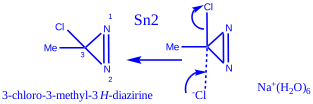
Here is the located transition state for the above, using Na+.6H2O as the counter-ion to the chloride. The calculated free energy of this transition state is 3.2 kcal/mol lower than the previous Sn2′ version (FAIR data collection, 10.14469/hpc/5045), with an overall barrier to reaction of 26.5 kcal/mol. This compares to ~24.5 kcal/mol obtained by Breslow for solvolysis of the cyclopropenyl tosylate. Given the relatively simple solvation model I used in the calculation (only six waters to solvate all the ions, and a continuum solvent field for water), the agreement is not too bad.

The animation above is of a normal vibrational mode known as the transition mode (click on the image above to get a 3D rotatable animated model). The calculated vectors for this mode (its energy being an eigenvalue of the force constant matrix) are regularly used to “characterise” a transition state. I will digress with a quick bit of history here, starting in 1972 when another famous article appeared.[2] The key aspect of this study was the derivation of the first derivatives of the energy of a molecule with respect to the (3N) geometrical coordinates of the atoms, using a relatively simply quantum mechanical method (MINDO/2) to obtain that energy. Analytical first derivatives of the MINDO/2 Hamiltonian were then used to both locate the transition state for a simple reaction and then to evaluate the second derivatives (the force constant matrix) using a finite difference method. That force constant matrix, when diagonalized, reveals one negative root (eigenvalue) which is characteristic of a transition state. The vectors reveal how the atoms displace along the vibration, and should of course approximate to the path to either reactant or product.

Since that time, it has been a more or less mandatory requirement for any study reporting transition state models to characterise them using the vectors of the negative eigenvalue. The eigenvalue invariably expressed as a wavenumber. Because this comes from the square root of the mass-weighted negative force constant, it is often called the imaginary mode. Thus in this example, 115i cm-1, the i indicating it is an imaginary number. The vectors are derived from quadratic force constants, which is a parabolic potential surface for the molecule. Since most potential surfaces are not quadratic, it is recognized as an approximation, but nonetheless good enough to serve to characterise the transition state as the one connecting the assumed reactant and product. Thousands of published studies in the literature have used this approach.

So now to the animation above. If you look closely you will see that it is a nitrogen and not a carbon that is oscillating between two chlorines (here it is the lighter atoms that move most). The vectors confirm that, with a large one at N and only a small one at C. So it is Sn2 displacement at nitrogen that we have located? 

Not so fast. This is a reminder that we have to explore a larger region of the potential energy surface, beyond the quadratic region of the transition state from which the vectors above are derived. This is done using an IRC (intrinsic reaction coordinate). Here it is, and you see something remarkable.

The Cl…N…Cl motions seen above in the transition state mode change very strongly in regions away from the transition state. On one side of the transition state, it forms a Cl…C bond, on the other side a Cl…N.
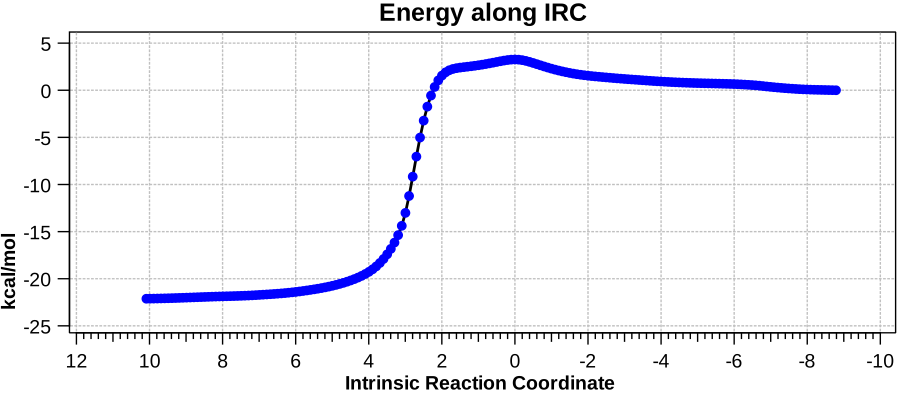
It is also reasonable to ask why the paths either side of the transition state are not the same? That may be because with only six explicit water molecules, three of which solvate the sodium ion, there are not enough to solvate equally the chloride anions either side of the transition state. As a result one chlorine does not behave in quite the same way as the other. The addition of an extra water molecule or two may well change the resulting reaction coordinate significantly.

The overall message is that there are two ways to characterise a computed reaction path. One involves looking at the motions of all the atoms just in the narrow region of the transition state. Most reported literature studies do only this. When the full path is explored with an IRC, a different picture can emerge, as here. The Cl…N…Cl Sn2 mode is replaced by a Cl…C/N…Cl mode. This example however is probably rare, with most reactions the transition state vibration and the IRC do actually agree!

References

  1. R. Breslow, "SYNTHESIS OF THE s-TRIPHENYLCYCLOPROPENYL CATION", Journal of the American Chemical Society, vol. 79, pp. 5318-5318, 1957. https://doi.org/10.1021/ja01576a067
  2. J.W. McIver, and A. Komornicki, "Structure of transition states in organic reactions. General theory and an application to the cyclobutene-butadiene isomerization using a semiempirical molecular orbital method", Journal of the American Chemical Society, vol. 94, pp. 2625-2633, 1972. https://doi.org/10.1021/ja00763a011
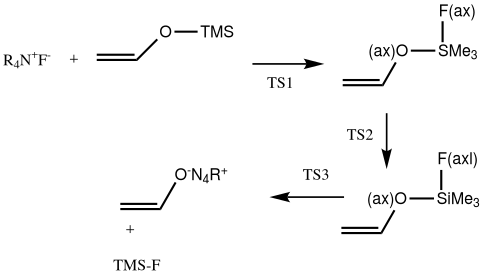
An alternative mechanism for nucleophilic substitution at silicon using a tetra-alkyl ammonium fluoride.

Friday, May 27th, 2016

In the previous post, I explored the mechanism for nucleophilic substitution at a silicon centre proceeding via retention of configuration involving a Berry-like pseudorotation. Here I probe an alternative route involving inversion of configuration at the Si centre. Both stereochemical modes are known to occur, depending on the leaving group, solvent and other factors.[1],[2],[3]

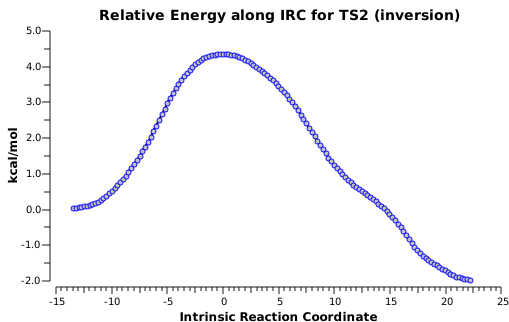
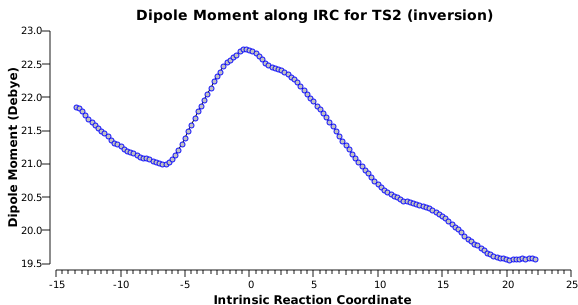
This alternative involves attack by F along the axial trajectory of the trigonal bipyramidal Si centre, with the OR group occupying the other axial position (TS1). In order to prepare the OR group for elimination with inversion of stereochemistry, the ion-pair complex has to reorganise (a process replacing the previous Berry pseudorotation necessary with for stereochemical retention) via TS2. And finally the OR is eliminated in TS3. The energetics of this pathway (ωB97XD/6-31+G(d) or Def2-TZVPPD/SCRF=thf) are shown below, with the inversion pathway coming out lower in energy than the previously reported retention pathway. 

System Relative free energy DataDOI
Inversion mechanism
Reactants 0.0 [4]

TS1

4.9 (4.1)* [5]
TS2 3.1 [6]
TS3 0.0 (-0.8)* [7]
Retention mechanism
TS1 7.9 (8.3)* [8]
TS2 9.2 (8.7)* [9]
TS3 5.2 (4.9)* [10]

* Values in parentheses are computed for the Def2-TZVPP basis set.

The key new finding for the inversion mechanism is the ion-pair isomerisation (TS2), which is animated below. Transition states which involve no rearrangement at a bond (either formation/cleavage or rotation) are quite rare, and it is nice to show one here.


So the nucleophilic displacement reaction at 4-substituted silicon centres is really quite different from carbon.Two distinct associative/elimination mechanisms proceeding through 5-coordinate silicon seem possible. For the specific case of tetra-alkyl ammonium fluoride as nucleophile and an enolate anion as the leaving group, it appears that an inversion mechanism is favoured, and one gets strong indications of this from crystal structures of such 5-coordinate species. It might be nice to repeat this study with a reaction which is known to strongly favour retention of configuration.

References

  1. L. Wozniak, M. Cypryk, J. Chojnowski, and G. Lanneau, "Optically active silyl esters of phosphorus. II. Stereochemistry of reactions with nucleophiles", Tetrahedron, vol. 45, pp. 4403-4414, 1989. https://doi.org/10.1016/s0040-4020(01)89077-3
  2. L.H. Sommer, and H. Fujimoto, "Stereochemistry of asymmetric silicon. X. Solvent and reagent effects on stereochemistry crossover in alkoxy-alkoxy exchange reactions at silicon centers", Journal of the American Chemical Society, vol. 90, pp. 982-987, 1968. https://doi.org/10.1021/ja01006a024
  3. D.N. Roark, and L.H. Sommer, "Dramatic stereochemistry crossover to retention of configuration with angle-strained asymmetric silicon", Journal of the American Chemical Society, vol. 95, pp. 969-971, 1973. https://doi.org/10.1021/ja00784a081
  4. H. Rzepa, "enol + Me4N(+).F(-) Reactant", 2016. https://doi.org/10.14469/hpc/565
  5. H. Rzepa, "Di-axial elimination of F", 2016. https://doi.org/10.14469/hpc/570
  6. H.S. Rzepa, "C 9 H 24 F 1 N 1 O 1 Si 1", 2016. https://doi.org/10.14469/ch/195052
  7. H. Rzepa, "Di-axial elimination of O TS", 2016. https://doi.org/10.14469/hpc/567
  8. H. Rzepa, "trimethyl silyl enol + Me4N(+).F(-) 5-coordinate intermediate F axial TS", 2016. https://doi.org/10.14469/hpc/554
  9. H. Rzepa, "5-coordinate intermediate Berry pseudorotation TS2 New conf?", 2016. https://doi.org/10.14469/hpc/577
  10. H. Rzepa, "trimethyl silyl enol + Me4N(+).F(-) TS", 2016. https://doi.org/10.14469/hpc/539

Mesomeric resonance in substituted benzenes: a crystallographic reality check.

Wednesday, August 26th, 2015

Previously, I showed how conjugation in dienes and diaryls can be visualised by inspecting bond lengths as a function of torsions. Here is another illustration, this time of the mesomeric resonance on a benzene ring induced by an electron donating substituent (an amino group) or an electron withdrawing substituent (cyano).

Scheme

In both cases, you can see this resonance showing as a lengthening of the C(ipso)-C(ortho) and C(meta)-C(para) bonds, and a contracting of the C(ortho)-C(meta) bonds. Does this reflect in the measured structures? The usual search is applied (R < 5%, no disorder, no errors) and qualified with the following:

  1. The amino has three bonds, and can bear either H, or 4-bonded carbon only.
  2. R on the ring can be either H or C.
  3. Three distances are defined.

Scheme

The results of a search are shown below; the hotspot shows the C-C(ortho) distance is close to 1.40Å, whilst the corresponding value for C(ortho)-C(meta) is 1.38Å, a contraction of ~0.02Å. The contraction is smaller for phenols (~0.01Å).

Scheme

The C(ortho)-C(meta) vs C(meta)-C(para) amino plot shows a cluster of hotspots for which the former (1.38Å) is  shorter than the latter (~1.39Å) but the effect is less clear cut as the distance from the substituent increases.

Scheme

For an electron withdrawing cyano substituent, C(ipso)-C(ortho) at 1.395Å is longer than C(ortho)-C(meta) at 1.385Å, although the difference seems smaller than for the amino substituent. The (ortho)-C(meta) to C(meta)-C(para) comparison is similar.

Scheme

Scheme

These searches take but a few minutes to perform, and do serve as a reality check on the oft-seen mesomeric π-resonance shown in all organic text books.

A new way of exploring the directing influence of (electron donating) substituents on benzene.

Friday, April 17th, 2015

The knowledge that substituents on a benzene ring direct an electrophile engaged in a ring substitution reaction according to whether they withdraw or donate electrons is very old.[1] Introductory organic chemistry tells us that electron donating substituents promote the ortho and para positions over the meta. Here I try to recover some of this information by searching crystal structures.

I conducted the following search:
xray

  1. Any electron donating group as a ring substituent, defined by any of the elements N, O, F, S, Cl, Br.
  2. A distance from the H of an OH fragment (as a hydrogen bonder to the aryl ring) to the ortho position relative to the electron donating group.
  3. A similar distance to the meta position.
  4. The |torsion angle| between the aryl plane and the C…H axis to be constrained to 90° ± 20.
  5. Restricting the H…C contact distance to the van der Waals sum of the radii -0.3Å (to capture only the stronger interactions)
  6. The usual crystallographic requirements of R < 0.1, no disorder, no errors and normalised H positions.

The result of such a search is seen below. The red line indicates those hits where the distance from the H to the ortho and meta positions is equal. In the top left triangle, the distance to ortho is shorter than to meta (and the converse in the bottom right triangle). You can see that both the red hot-spot and indeed the majority of the structures conform to ortho direction (of π-facial ) hydrogen bonding.

benzene-xrayHere is a little calculation, optimising the position that HBr adopts with respect to bromobenzene. You can see that the distance discrimination towards ortho is ~ 0.17Å, a very similar value to the “hot-spot” in the diagram above.

benzene-HBr

This little search of course has hardly scratched the surface of what could be done. Changing eg the OH acceptor to other electronegative groups. Restricting the wide span of N, O, F, S, Cl, Br. Probing rings bearing two substituents. What of the minority of points in the bottom right triangle; are they true exceptions or does each have extenuating circumstances? Why do many points actually lie on the diagonal? Can one correlate the distances with the substituent? Is there a difference between intra and intermolecular H-bonds? What of electron withdrawing groups?

The above search took perhaps 20 minutes to define and optimise, and it gives a good statistical overview of this age-old effect. It is something every new student of organic chemistry can try for themselves! If you run an introductory course in organic aromatic chemistry, or indeed a laboratory, try to see what your students come up with!

References

  1. H.E. Armstrong, "XXVIII.—An explanation of the laws which govern substitution in the case of benzenoid compounds", J. Chem. Soc., Trans., vol. 51, pp. 258-268, 1887. https://doi.org/10.1039/ct8875100258