Archive for the ‘crystal_structure_mining’ Category

Bond stretch isomerism. Did this idea first surface 100 years ago?

Tuesday, February 9th, 2016

The phenomenon of bond stretch isomerism, two isomers of a compound differing predominantly in just one bond length, is one of those chemical concepts that wax and occasionally wane.[1] Here I explore such isomerism for the elements Ge, Sn and Pb.

In one earlier post, I noted a form of bond stretch isomerism that can arise from a Jahn-Teller distortion ending in two different geometries in which one or more pairs of bonds swap short/long lengths. Examples include substituted cyclo-octatetraenes[2] and octahedral d9-Cu(II) complexes.[3] A more interesting seminal possibility was implied by G. N. Lewis a century ago when discussing the arrangement of electrons in a (carbon-carbon) triple bond.[4]

lewis1
*It took ~50 years to prove this assertion wrong.[5]

In a commentary, I reported the results of a search of the crystal structure database for the geometries associated with RX≡XR systems (X= C, Si, Ge, Sn, Pb). Here I focus the search[6] specifically for X=Sn,Ge; this version of bond stretch isomerism also allows angles to change (= rehybridisation at atoms) in order to provide a mechanism for a barrier separating the two forms.

For X=Sn, note the presence of up to three clusters, although the relatively low number of hits makes the statistics less certain.

  1. The hotspot cluster centered around angles of 125° and a Sn-Sn distance of ~2.6Å.
  2. Another with angles of <100° and Sn-Sn distances of ~3.3Å.
  3. A third with angles of <100° and Sn-Sn distances of 2.8Å, which may or may not be a genuine unique form of bonding.

This pattern was commented on in 2010 by Power[7], whose group synthesized most of the examples in the hits above. A plot of compounds with Ge-Ge bonds reveals both similarity with (two, possibly three clusters) and difference from (the clusters are closely spaced in terms of the Ge-Ge bond length, but separated in terms of angle) Sn.

GeGe

Time for some computations (which at least will remove random errors in the geometry). I selected the only known example of an RPb-PbR compound[8] as a seed and put it through a B3LYP+D3/Def2-TZVPP calculation (with 172 atoms and 2920 basis functions, this is a relatively large calculation!), which reproduces the known structure pretty well (table).

QIMQUY

So what about another bond stretch isomers? The Pb=Pb variation is indeed a stable minimum around 28.0 kcal/mol above the known structure, which seems to put this form out of experimental reach (with this ligand/aryl group at least). With Sn for the same aryl ligand, the energy difference is smaller (~15.8 kcal/mol for this ligand; Powers reports other systems where the energy difference may be only ~5 kcal/mol). Judging by the distribution of the 13 hits recovered from the CSD search, both bond stretch isomers may be accessible experimentally. The calculations show that the GeGe bond isomers are much closer in energy than SnSn (for this ligand). For all three metals however, the calculated difference in the metal-metal length for the two isomers is ~0.45 – 0.52Å. This strongly suggests that whereas the SnSn plot above is demonstrating bond length isomerism, the GeGe plot may not be; at least not of the same type that the calculations here are revealing (via the Wiberg bond orders).

System Relative energy XX distance RXX angle Wiberg bond order DataDOI
Pb=Pb +28.0 2.767 118.7 1.666 [9]
Pb-Pb 0.0 3.215 (3.188)[8] 93.7 (94.3)[8] 0.889 [10]
Sn=Sn +15.8 2.640 123.1 1.911 [11]
Sn-Sn 0.0 3.126 95.5 0.892 [12]
Ge=Ge +0.5 2.263 125.2 2.138 [13]
Ge-Ge 0.0   2.777 99.7 0.866 [14]

No doubt the particular bond length form is being facilitated by the nature of the ligand and the steric interactions therein imparted, both repulsive AND attractive. These interactions can be visualised via NCI (non-covalent-interaction) plots (click on the image to obtain a rotatable 3D model). First Pb-Pb followed by Pb=Pb. Note how in both cases, the PbPb region is enclosed in regions of weak attractive dispersion interactions, which however avoid the "hemidirected" inert Pb lone pairs.[15]

Pb-Pb Pb=Pb

So in the end we have something of a mystery. There is evidence from crystal structures that at least two bond-stretch isomers of RSnSnR compounds can form, but the calculations indicate that the Sn=Sn form is significantly higher in energy (although not impossibly so for thermal accessibility). Conversely, the Ge=Ge equivalent is very similar in energy to a Ge-Ge form with a significantly longer bond length, but there seems no crystallographic evidence for such a big difference in bond lengths. Perhaps the answer lies with the ligands?

It seems particularly appropriate on the centenary of G. N. Lewis' famous paper in which he clearly notes the possibility of three isomeric forms for the triple bond, to pay tribute to the impact his suggestions continue to make to chemistry.


The individual entries can be inspected via the following dois: [16],[17],[18],[19],[20],[21],[22],[23],[24],[25]

You can view individual entries via the following DOIs: [26],[27],[28],[29],[30],[31],[32],[33],[34],[35]

References

  1. J.A. Labinger, "Bond-stretch isomerism: a case study of a quiet controversy", Comptes Rendus. Chimie, vol. 5, pp. 235-244, 2002. https://doi.org/10.1016/s1631-0748(02)01380-2
  2. J.E. Anderson, and P.A. Kirsch, "Structural equilibria determined by attractive steric interactions. 1,6-Dialkylcyclooctatetraenes and their bond-shift and ring inversion investigated by dynamic NMR spectroscopy and molecular mechanics calculations", Journal of the Chemical Society, Perkin Transactions 2, pp. 1951, 1992. https://doi.org/10.1039/p29920001951
  3. W. Zhang, L. Chen, R. Xiong, T. Nakamura, and S.D. Huang, "New Ferroelectrics Based on Divalent Metal Ion Alum", Journal of the American Chemical Society, vol. 131, pp. 12544-12545, 2009. https://doi.org/10.1021/ja905399x
  4. G.N. Lewis, "THE ATOM AND THE MOLECULE.", Journal of the American Chemical Society, vol. 38, pp. 762-785, 1916. https://doi.org/10.1021/ja02261a002
  5. F.A. Cotton, "Metal-Metal Bonding in [Re<sub>2</sub>X<sub>8</sub>]<sup>2-</sup> Ions and Other Metal Atom Clusters", Inorganic Chemistry, vol. 4, pp. 334-336, 1965. https://doi.org/10.1021/ic50025a016
  6. H. Rzepa, "Crystal structures containing Sn...Sn bonds", 2016. https://doi.org/10.14469/hpc/249
  7. Y. Peng, R.C. Fischer, W.A. Merrill, J. Fischer, L. Pu, B.D. Ellis, J.C. Fettinger, R.H. Herber, and P.P. Power, "Substituent effects in ditetrel alkyne analogues: multiple vs. single bonded isomers", Chemical Science, vol. 1, pp. 461, 2010. https://doi.org/10.1039/c0sc00240b
  8. L. Pu, B. Twamley, and P.P. Power, "Synthesis and Characterization of 2,6-Trip<sub>2</sub>H<sub>3</sub>C<sub>6</sub>PbPbC<sub>6</sub>H<sub>3</sub>-2,6-Trip<sub>2</sub> (Trip = C<sub>6</sub>H<sub>2</sub>-2,4,6-<i>i</i>-Pr<sub>3</sub>):  A Stable Heavier Group 14 Element Analogue of an Alkyne", Journal of the American Chemical Society, vol. 122, pp. 3524-3525, 2000. https://doi.org/10.1021/ja993346m
  9. H.S. Rzepa, "C 72 H 98 Pb 2", 2016. https://doi.org/10.14469/ch/191856
  10. H.S. Rzepa, "C 72 H 98 Pb 2", 2016. https://doi.org/10.14469/ch/191873
  11. https://doi.org/
  12. H.S. Rzepa, "C 72 H 98 Sn 2", 2016. https://doi.org/10.14469/ch/191881
  13. H.S. Rzepa, "C 72 H 98 Ge 2", 2016. https://doi.org/10.14469/ch/191882
  14. H.S. Rzepa, "C 72 H 98 Ge 2", 2016. https://doi.org/10.14469/ch/191883
  15. M. Imran, A. Mix, B. Neumann, H. Stammler, U. Monkowius, P. Gründlinger, and N.W. Mitzel, "Hemi- and holo-directed lead(<scp>ii</scp>) complexes in a soft ligand environment", Dalton Transactions, vol. 44, pp. 924-937, 2015. https://doi.org/10.1039/c4dt01406e
  16. Jones, C.., Sidiropoulos, A.., Holzmann, N.., Frenking, G.., and Stasch, A.., "CCDC 892557: Experimental Crystal Structure Determination", 2012. https://doi.org/10.5517/ccyys5t
  17. Phillips, A.D.., Wright, R.J.., Olmstead, M.M.., and Power, P.P.., "CCDC 187521: Experimental Crystal Structure Determination", 2002. https://doi.org/10.5517/cc6942p
  18. Peng, Yang., Fischer, R.C.., Merrill, W.A.., Fischer, J.., Pu, Lihung., Ellis, B.D.., Fettinger, J.C.., Herber, R.H.., and Power, P.P.., "CCDC 771267: Experimental Crystal Structure Determination", 2010. https://doi.org/10.5517/cctwklt
  19. Peng, Yang., Fischer, R.C.., Merrill, W.A.., Fischer, J.., Pu, Lihung., Ellis, B.D.., Fettinger, J.C.., Herber, R.H.., and Power, P.P.., "CCDC 771268: Experimental Crystal Structure Determination", 2010. https://doi.org/10.5517/cctwkmv
  20. Peng, Yang., Fischer, R.C.., Merrill, W.A.., Fischer, J.., Pu, Lihung., Ellis, B.D.., Fettinger, J.C.., Herber, R.H.., and Power, P.P.., "CCDC 771270: Experimental Crystal Structure Determination", 2010. https://doi.org/10.5517/cctwkpx
  21. Peng, Yang., Fischer, R.C.., Merrill, W.A.., Fischer, J.., Pu, Lihung., Ellis, B.D.., Fettinger, J.C.., Herber, R.H.., and Power, P.P.., "CCDC 771271: Experimental Crystal Structure Determination", 2010. https://doi.org/10.5517/cctwkqy
  22. Peng, Yang., Fischer, R.C.., Merrill, W.A.., Fischer, J.., Pu, Lihung., Ellis, B.D.., Fettinger, J.C.., Herber, R.H.., and Power, P.P.., "CCDC 771272: Experimental Crystal Structure Determination", 2010. https://doi.org/10.5517/cctwkrz
  23. Peng, Yang., Fischer, R.C.., Merrill, W.A.., Fischer, J.., Pu, Lihung., Ellis, B.D.., Fettinger, J.C.., Herber, R.H.., and Power, P.P.., "CCDC 771274: Experimental Crystal Structure Determination", 2010. https://doi.org/10.5517/cctwkt1
  24. Fischer, R.C.., Pu, Lihung., Fettinger, J.C.., Brynda, M.A.., and Power, P.P.., "CCDC 624216: Experimental Crystal Structure Determination", 2007. https://doi.org/10.5517/ccnyk04
  25. Pu, Lihung., Phillips, A.D.., Richards, A.F.., Stender, M.., Simons, R.S.., Olmstead, M.M.., and Power, P.P.., "CCDC 221953: Experimental Crystal Structure Determination", 2004. https://doi.org/10.5517/cc7fysc
  26. Sasamori, Takahiro., Sugahara, Tomohiro., Agou, Tomohiro., Guo, Jing-Dong., Nagase, Shigeru., Streubel, Rainer., and Tokitoh, Norihiro., "CCDC 1035078: Experimental Crystal Structure Determination", 2014. https://doi.org/10.5517/cc13r2mk
  27. Sidiropoulos, A.., Jones, C.., Stasch, A.., Klein, S.., and Frenking, G.., "CCDC 749451: Experimental Crystal Structure Determination", 2010. https://doi.org/10.5517/cct4vvm
  28. Shan, Yu-Liang., Yim, Wai-Leung., and So, Cheuk-Wai., "CCDC 1019495: Experimental Crystal Structure Determination", 2015. https://doi.org/10.5517/cc136vy3
  29. Sugiyama, Y.., Sasamori, T.., Hosoi, Y.., Furukawa, Y.., Takagi, N.., Nagase, S.., and Tokitoh, N.., "CCDC 297827: Experimental Crystal Structure Determination", 2006. https://doi.org/10.5517/cc9zxbh
  30. Stender, M.., Phillips, A.D.., Wright, R.J.., and Power, P.P.., "CCDC 180660: Experimental Crystal Structure Determination", 2002. https://doi.org/10.5517/cc61zry
  31. Peng, Yang., Fischer, R.C.., Merrill, W.A.., Fischer, J.., Pu, Lihung., Ellis, B.D.., Fettinger, J.C.., Herber, R.H.., and Power, P.P.., "CCDC 771273: Experimental Crystal Structure Determination", 2010. https://doi.org/10.5517/cctwks0
  32. Peng, Yang., Fischer, R.C.., Merrill, W.A.., Fischer, J.., Pu, Lihung., Ellis, B.D.., Fettinger, J.C.., Herber, R.H.., and Power, P.P.., "CCDC 771269: Experimental Crystal Structure Determination", 2010. https://doi.org/10.5517/cctwknw
  33. Peng, Yang., Fischer, R.C.., Merrill, W.A.., Fischer, J.., Pu, Lihung., Ellis, B.D.., Fettinger, J.C.., Herber, R.H.., and Power, P.P.., "CCDC 771266: Experimental Crystal Structure Determination", 2010. https://doi.org/10.5517/cctwkks
  34. Jones, C.., Sidiropoulos, A.., Holzmann, N.., Frenking, G.., and Stasch, A.., "CCDC 892556: Experimental Crystal Structure Determination", 2012. https://doi.org/10.5517/ccyys4s
  35. Jones, C.., Sidiropoulos, A.., Holzmann, N.., Frenking, G.., and Stasch, A.., "CCDC 892555: Experimental Crystal Structure Determination", 2012. https://doi.org/10.5517/ccyys3r

Could anyone comment on any recent calculated results on the planarity, or lack thereof, of azobenzene?

Sunday, December 20th, 2015

This question was posted on the CCL (computational chemistry list) by John McKelvey. Here, I give an answer in the form of a search of the CSD (crystal structure database).

I was not sure if the question related purely to the geometries obtained using computational methods or to comparisons with experimentally determined structures. Or indeed whether it related to azobenzene specifically or to azobenzenes in general. Here, I comment only in respect of the latter two. The search was defined as below, with the following specifications:

  1. The absolute value of the central torsion (TOR1) was constrained to 0-60° for cis azobenzenes and to 120-180° for trans azobenzenes.
  2. Two further torsions (TOR2, TOR3) specify the torsion angle about the aryl to N bond.
  3. The R factor is < 0.1, and there are no errors or disorder.
  4. The C-N bonds were specified as acyclic.

search azobenzene

Trans Azobenzenes, 1111 examples
trans azobenzene
Cis Azobenzenes, 42 examples
cis azobenzene

The results show that by and large, trans azo-benzenes are co-planar to ± 30°, but there are some interesting points in the centre with dihedral angles of ~90°. Cis azobenzenes on the other hand are mostly NOT planar, with red hotspots at about 50 or 130° of twist.

These results took about 20 minutes to define, search, and plot as per above. I hope it provides John with an answer, even if it’s not the one he might have meant!

Deviations from planarity of trigonal carbon and from linearity of digonal carbon.

Sunday, September 13th, 2015

Previously, I explored deviation from ideal tetrahedral arrangements of four carbon ligands around a central (sp3) carbon using crystal structures. Now it is the turn of digonal (sp1) and trigonal (sp2) carbons. 

Firstly, the digonal C≡C case. Attached to each carbon of the C≡C unit are two saturated carbon ligands; this to prevent conjugation from influencing our result. 

Scheme

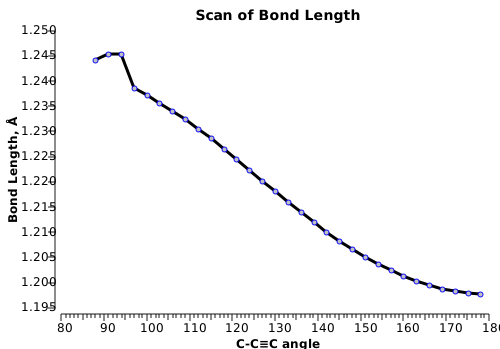
The result of a search (R-factor < 5%, no errors, no disorder) shows the hotspot at the expected ~180°, but then a fascinating curve as the angle subtended at the digonal carbon angle decreases down to ~110°, with the C≡C bond length gradually increasing. This apparently non-linear behaviour would be interesting to replicate using quantum mechanics.

Scheme

Next, the trigonal case. Again, the substituents are 4-coordinate carbons to prevent complicating conjugations.

Scheme

A plot of the C=C distance vs the C-C=C angle brings a surprise. There are four clusters centered at angles of ~132°, 123°, 110° and 94° (cyclobutenes) and a small cluster at ~150°. The C=C distance stays constant at around 1.335Å or shorter, a clear difference with the sp-case. There is perhaps a small outlier collection where the angle is ~108° and the distance ~1.4Å.

Scheme

This plots the dihedral angle subtended at one of the trigonal carbon atoms and measures how non-planar that atom is. There is again no real evidence that the C=C bond length changes as the trigonal centre becomes bent.

Scheme

This dihedral angle measures the twist about the C=C bond; up to about 30° is tolerated, but again there is no clear indication of a systematic change in the C=C length.

Scheme

These analyses reveal general trends on bond lengths induced by distorting the normal coordination around trigonal and digonal carbon atoms. It is only the start of the story of course, since there are plenty of isolated outliers that really should be explored; some may be simply due to undetected crystallographic errors, whilst with others there may lurk interesting or even new chemical phenomena. 


Below, the crystal structure result (with the axes transposed) is compared to a closed shell single reference ωB97XD/6-311+G(2df) calculation. Whilst the trend is replicated, it is not quantitative. This is probably because many of the crystal structures are perturbed by other effects, most probably by coordination of a metal and hence back-donation of π-electrons into vacant metal orbitals. The CSD indexing of the structures however retains the C≡C bond notation, even though the bond is no longer truly a triple one. This reinforces the observation I made in the previous post that when searching the CSD, one can stipulate a bond type to constrain the search. But that bond type may be purely nominal and bear little resemblance to the actual electronic structure of the species. There are other issues;  the wave function was constrained to closed shell single determinant. At low angles, the calculation itself is probably not accurate (as can be seen from a kink in the plot, indicating instability).

Scheme

Scheme


Deviations from tetrahedral four-coordinate carbon: a statistical exploration.

Sunday, September 6th, 2015

An article entitled “Four Decades of the Chemistry of Planar Hypercoordinate Compounds[1] was recently reviewed by Steve Bacharach on his blog, where you can also see comments. Given the recent crystallographic themes here, I thought I might try a search of the CSD (Cambridge structure database) to see whether anything interesting might emerge for tetracoordinate carbon.

The search definition is shown below using a  simple carbon with four ligands, the ligands themselves also being tetracoordinate carbon. The search is restricted to data collected below temperatures of 140K, as well as R-factor <5%, no errors and no disorder. Cyclic species are allowed and a statistically reasonable 2773 hits emerged from the search.

Scheme

Recollect that the idealised angle subtended at the centre is 109.47°. I show below three separate heat plots of the search results. Why three? The way the search software (Conquest) works is that one could define four C-C distances and six angles, and then plot any combination of one distance and one angle. I show just three combinations here, but could have included many more.

There appear to be four distinct clusters of values for this angle that emerge from the three plots shown below (the “bin size” is 100, and the frequency colour code indicates how many hits there are in each bin).

  1. The hotspot is unsurprisingly ~109° with a corresponding C-C distance of ~1.54Å.
  2. There may be two clusters at angles of ~60° (cyclopropane), with C-C values ranging from ~1.47 to ~1.55Å.
  3. A collection at ~90° (mostly cyclobutane?), with C-C values up to 1.6Å.
  4. A collection at ~140° (again small rings), now with much shorter C-C values of ~1.46Å. This reminds of the approximation that the hybridisation in e.g. cyclopropane is a combination of sp5 and sp3.

Scheme

Scheme

Scheme

Ideally, what one might want to plot would be sums of four angles; for a pure tetrahedral carbon the sum would always be 438° (4*109.47°) but for a pure planar carbon it could be as low as 360° (4*90°). One could then see how closely the distribution approaches to the latter and hence reveal whether there are any true planar tetracoordinate carbon species known. Although the Conquest software cannot analyse in such terms, a Python-based API has recently been released that should allow this to be done, although I should state that this requires a commercial license and it is not open access code. If we manage to get it working, I will report!


As a teaser I also include a plot of six-coordinate carbon, in which the ligands can be any non-metal. Note the clusters at angles of 60, ~112 and ~120-130°. It is worth pointing out that the definition of the connection between a carbon and a ligand as a “bond” becomes increasingly arbitrary as the coordination becomes “hyper”. Because crystallography does not measure electron densities in “bonds”, we know nothing of its topology in this region. It is therefore quite possible that the appearance of the heat plot below might be related just as much to whatever convention is being used in creating the entry in the CSD as it would be to a quantum analysis of the bonding.

Scheme

References

  1. L. Yang, E. Ganz, Z. Chen, Z. Wang, and P.V.R. Schleyer, "Four Decades of the Chemistry of Planar Hypercoordinate Compounds", Angewandte Chemie International Edition, vol. 54, pp. 9468-9501, 2015. https://doi.org/10.1002/anie.201410407

π-Resonance in thioamides: a crystallographic “diff” with amides.

Saturday, September 5th, 2015

The previous post explored the structural features of amides. Here I compare the analysis with that for the closely related thioamides.

Scheme

Here is the torsional analysis around the C-N bond. The “diff” (difference) is that almost all the hits are concentrated into angles of 0° or 180°; the twist about the C-N bond from co-planarity is much less if S is present. This is normally explained in terms of Spπ-Cpπ overlaps being less favourable than Opπ-Cpπ ones owing to the mismatch in the size of the atomic orbital for S and C. Hence the resonance which reduces the C=S double bond character in favour of greater C=N character is enhanced compared to O.

Scheme

A consequence is that the nitrogen atom is less easily deformed from planarity in a thioamide. Notice also that at the hotspot, the C=N distance is ~1.32Å compared to 1.34Å for a regular amide.

Scheme

This emerges from the plot below as well; the range of values for the C-N bond is reduced compared to amides, but the diagonal trend that as the C=N bond gets longer so the C-S gets shorter is still seen.

Scheme

All these trends are described qualitatively in most text books of organic chemistry, but one never sees statistical evidence for them. And it truly only takes 5-10 minutes to produce.

π-Resonance in thioamides: a crystallographic "diff" with amides.

Saturday, September 5th, 2015

The previous post explored the structural features of amides. Here I compare the analysis with that for the closely related thioamides.

Scheme

Here is the torsional analysis around the C-N bond. The “diff” (difference) is that almost all the hits are concentrated into angles of 0° or 180°; the twist about the C-N bond from co-planarity is much less if S is present. This is normally explained in terms of Spπ-Cpπ overlaps being less favourable than Opπ-Cpπ ones owing to the mismatch in the size of the atomic orbital for S and C. Hence the resonance which reduces the C=S double bond character in favour of greater C=N character is enhanced compared to O.

Scheme

A consequence is that the nitrogen atom is less easily deformed from planarity in a thioamide. Notice also that at the hotspot, the C=N distance is ~1.32Å compared to 1.34Å for a regular amide.

Scheme

This emerges from the plot below as well; the range of values for the C-N bond is reduced compared to amides, but the diagonal trend that as the C=N bond gets longer so the C-S gets shorter is still seen.

Scheme

All these trends are described qualitatively in most text books of organic chemistry, but one never sees statistical evidence for them. And it truly only takes 5-10 minutes to produce.

π-Resonance in amides: a crystallographic reality check.

Saturday, September 5th, 2015

The π-resonance in amides famously helped Pauling to his proposal of a helical structure for proteins. Here I explore some geometric properties of amides related to the C-N bond and the torsions about it.

Scheme

The key aspect of amides is that a lone pair of electrons on the nitrogen can conjugate with the C=O carbonyl only if the lone pair orbital is parallel to the C-O π-system. We can define this with the O=C-N-R torsion angle (and equate 0 or 180° with the p-orbitals being parallel). In the above definition, each R can be either 4-coordinate C (to avoid alternative conjugations) or H and the C-N bond is specified as being cyclic. As usual the R-factor is < 5%, no errors, no disorder.

First, the C-N torsion, which adopts values of either 0 or 180°. Notice that whilst the anti R-group shows no more than about 20° deviation from 180°, it does have a small tail tending towards longer C-N distances of >1.4Å. The hotspot is for the syn R-group.  Here there is a strong trend that as the dihedral deviates from 0° the C-N bond very clearly elongates. As the π-π overlap decreases, the bond elongates from the hot spot value of ~1.34Å to 1.41Å at 50°. The greater propensity of the syn-R to twist may be because it incurs more steric hindrance or perhaps because we have defined the C-N bond to be part of a cycle.

Scheme

Next, we plot the C-N distance against the torsion R-N-C-R’, which defines how planar the nitrogen is. A value of 180° is planar and the hot-spot is here. But as the planarity decreases down to almost tetrahedral (110°) the C-N bond elongates to  1.41Å. Notice one rather intriguing aspect;  from 180° to 160° or so, there is little response from the  C-N bond, but the elongation really accelerates from 140° to 110°. A little twisting hardly affects the π-π overlap, but it really starts to matter for twists of >50°.

Scheme

Finally a plot of the C-N vs the C-O distances. As the C-N increases, the C-O contracts, this being a nice summary of the π resonance in amides. 

Scheme

We have not seen any surprises, but this statistical exploration of crystal structures at least puts some numbers on the changes in bond lengths as a result of conjugative resonance.

A visualization of the anomeric effect from crystal structures.

Thursday, August 27th, 2015

The anomeric effect is best known in sugars, occuring in sub-structures such as RO-C-OR. Its origins relate to how the lone pairs on each oxygen atom align with the adjacent C-O bonds. When the alignment is 180°, one oxygen lone pair can donate into the C-O σ* empty orbital and a stabilisation occurs. Here I explore whether crystal structures reflect this effect.

Scheme

The torsion angles along each O-C bond are specified, along with the two C-O distances. All the bonds are declared acyclic, and the usual R < 5%, no disorder and no errors specified.

  1. You can see from the plot below that the hotspot occurs when both RO-CO torsions are ~65°. From this we will assume that the two (unseen) lone pairs at any one of the oxygens are distributed approximately tetrahedrally around each oxygen, and if this is true then one of them must by definition be oriented ~ 180° with respect to the same RO-CO bond (the other is therefore oriented -60°). This allows it to be antiperiplanar to the adjacent C-O bond and hence interact with its σ* empty orbital. So the hotspot corresponds to structures where BOTH oxygen atoms have lone pairs which interact with the adjacent O-C anti bond.
  2. There is a tiny cluster for which both RO-CO torsions are ~180° and hence neither oxygen has an antiperiplanar lone pair.
  3. Only slightly larger are clusters where one torsion is ~65° and the other ~180°, meaning that only one oxygen has an antiperiplanar lone pair.
  4. A plot of the two C-O lengths indeed shows an overall hotspot at ~1.40Å for both distances. If the search is filtered to include only torsions in the range 150-180°, the hotspot value increases to 1.415Å for both. If one torsion is restricted to 40-80° and the other to 150-180° the hotspot shows one C-O bond is about 0.012Å shorter than the other.

Scheme

Scheme

I also include a further constraint, that the diffraction data must be collected below 140K. The hotspot moves to ~ 55/60° indicating values free of some vibrational noise.

Scheme

Interestingly, replacing  oxygen with  nitrogen reveals relatively few examples of the effect (C(NR2)4 is an exception). Replacing  O by divalent S produces only 13 hits, with the surprising result (below) that in all of them only one S sets up an anomeric interaction. Arguably, the number of examples is too low to draw any firm conclusions from this observation.

Scheme


Most diffractometers measure low angle scattering of X-rays by high density electrons. These are the core electrons associated with a nucleus rather than the valence electrons associated with lone pairs. Hence very few positions of valence lone pairs have ever been crystallographically measured.

Mesomeric resonance in substituted benzenes: a crystallographic reality check.

Wednesday, August 26th, 2015

Previously, I showed how conjugation in dienes and diaryls can be visualised by inspecting bond lengths as a function of torsions. Here is another illustration, this time of the mesomeric resonance on a benzene ring induced by an electron donating substituent (an amino group) or an electron withdrawing substituent (cyano).

Scheme

In both cases, you can see this resonance showing as a lengthening of the C(ipso)-C(ortho) and C(meta)-C(para) bonds, and a contracting of the C(ortho)-C(meta) bonds. Does this reflect in the measured structures? The usual search is applied (R < 5%, no disorder, no errors) and qualified with the following:

  1. The amino has three bonds, and can bear either H, or 4-bonded carbon only.
  2. R on the ring can be either H or C.
  3. Three distances are defined.

Scheme

The results of a search are shown below; the hotspot shows the C-C(ortho) distance is close to 1.40Å, whilst the corresponding value for C(ortho)-C(meta) is 1.38Å, a contraction of ~0.02Å. The contraction is smaller for phenols (~0.01Å).

Scheme

The C(ortho)-C(meta) vs C(meta)-C(para) amino plot shows a cluster of hotspots for which the former (1.38Å) is  shorter than the latter (~1.39Å) but the effect is less clear cut as the distance from the substituent increases.

Scheme

For an electron withdrawing cyano substituent, C(ipso)-C(ortho) at 1.395Å is longer than C(ortho)-C(meta) at 1.385Å, although the difference seems smaller than for the amino substituent. The (ortho)-C(meta) to C(meta)-C(para) comparison is similar.

Scheme

Scheme

These searches take but a few minutes to perform, and do serve as a reality check on the oft-seen mesomeric π-resonance shown in all organic text books.

A visualisation of the effects of conjugation; dienes and biaryls.

Tuesday, August 25th, 2015

Here is another exploration of simple chemical concepts using crystal structures. Consider a simple diene: how does the central C-C bond length respond to the torsion angle between the two C=C bonds?

arm1

The search of the CSD (Cambridge structure database) is constrained to R < 5%, no errors and no disorder and the central  C-C bond is specific to be acyclic.

arm1

  1. Note first that the hotspot occurs for a torsion angle of 180°, a trans diene.
  2. There is just a hint that the C-C distance for a cis-diene might be a little shorter than the trans diene, but this might not be significant.
  3. There is a gentle curve illustrating that the C-C distance is indeed a maximum at 90°
  4. The C-C bond extends from ~1.445Å when the two double bonds are coplanar (fully conjugated) to ~1.48Å when orthogonal. Not much of a change, but statistically highly significant.

Here is another search, this time of the C=C-C=C motif embedded into a biaryl, of which there are far more examples. This time, the (red) hotspot is actually at 90°, with local (green) hotspots at 0 and 180° but also at 45 and 135°. Again, you can easily spot the maximum in C-C bond length at 90° but notice how much smaller the bond lengthening is (~ 0.01Å). This lengthening is inhibited by retention of the aromaticity of the two aryl rings; again the statistical effect is highly significant. Perhaps also significant is that the  C-C bond at torsions of 0 or 180° appear to be no shorter than the values at 45 and 135°.

arm1

arm1

Both these searches took about  5 minutes each, and serve to illustrate just how many basic chemical concepts can be teased out of a statistical analysis of crystal structures.


The analogous diagram for O=C-C=C is shown below;

arm1

That for  O=C-C=O is different however;

arm1