Posts Tagged ‘Coordination complex’

Imaging normal vibrational modes of a single molecule of CoTPP: a mystery about the nature of the imaged species.

Thursday, April 25th, 2019

Previously, I explored (computationally) the normal vibrational modes of Co(II)-tetraphenylporphyrin (CoTPP) as a “flattened” species on copper or gold surfaces for comparison with those recently imaged[1]. The initial intent was to estimate the “flattening” energy. There are six electronic possibilities for this molecule on a metal surface. Respectively positively, or negatively charged and a neutral species, each in either a low or a high-spin electronic state. I reported five of these earlier, finding each had quite high barriers for “flattening” the molecule. For the final 6th possibility, the triplet anion, the SCF (self-consistent-field) had failed to converge, but for which I can now report converged results.

charge

Spin

Multiplicity

ΔG, Twisted Ph,
Hartree
ΔG, “flattened”,
Hartree

ΔΔG,

kcal/mol

-1 Triplet -3294.68134 (C2) -3294.64735 (C2v) 21.3
-3294.60006 (Cs) 51.0
-3294.37012 (D2h) 195.3
Singlet -3294.67713 (S4) -3294.39418 (D4h) 175.6
-3294.39321 (D2h) 178.2
-3294.56652 (D2) 69.4
FAIR data at DOI: 10.14469/hpc/5486

I am exploring the so-called “flattened” mode, induced by the voltage applied at the tip of the STM (scanning-tunnelling microscope) probe and which causes the phenyl rings to rotate as per above. This rotation in turn causes the hydrogen atom-pair encircled above to approach each other very closely. To avoid these repulsions, the molecule buckles into one of two modes. The first causes the phenyl rings to stack up/down/up/down. The second involves an all-up stacking, as shown below. Although these are in fact 4th-order saddle points as isolated molecules, the STM voltage can inject sufficient energy to convert these into apparently stable minima on the metal surface.

All syn mode, Triplet anion

The up/down/up/down “flattened” form (below) shows a much more modest planarisation energy than all the other charged/neutral states reported in the previous post, whereas the all-up isomer (which on the face of it looks a far easier proposition to come into close contact with a metal surface) is far higher in free energy.

The caption to Figure 3 in the original article[1] does not explicitly mention the nature of the metal surface on which the vibrations were recorded, but we do get “The intensity in the upper right corner of the 320-cm−1 map is from a neighbouring Cu–CO stretch” which suggests it is in fact a copper surface. Coupled with the other observation that in “contrast to gold, the Kondo resonance of cobalt disappears on Cu(100), suggesting that it acquires nearly a full electron from the metal (see Extended Data Fig. 2),” the model below of a triplet-state anion on the Cu surface seems the most appropriate.

Syn/anti mode, Triplet anion with C2v symmetry

There is one final remark made in the article worth repeating here: “This suggests that the vibronic functions are complex-valued in this state, as expected for Jahn–Teller active degenerate orbitals of the planar porphyrin.26” Orbital degeneracy can only occur if the molecule has e.g. D4h point group symmetry, whereas the triplet anion stationary-point shown in the figure above has only C2v symmetry for which no orbital degeneracies (E) are expected. Enforcing D4h symmetry on Co(II) tetraphenylporphyrin results in eight pairs of H…H contacts of 1.34Å, which is an impossibly short distance (the shortest known is ~1.5Å). Moreover this geometry has an equally impossible free energy 176 kcal/mol above the relaxed free molecule. Visually from Figure 3, the H…H contact distance looks even shorter (below, circled in red)! A D2h form (with no E-type orbitals) can also be located.

Singlet, Calculated with D4h symmetry. Click for vibrations.

Singlet, Calculated with D2h symmetry. Click for vibrations.

Taken from Figure 3 (Ref 1).

These totally flat species are calculated to be at 13 or 12th-order saddle points, with the eight most negative force constants having vectors which correspond to up/down avoidance motions of the proximate hydrogen pairs encircled above and the remaining being buckling modes of the entire ring.

So to the mystery, being the nature of the “flattened” CoTPP on the copper metal surface, as represented in Figure 3 of the article.[1] Is it truly flat, as implied by the article? If so, the energy of such a species would be beyond the limits of what is normally considered feasible. Moreover, it would represent a species with truly mind-blowing short H…H contacts. Or could it be a saddle-shaped geometry, where the phenyl rings are not lying flat in contact with the metal but interacting via the phenyl para-hydrogens? That geometry has not only a much more reasonable energy above the unflattened free molecule, but also acceptable H…H contacts (~2.0.Å) However, would such a shape correspond to the visualised vibrational modes also shown in Figure 3? I have a feeling that there must be more to this story.


These convergence problems were solved by improving the basis set via adding “diffuse” functions, as in (u)ωB97XD/6-311+G(d,p). If the crystal structure for these species is flattened without geometry optimisation, the H-H distance is around 0.8Å

References

  1. J. Lee, K.T. Crampton, N. Tallarida, and V.A. Apkarian, "Visualizing vibrational normal modes of a single molecule with atomically confined light", Nature, vol. 568, pp. 78-82, 2019. https://doi.org/10.1038/s41586-019-1059-9
A wider look at π-complex metal-alkene (and alkyne) compounds.

Monday, June 13th, 2016

Previously, I looked at the historic origins of the so-called π-complex theory of metal-alkene complexes. Here I follow this up with some data mining of the crystal structure database for such structures.

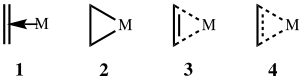
Alkene-metal "π-complexes" have what might be called a representational problem; they do not happily fit into the standard Lewis model of using lines connecting atoms to represent electron pairs. Structure 1 was the original representation used by Dewar intending the meaning of partial back donation from a filled metal orbital to the empty π* of the alkene. At the other extreme these compounds can be called metallacyclopropanes (2) in which only single bonds feature (these can be thought of as representing full back bonding from metal to alkene and full forward bonding from alkene to metal). Representations 3 and 4 are a more fuzzy blend of these, implying some sort of partial bond order for the metal-carbon bonds. Taken together, they imply that the formal bond order of the C-C bond might vary between single to double. Structures 1 and 2 in particular imply that there might be two distinct ways in arranging the bonding and that π-complexes and metallacyclopropanes might therefore be distinct valence-bond isomers, each potentially capable of separate existence.

Why do these representations matter? Well, I am going to mine the crystal structure database for these species to try to see if there is any evidence for a bimodal distribution in the C-C lengths, perhaps indicating evidence of the isomerism suggested above. Such a structural database is indexed against atom-pair connectivity in the first instance and then bond type; one can specify the following types of bond connecting any two atoms: single, double, triple, quadruple, polymeric, delocalised, pi and any. It is not entirely obvious which if any of these types apply to structure 1 (it is not possible to draw a bond ending at the mid-point of another bond using the Conquest structure editor); the dashed lines in structures 3 and 4 could be classed as delocalised, pi, or most generally any. The search query can be constructed thus, where the two carbons carry R which can be either H or C and all four C-R bonds are specified as acyclic (to try to avoid complications by excluding compounds such as cyclic metallacenes). Because representation 1 cannot be constructed in the editor, I am going to specify that each carbon carries four bonds of any type in the first instance. The torsion specified is defined as R-C-C-M and the full queries can be found deposited here.[1]

If the metallacyclopropane representation 2 is defined with explicit single bonds, one gets only 22 hits (no errors, no disorder, R < 0.1). The distribution of C-C bond lengths is shown below. Already one sees a representational problem emerging. A true metallacyclopropane might be expected to show a C-C single bond length, say > ~1.5Å. But only one or two of these examples actually have this value, the most probable value being ~1.4Å.

Using representation 3, one gets 1861 hits, but as before one sees a maximum at ~1.4Å with a tail reaching to both single and double bond values for the C-C distance.

If the C-C bond is also specified as "any", the hits increase to 3948, but the bond length distribution is still very similar, with no sign of any bimodal distribution.

Such a distribution is however found if the torsions between the R-C bond vector and the C-M bond vector are plotted (for all types of bond). A large number of the complexes have a torsion <90°, which suggests that in fact the substituent R is probably interacting with the metal (even though this would lead to formal cyclicity, specifying R-C as acyclic does not detect this interaction). Could this be masking a bimodal distribution in the C-C lengths?

If the previous search is repeated, but this time specifying that all four torsions must lie in the range 90-180° (the range expected for a "classical" alkene-metal complex and selecting only the top right hand side cluster in the plot above) the reduced value of 1051 hits are obtained, but the monomodal distribution remains.

For this last set, here is a plot of the two C-metal bond length, with colour indicating the C-C bond length, indicating the two C-metal bonds are clearly linearly correlated.

One final variation;  the atom on either C can only be H or a 4-coordinate (sp3) carbon; 645 hits. Again, a monomodal distribution centered at 1.4Å.

So this foray through metal alkene complexes suggests that there is a continuum between the formal metallacyclopropane with a C-C single bond and the only slightly perturbed alkene-metal complex with a C=C double bond. Whilst this would not prevent any one of these compounds existing as two distinctly different valence-bond isomers, it makes it very unlikely. I had noted in an earlier post that for molecules of the type RX≡XR (X=Si, Ge, Sn, Pb) that there was indeed a clear bimodal distribution of the X-X lengths evident in the crystal structures (for a relatively small sample number). The structures 1-4 shown at the start of this post are all simply just variations in a continuum and not distinct isomers.

POSTSCRIPT:  I noted above the bimodel distribution in compounds involving formal triple bonds. So I repeated the search above for π-complex metal-alkyne complexes. Specifying an acyclic C-R bond, and any for the CC bond type, one gets the following.

There is now a tantalizing suggestion of two clusters, one at 1.3 and another at 1.4Å. The torsional distribution shows that the latter distance appears to be associated with much smaller torsions, whereas the top right cluster is associated with shorter lengths.

If the torsions are restricted to the range 90-180, then the histogram looses the smaller cluster, and perhaps gains a second cluster at 1.22Å?  As I said, all quite tantalizing!


The tail in all the histograms extends into the 1.1-1.3Å region, which seems unreasonable for a carbon where four bonds are specified. This region probably represents errors in the crystallographic analysis or reporting. But who knows, perhaps some very unusual compounds are lurking there!


References

  1. H. Rzepa, "A wider look at the π-complex theory of metal-alkene compounds.", 2016. https://doi.org/10.14469/hpc/642

Bond stretch isomerism. Did this idea first surface 100 years ago?

Tuesday, February 9th, 2016

The phenomenon of bond stretch isomerism, two isomers of a compound differing predominantly in just one bond length, is one of those chemical concepts that wax and occasionally wane.[1] Here I explore such isomerism for the elements Ge, Sn and Pb.

In one earlier post, I noted a form of bond stretch isomerism that can arise from a Jahn-Teller distortion ending in two different geometries in which one or more pairs of bonds swap short/long lengths. Examples include substituted cyclo-octatetraenes[2] and octahedral d9-Cu(II) complexes.[3] A more interesting seminal possibility was implied by G. N. Lewis a century ago when discussing the arrangement of electrons in a (carbon-carbon) triple bond.[4]

lewis1
*It took ~50 years to prove this assertion wrong.[5]

In a commentary, I reported the results of a search of the crystal structure database for the geometries associated with RX≡XR systems (X= C, Si, Ge, Sn, Pb). Here I focus the search[6] specifically for X=Sn,Ge; this version of bond stretch isomerism also allows angles to change (= rehybridisation at atoms) in order to provide a mechanism for a barrier separating the two forms.

For X=Sn, note the presence of up to three clusters, although the relatively low number of hits makes the statistics less certain.

  1. The hotspot cluster centered around angles of 125° and a Sn-Sn distance of ~2.6Å.
  2. Another with angles of <100° and Sn-Sn distances of ~3.3Å.
  3. A third with angles of <100° and Sn-Sn distances of 2.8Å, which may or may not be a genuine unique form of bonding.

This pattern was commented on in 2010 by Power[7], whose group synthesized most of the examples in the hits above. A plot of compounds with Ge-Ge bonds reveals both similarity with (two, possibly three clusters) and difference from (the clusters are closely spaced in terms of the Ge-Ge bond length, but separated in terms of angle) Sn.

GeGe

Time for some computations (which at least will remove random errors in the geometry). I selected the only known example of an RPb-PbR compound[8] as a seed and put it through a B3LYP+D3/Def2-TZVPP calculation (with 172 atoms and 2920 basis functions, this is a relatively large calculation!), which reproduces the known structure pretty well (table).

QIMQUY

So what about another bond stretch isomers? The Pb=Pb variation is indeed a stable minimum around 28.0 kcal/mol above the known structure, which seems to put this form out of experimental reach (with this ligand/aryl group at least). With Sn for the same aryl ligand, the energy difference is smaller (~15.8 kcal/mol for this ligand; Powers reports other systems where the energy difference may be only ~5 kcal/mol). Judging by the distribution of the 13 hits recovered from the CSD search, both bond stretch isomers may be accessible experimentally. The calculations show that the GeGe bond isomers are much closer in energy than SnSn (for this ligand). For all three metals however, the calculated difference in the metal-metal length for the two isomers is ~0.45 – 0.52Å. This strongly suggests that whereas the SnSn plot above is demonstrating bond length isomerism, the GeGe plot may not be; at least not of the same type that the calculations here are revealing (via the Wiberg bond orders).

System Relative energy XX distance RXX angle Wiberg bond order DataDOI
Pb=Pb +28.0 2.767 118.7 1.666 [9]
Pb-Pb 0.0 3.215 (3.188)[8] 93.7 (94.3)[8] 0.889 [10]
Sn=Sn +15.8 2.640 123.1 1.911 [11]
Sn-Sn 0.0 3.126 95.5 0.892 [12]
Ge=Ge +0.5 2.263 125.2 2.138 [13]
Ge-Ge 0.0   2.777 99.7 0.866 [14]

No doubt the particular bond length form is being facilitated by the nature of the ligand and the steric interactions therein imparted, both repulsive AND attractive. These interactions can be visualised via NCI (non-covalent-interaction) plots (click on the image to obtain a rotatable 3D model). First Pb-Pb followed by Pb=Pb. Note how in both cases, the PbPb region is enclosed in regions of weak attractive dispersion interactions, which however avoid the "hemidirected" inert Pb lone pairs.[15]

Pb-Pb Pb=Pb

So in the end we have something of a mystery. There is evidence from crystal structures that at least two bond-stretch isomers of RSnSnR compounds can form, but the calculations indicate that the Sn=Sn form is significantly higher in energy (although not impossibly so for thermal accessibility). Conversely, the Ge=Ge equivalent is very similar in energy to a Ge-Ge form with a significantly longer bond length, but there seems no crystallographic evidence for such a big difference in bond lengths. Perhaps the answer lies with the ligands?

It seems particularly appropriate on the centenary of G. N. Lewis' famous paper in which he clearly notes the possibility of three isomeric forms for the triple bond, to pay tribute to the impact his suggestions continue to make to chemistry.


The individual entries can be inspected via the following dois: [16],[17],[18],[19],[20],[21],[22],[23],[24],[25]

You can view individual entries via the following DOIs: [26],[27],[28],[29],[30],[31],[32],[33],[34],[35]

References

  1. J.A. Labinger, "Bond-stretch isomerism: a case study of a quiet controversy", Comptes Rendus. Chimie, vol. 5, pp. 235-244, 2002. https://doi.org/10.1016/s1631-0748(02)01380-2
  2. J.E. Anderson, and P.A. Kirsch, "Structural equilibria determined by attractive steric interactions. 1,6-Dialkylcyclooctatetraenes and their bond-shift and ring inversion investigated by dynamic NMR spectroscopy and molecular mechanics calculations", Journal of the Chemical Society, Perkin Transactions 2, pp. 1951, 1992. https://doi.org/10.1039/p29920001951
  3. W. Zhang, L. Chen, R. Xiong, T. Nakamura, and S.D. Huang, "New Ferroelectrics Based on Divalent Metal Ion Alum", Journal of the American Chemical Society, vol. 131, pp. 12544-12545, 2009. https://doi.org/10.1021/ja905399x
  4. G.N. Lewis, "THE ATOM AND THE MOLECULE.", Journal of the American Chemical Society, vol. 38, pp. 762-785, 1916. https://doi.org/10.1021/ja02261a002
  5. F.A. Cotton, "Metal-Metal Bonding in [Re<sub>2</sub>X<sub>8</sub>]<sup>2-</sup> Ions and Other Metal Atom Clusters", Inorganic Chemistry, vol. 4, pp. 334-336, 1965. https://doi.org/10.1021/ic50025a016
  6. H. Rzepa, "Crystal structures containing Sn...Sn bonds", 2016. https://doi.org/10.14469/hpc/249
  7. Y. Peng, R.C. Fischer, W.A. Merrill, J. Fischer, L. Pu, B.D. Ellis, J.C. Fettinger, R.H. Herber, and P.P. Power, "Substituent effects in ditetrel alkyne analogues: multiple vs. single bonded isomers", Chemical Science, vol. 1, pp. 461, 2010. https://doi.org/10.1039/c0sc00240b
  8. L. Pu, B. Twamley, and P.P. Power, "Synthesis and Characterization of 2,6-Trip<sub>2</sub>H<sub>3</sub>C<sub>6</sub>PbPbC<sub>6</sub>H<sub>3</sub>-2,6-Trip<sub>2</sub> (Trip = C<sub>6</sub>H<sub>2</sub>-2,4,6-<i>i</i>-Pr<sub>3</sub>):  A Stable Heavier Group 14 Element Analogue of an Alkyne", Journal of the American Chemical Society, vol. 122, pp. 3524-3525, 2000. https://doi.org/10.1021/ja993346m
  9. H.S. Rzepa, "C 72 H 98 Pb 2", 2016. https://doi.org/10.14469/ch/191856
  10. H.S. Rzepa, "C 72 H 98 Pb 2", 2016. https://doi.org/10.14469/ch/191873
  11. https://doi.org/
  12. H.S. Rzepa, "C 72 H 98 Sn 2", 2016. https://doi.org/10.14469/ch/191881
  13. H.S. Rzepa, "C 72 H 98 Ge 2", 2016. https://doi.org/10.14469/ch/191882
  14. H.S. Rzepa, "C 72 H 98 Ge 2", 2016. https://doi.org/10.14469/ch/191883
  15. M. Imran, A. Mix, B. Neumann, H. Stammler, U. Monkowius, P. Gründlinger, and N.W. Mitzel, "Hemi- and holo-directed lead(<scp>ii</scp>) complexes in a soft ligand environment", Dalton Transactions, vol. 44, pp. 924-937, 2015. https://doi.org/10.1039/c4dt01406e
  16. Jones, C.., Sidiropoulos, A.., Holzmann, N.., Frenking, G.., and Stasch, A.., "CCDC 892557: Experimental Crystal Structure Determination", 2012. https://doi.org/10.5517/ccyys5t
  17. Phillips, A.D.., Wright, R.J.., Olmstead, M.M.., and Power, P.P.., "CCDC 187521: Experimental Crystal Structure Determination", 2002. https://doi.org/10.5517/cc6942p
  18. Peng, Yang., Fischer, R.C.., Merrill, W.A.., Fischer, J.., Pu, Lihung., Ellis, B.D.., Fettinger, J.C.., Herber, R.H.., and Power, P.P.., "CCDC 771267: Experimental Crystal Structure Determination", 2010. https://doi.org/10.5517/cctwklt
  19. Peng, Yang., Fischer, R.C.., Merrill, W.A.., Fischer, J.., Pu, Lihung., Ellis, B.D.., Fettinger, J.C.., Herber, R.H.., and Power, P.P.., "CCDC 771268: Experimental Crystal Structure Determination", 2010. https://doi.org/10.5517/cctwkmv
  20. Peng, Yang., Fischer, R.C.., Merrill, W.A.., Fischer, J.., Pu, Lihung., Ellis, B.D.., Fettinger, J.C.., Herber, R.H.., and Power, P.P.., "CCDC 771270: Experimental Crystal Structure Determination", 2010. https://doi.org/10.5517/cctwkpx
  21. Peng, Yang., Fischer, R.C.., Merrill, W.A.., Fischer, J.., Pu, Lihung., Ellis, B.D.., Fettinger, J.C.., Herber, R.H.., and Power, P.P.., "CCDC 771271: Experimental Crystal Structure Determination", 2010. https://doi.org/10.5517/cctwkqy
  22. Peng, Yang., Fischer, R.C.., Merrill, W.A.., Fischer, J.., Pu, Lihung., Ellis, B.D.., Fettinger, J.C.., Herber, R.H.., and Power, P.P.., "CCDC 771272: Experimental Crystal Structure Determination", 2010. https://doi.org/10.5517/cctwkrz
  23. Peng, Yang., Fischer, R.C.., Merrill, W.A.., Fischer, J.., Pu, Lihung., Ellis, B.D.., Fettinger, J.C.., Herber, R.H.., and Power, P.P.., "CCDC 771274: Experimental Crystal Structure Determination", 2010. https://doi.org/10.5517/cctwkt1
  24. Fischer, R.C.., Pu, Lihung., Fettinger, J.C.., Brynda, M.A.., and Power, P.P.., "CCDC 624216: Experimental Crystal Structure Determination", 2007. https://doi.org/10.5517/ccnyk04
  25. Pu, Lihung., Phillips, A.D.., Richards, A.F.., Stender, M.., Simons, R.S.., Olmstead, M.M.., and Power, P.P.., "CCDC 221953: Experimental Crystal Structure Determination", 2004. https://doi.org/10.5517/cc7fysc
  26. Sasamori, Takahiro., Sugahara, Tomohiro., Agou, Tomohiro., Guo, Jing-Dong., Nagase, Shigeru., Streubel, Rainer., and Tokitoh, Norihiro., "CCDC 1035078: Experimental Crystal Structure Determination", 2014. https://doi.org/10.5517/cc13r2mk
  27. Sidiropoulos, A.., Jones, C.., Stasch, A.., Klein, S.., and Frenking, G.., "CCDC 749451: Experimental Crystal Structure Determination", 2010. https://doi.org/10.5517/cct4vvm
  28. Shan, Yu-Liang., Yim, Wai-Leung., and So, Cheuk-Wai., "CCDC 1019495: Experimental Crystal Structure Determination", 2015. https://doi.org/10.5517/cc136vy3
  29. Sugiyama, Y.., Sasamori, T.., Hosoi, Y.., Furukawa, Y.., Takagi, N.., Nagase, S.., and Tokitoh, N.., "CCDC 297827: Experimental Crystal Structure Determination", 2006. https://doi.org/10.5517/cc9zxbh
  30. Stender, M.., Phillips, A.D.., Wright, R.J.., and Power, P.P.., "CCDC 180660: Experimental Crystal Structure Determination", 2002. https://doi.org/10.5517/cc61zry
  31. Peng, Yang., Fischer, R.C.., Merrill, W.A.., Fischer, J.., Pu, Lihung., Ellis, B.D.., Fettinger, J.C.., Herber, R.H.., and Power, P.P.., "CCDC 771273: Experimental Crystal Structure Determination", 2010. https://doi.org/10.5517/cctwks0
  32. Peng, Yang., Fischer, R.C.., Merrill, W.A.., Fischer, J.., Pu, Lihung., Ellis, B.D.., Fettinger, J.C.., Herber, R.H.., and Power, P.P.., "CCDC 771269: Experimental Crystal Structure Determination", 2010. https://doi.org/10.5517/cctwknw
  33. Peng, Yang., Fischer, R.C.., Merrill, W.A.., Fischer, J.., Pu, Lihung., Ellis, B.D.., Fettinger, J.C.., Herber, R.H.., and Power, P.P.., "CCDC 771266: Experimental Crystal Structure Determination", 2010. https://doi.org/10.5517/cctwkks
  34. Jones, C.., Sidiropoulos, A.., Holzmann, N.., Frenking, G.., and Stasch, A.., "CCDC 892556: Experimental Crystal Structure Determination", 2012. https://doi.org/10.5517/ccyys4s
  35. Jones, C.., Sidiropoulos, A.., Holzmann, N.., Frenking, G.., and Stasch, A.., "CCDC 892555: Experimental Crystal Structure Determination", 2012. https://doi.org/10.5517/ccyys3r

Discovering chemical concepts from crystal structure statistics: The Jahn-Teller effect

Saturday, May 30th, 2015

I am on a mission to persuade my colleagues that the statistical analysis of crystal structures is a useful teaching tool.  One colleague asked for a demonstration and suggested exploring the classical Jahn-Teller effect (thanks Milo!). This is a geometrical distortion associated with certain molecular electronic configurations, of which the best example is illustrated by octahedral copper complexes which have a d9 electronic configuration. The eg level shown below is occupied by three electrons and which can therefore distort in one of two ways to eliminate the eg degeneracy by placing the odd electron into either a x2-y2 or a z2 orbital. Here I explore how this effect can be teased out of crystal structures.

JT

The search is set up with Cu specified as precisely 6-coordinate, and X=oxygen. The six X-Cu distances are defined as DIST1-DIST6. The R-factor is specified as < 0.05 (no disorder, no errors). The problem now is how to plot what is in effect a six-dimensional set of data, from which we are exploring whether four of the distances are different from the other two, and whether those four are the longer or the shorter. This requires analysis beyond the capability (as far as I know) of the Conquest program, and so here I will show sets of plots showing just the relationship between any two distances at a time. Of the 15 possible combinations of two distances, only four are shown below.

Some obvious patterns can already be spotted in the 400 or so compounds which satisfy the search criteria.

  • The largest clustering occurs at ~1.95Å, with two clusters each of fewer hits at ~2.5Å. The Wikipedia page notes that for Cu(OH2)6 the Jahn-Teller distortion favours four short bonds at ~1.95Å and two long ones at ~2.38Å, which agrees approximately with the positions and sizes of the centroids of these clusters.
  • Plots 1 and 2 show very little along the diagonals, where the two plotted distances have the same value. This probably means that one of the distances relates to an equatorial ligand and the other to an axial ligand.
  • Plots 3 and 4 show a strong diagonal trend, and so these distances both relate to either axial or equatorial, but not one of each.
  • All four plots show a hot spot at ~1.95Å, which hints that the Jahn-Teller distortion is four short bonds/two long.
  • Plot 4 also shows a green spot at ~2.5Å which is a tantalising suggestion of examples of four long bonds/two short.
  1. CuO-12
  2. CuO-34
  3. CuO-56
  4. CuO-13

Clearly this analysis can be followed up by a visual inspection of individual molecules in each cluster (as well as the outliers which appear to follow no pattern!), together with a more bespoke analysis of the six distances. Unfortunately, the spin state of the complexes cannot be quickly checked (are they all doublets?) since the database does not record these.  But the basic search described above takes only a few minutes to do, and it is surprising at how quickly the Jahn-Teller effect can be statistically tested with real experimental data obtained for ~400 molecules. Of course, here I have only explored X=O but this can easily be extended to X=N or X=Cl, to other metals or to alternative coordination numbers such as e.g. 4 where the Jahn-Teller effect can also in principle operate.


One genuine example of this type, also called compressed octahedral coordination, was reported for the species CuFAsF6 and CsCuAlF6[1]


The measured geometry of Cu(H2O)6 may in fact manifest with six equal Cu-O bond lengths due to the dynamic Jahn-Teller effect, because the kinetic barrier separating one Jahn-Teller distorted form and another (equivalent) isomer is small and hence averaged atom positions are measured which mask the effect. Thus the Jahn-Teller effects shown in the plots above may be under-estimated because of this dynamic masking. Reducing the temperature of the sample at which data was collected would reduce this dynamic effect. Indeed, Cu(D2O)6 collected at 93K shows a very clear Jahn-Teller distortion[2] with four long bonds ranging from 1.97-1.99Å and two long bonds 2.37-2.39Å.[3] Another example measured at 89K with dimethyl formamide replacing water and coordinated via oxygen[4] shows four short (1.97-1.98Å) and two long (2.315Å) bonds. This latter example is also noteworthy because this analysis is as yet unpublished in a journal, but the data itself has a DOI via which it can be acquired. A nice example of modern research data management!


References

  1. Z. Mazej, I. Arčon, P. Benkič, A. Kodre, and A. Tressaud, "Compressed Octahedral Coordination in Chain Compounds Containing Divalent Copper: Structure and Magnetic Properties of CuFAsF<sub>6</sub> and CsCuAlF<sub>6</sub>", Chemistry – A European Journal, vol. 10, pp. 5052-5058, 2004. https://doi.org/10.1002/chem.200400397
  2. W. Zhang, L. Chen, R. Xiong, T. Nakamura, and S.D. Huang, "New Ferroelectrics Based on Divalent Metal Ion Alum", Journal of the American Chemical Society, vol. 131, pp. 12544-12545, 2009. https://doi.org/10.1021/ja905399x
  3. Zhang, Wen., Chen, Li-Zhuang., Xiong, Ren-Gen., Nakamura, T.., and Huang, S.D.., "CCDC 755150: Experimental Crystal Structure Determination", 2010. https://doi.org/10.5517/cctbspl
  4. M.M. Olmstead, D.S. Marlin, and P.K. Mascharak, "CCDC 1053817: Experimental Crystal Structure Determination", 2015. https://doi.org/10.5517/cc14cl36