Posts Tagged ‘alkyne’

π-Facial hydrogen bonds to alkynes (revisited): how close can an acidic hydrogen approach?

Monday, April 17th, 2017

Following on from my re-investigation of close hydrogen bonding contacts to the π-face of alkenes, here now is an updated scan for H-bonds to alkynes. The search query (dataDOI: 10.14469/hpc/2478) is similar to the previous one:

  1. QA is any of N,O,F,Cl.
  2. X is any atom, including metals and non-metals.
  3. The carbon atoms are both specified as 2-coordinate, and the C-C bond type as any.
  4. The distance is from the hydrogen (normalised) to the C-C centroid, restricted to < 2.5Å to capture just the shortest examples.
  5. The mean of the sines of the two angles subtended at the centroid is calculated to indicate whether the approach is orthogonal.
  6. The mean of the absolute value of the sines of the two angles subtended at each carbon is calculated to indicate how non-linear the  X-C-C angle is.
  7. Other constraints are no disorder, no errors and R < 0.05.

First the intermolecular hits (38). Prominent short examples include:

Entry Article DOI DataDOI H-centroid distance
NOXHAJ [1] 2.16Å
KESDAO [2] 10.5517/CC9YHJ7 2.11Å
ICUTAC [3] 10.5517/CC9PNSD 2.19Å

In most of the stronger examples (blue), the approach of the hydrogen is perpendicular to the C-C bond centroid (X-axis of plot above). Many however exhibit significant bending (Y-axis of plot above) from linearity at the two carbons (~173°), mostly away from the H but in some examples towards the H!

Selected entries from the intra-molecular search (34 hits) are shown below. Perhaps due to the intra-molecular nature, the angle of approach of the H is more variable than the intermolecular examples and the bending of the erstwhile X-C-C angle is again prominent. 

Entry Article DOI H-centroid distance
KIXFOO [4] 2.11Å
KEMVOP [5] 2.16Å
BEMPUF [6] 2.14Å
VEWMIV [7] 2.14Å

ωB97XD/Def2-TZVPP calculations of one intermolecular example, ICUTAC (two molecules, dataDOI: 10.14469/hpc/2482) and one intramolecular case, KIXFOO (dataDOI: 10.14469/hpc/2481). For the former, crystal packing compressions perhaps provide some shortening of the hydrogen bond and the molecule also includes an example of a short C-H to π interaction (obs[3] 2.63Å).

What is noticeable from reading the abstracts of the articles cited above is that these hydrogen bonds are rarely commented upon by the authors and it does seem that most of these close contacts are serendipitous (they were not designed). All are somewhat longer than the shortest distances encountered for alkenes and it would be interesting to establish if this is an intrinsic property of the triple bond or whether less effort has hitherto been expended on designing closer approaches.


Not all entries have an assigned dataDOI at CCDC.

CrossRef DOIs here are collected as a citation at the bottom of the post using the WordPress KCite plugin. Unfortunately for a few months now, this plugin has stopped recognising DataCite DOIs, which is why here they are treated differently from CrossRef DOIs. This is purely a current attribute of the KCite plugin and does not imply any fundamental difference in the two types of DOI, other than one tends to be used as persistent identifiers of journal articles and the other of datasets.

References

  1. M. Akita, M. Chung, A. Sakurai, S. Sugimoto, M. Terada, M. Tanaka, and Y. Moro-oka, "Synthesis and Structure Determination of the Linear Conjugated Polyynyl and Polyynediyl Iron Complexes Fp*−(C⋮C)<i><sub>n</sub></i>−X (X = H (<i>n</i>= 1, 2); X = Fp* (<i>n</i>= 1, 2, 4); Fp* = (η<sup>5</sup>-C<sub>5</sub>Me<sub>5</sub>)Fe(CO)<sub>2</sub>)<sup>1</sup>", Organometallics, vol. 16, pp. 4882-4888, 1997. https://doi.org/10.1021/om970538m
  2. J. Forniés, S. Fuertes, A. Martín, V. Sicilia, E. Lalinde, and M.T. Moreno, "Homo‐ and Heteropolynuclear Platinum Complexes Stabilized by Dimethylpyrazolato and Alkynyl Bridging Ligands: Synthesis, Structures, and Luminescence", Chemistry – A European Journal, vol. 12, pp. 8253-8266, 2006. https://doi.org/10.1002/chem.200600139
  3. R. Banerjee, R. Mondal, J.A.K. Howard, and G.R. Desiraju, "Synthon Robustness and Solid-State Architecture in Substituted <i>g</i><i>em</i>-Alkynols", Crystal Growth & Design, vol. 6, pp. 999-1009, 2006. https://doi.org/10.1021/cg050598s
  4. B. Xu, K. Bussmann, R. Fröhlich, C.G. Daniliuc, J.G. Brandenburg, S. Grimme, G. Kehr, and G. Erker, "An Enamine/HB(C<sub>6</sub>F<sub>5</sub>)<sub>2</sub> Adduct as a Dormant State in Frustrated Lewis Pair Chemistry", Organometallics, vol. 32, pp. 6745-6752, 2013. https://doi.org/10.1021/om4004225
  5. M.J. Pouy, S.A. Delp, J. Uddin, V.M. Ramdeen, N.A. Cochrane, G.C. Fortman, T.B. Gunnoe, T.R. Cundari, M. Sabat, and W.H. Myers, "Intramolecular Hydroalkoxylation and Hydroamination of Alkynes Catalyzed by Cu(I) Complexes Supported by <i>N</i>-Heterocyclic Carbene Ligands", ACS Catalysis, vol. 2, pp. 2182-2193, 2012. https://doi.org/10.1021/cs300544w
  6. R.D. Dewhurst, A.F. Hill, and M.K. Smith, "Heterobimetallic C<sub>3</sub> Complexes through Silylpropargylidyne Desilylation", Angewandte Chemie International Edition, vol. 43, pp. 476-478, 2004. https://doi.org/10.1002/anie.200352693
  7. T. Holtrichter-Rößmann, C. Rösener, J. Hellmann, W. Uhl, E. Würthwein, R. Fröhlich, and B. Wibbeling, "Generation of Weakly Bound Al–N Lewis Pairs by Hydroalumination of Ynamines and the Activation of Small Molecules: Phenylethyne and Dicyclohexylcarbodiimide", Organometallics, vol. 31, pp. 3272-3283, 2012. https://doi.org/10.1021/om3001179
A wider look at π-complex metal-alkene (and alkyne) compounds.

Monday, June 13th, 2016

Previously, I looked at the historic origins of the so-called π-complex theory of metal-alkene complexes. Here I follow this up with some data mining of the crystal structure database for such structures.

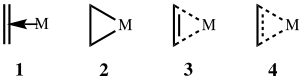
Alkene-metal "π-complexes" have what might be called a representational problem; they do not happily fit into the standard Lewis model of using lines connecting atoms to represent electron pairs. Structure 1 was the original representation used by Dewar intending the meaning of partial back donation from a filled metal orbital to the empty π* of the alkene. At the other extreme these compounds can be called metallacyclopropanes (2) in which only single bonds feature (these can be thought of as representing full back bonding from metal to alkene and full forward bonding from alkene to metal). Representations 3 and 4 are a more fuzzy blend of these, implying some sort of partial bond order for the metal-carbon bonds. Taken together, they imply that the formal bond order of the C-C bond might vary between single to double. Structures 1 and 2 in particular imply that there might be two distinct ways in arranging the bonding and that π-complexes and metallacyclopropanes might therefore be distinct valence-bond isomers, each potentially capable of separate existence.

Why do these representations matter? Well, I am going to mine the crystal structure database for these species to try to see if there is any evidence for a bimodal distribution in the C-C lengths, perhaps indicating evidence of the isomerism suggested above. Such a structural database is indexed against atom-pair connectivity in the first instance and then bond type; one can specify the following types of bond connecting any two atoms: single, double, triple, quadruple, polymeric, delocalised, pi and any. It is not entirely obvious which if any of these types apply to structure 1 (it is not possible to draw a bond ending at the mid-point of another bond using the Conquest structure editor); the dashed lines in structures 3 and 4 could be classed as delocalised, pi, or most generally any. The search query can be constructed thus, where the two carbons carry R which can be either H or C and all four C-R bonds are specified as acyclic (to try to avoid complications by excluding compounds such as cyclic metallacenes). Because representation 1 cannot be constructed in the editor, I am going to specify that each carbon carries four bonds of any type in the first instance. The torsion specified is defined as R-C-C-M and the full queries can be found deposited here.[1]

If the metallacyclopropane representation 2 is defined with explicit single bonds, one gets only 22 hits (no errors, no disorder, R < 0.1). The distribution of C-C bond lengths is shown below. Already one sees a representational problem emerging. A true metallacyclopropane might be expected to show a C-C single bond length, say > ~1.5Å. But only one or two of these examples actually have this value, the most probable value being ~1.4Å.

Using representation 3, one gets 1861 hits, but as before one sees a maximum at ~1.4Å with a tail reaching to both single and double bond values for the C-C distance.

If the C-C bond is also specified as "any", the hits increase to 3948, but the bond length distribution is still very similar, with no sign of any bimodal distribution.

Such a distribution is however found if the torsions between the R-C bond vector and the C-M bond vector are plotted (for all types of bond). A large number of the complexes have a torsion <90°, which suggests that in fact the substituent R is probably interacting with the metal (even though this would lead to formal cyclicity, specifying R-C as acyclic does not detect this interaction). Could this be masking a bimodal distribution in the C-C lengths?

If the previous search is repeated, but this time specifying that all four torsions must lie in the range 90-180° (the range expected for a "classical" alkene-metal complex and selecting only the top right hand side cluster in the plot above) the reduced value of 1051 hits are obtained, but the monomodal distribution remains.

For this last set, here is a plot of the two C-metal bond length, with colour indicating the C-C bond length, indicating the two C-metal bonds are clearly linearly correlated.

One final variation;  the atom on either C can only be H or a 4-coordinate (sp3) carbon; 645 hits. Again, a monomodal distribution centered at 1.4Å.

So this foray through metal alkene complexes suggests that there is a continuum between the formal metallacyclopropane with a C-C single bond and the only slightly perturbed alkene-metal complex with a C=C double bond. Whilst this would not prevent any one of these compounds existing as two distinctly different valence-bond isomers, it makes it very unlikely. I had noted in an earlier post that for molecules of the type RX≡XR (X=Si, Ge, Sn, Pb) that there was indeed a clear bimodal distribution of the X-X lengths evident in the crystal structures (for a relatively small sample number). The structures 1-4 shown at the start of this post are all simply just variations in a continuum and not distinct isomers.

POSTSCRIPT:  I noted above the bimodel distribution in compounds involving formal triple bonds. So I repeated the search above for π-complex metal-alkyne complexes. Specifying an acyclic C-R bond, and any for the CC bond type, one gets the following.

There is now a tantalizing suggestion of two clusters, one at 1.3 and another at 1.4Å. The torsional distribution shows that the latter distance appears to be associated with much smaller torsions, whereas the top right cluster is associated with shorter lengths.

If the torsions are restricted to the range 90-180, then the histogram looses the smaller cluster, and perhaps gains a second cluster at 1.22Å?  As I said, all quite tantalizing!


The tail in all the histograms extends into the 1.1-1.3Å region, which seems unreasonable for a carbon where four bonds are specified. This region probably represents errors in the crystallographic analysis or reporting. But who knows, perhaps some very unusual compounds are lurking there!


References

  1. H. Rzepa, "A wider look at the π-complex theory of metal-alkene compounds.", 2016. https://doi.org/10.14469/hpc/642

Joining up the pieces. Peroxidation of ethyne.

Monday, July 9th, 2012

Sometimes, connections between different areas of chemistry just pop out (without the help of semantic web tools, this is called serendipity). So here, I will try to join up some threads which emerge from previous posts.

  1. I had noted that antiaromaticity in cyclopropenium anion is lessened by the system adopting gross geometric distortions, which take the anionic lone pair out of conjugation from the ring.
  2. Similarly, cyclobutadiene can form a complex with the guanidinium cation in which the anti-aromaticity is reduced by the formation of strong C…H-N hydrogen bonds.
  3. Unhappy with modelling a cation without a counter-ion, I added one. I noted that the cyclobutadiene+ ion pair was more stable in this more complete form.
  4. My next connection is to a post on how ethyne reacts with peracetic acid. The initial product of this reaction is oxirene, which like cyclobutadiene or cyclopropenium anion is anti-aromatic. This time, the liberated acetic acid forms a remarkably strong hydrogen bond to the oxygen of the antiaromatic ring as a way of reducing the antiaromaticity. 
  5. Particularly noteworthy was that the initial attack of oxygen on the alkyne was very asymmetric. This reminded of another post on the reaction of dichlorocarbene with ethene, which too is asymmetric, yet again to avoid an antiaromatic transition state. However, as the hydrogen bond in 4 above get stronger, the antiaromatic oxirene becomes symmetrical again. It is as if the hydrogen bond had replaced the need for asymmetry (as with 2 above).
  6. Another asymmetric example is the 2+2 closed shell cycloaddition of two ethenes, which adopt a different form of distortion.

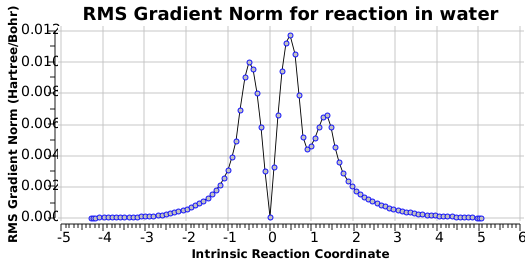
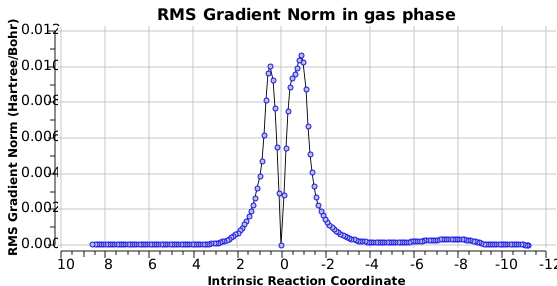
The original alkyne+peracid study was conducted using a gas phase model. I decided to revisit it now, but to change the modelled medium from the gas phase to continuum water. I show the IRC (intrinsic reaction coordinates) for this reaction in continuum water followed by the gas phase below (click on the animations to see the transition state model).

I want to compare the difference that introducing a model solvent (water) has made to the appearance of the reaction path.

  1. In water, the symmetry of the forming antiaromatic oxirene ring is always maintained. There is no distortion; the combination of hydrogen bond, developing ionicity and its stabilization by the model solvent, appears to eliminate the need for such distortion. The free energy barrier, ΔG (ωB97XD/6-311G(d,p) is 32.2 kcal/mol, outside of a room temperature reaction.
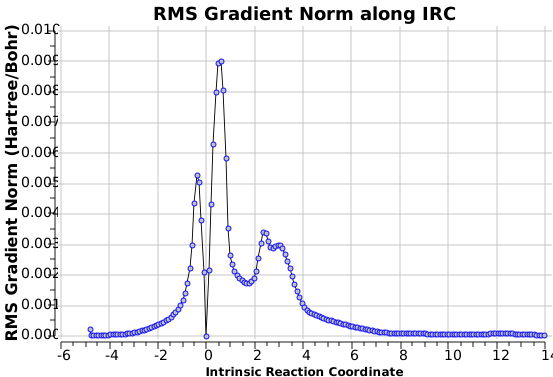
  2. In water, the proton transfer step comes much later, and is visible in the RMS gradient norm at +1.4.
  3. In the gas phase, the IRC is much more complex (as previously noted). Pronounced asymmetry develops, and this only resymmetrises late on, when the hydrogen bond forms.
  4. In the gas phase, the proton transfer occurs relatively early, and it cannot be found as a discrete feature in the RMS gradient norm plot. 
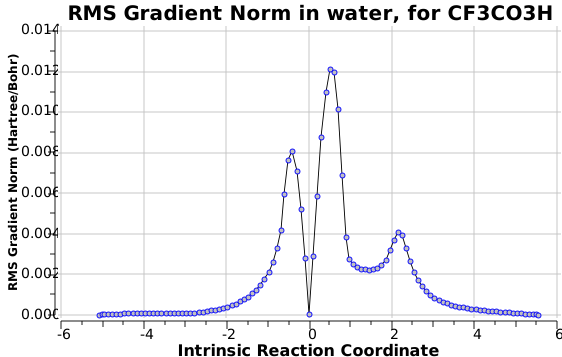
  5. If a more acidic peracid is introduced, say CF3CO3H, and the reaction is again simulated in water, the proton transfer is further delayed (below), and the barrier drops to ΔG 25.9 kcal/mol, an entirely viable thermal reaction. I do not believe this particular variation has ever been tested experimentally; anyone up for it? 
  6. The product of the CF3CO3H reaction is shown below. It has a remarkably short predicted hydrogen bond of 1.55Å between the oxirene and the trifluoracetic acid.

The take home message is that the very nature of a reaction, the geometry (symmetry) of the molecules taking part, and the timing of the changes can be very visibly changed by simulating the event with a solvent. In the past of course, all such computational studies were conducted purely as a gas phase model.

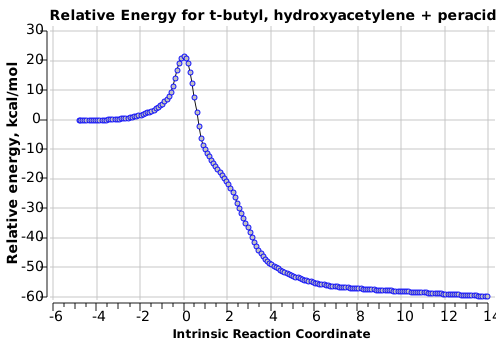
Postscript:The above shows how even a change in continuum solvent can affect the features of the reaction path. A rather greater perturbation is to change e.g. the substituents on the alkyne. I have tried replacing one H with t-butyl, and the other with OH. The rationale for the former is that t-butyl acetylene is actually the substrate that this reaction has been performed on, and for OH that it pushes electrons into the oxirene, making is more anti-aromatic and hence more liable to avoid that antiaromaticity. Animation of the IRC for this combination is shown below. Notice how the reaction now proceeds in a concerted manner directly from the alkyne to the hydroxy-carbene, without any sign of an intervening oxirene. 

The energy and gradient profiles for this variation are shown below. Notice in particular how the barrier has dropped; it is now a much easier reaction.