Posts Tagged ‘gas phase model’

Joining up the pieces. Peroxidation of ethyne.

Monday, July 9th, 2012

Sometimes, connections between different areas of chemistry just pop out (without the help of semantic web tools, this is called serendipity). So here, I will try to join up some threads which emerge from previous posts.

  1. I had noted that antiaromaticity in cyclopropenium anion is lessened by the system adopting gross geometric distortions, which take the anionic lone pair out of conjugation from the ring.
  2. Similarly, cyclobutadiene can form a complex with the guanidinium cation in which the anti-aromaticity is reduced by the formation of strong C…H-N hydrogen bonds.
  3. Unhappy with modelling a cation without a counter-ion, I added one. I noted that the cyclobutadiene+ ion pair was more stable in this more complete form.
  4. My next connection is to a post on how ethyne reacts with peracetic acid. The initial product of this reaction is oxirene, which like cyclobutadiene or cyclopropenium anion is anti-aromatic. This time, the liberated acetic acid forms a remarkably strong hydrogen bond to the oxygen of the antiaromatic ring as a way of reducing the antiaromaticity. 
  5. Particularly noteworthy was that the initial attack of oxygen on the alkyne was very asymmetric. This reminded of another post on the reaction of dichlorocarbene with ethene, which too is asymmetric, yet again to avoid an antiaromatic transition state. However, as the hydrogen bond in 4 above get stronger, the antiaromatic oxirene becomes symmetrical again. It is as if the hydrogen bond had replaced the need for asymmetry (as with 2 above).
  6. Another asymmetric example is the 2+2 closed shell cycloaddition of two ethenes, which adopt a different form of distortion.

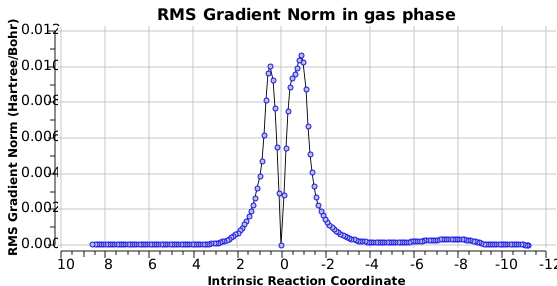
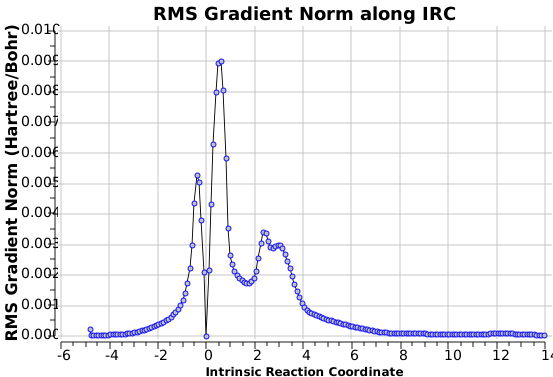
The original alkyne+peracid study was conducted using a gas phase model. I decided to revisit it now, but to change the modelled medium from the gas phase to continuum water. I show the IRC (intrinsic reaction coordinates) for this reaction in continuum water followed by the gas phase below (click on the animations to see the transition state model).

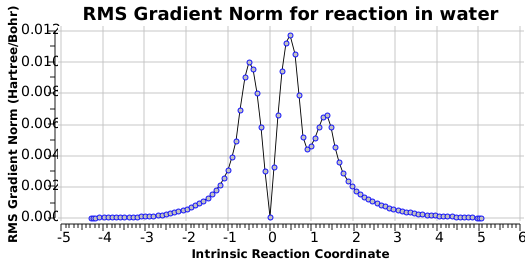
I want to compare the difference that introducing a model solvent (water) has made to the appearance of the reaction path.

  1. In water, the symmetry of the forming antiaromatic oxirene ring is always maintained. There is no distortion; the combination of hydrogen bond, developing ionicity and its stabilization by the model solvent, appears to eliminate the need for such distortion. The free energy barrier, ΔG (ωB97XD/6-311G(d,p) is 32.2 kcal/mol, outside of a room temperature reaction.
  2. In water, the proton transfer step comes much later, and is visible in the RMS gradient norm at +1.4.
  3. In the gas phase, the IRC is much more complex (as previously noted). Pronounced asymmetry develops, and this only resymmetrises late on, when the hydrogen bond forms.
  4. In the gas phase, the proton transfer occurs relatively early, and it cannot be found as a discrete feature in the RMS gradient norm plot. 
  5. If a more acidic peracid is introduced, say CF3CO3H, and the reaction is again simulated in water, the proton transfer is further delayed (below), and the barrier drops to ΔG 25.9 kcal/mol, an entirely viable thermal reaction. I do not believe this particular variation has ever been tested experimentally; anyone up for it? 
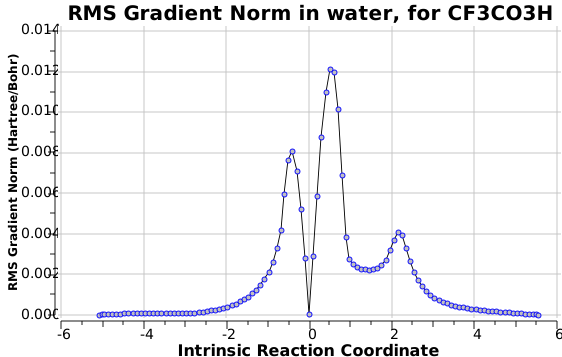
  6. The product of the CF3CO3H reaction is shown below. It has a remarkably short predicted hydrogen bond of 1.55Å between the oxirene and the trifluoracetic acid.

The take home message is that the very nature of a reaction, the geometry (symmetry) of the molecules taking part, and the timing of the changes can be very visibly changed by simulating the event with a solvent. In the past of course, all such computational studies were conducted purely as a gas phase model.

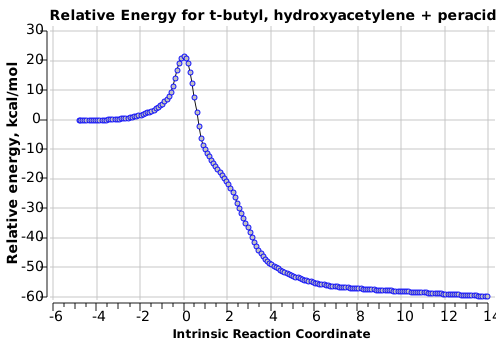
Postscript:The above shows how even a change in continuum solvent can affect the features of the reaction path. A rather greater perturbation is to change e.g. the substituents on the alkyne. I have tried replacing one H with t-butyl, and the other with OH. The rationale for the former is that t-butyl acetylene is actually the substrate that this reaction has been performed on, and for OH that it pushes electrons into the oxirene, making is more anti-aromatic and hence more liable to avoid that antiaromaticity. Animation of the IRC for this combination is shown below. Notice how the reaction now proceeds in a concerted manner directly from the alkyne to the hydroxy-carbene, without any sign of an intervening oxirene. 

The energy and gradient profiles for this variation are shown below. Notice in particular how the barrier has dropped; it is now a much easier reaction.
Do electrons prefer to move in packs of 4, 6 or 8 during proton exchange in a calixarene?

Friday, January 7th, 2011

This story starts with a calixarene, a molecule (suitably adorned with substituents) frequently used as a host to entrap a guest and perchance make the guest do something interesting. Such a calixarene was at the heart of a recent story where an attempt was made to induce it to capture cyclobutadiene in its cavity.

The basic skeleton of a calixarene

At the base of the calixarene are four hydroxyl groups, arranged in either a left or right handed manner. The molecule, in other words is chiral (C4 symmetry to be precise). As a chiral molecule, it might trap left and right-handed guests in a slightly different manner (forming two possible diastereomeric host-guest complexes).  As it happens, the guest in the cyclobutadiene story was just such a chiral molecule. But an essential question to ask is what the barrier to enantiomerization of such a calixarene might be?  One can envisage several ways of accomplishing such a conversion.

Enantiomerization pathways for a chiral calixarene

All four hydrogens can be moved in a single step, one might move two at a time in two steps, or one might move one at a time in four steps. These processes would involve respectively 8, 6 or 4 electrons in each step. There is a fundamental difference between the first pathway and the last two;  the latter involve  ionic intermediates (zwitterions) whereas the first is neutral. As such one might imagine the process would depend on the ability of the solvent to stabilize any such zwitterion.

Let us start with a gas phase model (ωB97XD/6-311G(d,p)), and a transition state with one negative force constant is indeed found with  C4v symmetry. The free energy barrier ΔG for the process is 14.0 kcal/mol, which means the reaction will occur rapidly, even at lower temperatures of  ~200K. A pack size of 8 seems preferred for this model. This is hardly a surprise since the formation of ionic intermediates would not be expected. One might however speculate thus. In the schematic above, n=1 and one might be tempted to ask if higher values of n (lets say  n=2, a pack size of 10, or n=3, a pack size of 12, etc ) might exhibit similar behaviour. Is there any limit to the ring/pack size for this type of proton exchange?

Transition state for enantiomerization of a calixarene in the gas phase. Click for 3D.

What about in solution? Well, let us apply the mildest of solvents, benzene as a so-called continuum field. This has a very low dielectric (2.3) and you might imagine it would have hardly any effect. Well click on the below. The C4v geometry now has three computed negative force constants; the two additional ones are shown below (they are degenerate with a wavenumber of 101i cm-1).

C4v symmetric geometry for calixarene in benzene solvent, with three negative force constants. Click for animation of E mode.

C4v geometry for calixarene in benzene. Click for animation of second E mode.

Each of these additional two negative force constants shows a displacement heading towards the zwitterion shown in the scheme below. As one increases the polarity of the solvent, so the force constant becomes more negative. Thus for dichloromethane, it is now 322i cm-1 and with water it is 376i cm-1

So now the question is what happens when either of the two additional negative force constants is followed downhill? Will it form a true zwitterion (which would have Cs symmetry), in which case it would be (two) 6 electron processes to enantiomerize the calixarene instead of one 8 electron one.

True transition state for proton exchange in solution phase calixarene

In fact this geometry of Cs symmetry, which does resemble the zwitterion shown in the scheme above, is NOT a minimum but a true transition state itself (the free energy barrier hardly changed from the value for the gas phase). So the answer seems to be that a calixarene enantiomerizes via transition state not of C4v but of Cs symmetry, and which resembles a zwitterion but is not actually one. The 8-packof electrons was tempted to take a short rest-break on their way to shifting the four protons, but in the end did it in a single journey! So we have an unusual zwitterionic but nevertheless concerted transition state for the process.

Still unresolved is whether such cyclic transfer of four protons between four oxygen atoms continues to be concerted for larger rings, or whether the system is finally tempted to break up the transfer by resting with one or more discrete intermediates along the way. I finally note that in the calixarene reported which catalysed the thoughts above, the four oxygens are capped with a guanidinium cation sitting just above them, and this too may have an interesting effect on the proton transfer process.

The structure of the hydrogen ion in water.

Sunday, February 21st, 2010

Stoyanov, Stoyanova and Reed recently published on the structure of the hydrogen ion in water. Their model was H(H2O)n+, where n=6 (DOI: 10.1021/ja9101826). This suggestion was picked up by Steve Bachrach on his blog, where he added a further three structures to the proposed list, and noted of course that with this type of system there must be a fair chance that the true structure consists of a well-distributed Boltzmann population of a number of almost iso-energetic forms.

The proposed structure of the hydrated proton in water

The evidence for the structure above comes from IR spectra. These operate on a fast enough scale to freeze-out individual forms, and therefore represent the instantaneous species rather than time averaged environments. A lively debate started on Steve’s blog, starting with Steve’s observation that the original article had reported only experimental results and no theoretical modelling of the proposed structure. It emerged that one way of modelling such species was within a cavity surrounded bv a continuum field modelling the bulk solvent (water in this case), and in particular one must properly optimize the structure and calculate the force constants within this field. When this is done, one significant difference between a simple gas-phase model of the structure above and its continuum-field structure emerges. In the former, the central O…H…O motif is symmetric (indeed the entire molecule is C2-symmetric). When the solvent field is applied, this unit desymmetrizes, ending up with one short (1.118Å) and one long (1.295Å) bond. I have transferred discussion of this from Steve’s blog to this one so that the resulting vibrations of this species can be shown here in animated form (its not possible to post animations in the comment field of a blog).

Firstly, the model. It is a PBE1PBE/aug-cc-pVTZ (the DFT method being the same as Steve used in his modelling, the basis set being rather better) and the continuum field applied was as SCRF(CPCM,solvent=water). The complete calculation can be inspected at DOI: 10042/to-4261. It is also important to remember that the force constants are harmonic. The resulting vibrations with the highest calculated intensities are tabled below.

Obs 1H freq Intensity 2H freq
338 481 ?
654 476 429 438
1202 1242 3837 942
1746 1749 599 1284
2816 3065 2829 2268
3127 913 2253
3134 3341 2018 2462
3134 3347 668 2424

One might note that the vibrations in the range 3100-3300 always tend to be over-estimated using theory, in part because of incomplete basis sets, and in part because the harmonic frequencies are always 200 or more wavenumbers higher than the observed anharmonic values. The match for the mid range vibrations (1746, 1202) seems remarkably good. Only the low range value (654) is significantly out, and this may be another anharmonic effect. Added for good measure are the closest matches to each vibration when the system is fully substituted with deuterium (because of mode mixing, the modes do not always map exactly; thus the mode at 338 appears to have no exact deuteriated analogue).

The displacement vectors are shown below (click on each picture to obtain an animation).

Normal mode 476 cm-1.

Normal mode 1242.

Normal mode 1749

Normal mode 3065

Normal mode 3341

Normal mode 3347

Calculated IR spectrum for H(H2O)6 +

Calculated IR spectrum for D(D2O)6 +

The overall conclusion does seem to be that the structure shown above for the solvated proton does seem to match the observed IR peaks rather well, and that further more accurate modelling of this species might be a worthwhile endeavour.

Chemical intimacy: Ion pairs in carbocations

Monday, January 11th, 2010

The scheme below illustrates one of the iconic reactions in organic chemistry. It is a modern representation of Meerwein’s famous experiment from which he inferred a carbocation intermediate, deduced from studying the rate of enantiomerization of isobornyl chloride when treated with the Lewis acid SnCl4.

The isomerisation of iso-bornyl chloride

Meerwein himself suggested (in effect, since he lacked the modern terminology used here) that the reaction proceeded via a hydride shift 3, which was acting as the mirror in reflecting 1 onto 1‘. A few years later, isotopic labelling studies demonstrated that another pathway occurs, at more or less the same rate. This alternative proceeds via a series of [1,2] carbon shifts, with the mirror now being 8 rather than 3. I have documented the story in detail in an article that will shortly appear in the J. Chemical Education (DOI: 10.1021/ed800058c). There, calculations reveal that the two transition states, 3 and 8 (which the experiments above suggest should be almost equal in energy) in fact differed by ~8 kcal/mol in favour of the latter for a gas-phase model which does not include the counterion. These calculations were done at a level (B3LYP/cc-pVQZ) which indicates that 8 kcal/mol represents a real discrepancy not so much in the calculation as in the model used for that calculation. I suggested that perhaps the discrepancy might be due to tunneling effects in the hydride transfer reaction, accelerating that pathway compared to methyl transfer.

What was missing from that particular model was the counter-ion, which is supposed to form an intimate ion-pair with the carbocation in moderately polar solvents. How much does the presence of such an object perturb the transition states?  To find out, we need calculate such systems (which by definition have very large dipole moments) with inclusion of solvation corrections. Now that new algorithms for computing transition states with solvation have made this a routine calculation, I can report an update to these results. This was done at the B3LYP/cc-pVTZ (aug-cc-pVTZ-pp for the Sn) level, using dichloromethane as a continuum solvent. Without the SnCl5 counterion, 3 and 8 differ by 5.4 kcal/mol in free energy (this difference now includes all the solvation free energy terms), and in the presence of the counter-ion this remains unchanged at 5.4 kcal/mol (see DOIs 10042/to-3668 and 10042/to-3667 without SnCl5 and 10042/to-3670 and 10042/to-3665 with). The free energy of activation with SnCl5 (see DOI: 10042/to-3695 for starting material) is 16.6 kcal/mol (for the [2,6] H shift) and 11.2 kcal/mol (for the  [1,2] Me shift), which indicates a facile room temperature reaction (as indeed is the case).

TS H-transfer. Click for animation

TS 1,2 Methyl shift. Click for animation

What are the implications for this result?

  1. Modelling an (intimate) ion-pair is different from that of covalent compounds in one respect. Whereas the geometry at covalent atoms is very well established and largely predictable, ion-pairs are potentially much more flexible. In other words, it is nowhere near as obvious where to place the counter-ion. In the above diagrams, the SnCl5 is located at a reasonable position, but there are other positions where it could be. Although what is shown is an energy optimized structure, a full search of all the possible positions that the SnCl5 could adopt has not been undertaken, and the possibility must remain that another pose of the ion might be lower in energy, for either of the two transition states. Indeed, if it turns out there are many positions for the ion of very similar in energy, then the entropy of the system would have to be corrected for these microstates.
  2. Nevertheless, one can draw insight from the two structures shown above (click to animate the transition mode). The counter-ion for the hydride transfer does approach the transferring hydrogen quite closely, and does appear to establish a H-bond between two hydrogens and one chlorine. This would stabilize that structure relative to the methyl shift transition state, where such hydrogen bonds do not appear to form. In this case  however, these interactions do not change the relative stabilties.
  3. These ion-pairs do have very large dipole moments (~23D for 3, ~27D for 8), which suggests that the result might in fact be sensitive to the nature of the solvent (and presumably the counter-ion itself).

Many reactions do take place in which intimate ion-pairs are formed (including a fair number of catalytic systems involving metals). We cannot generalise from the result above, but it may well be that the perturbation induced by such counter-ion may play significant roles in deciding selectivities. I would venture to suggest that increasingly modelling such as reported here will play a significant role in establishing mechanisms accounting for the selectivity of catalytic reactions.

The SN-1 Reaction live!

Friday, April 3rd, 2009

Pericyclic assistance for SN-1 solvolysis

Friday, April 3rd, 2009
Pericylically assisted solvolysis. Click above to see model.

Click on diagram to see model.

The reaction above is ostensibly a very simple pericyclic ring opening of a cyclopropyl carbocation to an allyl cation, preceeded by a preparatory step involving SN-1 solvolysis. As a 2-electron thermal process, the second step proceeds with disrotation of the terminii. Can this stereochemistry be illustrated with a computed model for the transition state for this process? Well, starting with a naked cation, its actually quite tricky to find such a transition state. In reality such cations are always solvated in real reactions, and a gas phase model is actually somewhat artificial. A much better bet is to also include in the model the SN-1 step that is presumed to preceed the actual pericyclic ring opening. Here we have included a simple protonated water molecule as the leaving group, rather than the tosyl group shown in the diagram above. Now when attempts are made to locate the ring opening transition state, it turns out that the SN-1 reaction and this ring opening are strongly coupled together. The ring opening helps to evict the water, or alternatively, one can look on it as the departing water helping to open the ring.

Such an intimate coupling of one mechanistic type (a pericyclic reaction) with another (SN-1 solvolysis) is a relatively unrecognized aspect of reaction mechanisms (although of course it is one of the characteristics of enzyme-catalysed reactions). I will cover several other examples of such synchrony in mechanisms in future entries in the blog.