Posts Tagged ‘proton transfer’

The mechanism of the Birch reduction. Part 2: a transition state model.

Monday, December 3rd, 2012

I promised that the follow-up to on the topic of Birch reduction would focus on the proton transfer reaction between the radical anion of anisole and a proton source, as part of analysing whether the mechanistic pathway proceeds O or M.
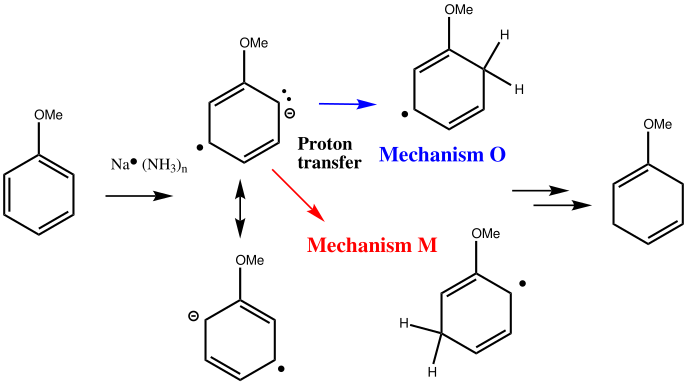
To add some context, Hammond’s postulate [1] states that “the structure of a transition state resembles that of the species nearest to it in free energy.” If the structure of the transition state for proton transfer above resembles that of the radical anion precursor we would call this an early transition state and it would be a reasonable approximation to infer properties of the reaction from the properties of that radical anion. The previous post explored those properties via the computed molecular electrostatic potential (MEP) and the highest energy NBO (natural bond orbitals, which are used here instead of molecular orbitals). Unfortunately, they did not agree with each other. Remember that Hammond’s postulate dates from 1955, an era when it was not practical to compute the structure of a transition state directly using quantum mechanics (certainly not so for such a complex reaction as that shown above). Indeed, one might argue that such a structure has only become computable in a practical sense very recently! As I showed previously, the radical ion-pair resulting from a 1-electron transfer from sodium to anisole has a dipole moment of ~11.6D, and the reaction is conducted in a solvent of medium polarity. This combination means that one really is obliged to take into account the dielectric of the solvent, and indeed any strong explicit hydrogen bonds that might be present. The codes for doing this have really only recently become robust enough to tackle such an endeavour[2], which might explain why such calculations are not yet abundant, or ubiquitously cited in the text books.

Proton transfer for M mechanism. Click for 3D.

The proton transfer via one M mechanism is shown above. The proton source is ammonia, which is known from experiment to lead to sluggish reactions (the more acidic t-butanol is often added to speed up the reaction), but we can see that the transition state is very late, νi 423.8 cm-1. The N…H bond is largely broken, and the C-H bond is mostly formed. The dipole moment is 7.7D, also different from that of the reactant. Perhaps, knowing this, it is not too surprising that inferences based on Hammond’s postulate as applied to the reactant are not reliable. The value of ΔG298computed from this model is 22.8 kcal/mol, which is on the high-ish side for a reaction to occur readily at room temperatures or below.[3] This nevertheless nicely conforms what we already know, that a more acidic proton donor is needed to achieve a fast reaction.

Proton transfer for O mechanism. Click for 3D.

The proton transfer via one O mechanism is similar, but a tad less “late”. This already raises doubts about application of Hammond’s postulate to this system; one cannot really compare two reactions in which each reactant differs in its resemblance to its transition state. The dipole moment of this alternative transition state is also 7.7D, but the transition imaginary mode is much higher at νi 869 cm-1. The free energy barrier is 21.0, some 1.8 kcal/mol lower than the barrier for the M mechanism. This corresponds to a rate about 21 times faster for O over M (at 298K).

To conclude, we characterise two (of the four) isomeric transition states for protonation of the radical anion intermediate in the Birch reduction of anisole. These two transition states are actually different in several subtle regards, differences which would not have manifested if only the properties of the reactant had been considered. The final word must be that the text books are likely correct on this one, although a little more work is still needed to tidy up loose ends.  

References

  1. G.S. Hammond, "A Correlation of Reaction Rates", Journal of the American Chemical Society, vol. 77, pp. 334-338, 1955. https://doi.org/10.1021/ja01607a027
  2. J. Kong, P.V.R. Schleyer, and H.S. Rzepa, "Successful Computational Modeling of Isobornyl Chloride Ion-Pair Mechanisms", The Journal of Organic Chemistry, vol. 75, pp. 5164-5169, 2010. https://doi.org/10.1021/jo100920e
  3. H.E. Zimmerman, and P.A. Wang, "Regioselectivity of the Birch reduction", Journal of the American Chemical Society, vol. 112, pp. 1280-1281, 1990. https://doi.org/10.1021/ja00159a078

Do electrons prefer to move in packs of 4, 6 or 8 during proton exchange in a calixarene?

Friday, January 7th, 2011

This story starts with a calixarene, a molecule (suitably adorned with substituents) frequently used as a host to entrap a guest and perchance make the guest do something interesting. Such a calixarene was at the heart of a recent story where an attempt was made to induce it to capture cyclobutadiene in its cavity.

The basic skeleton of a calixarene

At the base of the calixarene are four hydroxyl groups, arranged in either a left or right handed manner. The molecule, in other words is chiral (C4 symmetry to be precise). As a chiral molecule, it might trap left and right-handed guests in a slightly different manner (forming two possible diastereomeric host-guest complexes).  As it happens, the guest in the cyclobutadiene story was just such a chiral molecule. But an essential question to ask is what the barrier to enantiomerization of such a calixarene might be?  One can envisage several ways of accomplishing such a conversion.

Enantiomerization pathways for a chiral calixarene

All four hydrogens can be moved in a single step, one might move two at a time in two steps, or one might move one at a time in four steps. These processes would involve respectively 8, 6 or 4 electrons in each step. There is a fundamental difference between the first pathway and the last two;  the latter involve  ionic intermediates (zwitterions) whereas the first is neutral. As such one might imagine the process would depend on the ability of the solvent to stabilize any such zwitterion.

Let us start with a gas phase model (ωB97XD/6-311G(d,p)), and a transition state with one negative force constant is indeed found with  C4v symmetry. The free energy barrier ΔG for the process is 14.0 kcal/mol, which means the reaction will occur rapidly, even at lower temperatures of  ~200K. A pack size of 8 seems preferred for this model. This is hardly a surprise since the formation of ionic intermediates would not be expected. One might however speculate thus. In the schematic above, n=1 and one might be tempted to ask if higher values of n (lets say  n=2, a pack size of 10, or n=3, a pack size of 12, etc ) might exhibit similar behaviour. Is there any limit to the ring/pack size for this type of proton exchange?

Transition state for enantiomerization of a calixarene in the gas phase. Click for 3D.

What about in solution? Well, let us apply the mildest of solvents, benzene as a so-called continuum field. This has a very low dielectric (2.3) and you might imagine it would have hardly any effect. Well click on the below. The C4v geometry now has three computed negative force constants; the two additional ones are shown below (they are degenerate with a wavenumber of 101i cm-1).

C4v symmetric geometry for calixarene in benzene solvent, with three negative force constants. Click for animation of E mode.

C4v geometry for calixarene in benzene. Click for animation of second E mode.

Each of these additional two negative force constants shows a displacement heading towards the zwitterion shown in the scheme below. As one increases the polarity of the solvent, so the force constant becomes more negative. Thus for dichloromethane, it is now 322i cm-1 and with water it is 376i cm-1

So now the question is what happens when either of the two additional negative force constants is followed downhill? Will it form a true zwitterion (which would have Cs symmetry), in which case it would be (two) 6 electron processes to enantiomerize the calixarene instead of one 8 electron one.

True transition state for proton exchange in solution phase calixarene

In fact this geometry of Cs symmetry, which does resemble the zwitterion shown in the scheme above, is NOT a minimum but a true transition state itself (the free energy barrier hardly changed from the value for the gas phase). So the answer seems to be that a calixarene enantiomerizes via transition state not of C4v but of Cs symmetry, and which resembles a zwitterion but is not actually one. The 8-packof electrons was tempted to take a short rest-break on their way to shifting the four protons, but in the end did it in a single journey! So we have an unusual zwitterionic but nevertheless concerted transition state for the process.

Still unresolved is whether such cyclic transfer of four protons between four oxygen atoms continues to be concerted for larger rings, or whether the system is finally tempted to break up the transfer by resting with one or more discrete intermediates along the way. I finally note that in the calixarene reported which catalysed the thoughts above, the four oxygens are capped with a guanidinium cation sitting just above them, and this too may have an interesting effect on the proton transfer process.