The journal of chemical education can be a fertile source of ideas for undergraduate student experiments. Take this procedure for asymmetric epoxidation of an alkene.[1] When I first spotted it, I thought not only would it be interesting to do in the lab, but could be extended by incorporating some modern computational aspects as well.
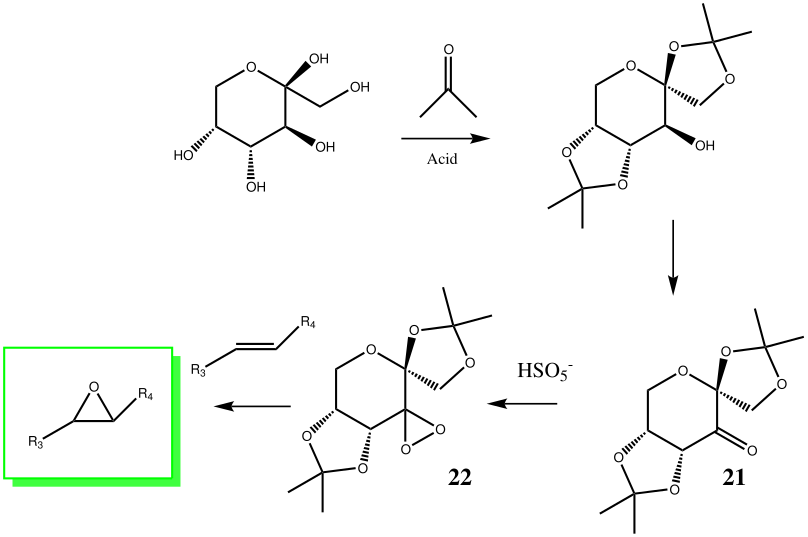
Oxygen atom transfer from this chiral dioxirane produces a specific enantiomer of the chiral epoxide in often high enantiomeric excess. For each alkene, there are up to eight possible transition states, arising from the following permutations:
- The two oxygen atoms of the oxidant are not equivalent
- Either the re or the si face of the alkene can be presented to the oxidant
- and the alkene itself can orient endo or exo with respect to the oxidant.
In fact, using the standard ωB97XD/6-311G(d,p)/SCRF=solvent method used on this blog, locating each transition state for any specific alkene can take about 24 hours, and hence doing all eight can take a week or more per alkene. We have groups of around 20 students doing this experiment, and so it was not practical in terms of computing resources to get them all to individually find these transition states. Instead, we give the students access to groups of eight pre-run calculations[2] for four different alkenes and invited them to perform various tasks for their selected alkene. These include:
- Identify the free energy of each of the eight transition states for their alkene, and using these suggest a predicted enantiomeric outcome for the epoxide
- Using the energy of the lowest transition state leading to the other enantiomer, work out a predicted enantiomeric excess for the reaction
- Produce a non-covalent-interactions isosurface and try to reconcile this with the predicted ee by visual inspection.
- Run a QTAIM analysis of the wavefunction for the optimal transition state to inspect various topological critical points, especially the weaker ones that are not normally considered.
- Ponder any anomeric or other stereoelectronic interactions that might be present in any selected transition state.
- Track down the crystal structures of the catalyst precursor itself (the ketone) and comment on any interesting aspect of its structure.
There are more tasks the students have to perform, and a full description will appear in an article I am writing.
<
p>
References
- A. Burke, P. Dillon, K. Martin, and T.W. Hanks, "Catalytic Asymmetric Epoxidation Using a Fructose-Derived Catalyst", Journal of Chemical Education, vol. 77, pp. 271, 2000. https://doi.org/10.1021/ed077p271
- H.S. Rzepa, Mii Hii., and E.H. Smith, "Asymmetric epoxidation: a twinned laboratory and molecular modelling experiment", 2014. https://doi.org/10.6084/m9.figshare.988346
Tags: chemical education, energy, free energy, Shi Fructose