Molecules of the year 2019: Hexagonal planar crystal structures.

January 23rd, 2020

Here is another selection from the Molecules-of-the-Year shortlist published by C&E News, in which hexagonal planar transition metal coordination is identified. This was a mode of metal coordination first mooted more than 100 years ago,[1] but with the first examples only being discovered recently. The C&E News example comprises a central palladium atom surrounded by three hydride and three magnesium atoms, all seven atoms being in the same plane.

As the original article makes clear,[1] the relative orbital simplicity of these early main group based ligands allows the bonding to be better understood, hence itself allowing “additional design principles” to be introduced for transition metal complexes. Here I thought I might extend the scope of this motif by a generalised crystal search for any other hexagonal planar structures to be found in the Cambridge crystal structure database.

A search query can be constructed by defining a plane using the six ligand atoms and then constraining the perpendicular distance between this plane and the transition metal atom at the centre to < 0.1Å. Six angles between adjacent ligands are then themselves constrained to the range 0-70° and the coordination of the central atom can also be constrained to either 6, 7 or 8. All searches are also defined by no disorder and no errors. The search queries can be found at DOI: 10.14469/hpc/6731

I carried out a number of separate searches. The least constrained (any coordination number at the central atom, and any type of attached ligand atom) produced 62 hits, exhibiting a variety of sometimes complex coordination modes. To simplify the search, I separated the searches into specific types. You can view 3D models of any of the molecules below by clicking on the static image.

  1. The first restricted the transition metal atom to 6-coordinate and for which the ligands all derive from the early main group periods (1A, 2A and H). The sole example (NORLOY[[1], DOI: 10.5517/ccdc.csd.cc2235v7) is the one noted above.
  2. The next search restricted all the ligands to a transition metal connected to the central atom, along with 6-coordination. Again just one hit (RISQEP[2] dating from 1997 and comprising a central Au atom surrounded by four Au-based ligands and two Fe-based ligands. This type of molecule is a member of a class known as a hexagonal planar metal cluster.

  3. This search now constrains all six ligands as comprising late main group atoms bonding to the central metal. Two hits, VOVZOV, dating from 1992[3] with a P-based ligand Ni central atom and ZUDWUQ from 1996[4] using As and Ni.

  4. The next category combines the previous two, with ligands either from the transition series or the late main group series, resulting in four more hits (HACBOF and HACBUL[5] (DOI: 10.5517/ccdc.csd.cc1n26pm and 10.5517/ccdc.csd.cc1n26qn) using a combination of three carbons (as acetylide)  and three Ag ligands, with Cu as the central ligand.

  5. Next, any ligand is allowed, together with a 7-coordinate central atom. Three examples, including  VAPZEU (2016, [6], DOI: 10.5517/ccdc.csd.cc1md045) with three Pd and three Si hexagonal ligands, with an additional 7th Cu surrounding a central Pd.


  6. One example (of eight found) with 8-coordination at central atom (1996, NANPOH[7]), a central Cd, six oxygen ligands and two further cyanide axial ligands.

  7. To finish, a rather wacky polymeric example with Ti at the centre, six hydrogens deriving from a terminal borane as the hexacoordinate planar motif and two axial P ligands (PEDJOY[8], DOI: 10.5517/ccb0d6x).

I hope this short journey through hexacoordinate planar transition metal complexes has revealed at least a flavour of the diversity in this category. I am also going to take some gentle issue with the C&E News reporting of this molecule, “Scientists proposed a hexagonal planar geometry more than 100 years ago, but it has never been captured in crystal form until now” (referring to the 2019 article which inspired this blog[1]). As I hope I have shown, a number of the examples above in crystal form actually emerged rather earlier than 2019!

References

  1. M. Garçon, C. Bakewell, G.A. Sackman, A.J.P. White, R.I. Cooper, A.J. Edwards, and M.R. Crimmin, "A hexagonal planar transition-metal complex", Nature, vol. 574, pp. 390-393, 2019. https://doi.org/10.1038/s41586-019-1616-2
  2. V.G. Albano, M.C. Iapalucci, G. Longoni, L. Manzi, and M. Monari, "Synthesis of [Au<sub>3</sub>Fe<sub>2</sub>(CO)<sub>8</sub>(dppm)]<sup>-</sup> and [Au<sub>5</sub>Fe<sub>2</sub>(CO)<sub>8</sub>(dppm)<sub>2</sub>]<sup>+</sup>:  X-ray Structures of [NEt<sub>4</sub>][Au<sub>3</sub>Fe<sub>2</sub>(CO)<sub>8</sub>(dppm)] and [Au<sub>5</sub>Fe<sub>2</sub>(CO)<sub>8</sub>(dppm)<sub>2</sub>][BF<sub>4</sub>]", Organometallics, vol. 16, pp. 497-499, 1997. https://doi.org/10.1021/om960850g
  3. R. Ahlrichs, D. Fenske, H. Oesen, and U. Schneider, "Synthesis and Structure of [Ni(P<i>t</i>Bu<sub>6</sub>)] and [Ni<sub>5</sub>(P<i>t</i>Bu)<sub>6</sub>(CO)<sub>5</sub>] and Calculations on the Electronic Structure of [Ni(P<i>t</i>Bu)<sub>6</sub>] and (PR)<sub>6</sub>, R = <i>t</i>Bu,Me", Angewandte Chemie International Edition in English, vol. 31, pp. 323-326, 1992. https://doi.org/10.1002/anie.199203231
  4. E. Hey‐Hawkins, M. Pink, H. Oesen, and D. Fenske, "Synthesen und Charakterisierung von [Ni(<i>t</i>BuAs)<sub>6</sub>] und [Pd(<i>t</i>BuAs)<sub>6</sub>]", Zeitschrift für anorganische und allgemeine Chemie, vol. 622, pp. 689-691, 1996. https://doi.org/10.1002/zaac.19966220420
  5. S.C.K. Hau, M.C. Yeung, V.W. Yam, and T.C.W. Mak, "Assembly of Heterometallic Silver(I)–Copper(I) Alkyl-1,3-diynyl Clusters via Inner-Core Expansion", Journal of the American Chemical Society, vol. 138, pp. 13732-13739, 2016. https://doi.org/10.1021/jacs.6b08674
  6. M. Tanabe, R. Yumoto, T. Yamada, T. Fukuta, T. Hoshino, K. Osakada, and T. Tanase, "Planar PtPd<sub>3</sub> Complexes Stabilized by Three Bridging Silylene Ligands", Chemistry – A European Journal, vol. 23, pp. 1386-1392, 2016. https://doi.org/10.1002/chem.201604502
  7. J. Kim, and K. Kim, "NEW THREE DIMENSIONAL [Cd(CN)<sub>2</sub>]<sub>n</sub> FRAMEWORK FORMED WITH CADMIUM CYANIDE AND Cd(CN)<sub>2</sub>·(18-CROWN-6): CRYSTAL STRUCTURE OF [Cd(CN)<sub>2</sub>]·1/2[Cd(CN)<sub>2</sub> (18-CROWN-6)]·3/2EtOH<sup>+</sup>", Journal of Coordination Chemistry, vol. 37, pp. 7-15, 1996. https://doi.org/10.1080/00958979608023536
  8. D.M. Goedde, and G.S. Girolami, "Titanium(II) and Titanium(III) Tetrahydroborates. Crystal Structures of [Li(Et<sub>2</sub>O)<sub>2</sub>][Ti<sub>2</sub>(BH<sub>4</sub>)<sub>5</sub>(PMe<sub>2</sub>Ph)<sub>4</sub>], Ti(BH<sub>4</sub>)<sub>3</sub>(PMe<sub>2</sub>Ph)<sub>2</sub>, and Ti(BH<sub>4</sub>)<sub>3</sub>(PEt<sub>3</sub>)<sub>2</sub>", Inorganic Chemistry, vol. 45, pp. 1380-1388, 2006. https://doi.org/10.1021/ic051556w

Comment on "Resolving the Quadruple Bonding Conundrum in C2 Using Insights Derived from Excited State Potential Energy Surfaces": The 7Σ heptet excited states for related molecules.

January 2nd, 2020

I noted in an earlier blog, a potential (if difficult) experimental test of the properties of the singlet state of dicarbon, C2. Now, just a few days ago, a ChemRxiv article has been published suggesting another (probably much more realistic) test.[1] This looks at the so-called 7Σ open shell state of the molecule where three electrons from one σ and two π orbitals are excited into the corresponding σ* and π* unoccupied orbitals. The argument is presented that these states are not dissociative, showing a deep minimum and hence a latent quadruple bonding nature. They also note that the isoelectronic BN molecule IS dissociative. Thus to quote: “Hence, the proof of existence of a minimum in the 7Σu+ for C2 and the absence of such a minimum in the equivalent case for BN is likely to corroborate our findings on quadruple bonding in these two cases.

Although a PES (potential energy surface) is shown for 7Σ C2, no vibrational wavenumber is reported. So in the spirit of a commentary on this pre-print, I have calculated these values (CCSD(T)/Def2-TZVPP) for the molecules noted in the article and a few other isoelectronic species. The results are collected at DOI: 10.14469/hpc/6599

Property BeC2- BB2- BC1- BN CC CN1+ NN2+ BeO BO1+ LiF
Bond length,
Å
2.281 1.858 1.768 3.216 1.585 1.638 1.523 2.602 200.7 2.179
Bond stretch,
cm-1
182 638 699 48 1055 759 934 363 0.4 626

The two singly occupied σ-orbitals are shown below and are in part responsible for the non-dissociative behaviour.

The results using this method (the article reports many more methods), reveal that C2 does indeed exist in a minimum for the heptet state, whilst the isoelectronic BN is only very weakly bound, in effect dissociative. Another dissociative isoelectronic is BO1+, whilst N22+ despite the coulombic repulsions of a double positive charge, still manages to be bound with a relatively short bond length. A further neutral diatomic BeO is also clearly non-dissociative.

Lets hope a spectroscopist somewhere tries to take a look at these heptet excited states of such molecules so that further experimental insight can be cast on this fascinating problem.


The orbital occupancy of this species is different from the others. As are the neutral ten valence electron N≡N (confirmed here) and HC≡CH.

References

  1. I. Bhattacharjee, D. Ghosh, and A. Paul, "Resolving the Quadruple Bonding Conundrum in C2 Using Insights Derived from Excited State Potential Energy Surfaces: A Molecular Orbital Perspective", 2019. https://doi.org/10.26434/chemrxiv.11446224.v1

Comment on “Resolving the Quadruple Bonding Conundrum in C2 Using Insights Derived from Excited State Potential Energy Surfaces”: The 7Σ heptet excited states for related molecules.

January 2nd, 2020

I noted in an earlier blog, a potential (if difficult) experimental test of the properties of the singlet state of dicarbon, C2. Now, just a few days ago, a ChemRxiv article has been published suggesting another (probably much more realistic) test.[1] This looks at the so-called 7Σ open shell state of the molecule where three electrons from one σ and two π orbitals are excited into the corresponding σ* and π* unoccupied orbitals. The argument is presented that these states are not dissociative, showing a deep minimum and hence a latent quadruple bonding nature. They also note that the isoelectronic BN molecule IS dissociative. Thus to quote: “Hence, the proof of existence of a minimum in the 7Σu+ for C2 and the absence of such a minimum in the equivalent case for BN is likely to corroborate our findings on quadruple bonding in these two cases.

Although a PES (potential energy surface) is shown for 7Σ C2, no vibrational wavenumber is reported. So in the spirit of a commentary on this pre-print, I have calculated these values (CCSD(T)/Def2-TZVPP) for the molecules noted in the article and a few other isoelectronic species. The results are collected at DOI: 10.14469/hpc/6599

Property BeC2- BB2- BC1- BN CC CN1+ NN2+ BeO BO1+ LiF
Bond length,
Å
2.281 1.858 1.768 3.216 1.585 1.638 1.523 2.602 200.7 2.179
Bond stretch,
cm-1
182 638 699 48 1055 759 934 363 0.4 626

The two singly occupied σ-orbitals are shown below and are in part responsible for the non-dissociative behaviour.

The results using this method (the article reports many more methods), reveal that C2 does indeed exist in a minimum for the heptet state, whilst the isoelectronic BN is only very weakly bound, in effect dissociative. Another dissociative isoelectronic is BO1+, whilst N22+ despite the coulombic repulsions of a double positive charge, still manages to be bound with a relatively short bond length. A further neutral diatomic BeO is also clearly non-dissociative.

Lets hope a spectroscopist somewhere tries to take a look at these heptet excited states of such molecules so that further experimental insight can be cast on this fascinating problem.


The orbital occupancy of this species is different from the others. As are the neutral ten valence electron N≡N (confirmed here) and HC≡CH.

References

  1. I. Bhattacharjee, D. Ghosh, and A. Paul, "Resolving the Quadruple Bonding Conundrum in C2 Using Insights Derived from Excited State Potential Energy Surfaces: A Molecular Orbital Perspective", 2019. https://doi.org/10.26434/chemrxiv.11446224.v1

Can a carbon radical act as a hydrogen bond acceptor?

December 28th, 2019

Having shown that carbon as a carbene centre, C: can act as a hydrogen bond acceptor, as seen from a search of crystal structures, I began to wonder if there is any chance that carbon as a radical centre, C could do so as well. Definitely a subversive thought, since radical centres are supposed to abstract hydrogens rather than to hydrogen bond to them.

One molecule that emerges from such a search (Query: 10.14469/hpc/6572) was reported recently as a resonance stabilized radical,[1] with the intermolecular hydrogen bond that emerges being from an aryl C-H directed at the carbon radical centre. The length (after correction by -0.1Å) is typical (this interaction is not noted in the article itself). Most of the 31 hits are in fact intra-molecular.

Click image to view 3D model

The spin density arising from the unpaired electron of the radical is indeed delocalised, although the largest part is in a pπ orbital on the carbon radical centre.

The molecular electrostatic potential (MEP) shows a negative π-potential (attractive to a proton) covering the radical carbon, but also the adjacent boron.

These types of hydrogen bond to a carbon radical acceptor are clearly weak (if indeed they are real), but perhaps a balance has to be achieved between two effects: less delocalised carbon radicals might form stronger hydrogen bonds but they will also abstract hydrogen atoms from potential hydrogen bond donors. More highly delocalised radicals are less likely to abstract, but probably also less likely to form strong hydrogen bond acceptors. Nonetheless, one can ask whether a stronger carbon radical hydrogen bond acceptor might be found that exists in that region where abstraction does not occur. As I noted at the start, I am trying to be provocative!

References

  1. T. Kushida, S. Shirai, N. Ando, T. Okamoto, H. Ishii, H. Matsui, M. Yamagishi, T. Uemura, J. Tsurumi, S. Watanabe, J. Takeya, and S. Yamaguchi, "Boron-Stabilized Planar Neutral π-Radicals with Well-Balanced Ambipolar Charge-Transport Properties", Journal of the American Chemical Society, vol. 139, pp. 14336-14339, 2017. https://doi.org/10.1021/jacs.7b05471

Carbon as a hydrogen bond acceptor: can dicarbon (C2) act in this manner?

December 27th, 2019

In the previous post, I showed that carbon can act as a hydrogen bond acceptor (of a proton) to form strong hydrogen bond complexes. Which brings me to a conceptual connection: can singlet dicarbon form such a hydrogen bond? 

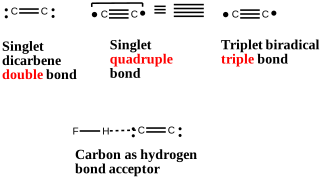
Dicarbon can be variously represented as above. The first form shows it as a bis-carbene, with an unbonded lone pair of electrons at each end of a carbon double bond. The middle form has emerged in the last ten years or so as a serious alternative to describing the singlet state structure.  It contains a so-called triple endobond and one further much weaker exo-bond (indicated separately by the symbol above the bond), referred to for simplicity as quadruple-bonded dicarbon. The third form would be a triplet biradical with triple bonded carbon. The species is known to be a singlet ground state with a significant excitation energy to the triplet. One can then ask the question: would either of these singlet state species be capable of being a hydrogen bond acceptor?

Time for calculations, at the CCSD(T)/Def2-TZVPP level using HF as the hydrogen bond donor (to enable advantage to be taken of the axial symmetry), data DOI: 10.14469/hpc/6554.

  1. The singlet quadruple bonded form emerges as 32 kcal/mol higher in total energy than the singlet dicarbene.
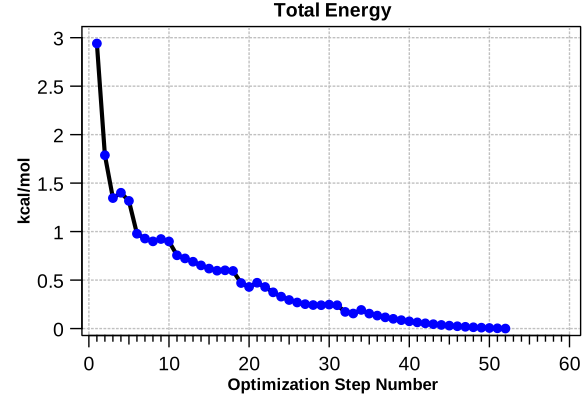
  2. The quadruple bonded form shows no sign of forming a hydrogen bond. The geometry optimisation curve is shown below followed by the final geometry (Å).


  3. The bis-carbene form  (calculated by a double electron excitation, orbitals 10 to 12 and 11 to 15) DOES form such a complex. The hydrogen bond length (2.04Å) is exactly that found from the crystal structures of the shortest such bonds.

  4. Two  of the normal vibrational modes of this species are shown below, being respectively the H…C and C=C stretches (153 and 1394 cm-1).   

So dicarbon CAN form a short hydrogen bond to a donor such as HF, but only in its excited singlet state, which is some 32 kcal/mol above the quadruple-bonded form. Perhaps because of that fourth bond, the hydrogen bonding ability of this species is entirely inhibited. We have gotten to the point I wanted to reach; an experimental prediction that if singlet dicarbon can ever be trapped in a very inert matrix at very low temperatures in the presence of a hydrogen bond donor, it will not form a hydrogen bond to that donor. That is going to be a difficult experiment, but at least the prediction is out there as a challenge!

Hydrogen bonds: carbon as an acceptor rather than as a donor?

December 23rd, 2019

A hydrogen bond donor is considered as an electronegative element carrying a hydrogen that is accepted by an atom carrying a lone pair of electrons, as in X:…H-Y where X: is the acceptor and H-Y the donor. Wikipedia asserts that carbon can act as a donor, as we saw in the post on the incredible chloride cage, where six Cl:…H-C interactions trapped the chloride ion inside the cage. This led me to ask how many examples are there of carbon as an acceptor rather than as a donor?

The basic query is constructed as above: in order to act as an acceptor, the carbon must bear a lone pair of electrons, of which a carbene is one example (Query, see DOI: 10.14469/hpc/6531). Thus we have QA=O,C,S and the central atom has only two connected atoms. When QC is any of C,N,O,F,Cl, we get the following result. The red circle corresponds to QC=O.

The shortest example of these is shown below, with a C:…HO distance of 1.91Å nominal but about 0.1Å shorter if corrected for the over-short H-O bond (Data DOI: 10.5517/ccvm80q)[1]

Click image to view 3D

The shortest C:…HN example is shown below with a distance of 2.07Å (DOI: 10.5517/ccdc.csd.cc21tzql)[2]

Click on image to view 3D model

Finally C:…HC, of which there are many in the region of 2.5Å, with the shortest example being 2.17Å[3]

Click on image to view 3D model

To round this off, N≡C:…HX, of which a nice example is (DOI: 10.5517/ccs7whc)[4]

Click on image for 3D model

From which we conclude that carbon as a hydrogen bond acceptor exhibits a diversity of forms, often with surprisingly short distances! I guess the wikipedia article needs updating.

References

  1. N.A. Giffin, M. Makramalla, A.D. Hendsbee, K.N. Robertson, C. Sherren, C.C. Pye, J.D. Masuda, and J.A.C. Clyburne, "Anhydrous TEMPO-H: reactions of a good hydrogen atom donor with low-valent carbon centres", Organic & Biomolecular Chemistry, vol. 9, pp. 3672, 2011. https://doi.org/10.1039/c0ob00999g
  2. J.M. Kieser, Z.J. Kinney, J.R. Gaffen, S. Evariste, A.M. Harrison, A.L. Rheingold, and J.D. Protasiewicz, "Three Ways Isolable Carbenes Can Modulate Emission of NH-Containing Fluorophores", Journal of the American Chemical Society, vol. 141, pp. 12055-12063, 2019. https://doi.org/10.1021/jacs.9b04864
  3. C. Jones, D.P. Mills, and R.P. Rose, "Oxidative addition of an imidazolium cation to an anionic gallium(I) N-heterocyclic carbene analogue: Synthesis and characterisation of novel gallium hydride complexes", Journal of Organometallic Chemistry, vol. 691, pp. 3060-3064, 2006. https://doi.org/10.1016/j.jorganchem.2006.03.018
  4. S. Mo, A. Krunic, B.D. Santarsiero, S.G. Franzblau, and J. Orjala, "Hapalindole-related alkaloids from the cultured cyanobacterium Fischerella ambigua", Phytochemistry, vol. 71, pp. 2116-2123, 2010. https://doi.org/10.1016/j.phytochem.2010.09.004

Molecules of the year – 2019: twisty tetracene.

December 22nd, 2019

All of the molecules in this year’s C&EN list are fascinating in their very different ways. Here I take a look at the twisty tetracene (dodecaphenyltetracene) which is indeed very very twisty.[1]

Click on image to view 3D model

Unfortunately, the authors point that the twisty-ness does not lead to a stable helical configuration at room temperatures and so separate enantiomers cannot be isolated. But its still worth speculating what the optical rotation of such a species might be if measured. An ωB97XD/Def2-SVP/SCRF=dichloromethane calculation (DOI: 10.14469/hpc/6527) gives the following values:

[α]589 -11178°
[α]800 -2310°

Of course, mere helicity (however twisty) does not necessarily map to high optical rotation! This would be a nice molecule to 3D print and sit on a coffee table for people to admire!

References

  1. Y. Xiao, J.T. Mague, R.H. Schmehl, F.M. Haque, and R.A. Pascal, "Dodecaphenyltetracene", Angewandte Chemie International Edition, vol. 58, pp. 2831-2833, 2019. https://doi.org/10.1002/anie.201812418

L-Malic acid: An exercise in conformational analysis impacting upon optical rotatory dispersion (ORD).

December 20th, 2019

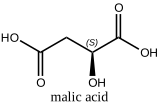
My momentum of describing early attempts to use optical rotation to correlate absolute configuration of small molecules such as glyceraldehyde and lactic acid with their optical rotations has carried me to L-Malic acid (below labelled as (S)-Malic acid).

The measured optical rotatory dispersion curve at low wavelengths is shown below (dashed line for Malic acid, solid line for Lactic acid). A sign inversion occurs <220nm to negative rotations. [1] I decided to explore how modern theory of both conformational analysis and chiroptical calculation performs for this small molecule at these wavelengths.

You need good tools to investigate the conformational space of even a small molecule such as malic acid. I used Gaussview 6 with the GMMX plugin. This identifies rotatable bonds and uses molecular mechanics to optimise all unique conformations which are located up to 3.5 kcal/mol above the lowest energy one. Using this procedure for malic acid produces 17 conformations! The geometry of each was then re-optimised at the following level: B3LYP+GD3BJ dispersion correction, Def2-TZVPP basis and using a superfinegrid pruned to 175,974 for first-row atoms (the default grid is 99,590 in the Gaussian 16 program) to avoid any significant incurrence of rotational dependence of the computed energy. Extra tight convergence criteria for the SCF and 2-electron integrals (12 and 14 respectively in the Gaussian definition) were also selected. A solvent correction for ethanol was also included and the free energy calculated. Once the geometries were obtained, the optical rotations were calculated using ωB97XF/Def2-TZVPP/SCRF=ethanol (DOI: 110.14469/hpc/6510) and the results inserted into a spreadsheet (which is available for you to inspect for yourself).

To summarise.

Wavelength ~Observed rotation, ° Calculated rotation, °
260 +250 +194
230 +1500 +318
220 +900 +385
215 +400 +631
205 -2660 -1778
  1. One first notes that 9 of the conformers have a population >1% and the maximum population of any single conformer is ~30%.
  2. Secondly, the ORD curve in the region 200-230 is extremely steep, so even tiny changes in the wavelength can induce large changes in the optical rotation. This propagates onto the calculations, where the accuracy of the predicted λmax is only about 20nm at this level of theory. This means that the maxima and minima in the experimental  ORD curve are likely to be displaced with respect to the calculated curve by perhaps 20nm.
  3. Next, I note the enormous variation in rotation amongst the conformers themselves. Thus at 215nm, the conformer with the largest +ve rotation has the value +28964°, and the largest -ve is -11749°, with the final value weighted by the Boltzmann populations being much smaller at 631°. This means you are weighting very large positive and negative numbers to produce a much smaller sum. Clearly even small errors in calculating the Boltzmann population could have a big impact upon the final total rotation. 

Given all these errors, and the observation that I have not plotted a complete range of wavelengths in order to determine the maximum and minimum values in the ORD curve, the final agreement with experiment is actually not that bad! Perhaps however it is easy to see why ORD is rarely used nowadays to assign absolute configuration using computations, given this combination of interacting errors. Perhaps the greatest value in performing these calculations is actually to give some sense of a reality check on the computed conformational analysis itself, with its calculated Boltzmann populations!


This also confirms that the rotation of L-Lactic acid is positive (+) for wavelengths down to 220nm, below which the sign also inverts to a negative rotation. Kuhn’s assertion of absolute configuration of lactic acid is nonetheless proven correct, although he only had access to the much less useful value of the rotation at 589nm.[2] The free Avogadro program can also perform this task.The calculations also include the VCD or vibrational circular dichroism responses for each conformation. I have thus far avoided the task of applying the Boltzmann populations to the VCD spectra for 1cm-1 increments to reveal the expected spectrum.

References

  1. J. Cymerman Craig, and S. Roy, "Optical rotatory dispersion and absolute configuration—IV", Tetrahedron, vol. 21, pp. 1847-1853, 1965. https://doi.org/10.1016/s0040-4020(01)98655-7
  2. W. Kuhn, "Absolute Konfiguration der Milchsäure.", Zeitschrift für Physikalische Chemie, vol. 31B, pp. 23-57, 1936. https://doi.org/10.1515/zpch-1936-3105

Molecules of the year – 2019: Topological molecular nanocarbons – All-benzene catenane and trefoil knot.

December 15th, 2019

Here is another molecule of the year, on a topic close to my heart, the catenane systems 1 and the trefoil knot 2[1] Such topology is closely inter-twinned with three dimensions (literally) and I always find that the flat pages of a journal are simply insufficient to do them justice. So I set about finding the 3D coordinates.

The most obvious place to start is the supporting information. I show below a little snippet of what I found, which is fairly typical of such data in the PDF-based SI documents accompanying most articles.

A bit of knowledgeable text-editing is needed to convert these into something that can be displayed as a rotatable 3D model. For this example, the three-column mode did not actually prove too problematic (but sometimes you have to work very hard to reduce it to the single column mode required for coordinates) and one has to remember to notice and remove the pagination text from the coordinates. Here I include the structure as a static 2D image which when clicked expands to a 3D model. Sadly, I know of no journal that offers up this relatively simple service as part of its “added-value” to the publication processes; it has been possible to do this since 1994![2],[3] I also found that the provided coordinates could be symmetrised to D2.

1a, which are here symmetrised to D2 symmetry.

Molecule 2 posed a new challenge. The coordinates when extracted from the SI had 480 atoms, double that of 1a. When displayed they overlayed each other. Clearly two sets of 240 atoms was the answer (the first probably in error) only the second set of which displays as a trefoil knot. The coordinates here can be symmetrised to D3, as appropriate for a trefoil knot.

2, which here are symmetrised to D3 symmetry

The above coordinates are computed using quantum mechanics at the B3LYP-D3/6-31G(d) level. What about the crystallographic coordinates? Here again a little expertise is needed to obtain these.

  1. Just after the article acknowledgements, the CCDC identifiers are given as 1860595-7 and 1908693. These values are resolved using www.ccdc.cam.ac.uk/structures/ which allows the download of a CIF file.
  2. These files reveal that a number of solvent and other molecules have been occluded into the structures, and for clarity it helps to edit all these out as well as disordered atoms with partial occupancy.

Crystallographic coordinates for 1a. DOI: 10.5517/ccdc.csd.cc20g36t

Crystallographic coordinates for 2. DOI: 10.5517/ccdc.csd.cc20g37v

Each of these experimental structures is also allocated a DOI of its own, which can be accessed from the captions above, if you want to view the un-edited coordinates. I have also made available my coordinates produced for the display here as a FAIR dataset (DOI: 10.14469/hpc/6470), together with metadata such as the InChI descriptors to improve its discoverability.

Having acquired and displayed both the calculated and the measured coordinates, I noticed one oddity. The calculated structure for 2 symmetrises to D3 symmetry, but the measured crystal structure only to C2 symmetry. This is due to a “kink” in the twists for the latter coordinates, a single region where the Ar-Ar single bond is twisted by 66°. This kink is absent in the calculated coordinates, where the largest dihedral angle at the Ar-Ar bond is only 37°. Is this effect real? What does it tell us about the conjugations and extended aromaticity of this system? Such twist localisation has been previously noticed in cyclacenes.[4] I think this observation highlights the need to have readily accessible 3D structures of such novel systems, if only to allow readers to spot such apparently anomalies.

So, with a little bit of knowledge and effort, one can indeed proceed from a published article to viewing aspects of the three-dimensional topology of the molecules discussed. I just feel it would be good if these aspects could be better integrated into the article itself, since I suspect that the additional effort and knowledge required to go further is probably not going to appeal to most readers.


Tidying up the PDF cartesian coordinates into a list of atomic number and a set of three coordinates per line of text is relatively simple. To coerce this format into a visualisation program takes more knowledge. Direct conversion to eg a standard molfile is not possible. I instead add a header to the coordinates to make it suitable for visualisation using the Gaussview program. Another good program for handling this is wxMacMolPlot which supports the veritable Xmol XYZ format, but again a correct header at the top of the file is needed for this program to recognise the file. As I noted, only a knowledgeable user would be able to do this, and the average reader is unlikely to go down this road.

References

  1. Y. Segawa, M. Kuwayama, Y. Hijikata, M. Fushimi, T. Nishihara, J. Pirillo, J. Shirasaki, N. Kubota, and K. Itami, "Topological molecular nanocarbons: All-benzene catenane and trefoil knot", Science, vol. 365, pp. 272-276, 2019. https://doi.org/10.1126/science.aav5021
  2. H.S. Rzepa, B.J. Whitaker, and M.J. Winter, "Chemical applications of the World-Wide-Web system", Journal of the Chemical Society, Chemical Communications, pp. 1907, 1994. https://doi.org/10.1039/c39940001907
  3. O. Casher, G.K. Chandramohan, M.J. Hargreaves, C. Leach, P. Murray-Rust, H.S. Rzepa, R. Sayle, and B.J. Whitaker, "Hyperactive molecules and the World-Wide-Web information system", Journal of the Chemical Society, Perkin Transactions 2, pp. 7, 1995. https://doi.org/10.1039/p29950000007
  4. S. Martín-Santamaría, and H.S. Rzepa, "Twist localisation in single, double and triple twisted Möbius cyclacenes†", Journal of the Chemical Society, Perkin Transactions 2, pp. 2378-2381, 2000. https://doi.org/10.1039/b005560n

Molecules of the year – 2019: the incredible chloride cage.

December 13th, 2019

Each year, C&E News runs a poll for their “Molecule of the year“. I occasionally comment with some aspect of one of the molecules that catches my eye (I have already written about cyclo[18]carbon, another in the list). Here, it is the Incredible chloride cage, a cryptand-like container with an attomolar (1017 M-1) affinity for a chloride anion.[1] The essence of the binding is six short CH…Cl and one slightly longer interactions to the same chloride (DOI: 10.5517/ccdc.csd.cc1ngqrl) and one further hydrogen bond to a water molecule; eight coordinated chloride anion!

Click image for 3D model

Here I thought I might explore how common the C-H…C motif is in crystal structures by showing some searches of the CSD. The CH—Cl distances reported in the article are around 2.7-2.9Å and I wanted to see how these compare with other structures. The searches were done with the constraint of data collection <90K, to minimise vibrational noise and intermolecular contacts only.

The first search is for all contacts to Cl, including covalent chlorine and also perchlorate anions, and you can see that they can extend down to about 2.4Å, although the commonest short contact is 2.5Å

This second search is for chloride anion only (by excluding any higher coordination at that atom), and the distribution does not really change.

This final search is for any chloride anion with at least THREE CH…Cl contacts to the same atom and now you are seeing ~2.7Å as the commonest short contact, which corresponds exactly with the molecule reported above.

So the apparently weak CH…Cl hydrogen bond, if there are seven of them, can accumulate to give attomolar binding affinities. Wow, imagine a drug with that sort of affinity!

References

  1. Y. Liu, W. Zhao, C. Chen, and A.H. Flood, "Chloride capture using a C–H hydrogen-bonding cage", Science, vol. 365, pp. 159-161, 2019. https://doi.org/10.1126/science.aaw5145