Posts Tagged ‘Interesting chemistry’

Can a carbon radical act as a hydrogen bond acceptor?

Saturday, December 28th, 2019

Having shown that carbon as a carbene centre, C: can act as a hydrogen bond acceptor, as seen from a search of crystal structures, I began to wonder if there is any chance that carbon as a radical centre, C could do so as well. Definitely a subversive thought, since radical centres are supposed to abstract hydrogens rather than to hydrogen bond to them.

One molecule that emerges from such a search (Query: 10.14469/hpc/6572) was reported recently as a resonance stabilized radical,[1] with the intermolecular hydrogen bond that emerges being from an aryl C-H directed at the carbon radical centre. The length (after correction by -0.1Å) is typical (this interaction is not noted in the article itself). Most of the 31 hits are in fact intra-molecular.

Click image to view 3D model

The spin density arising from the unpaired electron of the radical is indeed delocalised, although the largest part is in a pπ orbital on the carbon radical centre.

The molecular electrostatic potential (MEP) shows a negative π-potential (attractive to a proton) covering the radical carbon, but also the adjacent boron.

These types of hydrogen bond to a carbon radical acceptor are clearly weak (if indeed they are real), but perhaps a balance has to be achieved between two effects: less delocalised carbon radicals might form stronger hydrogen bonds but they will also abstract hydrogen atoms from potential hydrogen bond donors. More highly delocalised radicals are less likely to abstract, but probably also less likely to form strong hydrogen bond acceptors. Nonetheless, one can ask whether a stronger carbon radical hydrogen bond acceptor might be found that exists in that region where abstraction does not occur. As I noted at the start, I am trying to be provocative!

References

  1. T. Kushida, S. Shirai, N. Ando, T. Okamoto, H. Ishii, H. Matsui, M. Yamagishi, T. Uemura, J. Tsurumi, S. Watanabe, J. Takeya, and S. Yamaguchi, "Boron-Stabilized Planar Neutral π-Radicals with Well-Balanced Ambipolar Charge-Transport Properties", Journal of the American Chemical Society, vol. 139, pp. 14336-14339, 2017. https://doi.org/10.1021/jacs.7b05471

Carbon as a hydrogen bond acceptor: can dicarbon (C2) act in this manner?

Friday, December 27th, 2019

In the previous post, I showed that carbon can act as a hydrogen bond acceptor (of a proton) to form strong hydrogen bond complexes. Which brings me to a conceptual connection: can singlet dicarbon form such a hydrogen bond? 

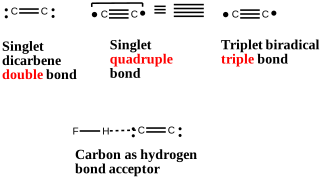
Dicarbon can be variously represented as above. The first form shows it as a bis-carbene, with an unbonded lone pair of electrons at each end of a carbon double bond. The middle form has emerged in the last ten years or so as a serious alternative to describing the singlet state structure.  It contains a so-called triple endobond and one further much weaker exo-bond (indicated separately by the symbol above the bond), referred to for simplicity as quadruple-bonded dicarbon. The third form would be a triplet biradical with triple bonded carbon. The species is known to be a singlet ground state with a significant excitation energy to the triplet. One can then ask the question: would either of these singlet state species be capable of being a hydrogen bond acceptor?

Time for calculations, at the CCSD(T)/Def2-TZVPP level using HF as the hydrogen bond donor (to enable advantage to be taken of the axial symmetry), data DOI: 10.14469/hpc/6554.

  1. The singlet quadruple bonded form emerges as 32 kcal/mol higher in total energy than the singlet dicarbene.
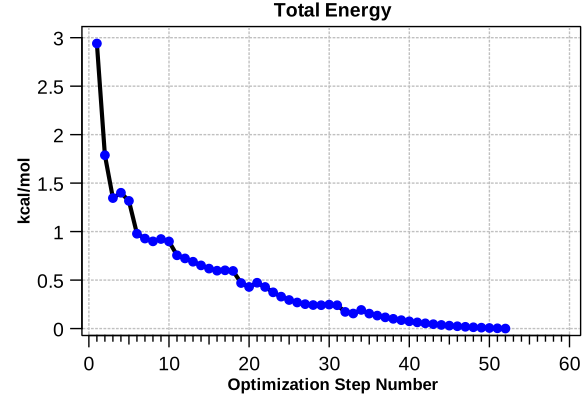
  2. The quadruple bonded form shows no sign of forming a hydrogen bond. The geometry optimisation curve is shown below followed by the final geometry (Å).


  3. The bis-carbene form  (calculated by a double electron excitation, orbitals 10 to 12 and 11 to 15) DOES form such a complex. The hydrogen bond length (2.04Å) is exactly that found from the crystal structures of the shortest such bonds.

  4. Two  of the normal vibrational modes of this species are shown below, being respectively the H…C and C=C stretches (153 and 1394 cm-1).   

So dicarbon CAN form a short hydrogen bond to a donor such as HF, but only in its excited singlet state, which is some 32 kcal/mol above the quadruple-bonded form. Perhaps because of that fourth bond, the hydrogen bonding ability of this species is entirely inhibited. We have gotten to the point I wanted to reach; an experimental prediction that if singlet dicarbon can ever be trapped in a very inert matrix at very low temperatures in the presence of a hydrogen bond donor, it will not form a hydrogen bond to that donor. That is going to be a difficult experiment, but at least the prediction is out there as a challenge!

Hydrogen bonds: carbon as an acceptor rather than as a donor?

Monday, December 23rd, 2019

A hydrogen bond donor is considered as an electronegative element carrying a hydrogen that is accepted by an atom carrying a lone pair of electrons, as in X:…H-Y where X: is the acceptor and H-Y the donor. Wikipedia asserts that carbon can act as a donor, as we saw in the post on the incredible chloride cage, where six Cl:…H-C interactions trapped the chloride ion inside the cage. This led me to ask how many examples are there of carbon as an acceptor rather than as a donor?

The basic query is constructed as above: in order to act as an acceptor, the carbon must bear a lone pair of electrons, of which a carbene is one example (Query, see DOI: 10.14469/hpc/6531). Thus we have QA=O,C,S and the central atom has only two connected atoms. When QC is any of C,N,O,F,Cl, we get the following result. The red circle corresponds to QC=O.

The shortest example of these is shown below, with a C:…HO distance of 1.91Å nominal but about 0.1Å shorter if corrected for the over-short H-O bond (Data DOI: 10.5517/ccvm80q)[1]

Click image to view 3D

The shortest C:…HN example is shown below with a distance of 2.07Å (DOI: 10.5517/ccdc.csd.cc21tzql)[2]

Click on image to view 3D model

Finally C:…HC, of which there are many in the region of 2.5Å, with the shortest example being 2.17Å[3]

Click on image to view 3D model

To round this off, N≡C:…HX, of which a nice example is (DOI: 10.5517/ccs7whc)[4]

Click on image for 3D model

From which we conclude that carbon as a hydrogen bond acceptor exhibits a diversity of forms, often with surprisingly short distances! I guess the wikipedia article needs updating.

References

  1. N.A. Giffin, M. Makramalla, A.D. Hendsbee, K.N. Robertson, C. Sherren, C.C. Pye, J.D. Masuda, and J.A.C. Clyburne, "Anhydrous TEMPO-H: reactions of a good hydrogen atom donor with low-valent carbon centres", Organic & Biomolecular Chemistry, vol. 9, pp. 3672, 2011. https://doi.org/10.1039/c0ob00999g
  2. J.M. Kieser, Z.J. Kinney, J.R. Gaffen, S. Evariste, A.M. Harrison, A.L. Rheingold, and J.D. Protasiewicz, "Three Ways Isolable Carbenes Can Modulate Emission of NH-Containing Fluorophores", Journal of the American Chemical Society, vol. 141, pp. 12055-12063, 2019. https://doi.org/10.1021/jacs.9b04864
  3. C. Jones, D.P. Mills, and R.P. Rose, "Oxidative addition of an imidazolium cation to an anionic gallium(I) N-heterocyclic carbene analogue: Synthesis and characterisation of novel gallium hydride complexes", Journal of Organometallic Chemistry, vol. 691, pp. 3060-3064, 2006. https://doi.org/10.1016/j.jorganchem.2006.03.018
  4. S. Mo, A. Krunic, B.D. Santarsiero, S.G. Franzblau, and J. Orjala, "Hapalindole-related alkaloids from the cultured cyanobacterium Fischerella ambigua", Phytochemistry, vol. 71, pp. 2116-2123, 2010. https://doi.org/10.1016/j.phytochem.2010.09.004

Molecules of the year – 2019: twisty tetracene.

Sunday, December 22nd, 2019

All of the molecules in this year’s C&EN list are fascinating in their very different ways. Here I take a look at the twisty tetracene (dodecaphenyltetracene) which is indeed very very twisty.[1]

Click on image to view 3D model

Unfortunately, the authors point that the twisty-ness does not lead to a stable helical configuration at room temperatures and so separate enantiomers cannot be isolated. But its still worth speculating what the optical rotation of such a species might be if measured. An ωB97XD/Def2-SVP/SCRF=dichloromethane calculation (DOI: 10.14469/hpc/6527) gives the following values:

[α]589 -11178°
[α]800 -2310°

Of course, mere helicity (however twisty) does not necessarily map to high optical rotation! This would be a nice molecule to 3D print and sit on a coffee table for people to admire!

References

  1. Y. Xiao, J.T. Mague, R.H. Schmehl, F.M. Haque, and R.A. Pascal, "Dodecaphenyltetracene", Angewandte Chemie International Edition, vol. 58, pp. 2831-2833, 2019. https://doi.org/10.1002/anie.201812418

Molecules of the year – 2019: Topological molecular nanocarbons – All-benzene catenane and trefoil knot.

Sunday, December 15th, 2019

Here is another molecule of the year, on a topic close to my heart, the catenane systems 1 and the trefoil knot 2[1] Such topology is closely inter-twinned with three dimensions (literally) and I always find that the flat pages of a journal are simply insufficient to do them justice. So I set about finding the 3D coordinates.

The most obvious place to start is the supporting information. I show below a little snippet of what I found, which is fairly typical of such data in the PDF-based SI documents accompanying most articles.

A bit of knowledgeable text-editing is needed to convert these into something that can be displayed as a rotatable 3D model. For this example, the three-column mode did not actually prove too problematic (but sometimes you have to work very hard to reduce it to the single column mode required for coordinates) and one has to remember to notice and remove the pagination text from the coordinates. Here I include the structure as a static 2D image which when clicked expands to a 3D model. Sadly, I know of no journal that offers up this relatively simple service as part of its “added-value” to the publication processes; it has been possible to do this since 1994![2],[3] I also found that the provided coordinates could be symmetrised to D2.

1a, which are here symmetrised to D2 symmetry.

Molecule 2 posed a new challenge. The coordinates when extracted from the SI had 480 atoms, double that of 1a. When displayed they overlayed each other. Clearly two sets of 240 atoms was the answer (the first probably in error) only the second set of which displays as a trefoil knot. The coordinates here can be symmetrised to D3, as appropriate for a trefoil knot.

2, which here are symmetrised to D3 symmetry

The above coordinates are computed using quantum mechanics at the B3LYP-D3/6-31G(d) level. What about the crystallographic coordinates? Here again a little expertise is needed to obtain these.

  1. Just after the article acknowledgements, the CCDC identifiers are given as 1860595-7 and 1908693. These values are resolved using www.ccdc.cam.ac.uk/structures/ which allows the download of a CIF file.
  2. These files reveal that a number of solvent and other molecules have been occluded into the structures, and for clarity it helps to edit all these out as well as disordered atoms with partial occupancy.

Crystallographic coordinates for 1a. DOI: 10.5517/ccdc.csd.cc20g36t

Crystallographic coordinates for 2. DOI: 10.5517/ccdc.csd.cc20g37v

Each of these experimental structures is also allocated a DOI of its own, which can be accessed from the captions above, if you want to view the un-edited coordinates. I have also made available my coordinates produced for the display here as a FAIR dataset (DOI: 10.14469/hpc/6470), together with metadata such as the InChI descriptors to improve its discoverability.

Having acquired and displayed both the calculated and the measured coordinates, I noticed one oddity. The calculated structure for 2 symmetrises to D3 symmetry, but the measured crystal structure only to C2 symmetry. This is due to a “kink” in the twists for the latter coordinates, a single region where the Ar-Ar single bond is twisted by 66°. This kink is absent in the calculated coordinates, where the largest dihedral angle at the Ar-Ar bond is only 37°. Is this effect real? What does it tell us about the conjugations and extended aromaticity of this system? Such twist localisation has been previously noticed in cyclacenes.[4] I think this observation highlights the need to have readily accessible 3D structures of such novel systems, if only to allow readers to spot such apparently anomalies.

So, with a little bit of knowledge and effort, one can indeed proceed from a published article to viewing aspects of the three-dimensional topology of the molecules discussed. I just feel it would be good if these aspects could be better integrated into the article itself, since I suspect that the additional effort and knowledge required to go further is probably not going to appeal to most readers.


Tidying up the PDF cartesian coordinates into a list of atomic number and a set of three coordinates per line of text is relatively simple. To coerce this format into a visualisation program takes more knowledge. Direct conversion to eg a standard molfile is not possible. I instead add a header to the coordinates to make it suitable for visualisation using the Gaussview program. Another good program for handling this is wxMacMolPlot which supports the veritable Xmol XYZ format, but again a correct header at the top of the file is needed for this program to recognise the file. As I noted, only a knowledgeable user would be able to do this, and the average reader is unlikely to go down this road.

References

  1. Y. Segawa, M. Kuwayama, Y. Hijikata, M. Fushimi, T. Nishihara, J. Pirillo, J. Shirasaki, N. Kubota, and K. Itami, "Topological molecular nanocarbons: All-benzene catenane and trefoil knot", Science, vol. 365, pp. 272-276, 2019. https://doi.org/10.1126/science.aav5021
  2. H.S. Rzepa, B.J. Whitaker, and M.J. Winter, "Chemical applications of the World-Wide-Web system", Journal of the Chemical Society, Chemical Communications, pp. 1907, 1994. https://doi.org/10.1039/c39940001907
  3. O. Casher, G.K. Chandramohan, M.J. Hargreaves, C. Leach, P. Murray-Rust, H.S. Rzepa, R. Sayle, and B.J. Whitaker, "Hyperactive molecules and the World-Wide-Web information system", Journal of the Chemical Society, Perkin Transactions 2, pp. 7, 1995. https://doi.org/10.1039/p29950000007
  4. S. Martín-Santamaría, and H.S. Rzepa, "Twist localisation in single, double and triple twisted Möbius cyclacenes†", Journal of the Chemical Society, Perkin Transactions 2, pp. 2378-2381, 2000. https://doi.org/10.1039/b005560n

Molecules of the year – 2019: the incredible chloride cage.

Friday, December 13th, 2019

Each year, C&E News runs a poll for their “Molecule of the year“. I occasionally comment with some aspect of one of the molecules that catches my eye (I have already written about cyclo[18]carbon, another in the list). Here, it is the Incredible chloride cage, a cryptand-like container with an attomolar (1017 M-1) affinity for a chloride anion.[1] The essence of the binding is six short CH…Cl and one slightly longer interactions to the same chloride (DOI: 10.5517/ccdc.csd.cc1ngqrl) and one further hydrogen bond to a water molecule; eight coordinated chloride anion!

Click image for 3D model

Here I thought I might explore how common the C-H…C motif is in crystal structures by showing some searches of the CSD. The CH—Cl distances reported in the article are around 2.7-2.9Å and I wanted to see how these compare with other structures. The searches were done with the constraint of data collection <90K, to minimise vibrational noise and intermolecular contacts only.

The first search is for all contacts to Cl, including covalent chlorine and also perchlorate anions, and you can see that they can extend down to about 2.4Å, although the commonest short contact is 2.5Å

This second search is for chloride anion only (by excluding any higher coordination at that atom), and the distribution does not really change.

This final search is for any chloride anion with at least THREE CH…Cl contacts to the same atom and now you are seeing ~2.7Å as the commonest short contact, which corresponds exactly with the molecule reported above.

So the apparently weak CH…Cl hydrogen bond, if there are seven of them, can accumulate to give attomolar binding affinities. Wow, imagine a drug with that sort of affinity!

References

  1. Y. Liu, W. Zhao, C. Chen, and A.H. Flood, "Chloride capture using a C–H hydrogen-bonding cage", Science, vol. 365, pp. 159-161, 2019. https://doi.org/10.1126/science.aaw5145

Sign inversions in optical rotation as a function of wavelength (ORD spectra)

Monday, December 9th, 2019

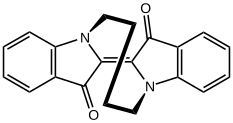
I have been discussing some historical aspects of the absolute configuration of molecules and how it was connected to their optical rotations. The nomenclature for certain types of molecules such as sugars and less commonly amino acids includes the notation (+) to indicate that the specific optical rotation of the molecule has a positive (rather than a negative) value. What is rarely mentioned is the implicit wavelength at which the rotation is measured. Historically polarimeters operated at the so-called sodium Fraunhofer D-line (588.995nm, hence the name [α]D) and only much more recently at the mercury e-line (546.073nm). The former was used for uncoloured organic molecules, since it was realised early on that colour and optical rotation did not mix well. Here I take a closer look at this aspect by constructing the hypothetical molecule shown below.

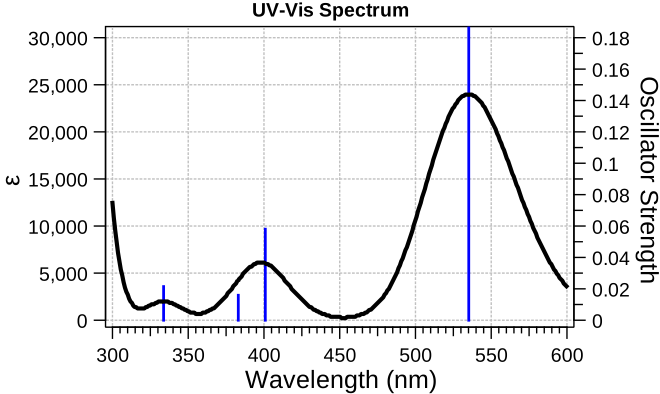
The rational behind this choice is that it is (a) based on indigo, which is deep blue in colour and (b) has a bridge of four methylene groups added to make it (axially) asymmetric. The calculated UV/Vis spectrum (ωB97XD/Def2-SVP/SCRF=water, FAIR DOI: 10.14469/hpc/6457) is shown below and you can see the very intense absorption at 535nm (corresponding to a visually blue colour).

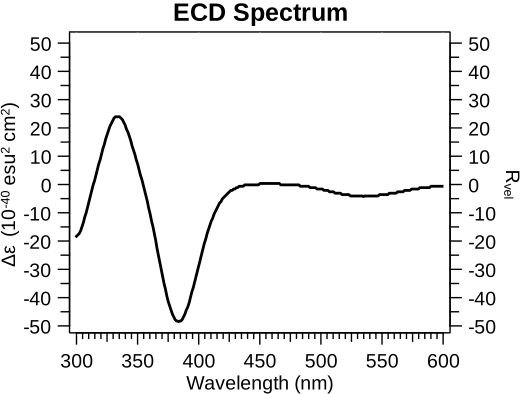
The electronic circular dichroism version of this spectrum (simply the difference in absorbance between left and right polarised light instead of absorbance by unpolarised light) is shown below, and this form of chiroptical spectroscopy in large measure replaced the use of specific optical rotations as a means of assigning absolute configurations from the 1960s onwards. Note that the large peak at 535nm is replaced by a much smaller one (the Cotton effect) in the ECD spectrum.

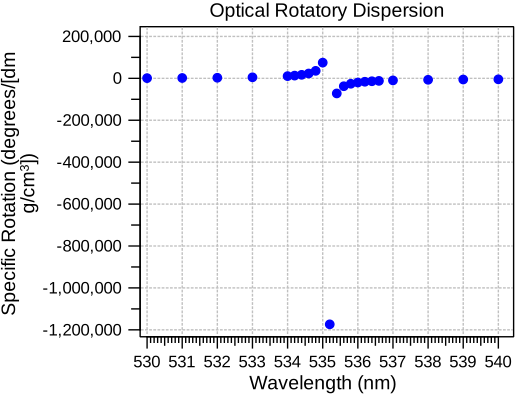
Now I show the original optical rotation as a function of wavelength in 10nm increments. At 589nm ([α]D) it is negative (-1364°), but what on earth is going on at a wavelength of ~535nm, which as you can see above is the value of the first electronic excitation?

An expansion in 0.2nm increments shows more clearly what is happening. The negative value suddently shoots down to -1,200,000°, frankly an absurd value, before discontinuously reversing sign to a positive value of 75,000°. At exactly the value of the electronic absorption it is zero. Most people seeing this happen would conclude that the mathematics derived from the solutions of the quantum mechanical equations is resulting in an unphysical discontinuity. It is in fact the result of the behaviour of the electric and magnetic dipole moment vectors, and it CAN be seen experimentally, albeit never in quite such extreme form![1] The sign of the optical rotation CAN invert, but in this very strange manner whereby if it starts as negative, it first becomes infinitely negative before passing through zero and becoming infinitely positive and finally settling down to a normal positive value. The reason by the way why the “blip” in the ORD spectrum above is +ve, but -ve in the expansion below is “digital resolution”, with the top trace having too coarse a resolution to capture the detail. Now the reason why optical rotation measurement at 589nm becomes clear; it avoids any inversions caused by this effect for the majority of less-coloured molecules. However, if you do have a molecule that were to absorb at 589nm itself, the sodium D-line is the last wavelength you would want to use to measure its optical rotation!

So the notation (+) or (-) used to describe the sign of the specific rotation of a chiral molecule might give the misleading impression that it is a characteristic of the molecule at all wavelengths used to measure it. The rotation can change sign an impressive number of times as the wavelength changes! Does anyone know of any coloured pharmaceutical drugs that are available as pure enantiomers?  It would be fun to repeat the above on such a molecule.

References

  1. M.S. Andrade, V.S. Silva, A.M. Lourenço, A.M. Lobo, and H.S. Rzepa, "Chiroptical Properties of Streptorubin B: The Synergy Between Theory and Experiment", Chirality, vol. 27, pp. 745-751, 2015. https://doi.org/10.1002/chir.22486

What effect do explicit solvent molecules have on calculated optical rotation: D-(“+”)-Glyceraldehyde.

Saturday, December 7th, 2019

In this series of posts on optical rotations, I firstly noted Kirkwood’s 1937 attempt to correlate the optical rotation of butan-2-ol with its absolute configuration. He had identified as essential knowing the relative orientation (the term conformation was not yet in common use) of the two methyl groups (the modern terms are gauche vs anti) and also that of the hydroxyl group, noting that anisotropy from this group could influence his result (he had assumed it was linear, or axially symmetric). I then looked at D-(+)-glyceraldehyde, noting that this species itself has a strongly negative rotation and that it is the hydrated diol that results in a positive rotation and hence the (+) designation. Here I take another look at this latter system to see what effect adding explicit water molecules to the unhydrated form of glyceraldehyde might have on its computed rotation, on the premise that strong hydrogen bonds can also contribute anisotropy to the system.

Firstly, here again are the computed results for glyceraldehyde on its own, albeit encased in a continuum solvent field for water (SCRF=water). At 303K and 589nm, the computed rotation is -193° compared to -147° inferred from the population of the aldehyde.[1]

Here are the new values (FAIR data DOI: 10.14469/hpc/6445) obtained by adding an explicit water molecule to the original conformations. This also introduces extra conformations, some of which are included below. This reduces the calculated value by ~25° to improve the agreement with measurement (-147°). The value at 436nm is -411 (calc), -380 (obs).

So a 25° correction is not entirely insignificant, but does not change the overall conclusion that the optical rotation of D-(+) glyceraldehyde is (-). How might the model be improved further?

  1. Adding more water molecules, in theory until a limit is reached where further anisotropy is not added to the model. But the major disadvantage is that each extra water molecule increases the conformational space to be explored. With say seven added water molecules, there are probably 100s of conformations that would have to be searched, now a major undertaking.
  2. Another interesting avenue to explore is the temperature dependence of the optical rotation. The experimental values are shown below. This is due to the change in Boltzmann populations as a function of temperature.

    At 343K, the original calculations without inclusion of a water molecule reduce the calculated rotation changes from -193 to -182.5, or about 10°. The observed value is a change of 39°. However, with the model including an extra water molecule, the value changes from -168.5 to -171°. So it might well be that reproduction of the temperature effects will require more water molecules added to the model.


References

  1. M. Fedoroňko, "Optical activity of D-glyceraldehyde in aqueous solutions", Collection of Czechoslovak Chemical Communications, vol. 49, pp. 1167-1172, 1984. https://doi.org/10.1135/cccc19841167

The Structure of Tetrodotoxin as a free base – with a better solvation model.

Tuesday, November 26th, 2019

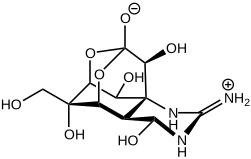
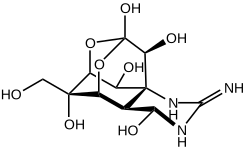
In the previous post, I discussed the structure of the free base form of tetrodotoxin, often represented as originally suggested by Woodward[1] below in an ionic form:

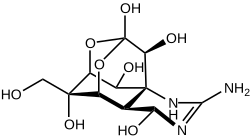
Quantum calculations suggested that this form was higher in energy than neutral forms devoid of the zwitterionic charge separation in a relatively non polar solvent such as chloroform. For this, a so-called continuum solvation model was used. But even chloroform is capable of forming rather strong O…H-C hydrogen bonds, and these specific isotropic interactions are not well modelled using a continuum solvent; you need to include the specific hydrogen bonds to do that. So here are two better models, the first including one or two chloroform molecules (in continuum chloroform) and the second three water molecules (in continuum water). The (FAIR) data for these results are available at DOI: 10.14469/hpc/6278 and you can view the 3D models by clicking on the images below.

System ΔΔG298, + 1CHCl3 ΔΔG298, + 2CHCl3 ΔΔG298, + 3H2O
Ionic form 0.0 0.0 0.0
non-ionic form -7.1 -4.9 +1.5

Adding additional solvent molecules in a “non-stochastic” manner is clearly an approximation. For example, three water molecules added to the neutral (non-zwitterionic) form could take up residency in many different ways, given the number of oxygen atoms present in tetrodotoxin. The energies reported above are for the lowest energy forms of the two that I located; I did not investigate more possibilities. However, the ionic form, with the water molecules directly hydrogen bonding with the ionic oxygen are more certain.

Ionic form: Click image to view 3D model

Neutral form: Click image to view 3D model

So we now see that Woodward’s original proposal for a charge-separated ionic form for the free base of tetrodotoxin may indeed be accurate, but only for polar solutions such as water. In rather less polar solutions such as chloroform it is probably not ionic. Clearly the stability also depends on the number of solvent molecules included in the model. The rather large chloroform molecule is less likely to accumulate around the ionic oxygen in numbers >>2 (and including more makes the calculation much slower), but already with just three water molecules the ionic form becomes the more stable. Also, e.g. two chloroforms or merely three waters are insufficient to form any sort of stabilizing “bridge” connecting the two ionic centres. So these results must be treated with a little caution.
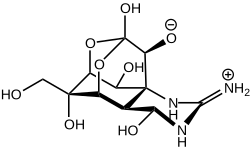
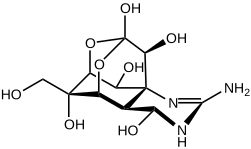
It is always rather risky to bet against Woodward’s chemical intuitions and insights (as for example Robinson found when debating the structure of strychnine[2] with him). He may well have been correct with the ionic structure of tetrodotoxin as well (at least in aqueous solutions)!

References

  1. R.B. Woodward, "The structure of tetrodotoxin", Pure and Applied Chemistry, vol. 9, pp. 49-74, 1964. https://doi.org/10.1351/pac196409010049
  2. R.B. Woodward, M.P. Cava, W.D. Ollis, A. Hunger, H.U. Daeniker, and K. Schenker, "THE TOTAL SYNTHESIS OF STRYCHNINE", Journal of the American Chemical Society, vol. 76, pp. 4749-4751, 1954. https://doi.org/10.1021/ja01647a088

The Structure of Tetrodotoxin as a free base.

Saturday, November 9th, 2019

The notorious neurotoxin Tetrodotoxin is often chemically represented as a zwitterion, shown below as 1. This idea seems to originate from a famous article written in 1964 by the legendary organic chemist, Robert Burns Woodward.[1] This structure has propagated on to Wikipedia and is found in many other sources.
With the elegance and the unique style that is typical Woodward, his article is a tour de force because of the way in which he deploys a large armoury of spectroscopic (X-ray crystal, NMR, IR) as well as physicochemical (pKa) tools to infer this structure; an approach that has been subsequently widely emulated. The article a well worth a read for the elegant logic that slowly builds to a climax on page 73 (sic!) of the article, when he unveils his final structure (XXXVIII, or 38). The lecture(s) from which the article is apparently derived must have been one hell of an occasion.

One technique not available in 1964 to Woodward was quantitative quantum calculation of the molecular free energies. This property is now routinely computable, but is still only rarely used for structural problems even today. Here I add this property to Woodward’s collection (FAIR data DOI: 10.14469/hpc/6278, method=ωB97XD/Def2-TZVPP, SCRF=chloroform).

My initial hypothesis was based on the observation of a rather large separation of the charges in the zwitterion. The surface below is the computed molecular electrostatic potential (value 0.1 au), which indeed shows large charge separation. The computed dipole moment is 18D.

MEP isosurface; orange = -ve,  yellow = +ve.

Charges by and large do not much like being separated, even though of course the actual separation is often misleadingly indicated by simple Lewis structures such as the above. So I started by moving one proton to produce 2 to see if that improved the free energy, by reducing charge separation. The dipole moment was indeed smaller at 14.6D (although the energy was not lower).

I then included three neutral forms (35) where the nominal charge separation is eliminated entirely.

Structure Diagram

ΔΔG

kcal/mol

Dipole moment
1 +10.4 18.0
2 +21.1 14.6
3 0.0 3.9
4 +1.8 6.0
5 +4.2 6.5

This computed model suggests 3 is the predominant species present (in chloroform solutions), although of course all the species are in a prototropic equilibrium. 3 also happens to have the smallest calculated dipole moment. Species 5 was also a front-runner in 1964[2] (as 1c in that article). Certainly the zwitterion 1 as suggested by Woodward, with its large degree of charge separation, is unlikely to feature and 5 is also less likely to be the dominant species.

The computed free energy for such molecules takes < 1 day of elapsed time to produce, and so I here argue that this should be a mandatory reported property for such structural problems.


The crystal structure is recorded[3] for the protonated species, as the HCl or HBr salt. These of course do not indicate where the protons are for the deprotonated neutral base. I only ever attended one lecture by Woodward. It lasted the typical two hours and was indeed hugely memorable in several regards. I also note the parsimony of stereochemical notation (just one dashed bond), presumably on the grounds that omitting such notation does not actually result in ambiguity. Disambiguation does depend of course on perceived “hidden line” removal.

References

  1. R.B. Woodward, "The structure of tetrodotoxin", Pure and Applied Chemistry, vol. 9, pp. 49-74, 1964. https://doi.org/10.1351/pac196409010049
  2. T. Goto, Y. Kishi, S. Takahashi, and Y. Hirata, "Further studies on the structure of tetrodotoxin", Tetrahedron Letters, vol. 5, pp. 779-786, 1964. https://doi.org/10.1016/0040-4039(64)83035-5
  3. A. Furusaki, Y. Tomiie, and I. Nitta, "The Crystal and Molecular Structure of Tetrodotoxin Hydrobromide", Bulletin of the Chemical Society of Japan, vol. 43, pp. 3332-3341, 1970. https://doi.org/10.1246/bcsj.43.3332