Posts Tagged ‘chemical knowledge’

WATOC2014 Conference report. Concepts for Organizing Chemical Knowledge

Monday, October 6th, 2014

I am attending a conference. Plenaries at such events can sometimes provide interesting pointers on things to come (and sometimes they simply point to things past). At WATOC2014 in Santiago Chile, the first plenary was by Paul Ayers with the impressive title “Concepts for organising chemical knowledge” which certainly sounds as if it is pointing forward!

WATOC stands for World Association of Theoretical and cOmputational Chemists (yes, the acronym does not expand) and so the organising concepts of course relate to quantum mechanics. Ayer’s talk however was more about chemical philosophy, and how we may continue to organise chemical rules according to sound quantum mechanical principles. He bases these principles on observables, rather than just mathematical formulations. The start point is electron distributions (I have noted elsewhere that these are indeed measurable observables, although the crystallography required to measure bond-based electron density is only rarely carried out) in the form of conceptual DFT. He strives to find examples that cannot be explained by e.g. the older ideas of molecular orbitals (as obtained from solution of a single reference determinant) and in particular to avoid the modern syndrome that as we improve our ability to achieve numerical accuracy, we tend to lose our insight into the phenomenon being studied. One example he gives is that of alkynes such as FC≡CF. If one removes a π-electron from the molecule, this should result in a decrease in the electron density distribution? Wrong. It actually increases the σ-electron density in the nodal planes of the lost π-electron. Ayer’s point is that Conceptual DFT provides a simple framework for explaining such observations, unlike MO theory.

But the most interesting moment came with discussion of Bader’s QTAIM methods (often used in this blog), as used by Ayers to provide a formulation of an electronic stress tensor approach to molecules. Expressed as Ehrenfest Forces and the corresponding Hessian, these provides a handle on the forces on bonds, or in simpler language, telling us “how bonds might move“. Think of it as the electronic equivalent of how nuclei move in molecules (aka vibrations). The reason my ears pricked up is that I have often discussed how organic chemists tend to conceptualize “how bonds might move” by using curly arrow pushing. This concept, dating back to  Robinson’s original example is often dismissed by theoreticians (and it has to be said by some organic chemists) as having little sound theoretical foundation; it is pure symbolism, and not to be over-interpreted. So perhaps electronic stress tensors based on Ehrenfest Forces might indeed tell us whether the hugely successful curly arrow pushing formalism (itself based on Lewis’ ideas of the shared electron bond formulated in 1916) might yet receive the theoretical makeover that it badly needs.

But before I end, one more example given by Ayers; keto-enol tautomerism in say propanone. Here a C-H bond breaks and an OH bond forms. The Ehrenfest Hessian indeed tells is that this is indeed “how the bonds want to move“. At the point the “audience” (in the form of a question) injected that sense of excitement that a conference occasionally provides. According to MO theory (!), the [1,3] sigmatropic shift of a hydrogen atom is a forbidden pericyclic process! How might the conceptual DFT electronic stress tensor approach tell us this? I have to confess I am not sure I understood Ayers’ answer at this point. Perhaps more work is needed before MOs are discarded entirely.

Oh, one more comment. Conference talks, presented in the form of slides which might linger on the projected screen for only a few seconds, rarely allow the audience to take much more than cursory notes. In particular,  without some more research,  I cannot here cite any of the references to Ayer’s recent work, since I did not have time to make a note of them.

Postscript: An article by Paul Geerlings, Paul Ayers et al on the topic of the  Woodward-Hoffmann rules has in fact been published[1].

Postscript2: I have computed the density difference isosurface for FCCF as noted above. It is shown as a thumbnail below (blue is decreased density on forming the cation, red is the increased density). Click on this to rotate.

Click for  3D

Click for 3D

References

  1. P. Geerlings, P.W. Ayers, A. Toro-Labbé, P.K. Chattaraj, and F. De Proft, "The Woodward–Hoffmann Rules Reinterpreted by Conceptual Density Functional Theory", Accounts of Chemical Research, vol. 45, pp. 683-695, 2012. https://doi.org/10.1021/ar200192t
Secrets of a university tutor. An exercise in mechanistic logic, prequel.

Saturday, October 27th, 2012

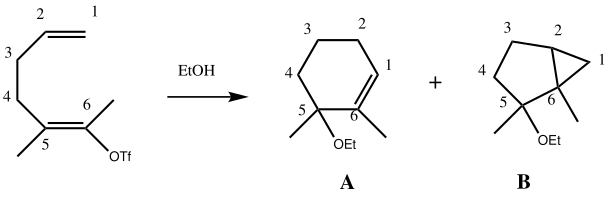
The reaction below plays a special role in my career. As a newly appointed researcher (way back now), I was asked to take tutorial groups for organic chemistry as part of my duties. I sat down to devise a suitable challenge for the group, and came upon the following reaction[1]. I wrote it down on page 2 of my tutorial book, which I still have. I continue to use this example in tutorials to this day, some 35 years later.

The challenge is to find a mechanistic explanation for the formation of products A and B. It is an exercise largely in perception and logic, with application of some chemical knowledge of carbocations and their (relative) stability.

  1. The first stage is to try to map the starting molecule to each of the products, and to do this the relevant atoms are numbered (it can be an arbitrary numbering scheme, but it should be consistent across all three molecules). One perceives that the numbers can be anchored to the two methyl groups present in all three molecules; they do not seem to play a role in the mechanism and we also take an informed guess that they do not migrate relative to each other.
  2. At this point, students normally ask what OTf is. It is in fact triflate, derived from triflic acid or trifluorosulfonic acid; CF3SO2OH. One can digress at this point into a discussion of acidity and pKa values. The essential conclusion that emerges is that it must be a very strong acid since the triflate anion is very highly stabilised by the electronegative groups present. In other words, the C-OTf bond must easily dissociate into triflate anion, leaving behind a carbocation.
  3. The next stage is to prepare a list of all the bond changes that must occur during the mechanism.
    1. The most obvious is to declare that C6-0 cleaving bond in the reactant,
    2. replacing it by formation of C5-O bonds in A and B.
    3. Reduce the bond order of C5-C6 to one.
    4. Increase the bond order of C1-C6 from zero to one to form A.
    5. Increase the bond order of C1-C6 from one to two to form A. Note that we do this in two explicit steps since (with only a few exceptions), bonds rarely change their order by more than one in any distinct mechanistic step.
    6. Reduce the bond order of C2-C1 to one.
    7. The above transforms were all overtly explicit; one sees in the diagram what needs to be done. The next two steps require perception of the implicit information in the diagram. It can take a while to spot that C1 has to lose a hydrogen atom to form A.
    8. And that the hydrogen so removed has to be added to C2 to form A.

    A list for B could be constructed along similar lines.

  4. Now it is time to choreograph these changes. One is helped in these decisions by the knowledge that one cannot, even temporarily, increase the valence of any carbon beyond four, but one can decrease it to three if it becomes a carbocation.
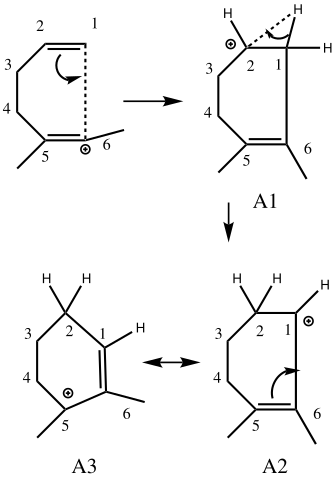
    • One will also spot that the list of eight items above can be grouped into pairs. Thus implementing items 4 and 6 as a pair requires just one arrow to be pushed to form intermediate A1. Item 6 defines the start point for the arrow and item 4 the end point.
    • A digression into carbocation stability is now required to explain the driving force for this arrow. The vinyl cation that is formed by loss of the triflate anion is very unstable. This is because the carbon contributes to the C-OTf bond via an sp2 hybrid orbital. The high s character of this hybrid means that the shared electron pair in this bond is more strongly attracted by the carbon nuclear charge, and hence are less easily lost to form a carbocation than would be the case with e.g. a C(sp3)-O bond. This boils down to stating that a vinyl carbocation is less stable than an alkyl carbocation, and hence that forming the latter from the former will be exothermic.
    • Another pair from the to-do list can be selected, 7 and 8. We must convert two implicit into two explicit hydrogen atoms to do this step. Again, a single electron arrow is required, and we get to A2. The driving force for this step is the conversion of a secondary isolated carbocation into a secondary allylic carbocation, which is resonance stabilised with an adjacent bond.
    • This leaves items 3 and 5, but we use them to illustrate the resonance stabilisation. A2 and A3 are resonance forms, and so we do not use the normal reaction arrow, but use a resonance arrow instead. This resonance form is in fact favoured because it converts a secondary carbocation into the more stable tertiary ion.

At this stage, the sequence can be completed with step 2. I will leave it to you, the reader, to work out the sequence of events required to form B rather than A if you wish.

Over the years, I have confronted groups of students with the reaction scheme shown at the top of this post, and asked them to work out the mechanism. Most look quite petrified, and certainly mystified, at this stage. Shown as at the top, it is indeed an intimidating mechanism. But by breaking it down into small and very simple steps, and then working out the order in which to implement them, most students come away from this exercise thinking it was actually rather easy! 

But I end this post with my real agenda! Is the above sequence actually supported by the “reality check” of quantum mechanics. Is the reaction likely to happen as I have dissected it above? Well, in all the years I have used it as an example of mechanism in organic chemistry, I had never subjected it to this test. In the next post, I will reveal what I discovered when I did so.

References

  1. T.C. Clarke, and R.G. Bergman, "Olefinic cyclization at a vinyl cation center. Inversion preference for intramolecular nucleophilic substitution by a double bond", Journal of the American Chemical Society, vol. 94, pp. 3627-3629, 1972. https://doi.org/10.1021/ja00765a062