Posts Tagged ‘Hawaii’

How many water molecules does it take to ionise HI?

Saturday, February 28th, 2015

Why is this post orphaned from the previous? In order to have the opportunity of noting that treating iodine computationally can be a little different from the procedures used for F, Cl and Br.

As the nuclear charge increases proceeding down the periodic table, the inner electron shells start becoming relativistic. Iodine is the first halogen where this might really start to matter.* There are two ways in which one can compute molecules with I; the first adopts the same procedure as for the earlier halogens, whereby all the electrons are described by basis functions (called an all-electron basis). This effect does not really include the effects of relativistic contractions on the inner (1s) shell unless special relativistic Hamiltonians are also used. The second replaces these inner cores with a pseudopotential, and this does incorporate some of the relativistic effects. To find out how much this might matter, I have included both types:

I
n I-H H-O
1 1.637/1.623 2.032/2.060[1]
2 1.657/1.641 1.863/1.889[2]
3 1.696/1.675 1.641/1.670[3]
4  2.316/2.304 1.014/1.015[4]

Non-relativistic calculation with an all-electron 6-311G(d,p) basis on I, 6-311++G(2d,2p) on O and H. Def2-TZVPPD basis, with pseudopotential just on I.

As with bromine, iodine shows a precipitous ionisation when the 4th water molecule is added. In the previous post, I compared this with pKa values, and a comment posted there reminded us that a pKa is measured for macroscopic bulk water and that all sorts of new effects due to free energy/entropy, continuum solvation and much else will take hold. But qualitatively at least, the ionisation of HI in a gas-phase cluster of water molecules seems to match the bulk properties. Relativistic effects do not appear to play a major role here.


*Whilst such effects can be prominent for I, arguably they actually start at Cl via an effect called spin-orbit (SO) coupling. This manifests in the calculation of chemical magnetic shieldings. If one uses standard GIAO NMR theories, one can calculate shieldings for e.g. C pretty accurately. But with Cl, the shieldings may be SO-perturbed by about 3ppm, with Br it’s about 12 ppm and with I it reaches 50 ppm![5]

References

  1. H.S. Rzepa, "H 3 I 1 O 1", 2015. https://doi.org/10.14469/ch/190924
  2. H.S. Rzepa, "H 5 I 1 O 2", 2015. https://doi.org/10.14469/ch/190921
  3. H.S. Rzepa, "H 7 I 1 O 3", 2015. https://doi.org/10.14469/ch/190925
  4. H.S. Rzepa, "H 9 I 1 O 4", 2015. https://doi.org/10.14469/ch/190927
  5. D.C. Braddock, and H.S. Rzepa, "Structural Reassignment of Obtusallenes V, VI, and VII by GIAO-Based Density Functional Prediction", Journal of Natural Products, vol. 71, pp. 728-730, 2008. https://doi.org/10.1021/np0705918
Using a polar bond to flip: on the knife-edge!

Sunday, August 10th, 2014

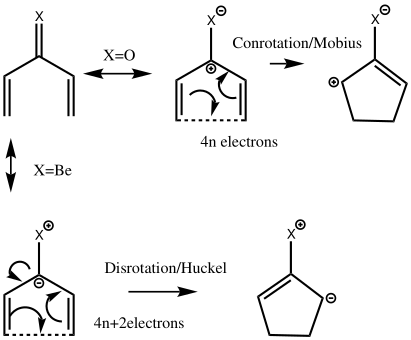
In my first post on the topic, I discussed how inverting the polarity of the C-X bond from X=O to X=Be (scheme below) could flip the stereochemical course of the electrocyclic pericyclic reaction of a divinyl system. This was followed up by exploring what happens at the half way stage, i.e. X=CH2, the answer being that one gets an antarafacial pathway as with X=O. Here I fill in another gap, X=BH to see if a metaphorical microscope can be used to view the actual region of the “flip” to a suprafacial mode.divinylketon This time, uniquely, it proved possible to locate TWO transition states for this process, one suprafacial[1] and one antarafacial[2], this latter being 10.5 kcal/mol lower in ΔG (ωB97XD/6-311G(d,p)/SCRF=dichloromethane). It is quite rare to be able to find BOTH stereochemical outcomes of a thermal pericyclic reaction.

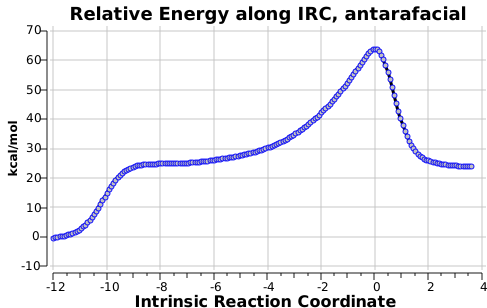
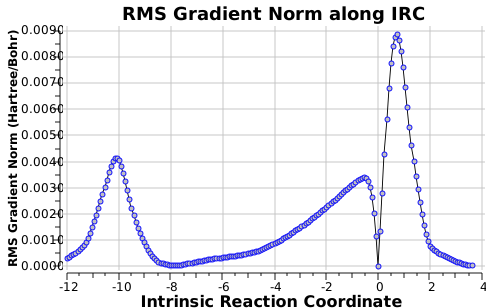
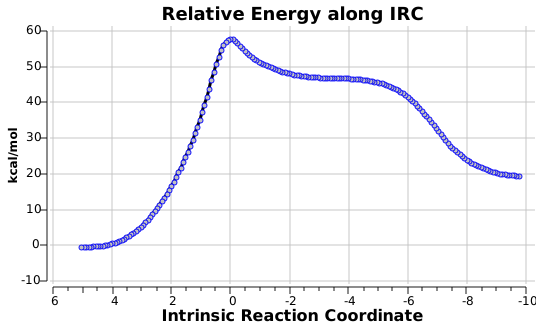
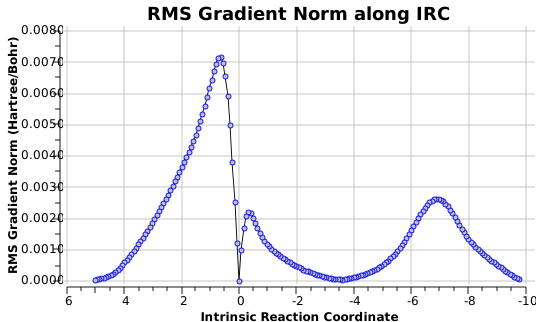
First, the antarafacial IRC (X=BH)[3]. There are several interesting features. Note at IRC = -8, the divinyl compound appears as a Hidden Intermediate (HI), having formed from a compound where the HB=C substituent has ring opened from a cyclobutene-like precursor (initial electrocyclic). If you watch the animation, you can see the antarafacial bond forming from the bottom face of the vinyl group on the left to the top face of the vinyl group in the HI on the right (antarafacial=conrotation). Because the entire process is concerted (no real intermediates participate), we have here an unusual pericyclic cascade where one electrocyclic reaction is immediately followed by another quite different one.BH-antaraa BH-antara BH-antaraG Now for the suprafacial IRC[4]. It is pretty similar to the previous path, but again if you inspect very carefully you will see that it is the TOP face of the vinyl group on the left forming the bond to the TOP face of the vinyl group on the right (suprafacial/disrotation). BH-supraaBH-supraBH-supraG You might ask if the molecules used here are realistic, i.e. could they form the basis of real reactions to be conducted in a laboratory? Well, the C=B-C fragment has 9 hits in the CCDC crystal database (none for C=B-H). One example is cited here.[5]. So, yes, possibly a realistic system, except the barriers do look too high. Perhaps suitable substituents might help? But even if this could not be carried out in a test-tube, it does teach one about pericyclic reactions and how one might manipulate them.


One such is the [1,6] sigmatropic shift in homotropylium cation involving migration of a Me2C+ group, where the “allowed” process in which the migrating group retains its configuration has a barrier of 17.7 kcal/mol and the “forbidden” route where the migrating group inverts its configuration with a barrier of 38.6 kcal/mol (thanks to Alex Genaev; I will strive to make the coordinates available via the repository shortly).

References

  1. H.S. Rzepa, "Gaussian Job Archive for C5H7B", 2014. https://doi.org/10.6084/m9.figshare.1133933
  2. H.S. Rzepa, "Gaussian Job Archive for C5H7B", 2014. https://doi.org/10.6084/m9.figshare.1133934
  3. H.S. Rzepa, "Gaussian Job Archive for C5H7B", 2014. https://doi.org/10.6084/m9.figshare.1133936
  4. H.S. Rzepa, "Gaussian Job Archive for C5H7B", 2014. https://doi.org/10.6084/m9.figshare.1134015
  5. M. Menzel, H.J. Winkler, T. Ablelom, D. Steiner, S. Fau, G. Frenking, W. Massa, and A. Berndt, "Diborylcarbenes as Reactive Intermediates in Double 1,2‐Rearrangements with Low Activation Enthalpies", Angewandte Chemie International Edition in English, vol. 34, pp. 1340-1343, 1995. https://doi.org/10.1002/anie.199513401

Using a polar bond to flip: a follow up project.

Wednesday, August 6th, 2014

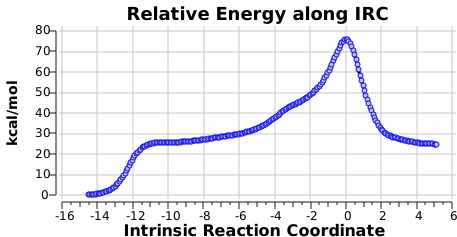
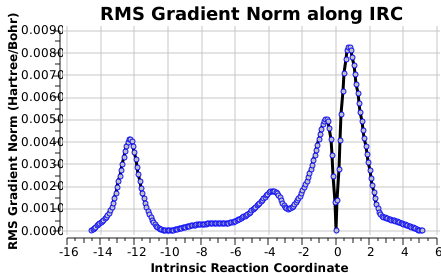
In my earlier post on the topic, I discussed how inverting the polarity of the C-X bond from X=O to X=Be could flip the stereochemical course of the electrocyclic pericyclic reaction of a divinyl system. An obvious question would be: what happens at the half way stage, ie X=CH2? Well, here is the answer. divinylketon CH2 The reaction occurs in two stages (ωB97XD/6-311G(d,p)/SCRF=dichloromethane)[1] but overall is a concerted, albeit asynchronous, reaction. The initial stage is a conrotatory ring closure (as observed with X=O but opposite to X=Be), and reaching what we will call a HI (hidden intermediate). This HI clearly has zwitterionic character, and manifests its presence most obviously at IRC = -3.5 below. CH2CH2G The polarity of this HI is revealed by the dipole moment (6D) and molecular electrostatic potentials, below. The dipole vector goes from -ve to +ve, and the MEP clearly reveals the polarity below. cd7 C2-MEP This ionic HI however is not stable, and in the second stage of the reaction collapses to the neutral bicyclic hydrocarbon shown below. Overall, it amounts to a  2+2 cycloaddition, but with a very unusual pathway in which one C-C bond is very much formed before the other (which is how the reaction escapes the clutches of the Woodward-Hoffmann forbidden-ness). cd8 Why is all this worth this follow-up? Well, one can now start to “design” the reaction. All three carbon atoms with formal charges can be stabilised or destabilised with appropriate substituents. It should not be too difficult to stabilise out the HI into just an I(intermediate), or indeed to remove it from the profile. Nice perhaps for a group of students, who can partition up the substituents amongst themselves and discover if they have the desired effect. And would any of this tinkering change the stereochemical outcome?

References

  1. H.S. Rzepa, "Gaussian Job Archive for C6H8", 2014. https://doi.org/10.6084/m9.figshare.1128205