Posts Tagged ‘HOMO/LUMO’

Why do flowers such as roses, peonies, dahlias, delphiniums (etc), exhibit so many shades of colours?

Monday, June 18th, 2018

It was about a year ago that I came across a profusion of colour in my local Park. Although colour in fact was the topic that sparked my interest in chemistry many years ago (the fantastic reds produced by diazocoupling reactions), I had never really tracked down the origin of colours in many flowers. It is of course a vast field. Here I take a look at just one class of molecule responsible for many flower colours, anthocyanidin, this being the sugar-free counterpart of the anthocyanins found in nature.
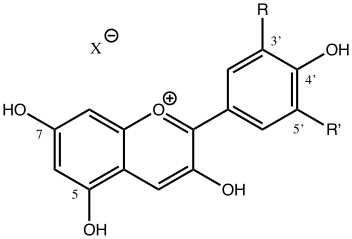
These vary widely in the substituent around the aromatic rings, but here I take a look at just three differing substitutions. Thus pelargonidin has just one OH on ring C (R1‘, R3‘=H, see crystal structure[1]), cyanidin has two (R5‘=H, see crystal structure[2]) and is found in red roses, dahlia, peonies etc. Finally delphinidin (no crystal structure available) has three OHs in that region and is found in yes, delphiniums but also grape skins etc. Below is a colour table that allows one to relate the electronic transitions in a molecule to the observed colour, which of course is due to removal (absorption) of wavelength of light leaving us to see all the remaining wavelengths.
colour table

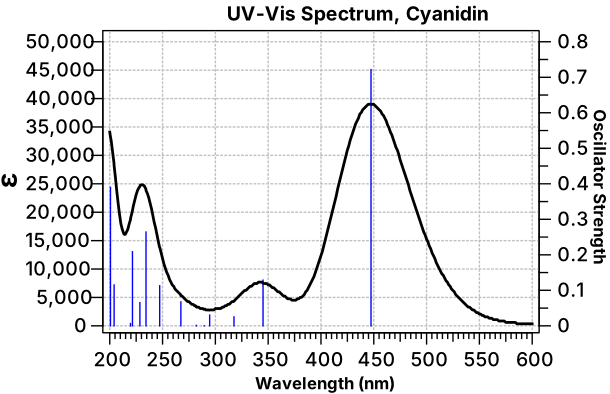
Next I show the computed UV/visible spectra of these three species (ωB97XD/6-311G(d,p)/SCRF=water). Click on any image to se a 3D model of the molecule.
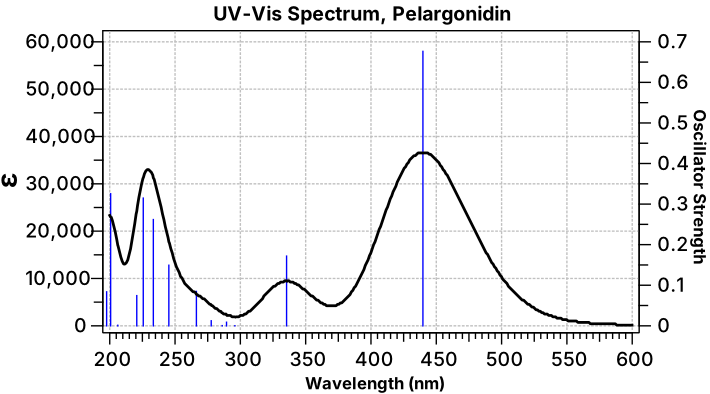
Note how in the visible region, all have a very simple (monochromatic) single electronic transition comprising mostly the HOMO→LUMO excitation.

Click to view 3D model of the HOMO

Click to view 3D model of the LUMO

Now, λmax can be predicted quite poorly using most DFT methods, but the trends should be better predicted. Thus the change induced by adding two hydroxy groups is ~7nm, which is in effect how the colour seen in a flower can be tuned to display different shades.

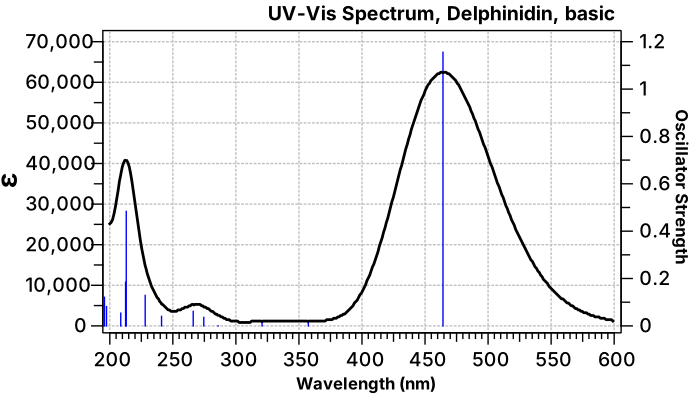
Next, pH. Using delphinidin, under basic conditions one can remove a proton from the cationic species to produce a neutral quinone. In fact, any one of five OH groups could have its proton removed and so it is of some interest to compare the relative energies of the five isomers so produced.

Position proton removed Relative ΔG298, kcal/mol
4′ 0.0
5 3.8
7 4.7
3′ 11.8
5′ 22.2

In fact, one species only would have the major Boltzmann population (4′) and so we need only look at its UV/Visible predicted spectrum. This is shifted 17nm towards the red, thus producing a blue colour in what remains after it is absorbed. The absorption (ε) also increases significantly. Indeed the very striking colour of blue delphiniums (one of my favourite flowers) must be produced by such pH control in the plant. Given the presence of delphinidin in many grape skins, the next time I drink a glass of red wine, I will see if it turns blue upon adding some NaOH!


FAIR data doi: 10.14469/hpc/4473

References

  1. N. Saito, and K. Ueno, "The Crystal and Molecular Structure of Pelargonindin Bromide Monohydrate", HETEROCYCLES, vol. 23, pp. 2709, 1985. https://doi.org/10.3987/r-1985-10-2709
  2. K. Ueno, and N. Saito, "Cyanidin bromide monohydrate (3,5,7,3',4'-pentahydroxyflavylium bromide monohydrate)", Acta Crystallographica Section B Structural Crystallography and Crystal Chemistry, vol. 33, pp. 114-116, 1977. https://doi.org/10.1107/s0567740877002702

Molecule orbitals as indicators of reactivity: bromoallene.

Thursday, September 1st, 2016

Bromoallene is a pretty simple molecule, with two non-equivalent double bonds. How might it react with an electrophile, say dimethyldioxirane (DMDO) to form an epoxide?[1] Here I explore the difference between two different and very simple approaches to predicting its reactivity. bromoallene

Both approaches rely on the properties of the reactant and use two types of molecule orbitals derived from its electronic wavefunction. The first of these is very well-known as the molecular orbital (MO), which has the property that it tends to delocalise over all the contributing atoms (the “molecule”). MOs are often used in this context; the highest energy occupied MO is thought of as being associated with the most nucleophilic (electron donating) regions of the molecule and so such a HOMO would be expected to predict the region of nucleophilic attack. The second is known as the natural bond orbital (NBO), which is evaluated in a manner that tends to localise it on bonds (the functional groups or reaction centres) and atom centres. What do these respective orbitals reveal for bromoallene? 

The MOs
HOMO, -0.3380 HOMO-1, -0.3692 au
Click for  3D

Click for 3D

Click for  3D

Click for 3D

The NBOs
HONBO, -0.3769 HONBO-2, -0.3898
Click for  3D

Click for 3D

Click for  3D

Click for 3D

The table above shows the energies (in Hartrees) of the four relevant orbitals. The less negative (less stable) the orbital, the more nucleophilic it is. The (heavily) delocalized HOMO is located on the C=C bond bond carrying the C-Br bond, Δ1,2 alkene, but it also has a large component on the Br. The more stable HOMO-1 is located on the C=C bond located away from the Br, the Δ2,3 alkene and also with a (different type of) component on the Br.

In contrast, the HONBO is located on the Δ2,3 alkene and it is the HONBO-2 that is on the Δ1,2 alkene. Both these orbitals have very little “leakage” onto other atoms, they are almost completely localised.

Well, now we have a problem since these two analyses lead to diametrically opposing predictions! So what does experiment say? A recent article[1] addresses this issue by isolating the initially formed epoxide from reaction with DMDO and characterising it using crystallography. But here comes the catch; such isolation only proved possible if the allene was also substituted with large sterically bulky groups such as t-butyl or adamantyl. And the isolated product was the Δ1,2 epoxide. So does that mean that the MO method was correct and the NBO method wrong? Well, not necessarily. Those large groups play an additional role via steric effects. To factor in such effects one has to look at the transition state model for the reaction rather than depending purely on the reactant properties. And the steric effects in this case appear to win out over the electronic ones.[1]

The Klopman[2]-Salem[3] equation (shown in very simplified, and original, form below for just the covalent term) casts some light on what is going on. This term is a double summation over occupied/unoccupied (donor-acceptor) orbital interactions, involving the coefficients of the orbitals (the overlap integrals in effect) in the numerator and the energy difference between the occupied/unoccupied orbital pair as denominator.

KS1

Performing such a double summation is rarely attempted; instead the equation is reduced to just one single term involving the donor of highest energy and the acceptor of lowest energy, ensuring the energy difference is a minimum and hence the term itself is (potentially) the largest in the summation. There is still the issue of the orbital coefficients, and here we get to the crux of the difference between the use of MOs and NBOs. You can see by inspection that the two π-MOs for bromoallene have different coefficients on the two atoms of interest, the two carbons of the double bond. One really has to evaluate the size of this term in the summation by using quantitative values for the respective coefficients and to very probably include the further terms in the summation for any other orbitals which also have significantly non-zero coefficients on these two atoms. But with the NBOs, the localisation procedure used to derive them has reduced the coefficients to just the carbon atoms and effectively no other atoms; all the other terms in the double summation in effect do drop out entirely. So with NBOs, the only number that matters is the energy difference between the occupied/empty orbitals (the denominator). But since the acceptor (the electrophile, DMDO in this case) is the same for both regiochemistries, things reduce even further to just comparing the donor energies for the two alternatives (Table above). The higher/less stable of these will have the greater contribution in the Klopman-Salem equation.

This little molecule teaches the important lesson that electronic and steric effects both play a role in directing reactions, and in this system they may well oppose each other. Simple interpretations based on reactant orbitals may give only a partial and even potentially misleading answer.

References

  1. D. Christopher Braddock, A. Mahtey, H.S. Rzepa, and A.J.P. White, "Stable bromoallene oxides", Chemical Communications, vol. 52, pp. 11219-11222, 2016. https://doi.org/10.1039/c6cc06395k
  2. G. Klopman, "Chemical reactivity and the concept of charge- and frontier-controlled reactions", Journal of the American Chemical Society, vol. 90, pp. 223-234, 1968. https://doi.org/10.1021/ja01004a002
  3. L. Salem, "Intermolecular orbital theory of the interaction between conjugated systems. I. General theory", Journal of the American Chemical Society, vol. 90, pp. 543-552, 1968. https://doi.org/10.1021/ja01005a001