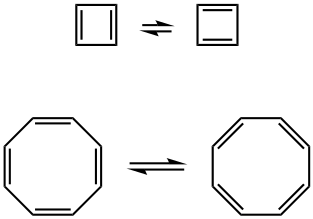
Cyclobutadiene is one of those small iconic molecules, the transience and instability of which was explained theoretically long before it was actually detected in 1965.[1] Given that instability, I was intrigued as to how many crystal structures might have been reported for this ring system, along with the rather more stable congener cyclo-octatetraene. Here is what I found.
The Conquest search query shown (with no disorder, no errors and R < 0.1 also specified). 
There are 23 instances (February 2017 database; see DOI: 10.14469/hpc/2231 for search query) of the supposedly unstable cyclobutadiene motif!
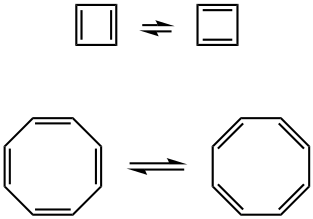
The three clusters deserve explanations. The orange cluster reveals a long C-C bond (rather longer than normal C-C bonds), accompanied by short C=C bonds, as indicated by the valence bond form shown below. Take particular note that the arrow connecting the two forms is NOT a resonance arrow but an equilibrium arrow. The “bond shifting” is not fast but slow, allowing long and short bonds to be measured in a crystal structure.
The rather larger blue cluster exhibits much more equal bonds. These arise from the presence of “push-pull” substituents on the ring which serve to delocalise the unfavourable cyclobutadiene ring and hence decrease the unfavourable anti-aromaticity. A typical example is shown below (EACBUT):

The small red cluster shows a long C=C bond and a short C-C bond! I have commented previously on apparently abnormally long C=C bonds, which in fact all turned out to be errors, and I suspect the same is true here. The bond orders in the indexing in the CSD data base have probably been mis-assigned, as per below for GANBII;

The Conquest search query is shown (with no disorder, no errors and R < 0.1 specified) for the 8-ring, which further specifies a torsion angle about a C-C bond to determine how planar the ring might be.

The “normal” cluster in the top left exhibits long C-C bonds and short C=C bonds. The colour code indicates how planar the ring is (red-blue spectrum = twisted ⇒ planar). The majority of examples are twisted about the C-C bond(s), but there are a few interesting examples that are not, as shown by the blue dots. There are only a few “bond-equalised” examples in the centre; perhaps “push-pull” induced equalisation is more difficult or perhaps few examples have been made?

The members of the red cluster in the bottom right all reveal short “C-C” bonds and long “C=C” bonds. Intriguingly they all also have low values of the torsion about one C-C bond (although not always about all four C-C bonds). A typical example (BAQVUK, DOI: 10.5517/CC4GWWB ) is shown below. These all need careful inspection and possibly reversal of the C-C and C=C indexing.


It was interesting to discover how many crystalline examples of this archetypal “unstable” cyclobutadiene motif have been made, and the means by which some of them at least have been stabilized. In the more abundant cyclo-octatetraene system, I learnt that one has to be cautious about blindly accepting the bond order designations in the database. Perhaps we might learn here that some of these have indeed been re-assigned in the next release of the database.
References
- L. Watts, J.D. Fitzpatrick, and R. Pettit, "Cyclobutadiene", Journal of the American Chemical Society, vol. 87, pp. 3253-3254, 1965. https://doi.org/10.1021/ja01092a049