Posts Tagged ‘cyclobutadiene’

Stable “unstable” molecules: a crystallographic survey of cyclobutadienes and cyclo-octatetraenes.

Sunday, March 5th, 2017

Cyclobutadiene is one of those small iconic molecules, the transience and instability of which was explained theoretically long before it was actually detected in 1965.[1] Given that instability, I was intrigued as to how many crystal structures might have been reported for this ring system, along with the rather more stable congener cyclo-octatetraene. Here is what I found.

The Conquest search query shown (with no disorder, no errors and R < 0.1 also specified). 

There are 23 instances (February 2017 database; see DOI: 10.14469/hpc/2231 for search query) of the supposedly unstable cyclobutadiene motif!

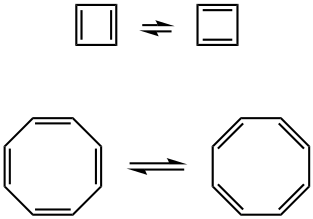
The three clusters deserve explanations. The orange cluster reveals a long C-C bond (rather longer than normal C-C bonds), accompanied by short C=C bonds, as indicated by the valence bond form shown below. Take particular note that the arrow connecting the two forms is NOT a resonance arrow but an equilibrium arrow. The “bond shifting” is not fast but slow, allowing long and short bonds to be measured in a crystal structure.

The rather larger blue cluster exhibits much more equal bonds. These arise from the presence of “push-pull” substituents on the ring which serve to delocalise the unfavourable cyclobutadiene ring and hence decrease the unfavourable anti-aromaticity. A typical example is shown below (EACBUT):

The small red cluster shows a long C=C bond and a short C-C bond! I have commented previously on apparently abnormally long C=C bonds, which in fact all turned out to be errors, and I suspect the same is true here. The bond orders in the indexing in the CSD data base have probably been mis-assigned, as per below for GANBII;

The Conquest search query is shown (with no disorder, no errors and R < 0.1 specified) for the 8-ring, which further specifies a torsion angle about a C-C bond to determine how planar the ring might be.

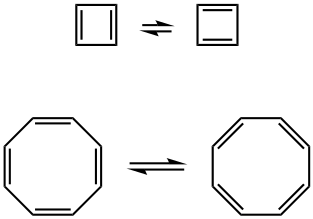
The “normal” cluster in the top left exhibits long C-C bonds and short C=C bonds. The colour code indicates how planar the ring is (red-blue spectrum = twisted ⇒ planar). The majority of examples are twisted about the C-C bond(s), but there are a few interesting examples that are not, as shown by the blue dots. There are only a few “bond-equalised” examples in the centre; perhaps “push-pull” induced equalisation is more difficult or perhaps few examples have been made?

The members of the red cluster in the bottom right all reveal short “C-C” bonds and long “C=C” bonds. Intriguingly they all also have low values of the torsion about one C-C bond (although not always about all four C-C bonds). A typical example (BAQVUK, DOI: 10.5517/CC4GWWB ) is shown below. These all need careful inspection and possibly reversal of the C-C and C=C indexing.

It was interesting to discover how many crystalline examples of this archetypal “unstable” cyclobutadiene motif have been made, and the means by which some of them at least have been stabilized. In the more abundant cyclo-octatetraene system, I learnt that one has to be cautious about blindly accepting the bond order designations in the database. Perhaps we might learn here that some of these have indeed been re-assigned in the next release of the database.

References

  1. L. Watts, J.D. Fitzpatrick, and R. Pettit, "Cyclobutadiene", Journal of the American Chemical Society, vol. 87, pp. 3253-3254, 1965. https://doi.org/10.1021/ja01092a049

Stable "unstable" molecules: a crystallographic survey of cyclobutadienes and cyclo-octatetraenes.

Sunday, March 5th, 2017

Cyclobutadiene is one of those small iconic molecules, the transience and instability of which was explained theoretically long before it was actually detected in 1965.[1] Given that instability, I was intrigued as to how many crystal structures might have been reported for this ring system, along with the rather more stable congener cyclo-octatetraene. Here is what I found.

The Conquest search query shown (with no disorder, no errors and R < 0.1 also specified). 

There are 23 instances (February 2017 database; see DOI: 10.14469/hpc/2231 for search query) of the supposedly unstable cyclobutadiene motif!

The three clusters deserve explanations. The orange cluster reveals a long C-C bond (rather longer than normal C-C bonds), accompanied by short C=C bonds, as indicated by the valence bond form shown below. Take particular note that the arrow connecting the two forms is NOT a resonance arrow but an equilibrium arrow. The “bond shifting” is not fast but slow, allowing long and short bonds to be measured in a crystal structure.

The rather larger blue cluster exhibits much more equal bonds. These arise from the presence of “push-pull” substituents on the ring which serve to delocalise the unfavourable cyclobutadiene ring and hence decrease the unfavourable anti-aromaticity. A typical example is shown below (EACBUT):

The small red cluster shows a long C=C bond and a short C-C bond! I have commented previously on apparently abnormally long C=C bonds, which in fact all turned out to be errors, and I suspect the same is true here. The bond orders in the indexing in the CSD data base have probably been mis-assigned, as per below for GANBII;

The Conquest search query is shown (with no disorder, no errors and R < 0.1 specified) for the 8-ring, which further specifies a torsion angle about a C-C bond to determine how planar the ring might be.

The “normal” cluster in the top left exhibits long C-C bonds and short C=C bonds. The colour code indicates how planar the ring is (red-blue spectrum = twisted ⇒ planar). The majority of examples are twisted about the C-C bond(s), but there are a few interesting examples that are not, as shown by the blue dots. There are only a few “bond-equalised” examples in the centre; perhaps “push-pull” induced equalisation is more difficult or perhaps few examples have been made?

The members of the red cluster in the bottom right all reveal short “C-C” bonds and long “C=C” bonds. Intriguingly they all also have low values of the torsion about one C-C bond (although not always about all four C-C bonds). A typical example (BAQVUK, DOI: 10.5517/CC4GWWB ) is shown below. These all need careful inspection and possibly reversal of the C-C and C=C indexing.

It was interesting to discover how many crystalline examples of this archetypal “unstable” cyclobutadiene motif have been made, and the means by which some of them at least have been stabilized. In the more abundant cyclo-octatetraene system, I learnt that one has to be cautious about blindly accepting the bond order designations in the database. Perhaps we might learn here that some of these have indeed been re-assigned in the next release of the database.

References

  1. L. Watts, J.D. Fitzpatrick, and R. Pettit, "Cyclobutadiene", Journal of the American Chemical Society, vol. 87, pp. 3253-3254, 1965. https://doi.org/10.1021/ja01092a049

To be cyclobutadiene, or not to be, that is the question? You decide.

Thursday, March 21st, 2013

A quartet of articles has recently appeared on the topic of cyclobutadiene.[1],[2],[3],[4]. You will find a great deal discussed there, but I can boil it down to this essence. Do the following coordinates (obtained from a (disordered) previously published[5] x-ray refinement) correspond to a van der Waals complex of 1,3-dimethyl cyclobutadiene and carbon dioxide, or do they instead represent a covalent interaction between these two components resulting in a compound with the chemical name 2-oxabicyclo[2.2.0]hex-5-en-3-one (i.e. not a cyclobutadiene)?

Click for  3D

Click for 3D. The unconnected atoms are the result of disordered partial occupancy.

The two bonds to concentrate on are shown in gold; a O…C pair with a distance of 1.61Å as obtained from the x-ray refinement and a C…C pair with a distance of 1.5Å (and if you want to go further, the O=C=O bond angle). I list below values obtained from the wonderful Webelements site. Using these values, this makes a van der Waals O…C contact 3.22Å and a C…C contact 3.40Å and covalent values of respectively 1.38Å and 1.5Å.

Element Covalent radius, Å van der Waals radius
C 0.75 1.70
O 0.63 1.52

According to chemistry convention, we classify the interaction between a pair of atoms according to which category best fits the observed distance. So this should allow you to decide if the molecule is a van der Waals complex of 1,3-dimethyl cyclobutadiene and carbon dioxide or the covalent system 2-oxabicyclo[2.2.0]hex-5-en-3-one. 

Oh, if the observed O…C pair with a distance of 1.61Å does not seem to perfectly fit either category above, one of the quartet of articles above[1] offers the explanation of an unusual π-anomeric effect lengthening the C…O bond in 2-oxabicyclo[2.2.0]hex-5-en-3-one slightly beyond the standard covalent distance. Of course, if the system were to be a van der Waals complex, that explanation cannot apply.

References

  1. H.S. Rzepa, "A Computational Evaluation of the Evidence for the Synthesis of 1,3‐Dimethylcyclobutadiene in the Solid State and Aqueous Solution", Chemistry – A European Journal, vol. 19, pp. 4932-4937, 2013. https://doi.org/10.1002/chem.201102942
  2. M. Shatruk, and I.V. Alabugin, "Reinvestigation of “Single‐Crystal X‐ray Structure of 1,3‐dimethylcyclobutadiene”", Chemistry – A European Journal, vol. 19, pp. 4942-4945, 2013. https://doi.org/10.1002/chem.201103017
  3. Y. Legrand, D. Dumitrescu, A. Gilles, E. Petit, A. van der Lee, and M. Barboiu, "A Constrained Disorder Refinement: “Reinvestigation of “Single‐Crystal X‐ray Structure of 1,3‐Dimethylcyclobutadiene” by M. Shatruk and I. V. Alabugin”", Chemistry – A European Journal, vol. 19, pp. 4946-4950, 2013. https://doi.org/10.1002/chem.201203234
  4. Y. Legrand, D. Dumitrescu, A. Gilles, E. Petit, A. van der Lee, and M. Barboiu, "Reply to A Computational Evaluation of the Evidence for the Synthesis of 1,3‐Dimethylcyclobutadiene in Solid State and Aqueous Solution—Beyond the Experimental Reality", Chemistry – A European Journal, vol. 19, pp. 4938-4941, 2013. https://doi.org/10.1002/chem.201203235
  5. Y. Legrand, A. van der Lee, and M. Barboiu, "Single-Crystal X-ray Structure of 1,3-Dimethylcyclobutadiene by Confinement in a Crystalline Matrix", Science, vol. 329, pp. 299-302, 2010. https://doi.org/10.1126/science.1188002

Some fun with no-go areas of chemistry: cyclobutadiene.

Sunday, September 18th, 2011

Organic chemistry has some no-go areas, where few molecules dare venture. One of them is described by a concept known as anti-aromaticity. Whereas aromatic molecules are favoured species, their anti-equivalent is avoided. I previously illustrated this (Hückel rule) with cyclopropenium anion. Now I take a look at cyclobutadiene, for which the π-system is said to be iso-electronic (where two electrons in a double bond have replaced the carbanion lone pair).

Geometric distortions available to square cyclobutadiene

The scheme above starts with a square geometry for the cyclobutadiene. This is strongly anti-aromatic, and the molecule will strive to reduce this by indulging in a geometrical distortion. The conventional distortive mechanism is into an R or rectangular geometry, where two of the C-C bonds get shorter and two longer. The trouble with this mode is that is does not actually prevent the π-π overlaps which made it anti-aromatic in the first place, it just reduces the effect. Thus rectangular cyclobutadiene is still a very very reactive and unstable molecule. So here I suggest another distortion mode, shown above as the ZW, or zwitterionic form. This converts the species into a combination of an allylic carbocation and a secondary carbanion. The latter would be expected to pyramidalize, thus reducing those pesky π-π overlaps. I am unaware of such a ZW-mode ever having been previously explored.

Any student of organic chemistry will be very familiar with how to go about stabilising either a carbocation or a carbanion. We need to do this, since another guiding tenet of organic chemistry is to try to avoid charge separation whenever possible (another almost no-go area). I am going to pull a surprise by evaluating the following model for this post.

Stabilization model for cyclobutadiene

  1. Firstly, two methyl groups have been placed at the carbocationic centres to stabilise the positive charge. Tertiary carbocations are of course well known to be more stable than secondary ones (I should state that methoxy groups in the same position would stabilise even more, but that is for another post).
  2. The carbanion could itself be stabilised with an electron withdrawing substituent (say CN) but here I am going to stabilise it with hydrogen bonding to a guanidinium cation. This has just the right shape to form two unusual hydrogen bonds from the N-H to either of the carbanionic lone pairs we might wish to promote (dashed lines above).
  3. Finally, we are going to simulate this in water as a solvent, in order to stabilize the zwitterion. One zwitterion that DOES form is of course that from the amino acid glycine, but it only forms when placed in water (and life as we know it would not be possible if amino acids did not do this).
The results are thus. The R distorted form does come out the most stable (ωB97XD/6-311G(d,p)/SCRF=water). An unsymmetrical ZW form (forming just one C…H-N hydrogen bond) is 11.2 kcal/mol higher in free energy, whilst a symmetrical form (as shown above, forming two C…H-N hydrogen bonds) is only 8.5 kcal/mol higher in free energy. It turns out that the R form of the 1,3-dimethylcyclobutadiene is itself stabilised by hydrogen bonding to the guanidinium cation. These hydrogen bonds form to the centre of the shortened C=C alkene bonds rather than being directed at an atom (π-facial bonding). In contrast, the ZW forms sustain hydrogen bonds directly to the carbons. To explore these unusual features, click on any of the three thumbnails below.
R form ZW-u form ZW-s form

CBD R form. Click for 3D

Zwitterionic form. Click for 3D.

Zwitterionic symmetric form. Click for 3D

Where have the electrons gone in e.g. the symmetric ZW system? An ELF analysis tells us. The two ELF basins labelled with green arrows contain 1.2 electrons each. The basins corresponding to the 4-ring are labelled with magenta arrows. Put simply, 2.4 electrons have fled the ring, and associated themselves instead with the N-H…C hydrogen bonds. By removing ~2 electrons from an anti-aromatic ring, one converts it into an aromatic one (4n => 4n+2)!

ELF analysis. Click for 3D

We have learned that the highly reactive alkene bonds in R-distorted cyclobutadiene can be reasonable hydrogen bond donors, but that an alternative distortion into a zwitterionic form can be stabilised by forming an even stronger hydrogen bond to the forming carbanion. A symmetric form of this latter is unusual, since it still sustains four equal C-C bond lengths, but anti-aromaticity is now avoided by pyramidalising two of the carbons and hydrogen bonding to them both. As I noted earlier, these isomers of cyclobutadiene have not hitherto been proposed, and they do seem good candidates for experimental investigations.

Reactions in supramolecular cavities – trapping a cyclobutadiene: ! or ?

Sunday, August 8th, 2010

Cavities promote reactions, and they can also trap the products of reactions. Such (supramolecular) chemistry is used to provide models for how enzymes work, but it also allows un-natural reactions to be undertaken. A famous example is the preparation of P4 (see blog post here), an otherwise highly reactive species which, when trapped in the cavity is now sufficiently protected from the ravages of oxygen for its X-ray structure to be determined. A colleague recently alerted me to a just-published article by Legrand, van der Lee and Barboiu (DOI: 10.1126/science.1188002) who report the use of cavities to trap and stabilize the notoriously (self)reactive 1,3-dimethylcyclobutadiene (3/4 in the scheme below). Again sequestration by the host allowed an x-ray determination of  the captured species!

Scheme for production of 1,3-dimethylcyclobutadiene 3 and CO2.

The colleague tells me he has himself already penned an article on the topic and submitted this to a conventional journal. However, their rules decree that whilst it is being refereed, I could not discuss the article here, or indeed even name its author. Assuming his article is published, I will indeed reveal his identity, so that he gets the credit he deserves! Meanwhile, I will concentrate in this blog purely on two other aspects of this reaction which caught my own eye after he brought the article to my attention.

The reaction involves imobilising a precursor 1 in a crystalline calixarene network as shown above, and then in situ photolysis to form the Dewar lactone 2. Further photolysis then results in extrusion of carbon dioxide and the formation of 1,3-dimethyl cyclobutadiene 3 and CO2, both still trapped in the host crystals. Thus imobilised, here they both apparently remain (at 175K) for long enough for their X-ray structure to be determined. What attracted me to this chemistry was the potential of this reaction as a nice example of a Diels Alder reaction occuring in a cavity. The first example of such catalysis was reported by Endo, Koike, Sawaki, Hayashida, Masuda, and Aoyama (DOI: 10.1021/ja964198s) and I have used this in my lectures for many years. This latter example however illustrates the promotion of a cycloaddition, which inside a cavity is accelerated by a factor of ~105, rather than of the reverse cycloelimination. I explain this to students by invoking entropy. Normally, when two molecules react together, there is an entropic penalty, which can add 8 or more kcal/mol to the free energy of activation of a bimolecular reaction in the absence of the cavity.

Structure of entrapped 1,3-dimethylcyclobutadiene, obtained from the CIF file provided via DOI: 10.1126/science.1188002

By a strange coincidence, my name is also on a recently published article (DOI: 10.1021/ol9024259) with other colleagues on the use of (Lewis) acid catalysts to accelerate a type of reaction known as the Prins. This involves the addition of an alkene to a carbonyl group. Now as it happens, the reaction in the scheme above showing 42 happens to combine these features; it is both a Diels-Alder cycloaddition and also involves an alkene adding to a carbonyl compound! It is therefore noteworthy that the claimed reaction 123 + CO2 is done in the presence of a strong acid catalyst, the guanidinium cation 5, which is itself part of the structure of the calixarene-based host. It is represented as X in the scheme above, and can also be identified in the above 3D model via the light blue atoms.

There are however crucial differences between these two earlier examples I quoted and the reaction of 23; the latter is in fact a cycloelimination and not a (cyclo)addition. In other words, according to literature precedent, the guanidinium cation-based cavity should act to accelerate the reverse cycloaddition 42 rather than the forward cycloelimination. Since the isomerisation 34 is thought to be fast, the question arises: how rapid is the reverse reaction 42? In particular, is it slow enough to allow X-ray diffraction data to be collected for 3/4 over the necessary period of 24 hours or more? Legrand, van der Lee and Barboiu do not address this point in their article. Nor is there discussion there of how the cavity and the acid catalyst might influence the position of the equilbrium 23 + CO2.

This is where calculations can help. At the B3LYP/6-311G(d,p) level four different models were selected.

  1. Model A is a simple gas phase calculation for the singlet state, which reveals the free energy barrier for 42 is already quite modest for a Diels-Alder reaction (more typical values are ~22 kcal/mol), due no doubt to the instability/reactivity of the cyclobutadiene. However, at 175K, that would still be quite sufficient to prevent the reverse reaction from occurring to any extent over the period of X-ray data collection.
  2. Model B adds a condensed phase (water) to the model. This serves in part to simulate the condensed crystal environment (which is pretty ionic being a tetra ion-pair). The barrier drops to 12.1 kcal/mol.
  3. Adding one guanidinium cation to both these models (C and D) which simulate the Prins conditions, drops the barrier to 8.3 kcal/mol (model 4).
  4. You can inspect details of any of the calculations by clicking on the digital repository entry (shown as dr in the table), where full data is available.

None of these models includes the entropic effects of full constraint in a cavity (which I estimated above as capable of reducing the free energy barrier for reaction by ~8 or more kcal/mol). If this correction is applied to model D, it would reduce the barrier to ~0 kcal/mol! The calculations also reveal that the reverse reaction 42 is exothermic, and this exothermicity is enhanced by the acid catalyst 5. It would be further enhanced by reducing the entropy of reaction by pre-organizing the reactants in the cavity. The tendency must therefore be for 3/4 to revert to 2 on purely thermodyamic grounds, and only the presence of a significant kinetic barrier would allow them to exist as separate species. This barrier, as one might infer from the calculations shown in the table below, may not be a large one. Even a barrier of 8 kcal/mol might require cooling to significantly lower than 175K to render the reaction slow on a ~24 hour timescale.

Model ΔG4 → 2
kcal/mol
ΔGreac 4 → 2 Singlet-triplet
separation
A. Gas phase,X=none dr ts 16.8 dr -3.5dr +5.7 dr
B. Continuum solvent (water),X=none dr ts 12.1dr -6.0 dr +7.7 dr
C. Gas phase,X=guanidinium+ dr ts 6.1 dr -19.5dr +2.1dr
D. Continuum solvent (water),X=guanidinium+ dr ts 8.3 dr -10.1 dr +7.7 dr

So I end my own speculations here on the nature of the reaction reported by Legrand, van der Lee and Barboiu by asking: are the products they claim (1,3-dimethylcyclobutadiene and carbon dioxide) capable of existing as separate species for long enough inside their cavity, even at 175K, to allow for the collection of X-ray data for a structure determination?

I tend to think probably not (? rather than !). But do decide for yourselves.


Archived as http://www.webcitation.org/5rpkn2Z5S on 08/08/2010. See also this post.