The reaction between a carbene and an alkene to form a cyclopropane is about as simple a reaction as one can get. But I discussed before how simple little molecules (cyclopropenyl anion) can hold surprises. So consider this reaction:
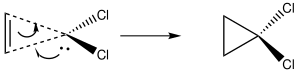

Transition state for reaction between ethene and dichlorocarbene. Click for 4D.
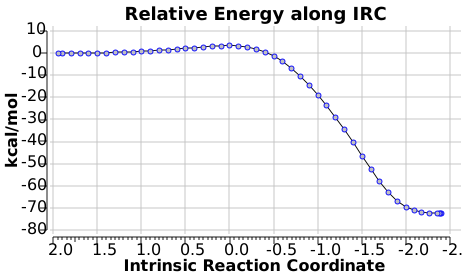
The reaction is a 4-electron pericyclic process, and so is subject to the Woodward-Hoffmann rules, which imply that such a 4n-thermal process should go with one antarafacial component. But there is a (rarely cited or observed) alternative, as was illustrated for the π2+π2 cycloaddition of ethene to itself. There we saw the gymnastics of a limbo dancer, with one ethene sliding up to the other rather than taking a full-frontal approach. But whilst that reaction had an unrealistic activation barrier of ~50 kcal/mol, the reaction between dichlorocarbene and an alkene is known to be a very facile one. And so the calculation shows (below). The barrier to reaction is small, and so this is an example of a low-barrier nominally forbidden reaction which nevertheless achieves a low barrier by avoiding the direct approach of the two molecules and adopting a round-about path!
 |
 |
 |
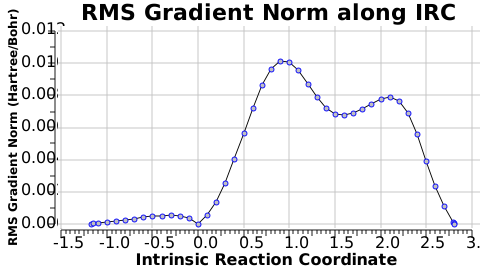 |
This round-about approach is seen best in the IRC for the addition to dicyano-ethene. Shown above is the gradient norm along the IRC.
- From IRC -1.2 to 0.0 (the transition state) the reaction corresponds to the formation of effectively just one C-C bond (a two electron process if you like).
- At IRC +2.0 a second distinct feature is seen in the graph, and this now corresponds to the formation of the second C-C bond, involving a sliding motion of the carbene (again, a two-electron process).
So by breaking a four-electron process into two phases, each involving just one electron pair, a lot of the forbidden Woodward-Hoffmann character seems to be avoided. Truly the direct approach not being the best!