Posts Tagged ‘Stereochemistry’
Saturday, August 6th, 2016
In the last few posts, I have explored the anomeric effect as it occurs at an atom centre X. Here I try to summarise the atoms for which the effect is manifest in crystal structures.
The effect is defined by X bearing two substituents, one of which Z is a centre bearing a “lone pair” of electrons (or two electrons in a π-bond), and another Y in which the X-Y bond has a low-lying acceptor or σ* empty orbital into which the lone pair can be donated. This donation will only occur if the Z-lone pair and the X-Y bond vectors align antiperiplanar. Here is the summary so far.
As required of a good periodic table, it has gaps that need completing, in this case X=N and X=S. Firstly N, for which the small molecule below is known (FUHFAP).

A ωB97XD/Def2-TZVPP calculation[1] yields an electron density distribution, which can be collected into monosynaptic basins using the ELF technique. There are two oxygen lone pairs (17 and 20) that are close to antiperiplanar to the adjacent N-O bond, having E(2) interaction energies obtained using the NBO method of 15.1 and 15.8 kcal/mol, typical of the anomeric range. The basin labelled 13 on X=N1 below is also perfectly aligned antiperiplanar with the adjacent O3-C2 bond, but its E(2) interaction energy is only 7.3 kcal/mol. Thus a strong anomeric interaction on the anomeric atom itself does not seem to occur. The same effect was noted for X=O in the previous post; the explanation remains unidentified.

With the X=S gap, we have lots of opportunity with polysulfide compounds, a good example of which is the C2-symmetric and helical S8 dianion TEGWAF[2]

Each of the 8 sulfur atoms exhibits antiperiplanar orientation of an S lone pair with an adjacent S-S acceptor σ* orbital;
1:2-3=23.7 kcal/mol;
2:3-4=18.5;
3:4-8=11.7, 3:2-1=7.4;
4:8-7=11.4, 4:3-2=9.2.
This just surveys the central main group elements, and it is possible that this little mini-periodic table may yet grow.
References
- H.S. Rzepa, "C 2 H 7 N 1 O 2", 2016. https://doi.org/10.14469/ch/195294
- Rybak, W.K.., Cymbaluk, A.., Skonieczny, J.., and Siczek, M.., "CCDC 880780: Experimental Crystal Structure Determination", 2012. https://doi.org/10.5517/ccykj88
Tags:Acetals, Alkane stereochemistry, Anomer, Anomeric effect, Atomic orbital, Carbohydrate chemistry, Carbohydrates, Chemical bond, Chemistry, interaction energy, Lone pair, Physical organic chemistry, Stereochemistry
Posted in crystal_structure_mining, Interesting chemistry | No Comments »
Friday, July 1st, 2016
The anomeric effect occurs at 4-coordinate (sp3) carbon centres carrying two oxygen substituents and involves an alignment of a lone electron pair on one oxygen with the adjacent C-O σ*-bond of the other oxygen. Here I explore whether other centres can exhibit the phenomenon. I start with 4-coordinate boron, using the crystal structure search definition below (along with R < 0.1, no disorder, no errors).[1]
The result shows two prominent clusters, one with both torsion angles being 180°, and another with both being ~60°. This latter is the one that implies that there must be two lone pairs, one on each oxygen, that are anti-periplanar to the adjacent B-O bond. There are two more diffuse clusters where only one antiperiplanar alignment is seen. So yes, 4-coordinate boron can exhibit an anomeric effect!
 This compares to the carbon-anomeric plot which is shown here for comparison, where the top right cluster of 180° torsions contains proportionately few hits than with boron.
 The next centre is at 4-coordinate silicon. Again three significant clusters are seen; one with two antiperiplanar lone pair alignments with Si-O bonds, and two more with just one such alignment. The previous hotspot for which both measured torsions were 180° is largely absent. So here, the anomeric effect is much stronger. Notice also that whereas the torsions in the region of 60° for the carbon centre lie along a ridge coincident with the diagonal (bottom left to top right), that for the silicon centre show a ridge running orthogonal to the diagonal. An interesting point to follow up perhaps?
Since the off-diagonal clusters are relatively prominent, implying just one anomeric interaction, it is of interest to see if this results in any asymmetry in the two Si-O bond lengths. If its present, the effect is small.

Finally 4-coordinate group 15 elements. Most of the hits are in fact for P; there are none for N. This shows four clusters; the two on the diagonal show respectively two and no antiperiplanar interactions. The two off-diagonal clusters show just one such orientation. As with Si, the ridge in the 60° region run orthogonal to the diagonal.
 So this little exploration shows that the anomeric effect, best known for sugars and at a carbon centre, is in fact more general to the adjacent elements.
References
- H. Rzepa, "Anomeric effects at boron, silicon and phosphorus.", 2016. https://doi.org/10.14469/hpc/696
Tags:Acetals, Alkane stereochemistry, Anomer, Anomeric effect, Bond length, Boron, Carbohydrate, Carbohydrate chemistry, Carbohydrates, crystal structure search definition, Ester, Physical organic chemistry, Stereochemistry
Posted in crystal_structure_mining | No Comments »
Monday, May 30th, 2016
This is a follow-up to one aspect of the previous two posts dealing with nucleophilic substitution reactions at silicon. Here I look at the geometries of 5-coordinate compounds containing as a central atom 4A = Si, Ge, Sn, Pb and of the specific formula C34AO2 with a trigonal bipyramidal geometry. This search arose because of a casual comment I made in the earlier post regarding possible cooperative effects between the two axial ligands (the ones with an angle of ~180 degrees subtended at silicon). Perhaps the geometries might expand upon this comment?

The search query is shown above results in 394 hits (May 2016) and is presented with the three variables in the query plotted as below, with the O-4A-O angle indicated by colour (red ~ 180°; blue ~90° and green ~120°).

- The cluster at distances of 4A-O of ~1.9Å represents silicon compounds, and tends to suggest that the pair of distances 4A-O are quite similar in value. The angles correspond to a di-axial arrangement around the silicon. In this scenario, one might imagine a stereoelectronic effect similar to the anomeric effect when 4A = C operates and which has the potential to strengthen both di-axial oxygens.
- The bulk of the points come at higher 4A-O distances of > 2.1Å and consist mostly of 4A = Sn. There are two a clear-cut distributions, one for angles of ~180° and a separate one for angles of ~90° and both are qualitatively different from the Si distribution. The 180° set corresponds to a di-axial arrangement for the oxygens, whereas the 90° set suggests an axial-equatorial geometry. Both distributions have prominent tails which reveal that as one 4A-O distance shortens, the other lengthens, equivalent to asymmetric anomeric effects at O-C-O.
- Noticeably absent are any green points; these would correspond to bond angles of ~120° and hence would correspond to di-equatorial ligands.
This quick exploration (with potential variations that I have not explored above) can be added to the collection of “ten minute explorations” I have described elsewhere.[1]
References
- H.S. Rzepa, "Discovering More Chemical Concepts from 3D Chemical Information Searches of Crystal Structure Databases", Journal of Chemical Education, vol. 93, pp. 550-554, 2015. https://doi.org/10.1021/acs.jchemed.5b00346
Tags:Anomer, Anomeric effect, Carbohydrate chemistry, Carbohydrates, Ligand, Molecular geometry, Physical organic chemistry, Stereochemistry, Stereoelectronic effect, Trigonal bipyramidal molecular geometry
Posted in Chemical IT, crystal_structure_mining | 3 Comments »
Wednesday, May 25th, 2016
The substitution of a nucleofuge (a good leaving group) by a nucleophile at a carbon centre occurs with inversion of configuration at the carbon, the mechanism being known by the term SN2 (a story I have also told in this post). Such displacement at silicon famously proceeds by a quite different mechanism, which I here quantify with some calculations.
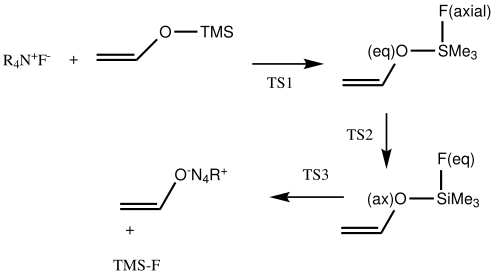
Trialkylsilyl is often used to protect OH groups, and as shown in the diagram above is specifically used to enforce the enol form of a ketone by replacing the OH with OTMS. The TMS can then be removed when required by utilising nucleophilic addition of e.g. fluoride anion from tetra-alkyl ammonium fluoride to form a 5-coordinate silicon intermediate, followed by collapse of this intermediate with expulsion of the oxygen to form an enolate anion. Before starting the calculations, I searched the crystal structure database for examples of R3SIF(OR), as in the search query below.

There were 55 instances of such species, and show below are their geometric characteristics. In all cases, the two electronegative substituents occupy the axial positions of a trigonal bipyramidal geometry. This of course is the orientation adopted by the two electronegative substituents in the SN2 mechanism for carbon, but with silicon this carbon "transition state" can be replaced by a stable (and as we see often crystalline) intermediate!

Turning to calculations (ωB97XD/6-31+G(d)/SCRF=thf), one can locate three transition states for the silicon process (there is only one for the SN2 reaction with carbon).
-
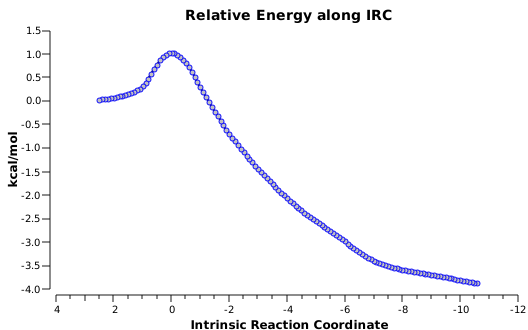
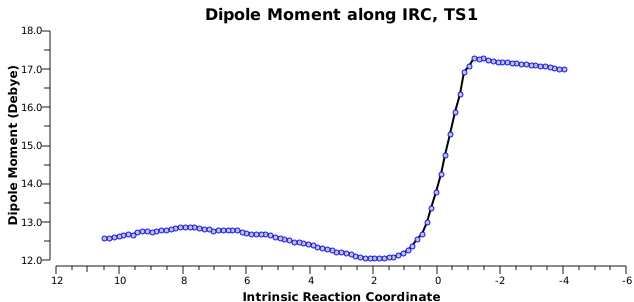
TS1 represents attack of fluoride anion along the axial position of the forming 5-coordinate silicon.[1],[2] The oxygen in this instance occupies an equatorial position, and this close proximity between the incoming F(-) and the about to depart OR groups represents a retention of configuration at the Si. Note that the reaction is endo-energic. (c.f. [3]).


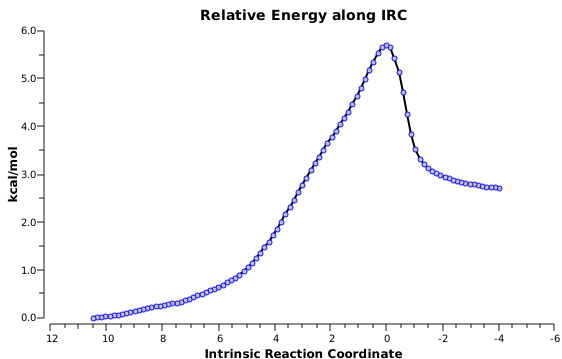
-
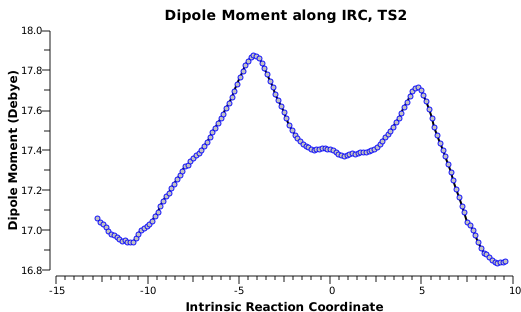
The next step, TS2[4],[5] is to move the F ligand to an equatorial position and the OR group from equatorial to its own axial position so that it can depart in the manner the F adopted to arrive. This requires what is called a Berry pseudorotation, an essentially isoenergic process.


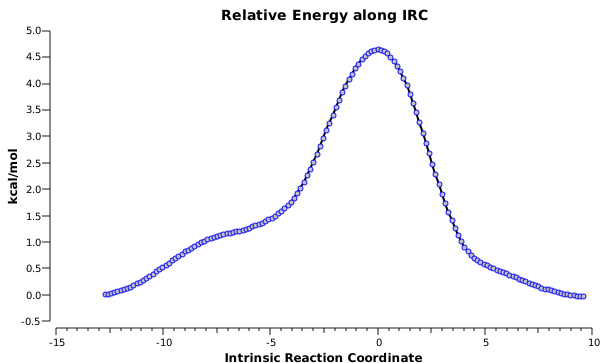
You might note a "hidden intermediate" at IRC ~-7 (the "bump" in the energy profile). This is caused by re-organisation of the ion-pair geometry, with the tetra-alkyl ammonium cation moving its orientation.
-
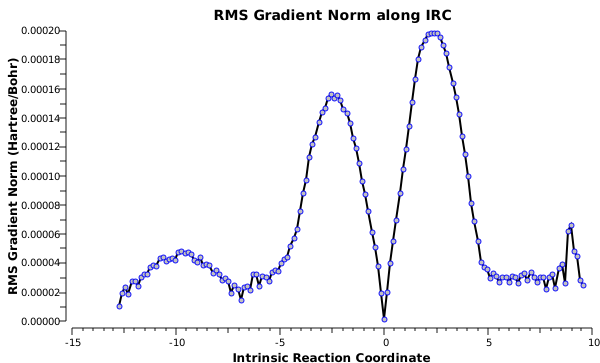
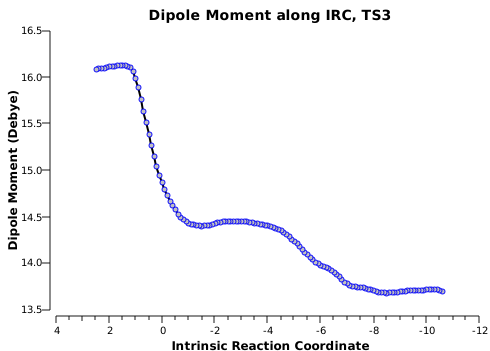
TS3[6],[7] now eliminates the –OR group to complete the deprotection.


The free energies are summarised below. Key points include:
-
The overall free energy of deprotection is appropriately exo-energic.
-
The highest energy barrier is actually for pseudo-rotation! This suggests that tuning the deprotection with alternative alkyl or aryl groups on the silicon may be a matter of controlling the Berry pseudorotation process.
-
TS1-3 proceed with the attacking and leaving groups in close proximity (the angle between an axial and an equatorial group is ~90° of course, whereas for a di-axial relationship (the inversion of the SN2 mechanism) it is instead 180°. This close proximity of nucleophile and nucleofuge minimises the required reorganisation of the ammonium counter-ion in the ion-pairs, and possibly also the dipole moments induced by the reactions, the changes of which for the three reactions are shown below:
-
The 5-coordinate intermediate where both F and O are axial is in fact significantly lower in energy (a cooperative effect) than when only one of them is axial, which matches the orientations identified above in the 55 crystal structures. For a substitution to occur, the cooperative strengthening of the Si-O and Si-F bonds must be removed; hence the retention of configuration.
|
System
|
Relative free energy
|
DataDOI
|
|
Reactants
|
0.0
|
[8]
|
|
TS1
|
7.9
|
[1]
|
|
Int F(ax), O(eq)
|
5.1
|
[9]
|
|
TS2
|
10.2 (9.2)*
|
[4]
|
|
Int F(eq), O(ax)
|
5.1
|
[10]
|
|
TS3
|
5.2
|
[6]
|
|
Products
|
-4.0
|
[11]
|
|
Int F,O(ax)
|
-2.5
|
[12]
|
*A lower energy orientation of the ion-pair has subsequently been found.[13]
This analysis shows just how different the carbon and the silicon substitution reactions are and how it is the pseudorotation interconverting two 5-coordinate intermediates that appears to be a key step. But questions remain unanswered. What is the energy of the pseudorotation interconverting an intermediate with ax/eq electronegative groups to one with di-axial electronegative groups? Are there transition states starting from the diaxial intermediate and resulting in elimination, and if so what are their relative energies? I leave answers to a follow up post.
References
- H. Rzepa, "trimethyl silyl enol + Me4N(+).F(-) 5-coordinate intermediate F axial TS", 2016. https://doi.org/10.14469/hpc/554
- H. Rzepa, "trimethyl silyl enol + Me4N(+).F(-) 5-coordinate intermediate F axial TS IRC", 2016. https://doi.org/10.14469/hpc/564
- L. Wozniak, M. Cypryk, J. Chojnowski, and G. Lanneau, "Optically active silyl esters of phosphorus. II. Stereochemistry of reactions with nucleophiles", Tetrahedron, vol. 45, pp. 4403-4414, 1989. https://doi.org/10.1016/s0040-4020(01)89077-3
- H. Rzepa, "trimethyl silyl enol + Me4N(+).F(-) 5-coordinate intermediate Berry pseudorotation TS", 2016. https://doi.org/10.14469/hpc/551
- H. Rzepa, "trimethyl silyl enol + Me4N(+).F(-) 5-coordinate intermediate Berry pseudorotation TS IRC", 2016. https://doi.org/10.14469/hpc/553
- H. Rzepa, "trimethyl silyl enol + Me4N(+).F(-) TS", 2016. https://doi.org/10.14469/hpc/539
- H. Rzepa, "trimethyl silyl enol + Me4N(+).F(-) TS IRC", 2016. https://doi.org/10.14469/hpc/552
- H. Rzepa, "enol + Me4N(+).F(-) Reactant", 2016. https://doi.org/10.14469/hpc/565
- H. Rzepa, "enol + Me4N(+).F(-) 5-coordinate intermediate F axial", 2016. https://doi.org/10.14469/hpc/555
- H. Rzepa, "trimethyl silyl enol + Me4N(+).F(-) 5-coordinate intermediate", 2016. https://doi.org/10.14469/hpc/540
- H. Rzepa, "enol + Me4N(+).F(-) Product", 2016. https://doi.org/10.14469/hpc/563
- H. Rzepa, "trimethyl silyl enol + Me4N(+).F(-) 5-coordinate intermediate F/O axial", 2016. https://doi.org/10.14469/hpc/550
- H. Rzepa, "5-coordinate intermediate Berry pseudorotation TS2 New conf?", 2016. https://doi.org/10.14469/hpc/577
Tags:Berry mechanism, Elimination reaction, energy, energy barrier, energy profile, free energy, Leaving group, lower energy orientation, Molecular geometry, Organic reactions, overall free energy, Pseudorotation, search query, SN2 reaction, Stereochemistry, Trigonal bipyramidal molecular geometry
Posted in reaction mechanism | No Comments »
Saturday, January 16th, 2016
The post on applying VSEPR ("valence shell electron pair repulsion") theory to the geometry of ClF3 has proved perennially popular. So here is a follow-up on another little molecue, F3SN. As the name implies, it is often represented with an S≡N bond. Here I take a look at the conventional analysis.

This is as follows:
-
Six valence electrons on the central S atom.
-
Three F atoms contribute one electron each.
-
One electron from the N σ-bond.
-
Donate two electrons from S to the two π-bonds.
-
Eight electrons left around central S, ≡ four valence shell electron pairs.
-
Hence a tetrahedral geometry.
-
The bond-bond repulsions however are not all equal. The SN bond repels the three SF bonds more than the S-F bonds repel each-other.
-
Hence the N-S-F angle is greater than the F-S-F angle, a distorted tetrahedron.
Now for a calculation[1]; ωB97XD/Def2-TZVP, where the wavefunction is analysed using ELF (electron localisation function), which is a useful way of locating the centroids of bonds and lone pairs (click on diagram below to see 3D model).

-
At the outset one notes that there are six ELF disynaptic basins surrounding the central S, integrating to a total of 7.05e. The sulfur is NOT hypervalent; it does not exceed the octet rule.
-
These six "electron sub-pair" basins are arranged octahedrally around the sulfur. The coordination is NOT tetrahedral, as implied above.
-
The three S-N basins have slightly more electrons (1.25e) than the three S-F basins (1.10e), resulting in …
-
the angle subtended at the S for the SN basins being 96° (a bit larger than octahedral) whilst the angle subtended at the S for the SF basins being smaller (89.9°). This matches point 7 above, but is achieved in an entirely different manner.
-
As a result, the N-S-F angle (122.5°) is larger than the ideal tetrahedral angle and the F-S-F angle (93.9°) is smaller, an alternative way of expressing point 7 above.
-
The S≡N triple bond as shown above does have some reality; it is a "banana bond" with three connectors rather than two. Each banana bond however has only 1.25e, so the bond order of this motif is ~four (not six) but nevertheless resulting in a short S-N distance (1.406Å) with multiple character.
So we have achieved the same result as classical VSEPR, but using partial rather than full electron pairs to do so. We got the same result with ClF3 before. So perhaps this variation could be called "valence shell partial electron pair repulsions" or VSPEPR.
References
- H.S. Rzepa, "F 3 N 1 S 1", 2016. https://doi.org/10.14469/ch/191808
Tags:Chemical bond, chemical bonding, Electron, Lone pair, Molecular geometry, Octet rule, Quantum chemistry, Stereochemistry, Tetrahedral molecular geometry, Theoretical chemistry, Valence, VSEPR theory
Posted in Hypervalency | 110 Comments »
Thursday, August 27th, 2015
The anomeric effect is best known in sugars, occuring in sub-structures such as RO-C-OR. Its origins relate to how the lone pairs on each oxygen atom align with the adjacent C-O bonds. When the alignment is 180°, one oxygen lone pair can donate into the C-O σ* empty orbital and a stabilisation occurs. Here I explore whether crystal structures reflect this effect.

The torsion angles along each O-C bond are specified, along with the two C-O distances. All the bonds are declared acyclic, and the usual R < 5%, no disorder and no errors specified.
- You can see from the plot below that the hotspot occurs when both RO-CO torsions are ~65°. From this we will assume that the two (unseen)‡ lone pairs at any one of the oxygens are distributed approximately tetrahedrally around each oxygen, and if this is true then one of them must by definition be oriented ~ 180° with respect to the same RO-CO bond (the other is therefore oriented -60°). This allows it to be antiperiplanar to the adjacent C-O bond and hence interact with its σ* empty orbital. So the hotspot corresponds to structures where BOTH oxygen atoms have lone pairs which interact with the adjacent O-C anti bond.
- There is a tiny cluster for which both RO-CO torsions are ~180° and hence neither oxygen has an antiperiplanar lone pair.
- Only slightly larger are clusters where one torsion is ~65° and the other ~180°, meaning that only one oxygen has an antiperiplanar lone pair.
- A plot of the two C-O lengths indeed shows an overall hotspot at ~1.40Å for both distances. If the search is filtered to include only torsions in the range 150-180°, the hotspot value increases to 1.415Å for both. If one torsion is restricted to 40-80° and the other to 150-180° the hotspot shows one C-O bond is about 0.012Å shorter than the other.


I also include a further constraint, that the diffraction data must be collected below 140K. The hotspot moves to ~ 55/60° indicating values free of some vibrational noise.

Interestingly, replacing oxygen with nitrogen reveals relatively few examples of the effect (C(NR2)4 is an exception). Replacing O by divalent S produces only 13 hits, with the surprising result (below) that in all of them only one S sets up an anomeric interaction. Arguably, the number of examples is too low to draw any firm conclusions from this observation.

‡Most diffractometers measure low angle scattering of X-rays by high density electrons. These are the core electrons associated with a nucleus rather than the valence electrons associated with lone pairs. Hence very few positions of valence lone pairs have ever been crystallographically measured.
Tags:Alkane stereochemistry, Anomeric effect, Carbohydrate chemistry, Carbohydrates, Carbon–oxygen bond, Chemical bond, Ether, Lone pair, Physical organic chemistry, Quantum chemistry, Stereochemistry, Technology/Internet
Posted in Chemical IT, crystal_structure_mining | No Comments »