February 16th, 2018
Last year, this article[1] attracted a lot of attention as the first example of molecular helium in the form of Na2He. In fact, the helium in this species has a calculated‡ bond index of only 0.15 and it is better classified as a sodium electride with the ionisation induced by pressure and the presence of helium atoms. The helium is neither valent, nor indeed hypervalent (the meanings are in fact equivalent for this element). In a separate blog posted in 2013, I noted a cobalt carbonyl complex containing a hexacoordinate hydrogen in the form of hydride, H–. A comment appended to this blog insightfully asked about the isoelectronic complex containing He instead of H–. Here, rather belatedly, I respond to this comment!
The complex [HCo6(CO)15]– has a calculated bond index at the hydrogen of 0.988 and a calculated NMR chemical shift of 21.6 ppm (ωB97XD/Def2-TZVPPD calculation) compared to a measured value of 23.2 ppm. Despite being six-coordinate, the hydride has a bond index that does not exceed one (it is not hypervalent).
So here is the neutral helium analogue. The He bond index emerges as 0.71 at the geometry of the hydride complex. Compare this with the bond index of 0.15 calculated for Na2He and it would be fair to say that at this geometry, the helium in [HeCo6(CO)15] would have a greater claim to be a molecular compound. Back in 2010, extrapolating from a series of posts here, I had speculated[2] about other molecular species of He, including the di-cation below. This has a He bond index of 0.54, rather less than that in [HeCo6(CO)15] but much more than in Na2He. It is also vibrationally stable.
But now, [HeCo6(CO)15] goes “pear-shaped” (why do pears have such a bad press?). I started a process of optimizing the geometry of this complex (ωB97Xd/Def2-TZVPPD). Slowly, the He started to creep out of the centre of the complex and emerge from the cavity. After about 100 steps it reached the geometry shown below, at which point the Wiberg bond index has dropped to 0.62 and still going down. I think it might take a few more steps to be completely expelled, but I have stopped the geometry optimisation at this stage.

So helium appears not to be valent in [HeCo6(CO)15]. However, I have yet to try Ne, which is both larger and softer. I will post results here.
‡All data at 10.14469/hpc/3587.
References
- X. Dong, A.R. Oganov, A.F. Goncharov, E. Stavrou, S. Lobanov, G. Saleh, G. Qian, Q. Zhu, C. Gatti, V.L. Deringer, R. Dronskowski, X. Zhou, V.B. Prakapenka, Z. Konôpková, I.A. Popov, A.I. Boldyrev, and H. Wang, "A stable compound of helium and sodium at high pressure", Nature Chemistry, vol. 9, pp. 440-445, 2017. https://doi.org/10.1038/nchem.2716
- H.S. Rzepa, "The rational design of helium bonds", Nature Chemistry, vol. 2, pp. 390-393, 2010. https://doi.org/10.1038/nchem.596
Tags: chemical bonding, Chemical elements, chemical shift, Chemistry, helium, Hydride, Hydrogen, Hypervalent molecule, Matter, Metal hydrides, Reducing agents, Transition metal hydride
Posted in Hypervalency | 4 Comments »
February 9th, 2018
Last year, I showed photos of wildflower meadows in west London close to where we live, evolving as the seasons changed. Today we hear the announcement that London itself is set be declared the world’s first National Park City in 2019.
What is a park city you may ask? It draws on the principles of National Parks such as the Peak District, the New Forest, or the South Downs in the UK, but in a city setting. It encourages people to explore how to improve life across the city, such as more time spent in nature outdoors and indeed visiting wild flower meadows! Meanwhile, spread the word.
As for those meadows, the “topping up” of last year’s seeding will start in March of 2018, and the area is set to expand substantially; it is pretty bare at the moment. When I get the list of expanded or new meadows, I will post here. Meanwhile I note that last year’s seeding of Cosmos produced a spectacular display which lasted at least three months. I cannot help but note that one of the main attractions at the RHS (Royal Horticultural Society) flower show at Chatsworth this year is the creation of a field of 12,000 Cosmos bipinnatus ‘Razzmatazz’, a river of flowers, outside the iconic Chatsworth House. This (IMHO) will be hard pressed to match that of west London last year!
Tags: City: London, Country: United Kingdom, Royal Horticultural Society, Wildflower
Posted in Interesting chemistry | 1 Comment »
February 3rd, 2018
The topic of open citations was presented at the PIDapalooza conference and represents a third component in the increasing corpus of open scientific information.
David Shotton gave us an update on Citations as First Class data objects – Citation Identifiers and introduced (me) to the blog where he discusses this topic. The citations or bibliography has long been regarded as an essential, and until recently inseparable, component at the end of a scientific article. It is also a component easily susceptible to “game play“. Authors can be tempted to self-cite themselves, possibly to excess and perhaps worse, to cite their friends and colleagues for other than purely scientific reasons. There are other issues. Thus to infer the context of any particular citation, one has to read the text where it is cited and this too can be subjected to game play. One may have to “read between the lines” to try to judge whether the citation is being cited favourably as supporting any case being made, or instead to indicate disagreement with the cited authors. An article that is being cited because one disagrees with the conclusions therein may still go on to contribute to the cited author’s “h-index” of esteem. So there are various aspects of citations that deserve improvement, or certainly development and evolution.
Shotton told us that many publishers are now releasing article citations as open (CC0) data in their own right, as urged to do so on the Initiative for Open Citations site. A corpus of some 13 million of these are now available as RDF triples with a SPARQL end-point. This latter means that semantic searches of the corpus can be undertaken. So what are the benefits? Worthy aspirations such as to explore connections between knowledge fields, and to follow the evolution of ideas and scholarly disciplines (similar in fact to the new Dimensions product I discussed in the previous post). When I probed into the various sites linked above, I had in mind to identify some clear scientific outcomes of making them available in this manner, perchance even in the field of chemistry. When I succeed I will follow-up on this post, but at the moment I am not yet in a position to illustrate these benefits with chemical stories. If anyone reading this post has such, please let us know!
I will conclude here by noting much discussion at universities of the future of the scientific article itself; whether it should be increasingly mandated as GOLD Open Access (made so by payment of an article processing charge, or APC, by its authors), or whether journals should retain the hybrid publishing models where only a proportion of articles are GOLD, and the remainder are paid for by subscription fees for licensing access to the non-GOLD articles in the journal. Meanwhile, in what seems sometimes as a separate conversation, the article itself is being dis-assembled into components such as open and/or FAIR data, open citations, infographics, social media and yes, even blogs. Are these two evolutions headed in different directions? Certainly, I think the future is not what it used to be!
Tags: Academic publishing, Applied linguistics, article processing charge, British National Corpus, chemical stories, cited author, Corpus linguistics, David Shotton, Entertainment/Culture, Linguistics, Open access, Quotation, RDF, social media, Texas A&M–Corpus Christi Islanders women's basketball
Posted in Chemical IT | 2 Comments »
January 23rd, 2018
Another occasional conference report (day 1). So why is one about “persistent identifiers” important, and particularly to the chemistry domain?
The PID most familiar to most chemists is the DOI (digital object identifier). In fact there are many; some 60 types have been collected by ORCID (themselves purveyors of researcher identifiers). They sometimes even have different names; in life sciences they tend to be known instead as accession numbers. One theme common to many (probably not all) is that they represent sources of metadata about the object being identified. Further information if which allows you (or a machine) to decide if acquiring the full object is worthwhile. So in no particular order, here are some of the things I learnt today.
- Mark Hahnel noted the recent launch of the Dimensions resource which links research data with other research activities; I have not yet had a chance to learn its capabilities, but it seems an interesting alternative to other stalwarts such as eg Google Scholar etc.
You can try this example: https://app.dimensions.ai/discover/publication?search_text=10.6084&search_type=kws&full_search=true which retrieves articles in which the data repository with prefix 10.6084 (Figshare) is cited. Try also the prefix 10.14469 which is the Imperial College repository.
- Andy Mabbett talked about the deployment and use of persistent identifiers (the Q numbers) in Wikidata, which increasingly underpin the basis for the various flavours of Wikipedia. He also noted their use of some 50 different identifiers.
- Johanna McEntyre noted some 5M published articles in life sciences which reference 1M+ ORCID identifiers, easily the domain with the fastest uptake of this type. Also noted was the new FREYA project; aiming to connect open identifiers for discovery, access and use of research resources.
- Tom Gillespie talked about RRID, or Research Resource Identifiers. Included in this are hardware, including instruments and with around 6000 RRIDs systematized so far. They argue this area promotes both the A and I of FAIR (accessible and inter-operable). Of course A and I mean many things to many people.
- Several other presentations talked about the finer detail of metadata, such as sub-classifications into e.g. descriptive/admin/technical, but I did rather miss demos showing how search queries of such fine-grained metadata could be constructed.
Apart from the presentations themselves, PIDapalooza is unusual for some other activities. Thus you could go get your PIDnails done, with a selection of 8 or so tasteful logos to choose from. There will be tattoos tomorrow (this is a conference for younger people after all). I may grab a photo or two to provide evidence!
Tags: Academic publishing, Andy Mabbett, Digital Object Identifier, Identifiers, Imperial College, Index, Information science, Johanna McEntyre, Knowledge, Mark Hahnel, ORCiD, Persistent identifier, Publishing, Quotation, researcher, Scholarly communication, SciCrunch, search engines, Technical communication, Technology/Internet, Tom Gillespie
Posted in Chemical IT | 1 Comment »
January 14th, 2018
I don’t normally write about the pharmaceutical industry, but I was intrigued by several posts by Derek Lowe (who does cover this area) on the topic of creating new drugs by deuterating existing ones. Thus he covered the first deuterated drug receiving FDA approval last year, having first reviewed the concept back in 2009. So when someone introduced me to sila-haloperidol, I checked to see if Derek had written about it. Apparently not, so here are a few details.

The idea appears to take a well-known drug, in this case haloperidol and selectively replacing a carbon atom with a silicon atom to form silahaloperidol.[1] The compound was actually reported in 2004 (see data citation 10.5517/cc7yhc0) but its drug-like properties were only reported four years later in 2008. Haloperidol itself has some undesirable side-effects, including those due to the metabolic products of the drug and so there are certainly reasons for trying to reduce these. Here are the main conclusions:
- The sila drug shows a significantly higher affinity for hD2 receptors (Table 1).
- Silahaloperidol exhibits higher subtype selectivity at dopamine and σ receptors
- The substitution by silicon has little effect on physico-chemical profiles
- The in-vivo half-life of the sila analogue was 3.6 times shorter (~18 minutes).
- An almost three-fold inhibitory effect against CYP3A4 was noted.
- The sila-drug displayed “a completely altered metabolic fate while otherwise maintaining a similar pharmacokinetic profile”.
These do seem to add up to a promising route for optimising drug activities. The authors themselves note the “great potential” for drug design. A review in 2017[2] concurs. So along with deuterated drugs, perhaps siladrugs are ones to watch in the future!
References
- R. Tacke, F. Popp, B. Müller, B. Theis, C. Burschka, A. Hamacher, M. Kassack, D. Schepmann, B. Wünsch, U. Jurva, and E. Wellner, "Sila‐Haloperidol, a Silicon Analogue of the Dopamine (D
<sub>2</sub>
) Receptor Antagonist Haloperidol: Synthesis, Pharmacological Properties, and Metabolic Fate", ChemMedChem, vol. 3, pp. 152-164, 2008. https://doi.org/10.1002/cmdc.200700205
- R. Ramesh, and D.S. Reddy, "Quest for Novel Chemical Entities through Incorporation of Silicon in Drug Scaffolds", Journal of Medicinal Chemistry, vol. 61, pp. 3779-3798, 2017. https://doi.org/10.1021/acs.jmedchem.7b00718
Tags: Chemistry, Derek Lowe, Deuterated drug, Drug, drug design, FDA, Food and Drug Administration, Haloperidol, Health, Health/Medical/Pharmaceuticals, HTC HD2 Smartphone, metabolic products, Pharmaceutical industry, Pharmacy, physico-chemical profiles, United States Public Health Service
Posted in General | No Comments »
January 13th, 2018
I discussed the molecule the molecule CH3F2- a while back. It was a very rare computed example of a system where the added two electrons populate the higher valence shells known as Rydberg orbitals as an alternative to populating the C-F antibonding σ-orbital to produce CH3– and F–. The net result was the creation of a weak C-F “hyperbond”, in which the C-F region has an inner conventional bond, with an outer “sheath” encircling the first bond. But this system very easily dissociates to CH3– and F– and is hardly a viable candidate for experimental detection. In an effort to “tune” this effect to see if a better candidate for such detection might be found, I tried CMe3F2-. Here is its story.
The calculation‡ is at the ωB97XD/Def2-TZVPPD/SCRF=water level (water is here used as an approximate model for a condensed environment, helping to bind the two added electrons).
- An NBO (Natural Bond orbital) analysis reveals a total Rydberg orbital population of 1.186e and the following bond indices; F 0.853, C 3.977, C(methyl) 4.051, H(*3) 1.332. The latter corresponds to the three methyl hydrogens aligned antiperiplanar to the C-F bond.
- To put this value into context, the hydrogen in the FHF– anion has an NBO H bond index of 0.724, and the bridging hydrogens in diborane only have a value of 0.988. Even the hexa-coordinate hydride system [Co6H(CO)15]– discussed in an earlier blog has an H bond index of just 0.86. Actually, coordination of six or even higher for hydrogen is no longer rare; some 28 crystal structures of the type HM6 (M=metal) are known (it would be useful to find out if any of the other 27 such structures might have a hydrogen bond index >1).
- Next, the ELF analysis (Electron localisation function), analysed firstly using the excellent MultiWFN program.[1]

This reveals an attractor basin integrating to 1.663e and located along the axis of the F-C bond and extended into the region of the three antiperiplanar methyl hydrogens. The C-F bond itself only supports a basin of 0.729e, typical of the fairly ionic C-F bond. The covalent C-Me bonds are also pretty normal, as are the other hydrogens.
- I also show ELF analysis using the alternative TopMod program[2]; the numerical values on this diagram are the calculated bond lengths in Å. The basin integrations are very similar to those obtained using MultiWFN.

The Wiberg bond orders of the three H…H regions shown connected by dashed lines above are 0.154, which contributes to the bond index of >1 at these three hydrogens.
- The predicted 1H chemical shift of these three “hypervalent” hydrogens is +3.0 ppm, whilst the other six methyl hydrogens are at -0.87ppm.
So changing CH3F2- to CMe3F2- has dramatically changed the bonding picture that emerges, rather than a fine-tuning. The C-F is no longer a “hyperbond”, although the Rydberg occupancy of 1.186e remains unusually large. Most of the additional electrons have fled the torus surrounding the C-F bond and relocated to the exo-region of that bond where they now influence the three antiperiplanar methyl hydrogens. A two-electron-three-centre interaction if you like, but with the electron basin occupying a tetrahedral vertex rather than the triatom centroid.
I end with a challenge. Is it possible to find “real” molecules containing hydrogen where the formal bond index for at least one hydrogen exceeds 1.0 significantly, thus making it hypervalent?
‡The calculations are all collected at FAIR doi; 10.14469/hpc/3372.
References
- T. Lu, and F. Chen, "Multiwfn: A multifunctional wavefunction analyzer", Journal of Computational Chemistry, vol. 33, pp. 580-592, 2011. https://doi.org/10.1002/jcc.22885
- S. Noury, X. Krokidis, F. Fuster, and B. Silvi, "Computational tools for the electron localization function topological analysis", Computers & Chemistry, vol. 23, pp. 597-604, 1999. https://doi.org/10.1016/s0097-8485(99)00039-x
Tags: Antibonding molecular orbital, candidate for experimental detection, chemical bonding, chemical shift, Chemistry, metal, Molecular orbital, Nature
Posted in Hypervalency | 2 Comments »
January 6th, 2018
The title here is from an article on metalenses[1] which caught my eye.
Metalenses are planar and optically thin layers which can be manufactured using a single-step lithographic process. This contrasts with traditional lenses that are not flat and where the optical properties result from very accurately engineered curvatures, which in turn are expensive to manufacture. Metalenses can have built into them many interesting optical properties, including light polarisation and dispersion. Nanoengineering has now resulted[1] in a metalens which can simultaneously present two images of opposite helicity of an object within the same field of view.
What is the relevance to chemistry? Well, a well-known chiroptical technique is known as electronic circular dichroism (ECD). At its simplest, it probes the difference in absorption by a chiral molecule of UV and visible light with opposite circular polarisation. This difference plotted as a function of the wavelength of the light is known as the ECD response. Importantly, this response can also be calculated for either enantiomer of the chiral molecule and hence the absolute configuration can be assigned on the basis of which calculated response matches the observed spectrum. Because the difference in response to the two polarisations of the light (Δε) is actually very small, the ECD technique is intrinsically less sensitive than e.g. normal UV/Visible spectra and this requires the use of expensive instruments to record that small difference. Chiral metalenses offer an interesting future opportunity to create new forms of ECD instrument, perhaps ones that are far more sensitive. In turn, this could lower the costs of acquiring ECD functionality in the standard laboratory (see [2] for an application in teaching laboratories). Very possibly, the most expensive component would in fact then be the computational simulations required to match up with the experimental spectrum!
When metalenses were first introduced, they were only able to lens a limited range of wavelengths. In another article by the same group[3] they now announce a new generation of metalens that covers the region 470 to 670 nm. This excludes the UV regions (<300nm) or the IR regions (>1200nm). The latter covers another important chiroptical instrumental technique known as vibrational circular dichroism, or VCD. As with ECD, the VCD response of a chiral molecule can be pretty well calculated using quantum chemistry and indeed often the VCD method is the only one that can successfully be used to assign absolute molecular configurations.[4] Unfortunately, VCD instruments are even more expensive than ECD ones, again largely due to the intrinsic insensitivity and the need to accumulate data using Fourier Transform methods over many hours. Few chemistry departments have such an instrument. So I will keep an eye out for when an effective chiral metalens operating in infra-red regions is announced! The prospect of routine VCD analyses is tantalising!
References
- M. Khorasaninejad, W.T. Chen, A.Y. Zhu, J. Oh, R.C. Devlin, D. Rousso, and F. Capasso, "Multispectral Chiral Imaging with a Metalens", Nano Letters, vol. 16, pp. 4595-4600, 2016. https://doi.org/10.1021/acs.nanolett.6b01897
- K.K.(. Hii, H.S. Rzepa, and E.H. Smith, "Asymmetric Epoxidation: A Twinned Laboratory and Molecular Modeling Experiment for Upper-Level Organic Chemistry Students", Journal of Chemical Education, vol. 92, pp. 1385-1389, 2015. https://doi.org/10.1021/ed500398e
- W.T. Chen, A.Y. Zhu, V. Sanjeev, M. Khorasaninejad, Z. Shi, E. Lee, and F. Capasso, "A broadband achromatic metalens for focusing and imaging in the visible", Nature Nanotechnology, vol. 13, pp. 220-226, 2018. https://doi.org/10.1038/s41565-017-0034-6
- J.I. Murray, N.J. Flodén, A. Bauer, N.D. Fessner, D.L. Dunklemann, O. Bob‐Egbe, H.S. Rzepa, T. Bürgi, J. Richardson, and A.C. Spivey, "Kinetic Resolution of 2‐Substituted Indolines by <i>N</i>‐Sulfonylation using an Atropisomeric 4‐DMAP‐<i>N</i>‐oxide Organocatalyst", Angewandte Chemie International Edition, vol. 56, pp. 5760-5764, 2017. https://doi.org/10.1002/anie.201700977
Tags: Biochemistry, Biology, Chemistry, Chirality, Circular dichroism, Nature, Pharmacology, Polarization, spectroscopy, Stereochemistry, Ultraviolet, Vibrational circular dichroism
Posted in Interesting chemistry | No Comments »
December 26th, 2017
Recollect the suggestion that diazomethane has hypervalent character[1]. When I looked into this, I came to the conclusion that it probably was mildly hypervalent, but on carbon and not nitrogen. Here I try some variations with substituents to see what light if any this casts.
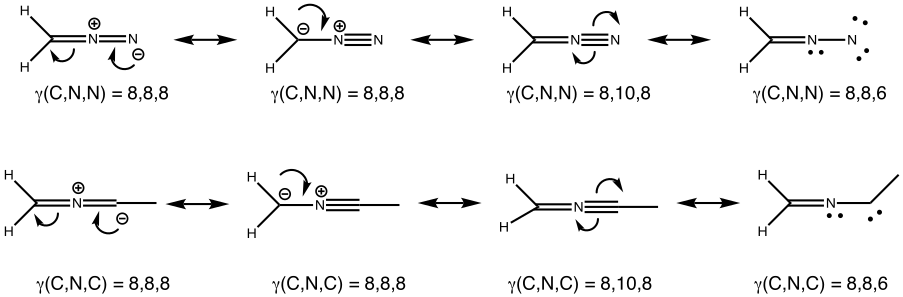
I have expanded the resonance forms of diazomethane by one structure from those shown in the previous two posts (a form by the way not considered in the original article[1]) to include a nitrene. This takes us back to an earlier suggestion on this blog that HC≡S≡CH is not a stable species but a higher order saddle point which distorts down to a bis-carbene, together with the suggestion that hypervalent triple bonds have the option of converting four of the six electrons into two carbene lone pairs, replacing the triple bond with a single bond. This in turn harks back to G. N. Lewis’ 101 year old idea for acetylene itself!
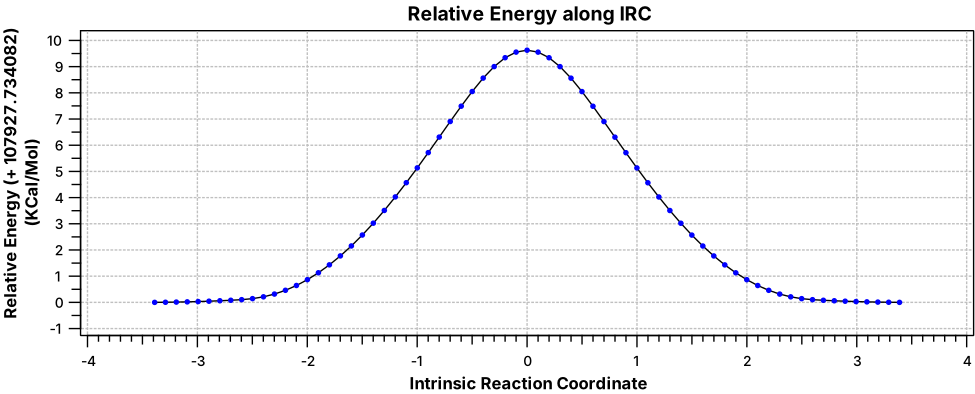
To explore this mode, I start by replacing the terminal ≡N in diazomethane with a ≡C-Me group, which cannot absorb electrons into lone-pairs in the manner that nitrogen can. A ωB97XD/Def2-TZVPP calculation‡ reveals that the linear form is a transition state for interconversion into a carbene. The IRC for the process (below) shows this carbene is ~10 kcal/mol lower than the linear “hypervalent” form.
NBO analysis of this transition state reveals a similar orbital pattern to diazomethane itself, including a non-bonding orbital on the H2C carbon. The Wiberg carbon bond indices are 3.6764 and N 3.6454 and the bond orders C=N 1.1390 and N=CMe 1.6192.

ELF analysis of this transition state reveals the presence of two non-bonding pairs on the carbon atoms either side of the nitrogen but unshared with it, with populations of 1.19e and 1.37e (DFT). That nitrogen really does not like excess electrons! The four atoms C,N,C,C have ELF valence basins totalling 8.00, 6.94, 7.69 and 7.92e (DFT) or 8.07, 7.07 and 7.61e (CASSCF), suggesting that unlike diazomethane itself, the octet-excess induced hypervalence on carbon is slightly decreased.


Pumping even more electrons in by replacing the ≡C-Me group with ≡C-NH2 does not increase any hypervalence, but does induce more electrons to reside in “lone pairs”. Of the four atoms along the chain, three have “lone pairs” associated with them, a total of 4.83e that do not contribute to bonds (valence).

An electron withdrawing ≡C-CN group replacing the ≡C-NH2 reverses the effect of the latter, but this linear species is still a transition state for carbon isomerisation:

Finally, combining all we have learnt by adding in nitro groups on the first carbon. This is no longer a transition state but now a stable species; the sum of the ELF basin integrations around the carbon on the left reaches 8.95e, slightly higher than the dinitro-diazomethane discussed in the previous post. The numerical Wiberg atom bond indices are C 3.8713, N 3.6898, C 3.8503, C 3.9958 and N 3.0288 for the atoms along the chain, with the first nitrogen the “least-valent”.
So we see that “hypervalence”, or at least “octet-excess”, which is not exactly the same as hypervalence since it includes contributions from non-bonding electrons, is balanced on a knife-edge. Trying to increase the octet-excess by pumping electrons in turns the system into a transition state for carbene formation. Octet-excess is seen as a metastable property, to be relieved by geometric distortions where possible or localization of electrons into non-bonding lone pairs. And I remind yet again that no evidence has manifested in calculations of the molecules above that the central nitrogen of these diazomethane-like systems has any propensity for octet or valence-excess as implied by the formula C=N≡X.[1]
‡FAIR data for all calculations is available at DOI: 10.14469/hpc/3476
References
- M.C. Durrant, "A quantitative definition of hypervalency", Chemical Science, vol. 6, pp. 6614-6623, 2015. https://doi.org/10.1039/c5sc02076j
Tags: chemical bonding, Chemistry, diazo, Diazo compounds, Diazomethane, diazomethane-like systems, Functional groups, Hypervalent molecule, Molecular geometry, Organic chemistry, Recollects
Posted in Hypervalency | 8 Comments »
December 26th, 2017
Recollect the suggestion that diazomethane has hypervalent character[1]. When I looked into this, I came to the conclusion that it probably was mildly hypervalent, but on carbon and not nitrogen. Here I try some variations with substituents to see what light if any this casts.

I have expanded the resonance forms of diazomethane by one structure from those shown in the previous two posts (a form by the way not considered in the original article[1]) to include a nitrene. This takes us back to an earlier suggestion on this blog that HC≡S≡CH is not a stable species but a higher order saddle point which distorts down to a bis-carbene, together with the suggestion that hypervalent triple bonds have the option of converting four of the six electrons into two carbene lone pairs, replacing the triple bond with a single bond. This in turn harks back to G. N. Lewis’ 101 year old idea for acetylene itself!
To explore this mode, I start by replacing the terminal ≡N in diazomethane with a ≡C-Me group, which cannot absorb electrons into lone-pairs in the manner that nitrogen can. A ωB97XD/Def2-TZVPP calculation‡ reveals that the linear form is a transition state for interconversion into a carbene. The IRC for the process (below) shows this carbene is ~10 kcal/mol lower than the linear “hypervalent” form.

NBO analysis of this transition state reveals a similar orbital pattern to diazomethane itself, including a non-bonding orbital on the H2C carbon. The Wiberg carbon bond indices are 3.6764 and N 3.6454 and the bond orders C=N 1.1390 and N=CMe 1.6192.

ELF analysis of this transition state reveals the presence of two non-bonding pairs on the carbon atoms either side of the nitrogen but unshared with it, with populations of 1.19e and 1.37e (DFT). That nitrogen really does not like excess electrons! The four atoms C,N,C,C have ELF valence basins totalling 8.00, 6.94, 7.69 and 7.92e (DFT) or 8.07, 7.07 and 7.61e (CASSCF), suggesting that unlike diazomethane itself, the octet-excess induced hypervalence on carbon is slightly decreased.
Pumping even more electrons in by replacing the ≡C-Me group with ≡C-NH2 does not increase any hypervalence, but does induce more electrons to reside in “lone pairs”. Of the four atoms along the chain, three have “lone pairs” associated with them, a total of 4.83e that do not contribute to bonds (valence).
An electron withdrawing ≡C-CN group replacing the ≡C-NH2 reverses the effect of the latter, but this linear species is still a transition state for carbon isomerisation:
Finally, combining all we have learnt by adding in nitro groups on the first carbon. This is no longer a transition state but now a stable species; the sum of the ELF basin integrations around the carbon on the left reaches 8.95e, slightly higher than the dinitro-diazomethane discussed in the previous post. The numerical Wiberg atom bond indices are C 3.8713, N 3.6898, C 3.8503, C 3.9958 and N 3.0288 for the atoms along the chain, with the first nitrogen the “least-valent”.
So we see that “hypervalence”, or at least “octet-excess”, which is not exactly the same as hypervalence since it includes contributions from non-bonding electrons, is balanced on a knife-edge. Trying to increase the octet-excess by pumping electrons in turns the system into a transition state for carbene formation. Octet-excess is seen as a metastable property, to be relieved by geometric distortions where possible or localization of electrons into non-bonding lone pairs. And I remind yet again that no evidence has manifested in calculations of the molecules above that the central nitrogen of these diazomethane-like systems has any propensity for octet or valence-excess as implied by the formula C=N≡X.[1]
‡FAIR data for all calculations is available at DOI: 10.14469/hpc/3476
References
- M.C. Durrant, "A quantitative definition of hypervalency", Chemical Science, vol. 6, pp. 6614-6623, 2015. https://doi.org/10.1039/c5sc02076j
Tags: chemical bonding, Chemistry, diazo, Diazo compounds, Diazomethane, diazomethane-like systems, Functional groups, Hypervalent molecule, Molecular geometry, Organic chemistry, Recollects
Posted in Hypervalency | 8 Comments »
December 23rd, 2017
In the previous post, I referred to a recently published review on hypervalency[1] which introduced a very simple way (the valence electron equivalent γ) of quantifying the effect. Diazomethane was cited as one example of a small molecule exhibiting hypervalency (on nitrogen) by this measure. Here I explore the effect of substituting diazomethane with cyano and nitro groups.‡

Firstly, dicyanodiazomethane. NBO analysis reveals the following atom bond indices; C, 3.810; N 3.834; N 2.971. Compare these values to diazomethane itself, C, 3.716; N 3.802; N 2.907 and you can see that the carbon bond index has increased slightly. The ELF basin integrations (below) which also take into account the “lone pair” on carbon are: C, 8.55, N, 6.65, N, 7.52 (DFT), again compared with diazomethane as C, 8.16; N, 6.59; N, 7.52. The CASSCF(14,14) result is very similar.


So the “γ(C)”† has increased from 8.2 to 8.55. Next, dinitrodiazomethane;

The NBO bond indices are C, 3.8203; N 3.8255; N 2.9802 and ELF integrations C, 8.82, N, 6.68, N, 7.49 (DFT).

So “γ(C)”† increases along the series 8.16 → 8.55 → 8.82, whereas “γ(N)” changes as 6.59 → 6.65 → 6.68, a smaller effect. Whilst 8.82 is still some way off the value of γ(N)=10 quoted[1] for diazomethane, dinitrodiazomethane is still a pretty good candidate for hypervalent carbon. The question now is whether even larger values of “γ(C)” can be identified in other molecules.
‡FAIR data for all calculations is available at DOI: 10.14469/hpc/3476. †The quotes in “γ(C)” indicate it is calculated here using ELF integrations rather than charge maps.
References
- M.C. Durrant, "A quantitative definition of hypervalency", Chemical Science, vol. 6, pp. 6614-6623, 2015. https://doi.org/10.1039/c5sc02076j
Tags: candidate for hypervalent carbon, chemical bonding, Hypervalent molecule, Molecular geometry
Posted in Hypervalency, Interesting chemistry | No Comments »