May 6th, 2018
The site fairsharing.org is a repository of information about FAIR (Findable, Accessible, Interoperable and Reusable) objects such as research data.

A project to inject chemical components, rather sparse at the moment at the above site, is being promoted by workshops under the auspices of e.g. IUPAC and CODATA and the GO-FAIR initiative. One aspect of this activity is to help identify examples of both good (FAIR) and indeed less good (unFAIR) research data as associated with contemporary scientific journal publications.
Here is one example I came across in 2017.[1]. The data associated with this article is certainly copious, 907 pages of it, not including data for 21 crystal structures! The latter is a good example of FAIR, being offered in a standard format (CIF) well-adapted for the type of data contained therein and for which there are numerous programs capable of visualising and inter-operating (i.e. re-using) it. The former is in PDF, not a format originally developed for data and one could argue is closer to the unFAIR end of the spectrum. More so when you consider this one 907-page paginated document contains diverse information including spectra on around 60 molecules. Thus the spectra are all purely visual; they are obviously data but in a form largely designed for human consumption and not re-use by software. The text-based content of this PDF does have numerous pattens, which lends itself to pattern recognition software such as OSCAR, but patterns are easily broken by errors or inexperience and so we cannot be certain what proportion of this can be recovered. The metadata associated with such a collection, if there is any at all, must be general and cannot be easily related to specific molecules in the collection. So I would argue that 907 pages of data as wrapped in PDF is not a good example of FAIR. But it is how almost all of the data currently being reported in chemistry journals is expressed. Indeed many a journal data editor (a relatively new introduction to the editorial teams) exerts a rigorous oversight over the data presented as part of article submissions to ensure it adheres to this monolithic PDF format.
You can also visit this article in Chemistry World (rsc.li/2HG7lTk) for an alternative view of what could be regarded as rather more FAIR data. The article has citations to the FAIR components, which is not published as part of the article or indeed by the journal itself but is held separately in a research data repository. You will find that at doi: 10.14469/hpc/3657 where examples of computational, crystallographic and spectroscopic data are available.
The workshop I allude to above will be held in July. Can I ask anyone reading this blog who has a favourite FAIR or indeed unFAIR example of data they have come across to share these here. We also need to identify areas simply crying out for FAIRer data to be made available as part of the publishing process beyond the types noted above. I hope to report back on both such feedback and the events at this workshop in due course.
References
- J.M. Lopchuk, K. Fjelbye, Y. Kawamata, L.R. Malins, C. Pan, R. Gianatassio, J. Wang, L. Prieto, J. Bradow, T.A. Brandt, M.R. Collins, J. Elleraas, J. Ewanicki, W. Farrell, O.O. Fadeyi, G.M. Gallego, J.J. Mousseau, R. Oliver, N.W. Sach, J.K. Smith, J.E. Spangler, H. Zhu, J. Zhu, and P.S. Baran, "Strain-Release Heteroatom Functionalization: Development, Scope, and Stereospecificity", Journal of the American Chemical Society, vol. 139, pp. 3209-3226, 2017. https://doi.org/10.1021/jacs.6b13229
Tags: above site, chemical components, Findability, Human behavior, Information, Information architecture, Information science, Institutional repository, journal data editor, Knowledge, Knowledge representation, Open access, Open access in Australia, Oscar, PDF, recognition software, Technology/Internet, Web design
Posted in Interesting chemistry | 2 Comments »
April 18th, 2018
The molecules below were discussed in the previous post as examples of highly polar but formally neutral molecules, a property induced by aromatisation of up to three rings. Since e.g. compound 3 is known only in its protonated phenolic form, here I take a look at the basicity of the oxygen in these systems to see if deprotonation of the ionic phenol form to the neutral polar form is viable.

The equilibrium being considered is shown below for compound 2:
The energetics of this equilibrium shown below, computed at the ωB97XD/Def2-TZVPPD/SCRF=water level and for which the FAIR data DOI is 10.14469/hpc/4073
For 1: X=Cl, the energy is shown below as a function of the O….H distance. Proton abstraction from HCl is exothermic by ~25 kcal/mol.
 For 2: X=Cl, the exothermicity increases by only ~5 kcal/mol , despite the apparent aromatisation of a further ring. It is also worth noting that this is greater basicity than that of e.g. water, where around 4-5 water molecules acting in concert are required to deprotonate HCl.
 For 1: X=OH, the proton abstraction from water is mildly endothermic by about 13 kcal/mol; indeed there is no energy minimum for carbonyl protonation and instead a relatively strong hydrogen bond to the water is formed instead.

For 2: X=OH the endothermicity is reduced to ~9 kcal/mol.
For 1: X=CH3, deprotonation of methane is now strongly endothermic by ~40 kcal/mol.

So the molecules 1 – 2 above are clearly not superbases, which perhaps augers well for being able to deprotonate the ionic phenols into these neutral but highly polar molecules.
Tags: Antiseptics, Aromatization, Chemistry, energy, energy minimum, Hydrogen, Molecule, Neurotoxins, Science
Posted in Interesting chemistry | No Comments »
April 13th, 2018
In several posts a year or so ago I considered various suggestions for the most polar neutral molecules, as measured by the dipole moment. A record had been claimed[1] for a synthesized molecule of ~14.1±0.7D. I pushed this to a calculated 21.7D for an admittedly hypothetical and unsynthesized molecule. Here I propose a new family of compounds which have the potential to extend the dipole moment for a formally neutral molecule up still further.
These molecules derive from a well-known class of molecule known as ortho-quinomethides. If the methide part is substituted with an electron donating substituent such as an amino group in 3, a push-pull opportunity now arises, which is strongly driven by aromatisation of the quinomethide ring. This allows one to design “neutral” molecules such as 1 and 2, which now contain respectively two and three rings that will be aromatised by the process. The aromatisation stabilization energy is balanced of course by an opposing increase in energy resulting from charge separation. You can observe that partially aromatising three independent rings as in 2 can drive a great deal of charge separation. One may indeed wonder how much charge separation can be sustained before a triplet instability occurs, driving the molecule back to being neutral. In the case of 2, the wavefunction is in fact stable to such an open shell state, but higher homologues may not be. An aspect worth investing!
Molecule 1 does have some precedent in 3[2] but this system exists as a phenol, having abstracted a proton from an acid and leaving behind the acid anion, as per below for 1. Any attempts to deprotonate this phenol with a superstrong base were unreported.

Unsurprisingly therefore, molecules such as 1 and 2 could be regarded as even more highly potent bases than 3, driven again by further aromatisation. The properties of such a potential superbase will be investigated in the next post.
References
- J. Wudarczyk, G. Papamokos, V. Margaritis, D. Schollmeyer, F. Hinkel, M. Baumgarten, G. Floudas, and K. Müllen, "Hexasubstituted Benzenes with Ultrastrong Dipole Moments", Angewandte Chemie International Edition, vol. 55, pp. 3220-3223, 2016. https://doi.org/10.1002/anie.201508249
- N.R. Candeias, L.F. Veiros, C.A.M. Afonso, and P.M.P. Gois, "Water: A Suitable Medium for the Petasis Borono‐Mannich Reaction", European Journal of Organic Chemistry, vol. 2009, pp. 1859-1863, 2009. https://doi.org/10.1002/ejoc.200900056
Tags: aromatisation stabilization energy, Chemical polarity, chemical properties, Chemistry, Dipole, Electric dipole moment, Electromagnetism, energy, Moment, Nature, Physical quantities, Physics, Potential theory
Posted in Interesting chemistry | 11 Comments »
March 18th, 2018
Around the time of the 2012 olympic games, the main site for which was Stratford in east London, I heard a fascinating talk about the “remediation” of the site from the pollution caused by its industrial chemical heritage. Here I visit another, arguably much more famous and indeed older industrial site.
The remediation of Stratford involved the removal, cleaning and returning of a vast amount of topsoil, something which was not cheap to do. About 190 miles west of Stratford lies what is called the lower Swansea (Abertawe) valley, through which the river Tawe runs. The remediation has taken 50 years or more using far less money than at the Stratford site. It is famous as being the world’s largest copper smelting area during the industrial revolution, using copper ore from Cornwall and coal from Welsh coalfields. An unfortunate by-product of using Cornish ore was that it contained large amounts of sulfur in the form of copper sulfide, which was liberated in the form of sulfurous and sulfuric acids. I remember hearing in the talk mentioned above that the acid rain produced from the smelting killed almost all plant life and trees in the locality. Unsurprisingly, the life expectancy amongst the workers was also low. Over the 200 or so years of smelting, what little plant life that did survive apparently developed an extraordinary tolerance to copper in the soil and no doubt the flora is nowadays of much interest for that reason to molecular biologists.
Well, nowadays it is certainly a green and pleasant land, but in the past it is tempting to associate it with the dark satanic mills of William Blake’s poem Jerusalem. To give a tiniest flavour of what the valley might have looked like, here is a photograph, with the river Tawe in the foreground. Apparently there were 100s of such chimneys along the valley. It has certainly changed now, and the walk along the river valley is very pleasant indeed!

Tags: City: London, Environment, Environmental Issues, Environmental toxicology, Geography of London, industrial chemical heritage, industrial site, London Borough of Newham, London boroughs, Pollution, Province/State: Swansea, Queen Elizabeth Olympic Park, river Tawe, Stratford, Stratford London, Stratford station, Summer Olympics, the 2012 olympic games, unfortunate by-product, William Blake
Posted in Interesting chemistry | No Comments »
March 18th, 2018
I have posted often on the chemical phenomenon known as hypervalency, being careful to state that as defined it applies just to “octet excess” in main group elements. But what about the next valence shell, occurring in transition metals and known as the “18-electron rule”? You rarely hear the term hypervalency being applied to such molecules, defined presumably by the 18-electron valence shell count being exceeded. So the following molecule (drawn in three possible valence bond representations) first made in 1992 intrigues.[1]
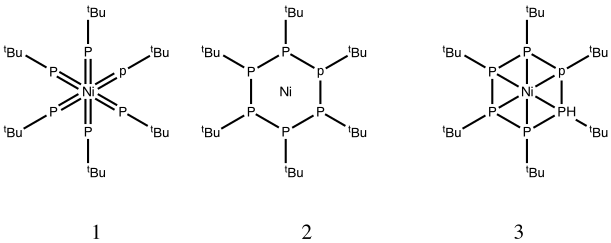
The molecule comprises six phosphinidene ligands (RP:, R=tert-butyl), the P analogues of nitrenes and arranged around nickel to form an unusual hexagonal planar coordinate species and with three of the t-butyl groups facing up and three down. This arrangement totally obscures the two nickel diaxial positions, preventing any ligand from occupying them. One may even speculate that the dispersion attractions between the two pairs of three t-butyl groups might be unusually stabilising,‡ maybe even on a par with those reported by Schreiner and co-workers for t-butyl substituted triphenylmethanes and noted on this blog.

Nitrenes can be represented coordinating to a metal as RN=M. If the analogy extends to P, the valence bond structure 1 above would result and the six P atoms would contribute 12 electrons to the Ni valence shell. Since the Ni shell is [Ar].3d8.4s2 adding another 12 electrons would make 22 electrons, thus exceeding the 18-electron rule. In fact it was never suggested as such; in the 1992 analysis of the bonding[1], the authors clearly state “The electronic structure … cannot be described in terms of the 18e rule”. To support this, they draw the structure in form 3 above, which implies a Ni valence shell of 16e, albeit also implying a Ni bond index of ~6.
Time I thought for calculations (wB97XD/Def2-TZVPP).† The calculated NBO bond index at Ni is in fact 2.38 and the individual Ni-P bond orders are 0.37. The P bond indices are each 3.24 and the P-P bond orders are 0.88. The final electronic configuration is [Ar]3d9.53.4s0.22.4p0.64.4d0.01.5p0.01 and the natural charge on Ni is -0.39. I show one NBO orbital which illustrates the two-electron-three-centre interaction spanning two P atoms and the Ni and giving rise to the modest Ni-P bond order.

The Ni electronic structure of [Ar].3d8.4s2 normally corresponds to its divalency, so in this sense it is mildly hypervalent. Overall, representation 2 above is perhaps more accurate than 3. The ELF (Electron localisation function) of the electron density is shown below (t-butyl groups represented by a single carbon) with the ELF basins highlighted. Basin 2 is a P lone pair, with an integration close to 2e. Basin 1 is a P-P basin with an integration of 1.89 and finally 3 is indeed a P-Ni basin, but with an integration of only 0.06e.

So this molecule really is a ring of six P atoms, encapsulating at its centre a lone Ni(II) atom. Rather than being hypervalent, perhaps it is most interesting as a complex in which a metal atom is contained in and perturbed by a dispersion-stabilized sphere of ligands.[2] We need more examples!
‡The original authors[1] merely stated that electron correlation effects are decisive for the stability. Of course, dispersion attractions are indeed a form of electron correlation! †FAIR data doi: 10.14469/hpc/3925
References
- R. Ahlrichs, D. Fenske, H. Oesen, and U. Schneider, "Synthesis and Structure of [Ni(P<i>t</i>Bu<sub>6</sub>)] and [Ni<sub>5</sub>(P<i>t</i>Bu)<sub>6</sub>(CO)<sub>5</sub>] and Calculations on the Electronic Structure of [Ni(P<i>t</i>Bu)<sub>6</sub>] and (PR)<sub>6</sub>, R = <i>t</i>Bu,Me", Angewandte Chemie International Edition in English, vol. 31, pp. 323-326, 1992. https://doi.org/10.1002/anie.199203231
- https://doi.org/
Posted in Hypervalency | 3 Comments »
March 18th, 2018
I have posted often on the chemical phenomenon known as hypervalency, being careful to state that as defined it applies just to “octet excess” in main group elements. But what about the next valence shell, occurring in transition metals and known as the “18-electron rule”? You rarely hear the term hypervalency being applied to such molecules, defined presumably by the 18-electron valence shell count being exceeded. So the following molecule (drawn in three possible valence bond representations) first made in 1992 intrigues.[1]

The molecule comprises six phosphinidene ligands (RP:, R=tert-butyl), the P analogues of nitrenes and arranged around nickel to form an unusual hexagonal planar coordinate species and with three of the t-butyl groups facing up and three down. This arrangement totally obscures the two nickel diaxial positions, preventing any ligand from occupying them. One may even speculate that the dispersion attractions between the two pairs of three t-butyl groups might be unusually stabilising,‡ maybe even on a par with those reported by Schreiner and co-workers for t-butyl substituted triphenylmethanes and noted on this blog.

Nitrenes can be represented coordinating to a metal as RN=M. If the analogy extends to P, the valence bond structure 1 above would result and the six P atoms would contribute 12 electrons to the Ni valence shell. Since the Ni shell is [Ar].3d8.4s2 adding another 12 electrons would make 22 electrons, thus exceeding the 18-electron rule. In fact it was never suggested as such; in the 1992 analysis of the bonding[1], the authors clearly state “The electronic structure … cannot be described in terms of the 18e rule”. To support this, they draw the structure in form 3 above, which implies a Ni valence shell of 16e, albeit also implying a Ni bond index of ~6.
Time I thought for calculations (wB97XD/Def2-TZVPP).† The calculated NBO bond index at Ni is in fact 2.38 and the individual Ni-P bond orders are 0.37. The P bond indices are each 3.24 and the P-P bond orders are 0.88. The final electronic configuration is [Ar]3d9.53.4s0.22.4p0.64.4d0.01.5p0.01 and the natural charge on Ni is -0.39. I show one NBO orbital which illustrates the two-electron-three-centre interaction spanning two P atoms and the Ni and giving rise to the modest Ni-P bond order.

The Ni electronic structure of [Ar].3d8.4s2 normally corresponds to its divalency, so in this sense it is mildly hypervalent. Overall, representation 2 above is perhaps more accurate than 3. The ELF (Electron localisation function) of the electron density is shown below (t-butyl groups represented by a single carbon) with the ELF basins highlighted. Basin 2 is a P lone pair, with an integration close to 2e. Basin 1 is a P-P basin with an integration of 1.89 and finally 3 is indeed a P-Ni basin, but with an integration of only 0.06e.

So this molecule really is a ring of six P atoms, encapsulating at its centre a lone Ni(II) atom. Rather than being hypervalent, perhaps it is most interesting as a complex in which a metal atom is contained in and perturbed by a dispersion-stabilized sphere of ligands.[2] We need more examples!
‡The original authors[1] merely stated that electron correlation effects are decisive for the stability. Of course, dispersion attractions are indeed a form of electron correlation! †FAIR data doi: 10.14469/hpc/3925
References
- R. Ahlrichs, D. Fenske, H. Oesen, and U. Schneider, "Synthesis and Structure of [Ni(P<i>t</i>Bu<sub>6</sub>)] and [Ni<sub>5</sub>(P<i>t</i>Bu)<sub>6</sub>(CO)<sub>5</sub>] and Calculations on the Electronic Structure of [Ni(P<i>t</i>Bu)<sub>6</sub>] and (PR)<sub>6</sub>, R = <i>t</i>Bu,Me", Angewandte Chemie International Edition in English, vol. 31, pp. 323-326, 1992. https://doi.org/10.1002/anie.199203231
- https://doi.org/
Tags: Hypervalency
Posted in Hypervalency | 3 Comments »
March 7th, 2018
C&EN has again run a vote for the 2017 Molecules of the year. Here I take a look not just at these molecules, but at how FAIR (Findable, Accessible, Interoperable and Reusable) the data associated with these molecules actually is.
I went about finding out as follows:
- The article DOI for all seven candidates was linked to the C&EN site.
- From there I manually tracked down the Supporting information
- Some of this SI gave a CCDC deposition number for crystal structure data for the molecule in question. The easiest way of going directly to the data was to use the search.datacite.org search engine and to enter the keywords CCDC + deposition number. This gives a DOI for the data, examples of which are included in the table below.
- In other examples, I used the CSD Conquest search program and entered the names of 2-3 of the authors of the articles. This also worked well.
- Most of the SI files, downloaded as PDF files also had static images of NMR spectra included. This is not active data, and hence does not fulfil the F and I of FAIR, and probably the A as well. None of it is FAIR as defined by my post here although it is actually really easy to make it so. One of the examples had ~116 spectra so unFAIRed.
- In another example there was also computational data, included simply as a set of XYZ coordinates and again contained in the PDF file. This too is not really FAIR, since one has to know how to extract it from this container and repurpose it. It also represents a tiny subset of the data potentially available.
The FAIRness of the data for these molecules of the year is largely rescued by the crystal structure data deposited with the CCDC in their CSD database and rendered F of FAIR by the persistent identifiers such as the (parochial) deposition numbers or the more general DOI. Now if the NMR and computational data were also covered in this way, we would be making great progress. There are of course many other types of data included with these examples, and procedures for making such data also FAIR have to be worked out by the community.
In order to construct the table above, I had to put about two hours of effort into tracking down the items (and this only because I have done this sort of search before). Perhaps next year I might persuade C&EN to include such a table in their own article!
Tags: Carotenoids, Chemistry, Epoxides, Macrocycles, Organic chemistry, Organofluorides, PDF, Peptides, search engine, search program, search.datacite.org search engine, Technology/Internet
Posted in Chemical IT, crystal_structure_mining, Interesting chemistry | No Comments »
March 4th, 2018
A bond index (BI) approximately measures the totals of the bond orders at any given atom in a molecule. Here I ponder what the maximum values might be for elements with filled valence shells.
Following Lewis in 1916[1] who proposed that the full valence shell for main group elements should be 2 (for the first two elements) and 8 (the “octet“), Bohr (1922[2]), Langmuir (1919-1921[3]) and Bury (1921[4]) extended this rule to include 18 (the transition series) and 32 (the lanthanides and actinides). If we assume no contributions from higher Rydberg shells (thus 3s, 3p, 3d for carbon etc) and an electron pair model for orbital population (which amounts to the single-determinantal model), then the maximum bond index for hydrogen (and helium) would be 1, it would be 4 for main group elements, and then what?
For the special case of hydrogen, I have previously identified (for a hypothetical species) a bond index of 1.33, due mostly to a high Rydberg occupancy of 1.19e. The more normal BI is <1.0, as noted for this hexacoordinated hydride system. My current estimate for the maximum bond index for main group elements is <4.5. Thus for SF6, it has the value of ~4.33 and that includes a modest occupancy of Rydberg shells of 0.36e = 0.18 BI. Exclude these and it is close to 4.
Move on from group 16 to group 6 and you get compounds such as Me4CrCrMe44- or ReMe82- where the metal bond indices are ~6.5.‡ Compounds such as Cr(Me)6 (BI = 5.6) and W(Me)6 (BI = 6.1) are rather lower. This is a long way from 18/2 = 9. The lanthanides and actinides[5] are unlikely to reveal many large BIs (32/2= 16 maximum value) since they are often ionic and the wavefunctions may be too complex to allow a simple index such as a BI to be safely computed.
So if we are hunting for record BIs, the transition elements are the place to hunt. Can a BI of 6.5 be beaten? Can it even approach 9, its maximum value? Does anyone know of candidate molecules?
‡FAIR Data doi: 10.14469/hpc/3352.
References
- G.N. Lewis, "THE ATOM AND THE MOLECULE.", Journal of the American Chemical Society, vol. 38, pp. 762-785, 1916. https://doi.org/10.1021/ja02261a002
- N. Bohr, "Der Bau der Atome und die physikalischen und chemischen Eigenschaften der Elemente", Zeitschrift f�r Physik, vol. 9, pp. 1-67, 1922. https://doi.org/10.1007/bf01326955
- I. Langmuir, "Types of Valence", Science, vol. 54, pp. 59-67, 1921. https://doi.org/10.1126/science.54.1386.59
- C.R. Bury, "LANGMUIR'S THEORY OF THE ARRANGEMENT OF ELECTRONS IN ATOMS AND MOLECULES.", Journal of the American Chemical Society, vol. 43, pp. 1602-1609, 1921. https://doi.org/10.1021/ja01440a023
- P. Pyykkö, C. Clavaguéra, and J. Dognon, "The 32‐Electron Principle", Computational Methods in Lanthanide and Actinide Chemistry, pp. 401-424, 2015. https://doi.org/10.1002/9781118688304.ch15
Tags: Atom, Chemical bond, chemical bonding, chemical properties, Chemistry, metal bond indices, Molecule, Nature, Quantum chemistry, Residential REITs, Resonance, Tennessine, Valence, Valence electron
Posted in Interesting chemistry | No Comments »
February 24th, 2018
Another post inspired by a comment on an earlier one; I had been discussing compounds of the type I.In (n=4,6) as possible candidates for hypervalency. The comment suggests the below as a similar analogue, deriving from observations made in 1989.[1]

This compound was investigated using 77Se NMR, with the following conclusions:
- The compound is fluxional, with the lines at room temperature broadened compared to those at -50°C.
- At -50°C the peaks are sharp enough to discern 1JSe-Se couplings, with multiplicities and integrations that suggest a central Se is surrounded by four equivalent further Se atoms, with shifts of 655.1 and 251.2 ppm.
- The magnitude of this 1JSe-Se coupling (391 Hz) leads to the suggestion of a considerable contribution of a resonance form with Se=Se bonds (structure 2 above).
- This was supported by 2J13C-77Se couplings which also imply a symmetrically coordinated central Se.
- Thus the two resonance forms 1 or 2 above were suggested as the predominant form at -50°C, with an increasing incursion of the open chain isomer 3 at higher temperatures giving rise to the observed fluxional dynamic behaviour.
- One may surmise from these results that the central Se is certainly hypercoordinated and by the classical interpretations hypervalent.
Here are some calculations (R=H), at the ωB97XD/Def2-TZVPP/SCRF=chloroform level.‡ In red are the calculated Wiberg Se-Se bond orders, which give little indication of any Se=Se double bond character.

The calculated 77Se shifts are shown in magenta, with the observed values being 655 and 255 ppm. The match is not good, the errors were 120 and 20.5 ppm.† However calculated shifts for elements adjacent to e.g. Se or Br etc suffer from relativistic effects such as spin orbit coupling.[2] Thus the shift for the central Se, surrounded by four other Se atoms is likely to have a significant error, but the error for the four other Se atoms should be less. The reverse is true.
However, all the calculations of this species (up to Def2-TZVPPD basis set) showed this symmetric form of D2h symmetry to actually be a transition state, as per below. 
There is a minimum with the structure below in which one pair of Se-Se lengths are longer than the other pair and for which the free energy is 6.5 kcal/mol lower. The Wiberg bond orders for the two sets of Se-Se bonds are now 0.16 and 0.86, which very much corresponds to structure 3 above.

Assuming that this compound is fluxional even at -50°C, the average of the pairs of Se atoms gives calculated shifts of 667 ppm (655 obs) whilst the central Se is 204.6 ppm (251 obs). The latter, influenced by two especially short Se-Se distances, is likely to have a very large spin-orbit coupling error, whilst for the former the error will be smaller (13C shifts adjacent to one Br typically have induced calculated errors of about 14 ppm[2]).
At this point I searched the Cambridge structure database for Se coordinated by four other Se atoms. A close analogue[3] has the structure shown below, in which pairs of Se-Se interactions have unequal bond lengths, the shorter being ~2.45Å. This matches the calculation above reasonably well.

Reconciling these various observations, we might assume that even at -50°C the fluxional behaviour has not been frozen out. Given that the fluxional barrier is only 6.5 kcal/mol, it is unlikely that the spectrum could be measured at a sufficiently low temperature to reveal not two sets of Se signals in the ratio 4:1 but three in the ratio 2:2:1. The spin-spin couplings reported presumably are a result of averaging a genuine 1JSe-Se coupling with a through space coupling.
So it appears that the analysis of the 77Se NMR reported in this article [1] may not be quite what it seems. A better interpretation is that structure 3 is the most realistic. This means no hypercoordination for the Se, never mind hypervalence!
‡FAIR data at DOI: 10.14469/hpc/3724. †The original reference, Me2Se was incorrectly calculated without solvation by chloroform. The values shown here are now corrected from those shown in the original post.
References
- Y. Mazaki, and K. Kobayashi, "Structure and intramolecular dynamics of bis(diisobutylselenocarbamoyl) triselenide as identified in solution by the 77Se-NMR spectroscopy", Tetrahedron Letters, vol. 30, pp. 2813-2816, 1989. https://doi.org/10.1016/s0040-4039(00)99132-9
- D.C. Braddock, and H.S. Rzepa, "Structural Reassignment of Obtusallenes V, VI, and VII by GIAO-Based Density Functional Prediction", Journal of Natural Products, vol. 71, pp. 728-730, 2008. https://doi.org/10.1021/np0705918
- R.O. Gould, C.L. Jones, W.J. Savage, and T.A. Stephenson, "Crystal and molecular structure of bis(NN-diethyldiselenocarbamato)-selenium(II)", Journal of the Chemical Society, Dalton Transactions, pp. 908, 1976. https://doi.org/10.1039/dt9760000908
Tags: C, chemical bonding, Chemistry, free energy, Hypervalent molecule, Matter, Molecular geometry, Nature, Nitrogen
Posted in Hypervalency | 3 Comments »
February 23rd, 2018
A little while ago I pondered allotropic bromine, or Br(Br)3. But this is a far wackier report[1] of a molecule of light.
The preparation and detection of dimer and trimer bound photon states is pure physics; probably considered by the physicists themselves as NOT chemistry. It is certainly true, as a chemist, that I understood only a little of the article. But chemistry uses photons extensively in the area we call photochemistry. We represent photons as hν, and hence (hν)3.
This molecular light has some fascinating properties. One is that it travels around 100,000 times slower than the usual speed of light. Another is the estimate of the photon-photon binding energies, which are ~1010 times smaller than in diatomic molecules such as NaCl and H2. I await with interest to see whether this new state of light will achieve any interesting chemistry.
References
- Q. Liang, A.V. Venkatramani, S.H. Cantu, T.L. Nicholson, M.J. Gullans, A.V. Gorshkov, J.D. Thompson, C. Chin, M.D. Lukin, and V. Vuletić, "Observation of three-photon bound states in a quantum nonlinear medium", Science, vol. 359, pp. 783-786, 2018. https://doi.org/10.1126/science.aao7293
Tags: Atomic physics, Bromine, Bromine compounds, chemist, Chemistry, Halogens, Hypobromite, Oxidizing agents
Posted in Interesting chemistry | No Comments »

