August 22nd, 2018
In 2012, I wrote a story of the first ever reaction curly arrows, attributed to Robert Robinson in 1924. At the time there was a great rivalry between him and another UK chemist, Christopher Ingold, with the latter also asserting his claim for their use. As part of the move to White City a lot of bookshelves were cleared out from the old buildings in South Kensington, with the result that yesterday a colleague brought me a slim volume they had found entitled The Journal of the Imperial College Chemical Society (Volume 6).‡
This journal is a record of lectures given to the chemistry department by visiting speakers, this one dating from 1926, about two years after the article by Robinson noted above.

There are a number of points of interest.
- Early on, Ingold introduces the topic of atoms in combination. Lewis (who is acknowledged to have introduced this concept in 1916) is mentioned in parentheses, if not actually in passing, as generalizing (Lewis) from this case, … As was the practice at the time, referencing one’s sources was not always common, and you do not here get an actual citation for Lewis!
- Next comes the topic changes in molecular structure (which could be a synonym for reactions) and here you get this diagram
 A modern version is shown below, scarcely different!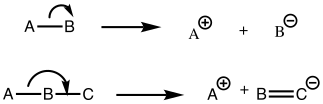
- Whilst the first example has examples such as SN1 ionizations, the second is perhaps not as common as might be imagined. It would only work if atom C (assuming it to be carbon) was e.g. a carbene (with six valence electrons) converting to a vinyl carbanion (with eight). Although we may speculate that Ingold thought that the second example might relate to common reactions, in the event both curly arrows are still entirely valid by modern standards. There is no acknowledgement of Robinson’s 1924 effort.
- Ingold goes on to discuss substitution patterns in benzene derivatives, and the o/p or m-directing abilities of substituents. He concludes that the Dewar formula for benzene is the most satisfactory vehicle for expressing the theory that electrical disturbances readily reach the o- and p-position, whilst only a small second order effect can reach the m-position. Here I think we can conclude that this approach has not survived into modern thinking. Robinson in his 1924 arrows had of course striven to explain the apparent propensity of nitrosobenzene towards electrophilic substitution in the p-position. Henry Armstrong some thirty years earlier in 1887[1] had arguably already made a pretty decent start, without requiring the use of Dewar benzene.
I suspect those who have dug through the historical archives to cast light on the Robinson/Ingold rivalry may not have appreciated that the Journal of the Imperial College Chemical Society might have been an interesting source!
‡There were nine volumes produced during 1921-1930. It then morphed into The Scientific Journal of the Royal College of Science which continued for an unknown number of years.
References
- H.E. Armstrong, "XXVIII.—An explanation of the laws which govern substitution in the case of benzenoid compounds", J. Chem. Soc., Trans., vol. 51, pp. 258-268, 1887. https://doi.org/10.1039/ct8875100258
Tags: arrow pushing, chemical reaction, Chemical Society, chemist, Chemistry, Christopher Ingold, Christopher Kelk Ingold, College of Science, Country: United Kingdom, Fellows of the Royal Society, Henry Armstrong, Imperial College Chemical Society, Imperial College London, Ingold, Knights Bachelor, Person Career, Robert Robinson, Royal College of Science, The Scientific Journal
Posted in Interesting chemistry | No Comments »
August 22nd, 2018
In 2012, I wrote a story of the first ever reaction curly arrows, attributed to Robert Robinson in 1924. At the time there was a great rivalry between him and another UK chemist, Christopher Ingold, with the latter also asserting his claim for their use. As part of the move to White City a lot of bookshelves were cleared out from the old buildings in South Kensington, with the result that yesterday a colleague brought me a slim volume they had found entitled The Journal of the Imperial College Chemical Society (Volume 6).‡
This journal is a record of lectures given to the chemistry department by visiting speakers, this one dating from 1926, about two years after the article by Robinson noted above.

There are a number of points of interest.
- Early on, Ingold introduces the topic of atoms in combination. Lewis (who is acknowledged to have introduced this concept in 1916) is mentioned in parentheses, if not actually in passing, as generalizing (Lewis) from this case, … As was the practice at the time, referencing one’s sources was not always common, and you do not here get an actual citation for Lewis!
- Next comes the topic changes in molecular structure (which could be a synonym for reactions) and here you get this diagram
 A modern version is shown below, scarcely different!
- Whilst the first example has examples such as SN1 ionizations, the second is perhaps not as common as might be imagined. It would only work if atom C (assuming it to be carbon) was e.g. a carbene (with six valence electrons) converting to a vinyl carbanion (with eight). Although we may speculate that Ingold thought that the second example might relate to common reactions, in the event both curly arrows are still entirely valid by modern standards. There is no acknowledgement of Robinson’s 1924 effort.
- Ingold goes on to discuss substitution patterns in benzene derivatives, and the o/p or m-directing abilities of substituents. He concludes that the Dewar formula for benzene is the most satisfactory vehicle for expressing the theory that electrical disturbances readily reach the o- and p-position, whilst only a small second order effect can reach the m-position. Here I think we can conclude that this approach has not survived into modern thinking. Robinson in his 1924 arrows had of course striven to explain the apparent propensity of nitrosobenzene towards electrophilic substitution in the p-position. Henry Armstrong some thirty years earlier in 1887[1] had arguably already made a pretty decent start, without requiring the use of Dewar benzene.
I suspect those who have dug through the historical archives to cast light on the Robinson/Ingold rivalry may not have appreciated that the Journal of the Imperial College Chemical Society might have been an interesting source!
‡There were nine volumes produced during 1921-1930. It then morphed into The Scientific Journal of the Royal College of Science which continued for an unknown number of years.
References
- H.E. Armstrong, "XXVIII.—An explanation of the laws which govern substitution in the case of benzenoid compounds", J. Chem. Soc., Trans., vol. 51, pp. 258-268, 1887. https://doi.org/10.1039/ct8875100258
Tags: arrow pushing, chemical reaction, Chemical Society, chemist, Chemistry, Christopher Ingold, Christopher Kelk Ingold, College of Science, Country: United Kingdom, Fellows of the Royal Society, Henry Armstrong, Imperial College Chemical Society, Imperial College London, Ingold, Knights Bachelor, Person Career, Robert Robinson, Royal College of Science, The Scientific Journal
Posted in Interesting chemistry | No Comments »
August 8th, 2018
White City is a small area in west london created as an exhibition site in 1908, morphing over the years into an Olympic games venue, a greyhound track, the home nearby of the BBC (British Broadcasting Corporation) and most recently the new western campus for Imperial College London.♣ The first Imperial department to move into the MSRH (Molecular Sciences Research Hub) building is chemistry. As a personal celebration of this occasion, I here dedicate three transition states located during my first week of occupancy there, naming them the White City trio following earlier inspiration by a string trio and their own instruments.
The chemistry revisits the mechanism of amide formation from an acid and an amine, which I first described on this blog about four years ago. I had constructed a model of one amine and one carboxylic acid, to which I added a further acid in recognition that proton transfers are a key aspect of the mechanism. When the model is quantified using quantum calculations (ωB97XD/6-311G(d,p)/SCRF=p-toluene) it resulted in a free energy barrier ΔG298‡ of about 22 kcal/mol. Re-reading what I wrote, I see I did rather gloss over this value, which implies a decently rapid reaction! In fact, the reaction occurs relatively slowly at the temperature of refluxing toluene. Perhaps some alarm bells should have been tinkling at this stage (although the sluggish reaction might for example instead be due to poor solubility) and so here I have a rethink of the model used to see if that modest barrier really is correct.
The new premise is to test if the required proton transfers can instead be mediated using a second molecule of amine instead of acid; thus two molecules of carboxylic acid are now accompanied by two of amine, one of which will be used to transfer protons. The second acid is retained to facilitate comparison. As before, the mechanism is characterised by three transition states and two tetrahedral intermediates. The new mechanism is summarised below, with TS1-3 being the White City Trio.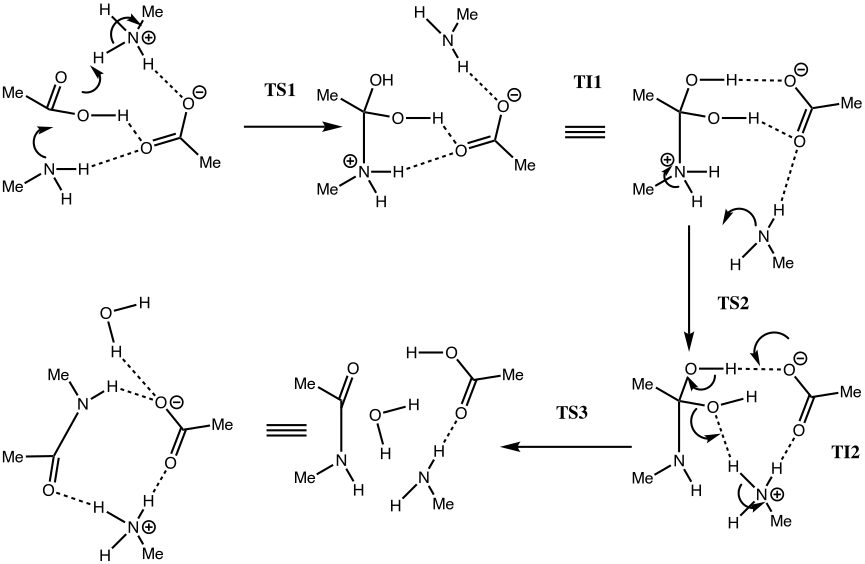
The free energies are summarised in the table below. TS3, the rate limiting step, is slightly lower in energy if the amine is used for the proton transfer than via carboxylic acid. This is the wrong direction; we really want the barrier to increase to explain the relative difficulty of the reaction as observed in refluxing toluene! Fear not however, the new barrier is indeed a much more sluggish 28.6 kcal/mol (30.5 using a larger basis set).
How did this happen? It’s the reactants! The original reactant model was based on the known structure of acetic acid dimer, with an amine weakly hydrogen bonded. Adding an extra amine now allows an entirely new motif to form, in which the amine disrupts the acetic dimer to form a cyclic system with a pair of very strong (-)O-H-N(+)-H-O(-) hydrogen bond units.† The original model did not have sufficient components to fully allow this to happen.
 So the White City Trio achieve a performance which helps explain why a reaction is sluggish rather than facile (normally one strives to show the opposite). Perhaps however it should be the White City quartet, in recognition that the reactant also had a role to play?
♣A photograph of the building under construction can be seen here. ‡Def2-TZVPPD basis set. †There does not appear to be a recorded structure for methylammonium acetate. We hope to obtain one to check what the extended structure actually is. ♥I will elaborate an interesting new use of this value in a separate post.
Tags: acetic acid, Acid, Amide, Amine, carboxylic acid, Chemistry, Company: BBC, Company: British Broadcasting Corporation, energy, Ester, exhibition site, free energy barrier, Functional groups, Hydrogen bond, Imperial College, Imperial College London, Ionic product, Newspaper & Magazine Printing Services, Non-ionic product, Olympic games, Organic chemistry, White City Trio
Posted in Interesting chemistry | 6 Comments »
August 8th, 2018
White City is a small area in west london created as an exhibition site in 1908, morphing over the years into an Olympic games venue, a greyhound track, the home nearby of the BBC (British Broadcasting Corporation) and most recently the new western campus for Imperial College London.♣ The first Imperial department to move into the MSRH (Molecular Sciences Research Hub) building is chemistry. As a personal celebration of this occasion, I here dedicate three transition states located during my first week of occupancy there, naming them the White City trio following earlier inspiration by a string trio and their own instruments.
The chemistry revisits the mechanism of amide formation from an acid and an amine, which I first described on this blog about four years ago. I had constructed a model of one amine and one carboxylic acid, to which I added a further acid in recognition that proton transfers are a key aspect of the mechanism. When the model is quantified using quantum calculations (ωB97XD/6-311G(d,p)/SCRF=p-toluene) it resulted in a free energy barrier ΔG298‡ of about 22 kcal/mol. Re-reading what I wrote, I see I did rather gloss over this value, which implies a decently rapid reaction! In fact, the reaction occurs relatively slowly at the temperature of refluxing toluene. Perhaps some alarm bells should have been tinkling at this stage (although the sluggish reaction might for example instead be due to poor solubility) and so here I have a rethink of the model used to see if that modest barrier really is correct.
The new premise is to test if the required proton transfers can instead be mediated using a second molecule of amine instead of acid; thus two molecules of carboxylic acid are now accompanied by two of amine, one of which will be used to transfer protons. The second acid is retained to facilitate comparison. As before, the mechanism is characterised by three transition states and two tetrahedral intermediates. The new mechanism is summarised below, with TS1-3 being the White City Trio.
The free energies are summarised in the table below. TS3, the rate limiting step, is slightly lower in energy if the amine is used for the proton transfer than via carboxylic acid. This is the wrong direction; we really want the barrier to increase to explain the relative difficulty of the reaction as observed in refluxing toluene! Fear not however, the new barrier is indeed a much more sluggish 28.6 kcal/mol (30.5 using a larger basis set).
How did this happen? It’s the reactants! The original reactant model was based on the known structure of acetic acid dimer, with an amine weakly hydrogen bonded. Adding an extra amine now allows an entirely new motif to form, in which the amine disrupts the acetic dimer to form a cyclic system with a pair of very strong (-)O-H-N(+)-H-O(-) hydrogen bond units.† The original model did not have sufficient components to fully allow this to happen.
 So the White City Trio achieve a performance which helps explain why a reaction is sluggish rather than facile (normally one strives to show the opposite). Perhaps however it should be the White City quartet, in recognition that the reactant also had a role to play?
♣A photograph of the building under construction can be seen here. ‡Def2-TZVPPD basis set. †There does not appear to be a recorded structure for methylammonium acetate. We hope to obtain one to check what the extended structure actually is. ♥I will elaborate an interesting new use of this value in a separate post.
Tags: acetic acid, Acid, Amide, Amine, carboxylic acid, Chemistry, Company: BBC, Company: British Broadcasting Corporation, energy, Ester, exhibition site, free energy barrier, Functional groups, Hydrogen bond, Imperial College, Imperial College London, Ionic product, Newspaper & Magazine Printing Services, Non-ionic product, Olympic games, Organic chemistry, White City Trio
Posted in Interesting chemistry | 6 Comments »
August 7th, 2018
Harnessing FAIR data is an event being held in London on September 3rd; no doubt most speakers will espouse its virtues and speculate about how to realize its potential. Admirable aspirations indeed, but capturing hearts and minds also needs lots of real life applications! Whilst assembling a forthcoming post on this blog, I realized I might have one nice application which also pushes the envelope a bit further, in a manner that I describe below.
The post I refer to above is about using quantum chemical calculations to chart possible mechanistic pathways for the reaction between a carboxylic acid and an amine to form an amide. The FAIR data for the entire project is collected at DOI: 10.14469/hpc/4598. Part of what makes it FAIR is the metadata not only collected about this data but also formally registered with the DataCite agency. Registration in turn enables Finding; it is this aspect I want to demonstrate here.
The metadata for the above DOI includes information such as;
- The ORCID persistent identifier (PID) for the creator of the data (in this instance myself)
- Date stamps for the original creation date and subsequent modifications.
- A rights declaration, in this case the CC0 license which describes how the data can be re-used.
- Related identifiers, in this case describing members of this collection.
The data itself is held in the members of the collection, each of which is described by a more specific set of metadata in addition to the more general types in the above list (e.g. 10.14469/hpc/4606).
- One important additional metadata descriptor is the ORE locator (Object Re-use and Exchange, itself almost a synonym for FAIR). This allows a machine to deduce a direct path to the data file itself, and hence to retrieve it automatically if desired. It is important to note that the DOI itself (i.e. 10.14469/hpc/4606) points only to the “landing page” for the dataset, and does not necessarily describe the direct path to any specific file in the dataset. The ORE path can be used with e.g. software such as JSmol to directly load a molecule based only on its DOI. You can see an example of this here.
- Each molecule-based dataset contains additional specific metadata relating to the molecule itself. For example this is how the InChiKey, an identifier specific to that molecule, is expressed in metadata;
<subject subjectScheme="inchikey" schemeURI="http://www.inchi-trust.org/">PVXKWVPAMVWJSQ-UHFFFAOYSA-N</subject>
The advantage of expressing the metadata in this way is that a general search of the type:
https://search.datacite.org/works?query=subjectScheme:inchikey+subject:CZABGBRSHXZJCF-UHFFFAOYSA-N
can be used to track down any molecule with metadata corresponding to the above InChIkey.
- Here is more metadata, introduced in this blog. It relates to the (computed) value of the Gibbs energy (the energy unit is in Hartree†), as returned by the Gaussian program;
<subject subjectScheme="Gibbs_Energy" schemeURI="https://goldbook.iupac.org/html/G/G02629.html" valueURI="http://gaussian.com/thermo/">-649.732417</subject>
I here argue that it represents a unique identifier for a molecule calculation using the quantum mechanical procedures implemented in e.g. Gaussian. This identifier is different from the InChIkey, in that it can be truncated to provide different levels of information.
- At the coarsest level, a search of the type
https://search.datacite.org/works?query=subjectScheme:Gibbs_energy+subject:-649.*
should reveal all molecules with the same number of atoms and electrons whose Gibbs energy has been calculated, but not necessarily with the same InChI (i.e. they may be isomers, or transition states, etc). This level might be useful for revealing most (not necessarily all‡) molecules involved in say a reaction mechanism. It should also be insensitive to the program system used, since most quantum codes will return a value for the Gibbs energy if the same procedures have been used (i.e. DFT method, basis set, solvation model and dispersion correction) accurate to probably 0.01 Hartree.
- The top level of precision however is high enough to almost certainly relate to a specific molecule and probably using a specific program;
https://search.datacite.org/works?query=subjectScheme:Gibbs_energy+subject:-649.732417
- The searcher can experiment with different levels of precision to narrow or broaden the search.
- I would also address the issue (before someone asks) of why I have used the Gibbs energy rather than the Total energy. Put simply, the Gibbs energy is far more useful in a chemical context. It can be used to relate the relative Gibbs energies of different isomers of the same molecule to e.g. the equilibrium constant that might be measured. Or the difference in Gibbs energies between a reactant and a transition state can be used to derive the free energy activation barrier for a reaction. The total energy is not so useful in such contexts, although of course it too could be added as a subject in the metadata above if a real use for it is found.
- The searcher can also use Boolean combinations of metadata, such as specifying both the InChIKey and the Gibbs Energy, along with say the ORCID of the person who may have published the data;
https://search.datacite.org/works?query=
subjectScheme:Gibbs_energy+subject:-649.*+
subjectScheme:inchikey+subject:CZABGBRSHXZJCF-UHFFFAOYSA-N+
ORCID:0000-0002-8635-8390♥
I have tried to show above how FAIR data implies some form of rich (registered) metadata. And how the metadata can be used to Find (the F in FAIR) data with very specific properties, thus Harnessing FAIR data.
†It is a current limitation of the V4.1 DataCite schema that there appears no way to specify the data type of the subject, including any units. ‡In theory, a range query of the type:
https://search.datacite.org/works?query=
subjectScheme:Gibbs_energy+subject:[-649.1 TO -649.8]
should be more specific, but I have not yet gotten it to work, probably because of the lack of data-typing means it is not recognised as a range of numeric values. ♥Implicit in this search is the grouping
https://search.datacite.org/works?query=(subjectScheme:Gibbs_energy+subject:-649.*)
+
(subjectScheme:inchikey+subject:CZABGBRSHXZJCF-UHFFFAOYSA-N)
+ORCID:0000-0002-8635-8390
Currently however DataCite do not correctly honour this form of grouping.
Tags: Academic publishing, chemical context, Code, data, DataCite, energy, free energy activation barrier, Identifiers, Information, ISO/IEC 11179, ORCiD, quantum chemical calculations, real life applications, Technical communication
Posted in Interesting chemistry | 9 Comments »
July 25th, 2018
Consider the four reactions. The first two are taught in introductory organic chemistry as (a) a proton transfer, often abbreviated PT, from X to B (a base) and (b) a hydride transfer from X to A (an acid). The third example is taught as a hydrogen atom transfer or HAT from X to (in this example) O. Recently an article has appeared[1] citing an example of a fourth fundamental type (d), which is given the acronym cPCET which I will expand later. Here I explore this last type a bit further, in the context that X-H bond activations are currently a very active area of research.
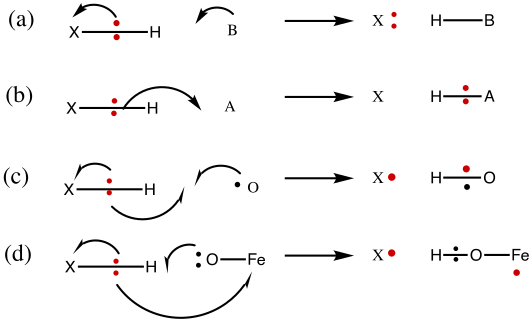
To help understand these four types, I have colour-coded the electron pair constituting the X-H covalent bond in red.
- In mechanism (a), this electron pair stays with X, thus liberating a proton which is captured by the base.
- The hydride transfer (b) is so-called because in fact this electron pair travels together with the proton, hence the term hydride or H–.
- Hydrogen atom transfers as in (c) in effect transfer both a proton and one electron to another atom (oxygen in the example above), leaving behind one electron on X. The electron and the proton are said to travel together as a “true” hydrogen atom.
- The fourth mechanism (d) is fundamentally different from (c) in that whilst the electron and the proton travel in concert (at the same time), they do not travel together. In this example the proton travels to the oxygen, whilst the electron travels to the iron centre, in the process reducing its oxidation state. This mode is now called a concerted proton-coupled electron transfer, or cPCET as above.
The tool employed to distinguish between mechanisms (c) and (d) is the IBO or intrinsic bond orbital localisation scheme.[2] One practical advantage of such a scheme over better known localisation methods such as NBO (Natural bond orbitals) is that IBOs can be made to transform smoothly during the course of a reaction, as followed by say an IRC (Intrinsic reaction coordinate). NBOs may instead show discontinuous behaviour along a reaction IRC. Klein and Knizia have located transition states for examples of both (c) and (d) above and studied the IBOs along such IRCs. The two IBO reaction transformations are very different, as illustrated below (used, with permission, from the article itself). For the HAT type (X=C above), an α-spin IBO morphs from a C-H bond into a H-O bond, whilst the β-spin counterpart morphs from being located on the C-H bond into a carbon-centered radical. For the cPCET mode, the α-spin IBO morphs from C-H to a C-centered radical, but the β-spin region grows onto an iron d-orbital. It is in fact even more complex than the diagram above implies, since some reorganisation of the O-Fe region occurs and the H…:O region is still anti-bonding at the transition state.

We can see from this that mechanistic reaction analysis is starting to track the “curly arrows” we conventionally use to represent reactions in some detail, as well as informing us about the relative detailing timing of the various curly arrows used. Of course this latter aspect cannot be easily represented by conventional curly arrows. It seems timely to revisit the vast corpus of organic and organometallic “curly arrow pushing” to starting adding such information!
References
- J.E.M.N. Klein, and G. Knizia, "cPCET versus HAT: A Direct Theoretical Method for Distinguishing X–H Bond‐Activation Mechanisms", Angewandte Chemie International Edition, vol. 57, pp. 11913-11917, 2018. https://doi.org/10.1002/anie.201805511
- G. Knizia, "Intrinsic Atomic Orbitals: An Unbiased Bridge between Quantum Theory and Chemical Concepts", Journal of Chemical Theory and Computation, vol. 9, pp. 4834-4843, 2013. https://doi.org/10.1021/ct400687b
Tags: chemical reactions, Chemistry, Deprotonation, Hydride, Hydrogen, Hydrogen atom abstraction, Proton, proton travel, Proton-coupled electron transfer, Technology/Internet
Posted in Interesting chemistry | No Comments »
July 18th, 2018
FAIR is one of those acronyms that spreads rapidly, acquires a life of its own and can mean many things to different groups. A two-day event has just been held in Amsterdam to bring some of those groups from the chemical sciences together to better understand FAIR. Here I note a few items that caught my attention.
- Fairsharing.org was the basis for several presentations. It serves as “a curated, informative and educational resource on data and metadata standards, inter-related to databases and data policies.” It promotes establishing metrics which strive to quantify how FAIR any given resource is.[1] Any site which achieves a good FAIR metric can be described as a FAIR data point (a term new to me), and which can serve as an exemplar of what FAIR data aspires to.
- Intrigued, I offered this page and hope to establish its FAIR metric in the near future, if only to understand how to improve its “score” so that future pages can be improved. It is based on the following Figure[2] which appeared in a recent article and appears to be a publishing “first” in as much as the figure contains hyperlinks directly to the data sources upon which it is based. The putative FAIR data point takes this a little further by wrapping the figure with visualisation tools which take the FAIR data and convert it to interactive models with the help of an added toolbox.
- Another topic for discussion was spectroscopy and a veritable file format for its distribution, JCAMP-DX. One emerging theme is the idea of promoting two types of spectral distribution. The first is the use of a common standard format (JCAMP-DX) which strives to eliminate much of the proprietary character associated with data emerging from instruments. At the other extreme is to to offer to readers the raw instrumental data,[3] which has the advantage of having none of the inevitable loss of information when transforming to standard formats. The downside is that it almost always can only be processed using proprietary software provided by the instrument vendor. One way of avoiding this is Mpublish (the topic of an earlier blog) and we heard interesting updates on progress from MestreLabs, the originators of this procedure. It is still my hope that more vendors (both of instruments and of software) will adopt such a model.
- A further topic was metadata, which is at the heart of each of the terms in FAIR (F = findable, A = accessible, I = interoperable and R = re-usable), which are all defined in part at least by the metadata associated with any item. The state of metadata associated with research data is often dire, and often too little resource has been assigned to its improvement. I presented an example of how richer metadata might be injected. The below is a snippet of the metadata associated with one entry in a data repository (download the metadata here and open the file with a text editor). An advantage of doing this is that rich searches against these terms become enabled.

- Finally, I note events such as e.g. Harnessing FAIR data are starting to spring up. This one is at Queen Mary University of London on 3rd September 2018, for which “PhDs and Post Docs from a range of disciplines” are welcomed, they of course being the pre-eminent generators of data and often the ones in charge of making it “FAIR”.
References
- M.D. Wilkinson, S. Sansone, E. Schultes, P. Doorn, L.O. Bonino da Silva Santos, and M. Dumontier, "A design framework and exemplar metrics for FAIRness", Scientific Data, vol. 5, 2018. https://doi.org/10.1038/sdata.2018.118
- S. Arkhipenko, M.T. Sabatini, A.S. Batsanov, V. Karaluka, T.D. Sheppard, H.S. Rzepa, and A. Whiting, "Mechanistic insights into boron-catalysed direct amidation reactions", Chemical Science, vol. 9, pp. 1058-1072, 2018. https://doi.org/10.1039/c7sc03595k
- J.B. McAlpine, S. Chen, A. Kutateladze, J.B. MacMillan, G. Appendino, A. Barison, M.A. Beniddir, M.W. Biavatti, S. Bluml, A. Boufridi, M.S. Butler, R.J. Capon, Y.H. Choi, D. Coppage, P. Crews, M.T. Crimmins, M. Csete, P. Dewapriya, J.M. Egan, M.J. Garson, G. Genta-Jouve, W.H. Gerwick, H. Gross, M.K. Harper, P. Hermanto, J.M. Hook, L. Hunter, D. Jeannerat, N. Ji, T.A. Johnson, D.G.I. Kingston, H. Koshino, H. Lee, G. Lewin, J. Li, R.G. Linington, M. Liu, K.L. McPhail, T.F. Molinski, B.S. Moore, J. Nam, R.P. Neupane, M. Niemitz, J. Nuzillard, N.H. Oberlies, F.M.M. Ocampos, G. Pan, R.J. Quinn, D.S. Reddy, J. Renault, J. Rivera-Chávez, W. Robien, C.M. Saunders, T.J. Schmidt, C. Seger, B. Shen, C. Steinbeck, H. Stuppner, S. Sturm, O. Taglialatela-Scafati, D.J. Tantillo, R. Verpoorte, B. Wang, C.M. Williams, P.G. Williams, J. Wist, J. Yue, C. Zhang, Z. Xu, C. Simmler, D.C. Lankin, J. Bisson, and G.F. Pauli, "The value of universally available raw NMR data for transparency, reproducibility, and integrity in natural product research", Natural Product Reports, vol. 36, pp. 35-107, 2019. https://doi.org/10.1039/c7np00064b
Tags: Acronym, Amsterdam, chemical sciences, City: Amsterdam, Queen Mary University of London, spectroscopy, Technology/Internet, text editor, University of London, visualisation tools
Posted in Interesting chemistry | 3 Comments »
July 12th, 2018
This last month, as a follow-up to the preceding post on the colour of flowers, I have been moonlighting by blogging elsewhere. Do go visit my “guerrilla blog” at perivalepark.london. Part of this project involves visiting two “physic or botanic” gardens, which originate from early 17th century explorations of herbs and other botanicals as medicines. Both are very old and their chemistry is indeed fascinating; more of which later.
Meanwhile to add a splash of colour, here is a photo of a (parched) Perivale Park itself.

Tags: Botany, Herb
Posted in Interesting chemistry | No Comments »
June 18th, 2018
It was about a year ago that I came across a profusion of colour in my local Park. Although colour in fact was the topic that sparked my interest in chemistry many years ago (the fantastic reds produced by diazocoupling reactions), I had never really tracked down the origin of colours in many flowers. It is of course a vast field. Here I take a look at just one class of molecule responsible for many flower colours, anthocyanidin, this being the sugar-free counterpart of the anthocyanins found in nature.
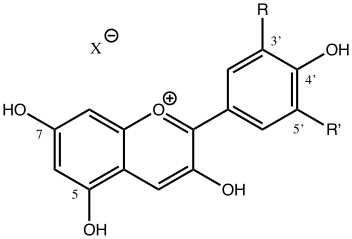
These vary widely in the substituent around the aromatic rings, but here I take a look at just three differing substitutions. Thus pelargonidin has just one OH on ring C (R1‘, R3‘=H, see crystal structure[1]), cyanidin has two (R5‘=H, see crystal structure[2]) and is found in red roses, dahlia, peonies etc. Finally delphinidin (no crystal structure available) has three OHs in that region and is found in yes, delphiniums but also grape skins etc. Below is a colour table that allows one to relate the electronic transitions in a molecule to the observed colour, which of course is due to removal (absorption) of wavelength of light leaving us to see all the remaining wavelengths.

Next I show the computed UV/visible spectra of these three species (ωB97XD/6-311G(d,p)/SCRF=water)‡. Click on any image to se a 3D model of the molecule.
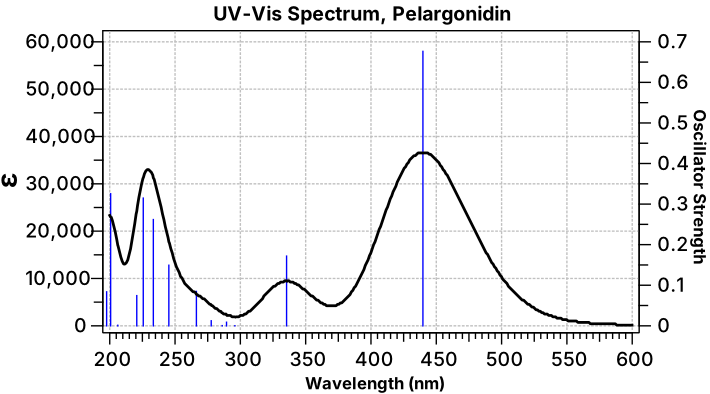
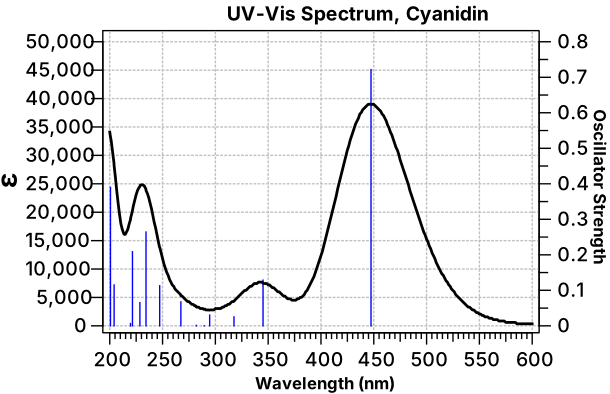

Note how in the visible region, all have a very simple (monochromatic) single electronic transition comprising mostly the HOMO→LUMO excitation.

Click to view 3D model of the HOMO

Click to view 3D model of the LUMO
Now, λmax can be predicted quite poorly using most DFT methods, but the trends should be better predicted. Thus the change induced by adding two hydroxy groups is ~7nm, which is in effect how the colour seen in a flower can be tuned to display different shades.
Next, pH. Using delphinidin, under basic conditions one can remove a proton from the cationic species to produce a neutral quinone. In fact, any one of five OH groups could have its proton removed and so it is of some interest to compare the relative energies of the five isomers so produced.
| Position proton removed |
Relative ΔG298, kcal/mol |
| 4′ |
0.0 |
| 5 |
3.8 |
| 7 |
4.7 |
| 3′ |
11.8 |
| 5′ |
22.2 |
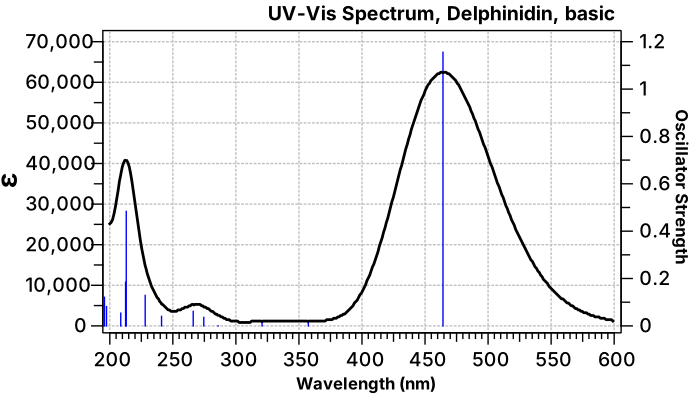
In fact, one species only would have the major Boltzmann population (4′) and so we need only look at its UV/Visible predicted spectrum. This is shifted 17nm towards the red, thus producing a blue colour in what remains after it is absorbed. The absorption (ε) also increases significantly. Indeed the very striking colour of blue delphiniums (one of my favourite flowers) must be produced by such pH control in the plant. Given the presence of delphinidin in many grape skins, the next time I drink a glass of red wine, I will see if it turns blue upon adding some NaOH!
‡FAIR data doi: 10.14469/hpc/4473
References
- N. Saito, and K. Ueno, "The Crystal and Molecular Structure of Pelargonindin Bromide Monohydrate", HETEROCYCLES, vol. 23, pp. 2709, 1985. https://doi.org/10.3987/r-1985-10-2709
- K. Ueno, and N. Saito, "Cyanidin bromide monohydrate (3,5,7,3',4'-pentahydroxyflavylium bromide monohydrate)", Acta Crystallographica Section B Structural Crystallography and Crystal Chemistry, vol. 33, pp. 114-116, 1977. https://doi.org/10.1107/s0567740877002702
Tags: Anthocyanidin, Anthocyanin, Chemistry, Delphinidin, HOMO/LUMO, Major, Molecular electronic transition, Molecule, Nature, PH indicators, Quantum chemistry, spectroscopy, Ultraviolet–visible spectroscopy
Posted in Interesting chemistry | 4 Comments »
May 16th, 2018
Ten years are a long time when it comes to (recent) technologies. The first post on this blog was on the topic of how to present chemistry with three intact dimensions. I had in mind molecular models, molecular isosurfaces and molecular vibrations (arguably a further dimension). Here I reflect on how ten years of progress in technology has required changes and the challenge of how any necessary changes might be kept “under the hood” of this blog.
That first post described how the Java-based applet Jmol could be used to present 3D models and animations. Gradually over this decade, use of the Java technology has become more challenging, largely in an effort to make Web-page security higher. Java was implemented into web browsers via something called Netscape Plugin Application Programming Interface or NPAPI, dating from around 1995. NPAPI has now been withdrawn from pretty much all modern browsers.‡ Modern replacements are based on JavaScript, and the standard tool for presenting molecular models, Jmol has been totally refactored into JSmol.† Now the challenge becomes how to replace Jmol by JSmol, whilst retaining the original Jmol Java-based syntax (as described in the original post). Modern JSmol uses its own improved syntax, but fortunately one can use a syntax converter script Jmol2.js which interprets the old syntax for you. Well, almost all syntax, but not in fact the variation I had used throughout this blog, which took the form:
<img onclick=”jmolApplet([450,450],’load a-data-file;spin 3;’);” src=”static-image-file” width=”450″ /> Click for 3D structure
This design was originally intended to allow browsers which did not have the Java plugin installed to default to a static image, but that clicking on the image would allow browsers that did support Java to replace (in a new window) the static image with a 3D model generated from the contents of a-data-file. The Jmol2.js converter script had not been coded to detect such invocations. Fortunately Angel came to my rescue and wrote a 39 line Javascript file that does just that (my Javascript coding skills do not extend that far!). Thanks Angel!!
In fact I did have to make one unavoidable change, to;
<img onclick=”jmolApplet([450,450],’load a-data-file;spin 3;’,’c1′);” src=”image-file” width=”450″ /> Click for 3D structure
to correct an error present in the original. It manifests when one has more than one such model present in the same document, and this necessitates that each instance has a unique name/identifier (e.g. c1). So now, in the WordPress header for the theme used here (in fact the default theme), the following script requests are added to the top of each page, the third of which is the new script.
<script type=”text/javascript” src=”JSmol.min.js”></script>
<script type=”text/javascript” src=”js/Jmol2.js”></script>
<script type=”text/javascript” src=”JmolAppletNew.js”></script>
The result is e.g.

Click for 3D structure of GAVFIS

Click for 3D interaction
This solution unfortunately is also likely to be unstable over the longer term. As standards (and security) evolve, so invocations such as onclick= have become considered “bad practice” (and may even become unsupported). Even more complex procedures will have to be devised to keep up with the changes in web browser behaviour and so I may have to again rescue the 3D models in this blog at some stage!¶ Once upon a time, the expected usable lifetime of e.g. a Scientific Journal (print!) was a very long period (>300 years). Since ~1998 when most journals went online, that lifetime has considerably shortened (or at least requires periodic, very expensive, maintenance). For more ambitious types of content such as the 3D models discussed here, it might be judged to be <10 years, perhaps much less before the maintenance becomes again necessary. Sigh!
‡ At the time of writing, WaterFox is one of the few browsers to still support it. †An early issue with using Javascript instead of Java was performance. For some tasks, the former was often 10-50 times slower. Improvements in both hardware and software have now largely eliminated this issue. ¶Thus using Jquery.
Tags: Ajax, Computer programming, computing, Cross-platform software, HTML, Java, Java applet, Java technology, JavaScript, JavaScript libraries, jmol, JQuery, NPAPI, Scientific Journal, Software engineering, Technology/Internet, web browser behaviour, web browsers, Web-page security
Posted in Interesting chemistry | 6 Comments »


