Posts Tagged ‘Interesting chemistry’

Herapathite: an example of (double?) serendipity.

Thursday, October 14th, 2021

On October 13, 2021, the historical group of the Royal Society of Chemistry organised a symposium celebrating ~150 years of the history of (molecular) chirality. We met for the first time in person for more than 18 months and were treated to a splendid and diverse program about the subject. The first speaker was Professor John Steeds from Bristol, talking about the early history of light and the discovery of its polarisation. When a slide was shown about herapathite[1] my “antennae” started vibrating. This is a crystalline substance made by combining elemental iodine with quinine in acidic conditions and was first discovered by William Herapath as long ago as 1852[2] in unusual circumstances. Now to the serendipity!

Herapath was able to get small crystals of this substance and discovered that when he placed one crystal upon another at “right angles”, the combination went “black as midnight”. He recognised that it was functioning as an excellent linear light polarizer, absorbing virtually all the light polarized along the shorter axis of the best-developed facet of the crystal. A number of well known scientists investigated this substance at the time, but by about 1951 it had largely been forgotten. The person to rediscover it was Edwin Land, of Polaroid camera fame.[3] He oriented the microcrystals into an extruded polymer to stabilize them and hence produce the first large-aperture light polarizer, which enabled him to manufacture his first camera. The serendipity resulted from him spotting the by then forgotten properties of Herapathite (I wonder if he recorded how this actually came about) and recognising how to exploit it.

In 2009 Bart Kahr had noticed that the crystal structure of this material had never been reported. It was a challenging structure to solve[1] but established that the polarizing property of the crystals was in large measure due to the presence of infinite chains of I3 units aligned in an almost linear channel in the crystal structure. And so it was that in October 2021, John Steeds showed the structure containing these iodine chains in his slide on the topic. The crystal structure is in the CCDC database as WEYDOV and can be seen here at DOI: 10.5517/ccsdg7v I show below part of the extended lattice, showing that chain of iodines.

Click to view 3D model of WEYDOV

So the next (possible) instance of serendipity. From the audience, I immediately recognised this structural motif as being related to the crystal structure of both Na+I (NAIACE) and Na+I2 (GADMOO)[4] which I discussed in one of the very first posts on this blog in 2009 as part of a story about the Finkelstein reaction. Both these structures were obtained from acetone solution, and this solvent very much forms part of the crystal structures, serving to coordinate the sodium cations and playing the role of the quinine in herapathite. The iodine chains, comprising in GADMOO units of I3 and I, are almost exactly linear!

Click to view 3D model of NAICE

Click to view 3D model of GADMOO

So, the question arises as to whether crystals of Na+I2 have ever been examined for light polarisation? One might also ask whether eg the chiral quinine imparts a critical property to the herapathite crystal, or could the achiral acetone also serve the purpose? What would happen if substituted versions of acetone were used (halo, methyl etc)? Would they destroy those linear chains, or would they survive? Are repeating chains of I3 units essential, or can chains of alternating units of I3 and I also serve the purpose? All questions that can only be answered by experiments! Anyone up for trying?


This post has DOI: 10.14469/hpc/9537


References

  1. B. Kahr, J. Freudenthal, S. Phillips, and W. Kaminsky, "Herapathite", Science, vol. 324, pp. 1407-1407, 2009. https://doi.org/10.1126/science.1173605
  2. W.B. Herapath, "XXVI. <i>On the optical properties of a newly-discovered salt of quinine, which crystalline substance possesses the power of polarizing a ray of light, like tourmaline, and at certain angles of rotation of depolarizing it, like selenite</i>", The London, Edinburgh, and Dublin Philosophical Magazine and Journal of Science, vol. 3, pp. 161-173, 1852. https://doi.org/10.1080/14786445208646983
  3. E.H. Land, "Some Aspects of the Development of Sheet Polarizers*", Journal of the Optical Society of America, vol. 41, pp. 957, 1951. https://doi.org/10.1364/josa.41.000957
  4. R.A. Howie, and J.L. Wardell, "Polymeric tris(μ<sub>2</sub>-acetone-κ<sup>2</sup><i>O</i>:<i>O</i>)sodium polyiodide at 120 K", Acta Crystallographica Section C Crystal Structure Communications, vol. 59, pp. m184-m186, 2003. https://doi.org/10.1107/s0108270103006395
More record breakers for the anomeric effect involving C-N bonds.

Saturday, September 4th, 2021

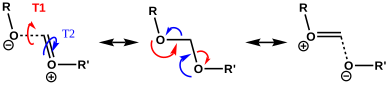
An earlier post investigated large anomeric effects involving two oxygen atoms attached to a common carbon atom.

A variation is to replace one oxygen by a nitrogen atom, as in N-C-O. Shown below is a scatter plot of the two distances to the common carbon atom derived from crystal structures.

You can see some entries for which the C-O bond length is shorter than normal and the C-N distance very much longer than normal; an example of a highly asymmetric anomeric effect operating in just one direction rather than the two shown in the top diagram (red/blue arrows).

One example is LOFPON[1] (DOI: 10.5517/cc121rsn) with bond lengths shown calculated at the ωB97XD/def2svpp level (Calculation DOI: 10.14469/hpc/8682) and is rationalised by the nitrogen being a quaternary cation and hence an excellent leaving group which biases the electron flow towards it. Anomeric effects can be quantified using a technique known as NBO analysis, which uses perturbation theory to estimate the interaction energy between a donor orbital (the oxygen lone pair in this case) and an acceptor orbital (the C-N σ* unoccupied orbital). Populating the C-N σ* antibonding orbital causes the C-N length to increase and the interaction energy in this example is 36.4 kcal/mol. This is around twice the normal value for anomeric effects and so is unusually large.

LOFPON

The other prominent example is NAWNUV (Data DOI: 10.5517/cc93pkm) where the bond length asymmetry is slightly larger and so is the perturbation energy (E2) is 41.0 kcal/mol (ωB97XD/def2svpp calculation DOI: 10.14469/hpc/8378). 

NAWNUV

In the opposite direction, NUQKAM[2] is an example of a lengthened C-O bond and a shortened C-N bond, with the crystal structure (DOI: 10.5517/ccv3ln5) shown below.

In this instance, a ωB97XD/def2svpp calculation (Data DOI: 10.14469/hpc/8806) does not bear this structure out, with CN and CO bond lengths of 1.422 (vs 1.369) and 1.434 (vs 1.529)Å and a final E(2) of 22.1 kcal/mol (which is close to normal). This is an example of how mining the crystal structure can yield results that can be checked by a different (quantum computational) technique, which in this instance reveals a probable issue in the crystal structure refinement which is probably causing the apparently large anomeric effect in the crystal structure to manifest.

Another entry is ANUVUD[3] with a crystal structure (data DOI: 10.5517/ccdc.csd.cc24zxdg) shown below and CN and CO lengths of 1.391 and 1.559Å, which in this case ARE reasonably replicated by calculation (1.402, 1.499). This effect is promoted by the good leaving group ability of the carboxylate anion and the antiperiplanar orientation of the nitrogen lone pair with respect to the C-O bond, E(2)=35.2 kcal/mol (DOI: 10.14469/hpc/8807)

I end with FEHYOG, a relatively old structure[4] showing a very long C-N distance (1.673Å) but a normal associated C-O distance (1.423Å). This rings an alarm bell. Indeed, the respective computed distances are 1.482 and 1.425Å, a significant discrepancy (DOI: 10.14469/hpc/8769). The NBO interaction energy is an umremarkable 12.5 kcal/mol.

Data mining of the crystal structure database has revealed a number of abnormally large bond length asymmetries around the N-C-O unit. Some of these are true record breakers, but two have been identified where calculations cannot reproduce the observed bond lengths. One might indeed ask whether a quantum computation of the structure might not be added to the curation checks made by the CCDC of their database. It might improve the quality of the data even further!

References

  1. N. Mercadal, S.P. Day, A. Jarmyn, M.B. Pitak, S.J. Coles, C. Wilson, G.J. Rees, J.V. Hanna, and J.D. Wallis, "<i>O</i>-<i>vs. N</i>-protonation of 1-dimethylaminonaphthalene-8-ketones: formation of a<i>peri</i>N–C bond or a hydrogen bond to the pi-electron density of a carbonyl group", CrystEngComm, vol. 16, pp. 8363-8374, 2014. https://doi.org/10.1039/c4ce00981a
  2. A. Rivera, J.J. Rojas, J. Ríos-Motta, M. Dušek, and K. Fejfarová, "3,3′-Ethylenebis(3,4-dihydro-6-chloro-2<i>H</i>-1,3-benzoxazine)", Acta Crystallographica Section E Structure Reports Online, vol. 66, pp. o1134-o1134, 2010. https://doi.org/10.1107/s1600536810014248
  3. Y. Wang, D. Sun, Y. Chen, J. Xu, Y. Xu, X. Yue, J. Jia, H. Li, and L. Chen, "Alkaloids of Delphinium grandiflorum and their implication to H2O2-induced cardiomyocytes injury", Bioorganic & Medicinal Chemistry, vol. 37, pp. 116113, 2021. https://doi.org/10.1016/j.bmc.2021.116113
  4. N. Paillous, S.F. Forgues, J. Jaud, and J. Devillers, "[2 + 2] Cycloaddition of two CN double bonds. First structural evidence for head-to-tail photodimerization in the 2-phenylbenzoxazole series", J. Chem. Soc., Chem. Commun., pp. 578-579, 1987. https://doi.org/10.1039/c39870000578

Tetra-isopropylmethane and tetra-t-butylmethane.

Tuesday, August 17th, 2021

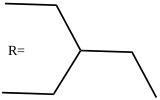
The homologous hydrocarbon series R4C is known for R=Me as neopentane and for R=Et as 3,3-diethylpentane. The next homologue, R=iPr bis(3,3-isopropyl)-2,4-dimethylpentane is also a known molecule[1] for which a crystal structure has been reported (DOI: https://doi.org/10.5517/cc4wvnh). The final member of the series, R= tbutyl is unknown. Here I have a look at some properties of the last two of these highly hindered hydrocarbons.

First the non-covalent-interactions (NCI) analysis, for a ωB97XD/Def2-SVPP/SCRF=dichloromethane wavefunction. This explores the properties of the weak electron density in the regions in between bonds, ie the non-bonded regions. In the presentation below, if that region is stabilizing, the surface is coloured cyan or dark green whereas if it is destabilising, it is pale green, yellow or orange. 

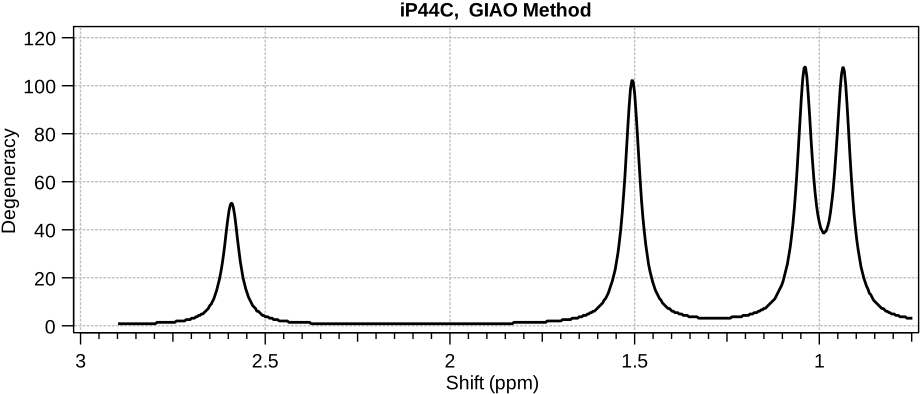
The above for R=iPr shows extensive but disconnected regions with NCI properties, with the pale cyan/green ones stabilizing and the regions verging on yellow repulsive. It would not be easy to conclude that this molecule overall is stabilised by dispersion! The predicted 1H NMR spectrum shows only one methine environment (2.59 ppm) but three methyl ones at 1.51, 1.04 and 0.94 (1.16 av/obs 2.23 and 1.04) ppm. The C-C bond lengths are 1.581Å (obs 1.599).

The NCI for R = tbutyl shows that the entire NCI surface is connected within the regions of the molecule, with far more green/yellow than stabilizing cyan. This molecule, which has an unusual T chiral symmetry is certainly sterically strained. The predicted C-C bond lengths of 1.668Å are unusually long (wB97XD/Def2-TZVPP).

The optical rotation (589nm) is -179°, which raises the question of whether it would be configurationally stable? The predicted 1H NMR shows three methyl environments (2.21, 1.92 and 0.44 ppm), averaging to 1.52ppm, which is significantly different from the isopropyl analogue.

Tetra t-butylmethane is often cited as the smallest branched hydrocarbon that cannot be made.[2],[3],[4] Certainly it looks far more strained than the isopropyl version. Its preparation is a challenge that might never be achieved!

References

  1. S.I. Kozhushkov, R.R. Kostikov, A.P. Molchanov, R. Boese, J. Benet-Buchholz, P.R. Schreiner, C. Rinderspacher, I. Ghiviriga, and A. de Meijere, "Tetracyclopropylmethane: A Unique Hydrocarbon with S4 Symmetry", Angewandte Chemie International Edition, vol. 40, pp. 180-183, 2001. https://doi.org/10.1002/1521-3773(20010105)40:1<180::aid-anie180>3.0.co;2-k
  2. K.M. Nalin de Silva, and J.M. Goodman, "What Is the Smallest Saturated Acyclic Alkane that Cannot Be Made?", Journal of Chemical Information and Modeling, vol. 45, pp. 81-87, 2004. https://doi.org/10.1021/ci0497657
  3. M. Cheng, and W. Li, "Structural and Energetics Studies of Tri- and Tetra-<i>tert</i>-butylmethane", The Journal of Physical Chemistry A, vol. 107, pp. 5492-5498, 2003. https://doi.org/10.1021/jp034879r
  4. N.L. Allinger, J. Lii, and H.F. Schaefer, "Molecular Mechanics (MM4) Studies on Unusually Long Carbon–Carbon Bond Distances in Hydrocarbons", Journal of Chemical Theory and Computation, vol. 12, pp. 2774-2778, 2016. https://doi.org/10.1021/acs.jctc.5b00926

Sterically stabilized cyclopropenylidenes. An example of Octopus publishing?

Sunday, August 15th, 2021

Whilst I was discussing the future of scientific publication in the last post, a debate was happening behind the scenes regarding the small molecule cyclopropenylidene. This is the smallest known molecule displaying π-aromaticity, but its high reactivity means that it is unlikely to be isolated in the condensed phase. A question in the discussion asked if substituting it with a large sterically hindering group such as R=Et3C might help prevent its dimerisation and hence allow for isolation of the monomer so that its properties can be studied.

But first, a crystal structure search for this interesting group, Et3C, which is one step up in steric size from the very much better known Me3C or t-butyl. As it happens 34 examples emerge, and the dihedral angle distribution of the three ethyl groups is shown below. The three clusters all correspond to conformations with two gauche and one anti ethyl group. 

Whilst on the topic of crystal structures, I note that there are 5 examples known of the next steric homologue, i-Pr3C and a surprising 18 of t-Bu3C. I will discuss these groups elsewhere.

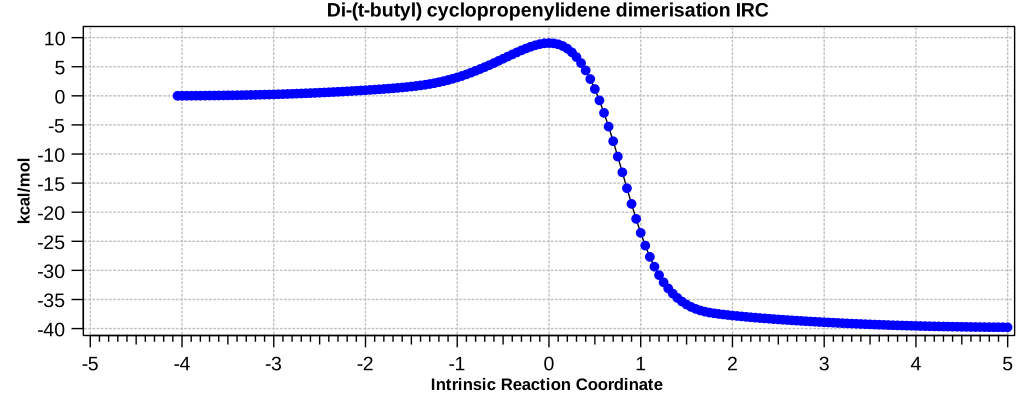
Next, a protocol for modelling the dimerisation: ωB97XD/Def2-SVPP/SCRF=dichloromethane. The IRC for R=H is shown at DOI: 10.14469/hpc/8705 and here I show that for R=Me3 showing a slightly larger barrier.

The results for three substituents are summarised in the table below which show that the barrier is a maximum for the t-butyl group and then decreases slightly for the apparently “larger” Et3C group.

R ΔG FAIR Data DOI
H 14.4 10.14469/hpc/8470
10.14469/hpc/8495
Me3C 16.0 10.14469/hpc/8706
10.14469/hpc/8707
Et3C 15.4 10.14469/hpc/8712
10.14469/hpc/8724
iPr3C* 25.5 10.14469/hpc/8722
tBu3C* 101.7 10.14469/hpc/8768
10.14469/hpc/8743

The analysis of this result is as noted in the discussion alluded to above, which is that these large groups, bristling with exposed hydrogen atoms, are strong dispersion attractors, at the right interatomic distances. The t-butyl group must be slightly sterically repulsive for the dimerisation reaction, but those dispersion attractions stabilise the slightly larger Et3C group. This could be tested further with R=i-Pr3C and t-Bu3C*.

I wanted to end this by going back to the opening line of this post. It struck me that the three posts here on the topic of cyclopropenylidene and the discussion they induced is not dissimilar from the “octopus” publishing modelling I had previously looked at.

  1. It started with setting out the initial seeding publication, in this case by noting that cyclopropenylidene had recently been reported in the atmosphere of Saturn’s moon Titan.[1].
  2. The hypothesis was that this molecule might be π-aromatic, an observation not noted in the original report (DOI: 10.14469/hpc/8716)
  3. A protocol for testing this hypothesis was to look at the occupied molecular orbitals of this molecule using a DFT-based quantum method (DOI: 10.14469/hpc/8716)
  4. The data resulting from this protocol is published (DOI: 10.14469/hpc/8714).
  5. Visual analysis showed two π-electrons (4n+2, n=0) i0n a molecular orbital fully delocalised around the three membered ring, which itself implies charge asymmetry in the molecule (DOI: 10.14469/hpc/8716)
  6. The original hypothesis of ring aromaticity was thus confirmed.
  7. A real-world problem then arose in the discussion relating to the dipole moment of this species resulting from the charge asymmetry.
  8. The review in this case was by comments posted to the blog posts here (a form of non-anonymous review).
  9. These reviews then spawned a new hypothesis, that a molecule based on cyclopropenylidene might support a record-large dipole moment (DOI: 10.14469/hpc/8717)
  10. This idea started a new cycle in which cyclopropenylidene might react with a source of dicarbon to give the desired molecule (DOI: 10.14469/hpc/8717)
  11. This cycle in turn spawned the current discussion, which relates to whether cyclopropenylidene might have a sufficiently long bimolecular lifetime to react with another molecule in preference to reacting with itself (DOI: 10.14469/hpc/8715)
  12. With a fork into crystal structure mining of steric groups beyond t-butyl.
  13. The latter resulting in a further cycle likely to be started relating to the hypothesis of R = i-Pr3C as an interesting steric group.

So we see here what might map to three cycles of “octopus publishing”. Those cycles were however non-linear, in that they did not happen in quite the sequence outline above; the discussions forked and split out from the original cycle, re-entering at different points in the cycle. My point being that scientific research is indeed very often cyclical and non-linear, albeit traditionally its reporting taking place in a form where many of the individual aspects of this process are bundled together in the form of a research article, a box-set if you will, which you can binge on if you wish. The concept of Octopus publishing is to fragment this model into smaller, stand-alone episodes, linked perhaps by a metadata-based DOI crumb trail. Lets see if the perceived benefits of publishing in this way catch on in chemistry.


*Further entries added to table.

References

  1. C.A. Nixon, A.E. Thelen, M.A. Cordiner, Z. Kisiel, S.B. Charnley, E.M. Molter, J. Serigano, P.G.J. Irwin, N.A. Teanby, and Y. Kuan, "Detection of Cyclopropenylidene on Titan with ALMA", The Astronomical Journal, vol. 160, pp. 205, 2020. https://doi.org/10.3847/1538-3881/abb679

Molecules with very large dipole moments: cyclopropenium acetylide

Sunday, July 11th, 2021

Occasionally, someone comments about an old post here, asking a question. Such was the case here, when a question about the dipole moment of cyclopropenylidene arose. It turned out to be 3.5D, but this question sparked a thought about the related molecule below.

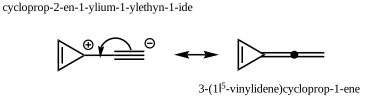
Of the two resonance forms show above, the one on the left is a zwitterion resulting in the formation of an aromatic cyclopropenium ring, with the charge balanced by the acetylide anion. The calculated structure (ωB97XD/Def2-TZVPP/SCRF=chloroform, Data DOI 10.14469/hpc/8399 ) shows a short terminal CC bond which indicates a significant degree of delocalisation of the three membered ring.

Molecular electrostatic potential

The molecular electrostatic potential (above) agrees with a large dipole moment of 11.9D. This is certainly up there with the molecule suggested in 2016 as being the most polar molecule neutral compound synthesised[1] and is a fair bit smaller than that candidate. A brief search of the literature (Scifinder) suggest that the molecule is currently unknown. Anybody fancy making it?

The Data DOI by the way gives you access to the other outputs from the calculation, which would include the molecular orbitals and the molecular vibrations which I have not shown here.


Such zwitterions are known as unstable intermediates. See e.g. [2] for examples.

References

  1. J. Wudarczyk, G. Papamokos, V. Margaritis, D. Schollmeyer, F. Hinkel, M. Baumgarten, G. Floudas, and K. Müllen, "Hexasubstituted Benzenes with Ultrastrong Dipole Moments", Angewandte Chemie International Edition, vol. 55, pp. 3220-3223, 2016. https://doi.org/10.1002/anie.201508249
  2. H.S. Rzepa, "Routes involving no free C <sub>2</sub> in a DFT-computed mechanistic model for the reported room-temperature chemical synthesis of C <sub>2</sub>", Physical Chemistry Chemical Physics, vol. 23, pp. 12630-12636, 2021. https://doi.org/10.1039/d1cp02056k

A closer look at that fourth bond in C2.

Wednesday, June 2nd, 2021

From the last few posts here, you might have noticed much discussion about how the element carbon might sustain a quadruple bond. The original post on this topic from some years ago showed the molecular orbitals of the species CN+, which included two bonding π-types and a low lying nodeless bonding σ-orbital, all with double occupancies and adding up to a triple bond. Discussing now C2 itself, there are two remaining orbitals for consideration which we will for the purpose here call the highest occupied σ-MO or HOσMO (Σu) and the lowest unoccupied σ-MO or LUσMO (Σg) and which are more mysterious.

The HOσMO itself has one node (the lowest unoccupied or LUσMO has a further second node) bisecting the centre of the C-C bond, which makes it anti-bonding. This is emphasised by squaring the orbital (below), which shows a clear void of electron density in the C-C region. For this reason, many text books illustrating the main group diatomic molecules represent C2 with two bonds: 3-1 = 2.

CASSCF(8,6) “HOMO”/”LUMO” orbitals and densities of C2
(HOσMO)@0.02au (LUσMO)@0.02au
(HOσMO2)@0.0004au (LUσMO2)@0.0004au

Now to a MCSCF(8,6)/Def2-SVPD calculation (FAIR DOI: 10.14469/hpc/8307) which means a multi-configuration calculation. Regular e.g. DFT methods assume only a single electronic configuration in which one set of doubly-occupied orbitals is variationally optimized. Thankfully, for the vast majority of molecules, this is actually a very good approximation. However for some species, and C2 is one such, this is no longer true. A CASSCF(8,6) calculation uses the 105 different electronic configurations generated by using eight electrons in an active space of six orbitals and variationally optimises them all for a self-consistent-field. The orbitals corresponding to the erstwhile single-configurational HOσMO and LUσMO are the ones shown above. Their squares are shown underneath, the latter as noted above relating to the electron density distribution in the molecule.

The MCSCF calculation for C2 shows that primarily two different electronic configurations contribute significantly to the total wavefunction, the one with two electrons in the original HOσMO (now of course a misnomer) having a weight of 1.573e and the configuration with two electrons promoted to the now similarly misnamed LUσMO orbital by virtue of having a weight of 0.427e. This shows that this final 2e really must be described by two electronic configurations rather than one (and which reminds that the terms HOσMO and LUσMO really only apply to single-configuration methods). What difference does that make to the picture? The scaled linear combination of the two orbitals deriving from the two dominant electronic configurations for C2 below shows that each now has an “extrusion” of the original orbital creeping along the C-C axis.

(1.573*HOσMO + 0.427*LUσMO)@0.02au (1.573*HOσMO – 0.427*LUσMO)@0.02au

Squaring and weighted adding shows us what is happening to the electron density. That void in the density along the C-C axis apparent in the HOσMO above has now been nicely filled with density from those extrusions deriving from the partially occupied “LUσMO”. As a result, the node in the density along the bond has now vanished. By elevating 0.427 of the electrons from the original anti-bonding HOσMO into the complementary LUσMO, a new weakly-bonding “baby” orbital with ~two-electron occupancy replaces the original antibonding HOσMO. There is however relatively little additional density placed into the C-C region because of only 0.427e transfer into the “LUσMO”. The weak bonding character also matches the “bond dissociation energy” of this fourth bond of ~17 kcal/mol as inferred by experimental measurement of the energies of the two reactions HC≡CH → HC≡C + H; HC≡C → CC + H.

(1.573*(HOσMO)2 + 0.427*(HOσMO)2)@0.0004au
The (Σg)2@0.0004au conventional σ-bond for comparison
g)2 – (1.573*(HOσMO)2 + 0.427*(HOσMO)2)@0.0004au

So by combining the appropriate occupancies of the HOσMO and LUσMO in a multi-configurational approach to C2, a new weak bond emerges, which when added to the three existing bonds referred to above gives a representation of four rather than two bonds for this molecule.


The DOI of this post is https://doi.org/gf9s


The weights for a CASSCF(12,12) calculation with 427350 configurations are 1.568 and 0.426. Conversely, a CASSCF(8,5) calculation on 15 configurations yields 1.533 and 0.467. The optimised geometries also show an interesting trend. Thus 8,5 = 1.198Å, 8,6 = 1.230 and 12,12 = 1.262Å. As the active space decreases, so the weight of the configuration with a populated Σg orbital increases by “concentration” into this orbital and hence the C-C bond length also decreases as the amount of density injected into the C-C region increases.

A reality-based suggestion for a molecule with a metal M⩸N quadruple bond.

Thursday, May 13th, 2021

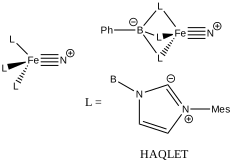
I noted in an earlier post the hypothesized example of (CO)3Fe⩸C[1] as exhibiting a carbon to iron quadruple bond and which might have precedent in known five-coordinate metal complexes where one of the ligands is a “carbide” or C ligand. I had previously mooted that the Fe⩸C combination might be replaceable by an isoelectronic Mn⩸N pair which could contain a quadruple bond to the nitrogen. An isoelectronic alternative to FeC could also be FeN+. Here I explore the possibility of realistic candidates for such bonded nitrogen.

So I follow the strategy set in the previous post of conducting a crystal structure search of molecules containing the sub-structure L3-MN or L4-MN. Of the 85 hits for the former (FAIR DOI 10.14469/hpc/8196), I focus on those where N has only one bonded atom (to the metal M) and the ligand L is non-anionic connecting to the metal via e.g. carbon or phosphorus. This reduces to 11 hits, which in fact contain something similar to the Arduengo “carbene” ligand L shown below, this being known as a phosphine replacement. Here I look at one of these molecules, the internal ion-pair where the positive charge on the N is balanced by a four-coordinate negative boron, as in HAQLET.[2] (Data DOI: 10.5517/ccdc.csd.cc1p0mp0).

As with (CO)3Fe⩸C, L3Fe⩸N+ has a filled 18-electron metal valence shell. A ωB97XD/Def2-SVPD calculation on a simplified model (with aryl groups replaced by H) reveals the following NBO localised orbitals.

M-N, r = 1.475Å.
NBO 72, Occupied, Non-bonding d-orbital NBO 71, Occupied, Non-bonding d-orbital
NBO 67 π bond NBO 66 π bond
NBO 59 σ bond NBO 27 σ bond

There are two σ-bonds and two π-bonds between the Fe and the N. The molecule is presumably inhibited from reaction such as e.g. dimerising, because the iron-bonded nitrogen atom sits in a well created by the mesityl groups, thus sterically preventing any N…N approach close enough and at the appropriate angle to unite the two units. The free energy of dimerisation of the unhindered model used above is -49.7 kcal/mol.

I remind that the NBO method being used to ascertain the nature of the bonding here is a binary method, giving localised NBO orbitals with ~2e occupancies that contain an integer number of bonding orbitals between any pair of atoms. In this case, these can point to either a triple or a quadruple M…N bond for such systems and do not allow for a continuum approach where the weight of each localised bond might not be close to an integer. The purpose here is to flag this system for further analysis rather than as a definitive declaration of its quadruple-bonded nature.

References

  1. A.J. Kalita, S.S. Rohman, C. Kashyap, S.S. Ullah, and A.K. Guha, "Transition metal carbon quadruple bond: viability through single electron transmutation", Physical Chemistry Chemical Physics, vol. 22, pp. 24178-24180, 2020. https://doi.org/10.1039/d0cp03436c
  2. L. Bucinsky, M. Breza, W. Lee, A.K. Hickey, D.A. Dickie, I. Nieto, J.A. DeGayner, T.D. Harris, K. Meyer, J. Krzystek, A. Ozarowski, J. Nehrkorn, A. Schnegg, K. Holldack, R.H. Herber, J. Telser, and J.M. Smith, "Spectroscopic and Computational Studies of Spin States of Iron(IV) Nitrido and Imido Complexes", Inorganic Chemistry, vol. 56, pp. 4751-4768, 2017. https://doi.org/10.1021/acs.inorgchem.7b00512

A suggestion for a molecule with a M⩸C quadruple bond with trigonal metal coordination.

Thursday, May 13th, 2021

The proposed identification of molecules with potential metal to carbon quadruple bonds, in which the metal exhibits trigonal bipyramidal coordination rather than the tetrahedral modes which have been proposed in the literature[1],[2],[3] leads on to asking whether simple trigonal coordination at the metal can also sustain this theme?

The rational for doing this is the observation for the trigonal bipyramidal molecules that repulsions between a non-bonding occupied d-orbital on the metal and one of the two putative metal to carbon σ-bonds resulted in the two electrons localising into a lone pair on carbon. By removing the electrons in this metal d-orbital or by increasing its size, the C σ-lone pair was encouraged to abandon some of its lone pair character and participate in a quadruple bond.

Another way of achieving this result is explored here, with the molecule shown above. Two of the trigonal carbon ligands are pinned back by the ring to reduce any potential repulsions. As before, this complex constitutes a filled 18-valence shell metal. The calculated orbitals (ωB97XD/Def2-SVPD, FAIR DOI: 10.14469/hpc/8206) are shown below.

M=Co, r = 1.493Å.
NBO 26, π bond NBO 24, non-bonding d-orbital
NBO 23 σ bond, 0.02 au NBO 23 σ bond, 0.01 au
NBO 22 π bond NBO 14 σ bond

Despite the appearance of a bond between Co and C along the C⩸Co axis in the representations above (inserted off its own bat by the JSmol program), no such bond exists in the NBO list. No precedent for this kind of structure appears in the crystal structure database. As before, the NBO 23 σ bond at low isosurface thresholds expands to add a second layer along the Co⩸C axis, in which the nodal surface exists between the two layers rather than along the bond itself. It therefore constitutes a bonding orbital.

These quadruple bond motifs involving carbon are certainly starting to emerge in unexpected places and I do wonder how many more variations on this theme will be identified.

References

  1. A.J. Kalita, S.S. Rohman, C. Kashyap, S.S. Ullah, and A.K. Guha, "Transition metal carbon quadruple bond: viability through single electron transmutation", Physical Chemistry Chemical Physics, vol. 22, pp. 24178-24180, 2020. https://doi.org/10.1039/d0cp03436c
  2. A.J. Kalita, S.S. Rohman, C. Kashyap, S.S. Ullah, I. Baruah, L.J. Mazumder, P.P. Sahu, and A.K. Guha, "Is a transition metal–silicon quadruple bond viable?", Physical Chemistry Chemical Physics, vol. 23, pp. 9660-9662, 2021. https://doi.org/10.1039/d1cp00598g
  3. L.F. Cheung, T. Chen, G.S. Kocheril, W. Chen, J. Czekner, and L. Wang, "Observation of Four-Fold Boron–Metal Bonds in RhB(BO<sup>–</sup>) and RhB", The Journal of Physical Chemistry Letters, vol. 11, pp. 659-663, 2020. https://doi.org/10.1021/acs.jpclett.9b03484

What does a double σ-bond along a bond axis look like?

Monday, May 10th, 2021

Introductory chemistry will tell us that a triple bond between say two carbon atoms comprises just one bond of σ-axial symmetry and two of π-symmetry. Increasingly mentioned nowadays is the possibility of a quadruple bond between carbon and either itself or a transition metal, as discussed in the previous post. Such a bond comprises TWO bonds of σ-axial symmetry. Since most people are unfamiliar with such double bonds and in particular with how that second σ-bond sits with the first, I thought it would be interesting to show such an orbital. This one is a localised orbital 41, selected from the previous post for the molecule (PH3)2(CN)2Mo⩸C.

NBO 41, threshold 0.040 au NBO 41, threshold 0.018
NBO 41, threshold 0.016 NBO 41, threshold 0.014
NBO 41, threshold 0.012 NBO 41, threshold 0.007

The above shows how the orbital changes with the isosurface threshold. At high values, it looks very similar to the normal σ-bond but as the threshold gradually decreases, a second “sheath” starts to surround the inner orbital until the latter is entirely enclosed. This orbital has a node not so much along the bond itself, but between the inner and outer layers of the bond, which is how the two σ-bonds are differentiated. This effect was first noted in 2016 in terms of the compound CH3F2-, in which an expanded carbon valence shell creates a second σ-bond.

Certainly not a representation that has ever appeared in a text book I think! But perhaps one that chemists may have increasingly to become familiar with.


Appendix Here are some superimposed orbitals to facilitate comparisons. Firstly orbital 41 (the higher energy σ-orbital) with orbital 22 (the lower energy σ-orbital). The first has yellow/green for the two phases, the second has red/blue.

Next, σ-orbital 22 (yellow/green) with orbital 42 (red/blue) surrounding it, revealing the avoided overlaps (Pauli repulsions) between the two by virtue of having orbital 42 unoccupied.

Next, σ-orbital 41 (yellow/green) with orbital 42 (red/blue) surrounding it, revealing the reduced overlap between these two.

Appendix 2 A “pure” form of the double-layered σ-bond can be seen with the diatomic molecule Ti2, contoured at 0.0225 au. The red phase is about to join in the middle.

The electron density from this orbital is shown below and shows clearly the two layers of density comprising the σ-bond, with the outer layer at this isosurface value (0.00052 au) about to join up in the middle to complete the outer sheath. I have left it unjoined so that you can see “inside layer”, since translucency does not always get the message across.

Two new reality-based suggestions for molecules with a metal M⩸C quadruple bond.

Saturday, May 8th, 2021

Following from much discussion over the last decade about the nature of C2, a diatomic molecule which some have suggested sustains a quadruple bond between the two carbon atoms, new ideas are now appearing for molecules in which such a bond may also exist between carbon and a transition metal atom. A suggested, albeit hypothetical example was C⩸Fe(CO)3[1]. Iron has a [Ar].3d6.4s2 electronic configuration and if we ionise to balance a C4- ligand, the iron becomes formally FeVI or [Ar].3d4. By adding 14 electrons deriving from the seven “bonds” to the 3d4, including a quadruple count from carbon, the Fe formally completes its 18-electron valence shell, as also found in e.g. Ferrocene.

A search for crystal structures containing the very simple query structure shown below, where C is defined as having one atom only attached, TR is any transition metal and the structure is non-polymeric, was undertaken to see if any examples of this motif might already exist. 

Zero hits with 4-coordinate metal atoms, but 11 real examples were found (FAIR DOI 10.14469/hpc/8190), all of which exhibit a five-coordinate transition metal centre, where X is a mono-anionic ligand (CN, halogen, etc) and L is a neutral ligand (PR3 etc). The most common metal was M = Ru, the electronic configuration of which is [Kr].4d75s1, becoming [Kr].4d2 by ionising to balance a C4- ligand and the two X ligands. There are now 16 electrons from the eight “bonds” surrounding the atom, including again a quadruple one from the carbon and forming a filled 18-electron valence shell around the metal.

So could these 11 constitute known examples of quadruple bonds from a transition metal to carbon? I will investigate using M=Ru, L = PH3 and X = CN, which represents a simplified form of one of the 11 examples[2] using the following electronic model: ωB97XD/Def2-SVPD. The focus will be on five localised NBO orbitals (the procedure I used previously to count the number of bonds at carbon for C⩸Fe(CO)3).

For M=Ru, the NBOs emerge as follows (click on any orbital thumbnail to convert to a 3D rotatable model).

M=Ru, r = 1.624Å.
NBO 42, Occupied, Non-bonding d-orbital NBO 41 π bond
NBO 36 π bond NBO 35 σ bond
NBO 34 non-bonding carbon lone pair Overlap of orbitals 42 and 34

This reveals only a triple Ru≡C bond plus a non-bonding lone pair on carbon. It turns out that bonding σ-orbital 34 is “surrounded” by the non-bonding Ru d-orbital 42. The electron-electron repulsions between the pair causes the electrons in orbital 34 to locate onto the carbon to form a non-bonding lone pair, as thus:

So might it be possible to persuade this carbon lone pair to instead donate into the M-C bond to form that fully-fledged quadruple bond?

One simple strategy is to remove the two electrons in orbital 42, preventing the Pauli repulsions from occuring and this can be done by using Mo instead of Ru.

M=Mo, r = 1.673Å
NBO 42 unoccupied Non-bonding d-orbital NBO 41 σ bond
NBO 40 π bond NBO 39 π bond
NBO 22 σ bond

By removing the repulsions to the non-bonding d-orbital, we have now transformed the erstwhile carbon lone pair into a fully fledged bond as in orbital 22, thus forming the quadruple motif. There are two electrons less, so this time the Mo valence shell is a 16-electron system.

So, SUGGESTION 1:

The second possibility is to increase the size of the non-bonding d-orbital 42 by changing from Ru to Os. Here again, orbital 22 is less repelled by the electrons in orbital 42 due to the larger size of the latter and so can again become C-Os bonding rather than non-bonding carbon lone pair.

M=Os, r = 1.679Å
NBO 42 Occupied Non-bonding d-orbital NBO 41 π bond
NBO 40 σ bond NBO 35 π bond
NBO 22 σ bond

So, SUGGESTION 2

This approach also reveals the binary decision in the NBO analysis, either an orbital is classified as “LP” and hence is not considered a bond, or it is classified as “BD” and is a bond. Reality is certainly more nuanced, with weights needing to be assigned to each valence bond representation (rather than just 1.0 or 0.0). Probably also these weights will depend on a number of factors, such as basis set quality and the method applied (e.g. the DFT procedure used). So the binary terms “triple” or “quadruple” do not carry the full measure of the bonding behaviour, which may be a continuum between these two extremes. But the two molecules shown above do represent molecules that could be realistically synthesized, since they are but small variations of already known molecules. Once made, they could then be subjected to appropriate experimental analysis to test the bonding hypotheses made here.


This post has DOI: https://doi.org/gbq3


References

  1. A.J. Kalita, S.S. Rohman, C. Kashyap, S.S. Ullah, and A.K. Guha, "Transition metal carbon quadruple bond: viability through single electron transmutation", Physical Chemistry Chemical Physics, vol. 22, pp. 24178-24180, 2020. https://doi.org/10.1039/d0cp03436c
  2. T.J. Morsing, A. Reinholdt, S.P.A. Sauer, and J. Bendix, "Ligand Sphere Conversions in Terminal Carbide Complexes", Organometallics, vol. 35, pp. 100-105, 2015. https://doi.org/10.1021/acs.organomet.5b00803