Posts Tagged ‘Interesting chemistry’

Room-temperature superconductivity in a carbonaceous sulfur hydride!

Saturday, October 17th, 2020

The title of this post indicates the exciting prospect that a method of producing a room temperature superconductor has finally been achived[1]. This is only possible at enormous pressures however; >267 gigaPascals (GPa) or 2,635,023 atmospheres.

The system is made by milling a mixture of elemental carbon and sulfur, followed by adding hydrogen gas, compression to 4 GPa and finally laser-induced photolysis at 532nm for several hours. The result of this is the production of three entirely unexotic molecules, H2S, CH4 and H2 in approximately stoichiometic quantities, which at this pressure form a complex bound by van der Waals attractions. Since in this blog, I am particularly interested in molecular structures, my eye was drawn to “Extended data Figure 6, A DFT-optimized structure for (H2S)(CH4)H2 (variant 2) at 4 GPa. This structure was produced by DFT optimisation modelled at 4 GPa using the PBE functional and importantly the now standard Grimme dispersion correction (often indicated as GD3+BJ, and used frequently on this blog). Since this complex is bound by dispersion attractions, it might be tempting to conclude that the intermolecular features of this structure originate in part from the Grimme dispersion model as well as possible hydrogen bonding from quantum effects.

I would love to be able to play with this structure to e.g. measure properties such as hydrogen bonding lengths or perform e.g. a QTAIM analysis, but have not yet acquired the “extended data” of figure 6 in the form of coordinates.‡  I have italicised the term extended data, being unsure what the journal means by this. If the figure relates to the three-dimensional extended structure of the crystal form of this complex, then one might imagine that any extended data associated with this figure would indeed be the numerical coordinates. Since the authors express the hope that “chemical tuning” of this system might enable complexes exhibiting superconductivity at lower pressures, I fancy that these coordinates might help provide insight into how to achieve such tuning. This closing paragraph of mine arose because I still frequently fail to see even prestiguous journals doing very much to encourage FAIR data associated with articles. In this instance, FAIR, at least to my mind is more than just a Figure (with or without extended data), but is genuinely inter-operable (I) or re-usable (R) data such as indeed are coordinates. To this end, I am unconvinced that this “extended data figure” is indeed properly FAIR.


I have requested these from the authors, and hope to make them available in the form of a 3D rotatable model here on the blog. It would be interesting to know if this model has been tested at the enormous pressures in this experiment. Standard dispersion models pertain to normal pressures. As was done here for Na2He.

References

  1. E. Snider, N. Dasenbrock-Gammon, R. McBride, M. Debessai, H. Vindana, K. Vencatasamy, K.V. Lawler, A. Salamat, and R.P. Dias, "RETRACTED ARTICLE: Room-temperature superconductivity in a carbonaceous sulfur hydride", Nature, vol. 586, pp. 373-377, 2020. https://doi.org/10.1038/s41586-020-2801-z

High-performance polythioesters with high chemical recyclability.

Wednesday, September 2nd, 2020

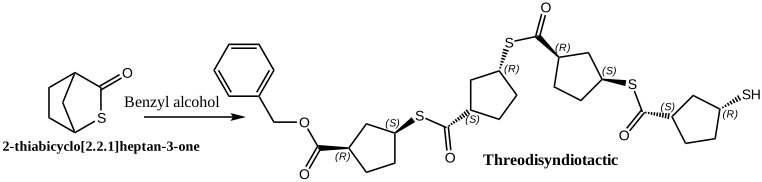
Here I investigate a recent report[1] of a new generation of polyesters with the intrinsic properties of high crystallinity and chemical recyclability. The latter point is key, since many current plastics cannot be easily recycled to a form which can be used to regenerate the original polymer with high yield. Here I show some aspects of this fascinating new type of polymer.

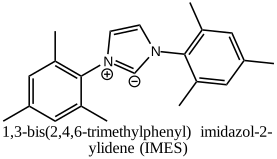
The starting monomer is 2-thiabicyclo[2.2.1]heptan-3-one, which is easily prepared on a 50g scale. When polymerised with the organocatalyst IMES (below) it produces a stereoregular threodisyndiotactic polymer of the structure shown above. Various other catalysts produced different stereochemistries.

The 13C NMR spectrum of the IMES-catalysed polymer showed just a single 13C carbonyl resonance, and the stereochemical assignment was based in part on DFT geometry optimisation calculations and then obtaining relative free energies of a model dimeric molecule, capped as a methyl ester rather than a benzyl ester. These showed that the (R,S,S,R) stereoisomer was lower than the next lowest by ~1.3 kcal/mol (Figure below). These calculations were done using a DFT procedure (BP86) that does not include dispersion corrections and so I could not but help wonder whether the conformational analysis was entirely reliable, especially if it is to be used to “tentatively” assign stereochemistry (the authors’ own description, Figure 3 below) to the pure stereopolymer B.

I thought I might make my own very quick investigation of the conformation of these quite flexible monomers. I proceeded as follows:

  1. I drew the molecule as a tetramer as shown above, for the (R,S,S,R) stereoisomer and saved the coordinates as a molfile. This adds approximate three dimensionality based on the hashes and wedges. I used a tetramer to give it sufficient size to coil around on itself if it wanted to; a dimer is a little too small to do this.
  2. This is then fed to a program which can refine such approximate structures using molecular mechanics (the MMFF94s force field, which intrinsically includes attractive dispersion terms). In this instance, I used Avogadro, producing a more accurate 3D model of the system.
  3. This was then subjected to semi-systematic conformer searching using Avogadro. The lowest energy of 27 conformations found was then taken forward for optimisation using quantum mechanical procedures.
  4. The first of these used PM7, a rapid semi-empirical procedure that includes the 3rd generation Grimme dispersion correction.
  5. This was then subjected to B3LYP+GD3BJ/Def2-SVP final refinement (again a procedure that includes a modified GD3 dispersion term with BJ damping).

The original dimer model reported in the supporting information for the article as stereoisomer 1 is shown below next to the tetramer optimised using the procedure described above.

Conformation of literature stereoisomer 1, (R,S,S,R). Click to show 3D rotatable mode

Conformation of 1 as obtained by the procedures above on the tetramer. Click to show 3D rotatable model.

Conformer 5.1 kcal/mol lower in free energy

You can explore both conformations yourself by clicking on the images above to get a 3D rotatable model. They do look rather different, in that the tetramer is wound back upon itself (a sort of hairpin looping), encouraged by the face of the phenyl group which accepts a 5-ring by dispersion attractions. The tentative assignment[1] that the (R,S,S,R) stereochemistry corresponds to that of the pure polymer B produced using the IMES catalyst must probably be just that, tentative. No doubt crystallography will verify this in due course.

We see here a possible glimpse of the future of plastics, whereby highly recyclable polymers can be produced that recover the original monomer with very little loss. All that is needed now is that the plastic is efficiently recycled and not just dumped into the oceans!


Data at DOI: 10.14469/hpc/7375

References

  1. C. Shi, M.L. McGraw, Z. Li, L. Cavallo, L. Falivene, and E.Y. Chen, "High-performance pan-tactic polythioesters with intrinsic crystallinity and chemical recyclability", Science Advances, vol. 6, 2020. https://doi.org/10.1126/sciadv.abc0495

Question for the day – Einstein, special relativity and atomic weights.

Saturday, July 25th, 2020

Sometimes a (scientific) thought just pops into one’s mind. Most are probably best not shared with anyone, but since its the summer silly season, I thought I might with this one.

Famously, according to Einstein, m  = E/c^^2, the equivalence of energy to mass. Consider a typical exoenergic chemical reaction:

 A → B, ΔG -100 kJ/mol.  

According to the above, the molecule looses 100 kJ ≡ 1.112650056053618e-18 g after transformation from A to  B. Not much, but possibly measurable using today’s very best technology.

Now for the questions that might arise.

  1. What sort of energy applies above?  If its a free energy, then thermal (zero point and entropic vibrational) energy must clearly contribute. Or is it total energy without thermal and entropic contributions? 
  2. Is the mass loss distributed equally amongst all the atoms. In other words, how much mass does any particular atom lose after reaction or is this question meaningless?
  3. Since clearly the atoms must each lose some mass, that must mean that their atomic weight is a function of the energy content of the molecule they are part of.  A molecule with a lot of internal energy (lets say octanitrocubane, which decomposes to carbon dioxide and nitrogen) must have heavier atoms in the form of cubane than as nitrogen gas.
  4. And to recapitulate the question above, how many orders of magnitude away (if any) might we be from being able to measure this? Or, one can repose this question by asking whether one can measure the mass lost by a battery after discharging?

As with most spontaneous questions, the answers are probably all out there somewhere. Just a matter of finding them!


Here is a real-world example. At the large hadron collider at CERN, about 1011 protons are accelerated to almost the speed of light. During this process, they acquire a mass approaching kgs (I do not recollect the exact value). It certainly is a surprisingly large mass! And it is a surprisingly large amount of energy that has to be injected to achieve this. And when the beam is quenched, that mass is very quickly lost (and a lot of heat is generated in the quenching tunnel).

Fascinating stereoelectronic control in Metaldehyde and Chloral.

Tuesday, June 9th, 2020

Metaldehyde is an insecticide used to control slugs. When we unsuccessfully tried to get some recently, I discovered it is now deprecated in the UK. So my immediate reaction was to look up its structure to see if that cast any light (below, R=CH3, shown as one stereoisomer).

A X-ray crystal structure exists (DOI: 10.5517/ccdc.csd.cc20n2pg) and reveals it to be the tetramer of acetaldehyde, or (CH3CHO)4. One further structure came to light, another tetramer of trichloromethylacetaldehyde, known as chloral.[1] This latter compound forms a hydrate, hence chloral hydrate. These two compounds, differing only in the methyl group, show very different conformations of the eight-membered rings. As to why this is, makes for a fascinating story.

Click to obtain 3D model

Firstly, the approach I used. I optimised the structure from the crystal data using ωB97XD/Def2-TZVPP, using C4v symmetry in which all four of the methine hydrogens point in the same direction. The resulting four H…H contacts of 2.13Å are on the short side, and are certainly contributing to the stability by dispersion (London) attractions. The C-O distances are 1.399Å. I then did an ELF (Electron localisation function) analysis to identify what are called the monosynaptic basins. Better known as lone pairs! These (along with the disynaptic basins along the C-O bonds) are shown in purple above. I have displayed the torsion or dihedral angles between each of the lone pairs on oxygen and the adjacent C-O bond (150.1 and 42.0°). This now reveals the so-called anomeric effects in the molecule. Basically one of the lone pairs on oxygen has eight sets of 150.1 angles and the other lone pair eight sets of 42.0°. Only the former lone pairs are close to being anti-periplanar to the adjacent C-O bond. In this geometry, this lone pair can donate into the C-Oσ* orbital of the bond. One can quantify the strength of this interaction using NBO (natural bond orbital) analysis, which gives a so-called E(2) perturbation interaction energy of 19.7 kcal/mol, in total eight of them. The other lone pair on each oxygen shows no discernible interaction.

On to Chloral (X = CCl3). This shows an entirely different geometry with Ci symmetry. This has two distinctly different pairs of oxygen atoms, with a pair of 2.36Å H…H contacts and two pairs of C-O distances 1.406 and 1.378Å; 1.406 and 1.380Å. This asymmetry immediately implies chloral will be more reactive towards e.g. hydrolysis, since one of the C-O bonds is already slightly lengthened. There are 16 distinct dihedral values between an oxygen lone pair and either an adjacent C-O or a C-CCl3 bond. The largest has a torsion angle at C-O of 161.2° with an NBO E(2) energy of 20.6 kcal/mol for a C-O interaction; the other torsions are 149.9, 141.1, 127.5, 112.6, 112.0, 111.1, 74.6, 68.2, 54.1, 42.6, 38.7, 32.6, 20.7, 5.7 and 4.1. There is a new anomeric effect to the adjacent C-CCl3 bond of 12.1 kcal/mol, lower for this latter interaction because the angle (113°) is far from the ideal 180°. In this model, all eight oxygen lone pairs play a role in stabilising the molecule, whereas in metaldehyde only four lone pairs do this.

Click to obtain 3D model

One can now transpose the symmetry of each molecule onto the other compound. Metaldehyde in Ci symmetry is +5.5 kcal/mol higher in free energy and chloral in C4v symmetry is +3.9 kcal/mol. The origins of these difference are probably dissipated across the multiple anomeric effects and H…H dispersion attractions.

This technique of locating the centroids of lone pairs using ELF and then correlating the dihedral angle between the lone pair and any adjacent C-X bond (X = electronegative, which makes the C-X bond a good electron acceptor) is very useful in explaining instances of the anomeric effect and comparing them across isomers.

References

  1. D. Hay, and M. Mackay, "The crystal and molecular structure of metachloral, 2(e),4(e),6(e),8(e)-Tetrakis-(trichloromethy1)-1,3,5,7-tetraoxocan", Australian Journal of Chemistry, vol. 33, pp. 2249-2253, 1980. https://doi.org/10.1071/ch9802249

The strongest bond in the universe: revisited ten years on.

Saturday, May 23rd, 2020

I occasionally notice that posts that first appeared here many years ago suddenly attract attention. Thus this post, entitled The strongest bond in the universe, from ten years back, has suddently become the most popular, going from an average of 0-2 hits per day to 92 in a single day on May 22nd (most views appear to originate from India). I can only presume that a university there has set some course work on this topic and Google has helped some of the students identify my post. Well, re-reading something you wrote ten years ago can be unsettling. Are the conclusions still sound? Would I establish my claim the same way now? After all, one picks up a little more experience in ten years. So here is my revisitation.

The hypothesis was that mono and then diprotonating dinitrogen strengthened the N-N bond, in the sequence N≡N → H-N≡N+ → H-N≡N-H2+ to the point that the latter was now a candidate for the strongest known bond between two (non-hydrogen) atoms. One of my original criteria was to calculate the N-N stretching wavenumber. To get this, I had to project out the coupling between the N-N stretching mode and the H-N modes in the latter two species. In the original discussion, Igor suggested another candidate O22+ in the comments. I speculated that the heavy atom diatomic force constant might be a better way of estimating how strong the bond was rather than the stretching wavenumber, but I never followed this up! So time to do so now.

The calculations are now at the CCSD(T)/Def2-TZVPP level (FAIR DOI: 10.14469/hpc/7214).

Species Heavy atom Force constant, mDyne/Å Projected heavy atom stretch, cm-1 Bond length, Å
N≡N 45.5177 2349 1.1029
HN≡N+ 50.2662 2469 1.0983
HN≡NH2+ 56.4903 2617 1.0859
O≡O2+ 44.9542 2184 1.0510
N≡O1+ 49.0119 2365 1.0678
HN≡O2+ 50.8061 2411 1.065
HN≡C 38.4408 2234 1.175

I did learn one new trick. To project out mode mixing between the hydrogen stretch and the heavy atom stretch, the hydrogen atom masses are now set at 10,000! This has the effect of suppressing any mode mixing, but it also results in exactly the same reduced mass for the NN stretch (14.0) for the three species N≡N, H-N≡N(+) and H-N≡N-H(2+), thus facilitating a like for like comparison. Ten years ago I had also tried the other direction, setting the mass of H to 0.001. Although this latter also eliminates the mode mixing, it does not result in the same reduced masses for the NN mode. So we will stick to the heavy hydrogen projection for comparisons.

The force constant increases almost linearly on mono and then diprotonation of dinitrogen, reaching 56.5 mDyne/Å. In comparison, both O22+ and NO1+ are a little lower. Does monoprotonating NO1+ strengthen its bond? Yes, but not quite surpassing HN≡NH2+. And the neutral HN≡C, which is isoelectronic with HN≡N+, also shows a weaker bond.

So my revisitation ten years on still shows that diprotonated nitrogen has the strongest bond (presumably in the universe), as now judged by the diatomic force constant. The hunt is still on for a species where the force constant between two non-hydrogen atoms is higher. Maybe I will return in another ten years to see the state of this challenge!

Discussion of (the) Room-temperature chemical synthesis of dicarbon – open and transparent science.

Wednesday, May 6th, 2020

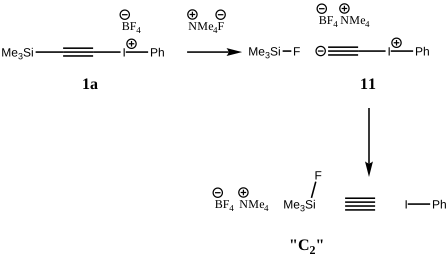
A little more than a year ago, a ChemRxiv pre-print appeared bearing the title referenced in this post,[1] which immediately piqued my curiosity. The report presented persuasive evidence, in the form of trapping experiments, that dicarbon or C2 had been formed by the following chemical synthesis. Here I describe some of what happened next, since it perhaps gives some insight into the processes of bringing a scientific result into the open.

My curiosity at that time was because a thermal facile reaction is normally associated with a sufficiently low free energy barrier to the transition state to allow a flux of the product to form on a reasonable timescale, and at a concentration that can be e.g. trapped. Dicarbon however is normally considered a very high energy species. Its formation from a precursor bearing a triple bond in this case would involve breaking the ≡CI bond in 11 above and replacing it by C⩸C, where the 4th bond is experimentally estimated to recover ~20 kcal/mol of energy. I estimated the bond dissociation energies and further calculated the free energies of the reactions of 1a, 11 and “C2” above, thus adding to the information available from the pre-print.

The original pre-print has now appeared as a full paper in Nature Communications, having passed through the peer review processes.[2] I can reveal here that I was one of the referees of this article. In my referee report I felt it appropriate to comment on my thermochemical observations on the reaction. I also waived my anonymity as part of this process (an option given to referees of this journal). Regarding the thermochemistry as essential to understanding this fascinating reaction and because it is not discussed in the final published article itself,[2] I decided to add this to the public record in the form of a matter arising (MA), also submitted to Nature Communications. Interestingly, such a form of response incurs no open access article processing charge (APC), unlike the communications themselves. In its acknowledgement of submission, the journal informs the submitting author that they can freely place the final author-version of the submission onto a pre-print server. In a sense, this completes the first cycle of this process, since that is how it all started a year ago.[1] Accordingly, you can now judge my case for the thermochemistry[3] as a ChemRxiv pre-print. This is not yet the end of the process, since the MA itself is now subjected to peer review and the original authors can also respond, a process that can take several months. 

Until recently, the mechanisms by which any given scientific article emerges, fully formed so to speak, into the (possibly) open via a journal has tended towards opaqueness, with much of the process of assessment shrouded in anonymity. At a time of a global epidemic, with major life changing daily decisions being (hopefully) made on the basis of scientific discussion and (open?) evidence, it is I think especially pertinent to show how science can operate openly and transparently, to some extent and on occasion at least.


I was informed by the editor of the journal that a blog such as this can also be considered an appropriate pre-print server. Perhaps it was a sense of symmetry that made me chose the same location where this story started, whilst charting its progress here.

This post has DOI: dtwk

References

  1. K. Miyamoto, S. Narita, Y. Masumoto, T. Hashishin, M. Kimura, M. Ochiai, and M. Uchiyama, "Room-Temperature Chemical Synthesis of C2", 2019. https://doi.org/10.26434/chemrxiv.8009633.v1
  2. K. Miyamoto, S. Narita, Y. Masumoto, T. Hashishin, T. Osawa, M. Kimura, M. Ochiai, and M. Uchiyama, "Room-temperature chemical synthesis of C2", Nature Communications, vol. 11, 2020. https://doi.org/10.1038/s41467-020-16025-x
  3. H.S. Rzepa, "A Thermodynamic assessment of the reported room-temperature chemical synthesis of C2", 2020. https://doi.org/10.26434/chemrxiv.12237980.v2

A molecular sponge for hydrogen storage- the future for road transport?

Sunday, April 19th, 2020

In the news this week is a report of a molecule whose crystal lattice is capable of both storing and releasing large amounts of hydrogen gas at modest pressures and temperatures. Thus “NU-1501-Al” can absorb 14 weight% of hydrogen. To power a low-polluting car with a 500 km range, about 4-5 kg of hydrogen gas would be need to be stored and released safely. The molecule is of interest since it opens a systematic strategy of synthetically driven optimisation towards a viable ultra-porous storage material,[1] much like a lead drug compound can be optimised.

I thought it would be informative to show a 3D interactive model of the crystal lattice here and so I went in search of coordinates. These are indeed available online. This is an example of scientific data Interoperability and Reuse, part of the FAIR data acronym. Before showing the model, I thought it worth briefly describing the procedure for starting with deposited data and converting (interoperating) it to the model here.

  1. The molecule is a so-called MOF, or Metal-Organic-Framework. The core organic framework in this case is composed of linked tryptycene derivatives. Shown below is the 3D structure of this linker, oriented here to show the three-fold symmetry (actually D3) of the molecule, rather than any attempt to reveal all the atoms without any hidden ones. To see the latter, you are encouraged to click on the diagram and view the molecule as a rotatable model instead. The coordinates below are optimised using molecular mechanics to reveal the role of the linker units.

Click for a rotatable 3D model.

  1. The data comes in the form of a CIF (crystallographic information) file and needs to be loaded into software that can manipulate such a format. In this case a program called Mercury (from CCDC) is available. Doing so reveals two minor oddities, circled in red below. The phenomenon arises from disorder, or two or more structures each with what is called partial occupancy. In this case, the disorder is largely limited to a p-substituted phenyl spacer linkage, which can adopt one of two rotational positions in the structure. The projection below is now selected to reveal the disorder rather than the symmetry.
  2. I want to “inter-operate” these coordinates into something that can be modelled and for this, the structure has to be edited to reduce it to a single unambiguous model. My very simple expedient here was simply to remove extraneous disordered atoms entirely; since they are acting as a spacing unit, this is unlikely to change the overall picture. Again, the projection below is selected to show the symmetry present and in particular the hexagonal-like channels that appear in the crystal lattice. To achieve this lattice, the unit cell has to be grown in all three directions using the calculate packing option in the Mercury program.

Click for 3D rotatable model

Clearly, the hexagonal cavities formed can accommodate a large number of hydrogen molecules. As to why, it is no doubt complex, but I cannot help but notice that the surface of the cavity is lined with multiple C-H units from the aryl spacer units pointing inwards. Given that hydrogen is a very good inducer of dispersion attractions, it would be interesting indeed to see whether the very large number of H…H2 dispersion attractions possible inside the cavity of this species might at least in part be responsible for the ability of this framework to accommodate hydrogen (or methane) gas.[2] It would be good to have an estimate of the dispersion energy term for NU-1501-Al and related species and the contribution of this term to the overall thermodynamics of the system. By the same token, replacing the four aryl C-H units with C-F units (a weaker dispersion attractor, think non-stick teflon) should reduce the ability to absorb hydrogen if dispersion is indeed important.


On the other hand, if the orientation of the aryl C-H groups is important in terms of dispersion attractons, perhaps these groups are actually critical to the effect.

References

  1. Z. Chen, P. Li, R. Anderson, X. Wang, X. Zhang, L. Robison, L.R. Redfern, S. Moribe, T. Islamoglu, D.A. Gómez-Gualdrón, T. Yildirim, J.F. Stoddart, and O.K. Farha, "Balancing volumetric and gravimetric uptake in highly porous materials for clean energy", Science, vol. 368, pp. 297-303, 2020. https://doi.org/10.1126/science.aaz8881
  2. S. Rösel, C. Balestrieri, and P.R. Schreiner, "Sizing the role of London dispersion in the dissociation of all-meta tert-butyl hexaphenylethane", Chemical Science, vol. 8, pp. 405-410, 2017. https://doi.org/10.1039/c6sc02727j

The singlet and open shell higher-spin states of [4], [6] and [8]-annulenes and their Kekulé vibrational modes

Wednesday, March 11th, 2020

In 2001, Shaik and co-workers published the first of several famous review articles on the topic A Different Story of π-Delocalization. The Distortivity of π-Electrons and Its Chemical Manifestations[1]. The main premise was that the delocalized π-electronic component of benzene is unstable toward a localizing distortion and is at the same time stabilized by resonance relative to a localized reference structure.  Put more simply, the specific case of benzene has six-fold symmetry because of the twelve C-C σ-electrons and not the six π-electrons. In 2009, I commented here on this concept, via a calculation of the quintet state of benzene in which two of the six π-electrons are excited from bonding into anti-bonding π-orbitals, thus reducing the total formal π-bond orders around the ring from three to one. I focused on a particular vibrational normal mode, which is usefully referred to as the Kekulé mode, since it lengthens three bonds in benzene whilst shortening the other three. In this case the stretching wavenumber increased by ~207 cm-1 when the total π-bond order of benzene was reduced from three to one by spin excitation. In other words, each C-C bond gets longer when the π-electrons are excited, but the C-C bond itself gets stronger (in terms at least of the Kekulé mode). This behaviour is called a violation of Badger’s rule[2] for the relationship between the length of a bond and its stretching force constant. 

This blog has come about because I wanted to revisit my original calculations and complete them with a calculation for a heptet state of benzene in which three π-electrons are promoted from bonding into anti-bonding π-orbitals, thus resulting in a total π-bond order of zero. For completness, I here present the results not only for benzene but for some other small-annulene systems, both charged and neutral. These are all done at the coupled-cluster level of theory, both CCSD and CCSD(T), along with two basis set levels (see DOI: 10.14469/hpc/6624 for the whole collection of calculations).

Before discussing the other systems, let your eye drop down the table below to the entries in red. These show the force constants for the singlet, quintet and heptet states of benzene vs the optimized C-C bond length for each (at the same level of theory). These confirm the earlier result in revealing that the quintet state (total ring π-bond order 1) has a longer bond but a stronger force constant for the Kekulé mode than the singlet state (total ring π-bond order 3). The heptet state now has a normal length C-C single bond (total ring π-bond order 0) but a Kekulé distorsion force constant higher than benzene itself! 

Things now start to get more complicated. Firstly, for benzene itself, reducing the remaining π-bond order from 1 to 0 on exciting from quintet to heptet substantially reduces the force constant. So one might conclude that reducing an annulene total π-bond order does not always result in an increase in force constant. Badger’s rule is not always violated and the distortivity of π-electrons may not be a linear phenomenon.

State Method “Kekule”
Mode, cm-1
FC,
mDyne/Å
Reduced
mass, AMU
Bond
length, Å

Data

DOI

Cyclobutadiene, dication
1A1g CCSD(T)/Def2-TZVPP 1383a 5.4102 6.5340 1.449 6920
1329b 8.0442 7.7338
3B1g CCSD/Def2-TZVPP -2195a -33.0943 11.6515 1.589 6944
-2211b -17.6740 6.1313
3A1g CCSD/Def2-TZVPP -2171a -32.2296 11.6023 1.593 6933
-2189b -16.0614 5.6844
Cyclobutadiene
3A1g CCSD/Def2-SVP 1422a 7.7848 6.5340 1.444 6634
1373b 7.9700 7.1807
CCSD(T)/Def-SVP 1395 7.2647 6.3381 1.449 6643
1345 7.6931 7.2202
CCSD/Def2-TZVPP 1392 6.9173 6.0600 1.438 6671
1342 8.0252 7.5582
CCSD(T)/Def2-TZVPP 1360 7.2647 6.3381 1.449 6672
1310 7.7044 7.6151

5B1g CCSD/Def2-SVP 1192 2.2102 2.6391 1.566 6635
1088 4.9656 7.1153
CCSD(T)/Def-SVP 1176 2.0739 2.5452 1.569 6644
1069 4.7829 7.0983
CCSD/Def-TZVPP 1177 1.8783 2.3023 1.563 6636
1067 5.0294 7.5000
CCSD(T)/Def-TZVPP 1157 1.7555 2.2253 1.568 6678
1045 4.8322 7.5073
Cyclobutadiene Di-anion (isoelectronic with benzene)
1A1g CCSD/Def2-SVP 1283 5.9023 6.0872 1.470 6652
1233 6.3831 7.1172
CCSD(T)/Def2-SVP 1258 5.5888 5.9952 1.475 6653
1209 6.1657 7.1565
CCSD/Def2-TZVPP 1216 4.3487 4.9883 1.467 6676
1165 6.2282 7.7827
CCSD(T)/Def2-TZVPP 1187 4.1223 4.9621 1.473 6679
1138 6.0103 7.8734
Benzene
1A1g CCSD/Def2-SVP 1337 4.9922 4.7425 1.401 6623
1308 10.7126 10.6244
CCSD(T)/Def2-SVP 1359 6.9812 6.4190 1.405 6647
1339 11.3860 10.7785
CCSD/Def2-TZVPP 1309 3.5714 3.5358 1.392 6646
1273 10.1936 10.6709
CCSD(T)/Def2-TZVPP 1328 5.6130 5.4004 1.398 6710
1306 10.9097 10.8588

5A1g CCSD/Def2-SVP 1600 17.4689 11.5855 1.463 6626
1597 17.4799 11.6274
CCSD/Def2-TZVPP 1572 17.1041 11.7511 1.455 6669
1571 17.1770 11.8198

7B1u CCSD/Def2-SVP 1361 11.0797 10.1574 1.550 6632
1355 12.4274 11.4839
Cyclo-octatetraene Dication (isoelectronic with benzene)
1A1g CCSD/Def2-SVP 1750 21.4531 11.8876 1.414 6648
1750 21.5770 11.9620
CCSD(T)/Def2-SVP 1707 20.4695 11.9226 1.420 6673
1707 20.5570 11.9773

5A1g CCSD/Def2-SVP 1702 20.4349 11.9684 1.444 6663
1702 20.4690 11.9899

7B1g CCSD/Def2-SVP 1460 14.8761 11.8407 1.511 6675
1460 15.0578 11.9890
Cyclo-octatetraene
3B2g CCSD/Def2-SVP 1777 22.3143 11.9956 1.409 6637
1777 22.3176 11.9976

7A1g CCSD/Def2-SVP 1637 18.9335 11.9851 1.484 6639
1637 18.9464 11.9941

9B1g CCSD/Def2-SVP 1441 14.6711 11.9988 1.553 6640
1441 14.6723 11.9998
CCSD(T)/Def2-SVP 1421 13.4795 11.3256 1.555 6677
     
Cyclo-octatetraene dianion
1A1g CCSD/Def2-SVP 1731 21.1621 11.9903 1.419 6695
1731 21.1668 11.9937

5A1g CCSD/Def2-SVP 1642 19.0214 11.9711 1.461 6698
1642 19.0408 11.9852

9B2u CCSD/Def2-SVP 1517 16.0290 11.8174 1.528 6700
1517 16.1516 11.9186

aUnprojected, with possible Dushinsky coupling bProjected from Dushinksky coupling. In all cases, the excited states show -ve force constants for out of plane deformations, but the in-plane Kekule modes are all +ve except for the first entry.

I will now make some short comments about the other ring systems reported above.


  1. Cyclobutadiene, dication. The Kekulé mode is very similar to benzene, but based clearly on just two π-electrons rather than six. There are two ways of forming a triplet state by exciting one of the two π-electrons to give a total π-bond order of zero. Both give a C-C distance a little longer than that typical of cyclobutanes (1.56Å). These triplet states however are not equilibrium species but transition states for the dissociation into two molecules of acetylene radical cation, a reaction driven no doubt by the large coulomb repulsions found for a di-cation.
  2. Cyclobutadiene. The singlet ground state has Jahn-Teller effects (which by the way are absent from all the other excited states reported here), but the triplet state again has a Kekulé mode is very similar to benzene. Removing all the π-bond orders in the quintet reduces the Kekulé force constant. This is in contrast to benzene itself.
  3. Cyclobutadiene, di-anion. Only the singlet state was calculable (the excited states did not converge), and now the Kekulé force constant is distinctly lower than benzene, probably again due to coulombic repulsions of the di-anion coupled with greater Pauli repulsions of the additional electrons. One other vibrational mode is worth showing here, the Eu mode (ν 1267 cm-1) which shows interesting charge localisation into a carbon-centred anion and a delocalised allylic anion.
  4. Cyclo-octatetraene Dication. Although isoelectronic with benzene, it shows very different behaviour. As the spin-multiplicity increases, so the Kekulé force constant decreases and the bond length increases, in accordance with Badger's rule. Again, another vibration (E3u, ν 1544 cm-1) shows charge localisation to give a 1,4-separated di-cation.
  5. Cyclo-octatetraene. The triplet has a total ring π-bond order 3 (with two electrons in non-bonded orbitals) and a C-C bond length similar to benzene itself. The nonet state total ring π-bond order is reduced to 0, with a C-C length again identical to a single bond. As with the di-cation, the force constant is reduced as the bond length increases, in accordance with Badger's rule.
  6. Cyclo-octatetraene di-anion is similar to the neutral system in following Badger's rule.

I do need to insert some caveats here. The original hypothesis[1] of distortive π-electrons was based on the singlet states (both ground and excited) and the results reported here are based on higher spin states, the assumption being that these are well-described by single reference states or configurations. It may well be that these higher spin states need more complex multi-reference determinants to describe them properly, in which case the coupled-cluster calculations reported here would be inappropriate. Thus for the larger rings, some of the CC calculations either failed to converge for large basis sets or gave some unphysical force constants (i.e. huge). This does tend to suggest that the internal MP expansion performed for coupled-cluster calculations is failing to converge, a well known propensity for systems where a multi-reference determinant is needed.

So one should not conclude too firmly that only benzene itself (in this series; there are many other examples to be found in [1]) exhibits Badger’s rule violations. Nonetheless, it would be valuable in the future to know whether the concept of distortivity of π-electrons can be applied to the small ring annulenes where the π-bond orders have been progressively reduced down to zero by specifying higher-spin π-states.


In 2014, I looked at some of the historical origins of this attribution to Kekulé, and you might also want to read the fascinating discussion by others on this topic.I thank Sason Shaik for his comments on the above results!

References

  1. S. Shaik, A. Shurki, D. Danovich, and P.C. Hiberty, "A Different Story of π-DelocalizationThe Distortivity of π-Electrons and Its Chemical Manifestations", Chemical Reviews, vol. 101, pp. 1501-1540, 2001. https://doi.org/10.1021/cr990363l
  2. R.M. Badger, "A Relation Between Internuclear Distances and Bond Force Constants", The Journal of Chemical Physics, vol. 2, pp. 128-131, 1934. https://doi.org/10.1063/1.1749433

Encouraging Submission of FAIR Data at the Journal of Organic Chemistry and Organic Letters

Friday, February 14th, 2020

In a welcome move, one of the American chemical society journals has published an encouragement to submit what is called FAIR data to the journal.[1]. A reminder that FAIR data is data that can be Found (F), Accessed (A), Interoperated(I) and Re-used( R). I thought I might try to explore this new tool here.

You start at the ACS Research Data Center  with the tag line Submit your NMR Data. By this they mean the primary or “raw” NMR data as it emerges from a spectrometer. At this point I would note that primary data is not necessarily FAIR data yet. It is however a great deal more easily inter-operated and re-used than say the more conventional form of such data, which is a visual spectrum stored as a PDF file. If you did want to re-analyse the data, the primary data is the place to start, not the PDF spectrum!

The tool next asks to to drop your FID file into the upload area. Depending on the spectrometer type, this can take the form of a ZIP archive of various instrument files (typical of Bruker spectrometers) or just a single file (JDF, typical of Jeol spectrometers). The next request is for some “metadata” such as Title, Funder and Author(s), with an additional request to provide an ORCID for the latter. All these are easily provided. It was the next step where my exploration on this occasion had to stop, since the next button takes you to the Manuscript submission page, which can only be followed if you have a manuscript to complete! 

What would I expect to happen next? Well, this metadata has to be augmented with molecule metadata, such as for example an InChI of the molecule. This is what would turn our primary data in fully FAIR data. To complete the process, the data and its now completed metadata descriptors would need to be Registered, in order to facilitate its discovery and hence enable the F of FAIR. This is normally completed with the DataCite registration agency, and in exchange you get a DOI corresponding to the registered metadata and you can then infer a link of the type https://data.datacite.org/application/vnd.datacite.datacite+xml/…your-allocated…DOI which allows you to inspect the metadata and search for it (see eg DOI: 10.14469/hpc/5920 for examples of such searches). Currently I do not know if this happens with this ACS tool. I would certainly like to inspect the collected metadata before I could comment on whether the title of this post is accurate, ie the encouragement of FAIR data. It would also be interesting to see what (if any) procedures are used to generate an InChI for the molecule and its NMR data, and exactly how that is also included in the metadata.

I would also note one other crucial aspect of this process, how to enable the A of FAIR. Primary or raw NMR data is entirely opaque (the files themselves are often binary encoded files) and you do need a tool to transform this data into visual or spectral form. So you will need to acquire such a tool, most often in the form of software such as MestreNova or Topspin. This can be a complex process, and may well involve paying the vendors money. In this context, I would note the Mpublish tool,[2] which allows a single-free-to-use license to be generated which allows e.g. MestreNova to be freely used for that dataset only. Some form of suitable Access to a FAIR dataset is an essential (if often unmentioned) component of the process.

At this stage therefore, there are quite a few questions about this new ACS system which I cannot provide answers to. On these answers will depend whether the process can be truly described as the submission of FAIR data. If anyone reading this manages to complete the process above, do please describe the subsequent experiences. I fancy there will have to be a future follow up to this post! Meanwhile, if you do have a manuscript you are ready to submit, give it a go and perchance report your experiences here!

References

  1. A.M. Hunter, E.M. Carreira, and S.J. Miller, "Encouraging Submission of FAIR Data at <i>The Journal of Organic Chemistry</i> and <i>Organic Letters</i>", Organic Letters, vol. 22, pp. 1231-1232, 2020. https://doi.org/10.1021/acs.orglett.0c00383
  2. A. Barba, S. Dominguez, C. Cobas, D.P. Martinsen, C. Romain, H.S. Rzepa, and F. Seoane, "Workflows Allowing Creation of Journal Article Supporting Information and Findable, Accessible, Interoperable, and Reusable (FAIR)-Enabled Publication of Spectroscopic Data", ACS Omega, vol. 4, pp. 3280-3286, 2019. https://doi.org/10.1021/acsomega.8b03005

Comment on “Resolving the Quadruple Bonding Conundrum in C2 Using Insights Derived from Excited State Potential Energy Surfaces”: The 7Σ heptet excited states for related molecules.

Thursday, January 2nd, 2020

I noted in an earlier blog, a potential (if difficult) experimental test of the properties of the singlet state of dicarbon, C2. Now, just a few days ago, a ChemRxiv article has been published suggesting another (probably much more realistic) test.[1] This looks at the so-called 7Σ open shell state of the molecule where three electrons from one σ and two π orbitals are excited into the corresponding σ* and π* unoccupied orbitals. The argument is presented that these states are not dissociative, showing a deep minimum and hence a latent quadruple bonding nature. They also note that the isoelectronic BN molecule IS dissociative. Thus to quote: “Hence, the proof of existence of a minimum in the 7Σu+ for C2 and the absence of such a minimum in the equivalent case for BN is likely to corroborate our findings on quadruple bonding in these two cases.

Although a PES (potential energy surface) is shown for 7Σ C2, no vibrational wavenumber is reported. So in the spirit of a commentary on this pre-print, I have calculated these values (CCSD(T)/Def2-TZVPP) for the molecules noted in the article and a few other isoelectronic species. The results are collected at DOI: 10.14469/hpc/6599

Property BeC2- BB2- BC1- BN CC CN1+ NN2+ BeO BO1+ LiF
Bond length,
Å
2.281 1.858 1.768 3.216 1.585 1.638 1.523 2.602 200.7 2.179
Bond stretch,
cm-1
182 638 699 48 1055 759 934 363 0.4 626

The two singly occupied σ-orbitals are shown below and are in part responsible for the non-dissociative behaviour.

The results using this method (the article reports many more methods), reveal that C2 does indeed exist in a minimum for the heptet state, whilst the isoelectronic BN is only very weakly bound, in effect dissociative. Another dissociative isoelectronic is BO1+, whilst N22+ despite the coulombic repulsions of a double positive charge, still manages to be bound with a relatively short bond length. A further neutral diatomic BeO is also clearly non-dissociative.

Lets hope a spectroscopist somewhere tries to take a look at these heptet excited states of such molecules so that further experimental insight can be cast on this fascinating problem.


The orbital occupancy of this species is different from the others. As are the neutral ten valence electron N≡N (confirmed here) and HC≡CH.

References

  1. I. Bhattacharjee, D. Ghosh, and A. Paul, "Resolving the Quadruple Bonding Conundrum in C2 Using Insights Derived from Excited State Potential Energy Surfaces: A Molecular Orbital Perspective", 2019. https://doi.org/10.26434/chemrxiv.11446224.v1