Posts Tagged ‘Interesting chemistry’

Startling bonds: revisiting C⩸N+, via the helium bond in N≡C-He+.

Monday, May 27th, 2019

Although the small diatomic molecule known as dicarbon or C2 has been known for a long time, its properties and reactivity have really only been determined via its very high temperature generation. My interest started in 2010, when I speculatively proposed here that the related isoelectronic species C⩸N+ might sustain a quadruple bond. Shortly thereafter, a torrent of theoretical articles started to appear in which the idea of a quadruple bond to carbon was either supported or rejected. Clearly more experimental evidence was needed. The recent appearance of a Chemrxiv pre-print entitled “Room-temperature chemical synthesis of C2“.[1] claims to provide just this! Using the synthetic scheme outlined below, they trapped “C2” with a variety of reagents (see Figure 2A in their article), concluding that the observed reactivity best matched that of singlet “biradicaloid” C2 sustaining a quadruple bond.
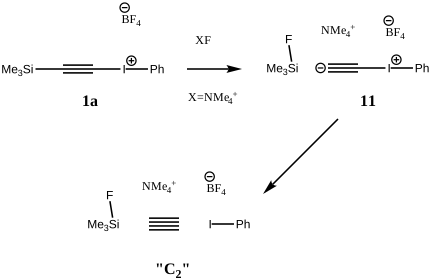
Inspired by the report of this chemical synthesis, I thought I would revisit C⩸N+ to speculate how it too might be made. A colleague (thanks Ed!) had alerted me to a probably ultimate method for generating cations using tritium.[2] Radioactive decay loses an electron by β emission and forms He+, which is followed by expulsion of a helium atom to leave behind a cationic centre; in this example at the sp-carbon of an alkyne.

So on to explore the energetics of generating cationic C⩸N+ by this synthetic/nuclear-decay method. The thermochemistry of the reaction (N≡C-T →) N≡C-He+ + e → N≡C+ + He ⟺ C⩸N+ will be calculated using the CCSD(T)/Def2-TZVPP method. Firstly the geometry of N≡C-He+, which is bent and not linear.. This species sustains a short C-He bond, which has a calculated Wiberg bond order of 0.67. Recollect the excitement when a report appeared of bonded helium, which has a computed bond order of just 0.15! The C-He stretch in N≡C-Heis 907 cm-1 with the bend being 193 cm-1 and the C≡N stretch 2116 cm-1.

Click image to view 3D animated model

A He atom is then lost, resulting in an exo-energic ΔΔG298 of -12.6 kcal/mol (see FAIR data DOI: 10.14469/hpc/5691). Despite all that energy injected by a nuclear decay process, together with the supercharged leaving group, the reaction is only moderately exo-energic.

Is this experiment a viable method for generating C⩸N+ cations? Since the half-life of T, aka 3H, is ~11 years, any experiment must be run for months to generate detectable amounts of products (six months as reported here[2]). The C⩸N+ must therefore be trapped as soon as it is formed. The selection of the chemical traps (avoiding HCN itself?) which could demonstrate the nature of this species will therefore be an interesting challenge, should anyone wish to try this experiment.


A similar procedure was used to generate the hitherto elusive perbromic acid by β decay of 83Se into 83Br. The thermochemistry for the method reported here[1] will be explored separately. The second of the two consecutive experimental C-H BDEs (bond dissociation energies) for the reaction H-C≡C-H → H-C≡C• and then H-C≡C• → C⩸C is known experimentally to be about 20 kcal/mol lower than the first. This observation is most simply explained by the formation of a 4th bond, here represented by ⩸. If you are interested in how to invoke this and other chemically useful glyphs, see here. Such thermochemistry was previously evaluated using correlated methods[3] such as CCSD(T) and MRCI (multi-reference configuration interaction, used specifically for C2); procedures which reproduced well these relative experimental BDEs.[3] Here (see FAIR data DOI: 10.14469/hpc/5684) I found that using single reference CCSD(T)/Def2-TZVPP throughout also gives a similar result, the second BDE being ~22 kcal/mol less than the first. Accordingly, this method is here used to estimate the geometry and energy of N≡CHe+ and its carbon-helium bond-dissociation to give C⩸N+ + He. I recognise that ultimately, multi-reference methods should also be used to check these results.

References

  1. K. Miyamoto, S. Narita, Y. Masumoto, T. Hashishin, M. Kimura, M. Ochiai, and M. Uchiyama, "Room-Temperature Chemical Synthesis of C2", 2019. https://doi.org/10.26434/chemrxiv.8009633.v1
  2. G. Angelini, M. Hanack, J. Vermehren, and M. Speranza, "Generation and trapping of an alkynyl cation", Journal of the American Chemical Society, vol. 110, pp. 1298-1299, 1988. https://doi.org/10.1021/ja00212a052
  3. D. Danovich, P.C. Hiberty, W. Wu, H.S. Rzepa, and S. Shaik, "The Nature of the Fourth Bond in the Ground State of C<sub>2</sub>: The Quadruple Bond Conundrum", Chemistry – A European Journal, vol. 20, pp. 6220-6232, 2014. https://doi.org/10.1002/chem.201400356
Organocatalytic cyclopropanation of an enal: Transition state models for stereoselection.

Sunday, September 30th, 2018

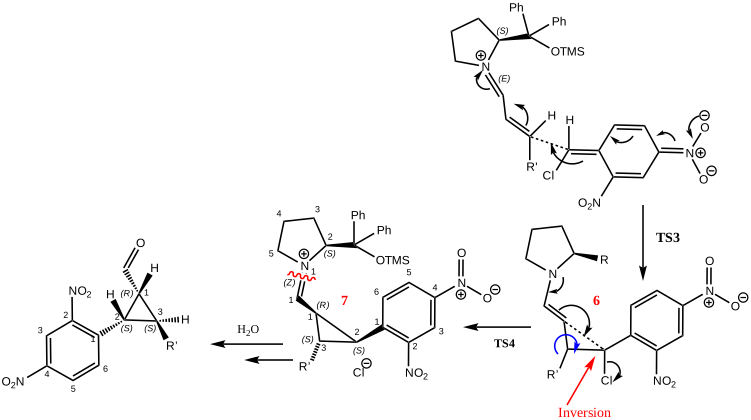
Here is the concluding part of my exploration of a recently published laboratory experiment for undergraduate students.[1] I had previously outlined a possible mechanistic route, identifying TS3 (below) as the first transition state in which C-C bond formation creates two chiral centres. This is followed by a lower energy TS4 where the final stereocentre is formed, accompanied by inversion of configuration of one of the previously formed centres (red below). Now I explore what transition state calculations have to say about the absolute configurations of the final stereocentres in the carbaldehyde product.

Previously, I had clarified that using the (S)-configuration of the prolinol catalyst results in the major stereochemical isomer as (1R,2S,3S), as shown above. TS3 is now explored in more detail as four stereochemical isomers, depending on the facial selectivity of the two nominal double bonds used to create the new C-C bond (dashed line above). The subsequent step TS4 is of lower energy and hence is not rate determining in a classical sense at least. It involves inversion of configuration to eliminate the chlorine to form the second C-C bond. Then a last tidying up step where the imine is hydrolysed down to the carbaldehyde, a process in which no stereocentres are involved. The computational method used is as before, B3LYP+GD3BJ/6-311G(d,p)/SCRF=chloroform and T=273.15K. This selection is so that a good quality recent dispersion correction (GD3BJ) can be used, since dispersion attractions in large part often control stereochemical outcomes.

The results are summarised below for two models; (a) a partial model in which the products of the first steps of the reaction, namely water and amine base, are excluded; (b) a fuller model in which both water and amine base are allowed to interact with the transition state. The R’ group (Me replacing heptyl) is placed trans to the en-iminium group for the four transition states arising from facial selectivity. Two more are derived from bond rotation (blue above) to place the R’ group cis to the iminium group.

Transition state models.

Stereochem

of product[1]

ΔΔG273
Model (a)
kcal/mol
ΔΔG273
Model (b)
kcal/mol

TS3

(click for model)

(1R,2S,3S) ≡ 4a

major” isomer

0.0 0.0

(1S,2S,3R)

middle isomer?

6.8 0.3

(1S,2S,3S) = 4b 

“middle” isomer

7.9 1.8

(1R,2R,3S) ≡ 4c

minor” isomer

0.9 0.7

(1S,2R,3R)

undetected isomer

7.4 1.8

(1S,2R,3S) = 4d

undetected isomer

7.8 2.0

FAIR data DOI 10.14469/hpc/4704 The links to ΔΔG273 are to a DataCite metadata search of the free energy values for these species as described here.


The following conclusions can be drawn.

  1. The major 1R,2S,3S isomer resulting from use of (S)-chiral auxiliary agrees with experimental assignments in being the lowest in activation free energy for both models (a) and (b).
  2. Similarly the experimentally undetected 1S,2R,3R isomer 4d also has the highest activation free energy.
  3. There is however a mismatch between the experimental chiral assignment for the “middle” isomer and the calculations. The predicted stereochemistry deriving from the latter is derived from one of the four possibilities arising from Re/Si C=C facial selection when forming a bond between the two double bonds (TS3 = 1S,2S,3R). The experimental assignment[1] implies a mechanism that involves rotation about one C=C bond (and not of a C=C face), as indicated by the blue arrow in the diagram above (= 1S,2S,3S). This is not intrinsically unlikely, since in species  6, following the first C-C bond formation, the pertinent C-C bond is now closer to single than double. This implies however that stereochemistry is determined AFTER the rate limiting transition state is passed. Incorporating such a rotation into TS3 itself for such stereochemistry (1S,2S,3S) makes the free energy slightly higher than for the unrotated TS3 (1S,2S,3R). So we might conclude that the stereochemistry observed for 4b (the “middle” isomer”) could be the result of dynamic effects such as bond rotation after the rate limiting transition state is passed. It might also be that the (1S,2S,3S) stereochemistry indicated in the article[1] for 4b is mis-assigned. 
  4. The minor isomer 1R,2R,3S ≡ 4c has a relative energy in both models (a) and (b) that matches perfectly its low abundance.
  5. The undetected isomer suffers from the same issue as the middle isomer. Its stereochemistry would be 1S,2R,3R from the Re/Si C=C facial selection criterion used to construct TS3, or 1S,2R,3S as shown in the article.[1] Since it is undetected, there is no experimental data for comparison.
  6. The full model (b) appears to replicate the observed results better, in predicting three observable stereoisomers (ΔΔG ≤ 1.0 kcal/mol) and one unobserved isomer (ΔΔG ≥ 1.8 kcal/mol) This has important implications for such modelling, implying that incorporating species not directly involved in the bond making/breaking can nevertheless play a subtle role in the stereochemical outcomes.

The stereochemistry of the formation of two new stereogenic centres during the carbon-carbon bond formation by reaction between the ion-pair of an en-iminium cation and a benzylic anion using a chiral auxiliary has been modelled using a DFT theory which incorporates a good quality dispersion correction term. The very act of constructing such models forces one to inspect the stereochemistry very carefully, and for this purpose the CIP (Cahn-Ingold-Prelog) notation is invaluable. Two versions of such a model both agree on the nature of the major product of this reaction, and they also agree on what is likely to be an unobserved product. But one issue remains to be resolved, the nature of the second most abundant isomer, the “middle” product. Two of the three chiral centres present in the resulting cyclopropane derivative are introduced during the first C-C bond formation between the ion-pair, whilst the third results from a lower energy downstream final C-C coupling, accompanied by inversion of one of the previously introduced stereogenic centres due to elimination of chloride. Here, the experimentally assigned stereochemistry for the “middle” product would require bond rotation AFTER the first C-C bond formation. To computationally model that would probably require the molecular dynamics trajectories to be mapped out. But before doing this, it is worth flagging the need to carefully re-verify the experimental stereochemical assignments for this “middle” product.


Because the final product has three chiral centres, a total of eight possible stereoisomers could result, arranged as two sets of eight enantiomeric pairs depending on the chirality of the auxiliary used. The published article (caption, Figure 3) shows dihedral angles for each possible diastereomer of the cyclopropanation, accompanied by four structures. The other four isomers are enantiomers of these four. In this post, six of the eight stereoisomers possible using the S-chiral auxilliary are shown in the table above.

References

  1. M. Meazza, A. Kowalczuk, S. Watkins, S. Holland, T.A. Logothetis, and R. Rios, "Organocatalytic Cyclopropanation of (<i>E</i>)-Dec-2-enal: Synthesis, Spectral Analysis and Mechanistic Understanding", Journal of Chemical Education, vol. 95, pp. 1832-1839, 2018. https://doi.org/10.1021/acs.jchemed.7b00566

The Bond Slam – a second peek inside.

Saturday, August 12th, 2017

At the moment, the bond slam is something of a home from home for this blog and since much of my activity is happening there rather than here, I thought I might give you pointers to some of the topics, which are evolving, so to speak, before our very eyes.

  1. The topic of agostic interactions (or perhaps bonds) was seeded by a graduate student (with some encouragement perhaps from his supervisor). It is a different kind of hydrogen bond, one specifically involving a metal. As per many types of bond, it has its controversies! Thus is it useful to fragment this into true agostic interactions and into those which are merely anagostic? How should the calculated wavefunction for a molecule exhibiting the effect be analysed? Geometries, normal mode frequencies, electron density shifts, QTAIM, NCI, NBO, ELF are all discussed, thus far with much apparent agreement! I have contributed some crystal structure searches, such as the one below. If you want to understand what these acronyms all mean, go visit the topic, and perchance even contribute!
  2. Readers of this blog might have noticed the topic of hypervalence has occasionally appeared, sometimes coupled with hypercoordination. Often these two terms are loosely interchanged in their meaning and it is certainly (I believe) often taught even more loosely in undergraduate lectures. For my take on the topic, go visit the slam, where some examples of what I choose to call true hypervalence are suggested. It is not as common as you might think!
  3. Molecular electrides make an appearance, again a topic I have occasionally covered on this blog.
  4. Penta and hexa-coordinate carbon (not to be confused, but probably it will be, with penta and hexavalent carbon) make separate appearances, with some new suggestions for hitherto undiscovered analogues for other elements.
  5. But the most unusual and original suggestion is that we consider the properties of Positronium Hydride or PsH. One for the physicists to detect I fancy!

There are still around three weeks to go before the live debate in front of an audience, so check regularly to see what new insights might have been added. 

Chemical Bonds at the 21st Century – 2017: the Bond Slam.

Wednesday, August 2nd, 2017

It is always interesting to observe conference experiments taking place. The traditional model involves travelling to a remote venue, staying in a hotel, selecting sessions to attend from a palette of parallel streams and then interweaving chatting to colleagues both old and new over coffee, lunch, dinner or excursions. Sometimes conferences occur in clusters, with satellite meetings breaking out in the vicinity, after a main conference has done the job of attracting delegates to the region. Here I bring to your attention one such experiment, the Bond Slam which is part of a satellite meeting in Aachen to be held September 2-4 2017 on the topic of Chemical Bonds at the 21st Century, following on from the WATOC 2017 congress in Munich Germany a few days earlier.

The Bond Slam involves participants selecting a challenge from 16 topics of current interest and is exposed using a Wiki. A selection of the challenges will be presented in person at the conference, but you don’t have to go to Aachen to contribute virtually to discussion. This sort of format can have novel outcomes.[1] If your interest is piqued by any of the challenges or you cannot resist adding your own, do go visit the site and browse. 


References

  1. P.L. Ayers, R.J. Boyd, P. Bultinck, M. Caffarel, R. Carbó-Dorca, M. Causá, J. Cioslowski, J. Contreras-Garcia, D.L. Cooper, P. Coppens, C. Gatti, S. Grabowsky, P. Lazzeretti, P. Macchi, . Martín Pendás, P.L. Popelier, K. Ruedenberg, H. Rzepa, A. Savin, A. Sax, W.E. Schwarz, S. Shahbazian, B. Silvi, M. Solà, and V. Tsirelson, "Six questions on topology in theoretical chemistry", Computational and Theoretical Chemistry, vol. 1053, pp. 2-16, 2015. https://doi.org/10.1016/j.comptc.2014.09.028

Dispersion “bonds” not involving just hydrogen: can it work for F…H?

Tuesday, July 18th, 2017

The effects of loading up lots of dispersion attractions (between t-butyl groups) into a compact molecule has the interesting consequence of allowing two “non-bonded” hydrogen atoms to approach to ~1.5Å of each other, thus creating the appearance of a “bond” where one normally would not be found. Can such an effect be injected into other combinations of two atoms, say H and F? Here I briefly explore this notion.

The system is a slightly modified version of the one[1] already studied; R3C-F…H-CR3 (R=3,5-bis-t-butylphenyl), and a B3LYP+D3BJ/6-311G(d,p) calculation (with C3-symmetry imposed) shows (DOI: 10.14469/hpc/2734) the following, with the key atom pair distances shown below. Note the abnormally short F…H distance, and the relatively long C-F one.

Note the casual phrase “C3-symmetry imposed”. This is a little “shortcut” one can try to use to shorten the calculation time. I should explain that on our computer system here, we are allowed a maximum of 72 hours per calculation. I already suspected that without the use of such symmetry the calculation would take longer and so used symmetry to “fit the calculation in” to this time slot. In the event it took 55 hours. There is a simple test however to see if this shortcut is justified; does the resulting molecule have 3N-6 real normal vibrational modes (i.e. ones with +ve force constants)? In fact this system fails this test; two of these modes have small negative force constants, corresponding to ν -11 cm-1. You might think this is small enough to perhaps attribute to e.g. the use of too-small a basis set or some other computational imperfection. Actually, although -11 cm-1 is numerically small, the mass-weighting associated with the vibration is in effect the entire system (below) and hence this mode is indeed significant.

So time to release the symmetry and when one does this an entirely different geometry emerges (DOI: 10.14469/hpc/2736) for which now all the 3N-6 normal modes have +ve force constants.

The “non-bonded” F…H interaction is now considerably longer, although still ~0.5Å shorter than the sum of the van der Waals radii (~2.65Å). This F…H non-bonded distance shows up as below in the Cambridge structure database (CSD) distribution. This suggests the shortest interaction is indeed ~2.1Å. The string of isolated examples with shorter distances down to < 1Å are very likely all crystallographic artefacts or errors.

So we may conclude that using the same system that was so successfully used to demonstrate the dispersion-induced ultra-short H…H distance cannot be modified to produce any such extreme effects in the F…H pair.  Perhaps indeed “dispersion bonds” will always be limited to  H…H pairs.


When this method is used for the original H…H system, it yields a H…H distance of 1.529Å for which all the normal vibrational modes are real; DOI: 10.14469/hpc/2739).

References

  1. S. Rösel, H. Quanz, C. Logemann, J. Becker, E. Mossou, L. Cañadillas-Delgado, E. Caldeweyher, S. Grimme, and P.R. Schreiner, "London Dispersion Enables the Shortest Intermolecular Hydrocarbon H···H Contact", Journal of the American Chemical Society, vol. 139, pp. 7428-7431, 2017. https://doi.org/10.1021/jacs.7b01879

More stereo electronics: the Eschenmoser double fragmentation and guerrilla tutorials.

Thursday, December 10th, 2015

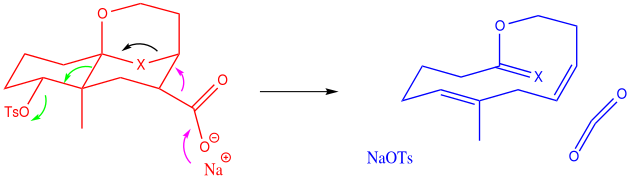
The layout of floor 2 of the chemistry department here contains a number of small rooms which function as tutorial areas. Each has a (non-interactive) whiteboard used by students and tutors for, inter-aliathought-showering. It was in one such room that I found myself with three colleagues this monday afternoon. We soon all sensed something not quite right about the room; it slowly dawned that the whiteboard was entirely devoid of thoughts (it is normally left adorned with chemical hieroglyphics). Before we departed, one of our number crept up to the board and showered the following (the red bit only followed by a ?; thanks Willie!). The chemistry equivalent you might say of Guerrilla gardening. The product shown in blue below is for your benefit here. It is an example of a double fragmentation reaction; by an odd coincidence following on nicely from the previous post.

Eschenmoser

I have now found out that it represents the Eschenmoser double-fragmentation reaction to produce a medium-size macrolide ring.[1] It is interesting for several reasons:

  1. The reaction only proceeds if X=O (but not if X=CH2).
  2. from which the possible role that the anomeric effects in this region play become of interest.
  3. leading to the issue of whether the two fragmentations are connected in a concerted manner or are separate processes (first the green arrows, then the magenta arrows).

So, to provide a possible answer to the guerrilla tutorial on our next visit in a weeks time, I put a preview up here.

System ΔG298 DataDOI
X=O, Reactant 0.0 [2]
X=O, TS1 23.5  [3]
X=O, TS2 14.5  [4]

Analysis

Reactant geometry

The reactant shows an asymmetric anomeric effect, with the X=O bond shorter (1.399Å) than the alternate C-O (1.426Å, diagram below, ωb97xd/6-311g(d,p) calculation). The C-X (X=O) bond shown cleaving in the diagram above is longer than either of the others (1.442Å) and the C-C cleaving bond (green arrow) is also longer than usual (1.563Å)

em1

The four centres involved in the first fragmentation subtend a dihedral angle of 179.8° and the second set 177.6°. Both are therefore perfectly aligned for fragmentation. But the angle between the two fragmentations is 67.2°, meaning that they are NOT aligned correctly to occur synchronously.

Reactant NBO localised orbital analysis

The NBO interaction energy due to overlap (the black arrow above) between the oxygen lone pair (Lp) on X=O and the adjacent C-O* orbital is 16.4 kcal/mol, whereas the reverse interaction from the other oxygen is 10.1 kcal/mol due to a slightly worse anti-periplanar alignment. The NBO E(2) interaction term between the lone pair (Lp) on X=O and the adjacent about-to-fragment C-C* orbital is also relatively large at 6.6 kcal/mol, whereas that for the non-fragmenting C-C* orbital is 4.4 kcal/mol.

Reactant ELF-based lone pair analysis

In order to estimate the dihedral (antiperiplanar) angle between two atoms  (more accurately the anti bond between them) and an electron lone pair on the adjacent oxygen, one needs the coordinates of the oxygen lone pair (Lp). These can be obtained using a localising technique called ELF (electron localisation function). The values are as follows:

  1. X=O, Lp with anomeric C-O bond: 177°
  2. X=O, Lp with fragmenting C-C bond: 174°

So the reactant is already pre-disposed to the green+black fragmentation due to both of the X=O:: lone pairs, hence accounting for why only this substituent shows this reaction. It also hints the first fragmentation (green arrows) is pre-disposed to start before the second one (magenta arrows).

Energies and conclusion

ΔG can be obtained for two discrete transition states (green, TS1 and magenta TS2 steps), the first being distinctly the higher in free energy and corresponding to a reasonable rate reaction at elevated temperatures.

The problem illustrates nicely the importance of aligning reaction centres correctly, and how a lone pair can influence the result.


The corresponding free energy activation barrier for X=CH2 is 25.6 kcal/mol[5],[6]. Transposing  C=CH2 with the remaining oxygen (an untried experiment) gives a barrier of 25.4 kcal/mol.[7]


References

  1. D. Sternbach, M. Shibuya, F. Jaisli, M. Bonetti, and A. Eschenmoser, "Ein fragmentativer Zugang zu Makroliden: (5‐<i>E</i>, 8‐<i>Z</i>)‐6‐Methyl‐5, 8‐undecadien‐11‐olid", Angewandte Chemie, vol. 91, pp. 670-672, 1979. https://doi.org/10.1002/ange.19790910827
  2. H.S. Rzepa, "Gaussian Job Archive for C19H23NaO7S", 2015. https://doi.org/10.6084/m9.figshare.1621347
  3. H.S. Rzepa, "C 19 H 23 Na 1 O 7 S 1", 2015. https://doi.org/10.14469/ch/191687
  4. H.S. Rzepa, "C 19 H 23 Na 1 O 7 S 1", 2015. https://doi.org/10.14469/ch/191683
  5. H.S. Rzepa, "C 20 H 25 Na 1 O 6 S 1", 2015. https://doi.org/10.14469/ch/191701
  6. H.S. Rzepa, "C 20 H 25 Na 1 O 6 S 1", 2015. https://doi.org/10.14469/ch/191697
  7. H.S. Rzepa, "C 20 H 25 Na 1 O 6 S 1", 2015. https://doi.org/10.14469/ch/191708

Impressions of China 2: The colour of porcelain.

Wednesday, October 14th, 2015

In Jingdezhen an Imperial Kiln was built in 1369 to produce porcelain that was “white as jade, thin as paper, bright as a mirror and tuneful as a bell”. It’s the colours of the glazes that caught my eye, achieved by a combination of oxidative and reductive firing in the kiln, coupled with exquisite control of the temperature.

The photo below represents the glaze master weighing out the transition metal salts required to produce the colours, with abacus to hand! The labels on the bottles are not translated (I forgot to load up the camera-based translator onto my iPad, which I am using to write this post). Question: what colours does oxidative or reductive firing with vanadium salts produce?

image

image

And in Tunxi in the old village of Xidi the bridge made famous by the film Crouching Tiger, Hidden Dragon. image

Impressions of China. New units of speed and old ways of counting.

Friday, October 9th, 2015

This comes to you from China, and the city of Suzhou. To set the scene, cities in China have a lot of motorbikes. Electric ones. With their own speed units, a % of Panda speed. image

Msny msny people ride bikes such as these; some even manage three passengers, or several boxes of shopping. And the streets will have dedicated lanes for them, although you do need eyes in the back of your head to spot their silent (often 15 kph) approach. image

The chinese pharmacy also has separate lanes, for the modern tablets, pills and lotions familiar in the West but with equal prominence to traditional herbal medicines.

image

image

The duality also extends to the checkout!

image

We are here to visit the gardens, both formal snd botsnical. And to exercise our reaction times (see above).

Electrides (aka solvated electrons).

Wednesday, July 8th, 2015

Peter Edwards has just given the 2015 Hofmann lecture here at Imperial on the topic of solvated electrons. An organic chemist knows this species as “e” and it occurs in ionic compounds known as electrides; chloride = the negative anion of a chlorine atom, hence electride = the negative anion of an electron. It struck me how very odd these molecules are and so I thought I might share here some properties I computed after the lecture for a specific electride known as GAVKIS.[1] If you really want to learn (almost) everything about these strange species, go read the wonderful review by Zurek, Edwards and Hoffmann,[2] including a lesson in the history of chemistry stretching back almost 200 years.

GAVKIS consists of a tricyclic aza-ether ligand or cryptand wrapping a potassium atom in the centre, the overall unit having no charge. The oxygen and nitrogen heteroatoms coordinate to the metal, in the process evicting its single electron. The question that struck me is “where does that electron go?”. You see in all normal molecules that electrons are associated with either one, two (or rarely) three nuclei, to form one-centred monosynaptic basins (lone pairs), two-centre or disynaptic basins (i.e. bonds) and more rarely three-centre bonds. The shared-electron two-centre manifestation was of course famously introduced by Gilbert N. Lewis in 1916 (note the centenary coming up!). Knowing where the electron (pairs) are has enabled the technique popular with organic chemists known as arrow pushing, or the VSEPR analysis of inorganic compounds. But an electride has no nucleus associated with it! So how can one describe its location?

[jsmol caption=’The crystal structure of GAVFIS’ fileurl=’https://www.rzepa.net/blog/wp-content/uploads/2015/07/GAVFIS-lattice.mol2′ id=’a2′ commands=’=spacefill 23%;wireframe 0.15;color cpk;’ debug=’false’]

The crystal structure of GAVFIS shows the potassium to be 8-coordinate. Remember, x-rays are diffracted not by a nucleus but by electrons in the molecule. The highest densities are of course associated with electrons in inner shells centered on nuclei and the much lower densities found in conventional bonds are not normally located by this technique (but see here). So it is no surprise to find that this x-ray analysis[1] did not succeed in answering the question posed above; where is the single electron liberated from the potassium atom? They did look for it, but surmised only that would be found in the “noise level electron density in the spaces between them (molecules)“. For GAVFIS, that empty space is actually dumb-bell shaped, and so perhaps an answer is that the electron occupies the dumb-bell shaped spaces between the ligand-potassium complex.

X-ray analysis was defeated by noise; it is an experimental technique after all. But the noise in a quantum mechanical calculation is much smaller; can this reveal where the evicted electron is? Here is the spin density (unpaired electron) distribution for one molecule of GAVFIS computed using the UωB97XD/6-31++(G) DFT method.[3] It is a stratocumulus-like cloud that enshrouds the molecule (click on the diagram below and you can rotate the function to view it from your own point of interest) but interestingly avoiding the regions along the N….N axis. There are also tiny amounts of (negative) spin density on the ligand atoms. So even when the “empty space” is infinitely large, the shape of the electride anion is nevertheless quite specific, but a holistic function of the shape of the entire molecule rather than its component atoms.

[jsmol caption=’The spin density in GAVFIS’ fileurl=’https://www.rzepa.net/blog/wp-content/uploads/2015/07/GAVFIS_sden.cub.xyz’ id=’a3′ commands=’=isosurface wp-content/uploads/2015/07/GAVFIS_sden.cub.jvxl translucent;zoom 70;’ debug=’false’]

Another way of describing where electrons are is using functions known as molecular orbitals. Below is the SOMO (singly occupied MO) and its shape in this case coincides with that of the spin density.

[jsmol caption=’The SOMO for GAVFIS’ fileurl=’https://www.rzepa.net/blog/wp-content/uploads/2015/07/GAVFIS_gp_mo113.cub.xyz’ id=’a3′ commands=’=isosurface wp-content/uploads/2015/07/GAVFIS_gp_mo113.cub.jvxl translucent;zoom 70;’ debug=’false’]

The molecular electrostatic potential is rather wackier (red = attractive to protons).

[jsmol caption=’The molecular electrostatic potential in GAVFIS’ fileurl=’https://www.rzepa.net/blog/wp-content/uploads/2015/07/GAVFIS_gp_esp.cub.xyz’ id=’a4′ commands=’=isosurface wp-content/uploads/2015/07/GAVFIS_gp_esp.cub.jvxl translucent;zoom 40;’ debug=’false’]

Odder still is the ELF (electron localisation function) and the identification of the centroids of its basins. These centroids normally coincide with the two-centre basins (bonds) and one-centre basins (lone pairs, inner shell electrons) in normal molecules, both being close to nuclear centres (atoms). For GAVFIS, two unexpected one-centre basins are found close to the two nitrogen atoms in the molecule, each with a population of 0.48 electrons, along with regular one-centre “lone pair” basins pointing inwards to the potassium (2.38 electrons each). The odd-looking pair of locations identified for the electride anion may have little physical reality, except for reminding us that the electride can indeed be in more than one location simultaneously!

[jsmol caption=’The ELF centroids in GAVFIS’ fileurl=’https://www.rzepa.net/blog/wp-content/uploads/2015/07/GAVFIS_bas.mol’ id=’a5′ debug=’false’]

I often also use the NCI (non-covalent-interaction) property of the electron density in these blogs. It tells us about regions of non-covalent electron density which represent attractive weak interactions between or within molecules. Here, it again shows us the weak non-covalent density (as the reduced density gradients) wrapping the molecule (green=weakly stabilizing).

[jsmol caption=’The NCI function in GAVFIS’ fileurl=’https://www.rzepa.net/blog/wp-content/uploads/2015/07/GAVFIS-gp-lr.xyz’ id=’a6′ commands=’=isosurface wp-content/uploads/2015/07/GAVFIS-gp-lr.jvxl translucent;zoom 70;’ debug=’false’]

The obvious next question is that if each molecule is surrounded by weak spin density arising from an unpaired electron, would two such species form a dimer in which the spins are paired in an manner analogous to the conventional single bond? The overlap is not going to be fantastic if the spin distribution has the shape shown above, but what the hell. Here is the HOMO of such a species.[4] It appears the shape of the electride is very pliable indeed; they have been squeezed out of the contact region between the two molecules (which form a close contact pair) into wrapping the dimer rather than the monomer! The spin-coupled singlet by the way is about 4.6 kcal/mol more stable in free energy ΔG298 than two isolated monomer doublets, and 5.5 kcal/mol lower than the triplet species[5] which retains two unpaired electrons. A sort of weak molecule-pair bond rather than an atom-pair bond.
[jsmol caption=’The MO in GAVFIS dimer’ fileurl=’https://www.rzepa.net/blog/wp-content/uploads/2015/07/GAVFIS_mo225.cub.xyz’ id=’a8′ commands=’=isosurface wp-content/uploads/2015/07/GAVFIS_mo225.cub.jvxl translucent;zoom 70;’ debug=’false’]
This has hardly started to scratch the surface of the strange properties of electrides. If your appetite has been whetted, go read the article I noted at the beginning.[2]


For normal molecules, a Mulliken or other population analysis reduces the charge and spin density down to an atom-centered distribution. If this is done for GAVFIS, the spin density collapses down to the molecular centroid, in this case the potassium (spin density 1.15). This of course is horribly misleading, and serves to remind us that such atom-centered distributions can sometimes be far from realistic.


References

  1. D.L. Ward, R.H. Huang, and J.L. Dye, "Structures of alkalides and electrides. I. Structure of potassium cryptand[2.2.2] electride", Acta Crystallographica Section C Crystal Structure Communications, vol. 44, pp. 1374-1376, 1988. https://doi.org/10.1107/s0108270188002847
  2. E. Zurek, P. Edwards, and R. Hoffmann, "A Molecular Perspective on Lithium–Ammonia Solutions", Angewandte Chemie International Edition, vol. 48, pp. 8198-8232, 2009. https://doi.org/10.1002/anie.200900373
  3. H.S. Rzepa, "C 18 H 36 K 1 N 2 O 6", 2015. https://doi.org/10.14469/ch/191347
  4. H.S. Rzepa, "C 36 H 72 K 2 N 4 O 12", 2015. https://doi.org/10.14469/ch/191348
  5. H.S. Rzepa, "C 36 H 72 K 2 N 4 O 12", 2015. https://doi.org/10.14469/ch/191350

A connected world (journals and blogs): The benzene dication.

Thursday, April 10th, 2014

Science is rarely about a totally new observation or rationalisation, it is much more about making connections between known facts, and perhaps using these connections to extrapolate to new areas (building on the shoulders of giants, etc). So here I chart one example of such connectivity over a period of six years.

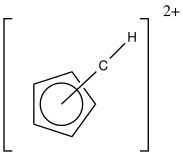
The story starts with this article[1], a preview talk about which (Hypervalent Carbon Atom: “Freezing” the SN2 Transition State) I actually saw at an ACS conference a year or so earlier. When the article was published, Steve Bachrach blogged about it, noting the claim for pentavalent carbon. The semantics of a valency vs a coordination are subtle, and I was not convinced that this frozen transition state deserved its elevation from penta-coordinate to pentavalent. After some discussion on Steve’s blog, I built upon these ideas with a few thoughts of my own on the present blog and then wondered whether they could be finally distilled into a more formal publication (testing the precedent in some ways of whether collaborative and public discussions of ideas could be published formally, or whether they would be rejected as having been already “published”). Well, these final distilled thoughts were indeed published in 2010[2], including their genesis in Steve’s blog (I wanted to put blogs more firmly into the acceptable scientific circle). This article included one species (numbered 5 in that article in 2010[2]) and pointed out an analogy to replacing CH2+ by e.g the isoelectronic BH1+, in as much as an example of the latter is indeed known as a stable crystalline compound.[3]. Iso-electronics is a very fruitful source of connections in chemistry!

5

Matters rested there until yesterday, when I spotted this on Steve’s blog where he discusses this recent article on the structure of the benzene dication.[4] Hey presto, there is that molecule again, but now there is firm experimental evidence of its existence! It was I think rather too much to expect the authors of this article to have spotted the connection to mine (although as it happens, both address the issue of complexes to He). The relationship between CH2+ and BH1+ is a little more subtle. From my point of view, it is always worth trawling through the crystal structure database in favour of evidence for hypothetical species (or their isoelectronic substitutions), and so it proved in this case!

There are other connections possible. Thus the dication of benzene has a (higher energy) isomer which is in fact a 4π antiaromatic species which avoids this antiaromaticity by a geometric distortion, with two C-H bonds bending above and below the ring. Such avoided antiaromaticity has been noted elsewhere here.

There is one final connection for me to make. My 2010 article[2] contained one of my interactive tables containing the data for the various structures (yes, although its data, you will need to have a subscription to the journal to access it). As it happens, last year we wished to reprise this style of publication, but as I blogged at the time, the journal had changed its production processes, and they could no longer offer me that opportunity. Some quick thinking came up with a replacement, which we now use extensively.[5] So the chain of connections resulting from that original talk some six years ago continues.

<

p>As for that chain, it arose distressingly randomly. I do not routinely read the entire ToC of JACS and so would not have discovered[4] the connection by that route. Fortunately, Steve Bachrach does and helped me make that connection to the molecule shown above. Although I did spend a few minutes thinking to myself “does that structure ring any bells?”. Fortunately, one did (eventually) ring. But for every connection made in this wonderfully human manner, I cannot help but think how many are not! However, if connections were much easier to make, could we as humans cope with the overwhelming deluge of new ideas?

References

  1. S. Pierrefixe, S. van Stralen, J. van Stralen, C. Fonseca Guerra, and F. Bickelhaupt, "Hypervalent Carbon Atom: “Freezing” the S<sub>N</sub>2 Transition State", Angewandte Chemie International Edition, vol. 48, pp. 6469-6471, 2009. https://doi.org/10.1002/anie.200902125
  2. H.S. Rzepa, "The rational design of helium bonds", Nature Chemistry, vol. 2, pp. 390-393, 2010. https://doi.org/10.1038/nchem.596
  3. C. Dohmeier, R. Köppe, C. Robl, and H. Schnöckel, "Kristallstruktur von [Cp★BBr][AlBr4]", Journal of Organometallic Chemistry, vol. 487, pp. 127-130, 1995. https://doi.org/10.1016/0022-328x(94)05089-t
  4. J. Jašík, D. Gerlich, and J. Roithová, "Probing Isomers of the Benzene Dication in a Low-Temperature Trap", Journal of the American Chemical Society, vol. 136, pp. 2960-2962, 2014. https://doi.org/10.1021/ja412109h
  5. A. Armstrong, R.A. Boto, P. Dingwall, J. Contreras-García, M.J. Harvey, N.J. Mason, and H.S. Rzepa, "The Houk–List transition states for organocatalytic mechanisms revisited", Chem. Sci., vol. 5, pp. 2057-2071, 2014. https://doi.org/10.1039/c3sc53416b