In two previous posts, I have looked at why cis-butene adopts conformation (a) rather than (b). I suggested it boiled down to electronic interactions between the methyl groups and the central alkene resulting in the formation of a H…H “topological” bond, rather than attraction between the H…H region to form a weak chemical “bond“. Here I take a look at what happens when that central C=C bond is gradually removed.

Two possible conformations of cis but-2-ene.
One reaction that removes this bond (marked with a magenta arrow below) is the Diels Alder π2s + π4s cycloaddition to a butadiene.

The classic Diels Alder cycloaddition
An intrinsic reaction coordinate for this reaction looks as below: the barrier is around 25 kcal/mol and the reaction is exothermic (SVG compatible browser needed to view figure).
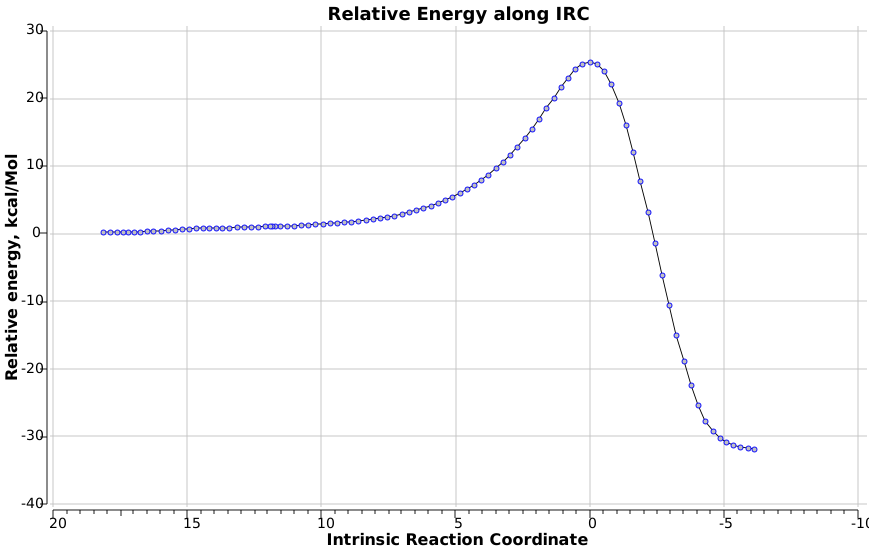
But much more interesting are the geometric responses of the two molecules as the reaction proceeds:
- Watch first the butadiene component. Its resting conformation is gauche rather than eclipsed at the central C-C single bond, with the two double bonds rotated slightly to avoid (in this case) a close H…H contact. The first step in the reaction path is to rotate the butadiene from this gauche orientation into a eclipsed conformation at that bond.
- Next, the action takes place on the cis-butene. Unlike the diene, it starts off eclipsed (due to the effects noted previously) in conformation (a) above, but as the alkene starts to weaken (and the electronic effects holding it in this shape lessen), the two methyl groups rotate into conformation (b). In effect, the electronic reorganisation has moved the close H…H contact from the alkene to the diene!
- Finally, the two C-C bonds can proceed to form, and the rest of the reaction proceeds to form the cyclohexene product.
- Keep an eye out as well for the two methyl groups on the butadiene. Watch how they too rotate near the final stages of the reaction.

Geometric responses to the cycloaddition reaction.
I have observed methyl groups in a number of reactions now via intrinsic reaction coordinates, and they do seem to be acting as flags, highlighting subtle effects in the electronic reorganisations. Rotating methyl groups should be looked at more often as harbingers of interesting effects!