Posts Tagged ‘disorder’

Spotting the unexpected. Anomeric effects involving alkenes?

Wednesday, November 2nd, 2011

How one might go about answering the question: do alkenes promote anomeric effects? A search of chemical abstracts does not appear to cite any examples (I may have missed them of course, since it depends very much on the terminology you use, and new effects may not yet have any agreed terminology) and a recent excellent review of hyperconjugation does not mention it. Here I show how one might provide an answer.

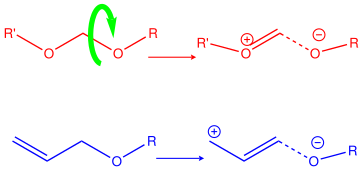
First, what is an anomeric effect? The diagram below shows the classic anomeric effect in which a donor (an oxygen lone pair) interacts with an acceptor (a C-O bond). The orientation around the single bond shown with a green arrow is crucial; the effect only happens when the donating lone pair is aligned antiperiplanar to the accepting C-O bond, at which point the lengthening of the C-O bond should be maximal (shown as a dashed line below). The blue analogue is the corresponding effect using an alkene as the donor, but retaining the C-O bond as the acceptor.
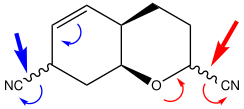
I had previously addressed this theme by discussing the molecule below. Switching the acceptor from a C-O to a C-cyano bond has the effect of inducing an axial orientation for both cyano groups, a “cyanomeric” effect! Whilst the stronger is undoubtedly the one shown in red, note the blue interaction, that involves an alkene rather than oxygen as donor.
One way of providing evidence is a crystallographic search. Here I am using Conquest, the program provided by the Cambridge crystallographic data centre, with the following specification (thanks to Andrew White for helping me frame this search!).

The search query

  1. The length of the C-O bond (blue arrow) is defined as a search parameter
  2. The absolute value of the torsion around the bond (red arrow) is also so defined
  3. I have restricted the acceptor to C-O bonds (this of course excludes C-CN).
  4. The C-O acceptor can be enhanced by bearing an electron withdrawing group, which can be e.g. carbonyl, phosphate, sulfate, perchlorate etc.
  5. The alkene donor can be enhanced with donating groups such as oxygen, nitrogen or carbon
  6. NOT Booleans are applied to restrict the substituents the alkene can carry  to only sp3 carbons (or H) by excluding sp2 or sp hybridised carbons. This is to prevent the substituents from delocalizing the alkene (in effect preventing competition from these substituents), but allowing them to stabilise any induced carbocation resonance by hyperconjugation.
  7. The C of the C-O is specified as acyclic (to allow the torsion to in theory have any allowed value).
  8. The search is also restricted to structures with no disorder or other errors, and an R factor of < 0.075.
These specifications can be seen in the first hit obtained:

A hit

A total of 215 structures are found, and a scatterplot of the C-O bond length version the (abs)C=C-C-O torsion is shown below.

Scatterplot. Click to view a larger version.

There are two main clusters of hits, those with torsions close to zero, and those with torsions between ~90-120°. The latter cluster is very clearly shifted to the right of the former, indicating that on average these C-O bond lengths are longer. The red-orange-light green hits (1.46-1.50Å range) are to be found exclusively in the “antiperiplanar” cluster. One might conclude that statistically, the π-anomeric effect appears real. Of course, there may be many other reasons why the C-O bond is lengthened, and each of the molecules above should be individually inspected to exclude these.

This sort of structural search takes only minutes (if you know how to formulate it) and I would certainly encourage you to try it out on your own favourite effect!  See if the excellent  and open CrystalEye resource gives a similar answer (the Conquest /CCDC system is commercial, and not open).


H. S. Rzepa, 2011-11-02. URL:http://www.ch.imperial.ac.uk/rzepa/blog/?p=5368. Accessed: 2011-11-02. (Archived by WebCite® at http://www.webcitation.org/62tOSgnzK)

Scalemic molecules: a cheminformatics challenge!

Wednesday, July 6th, 2011

A scalemic molecule is the term used by Eliel to describe any non-racemic chiral compound. Synthetic chemists imply it when they describe a synthetic product with an observable enantiomeric excess or ee (which can range from close to 0% to almost 100%). There are two cheminformatics questions of interest to me:

  1. How many non-trivial scalemic molecules have been reported in the literature (let’s assume their ee is significantly greater than 0%)?
    • The distribution function for the ee of these molecules would be most interesting!
  2. Of those, how many have the absolute configuration of the predominant enantiomer established with high confidence?
    • Or, to put this another way, how many may prove to be mis-assigned?

Note the careful qualification in the above questions. Thus by non-trivial, I mean compounds whose scalemic attributes persist in solution for a chemically useful duration. That could be taken to mean configurationally stable chiral molecules, rather than those that might be conformationally chiral (an example of a trivial scalemic molecule would be e.g. the twist-boat conformation of cyclohexane, which having D2 symmetry is dissymetric, but which would only retain its scalemic property for a trivially short timescale).

What are boundary values? These are some:

  • As I write this, CAS records 61,257,703 chemical substances. Needless to say (unless I missed it), the answer to my first question is not to be found there.
  • Beilstein (Reaxys) records 1,126,995 compounds as having one or more reported chiroptical properties (which is the most direct way of establishing a molecule is scalemic, although strictly, having say an optical rotation of 0° does not necessarily mean the molecule is not scalemic). We have no way of knowing how many molecules are scalemic for which no chiroptical measurement has been made (but one would hope its a small proportion). Perhaps that is a good answer to question 1?
    • of which 1,097,094 relate to optical rotatory power, 17,515 to optical rotatory dispersion and 62,248 to electronic circular dichroism.
    • it is more difficult to answer how many of these 1,126,995 substances have a firmly established absolute configuration. Measuring a chiroptical property per se does NOT in itself establish the absolute configuration. Doing so is a fascinating exercise in sequential logical argument, and how one does it has changed quite a lot over time. And what might I mean with high confidence? An older assignment (made say > 40 years ago) might be less confident than one established in 2011 (fortunately, we can probably trust the absolute configurations of the amino acids!). A bit of a can of worms, nevertheless. But it interests me because it is a good example of what the semantic web is supposed to be all about.
  • The Cambridge crystallographic database reports 560,307 entries, of which 72,340 are in chiral space groups (in which a chiral molecule can crystallise) and exhibit no disorder or other errors. We do not know how many of these are non-trivial, since all manner of small (and low energy) distortions can create a chiral species (in the solid state), but which would not persist  for a chemically useful duration in solution (i.e. it might for example immediately racemize and become non-scalemic).
  • The Flack parameter has been used since 1983 for enantiomorph estimation (a value of ~≤ 0.10(10) would be considered meaningful). This could in principle provide an answer of known confidence to my question 2 above (but would not address the issue of non-triviality).
    • The challenge now is to quantify how many compounds have a meaningful reported Flack parameter (presumably a sub-set of 72,340?)

Let me declare one personal interest. Over the last four years or so, we have been asked to confirm the absolute configuration of around eight scalemic molecules. After a detailed study, we concluded three were mis-assigned. Now this in no way implies anything about what the answer to question 2 above might be! But it does make one think!

Déjà vu all over again. Are H…H interactions attractive or repulsive?

Tuesday, May 31st, 2011

The Pirkle reagent is a 9-anthranyl derivative (X=OH, Y=CF3). The previous post on the topic had highlighted DIST1, the separation of the two hydrogen atoms shown below. The next question to ask is how general this feature is. Here we take a look at the distribution of lengths found in the Cambridge data base, and focus on another interesting example.

9-anthranyl derivatives. Click for Pirkle with normalised C-H lengths.

The histogram below shows all 9-anthranyl compounds in the CCDC database distributed by DIST1. The search was conducted with the restrictions of no disorder, no “errors”, and using normalised hydrogen bond lengths. A note of explanation for the latter. Because of the nature of x-ray diffraction, when a C-H distance is obtained from a structural refinement, it tends to emerge ~0.1Å to short. Normalisation means adjusting that distance to a more correct 1.09Å (the heavy atom stays put, its the  H that moves). In our case, this has the effect of actually shortening DIST1. In the Pirkle structure (shortcode SOCLIF) the nominal value for DIST1 is 1.94-1.96Å, but normalisation reduces these to 1.82-1.85Å. This really is an unusually short contact between two hydrogen atoms (the sum of the vdW radii is 2.4Å). So how unusual might this be? Show below is the result of the CCDC search.

H...H Contacts in 9-anthranyl derivatives

Notice how a maximum in the number of examples is visible at ~1.9Å, but examples all the way down to ~1.7Å are known! If one restricts the search to examples where X=O, the following plot is obtained. The entry on the bottom left is JARYEG, where Y is sufficiently large to enforce short H…H or O…H contacts on both sides. Click on the histogram picture below to see it. When you do so, you will also see the NCI surface computed at this geometry. Note that both the short H..H (DIST1) and the short O…H (DIST2) interaction surfaces are coloured blue, indicating attractive contacts!

9-anthranyl derivatives, X=O.

If you explore the 3D model further, you will notice other blue interaction surfaces, and a number which have both blue AND orange (= repulsive) zones. We see here yet another example of a weak interaction being simultaneously both attractive and repulsive. It is no longer sufficient to say that the interaction between two atoms is either one or the other. Depending on where you measure it, it can be both! In other words, even weak bonds can have internal structure (for a discussion of the internal structure of a strong C-S bond, see DOI 10.1021/ct100470g).