Posts Tagged ‘Julia Contreras-Garcia’
Friday, December 11th, 2015
You might have noticed the occasional reference here to the upcoming centenary of the publication of Gilbert N. Lewis’ famous article entitled “The atom and the molecule“.[1] A symposium exploring his scientific impact and legacy will be held in London on March 23, 2016, exactly 70 years to the day since his death. A list of the speakers and their titles is shown below; there is no attendance fee, but you must register as per the instructions below.
Royal Society of Chemistry Historical Group Meeting on 23th March 2016, Burlington House, Piccadilly, London: The atom and the molecule: A symposium celebrating Gilbert N. Lewis.
- Dr Patrick Coffey (Berkeley, USA): Does Personality Influence Scientific Credit? Simultaneous Priority Disputes: Lewis vs. Langmuir and Langmuir vs. Harkins
- Professor Robin Hendry (Durham, UK): Lewis on Structure and the Chemical Bond
- Professor Alan Dronsfield (UK): An organic chemist reflects on the Lewis two-electron bond
- Dr Julia Contreras-García (UPMC, France): Do bonds need a name?
- Professor Nick Greeves (Liverpool, UK): The influence of Lewis on organic chemistry teaching, textbooks and beyond
- Professor Clark Landis (UWM, USA): Lewis and Lewis-like Structures in the Quantum Era
- Professor Michael Mingos (Oxford, UK): The Inorganic dimension to Lewis and Kossel’s landmark contributions
- Dr Patrick Coffey (Berkeley, USA): Lewis’ Life, Death, and Missing Nobel Prize
Prior registration is essential. Please email your name and address to Professor John Nicholson, jwnicholson01 @ gmail.com
References
- G.N. Lewis, "THE ATOM AND THE MOLECULE.", Journal of the American Chemical Society, vol. 38, pp. 762-785, 1916. https://doi.org/10.1021/ja02261a002
Tags:Alan Dronsfield, Clark Landis, Durham, France, Gilbert N. Lewis, John Nicholson, Julia Contreras-Garcia, Liverpool, London, Michael Mingos, Nick Greeves, organic chemist, Oxford, Patrick Coffey, professor, Robin Hendry, Royal Society of Chemistry Historical Group, United Kingdom, United States
Posted in Interesting chemistry | 1 Comment »
Wednesday, December 19th, 2012
The Sharpless epoxidation of an allylic alcohol had a big impact on synthetic chemistry when it was introduced in the 1980s, and led the way for the discovery (design?) of many new asymmetric catalytic systems. Each achieves its chiral magic by control of the geometry at the transition state for the reaction, and the stabilizations (or destabilizations) that occur at that geometry. These in turn can originate from factors such as stereoelectronic control or simply by the overall sum of many small attractions and repulsions we call dispersion interactions. Here I take an initial look at these for the binuclear transition state shown schematically below.
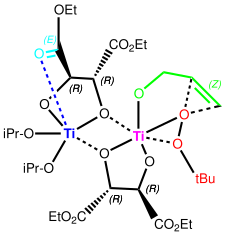
The NCI method was described recently[1] as a method for probing the non-covalent electron density in a molecule. It does this by cleverly filtering out the covalent density via computing a first derivative of the density ρ(r) called the reduced density gradient and taking the band of values appropriate for non-covalent densities. By inspecting the Laplacian of these densities at any point in space, the region can be characterised as attractive, repulsive or neutral. Visually, this information can be transformed into isosurfaces which are colour coded depending on whether the region is attractive (=blue to green) or repulsive (yellow to red). In the previous post, it turned out that the attractive contributions to the dispersion energies differed for the two diasteromeric transition states (in the conformations calculated) by about 2.6 kcal/mol. Shown below are the two NCI surfaces for these which allow one to get some insight into where this overall contribution might come from (together with weak hydrogen bonds and other non-covalent contributions).
 (R)-diastereomer. Click for NCI surfaces |
 (S)-diastereomer. Click for NCI surfaces. |
Yes, it is a very complex diagram, and you really do need to study it by obtaining the 3D model and rotating it around to explore the 3D space. I would note that it is possible to integrate the NCI function (see [2] for an example and leading references) and hence try to obtain further insights. I highlight just one here; the terminal =CH2 of the allyl alcohol points into empty space for (R), but folds back to interact with the catalyst for (S).
Finally, in case you are asking how do I obtain an NCI surface, I have created a little web site where you can submit a computed (or indeed experimental) electron density cube for processing using Jmol. Give it a go and see how it works (and thanks to Julia Contreras-Garcia and Bob Hanson for putting this together).
References
- E.R. Johnson, S. Keinan, P. Mori-Sánchez, J. Contreras-García, A.J. Cohen, and W. Yang, "Revealing Noncovalent Interactions", Journal of the American Chemical Society, vol. 132, pp. 6498-6506, 2010. https://doi.org/10.1021/ja100936w
- J.L. Arbour, H.S. Rzepa, J. Contreras‐García, L.A. Adrio, E.M. Barreiro, and K.K.(. Hii, "Silver‐Catalysed Enantioselective Addition of OH and NH Bonds to Allenes: A New Model for Stereoselectivity Based on Noncovalent Interactions", Chemistry – A European Journal, vol. 18, pp. 11317-11324, 2012. https://doi.org/10.1002/chem.201200547
Tags:asymmetric catalytic systems, Bob Hanson, catalysis, Julia Contreras-Garcia, little web site, NCI, non-covalent-analysis, Reaction Mechanism, terminal =CH
Posted in Interesting chemistry | No Comments »
Friday, October 7th, 2011
The properties of electrons are studied by both chemists and physicists. At the boundaries of these two disciplines, sometimes interesting differences in interpretation emerge. One of the most controversial is that due to Bader (for a recent review, see DOI: 10.1021/jp102748b) a physicist who brought the mathematical rigor of electronic topology to bear upon molecules. The title of his review is revealing: “Definition of Molecular Structure: By Choice or by Appeal to Observation?”. He argues that electron density is observable, and that what chemists call a bond should be defined by that observable (with the implication that chemists instead often resort to arbitrary choice). Here I explore one molecule which could be said to be the focus of the differences between physics and chemistry; cis-but-2-ene.

Two possible conformations of cis but-2-ene.
The structure of this system has been determined by electron diffraction to exhibit a H…H distance of ~2.1Å as in (a), DOI: 10.3891/acta.chem.scand.24-0043. Why is this of interest? Because a rotational alternative, shown as (b) could result in a significantly longer H…H distance (~ 2.6Å). Now bear in mind that the van der Waals radius of hydrogen is estimated at ~1.2Å, and that two hydrogens will be most strongly attracted by dispersion forces when separated by ~2.4Å. As they get closer, that attraction will be counterbalanced by a repulsion, which will eventually win out. Structure (b) does not benefit from H…H dispersion attractions, but are the hydrogens in structure (a) too close to do so as well?
Well, let us adopt Bader’s approach, and look at the topology (QTAIM) of the electronic distribution in structure (a). The features to concentrate on are the purple dots, which in this analysis have been named bond critical points (BCP) and the single yellow sphere, which is a ring critical point (RCP). There are two other types of critical points, which I will call nuclear attractors (NACP) and cage points (CCP). The total occurrences of all these critical points is determined by a topological theorem (Poincare-Hopf), which states that NACP-BCP+RCP-CCP=1. You can see below that the H…H region is indeed connected by a bond critical point (none of the other purple dots are controversial). To a physicist, this is a real feature of the (observable or in this instance the calculated) electron density. In effect, it is a topological bond. Unfortunately, chemists like to think of bonds as entities which result in stability; a bond contributes to the stability of a molecule (and an anti-bond, should such exist, to instability). Hence aromaticity (=stability) vs anti-aromaticity (=instability). Chemists, by choice, might prefer not to call the H…H region a bond because it is probably not contributing to the stability of the molecule. Of course, the two camps are arguing about different things; the topology of the electron density ρ(r) vs the energy of the molecule.

QTAIM topological analysis of cis but-2-ene. Click for 3D.
Somewhat ignored in this discussion up to this point has been the yellow dot, the RCP. Firstly, notice how close it is to the H…H BCP. Secondly, notice from the Poincare-Hopf relationship that if you remove BOTH of these points, the theorem is still satisfied; a BCP and a RCP are said to be capable of annihilating each other (much like and electron and a positron might). So perhaps a chemical picture might emerge if you choose to consider BOTH points together, rather than just the BCP?
I have done so below using the NCI (non-covalent interaction) procedure (which I have commented on in many other posts here). The NCI surface is shown below, embedded within the NCI surface as purple dots are the BCP and RCP discussed above. Now, the NCI method cleverly attempts to ascertain whether a region is attractive or repulsive, and it colour codes the surface accordingly. In the below, blue is deemed attractive, and red repulsive. We immediately see that the H…H BCP is embedded in an attractive region, but the adjacent RCP is embedded in a repulsive region. Whatever attraction the BCP might be experiencing is negated by the repulsion the RCP has. The two cancel (annihilate). Taken together, the H…H region is probably repulsive (ways of quantifying how NCI regions integrate are being investigated and will be discussed in a future post). Perhaps this manner of looking at it satisfies both the physicists and the chemists?

The NCI surface for cis but-2-ene. Click for 3D.
Well, not quite. A chemist would still ask why structure (a) is preferred over structure (b), if the wider H…H region is not deemed attractive (I call it a region rather than a bond in a probably futile attempt to avoid controversy). Actually, the answer might be in how the two methyl groups each interact with the other part of the molecule, the alkene, and how that might depend on their orientation with respect to the alkene. But that analysis is for
another post!
Tags:CCP, chemical picture, chemist, conformational analysis, energy, Julia Contreras-Garcia, physicist
Posted in General, Interesting chemistry | 6 Comments »
Tuesday, May 31st, 2011
The title of this post paraphrases E. J. Corey’s article in 1997 (DOI: 10.1016/S0040-4039(96)02248-4) which probed the origins of conformation restriction in aldehydes. The proposal was of (then) unusual hydrogen bonding between the O=C-H…F-B groups. Here I explore whether the NCI (non-covalent-interaction) method can be used to cast light on this famous example of how unusual interactions might mediate selectivity in organic reactions.

Crystal structure of RUGYEX. Click for 3D
The crystal structure revealed a fixed syn orientation between one B-F bond and the formyl C-H bond, with a distance of ~2.36Å (using un-normalised C-H lengths), compared with a value of 2.55Å for the vdW sum. Since hydrogen bonds to fluorine are quite rare, it seems worth applying the NCI method (
DOI for calculation).

NCI surfaces for RUGYEX. click for 3D.
The result indeed shows a strongly blue (= attractive) interaction surface for the CH…F region, and only a tiny one for the adjacent H…H region. A welcome surprise however is the O…O region, which also shows a distinct (strong) attraction. Perhaps this is due to the presence of the electron withdrawing BF3 group on one of the oxygens. This could also be regarded as a through-space anomeric effect, from one oxygen donating into the O-B σ* orbital. Such
through spaceanomeric effects (they are normally propagated through bonds, as in sugars) are probably more common than we believe.
This result nicely illustrates the utility of the NCI method; it brings an immediate visual impact, which serves to highlight interactions which otherwise might be ignored.
Tags:conformational analysis, Corey, formyl hydrogen, Julia Contreras-Garcia
Posted in Interesting chemistry | 2 Comments »
Tuesday, May 31st, 2011
The Pirkle reagent is a 9-anthranyl derivative (X=OH, Y=CF3). The previous post on the topic had highlighted DIST1, the separation of the two hydrogen atoms shown below. The next question to ask is how general this feature is. Here we take a look at the distribution of lengths found in the Cambridge data base, and focus on another interesting example.

9-anthranyl derivatives. Click for Pirkle with normalised C-H lengths.
The histogram below shows all 9-anthranyl compounds in the CCDC database distributed by DIST1. The search was conducted with the restrictions of no disorder, no “errors”, and using normalised hydrogen bond lengths. A note of explanation for the latter. Because of the nature of x-ray diffraction, when a C-H distance is obtained from a structural refinement, it tends to emerge ~0.1Å to short. Normalisation means adjusting that distance to a more correct 1.09Å (the heavy atom stays put, its the H that moves). In our case, this has the effect of actually shortening DIST1. In the Pirkle structure (shortcode SOCLIF) the nominal value for DIST1 is 1.94-1.96Å, but normalisation reduces these to 1.82-1.85Å. This really is an unusually short contact between two hydrogen atoms (the sum of the vdW radii is 2.4Å). So how unusual might this be? Show below is the result of the CCDC search.

H...H Contacts in 9-anthranyl derivatives
Notice how a maximum in the number of examples is visible at ~1.9Å, but examples all the way down to ~1.7Å are known! If one restricts the search to examples where X=O, the following plot is obtained. The entry on the bottom left is JARYEG, where Y is sufficiently large to enforce short H…H or O…H contacts on both sides. Click on the histogram picture below to see it. When you do so, you will also see the NCI surface computed at this geometry. Note that both the short H..H (DIST1) and the short O…H (DIST2) interaction surfaces are coloured blue, indicating attractive contacts!

9-anthranyl derivatives, X=O.
If you explore the 3D model further, you will notice other blue interaction surfaces, and a number which have both blue AND orange (= repulsive) zones. We see here yet another example of a weak interaction being simultaneously both attractive and repulsive. It is no longer sufficient to say that the interaction between two atoms is either one or the other. Depending on where you measure it, it can be both! In other words, even weak bonds can have internal structure (for a discussion of the internal structure of a strong C-S bond, see DOI
10.1021/ct100470g).
Tags:9-anthranyl, Cambridge, disorder, Julia Contreras-Garcia, X-ray
Posted in Interesting chemistry | 1 Comment »
Sunday, May 29th, 2011
Observation of the slow racemization of isobornyl chloride in a polar solvent in 1923-24 by Meerwein led to the recognition that mechanistic interpretation is the key to understanding chemical reactivity. The hypothesis of ion pairs in which a chloride anion is partnered by a carbocation long ago entered the standard textbooks (see DOI 10.1021/ed800058c and 10.1021/jo100920e for background reading). But the intimate secrets of such ion-pairs are still perhaps not fully recognised. Here, to tease some of them them out, I use the NCI method, which has been the subject of several recent posts.

NCI analysis of the iod-pair transition state for methyl migration in isobornyl chloride. Click for 3D.
To remind, the colour coding of the NCI surface is
blue=strongly attractive,
red=strongly repulsive,
green=weakly attractive,
yellow=weakly repulsive. Shown above is the
ion-pair transition state for [1,2]methyl migration. Note how the hydrogen bonds between the chloride anion and the water molecules are clearly blue. Only slightly weaker (with a turquoise tint) is a pair of hydrogen bonds between the oxygen atoms and H-C bonds in the isobornyl cation. Such C-H…O bonding in ion-pairs seems to be particularly important. There are other blue regions, between an H…H pair, and a C-H bond and the carbon of the migrating methyl group. Also noteworthy is that many atom pairs have multi-coloured NCI regions, suggesting the interaction is not homogenous, and can be both attractive AND repulsive between any pair of atoms.
The NCI plot below shows the competing 1,6-hydride shift in isobornyl chloride, again involving an ion-pair transition state.

NCI surfaces for the 1,6 hydride migration transition state in isobornyl chloride. Click for 3D.
Notice in this example how the migrating hydrogen supports an attractive hydrogen bond to the chloride anion (ostensibly between a hydride atom and an anionic chloride?), and again how there are a number of
blue regions elsewhere.
Modelling is increasingly focusing on these weaker interactions, that probably mediate much (stereo)selectivity in organic reactions. How long before such approaches themselves enter the text-books?
Tags:chemical reactivity, ion pair, isobornyl, Julia Contreras-Garcia, nnon-covalent-interactions, watoc11
Posted in Interesting chemistry | No Comments »
Wednesday, May 25th, 2011
This molecule is not leaving me in peace. It and I first met in 1990 (DO: 10.1039/C39910000765), when we spotted the two unusual π-facial bonds formed when it forms a loose dimer. The next step was to use QTAIM to formalise this interaction, and this led to spotting a second one missed the first time round (labelled 2 in that post). Then a method known as NCI was tried, which revealed an H…H interaction, labelled ? in that post! Here I discuss the origins of the ?

The Pirkle reagent
What sparked this re-visitation? Firstly, in this post, a CH…O interaction in Z-DNA was identified using NCI, and its origins probed using NBO E2 perturbation energies, which revealed that the C-H bond was antiperiplanar to a C-O bond (effects 2 and 3 in that post), that could have the effect of acidifying the H, and making it more prone to hydrogen bond to the lone pair of an oxygen. Inspired by this, I worked out how to display NCI colour codes surfaces here on this blog using Jmol (previously, VMD had been used, which cannot be embedded in a blog).

NCI Surface for the Pirkle reagent. Click for 3D
The H..H interaction previously alluded to is shown with a magenta arrow (between the two atoms with halos in the 3D model). The colour coding
blue means it is distinctly attractive. In my (second) post, I did not mention why it might be special (and also the colour coding covered a large range, which meant the blue tinge did not really stand out visually). Why might that interaction be significant? Well, the C-H bond is perfectly aligned with the C-F σ* orbital. The NBO E2 energy is 3.9 kcal/mol, which represents a modest acidification of the hydrogen.
You may notice from the above other blue regions. Click on the diagram, and go explore them. The history of this molecule is such that it is bound to hold more surprises!
Tags:energy, Julia Contreras-Garcia, Tutorial material
Posted in Interesting chemistry | 1 Comment »
Wednesday, May 18th, 2011
In earlier posts, I alluded to what might make DNA wind into a left or a right-handed helix. Here I switch the magnification of our structural microscope up a notch to take a look at some more inner secrets.

A fragment of a single chain of DNA, taken from a Z-helix. Click for 3D.
The 3D coordinates of this fragment were obtained by taking a crystal structure of a Z-d(CGCG)2 containing oligomer, editing (to remove water, and superfluous bases) and subjecting it to ωB97XD/6-311G(d,p)/SCRF=water geometry refinement. This should be accurate enough to recover dispersion attractions, and various electronic and electrostatic interactions. Z-d(CGCG)2 was then reduced to the fragment you see above, which is large enough to capture the essence of the Z-helical wind, but small enough to be able to spot things which a larger fragment might overwhelm.
- The 3D model (click on above to obtain it) reveals that the oxygen of one of the five-membered (tetrahydrofuran) rings has a close contact to the guanine base of 2.85Å. This is some 0.3Å shorter than the combined van der Waals radii, and very typical of oxygen…electrophilic carbon interactions (see discussion here for more details). We can reasonably assume its real. It is supported by a small NBO perturbation term (~1.1 kcal/mol) corresponding to donation of the oxygen lone pair into a C-N π* orbital.
- The next interaction detected comes from a furanose C-H bond, in which the hydrogen approaches to within 2.48Å of the oxygen on the furanose the other side of the phosphate. This is ~0.14Å shorter than the combined van der Waals distances (remember, even at the actual vdW sum, the attraction is still attractive). Why would an apparently inert C-H bond do that? Such bonds are not normally considered in such analyses. Well, this one is special.
- It may well be (slightly) more acidic than normal due to a C-Hσ/C-Oσ* anti-periplanar interaction (E2 5.8, magenta bonds in 3D model) into the CH2-OH bond of the furanose. Hence the acidified H can form a weak(ish) hydrogen bond to the oxygen. The NBO E2 energy is 1.4 from the Olp to the C-H* bond (larger E2 interactions normally occur through bonds, but this one is through space, which is why it is smaller).
- These two interactions in turn set up a good orientation for the guanine to create a strong anomeric effect between it and the ribose; NLp/C-Oσ*; E2 11.6 (violet bond in 3D model, blue bond b in above diagram). To calibrate this interaction, anomeric effects in sugars are of the order of 14-16 kcal/mol. These stereoelectronic effect helps to slightly rigidify the relationship between the guanine base and the furanose it is connected to.
- In contrast, the cytosine-furanose link avoids the classical anomeric effect, and instead sets up a weaker one with a C-C bond instead (E2 6.8, indigo bond, blue bond a in above diagram). The Nlp is not as good a donor, because it is sequestered into the adjacent carbonyl group on the cytosine. The guanine has no such adjacent group, and so its Nlp is a better donor. The outcome of all of this is that the two bases, C and G end up having a different geometrical relationship to the furanose they are each connected to.
- Notice the gauche-like conformation of the ethane-1,2-diol fragment (gold bond in 3D model), which is again due to stereoelectronic alignments.
- Notice the Nlp …H-C distance of 2.51Å, which like 2 above, is around the sum of the vdW radii. It might be slightly more than just a dispersion attraction, since the NBO E2 Nlp/C-H* through space interaction is ~2 kcal/mol.
- There are some other relatively close atom-atom approaches, but I do not list them here. Do explore them yourself (they are labelled 8 in the diagram below).
To complete the present analysis, I include an ELF diagram. This can locate lone-pairs (as monosynaptic basins) as well as bond pairs (disynaptic basins) and so is useful for visualising the anti-periplanar anomeric effects between a lone pair and a bond (connecting a mono and a disynaptic basin if you like). Some of the interactions described in the list above are shown below with dotted lines (note that some of the lone pairs appear as two basins, distributed either face of the aromatic base).

ELF analysis. Click for 3D.
Well, cranking up the magnification on a microscope will always reveal new details. You might ask if these new details matter? Well, since DNA is such a very long polymer, repeating even a very weak (but predictable) interaction millions of times is bound to have some sort of cumulative effect. Who knows which of the ones above might play an important role in the super-winding of DNA, or its packing into a cell, or interaction with proteins, and so on. I do wonder how many of the terms I have identified above have been previously considered for such roles. Anyone know?
Postscript: Shown below is a non-covalent-analysis (NCI, see earlier post). A reminder that the interaction surface is colour coded with orange or red tinge if repulsive, blue if attractive, and green for weaker interactions. These surfaces pretty much recapitulate what it itemised above, adding also other interactions not listed above (labelled 8 in diagram).

NCI analysis for Z-CG fragment. Click for 3D.
Tags:adjacent, adjacent carbonyl, conformational analysis, energy, Julia Contreras-Garcia, N Lp, Postscript, Tutorial material, watoc11
Posted in General, Interesting chemistry | 3 Comments »
Tuesday, May 17th, 2011
The previous post set out a problem in conformational analysis. Here is my take, which includes an NCI (non-covalent interaction) display as discussed in another post.

The lowest energies of the four diastereomers A-D, each in two conformations (1/2) were calculated at the ωB97D/6-311G(d,p)/SCRF=ethanol level, and are shown here relative to A1 (kcal/mol) as free energies. The values of ΔΔG of each pair (relative to the lower energy conformation) are converted to relative concentrations using ΔΔG = -RT Ln K and these are shown in blue. Those conformations where a C-H bond is aligned anti-periplanar (app) with the C-NMe3 bond are highlighted in red. Various aspects of the questions posed include:
- Those conformations with two app combinations are likely to result in a mixture of two alkenes E and F (shown in the previous post), and likewise those with only one app alignment will give a single alkene.
- The concentration of the neomenthyl system (C) favours the conformer C1, which is also the one with app allignments. This will react readily. The menthyl system A has only a low relative concentration of A2, and so will react slowly. The experiments show the rate is about 10 times less than C, whereas the ratio of relative concentrations is larger. This may be due to difference in the transition state for the elimination, or possibly effects due to the presence of a counterion.
- The concentration of D1 is the lowest of the four pairs of conformational isomers. This might be due to buttressing, in which the relative proximity of the NMe3 and iPr groups forces the former into closer proximity with the axial methyl than is found in A2, the other conformer with an unfavourable 1,3-diaxial interaction.
- The relative energies of most of the pairs of combinations of conformers/diasteromers are interesting, and I leave it to you to play with them and draw conclusions (or detect mysteries).
I thought I would finish by adding an NCI analysis using a wavefunction computed for ωB97D/6-31G(d,p)/SCRF=ethanol. The green surfaces are indicative of regions where non-covalent interactions are occurring (which include electrostatic and van der Waals effects). The colour scheme is set to blue(ish) to indicate more attractive NCIs (such as strong hydrogen bonds), green to indicate weak(ish) NCIs, with a red or orange tinge indicating a repulsive NCI.
 A2 diaxial. Click for 3D. |
 B2 Axial-equatorial. click for 3D. |
 A1. Di-equatorial. Click for 3D. |
 B1.Di-equatorial. click for 3D. |
 C2. Equatorial-axial. Click for 3D. |
 D2. Equatorial-axial. Click for 3D. |
 C1 SRR. Axial-equatorial. Click for 3D. |
 D1 SSS. Axial-equatorial. Click for 3D. |
Amongst the many features visible in these plots is the strong 1,3-diaxial NCIs seen for A2 and particularly D1 and the conformational variability in the NCI between the iPr and NMe3 groups.
Tags:conformational analysis, iPr, Julia Contreras-Garcia, lower energy conformation, NMe, non-covalent-interactions, Tutorial material
Posted in Uncategorized | 2 Comments »
Saturday, April 9th, 2011
Understanding why and how proteins fold continues to be a grand challenge in science. I have described how Wrinch in 1936 made a bold proposal for the mechanism, which however flew in the face of much of then known chemistry. Linus Pauling took most of the credit (and a Nobel prize) when in a famous paper in 1951 he suggested a mechanism that involved (inter alia) the formation of what he termed α-helices. Jack Dunitz in 2001 wrote a must-read article on the topic of “Pauling’s Left-handed α-helix” (it is now known to be right handed). I thought I would revisit this famous example with a calculation of my own and here I have used the ωB97XD/6-311G(d,p) DFT procedure to calculate some of the energy components of a small helix comprising (ala)6 in both left and right handed form.
Firstly, it is important to note that Pauling was apparently not aware of the absolute handedness of amino acids (which are (S) in CIP terminology). This had in fact only been established a few months before Pauling’s publication by Bijvoet, and news of this might not have reached Pauling. So Pauling guessed (or perhaps, he had already built his models, and did not have time to reconstruct them) and his famous α-helix diagram turned out to be the enantiomer of the real McCoy. As with DNA itself, the helix bears a diastereomeric relationship to the chirality of the amino acids; both have to be inverted to get the proper enantiomer (which is what Pauling did). The secret that Pauling had discovered was hydrogen bonding, and particular, weak N-H…O=C interactions (Wrinch had thought it was strong covalent N-C-OH bonding instead). Of course, there are other effects at work, which include van der Waals or dispersion interactions, electrostatic effects resulting from the large dipoles in peptides (not least due to the zwitterionic character), the planarity of the peptide bond itself, the potential for other types of hydrogen bond (e.g. C-H…O) and entropic effects. I have split some of these down for left and right handed forms of DNA in another post.
It turns out calculating most of these effects on an even-handed basis is not that easy. Only the recent advent of dispersion-corrected DFT procedures, together with solvation algorithms that allow for accurate geometry optimisation and subsequent evaluation of free energies allows such a calculation to be performed. Hitherto, it has been mostly molecular mechanics that has been used (which itself relies on many parameters from quantum mechanics, such as atom charges, and explicitly identifying interactions for hydrogen bonding). By returning to a quantum-mechanical model, some of these assumptions inherent in the mechanics method need not be made.
We showed in 1991 that an effective solvation treatment required for the zwitterionic form of amino acids in aqueous solutions would ideally comprise not only a self-consistent-reaction-field, but also explicit water molecules as solvent. Here only the former solvation term is included, but expanding the model to include water is certainly possible. Both the zwitterionic and the neutral forms of (ala)6 are included below, so that the effect of a large dipole on the structure and relative helical stability can be estimated. One notes that (even in a dielectric cavity corresponding to water), the extended zwitterions are high energy species. In a protein, they of course would be stabilized by the immediate environment of the ions. The right-handed helix clearly comes out as more stable (by about 1 kcal/mol per residue, see also DOI: 10.1021/ja960665u), but this is not really due to either dispersion effects or entropy and must therefore arise largely from the hydrogen-bond like interactions. Ionizing the termini to form a zwitterion increases the propensity for a right handed helix slightly.
| Relative thermodynamic energies (kcal mol-1) of (ala)6 α-helices |
| System |
Total energy |
Dispersion |
ΔΔH298 |
Δ(T.ΔS298) |
ΔΔG298 |
| Left, neutral |
0.0
|
0.0 |
0.0 |
0.0 |
0.0 |
| Right, neutral |
-4.0
|
+0.2 |
-4.0 |
0.9 |
-4.9 |
| Left, zwitterion |
0.0 |
0.0 |
0.0 |
0.0 |
0.0 |
| Right, zwitterion |
-7.1 |
0.1 |
-6.3 |
1.7 |
-8.0 |
Shown below are the calculated structures. The chains have (inter alia) unusual bifurcated hydrogen-bonding interactions, between one carbonyl group and two N-H groups (show as atom with halo). These are not quite the models that Linus Pauling built!
 Left handed. Click for 3D |
 Right handed. Click for 3D |
 Left handed zwitterion. Click for 3D |
 Right handed zwitterion. Click for 3D |
For a more objective analysis of the interactions within the system, a QTAIM analysis is shown below.
 Left helix. Bond critical points in green. Click for 3D. |
 Right helix. Click for 3D |
Whilst the overall conclusion is that theory agrees well with the experimental observation that peptide sequences tend to coil into right rather than left handed helices, the reasons they do so is a little more subtle than simple model building alone can reveal. As the AIM shows, a plethora of unusual and weaker interactions occur within these helices, a full analysis of which must await presentation elsewhere.
An NCI analysis reveals strong hydrogen bonds as blue-shaded surfaces.

NCI surface. Click for 3D.
Tags:alpha-helix, aqueous solutions, chiroptical, conformational analysis, dielectric, energy, energy components, high energy species, Historical, Jack Dunitz, Julia Contreras-Garcia, protein, solvation algorithms, Tutorial material, watoc11
Posted in Interesting chemistry | 4 Comments »


