Posts Tagged ‘Postscript’

How many water molecules does it take to ionise HF and HBr?

Friday, February 27th, 2015

No doubt answers to the question posed in the previous post are already being obtained by experiment. Just in case that does not emerge in the next day or so, I offer a prediction here.

The methodology is the same as before, and I have not tried to look for new isomeric forms compared with the structures found with HCl. The method as before is DFT-based: ωB97XD/6-311++G(2d,2p). In the table below, I am recording the halogen-H distance and the distance from the same H to oxygen. You might also observe a more general principle here; first calibrate the method you intend to use with a system where there is an experimental answer. If the two match, use the same method to predict (extrapolate) to systems as yet unmeasured.

F Cl Br
n F-H, Å H-O Cl-H H-O Br-H H-O
1 0.937 1.702[1] 1.300 1.857 1.438 1.912[2]
2 0.951 1.631[3] 1.322 1.728 1.463 1.754[4]
3 0.967 1.532[5] 1.351 1.579 1.506 1.554[6]
4 0.972 1.504[7] 1.387 1.470 2.032 1.028[8]
5 1.043 1.329[9] 1.841 1.034 2.039 1.021[10]
6 1.067 1.283[11] 1.880 1.023 2.073 1.013[12]

From the bond distances, one notices that “ionisation” is an abrupt discontinuous event, happening for four molecules with HBr, five molecules with HCl and more than six molecules with HF. This nicely parallels the pka values: HBr (pKa = -9.0) < HCl (pKa = -6.0) << HF (pKa = +3.1).

It is good to see that such a process modelled on the nanoscale using just a few discrete molecules can map onto the macroscopic scale of solutions.


Postscript: If you check on the structures of these systems (click on the pictures in the previous post) you will see that the discontinuous ionisation event occurs in a bicyclic system, with the water forming two separate rings. Evidence that this really is the structure of microsolvated species has recently been put forward[13].

hf5h2o


References

  1. H.S. Rzepa, "H 3 F 1 O 1", 2015. https://doi.org/10.14469/ch/190911
  2. H.S. Rzepa, "H 3 Br 1 O 1", 2015. https://doi.org/10.14469/ch/190907
  3. H.S. Rzepa, "H 5 F 1 O 2", 2015. https://doi.org/10.14469/ch/190910
  4. H.S. Rzepa, "H 5 Br 1 O 2", 2015. https://doi.org/10.14469/ch/190909
  5. H.S. Rzepa, "H 7 F 1 O 3", 2015. https://doi.org/10.14469/ch/190912
  6. H.S. Rzepa, "H 7 Br 1 O 3", 2015. https://doi.org/10.14469/ch/190913
  7. H.S. Rzepa, "H 9 F 1 O 4", 2015. https://doi.org/10.14469/ch/190915
  8. H.S. Rzepa, "H 9 Br 1 O 4", 2015. https://doi.org/10.14469/ch/190916
  9. H.S. Rzepa, "H 11 F 1 O 5", 2015. https://doi.org/10.14469/ch/190918
  10. H.S. Rzepa, "H 11 Br 1 O 5", 2015. https://doi.org/10.14469/ch/190919
  11. H.S. Rzepa, "H 13 F 1 O 6", 2015. https://doi.org/10.14469/ch/190928
  12. H.S. Rzepa, "H 13 Br 1 O 6", 2015. https://doi.org/10.14469/ch/190917
  13. C. Pérez, J.L. Neill, M.T. Muckle, D.P. Zaleski, I. Peña, J.C. Lopez, J.L. Alonso, and B.H. Pate, "Water–Water and Water–Solute Interactions in Microsolvated Organic Complexes", Angewandte Chemie International Edition, vol. 54, pp. 979-982, 2014. https://doi.org/10.1002/anie.201409057

A short non-bonding H…H interaction (continued)

Wednesday, October 2nd, 2013

This is a continuation of the discussion started on Steve Bachrach’s blog about a molecule with a very short H…H interaction involving two Si-H groups with enforced proximity. It had been inferred from the X-ray structure[1] that the H…H distance was in the region of 1.50Å. It’s that cis-butene all over again! So is that H…H region a bond? Is it attractive or repulsive? Go read Steve’s blog first.

Next, in the previous post, I had blogged about assigning a publication doi to a procedure or tool. So Steve’s post provided a good opportunity to show how this might work. This is the tool doi: 10.6084/m9.figshare.811862  Using it, and another doi, this time data: 10.6084/m9.figshare.812621 we can create a new data set, visualised below. This is the NCI (non-covalent-interaction)[2] isosurface of the reduced density gradient, and colour coded according to (λ2)ρ, the eigenvalue of the density Hessian, to indicate attraction or repulsion. You should know that according to this scheme, blue is strongly attractive (it is normally seen for example for strong hydrogen bonds). You can see the blue region in-between the H…H region. So a strong (di)hydrogen bond then!

FSSF-NBO

Click for 3D.

Well, interesting, and this needs to be looked into further. For example, it might in fact be an anomalous result since the H…H region may in fact have charge-shift character,[3] which can change the characteristics of the density Hessian (and its Laplacian). 

One more property, the NBO (natural bond orbitals) for this region. Can one tell if H…H is bonding? It might seem so. Finally, the Wiberg bond index for the H…H region is 0.027, very slightly bonding.

SiHHSi

Click for 3D.


SiHHSi

Click for 3D.

I should conclude by stating that whilst the initial discussion of this molecule took the form of comments on Steve’s blog, the nature of the Word press system used there (and here) does not allow commentators to insert rotatable models into comments. So that discussion is continued here in order to achieve that effect.


And yet another data-doi could be created showing the interactive display, and this could be transcluded back into Steve’s blog to continue the to and fro.


Postscript: I have added the QTAIM analysis that first appeared on Steve’s blog. The red arrow points to the H…H bcp. The blue arrow points to one of the other (three in all) bcps, all of which are very close to a ring critical point, and hence should be regarded as unstable and prone to annihilation.

Click for 3D.

Click for 3D.

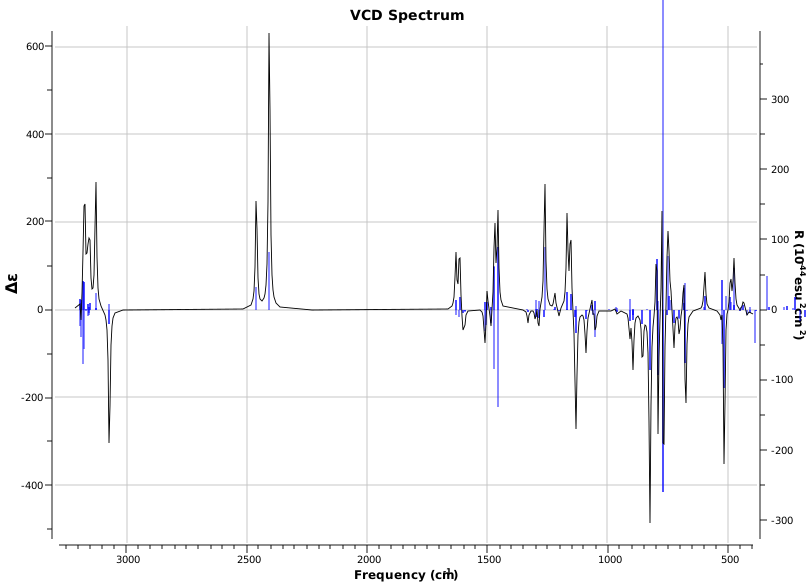
The B3LYP+D3/TZVP calculated Si-H vibrations are shown below. The VCD spectrum[4] is shown below it.

Click for animation

Click for animation

HH-vcd

Postscript 2. The Si-H vibration is reported as 2325 cm-1 (with weak bands at ~ 2360-2380), but in footnote 7 of the original report[1] the authors do note that there should be two Si-H bands. The calculation shown above suggests two values, 2406 (intensity 37) and 2460, intensity 10).

The 1H NMR spectrum of the two Si-H bands has two singlets which are reported (but not discussed in the text anywhere) as 8.23 and 8.56 ppm (Δδ 0.33ppm, CDCl3); B3LYP+D3/TZVP calculation[5] predicts 8.79 and 9.40 (Δδ 0.61 ppm). It is possible however these shifts are perturbed by spin-orbit coupling from the silicon[6]. The diastereotopic methylene groups are reported as 4.10 and 4.83, calc 3.95 and 5.03 ppm, which is a reasonable match, and gives confidence to the theoretical prediction.

Si

The 29Si NMR is reported as -32 and -40 ppm, calculated -31.6 (for the Si-H associated with bridging S) and -39.9 (for the Si associated with bridging C) ppm, which matches very well.

The reported 1H NMR spectrum appears to show 29Si satellites but their values are not reported numerically in the article. In Ph3Si-H, this coupling is known to be ~±205 Hz. The 29Si-1H couplings are calculated for the compound above as -191 (for the -31.6 peak) and -166 Hz (for the -39.9 peak), this latter being notably lower than the former. The 29Si-29Si coupling is 10 Hz. Most interestingly, the 0JHH coupling (i.e. through space) is predicted as +5.4 Hz; there is no sign of such a coupling for the two singlets reported at 8.23 and 8.56 ppm. This last observation may be of significance in terms of whether the axis along the four atoms Si-H-H-Si is indeed linear, or whether it is bent (enabling the two hydrogens to avoid close contact).

This problem is not yet closed!

References

  1. J. Zong, J.T. Mague, and R.A. Pascal, "Exceptional Steric Congestion in an <i>in</i>,<i>in</i>-Bis(hydrosilane)", Journal of the American Chemical Society, vol. 135, pp. 13235-13237, 2013. https://doi.org/10.1021/ja407398w
  2. E.R. Johnson, S. Keinan, P. Mori-Sánchez, J. Contreras-García, A.J. Cohen, and W. Yang, "Revealing Noncovalent Interactions", Journal of the American Chemical Society, vol. 132, pp. 6498-6506, 2010. https://doi.org/10.1021/ja100936w
  3. S. Shaik, D. Danovich, B. Silvi, D.L. Lauvergnat, and P.C. Hiberty, "Charge‐Shift Bonding—A Class of Electron‐Pair Bonds That Emerges from Valence Bond Theory and Is Supported by the Electron Localization Function Approach", Chemistry – A European Journal, vol. 11, pp. 6358-6371, 2005. https://doi.org/10.1002/chem.200500265
  4. H.S. Rzepa, "Gaussian Job Archive for C39H32S3Si2", 2013. https://doi.org/10.6084/m9.figshare.818954
  5. H.S. Rzepa, "Gaussian Job Archive for C39H32S3Si2", 2013. https://doi.org/10.6084/m9.figshare.817910
  6. D.C. Braddock, and H.S. Rzepa, "Structural Reassignment of Obtusallenes V, VI, and VII by GIAO-Based Density Functional Prediction", Journal of Natural Products, vol. 71, pp. 728-730, 2008. https://doi.org/10.1021/np0705918

Trimethylenemethane Ruthenium benzene

Wednesday, October 17th, 2012

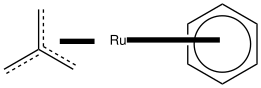
Every once in a while, one encounters a molecule which instantly makes an interesting point. Thus Ruthenium is ten electrons short of completing an 18-electron shell, and it can form a complex with benzene on one face and a ligand known as trimethylenemethane on the other[1].

This four-carbon molecule has been known for a long time[2] as a highly reactive intermediate, and as with cyclobutadiene (another 4π-electron species), it can be greatly stabilised (and crystallised) by coordination to a metal. Some twenty examples are known, and one is shown below.

JODLIX. Click for 3D.

Why might it be interesting? Because the trimethylenemethane has four carbons, of which the closest to the metal is the central one (2.03Å). The three outer distances are longer at 2.19Å. If one were to (formally) draw a bond from the metal to the central carbon atom, that atom would become what is known as hemispherical, i.e. all four ligands would be contained in a single hemisphere. This molecule is however normally represented with bonds only to the peripheral carbons, and with no bond to what is after all the shortest of the four distances! 

A QTAIM analysis gives the same answer. Only three bond-critical points are found in the topology of the electron density (red), and at the centre where one might have expected a Ru-C bond, one finds in fact a cage-critical point (blue). Of course, another way of looking at the molecule is that the trimethylenemethane simply contributes four electrons to the valence shell of the metal without trying to partition these into bonds. These four electrons, together with six from the benzene ligand, complete the 18-electron ruthenium shell.

So the take home message is that whilst the concept of discrete two-centre bonds still has its uses, this little molecule reminds us that bonds can be slippery customers. The common practice in most computer codes that represent molecules, of joining up the shortest contacts to form “bonds”, would lead us in this instance to hemispherical carbon. The consensus seems to be that this molecule does not exhibit this.


POSTSCRIPT:  An  ELF analysis of the related Iron complex is shown below. It too shows three disynaptic basins for the three peripheral  C-Fe “bonds” (red arrows), and none for the central one. The total basin integration for these three is  4.82e, a bit more than the nominal  4-electron ability of the ligand. 

Click for 3D

References

  1. G.E. Herberich, and T.P. Spaniol, "Trimethylenemethane complexes of ruthenium via the trimethylenemethane dianion", Journal of the Chemical Society, Chemical Communications, pp. 1457, 1991. https://doi.org/10.1039/c39910001457
  2. P. Dowd, "Trimethylenemethane", Accounts of Chemical Research, vol. 5, pp. 242-248, 1972. https://doi.org/10.1021/ar50055a003

Frozen Semibullvalene: a holy grail (and a bis-homoaromatic molecule).

Saturday, September 15th, 2012

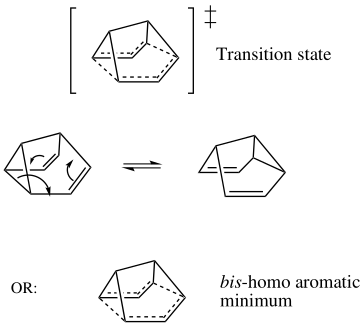
Semibullvalene is an unsettling molecule. Whilst it has a classical structure describable by a combination of Lewis-style two electron and four electron bonds, its NMR behaviour reveals it to be highly fluxional. This means that even at low temperatures, the position of these two-electron bonds rapidly shifts in the equilibrium shown below. Nevertheless, this dynamic behaviour can be frozen out at sufficiently low temperatures. But the barrier was sufficiently low that a challenge was set; could one achieve a system in which the barrier was removed entirely, to freeze out the coordinates of the molecule into a structure where the transition state (shown at the top) became instead a true minimum (bottom)? A similar challenge had been set for freezing out the transition state for the Sn2 reaction into a minimum, the topic also of a more recent post here. Here I explore how close we might be to achieving inversion of the semibullvalene [3,3] sigmatropic potential.

Why might such a frozen transition state be interesting? Well, all transition states for allowed thermal pericyclic reactions can be described as aromatic. If one were able to transmogrify such a transition state into a minimum, then it too would be expected to be aromatic, but a most unusual type of aromatic. The C-C bonds which represent the breaking and forming bonds in a [3,3] sigmatropic rearrangement would in effect be two-centre 1-electron bonds, and those electrons would be part of the aromatic sextet. Such bonds are normally referred to as homoaromatic, examples of which are pretty rare. In my previous post, I had noted a crystal structure[1] that apparently sustains two equal C-C bonds of length 1.99Å. However, a calculation at this geometry reveals it in fact to be a transition state (above, top), with an imaginary mode of 275i cm-1. So the challenge (computationally at least) is to find a system where this imaginary mode is changed to become real rather than imaginary.

CAZFUE. Click for animation of imaginary transition state mode.

My effort to achieve this involved augmenting CAZFUE with a further two cyano groups. This did indeed reduce the imaginary mode to 74i cm-1; we are getting close! 

Tetracyano derivative of CAZFUE. Click for animation.

The next step was to read a recent article[2] in which replacing the key C-C bond with a C-N bond was observed to reduce the barrier for the rearrangement to ~ 4 kcal/mol. So I immediately computed the tetra-azo system, in which the two key C-C bonds are now replaced by N-N bonds in order to extend this effect.

Tetra-azo semibullvalene. Click for animation of key frozen mode.

It was gratifying to observe that the [3,3] sigmatropic vibration, imaginary (i.e. corresponding to a transition state) in the previous examples, became +ve (+238 cm-1) in this system. The two N-N bonds are however not completely symmetric (2.06 and 2.17Å), but they are in effect essentially frozen at the half-way stage of the equilibrium.

The final step in this path is to combine the two effects above, by exploring the di-cyano-diaza derivative.

Di-cyano, diazo derivative. Click for 3D.

This now has C2 (chiral) exact two-fold symmetry, with C-N distances of 2.139Å. The [3,3] sigmatropic vibrational mode is again real, with a value of 255 cm-1. A real candidate for synthesis perhaps?

Finally, is it aromatic? The wavefunction for this system is stable (which means no triplet state lower in energy can be found), so it stands a good chance of being so. I will report back on this aspect in a later post.


Postscript: The above calculation for the last system was done at the B3LYP/6-311G(d,p)/SCRF=thf level. A similar result is obtained at e.g. a  MP2/6-311G(d,p)/SCRF=thf level; the  [3,3] vibrational mode has the real value of 318 cm-1.

References

  1. L.M. Jackman, A. Benesi, A. Mayer, H. Quast, E.M. Peters, K. Peters, and H.G. Von Schnering, "The Cope rearrangement of 1,5-dimethylsemibullvalene-2,6- and 3,7-dicarbonitriles in the solid state", Journal of the American Chemical Society, vol. 111, pp. 1512-1513, 1989. https://doi.org/10.1021/ja00186a064
  2. S. Zhang, J. Wei, M. Zhan, Q. Luo, C. Wang, W. Zhang, and Z. Xi, "2,6-Diazasemibullvalenes: Synthesis, Structural Characterization, Reaction Chemistry, and Theoretical Analysis", Journal of the American Chemical Society, vol. 134, pp. 11964-11967, 2012. https://doi.org/10.1021/ja305581f

Cyclopentadiene: a hydrocarbon at the crossroads of …

Sunday, July 29th, 2012

organic chemistry. It does not look like much, but this small little molecule brought us ferrocene, fluxional NMR, aromatic anions and valley-ridge inflexion points. You might not have heard of this last one, but in fact I mentioned the phenomenon in my post on nitrosobenzene. As for being at a crossroads, more like a Y-junction. Let me explain why.

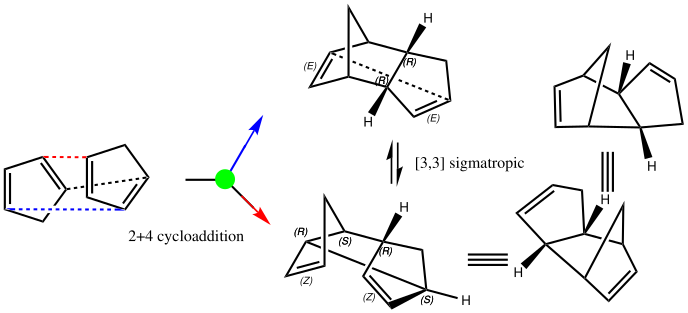
Cyclopentadiene is made by thermal cracking of its dimer, and on standing it slowly reverts to this species. At its simplest, this dimerisation can be described as a π2s + π4s pericyclic cycloaddition, one of the monomers being the π2s and the other the π4s. Two new bonds are formed; one of these is shown in black, but the other can be either the one in red (which makes the π4s the monomer on the right) or the one in blue (in which case the π4s comes from the molecule on the left). How do these two partners decide which role each is to play? Well, the short answer is that, initially at least, they do not! The reaction proceeds very asynchronously, forming at first only the black bond. Eventually, they cannot take the suspense any longer, and when the point indicated with a green dot is reached, they finally have to take a decision. Up to the green dot, the potential energy surface has followed along a valley ridge, and the green decision point is known as the bifurcation point; one with an equal probability of the reaction giving either the top dimer or the bottom dimer.

If you are sharp-eyed you may notice a methyl group has been added to one of the monomers; this was done to balance the decision very slightly in favour of one route down from the green point over the other. Otherwise, the IRC pathway often just stops at the green point, unable to decide which way to take.

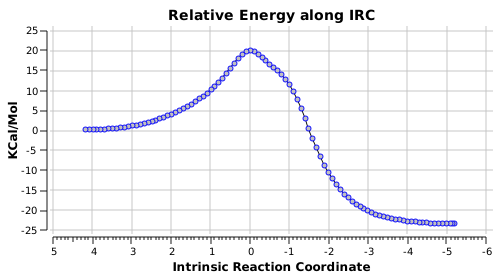
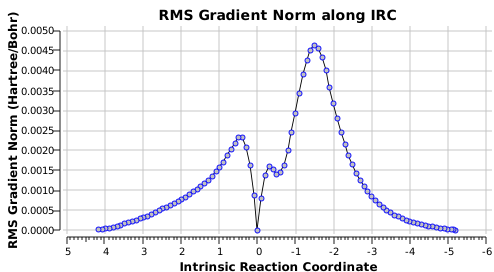
You can see this oddity reflected in the gradient norm of the IRC, which at IRC -1.5 suddenly acquires a new feature, the formation of the second bond. The lesson here is to remember that bonds do not have to form at the same time, they can instead follow, one after the other.

The two different dimers that result from the bifurcation are not in fact identical, they are mirror images (diastereomers because of the methyl group) of each other. They can in turn be inter-converted by a Cope rearrangement, a [3,3] sigmatropic reaction. The transition state for this process is none other than the green point reached earlier. It is indeed a transition state at a crossroads, connecting two quite different reactions, the Diels-Alder cycloaddition and the [3,3] Cope enantiomerisation of the dimer product. Such a reaction has been christened a bispericyclic reaction, one truly at a Y-junction.

Who would have thought that such an un-pretentious molecule could teach us so much. You can see this and many other examples of pericylic reactions in my course on the topic, available on an iPad by clicking here.

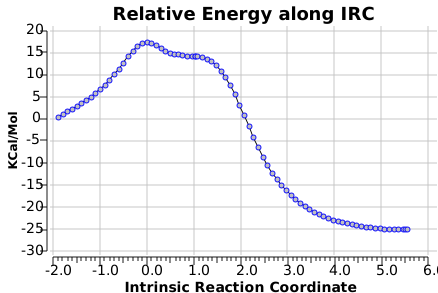
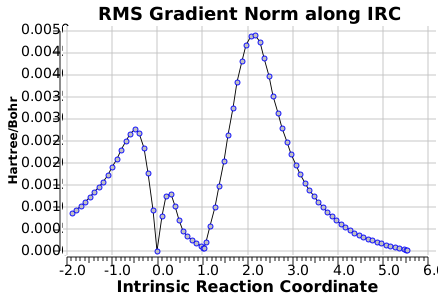
Postscript: I have managed to run a full IRC on the system without the methyl perturbation.

The bifurcation point (green dot) is clearly seen in the following two plots at a value of  IRC +1.0

The inner secrets of the DNA structure.

Wednesday, May 18th, 2011

In earlier posts, I alluded to what might make DNA wind into a left or a right-handed helix. Here I switch the magnification of our structural microscope up a notch to take a look at some more inner secrets.

A fragment of a single chain of DNA, taken from a Z-helix. Click for 3D.

The 3D coordinates of this fragment were obtained by taking a crystal structure of a Z-d(CGCG)2 containing oligomer, editing (to remove water, and superfluous bases) and subjecting it to ωB97XD/6-311G(d,p)/SCRF=water geometry refinement. This should be accurate enough to recover dispersion attractions, and various electronic and electrostatic interactions. Z-d(CGCG)2 was then reduced to the fragment you see above, which is large enough to capture the essence of the Z-helical wind, but small enough to be able to spot things which a larger fragment might overwhelm.

  1. The 3D model (click on above to obtain it) reveals that the oxygen of one of the five-membered (tetrahydrofuran) rings has a close contact to the guanine base of 2.85Å. This is some 0.3Å shorter than the combined van der Waals radii, and very typical of oxygen…electrophilic carbon interactions (see discussion here for more details). We can reasonably assume its real. It is supported by a small NBO perturbation term (~1.1 kcal/mol) corresponding to donation of the oxygen lone pair into a C-N π* orbital.
  2. The next interaction detected comes from a furanose C-H bond, in which the hydrogen approaches to within 2.48Å of the oxygen on the furanose the other side of the phosphate. This is ~0.14Å shorter than the combined van der Waals distances (remember, even at the actual vdW sum, the attraction is still attractive). Why would an apparently inert C-H bond do that? Such bonds are not normally considered in such analyses. Well, this one is special.
  3. It may well be (slightly) more acidic than normal due to a C-Hσ/C-Oσ* anti-periplanar interaction (E2 5.8, magenta bonds in 3D model) into the CH2-OH bond of the furanose. Hence the acidified H can form a weak(ish) hydrogen bond to the oxygen. The NBO E2 energy is 1.4 from the Olp to the C-H* bond (larger E2 interactions normally occur through bonds, but this one is through space, which is why it is smaller).
  4. These two interactions in turn set up a good orientation for the guanine to create a strong anomeric effect between it and the ribose; NLp/C-Oσ*E2 11.6 (violet bond in 3D model, blue bond b in above diagram). To calibrate this interaction, anomeric effects in sugars are of the order of 14-16 kcal/mol. These stereoelectronic effect helps to slightly rigidify the relationship between the guanine base and the furanose it is connected to.
  5. In contrast, the cytosine-furanose link avoids the classical anomeric effect, and instead sets up a weaker one with a C-C bond instead (E2 6.8, indigo bond, blue bond a in above diagram). The Nlp is not as good a donor, because it is sequestered into the adjacent carbonyl group on the cytosine. The guanine has no such adjacent group, and so its Nlp is a better donor. The outcome of all of this is that the two bases, C and G end up having a different geometrical relationship to the furanose they are each connected to.
  6. Notice the gauche-like conformation of the ethane-1,2-diol fragment (gold bond in 3D model), which is again due to stereoelectronic alignments.
  7. Notice the Nlp …H-C distance of 2.51Å, which like 2 above, is around the sum of the vdW radii. It might be slightly more than just a dispersion attraction, since the NBO E2 Nlp/C-H* through space interaction is ~2 kcal/mol.
  8. There are some other relatively close atom-atom approaches, but I do not list them here. Do explore them yourself (they are labelled 8 in the diagram below).

To complete the present analysis, I include an ELF diagram. This can locate lone-pairs (as monosynaptic basins) as well as bond pairs (disynaptic basins) and so is useful for visualising the anti-periplanar anomeric effects between a lone pair and a bond (connecting a mono and a disynaptic basin if you like). Some of the interactions described in the list above are shown below with dotted lines (note that some of the lone pairs appear as two basins, distributed either face of the aromatic base).

ELF analysis. Click for 3D.

Well, cranking up the magnification on a microscope will always reveal new details. You might ask if these new details matter? Well, since DNA is such a very long polymer, repeating even a very weak (but predictable) interaction millions of times is bound to have some sort of cumulative effect. Who knows which of the ones above might play an important role in the super-winding of DNA, or its packing into a cell, or interaction with proteins, and so on. I do wonder how many of the terms I have identified above have been previously considered for such roles. Anyone know?

Postscript: Shown below is a  non-covalent-analysis (NCI,  see earlier post). A reminder that the interaction surface is colour coded with orange or red tinge if repulsive, blue if attractive, and green for weaker interactions. These surfaces pretty much recapitulate what it itemised above, adding also other interactions not listed above (labelled 8 in diagram).

NCI analysis for Z-CG fragment. Click for 3D.

The melting points from benzene to cyclohexane: a prime example of dispersion forces in action?

Thursday, December 30th, 2010

One of the delights of wandering around an undergraduate chemistry laboratory is discussing the unexpected, if not the outright impossible, with students. The >100% yield in a reaction is an example. This is sometimes encountered (albeit only briefly) when students attempt to recrystallise a product from cyclohexane, and get an abundant crop of crystals when they put their solution into an ice-bath to induce the crystallisation. Of the solvent of course! I should imagine 1000% yields are possible like this.

What the students are not expecting is that cyclohexane has such a high melting point, higher than that of water! n-Octane for example melts at -57°C (and most of us have seen those travelogues in the antarctic where the petrol tanks need to be warned to prevent freezing), so why is that of cyclohexane so much higher? That it might be strange is shown by the melting points of the series:

  1. benzene, +5.5°C
  2. cyclohexadiene, -89°C
  3. cyclohexene, -97°C
  4. cyclohexane, +6.5°C.

Benzene one might explain because it famously stacks in a herring-bone fashion, with the relatively electropositive hydrogen attracted to the π-cloud on the face.

The crystal structure of benzene. Click for 3D

Clearly, this explanation cannot hold for cyclohexane, which has no π-face. What does the crystal look like?

Crystal structure of cyclohexane. Click for 3D

If one inspects the structure closely, one can find quite a few H…H contacts at about 2.4Å and they are arranged in a particularly rigid three-dimensional manner. The maximum attractive force resulting from van der Waals, or dispersion interactions between two hydrogens is thought to occur at ~2.4Å. Perhaps cyclohexane is a prime (possibly THE prime) example of the influence of this (under-rated) interaction? A molecule covered in Velcro no less. By the way, can you spot the connection with the previous post?


Postscript: Below is a so-called non-covalent-analysis (NCI) of cyclohexane as packed into a crystal lattice. The coordinates are obtained from a neutron diffraction structure. The green regions indicate weakly attractive zones.

Click for  3D.

Click for 3D.

The melting points from benzene to cyclohexane: a prime example of dispersion forces in action?

Thursday, December 30th, 2010

One of the delights of wandering around an undergraduate chemistry laboratory is discussing the unexpected, if not the outright impossible, with students. The >100% yield in a reaction is an example. This is sometimes encountered (albeit only briefly) when students attempt to recrystallise a product from cyclohexane, and get an abundant crop of crystals when they put their solution into an ice-bath to induce the crystallisation. Of the solvent of course! I should imagine 1000% yields are possible like this.

What the students are not expecting is that cyclohexane has such a high melting point, higher than that of water! n-Octane for example melts at -57°C (and most of us have seen those travelogues in the antarctic where the petrol tanks need to be warned to prevent freezing), so why is that of cyclohexane so much higher? That it might be strange is shown by the melting points of the series:

  1. benzene, +5.5°C
  2. cyclohexadiene, -89°C
  3. cyclohexene, -97°C
  4. cyclohexane, +6.5°C.

Benzene one might explain because it famously stacks in a herring-bone fashion, with the relatively electropositive hydrogen attracted to the π-cloud on the face.

The crystal structure of benzene. Click for 3D

Clearly, this explanation cannot hold for cyclohexane, which has no π-face. What does the crystal look like?

Crystal structure of cyclohexane. Click for 3D

If one inspects the structure closely, one can find quite a few H…H contacts at about 2.4Å and they are arranged in a particularly rigid three-dimensional manner. The maximum attractive force resulting from van der Waals, or dispersion interactions between two hydrogens is thought to occur at ~2.4Å. Perhaps cyclohexane is a prime (possibly THE prime) example of the influence of this (under-rated) interaction? A molecule covered in Velcro no less. By the way, can you spot the connection with the previous post?


Postscript: Below is a so-called non-covalent-analysis (NCI) of cyclohexane as packed into a crystal lattice. The coordinates are obtained from a neutron diffraction structure. The green regions indicate weakly attractive zones.

Click for  3D.

Click for 3D.

Data-round-tripping: moving chemical data around.

Saturday, November 20th, 2010

For those of us who were around in 1985, an important chemical IT innovation occurred. We could acquire a computer which could be used to draw chemical structures in one application, and via a mysterious and mostly invisible entity called the clipboard, paste it into a word processor (it was called a Macintosh). Perchance even print the result on a laserprinter. Most students of the present age have no idea what we used to do before this innovation! Perhaps not in 1985, but at some stage shortly thereafter, and in effect without most people noticing, the return journey also started working, the so-called round trip. It seemed natural that a chemical structure diagram subjected to this treatment could still be chemically edited, and that it could make the round trip repeatedly. Little did we realise how fragile this round trip might be. Years later, the computer and its clipboard, the chemistry software, and the word processor had all moved on many generations (it is important to flag that three different vendors were involved, all using proprietary formats to weave their magic). And (on a Mac at least) the round-tripping no longer worked. Upon its return to (Chemdraw in this instance), it had been rendered inert, un-editable, and devoid of semantic meaning unless a human intervened. By the way, this process of data-loss is easily demonstrated even on this blog. The chemical diagrams you see here are similarly devoid of data, being merely bit-mapped JPG images. Which is why, on many of these posts, I put in the caption Click for 3D, which gives you access to the chemical data proper (in CML or other formats). And I throw in a digital repository identifier for good measure should you want a full dataset.

It is only now that we (more specifically, this user) understand what had happened under-the-hood to break this round-tripping. In 1984, when Apple produced the Mac, they also produced a most interesting data format called PICT. A human saw the PICT as a PICTure, but the computer saw more. It (could) see additional data embedded in the PICT. The clipboard supported the PICT format, which meant that both picture and data could be transferred between programs. And ChemDraw and Word also understood this. Hence the ability to round-trip noted above (it has to be said between specifically these programs).

Times moved on and the limitations of PICT set in. Apple refocussed on the PDF format. Related, notice, to the Postscript format that Adobe had introduced in order to allow high quality laserprinting. PICT support was abandoned, and the various components no longer carried recognisable data (specifically the clipboard or the ability of Word to recognise the data). Round-tripping broke. Does this matter? Well, one colleague where I work had accumulated more than 1000 chemical diagrams, which he decided to store in Powerpoint (and yes, he threw the original Chemdraw files away). The day came when he wanted to round trip one of them. And of course he could not. He was rather upset I have to say!

PDF was not really a format designed to carry data (see DOI: 10.1021/ci9003688). But, bless their hearts, the three vendors involved in this story all agreed to support data embedded in the PDF hamburger (and Abobe to tolerate it) and now once again, a structure diagram can move into an Office program (on Mac) and out again and retain its chemical integrity. What lessons can be learnt?

  1. Firstly, out of side, out of mind. The clipboard is truly mostly out of sight, and it was not really designed from the outset to preserve data properly. Nowadays I wonder whether clipboards in general recognise XML (and hence CML) and preserve it. I truly do not know. But they should.
  2. Secondly, any system which relies on three or four commercial vendors, who at least in the past, devised proprietary formats which they could change without warning, is bound to be fragile.
  3. We have learnt that data is valuable. More so than the representation of it (i.e. a 2D or 3D structure diagram). But when its lost, the users should care! And tell the vendors.
  4. Peter Murray-Rust and his team have produced CML4Word (or as Microsoft call it, Chemistry add-in for Word). At its heart is data integrity. Fantastic! But I wonder if it survives on Microsoft’s clipboard (I know it does not on Apple’s, since CML4Word is not available on that OS. And is unlikely to ever become so).
  5. And I can see history about to repeat itself. The same seems about to happen on new devices such as the Apple iPad. It too has copy/paste via a clipboard. I bet this will not round trip chemistry (or much other) data! Want to bet that the lessons of this story have not yet been learnt?

Oh, for those who wish to round-trip chemistry on a Mac, you will have to acquire ChemDraw 12.0.2 and Word 2011 (version 14.01), as well as OS X 10.6 for it to work.