Posts Tagged ‘conformational analysis’

The mysterious (aromatic) structure of n-Butyl lithium.

Sunday, March 17th, 2013

n-Butyl lithium is hexameric in the solid state and in cyclohexane solutions. Why? Here I try to find out some of its secrets.

SUHBEC. CLICK FOR 3D.

SUHBEC. CLICK FOR 3D.

The crystal structure reveals the following points of interest:

  1. Six lithium atoms form a cluster with triangular faces.
  2. An off-centre carbanion caps a triangular lithium face.
  3. Four of the butyl groups are in a fully extended antiperiplanar conformation
  4. But two di-axial n-butyl exhibit a gauche conformation.

The lithium cluster has twelve electrons available for bonding; if the Li is considered as Li+, balanced by six C carbanions, the twelve electrons come from the six carbon lone pairs pointing towards each of six triangular faces. An ELF analysis can help identify how these twelve electrons are arranged. Shown below is the environment of a single Li-face, with the ELF basin ringed. It integrates to 2.08 electrons. So each tetrahedral cluster of three lithiums and one carbanion could be considered as a two-electron-four-centre bond, perhaps a natural progression from the two-electron-three-centre bonding found in a slightly less electron deficient system such as diborane. 

ELF basins. Click for  3D

ELF basins. Click for 3D

NBOs (natural bond orbitals) reflect this character. An NBO represents a localised two-electron orbital, and analysis indeed reveals six such orbitals, each having the form shown below.

NBO. Click for  3D.

NBO. Click for 3D.

This picture in turn leads us to identify this system as spherically aromatic (doi: 10.1002/1521-3773(20010803)40:15<2834::AID-ANIE2834>3.0.CO;2-H ). The three-dimensional equivalent of the Hückel rule is that any system with 2(N+1)2 σ or π electrons (or both) in a cluster can be considered aromatic/diatropic. In this case, N=0 and hence the magic count is 2 for each of the six CLi3 tetrahedra. The diatropic ring current might be manifested in the computed 1H NMR chemical shifts of the CH2 protons (-0.8ppm). Aromaticity does not immediately spring to mind with the name n-butyl lithium, but this unprepossessing molecule has six aromatic regions!

Each lithium atom is in turn hemispherically surrounded by three of these 2.08 electron basins (below, although the ELF centroid is very much biased towards the carbon, indicating considerable ionicity). What wonderful electronic economy! Despite there being only twelve electrons to be shared amongst six lithium atoms, each lithium manages nevertheless to surround itself with 6.24 electrons. All crammed into one half sphere, leaving a nice coordination hole; n-butyl lithium is after all a highly reactive species (even as a hexamer).

n-butyl-ELF1

I want to finish by exploring the observation that two of the six n-butyl groups adopt a gauche conformation. In free n-butane itself, around 31% of the population adopts this shape, which curiously is around the same proportion as is found in the hexameric structure of n-butyl lithium. More generally, a search of the Cambridge database for compounds containing such groups reveals the following distribution; about 1 in 7.

Gauche

Well, when you deprive a molecule of electrons, as any species with lithium must invariably suffer from, it is wonderful how the system responds. In this sense, a hexameric structure seems a very natural outcome. And it has brought us the two-electron-four-centre bond and the associated spherical aromaticity, both of which are a nice bonus.

A to-and-fro of electrons operating in s-cis esters.

Thursday, February 21st, 2013

I conclude my exploration of conformational preferences by taking a look at esters. As before, I start with a search definition, the ester being restricted to one bearing only sp3 carbon centers.

s-cis-ester-torsion-search

The result of such a search is pretty clear-cut; they all exist in just one conformation, the s-cis, in which a lone pair of electrons on the alkyl-oxygen is aligned quite precisely anti-periplanar with the axis of the C=O bond. This very narrow distribution suggests a relatively large energy preference for this orientation, and we need to seek its origins.

s-cis-ester-torsion

This arises from two electronic alignments. The first orients the in-plane alkyl oxygen lone pair (orange-purple below) anti-periplanar with the C=O σ* empty orbital (red-blue; orange=red, blue=purple), an interaction mapping to 7.7 kcal/mol in the NBO E(2) energy. The second reinforcement (not shown) aligns the (O=)C-Me donor bond with the antiperiplanar O-Me acceptor (5.3 kcal/mol). These two interactions are weaker in the s-trans ester, which is 8.1 kcal/mol higher in ΔG298 and for which the E(2) terms are respectively 3.0 and 0.6 kcal/mol. 

Click for  3D.

Lp(alkyl-O)/C=O σ* Click for 3D.

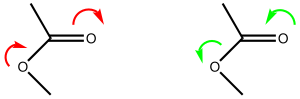
But wait, this interaction has electrons moving from the alkyl oxygen to the acyl oxygen (red arrows below) and apparently weakening the C=O bond in the process. But in an entirely different context, we learn that the C=O vibrational stretching wavenumber for an ester (1750 cm-1) is higher than that of a ketone (~1715 cm-1); the C=O is stronger rather than weaker in the ester. So now we have to move the σ-electrons back again (green arrows below).s-cis-ester

This strengthening of the C=O bond arises from the following overlap of the σ-lone pair on the carbonyl oxygen with the alkyl-O-C σ* empty orbital, for which E(2) is 41.5 kcal/mol, much larger than the previous effect. It however does NOT discriminate between the s-cis and s-trans  conformations, since this interaction is almost the same in the latter (41.8). So we have a to-of-(red)-electrons which promote the s-cis conformation, and rather stronger fro-of-(green)-electrons which strengthen the C=O bond. But they do not cancel each-other; each has its own job to do!

Click for  3D.

Lp(acyl-O)/C-O σ* Click for 3D.

There is one other overlap which may differentiate between s-cis and s-trans, but a rather less obvious one. That is the alkyl-Oπ donating to the acyl C=Oπ* which has E(2) 64.7 for the former and 59.4 kcal/mol for the latter. It is not immediately apparent why this overlap should favour s-cis. It is however the effect that induces a significant rotational barrier about the C-O bond (~12 kcal/mol).

Click for  3D.

Lp (alkyl-O π)/C=O π* Click for 3D.

Here is the result of another search of the crystal database;  namely the C=O distance (DIST1) vs the  C-O distance (DIST2). You can see that the red hot spot (~1400 examples) is very isolated (the blue squares represent < 200 hits), and there seems to be no significant correlation between the two lengths and the structure.

s-cis-ester-distance
I will conclude with a brief discussion of the carbonyl lone pairs. There are two, and one of them has been shown above in the Lp(acyl-O)/C-O σ* interaction. There is another, but it plays no role in the conformation, and is of quite a different character. Although a low-lying orbital, it is clearly non bonding; indeed might be slightly anti-bonding along the C=O axis. These two carbonyl lone pairs are quite different in character, since each performs a different role in the molecule.

Click for  3D.

Click for 3D.

So the conformational analysis of this simple little molecule reveals some interesting toos-and-fros in the electrons. I will deal with the issue of the carbonyl stretching frequencies in another post.

The conformational preference of s-cis amides. Ramachandran plots.

Monday, February 11th, 2013

This is really just a postscript to the previous post. There I showed how a search of the (small molecule) crystal database revealed the s-cis conformation about the N-C amide bond (the one with partial double bond character that prevents rotation) and how this conformation means that a C-H approaches quite closely to an adjacent oxygen. It is a tiny step from that search to a related, and very famous one named after Ramachandran[1]. Indeed this search, and the contour map used to display the results, really put crystal databases on the map so to speak.

ramachandran

The search above defines two torsion angles about the central sp3-hybridized carbon atom (the one that makes amino acids chiral if that carbon does not carry a second hydrogen atom, i.e. glycine). The two angles are called Ψ and Φ. Such searches have been done countless times; but here I subject it to my usual constraints (R < 0.05, no disorder, no errors, T ≤ 175K and acyclic bonds along the backbone so as not to constrain it). 

Ramachandran1

The red-spot (> 15 instances) occurs at angles of Ψ and Φ of ~ +150 and -70°. If the temperature constraint is switched off (below), a distinctly different plot emerges with the red-spot Ψ reduced to -25°. If the temperature constraint is replaced by the stipulation that the structure must be published post 2000, the first plot is largely recovered, and we may conclude that the two plots differ only because of the use of more modern diffractometers, where low temperature measurement is routine. If may also mean that more difficult structures previously inaccessible to older instruments tend to dominate the more modern plot.

Ramachandran3-no-temp

I also show a plot where the central carbon is forced to carry two H-C bonds (glycine derivatives). As is well-known, the absence of the steric bulk on that atom does induce a different backbone conformation (and hence a different location for the red spot). 

Ramachandran2

And so, with this thread I have moved from discussing quite tiny molecules into the arena of much vaster biomolecules. But the basic principles are the same for both.

References

  1. G. Ramachandran, C. Ramakrishnan, and V. Sasisekharan, "Stereochemistry of polypeptide chain configurations", Journal of Molecular Biology, vol. 7, pp. 95-99, 1963. https://doi.org/10.1016/s0022-2836(63)80023-6

The conformational preference of s-cis amides.

Sunday, February 10th, 2013

Amides with an H-N group are a component of the peptide linkage (O=C-NH). Here I ask what the conformation (it could also be called a configuration) about the C-N bond is. A search of the following type can be defined:

cis-amide

The dihedral shown is for H-N-C=O (but this is equivalent to the C-C-N-C dihedral, which is also often called the dihedral angle associated with the peptide group). I have also added a distance, from a C-H to the carbonyl oxygen. Other search constraints include T ≤ 175K, R < 0.05, no disorder, no errors, that neither N-C bonds are part of a ring and that the two carbons marked T4 both have four connected bonds. The search results in 619 hits (January 2013 version of the CCDC database), and these are displayed below.

cis-amide-search-heat

The horizontal axis reveals the highest concentration (red) at ~2.4Å due to a syn-co-planar alignment of the C-H bond with the plane of the C=O bond in the s-cis conformer (the significantly smaller hot-spot at ~3.9A may be due to an anti-co-planar alignment of this C-H bond).

s-cis-amide

The vertical axis shows a clear preference for a dihedral of 179° (in fact no hits with a dihedral of less than 14o° were found) and this can only arise from the s-cis conformation in which the H-N bond is oriented antiperiplanar to the axis of the C=O bond. This preference can be rationalised by filled/empty NBO-orbital interactions, which include:

  1. Antiperiplanar interaction between the N-H as donor and the C=O as a σ-acceptor (E(2) = 4.1 kcal/mol)
  2. Antiperiplanar interaction between the N-H as acceptor and C-H as donor (E(2) = 4.7 kcal/mol)
Click for 3D

H-N/C=O. Click for 3D


Click for 3D.

Click for 3D.

This latter overlap conspires to bring the C-H hydrogen close to the oxygen (~2.35Å, DIST1 in the diagram above). So one might be entitled to ask: is this a hydrogen bond? There are (at least) two ways of testing this.

  1. The NBO E(2) interaction energy between the oxygen in-plane lone pair and the H-C as acceptor is 0.8 kcal/mol. For hydrogen bonds, such E(2) energies more or less resemble the actual H-bond strengths, i.e. a strong H-bond has an E(2) energy of ~ 8 kcal/mol; and a medium O…H-C hydrogen bond weighs in at around 3 kcal/mol.  So this one is very weak. This is due to poor overlap resulting from the small ring size (5).
  2. The NCI (non-covalent-interaction) surface does reveal a feature in the CH…O region, but the colour coding (which indicates how attractive/repulsive this is) is both pale blue (attractive) and yellow (repulsive). Again this is only consistent with a very weak overall H-bond.
NCI surface. Click for 3D.

NCI surface. Click for 3D.

I end by reminding that the s-cis H-N-C=O conformation is a very common feature in peptides (the CCDC database comprises mostly small molecules, not larger peptides and proteins) arising from really quite subtle orbital interactions.

The conformation of acetaldehyde: a simple molecule, a complex explanation?

Friday, February 8th, 2013

Consider acetaldehyde (ethanal for progressive nomenclaturists). What conformation does it adopt, and why? This question was posed of me by a student at the end of a recent lecture of mine. Surely, an easy answer to give? Read on …

acetaldehyde

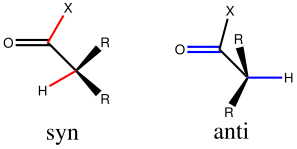
There really are only two possibilities, the syn and anti. Well, I have discovered it is useful to start with a search of the Cambridge data base. With R=H or C, X unspecified,  acyclic and T ≤ 175K, two searches were performed. The first identified the torsion around O=C-C-H. This clearly shows a maximum at 120° (with twice the probability), and a smaller one at 0°. This matches syn; the anti conformation above would be expected to have peaks at 60° and 180°; the latter in particular is singularly missing.

acetaldehyde-180

An alternative search is to define the distance between the oxygen and the H. For the syn conformer, distances of ~2.5 and 3.1Å are expected; for the anti conformer, 2.7 and 3.3Å. Again, syn matches better. Remember, searches based on the position of a hydrogen are less reliable than most, so these distributions provide only a statistical indication.

acetaldehyde-dist

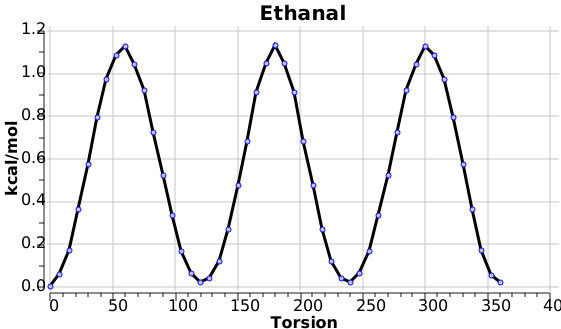
Now for a (ωB97XD/6-311G(d,p) calculation of the rotational barrier. The minima occur at torsions of 0, 120 and 240°, matching syn, although the barrier is very low.

acet-rot

Now to try to find explanations. The standard one finds this in three effects:

  1. Donation from two C-H bonds (R=H above) into the π*C=O NBO orbital (in the manner that was used to explain the cis-orientation of the two methyl groups in cis-butene). 
  2. Donation from the single co-planar C-H bond into the σ*C=O NBO orbital (blue bonds above)
  3. Pauli bond-bond repulsions between two filled NBOs. 

Effect 1 has an NBO perturbation energy E(2) of 7.0 kcal/mol for the syn conformer and 6.45 for the anti. The explanation is the π*C=O NBO “leans outward”, overlapping better with the C-H bonds in the syn than in the anti.  the One up to the syn! Effect 2 has values of 1.3 for the syn and 4.1 for the anti. The latter now has the edge. But wait, there are other (smaller) interactions. The syn has an antiperiplanar orientation of the two C-H bonds shown above (X=H,red), E(2) = 3.3 vs 0.6 for the corresponding syn-planar orientation in the anti-conformation. It’s now a tie; neck-and-neck.

Effect three suggests that the disjoint NLMO steric exchange energy is 54.34 for the anti and 53.88 (i.e. lower) for the syn. It is vaguely disappointing that no absolutely clear-cut explanation emerges. But then the difference (in total free energy) is only 1.4 kcal/mol. But even this small difference in energy can manifest in fairly clear-cut conformational preferences obtained from crystal structures. Ultimately of course, all effects in chemistry are reducible to the sum of lots of small effects (in other words unpredictable until one does the sum). 

I cannot end without mentioning the largest of all the NBO interactions, namely the in-plane lone pair on the oxygen as donor and the aldehyde proton C-H as acceptor (X=H). This has values of 29.3 for syn and 28.8 kcal/mol for anti. This manifest (inter alia) in a greatly reduced C-H vibrational wavenumber (ν 2982 for syn, 2900 cm-1 for anti) compared to the methyl C-H values (~3043-3164).

So this tiny little molecule ended up a little less obvious than might have seemed at the outset. One can find interesting things in even the tiniest of things! 


HC...C-H alignment. Click for  3D.

HC…C-H alignment. Click for 3D.


HC...C-H alignment. Click for  3D.

O=C*…C-H alignment. Click for 3D.

Secrets of a university tutor: conformational analysis and NMR spectroscopy.

Sunday, February 3rd, 2013

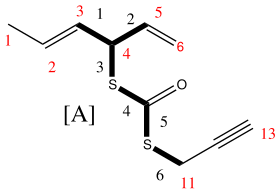
In a previous post, I set out how to show how one can reduce a 1H NMR spectrum to the structure [A] below. I speculated how a further test could be applied to this structure; back predicting its spectrum using just quantum mechanics. Overkill I know, but how well might the two match?

4nmr

  1. The process must start by considering the conformational possibilities of [A]. Each will have a different predicted spectrum. There are six rotatable bonds in the system, which if each bond has up to three rotamers would be 729 conformations potentially possible. A nightmare to explore (but do-able if you really needed to). I will try to reduce this by searching for the most probable for each bond (which may not of course lead to the final best conformation).
  2. Bonds 1 and 2 can be subjected to a search of the Cambridge database. The search criteria are the same as described in this post. The most probable dihedral angle around this type of bond is ± 110°.C=C-C-S
  3. Bond 3 has few entries, but they show as:O=C-S-C
  4. Bonds 4/5 are also the one that controls the conformation of esters, and is known as S-cis. All examples show the lone pair on the sulfur as anti to the axis of the C=O bond.SCC=O
  5. Bond 6 has just two conformations, anti and gauche.CC-C-S
  6. We have reduced the possible 729 to just two, which are then subjected to a ωB97XD/6-311G(d,p)/SCRF=chloroform calculation. Some faith in this combination can be obtained by inspecting the (remarkably accurate) result obtained for a Matryoshka doll. A suitable model can be invoked using a keyword NMR(mixed.spinspin). The method recovers at least a proportion of the effects on conformation induced by the weak dispersion forces present. The prediction comes in two forms:
    1. The magnetic shieldings relative to TMS (chemical shifts). One might expect these to be predicted with an error of around 0.3ppm, but if the actual NMR population comprises more than one rotamer, then one does need to take the Boltzmann average. For this molecule, predicting how the magnetic anisotropy induced from the double or triple bonds will perturb the chemical shifts will depend critically on the conformation of the molecule. In other words, this is actually a pretty challenging system to get right! 
    2. The spin-spin couplings. These have an expected predictability of ~1 Hz. 
  7. The calculation comes up with essentially identical free energies for the two selected conformations:
    Anti (0.1) Gauche (0.0)
    14-a Click for  3D
  8. The experimental spectrum was δ 1.70 (3H,d,6Hz), 2.23 (1H, t, 3Hz), 3.73 (2H, d, 3Hz), 4.84 (1H, dd, 7,8Hz), 5.15 (1H, d, 10Hz), 5.27 (1H, d, 17Hz), 5.51 (1H, dd, 8,16.5 Hz), 5.77 (1H, dq, 6,16.5 Hz), 5.88 (1H, ddd, 7,10,17Hz). 
  9. To compare with the computed one, firstly I note that the values for the three hydrogens of the methyl group have to be averaged over both conformations. The predicted chemical shifts are shown below. For the anti conformation, they all come within about 0.3ppm of the measured value.
    Chemical shifts
    Proton Expt anti Gauche
    1  1.70  1.68  1.66
    2  5.77  6.15  6.17
    3  5.51  5.76  5.76
    4  4.84  4.66  4.76
    5  5.88  6.15  6.19
    6  5.15  5.59  5.58
    6  5.27  5.76  5.84
    11  3.73  3.40  3.01
    11  3.73  3.49  3.01
    13  2.23  2.19  2.05
  10. The spin-spin couplings are shown below. Several differ by about 3Hz, but most are better. Notice how the sign of the coupling from H-11 to H-13 is identified as negative, and how the methylene group at C-11 is identified as slightly diastereotopic (from the presence of the chiral centre). The 2JHH coupling is not detected in the (first order) measured spectrum.
    Couplings, Hz
    Proton Expt anti Gauche
    1 6 6.6 6.6
    2 6,16.5 6.6,13.6 6.6,13.6
    3 16.5,8 13.6,9.2 13.6,9.2
    4 8,7 9.2,10.2 9.2,10.2
    5 7,10,17 10.2,10.4,15.4 10.210.4,15.4
    6 10 10.4 10.4
    6 17 15.4 15.4
    11 ±3 -15.5,-3.7,-3.7 -17.3,-3.5,-3.3
    11 ±3 -3.7,-3.7 -3.5
    13 ±3 -3.7, -3.7 -3.3

We might conclude from this analysis that the match between the measured spectrum of [A] and that calculated entirely from quantum mechanical principles is pretty good. We may be reasonably confident that the conformations we have identified are realistic. Of course, if we want to be sure there is none better, then the few hundred other possible conformations would have to be calculated. I am not about to try!

σ-π-Conjugation: seeking evidence by a survey of crystal structures.

Sunday, February 3rd, 2013

The electronic interaction between a single bond and an adjacent double bond is often called σ-π-conjugation (an older term for this is hyperconjugation), and the effect is often used to e.g. explain why more highly substituted carbocations are more stable than less substituted ones. This conjugation is more subtle in neutral molecules, but following my use of crystal structures to explore the so-called gauche effect (which originates from σ-σ-conjugation), I thought I would have a go here at seeing what the crystallographic evidence actually is for the σ-π-type.

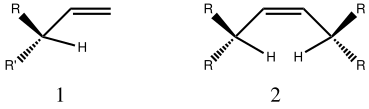
sigma-pi-conjugation

The basic two molecules are shown above; in effect propene 1 and butene 2. The latter was in fact the topic of another post, in which I attempted to show that the close H…H contact in cis-butene (2.1Å) was in effect an unwelcome consequence of the σ-π-conjugation of any of the four “outward leaning” C-H bonds of the methyl groups acting as donors (red-blue below) overlapping with the similarly “outward leaning” π* orbital of the alkene (purple-orange below; blue and purple overlap positively).

C-H/alkene interaction. Click for  3D.

NBO orbitals for C-H/alkene interaction. Click for 3D.

So how general might this be? To find out, I performed the following search on the Cambridge crystal database: cis-butene-search

  1. The search defines an alkene, bearing two cis-substituents each with at least one C-H bond. The substituents are both sp3 carbon, and the attachment bond to the alkene is defined as acyclic
  2. The H…H distance uses normalised terminal hydrogen positions (to try to correct for the normally over-short C-H bond lengths found by X-ray).
  3. Other constraints were R factor < 0.05, no disorder, no errors and (perhaps most importantly) T < 150K to try to reduce thermal libration.

I should qualify all of this by reminding that hydrogen positions in crystal structures are notoriously prone to errors. Nevertheless, with 624 hits using the above search, one might hope for statistical significance of a real effect.

Search result for close H...H contacts in cis-butenes.

Search result for close H…H contacts in cis-butenes.

For this sample, the most frequent H…H distance emerged as 2.1Å. This can only result from having the C-H bonds lie coplanar with the C=C alkene, as is shown above. The value is also remarkably close to the H…H distance for cis-butene itself (both computationally and as determined using electron diffraction). This does I feel provide a strong indication that σ-π-conjugation is manifesting in these systems.

Re-defining the search for propenes 1 as above gives 1656 hits, with a maximum in the distribution at 2.35Å corresponding to a syn-orientation of the C=C and the C-H bonds. The smaller maximum at about 2.75Å arises from a gauche-orientation between the C=C and C-H (in effect you have to halve this number, since there are twice as many possibilities for this to occur than for the syn). The “inward leaning” gauche C-H bond overlaps less well with the “outward leaning” π* orbital of the alkene.

Propene.

Search result for close H…H contacts in propenes.

These aspects are perhaps better seen in the orbital overlaps shown below.

Click for 3D.

Click for 3D.

I will follow-up this theme with esters and amides next.

The strangely attractive conformation of C17H36.

Sunday, January 13th, 2013

We tend to think of simple hydrocarbons as relatively inert and un-interesting molecules. However, a recent article[1], which was in fact highlighted by Steve Bachrach on his blog , asks what “The Last Globally Stable Extended Alkane” might be. In other words, at what stage does a straight-chain hydrocarbon fold back upon itself, and no significant population of the linear form remain? The answer was suggested to be C17H36. I thought I might subject this conformation to an NCI (non-covalent-interaction) analysis.

NCI analysis. Click for  3D.

NCI analysis. Click for 3D.

The colour coding for the NCI surface is such that towards blue is attractive, with green being mildly attractive and yellow mildly repulsive. Both blue and yellow can be seen at the point where the molecule bends round, and attractive green dominates the region where the two chains are parallel. Much in the manner of a Gekko’s feet[2], the strangely attractive van der Waals terms in a hydrocarbon are surprisingly cumulative!  You can generate an NCI surface for your favourite molecule here.

Addendum:  To show that NCI interactions are pretty additive, here is  C28H58:

C28 double hairpin. Click for  3D.

C28 double hairpin. Click for 3D.

References

  1. N.O.B. Lüttschwager, T.N. Wassermann, R.A. Mata, and M.A. Suhm, "The Last Globally Stable Extended Alkane", Angewandte Chemie International Edition, vol. 52, pp. 463-466, 2012. https://doi.org/10.1002/anie.201202894
  2. J. Yu, S. Chary, S. Das, J. Tamelier, N.S. Pesika, K.L. Turner, and J.N. Israelachvili, "Gecko‐Inspired Dry Adhesive for Robotic Applications", Advanced Functional Materials, vol. 21, pp. 3010-3018, 2011. https://doi.org/10.1002/adfm.201100493

A conflation of concepts: Conformation and pericyclic.

Thursday, January 10th, 2013

This is an interesting result I got when studying the [1,4] sigmatropic rearrangement of heptamethylbicyclo-[3.1.0]hexenyl cations. It fits into the last lecture of a series on pericyclic mechanisms, and just before the first lecture on conformational analysis. This is how they join.

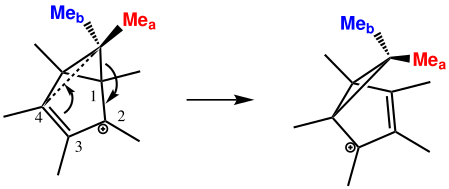
14me

The experiment it relates to[1] may well be a contender for the top ten list of most influential experiments ever conducted in chemistry. At -40°C, the 1H NMR spectrum of this species has three peaks, at δ2.06, 1.57 and 1.13 ppm with an integral ratio of 15:3:3. The five basal methyls are averaged to 2.06 ppm, whereas those marked above as Mea and Meb exhibit distinct separate resonances. At -90°C, the five basal methyls split into peaks at δ2.48, 2.02, 1.66, in the integral ratio of 6:3:6. This indicates a process that is slow at the lower temperature but becomes fast (on the NMR time scale) at the higher temperature. The process must retain the individual identity of Mea and Meb.

The explanation is of course that a pericyclic [1,4] sigmatropic shift occurs. As a four electron process, this must have one antarafacial component, and this is by far easier to achieve by inverting the configuration at the migrating carbon centre. To convince oneself that this process does indeed retain the individual identity of Mea and Meb, an IRC of the reaction can be computed (ωB97XD/6-311G).

Click for  3D.

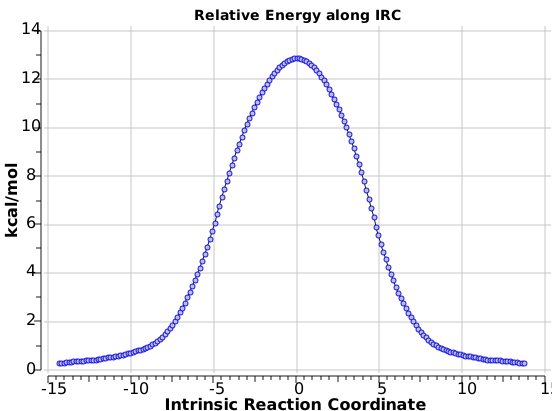
The energy profile is smooth and springs no surprises. The barrier is about right for the temperatures noted above. 14meE

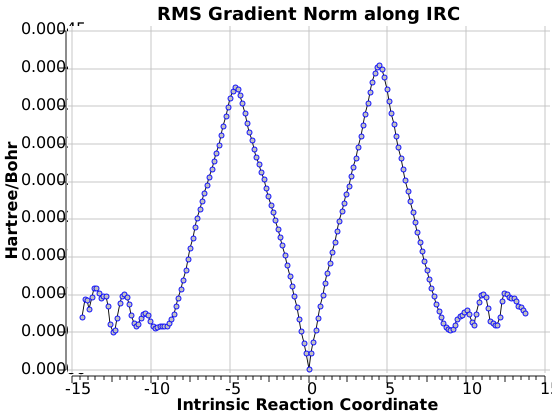
But the RMS gradient norm along the IRC is unexpected. 14meG

  1. Between the limits IRC ± 9, the profile is that of a reaction, involving bonds breaking and forming.
  2. In the range IRC ± (9 – 15), unexpected features appear (hidden intermediates if you check this post). A whole plethora of them. This is the conformational region where the methyl flags start waving (and no bonds are formed or broken). If you watch the animation above very carefully, you will note that the methyl groups start rotating at the start and at the end of the migration, at a stage when the ring has an allyl cation. This delocalised cation has a different impact upon the conformation of the methyl groups from that of the transition state, where the charge now resides largely on the migrating carbon, and the ring now has just a neutral butadiene. This latter imparts a different conformational preference upon the methyl groups. You can see an orbital analysis of these effects at this post.
  3. But perhaps the most surprising aspect of all of this is that each methyl flag waves at a different time from the others; first one waves, then the second and then the third. The two remaining basal methyls (attached to sp3 carbons) do not wave at all.

So this classic reaction is not just a pericyclic exemplar, it also illustrates nicely and concisely the conformational analysis of methyl groups interacting with an unsaturated system. Two for the price of one so to speak.

References

  1. R.F. Childs, and S. Winstein, "Ring opening and fivefold degenerate scrambling in hexa- and heptamethylbicyclo[3.1.0]hexenyl cations", Journal of the American Chemical Society, vol. 90, pp. 7146-7147, 1968. https://doi.org/10.1021/ja01027a059

The gauche effect: seeking evidence by a survey of crystal structures.

Friday, January 4th, 2013

I previously blogged about anomeric effects involving π electrons as donors, and my post on the conformation of 1,2-difluorethane turned out one of the most popular. Here I thought I would present the results of searching the Cambridge crystal database for examples of the gauche effect. The basic search is defined belowCCDC-search

Here, we define a four-atom torsion (TOR1), the two central carbon atoms having two groups R which can be only H or C. These two carbons are also defined as acyclic. The restrictions of the search as defined above also include R-factor < 0.05, not disordered and no errors. These combine to reduce the number of hits significantly (although not dissimilar distributions are obtained for less restricted searches). Each search takes only a few seconds, and one can rattle through many permutations very quickly.

So here come the results. First, QA=4M=F. All but one of the examples has a torsion in the region of 60°, the classic gauche effect!

F-C-C-F

F-C-C-F

Next, QA=O, 4M=F. Rather more hits, and the effect is almost as clear-cut. I should point out that the apparent “exceptions” to the gauche conformation may arise from structural restrictions, and each really would have to be inspected individually for the reasons (which I do not attempt here). 

OCCF

OCCF

With QA=4M=O,  one has many more instances. The effect is pretty convincing (it may be that hydrogen bonding may also control the conformation).

O-C-C-O

O-C-C-O

Now for QA=4M=Cl. The distribution is slanted more to the anti conformation, but there are still quite a few gauche.

Cl-CC-Cl

Cl-CC-Cl

With QA=4M=S, the conformations are now almost all anti; the gauche effect is no more! 

S-C-C-S

S-C-C-S

And for QA=4M=Br, it has also almost vanished (there is only one instance for I, and that too is antiperiplanar).

Br-C-C-Br

Br-C-C-Br

I now return to an earlier post in which I speculated that a cyano group might participate in the anomeric effect. Well here it is in the gauche effect; QA=CN, 4M = any of N,O,F,Cl,S. Quite a few gauche orientations for this pseudo-halogen!

Neg-C-C-CN

Neg-C-C-CN

Another group that can act as a powerful acceptor of electrons from a donor is QA=N(Me)3+.. With 4M= N, O, F, Cl, here  the population of gauche conformers is large. QA=CF3 is a similar group.

Neg-C-C-NMe3

Neg-C-C-NMe3


Neg-C-C-CF3

Neg-C-C-CF3


One can envisage other combinations. Thus QA= C=C, 4M = any of  N, O, F, Cl. An alkene seems one of the more powerful gauche effect participants!

alkene-C-C-Neg

alkene-C-C-Neg

And alkynes, perhaps slightly less so.

Alkyne-C-C-Neg

Alkyne-C-C-Neg

What about metals (QA = any metal, 4M = any of N, O, F, Cl, S). Well, not particularly biased either way, but clearly one in which the identity of the metal may matter.

Metal-C-C-electronegative

Metal-C-C-electronegative

I should end with inverting the model. If QA is electropositive (any group to the left of carbon, or below it in the periodic table) and 4M is electronegative, than they align almost exclusively anti-periplanar and not gauche. But notice how relatively few examples there are.  Synthetic chemists, please make more such molecules!

Electropositive-C-C-Electronegative

Electropositive-C-C-Electronegative

If you thought the gauche effect was restricted to just a few molecules, think again!