Posts Tagged ‘Nick Greeves’

The atom and the molecule: A one-day symposium on 23 March, 2016 celebrating Gilbert N. Lewis.

Friday, December 11th, 2015

You might have noticed the occasional reference here to the upcoming centenary of the publication of Gilbert N. Lewis’ famous article entitled “The atom and the molecule“.[1] A symposium exploring his scientific impact and legacy will be held in London on March 23, 2016, exactly 70 years to the day since his death. A list of the speakers and their titles is shown below; there is no attendance fee, but you must register as per the instructions below.


Royal Society of Chemistry Historical Group Meeting on 23th March 2016, Burlington House, Piccadilly, London: The atom and the molecule: A symposium celebrating Gilbert N. Lewis.

  • Dr Patrick Coffey (Berkeley, USA): Does Personality Influence Scientific Credit? Simultaneous Priority Disputes: Lewis vs. Langmuir and Langmuir vs. Harkins
  • Professor Robin Hendry (Durham, UK): Lewis on Structure and the Chemical Bond
  • Professor Alan Dronsfield (UK): An organic chemist reflects on the Lewis two-electron bond
  • Dr Julia Contreras-García (UPMC, France): Do bonds need a name?
  • Professor Nick Greeves (Liverpool, UK): The influence of Lewis on organic chemistry teaching, textbooks and beyond
  • Professor Clark Landis (UWM, USA): Lewis and Lewis-like Structures in the Quantum Era
  • Professor Michael Mingos (Oxford, UK): The Inorganic dimension to Lewis and Kossel’s landmark contributions
  • Dr Patrick Coffey (Berkeley, USA): Lewis’ Life, Death, and Missing Nobel Prize

Prior registration is essential. Please email your name and address to Professor John Nicholson,  jwnicholson01 @ gmail.com


References

  1. G.N. Lewis, "THE ATOM AND THE MOLECULE.", Journal of the American Chemical Society, vol. 38, pp. 762-785, 1916. https://doi.org/10.1021/ja02261a002

The mechanism of diazo coupling: more hidden mechanistic intermediates.

Saturday, March 8th, 2014

The diazo-coupling reaction dates back to the 1850s (and a close association with Imperial College via the first professor of chemistry there, August von Hofmann) and its mechanism was much studied in the heyday of physical organic chemistry.[1] Nick Greeves, purveyor of the excellent ChemTube3D site, contacted me about the transition state (I have commented previously on this aspect of aromatic electrophilic substitution). ChemTube3D recruits undergraduates to add new entries; Blue Jenkins is one such adding a section on dyes.
diazonium

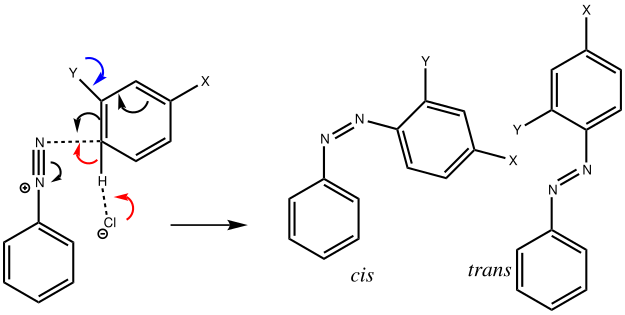
The mechanism can be rate limiting either in the initial electrophilic attack (black arrows) or in the subsequent proton removal (red arrows using an intermolecular base such as chloride anion).[2]. The product is normally assumed to be the trans-diazo compound rather than cis. This distribution is certainly true in the crystal structure database (below, although some examples of cis are known, including azobenzene itself). Would this distribution be reflected in the transition states? Initial attempts by the ChemTube3D team had resulted only in a cis-transition state being located, and they asked me to check this out.

diazo

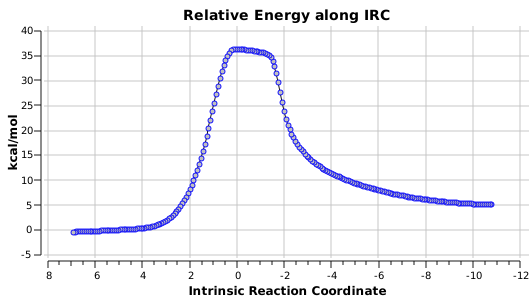
ωB97XD/6-311G(d,p)/SCRF=water calculations using phenyl diazonium chloride (I do like my counter-ions) coupling to benzene resulted in location of both cis[3] and trans[4] transition states, the former being the lower by 1.0 kcal/mol in free energy (this might well be due to the dispersion stabilisation from π-π stacking). The IRC for the cis is shown below.[5]

cis-diazocis-diazoEcis-diazoG

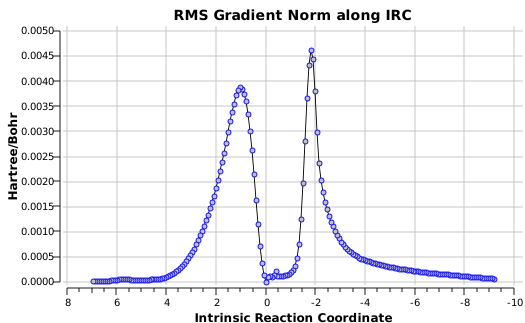
You can see that the entire process is concerted. The Wheland intermediate normally invoked as part of the mechanism of aromatic electrophilic substitution is not a proper intermediate but a hidden one for the reaction with X=Y=H. The reaction coordinate has a flat top, and that passage along this part represents the hidden Wheland. The reaction barrier is high however, and it is certainly observed that only activated arenes (phenols, anilines, X,Y=OH, NH2) actually couple with diazonium cations. For these, the hidden intermediate is stabilized by the substituent, and no doubt emerges as a real intermediate.

For my thesis work, I studied[2] diazo-coupling of indoles. I might have a go at returning to that work, to see if calculations can replicate my finding, that for unhindered indoles proton removal from the Wheland intermediate is fast, but add a few t-butyl hindering groups and it becomes slow.


PS. Here is the IRC for the formation of trans-diazobenzene.[6]

trans


Such diazo compounds make up a significant proportion of the 50 or so real molecules I have personally added to the collection of 84 million or so thus far identified.

Working with ions has one statistical problem that covalent systems do not have; where to geometrically place the counter-ion. One should really stochastically explore reasonable locations before concluding the likely location of the globally lowest energy pose.

References

  1. S.B. Hanna, C. Jermini, H. Loewenschuss, and H. Zollinger, "Indices of transition state symmetry in proton-transfer reactions. Kinetic isotope effects and Bronested's .beta. in base-catalyzed diazo-coupling reactions", Journal of the American Chemical Society, vol. 96, pp. 7222-7228, 1974. https://doi.org/10.1021/ja00830a009
  2. B.C. Challis, and H.S. Rzepa, "The mechanism of diazo-coupling to indoles and the effect of steric hindrance on the rate-limiting step", Journal of the Chemical Society, Perkin Transactions 2, pp. 1209, 1975. https://doi.org/10.1039/p29750001209
  3. H.S. Rzepa, "Gaussian Job Archive for C12H11ClN2", 2014. https://doi.org/10.6084/m9.figshare.956138
  4. H.S. Rzepa, "Gaussian Job Archive for C12H11ClN2", 2014. https://doi.org/10.6084/m9.figshare.956139
  5. H.S. Rzepa, "Gaussian Job Archive for C12H11ClN2", 2014. https://doi.org/10.6084/m9.figshare.956209
  6. H.S. Rzepa, "Gaussian Job Archive for C12H11ClN2", 2014. https://doi.org/10.6084/m9.figshare.956213

The first ever curly arrows.

Friday, July 20th, 2012

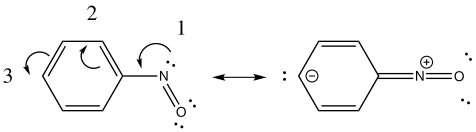
I was first taught curly arrow pushing in 1968, and have myself taught it to many a generation of student since. But the other day, I learnt something new. Nick Greeves was kind enough to send me this link to the origin of curly arrow pushing in organic chemistry, where the following diagram is shown and Alan Dronsfield sent me two articles he co-wrote on the topic (T. M. Brown, A. T. Dronsfield and P. J. T Morris, Education in Chemistry, 2001, 38, 102-104, 107 and 2003, 40, 129-134); thanks to both of them.

This diagram dates from 1924, and is to be found in an article published by Robert Robinson (J. Soc. Chem. Ind., 1924, 43, 1297, a journal difficult to get hold of nowadays). Here, Robinson was trying to explain why the nitroso group is o/p-directing in aromatic electrophilic substitution. Whilst the notation is remarkably modern, some aspects do need explaining. 

  1. Robinson shows the nitrogen lone pair (arrow 1) as a line, and not as we now do, a double dot.
  2. Similarly, he shows arrow 3 ending at a line. We now do not show this in the starting structure, but reveal it in the final result, as above on the right, and again shown as a double dot.
  3. Similarly, he shows a + charge on the nitrogen at the start, whereas we now show it as the outcome of the process.
  4. If Robinson intends to create a +ve charge, then he really should balance that by showing the creation of a negative charge in the p-position of the ring. He does not balance his charges! 
  5. As was the custom at the time, the benzene ring itself is not represented in the Kekule mode (which of course should have been well known in 1924) but as what looks to us now as cyclohexane. It must have been the case in 1924 (and for several decades after) that cyclohexane itself was not regarded as an interesting system, and hence there must have been little confusion about drawing benzene as (modern) cyclohexane. The implied semantic of showing such a ring was that it represented benzene.
    1. But this way of drawing it leads to really difficult issues. Thus Robinson’s arrow 2 departs from what looks to us like a single bond, in which case no bond would be left. Robinson of course means implicitly that arrow 2 reduces the bond order by one, and if we start with a double bond from a Kekule structure, that the bond is reduced to 1, not zero, as is shown in the modern notation above.
    2. Likewise, the destination of arrow 2 in Robinson’s notation clearly creates a double bond. Which again is an issue, since he is not showing the double bonds. The trouble really arises because Robinson does not illustrate the outcome of his process.
    3. Finally, whereas arrow 1 starts at a line representing a lone pair, that line is disconnected from the N. However, the destination of arrow 3 appears to create a bond, not a lone pair.

Now that we have clarified Robinson’s meaning, what else can we say about Robinson’s structure.

  1. It is important to realise that in 1924, the 3D characteristics of electrons (their wavefunction) were not known. Looking at the modern version of the diagram, chemists realise that when a double line is drawn, the two are not the same. One line represents a σ-bond, the other a π-bond. We recognise that the two have different spatial characteristics. Hückel it was who showed that in planar aromatics, the two sets are in fact orthogonal, and do not mix. At which point we need to sort out what the three arrows in Robinson’s diagram represent. Arrows 2 and 3 we recognise as π-arrows. But what of arrow 1? I decided to do a search of the Cambridge data base for nitrosobenzenes, finding 22 sets of coordinates. In all except one, the two atoms of the nitroso group were co-planar with the six of the benzene ring. We now know of course that this places the nitrogen lone pair firmly in the plane of the eight atoms, and hence of a σ-type. Strictly therefore, it is orthogonal to the π-arrows and cannot be mixed with them. The solution of course is to first rotate the nitroso group by 90° to bring the nitrogen lone pair into conjugation with the π-system, whereupon Robinson’s arrows now “work”. 
  2. On a more minor point, we recognise that the nitrogen lone pair occupies a trigonal position, and so we draw the C-NO group as bent, rather than linear as Robinson did.
  3. If the co-planarity of the nitroso and benzene rings is retained, then the only way to draw the arrows is in the opposite direction to Robinson, resulting in the creation of a -ve charge on the oxygen and a +ve charge on the p-carbon. This of course is the resonance we now show for the nitro group, and implies m-direction, not o/p
  4. Which raises the fascinating question. Why, if the structure of nitrosobenzenes appears to be planar and not rotated, is the nitroso group nevertheless observed to be an o/p director? The answer of course must be in looking at the properties of the transition state, and not the starting material itself. But in 1924, the concept of a transition state itself was not yet recognised.

So this little blast-from-the-past example still gives us lots to think about!