Posts Tagged ‘Missouri’

Monastral: the colour of blue

Tuesday, March 8th, 2011

The story of Monastral is not about a character in the Magic flute, but is a classic of chemical serendipity, collaboration between industry and university, theoretical influence, and of much else. Fortunately, much of that story is actually recorded on film (itself a unique archive dating from 1933 and being one of the  very first colour films in existence!). Patrick Linstead, a young chemist then (he eventually rose to become rector of Imperial College) tells the story himself here. It is well worth watching, if only for its innocent social commentary on the English class system (and an attitude to laboratory safety that should not be copied nowadays). Here I will comment only on its colour and its aromaticity.

Copper phthalocyanine

In 1933, Hückel was still thinking about his molecular orbital electronic theory of benzene, but for ~15 years, there remained little need for the rule we now know as 4n+2, because n was invariably equal to 1 for most known aromatic molecules! It was only the discovery of so-called non-benzenoid aromatics in the 1940s (e.g. Dewar’s tropolone structure) that propelled chemists to identify aromatic molecules with other values of n. And Monastral blue is a prime example of n=4 (although it would be of interest to find out when it became so associated with the Hückel rule). If you count the red bonds above, there are eight, along with one lone pair of electrons located on the highlighted (blue) nitrogen atom. This makes 18 π-electrons in the ring, or 4×4+2 (there are paths other than the one shown, but they give the same count). Part of the reason for the remarkable thermal stability of this molecule must be its aromaticity.

So what about the colour? The visible spectrum is shown below, with λmax ~ 610 and 710nm.

Visible absorption spectrum of copper phthalocyanine.

Well, a TD-DFT ωB97Xd/6-31G(d) calculation reveals the following. This reproduces the band at 610nm very nicely, but leaves the identity of the band at  710nm mysterious. How does that originate? One might speculate that this could arise from the presence of another species. Thus copper phthalocyanine itself is neutral, but it could easily be oxidised to a cation, and this could then form a  1:1 π-complex with a second molecule of the neutral radical (DOI:10.1021/ja00238a021 )
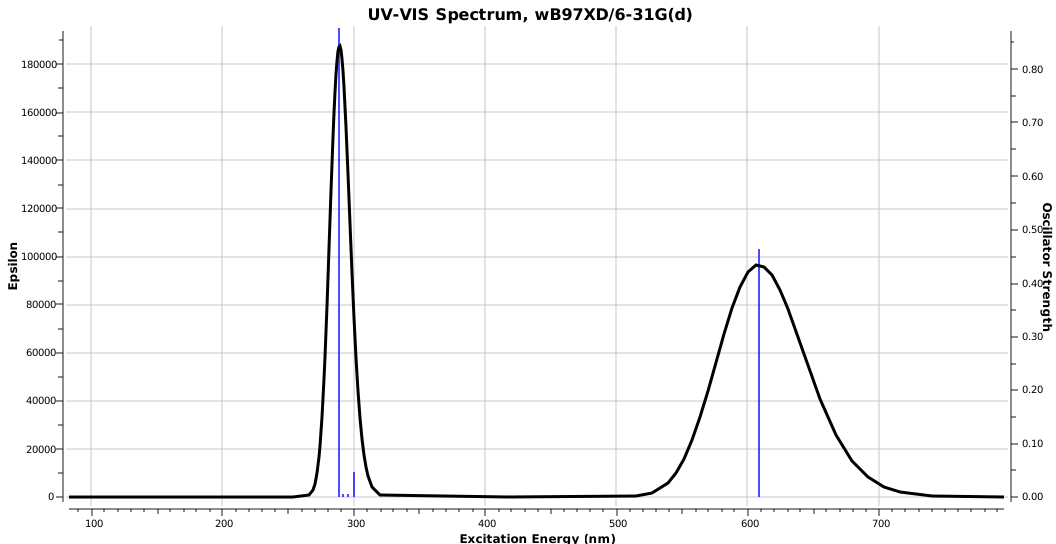
The electronic excitation at ~610nm arises from the following MOs:

Orbital 147, the highest occupied MO (HOMO). Click for 3D

Orbital 148, the lowest unoccupied MO.

The unpaired electron in copper phthalocyanine occupies the following rather interesting orbital, which appears not to be involved in its blue colour.

Orbital 146. The singly occupied MO.

So, just as with mauveine, a mystery remains. The colour of Monastral blue is not monochromatic, in that it appears to be caused by two bands in the 600-700 region. Calculation however reveals it to have only one band at 610nm. What is the other one?

Lapis lazuli: the colour of ultramarine.

Saturday, March 5th, 2011

My colleague Bill Griffith has again come up with another colour challenge: that of the ancient semi-precious stone Lapis Lazuli, mined in the mountains of Afghanistan for more than 6000 years and used by painters in some medieval paintings of the Virgin, the Wilton diptych etc.

Lapis Lazuli (photo from Wikipedia).

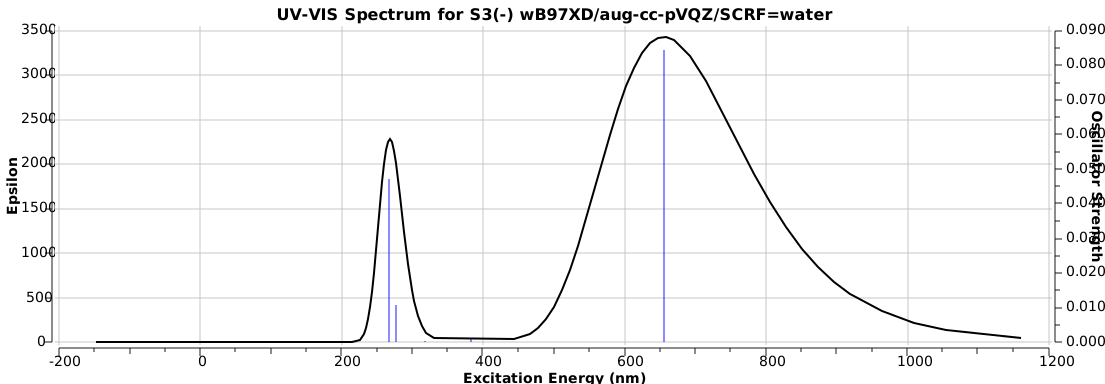
The formula is (approximately): (Na,Ca)8(AlSiO4)6(S,SO4,Cl)1-2, which sounds a bit of a challenge! But, as a very recent article points out (DOI: 10.1039/b910469k) the component that imparts the colour is the sulfur,  more specifically present in the stone as the  S3 radical anion. No recent calculation of the  UV/Vis spectrum of this simple triatomic has been reported, so here goes. A ωB97XD/aug-cc-pVQZ calculation, embedded in a continuum solvent field of water (which serves to compactify the otherwise diffuse anionic aspect) and with TD-DFT applied, shows the following (you will need an SVG enabled Web browser to see the spectrum. I am here promoting the use of this graphical standard, which differs from normal images in scaling as you resize the page size with no loss of resolution).

The λmax is ~ 650nm calculated and ~619nm measured (as a solution in an ionic liquid). Not bad agreement! The molecular orbitals involved in the excitation are shown below.

Highest doubly occupied MO. Click for 3D.

Lowest singly occupied MO. Click for 3D.

Such a precious colour, and produced using such a cheap material!

Carbobenzene: benzene with a difference

Friday, April 16th, 2010

Some molecules, when you first see them, just intrigue. So it was with carbobenzene, the synthesis of a derivative of which was recently achieved by Remi Chauvin and co-workers (DOI: 10.1002/chem.200601193). Two additional carbon atoms have been inserted into each of the six C-C bonds in benzene.

Carbobenzene

The structure shows two resonance forms, which remind one of Kekulé and of course benzene itself. Counting reveals 18π-electrons in the conventional π sense, but with a further set of 12 π-electrons located in the plane of the ring, and orthogonal to the first set. Since both could be cyclically conjugated, we can say that the first set belongs to a 4n+2 count, and should set up diatropic ring currents resulting in aromaticity, whilst the second set would belong to the 4n category, and might set up paratropic ring currents in the plane of the system. The lowest occupied molecular orbitals of each set look as follows.

The lowest MO for the 18π-electron set. Click for 3D

Lowest occupied molecular orbital for the 12π-electron set. Click for 3D

Experimentally, the molecule is found to be aromatic. One way of quantifying this is via the so-called dissected NICS magnetic response index (DOI: 10.1021/ol016217v). At the ring centroid, NICS(0,1,2,3)zz (respectively 0,1,2,3Å above the plane of the ring) are found to be -49, -46, -38 and -28 ppm (DOI: http://10042/to-4878).  The un-dissected NICS (which includes all σ-current contributions) were -18, -16.6, -13 and -9 ppm. This both confirms diatropicity (for which NICS is strongly negative) and also suggests that the 12-electron π-framework is opposing the 18-electron π-framework.

Another, less common way to study the aromaticity is to look at the delocalization of the electrons using the ELF technique.

ELF function evaluated using only the 18 π electrons. Click for 3D

ELF function evaluated using only the 12 σ-electrons. Click for 3D

The 18-electron set bifurcate (break up into smaller basins), at the threshold of 0.87 shown above (the ELF function has a maximum of 1.0 and a minimum of 0.0), a high value which is typical of aromatic systems (benzene bifurcates at ~0.9). In contrast, the 12-electron set break up well before a value of 0.1 (shown), a low value which tends to indicate anti-aromaticity.

There are many other ways of exploring the properties of such aromatic molecules, but the two above tend to suggest that carbobenzene has two personalities, one aromatic, the other antiaromatic, and with the former dominant. This gives it an interesting twist on benzene itself, and makes one wonder whether this dual Janus-like personality could be exploited in some interesting fashion.