Posts Tagged ‘aromatic systems’

First, hexacoordinate carbon – now pentacoordinate nitrogen?

Saturday, March 25th, 2017

A few years back I followed a train of thought here which ended with hexacoordinate carbon, then a hypothesis rather than a demonstrated reality. That reality was recently confirmed via a crystal structure, DOI:10.5517/CCDC.CSD.CC1M71QM[1]. Here is a similar proposal for penta-coordinate nitrogen.

First, a search of the CSD (Cambridge structure database) for such nitrogen. There are only three hits[2], [3], [4] all of which relate to RN bonded to four borons as part of a boron cage. There are none which relate to RN bonded to four carbon atoms. 

The original argument was based on cyclopentadienyl anion and its symmetric coordination to RC3+ to achieve six coordination for one carbon. Morphing C to the iso-electronic Ngets one to the ligand RN4+ and this can now be coordinated to the di-anion of cyclobutadiene, also iso-electronic in the 6π sense to cyclopentadienyl mono-anion.

The optimised structure of the methylated system (ωB97XD/Def2-TZVPP) as shown below (DOI: 10.14469/hpc/2348) is a true minimum and reveals a 5-coordinate nitrogen. It is the dication of an isomer of pentamethyl pyrrole.

One of the normal modes for this molecule is the so-called Kekule vibration, which elongates two C-C bonds and shortens the other two. The value (1266 cm-1) is typical of aromatic systems.

A QTAIM analysis shows four line (bond) critical points (LCP, magenta) connecting the 4-carbon base of the system and four further LCPs connecting each carbon to the nitrogen. Significantly, the four carbons are not themselves characterised by a ring critical point (RCP, green), these being confined to the rings formed between two carbons and the nitrogen. The value of the electron density ρ(r) at the basal bond is typical of a single bond; the value to the nitrogen indicates the bond has a smaller order.

An ELF (electron localisation function) analysis is similar, showing basal C-C electron basins of 2.12e and C-N basins of 1.25e.

In hunting for examples of hyper-coordination in the second row of the periodic table, the focus has tended largely towards identifying carbon examples. Perhaps that might now right-shift to the adjacent element nitrogen?

References

  1. M. Malischewski, and K. Seppelt, "Crystal Structure Determination of the Pentagonal‐Pyramidal Hexamethylbenzene Dication C<sub>6</sub>(CH<sub>3</sub>)<sub>6</sub><sup>2+</sup>", Angewandte Chemie International Edition, vol. 56, pp. 368-370, 2016. https://doi.org/10.1002/anie.201608795
  2. U. Doerfler, J.D. Kennedy, L. Barton, C.M. Collins, and N.P. Rath, "Polyhedral azadirhodaborane chemistry. Reaction of [{RhCl2(η5-C5Me5) }2] with [EtH2NB8H11NHEt] to give contiguous ten-vertex [1-Et-6,7-(η5-C5Me5)2- closo-6,7,1-Rh2NB7H7 ]", Journal of the Chemical Society, Dalton Transactions, pp. 707-708, 1997. https://doi.org/10.1039/a700132k
  3. L. Schneider, U. Englert, and P. Paetzold, "Die Kristallstruktur von Aza‐<i>closo</i>‐decaboran NB<sub>9</sub>H<sub>10</sub>", Zeitschrift für anorganische und allgemeine Chemie, vol. 620, pp. 1191-1193, 1994. https://doi.org/10.1002/zaac.19946200711
  4. M. Mueller, U. Englert, and P. Paetzold, "X-ray Crystallographic Structure of a 7-Aza-nido-undecaborane Derivative: (NB2tBu3H)NB10H12", Inorganic Chemistry, vol. 34, pp. 5925-5926, 1995. https://doi.org/10.1021/ic00127a034
The ten-electron homologue of semibullvalene.

Friday, September 21st, 2012

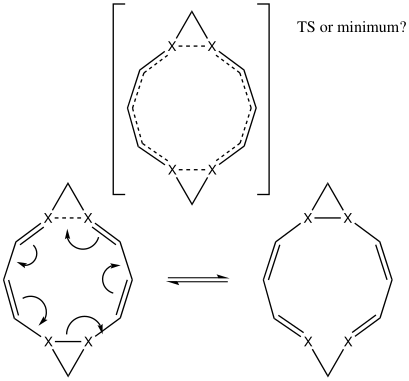
Semibullvalene is a molecule which undergoes a facile [3,3] sigmatropic shift. So facile that it appears this equilibrium can be frozen out at the transition state if suitable substituents are used. This is a six-electron process, which leads to one of those homologous questions; what happens with ten electrons?

A 5,5 double Möbius sigmatropic rearrangement. Click for 3D model.

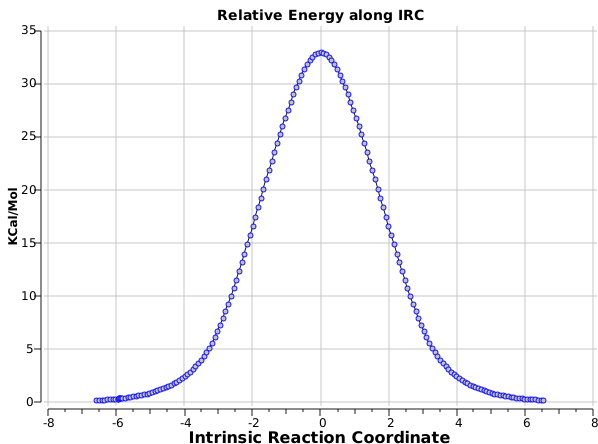
The carbocyclic version (X=CH) is a true [5,5] sigmatropic, ten electron reaction. This one has a twist however. Two in fact; I have shown it as a double-Möbius version, with two antarafacial components! Inspect the model to verify this for yourself. Such systems also have the potential to be aromatic. As you can see from the IRC pathway shown below, the activation barrier is quite high (but not unfeasible so for a thermally activated reaction). To freeze it out (i.e. to remove the barrier entirely) we have some work to do. 

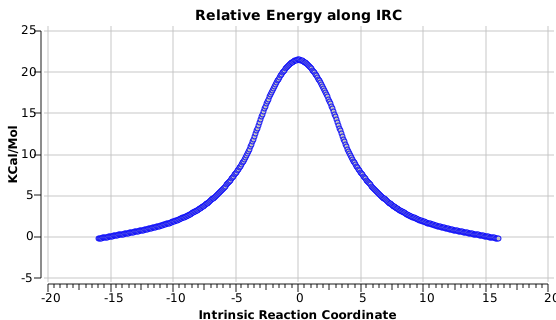
Well, I used the same trick as previously; turning to the tetra-aza derivative (X=N) and for good measure adding two additional cyano groups. As you can see below, this did reduce the barrier, but it’s still a long way from becoming zero. Still, [5,5] sigmatropic shifts are not exactly thick on the ground, and double-Möbius versions rarer still! The substituted one should have a low enough barrier to observe fluxional NMR behaviour at around room temperatures. If no other process takes over of course!

A substituted [5,5] sigmatropic rearrangement. Click for 3D model.

It is also worth noting that ten-electron aromatic systems are not so stable as six-electron ones (as Clar observed), and so suppressing any six-electron pericyclic reactions becomes the challenge.

Carbobenzene: benzene with a difference

Friday, April 16th, 2010

Some molecules, when you first see them, just intrigue. So it was with carbobenzene, the synthesis of a derivative of which was recently achieved by Remi Chauvin and co-workers (DOI: 10.1002/chem.200601193). Two additional carbon atoms have been inserted into each of the six C-C bonds in benzene.

Carbobenzene

The structure shows two resonance forms, which remind one of Kekulé and of course benzene itself. Counting reveals 18π-electrons in the conventional π sense, but with a further set of 12 π-electrons located in the plane of the ring, and orthogonal to the first set. Since both could be cyclically conjugated, we can say that the first set belongs to a 4n+2 count, and should set up diatropic ring currents resulting in aromaticity, whilst the second set would belong to the 4n category, and might set up paratropic ring currents in the plane of the system. The lowest occupied molecular orbitals of each set look as follows.

The lowest MO for the 18π-electron set. Click for 3D

Lowest occupied molecular orbital for the 12π-electron set. Click for 3D

Experimentally, the molecule is found to be aromatic. One way of quantifying this is via the so-called dissected NICS magnetic response index (DOI: 10.1021/ol016217v). At the ring centroid, NICS(0,1,2,3)zz (respectively 0,1,2,3Å above the plane of the ring) are found to be -49, -46, -38 and -28 ppm (DOI: http://10042/to-4878).  The un-dissected NICS (which includes all σ-current contributions) were -18, -16.6, -13 and -9 ppm. This both confirms diatropicity (for which NICS is strongly negative) and also suggests that the 12-electron π-framework is opposing the 18-electron π-framework.

Another, less common way to study the aromaticity is to look at the delocalization of the electrons using the ELF technique.

ELF function evaluated using only the 18 π electrons. Click for 3D

ELF function evaluated using only the 12 σ-electrons. Click for 3D

The 18-electron set bifurcate (break up into smaller basins), at the threshold of 0.87 shown above (the ELF function has a maximum of 1.0 and a minimum of 0.0), a high value which is typical of aromatic systems (benzene bifurcates at ~0.9). In contrast, the 12-electron set break up well before a value of 0.1 (shown), a low value which tends to indicate anti-aromaticity.

There are many other ways of exploring the properties of such aromatic molecules, but the two above tend to suggest that carbobenzene has two personalities, one aromatic, the other antiaromatic, and with the former dominant. This gives it an interesting twist on benzene itself, and makes one wonder whether this dual Janus-like personality could be exploited in some interesting fashion.