Archive for the ‘crystal_structure_mining’ Category

An inorganic double helix: SnIP.

Sunday, October 16th, 2016
After sixty years of searching, the first non-templated double helical carbon-free inorganic molecular structure has been reported.[1] That is so neat that I thought to load the 3D coordinates here for you to interact with and then to explore the prospect of using these coordinates to add some value with e.g. some chiroptical calculations.
I cannot really show you a diagram at this stage, since the article is not gold open access (OA) and hence is copyright protected as © 2016 WILEY-VCH Verlag GmbH & Co. KGaA, Weinheim. So to progress I have to get the 3D coordinates, which as data cannot be copyrighted and from these generate my own diagram. How did I go about getting this data and how FAIR (Findable, Accessible, Interoperable, Reusable) did I find it? Here I list the actions I went through.
  1. Go to the article[1] via its “landing page” and there I (as a human) navigated to the supporting information. Could automated software have done this I wonder if it were not familiar with the journal?
  2. There I found a PDF file and two MP4 movies. I know movies are unlikely to contain FAIR data, so I try the former. On pages 16-17 you find the space group, cell dimensions and fractional atomic coordinates. Its not really formatted to be “I” (copying/pasting out of PDF can be a challenge) and you have to be familiar with what is a specialised format (neither A nor really R then) and some knowledge of appropriate crystallographic software or procedure to convert Table S1 and S2 into an inter-operable format such as CIF (crystallographic interchange format).
  3. The main article does have the following statement: Further details of the crystal structure investigation(s) may be obtained from the Fachinformationszentrum Karlsruhe, 76344 Eggenstein-Leopoldshafen (Germany), on quoting the depository number CSD-430054. Do they want you to write them a letter?
  4. Well, a bit of Googling reveals https://www.fiz-karlsruhe.de/en/leistungen/kristallographie/kristallstrukturdepot/order-form-request-for-deposited-data.html as the required online link (why could that not be shortened and included in the article?)
  5. This form has not quite yet caught up with modern journal practice. The form stipulates a page number is apparently mandatory, but although this article is fully published, it is too new to have one. I wrote “not assigned yet” and hoped for the best; a “clever” non-human script might always decide the data type of this response is wrong and reject the request! There is no field for the article DOI, which is really all the information that is needed. I pasted that into the “volume number” and again crossed my fingers.
  6. Two days later, whilst awaiting a response to the above, I revisited Table S1/S2 but now armed with a sample CIF file for the space group P 2/c and using a text editor, inserted into it the values found in these tables (~15 minutes). The result is shown below.

[jsmol caption=’SnIP as a helical polymer’ fileurl=’https://www.rzepa.net/blog/wp-content/uploads/2016/10/SnIP.mol’ id=’a3′ commands=’=spin 3;’ debug=’false’]

This double helix is not of the complementary type found in DNA but a concentric one. The inner helix of a chain of P atoms is enclosed by the outer helix (winding in the same sense, anticlockwise as shown above) of a Sn-I-Sn-I chain. Click on the diagram above to load the 3D coordinates and inspect this for yourself.

The article reporting this structure[1] is full of fascinating insights into this new material. Time will no doubt tell whether it has exploitable properties. Meanwhile, when the CIF file arrives from my query above, I will make it available here as properly FAIR data.

References

  1. D. Pfister, K. Schäfer, C. Ott, B. Gerke, R. Pöttgen, O. Janka, M. Baumgartner, A. Efimova, A. Hohmann, P. Schmidt, S. Venkatachalam, L. van Wüllen, U. Schürmann, L. Kienle, V. Duppel, E. Parzinger, B. Miller, J. Becker, A. Holleitner, R. Weihrich, and T. Nilges, "Inorganic Double Helices in Semiconducting SnIP", Advanced Materials, vol. 28, pp. 9783-9791, 2016. https://doi.org/10.1002/adma.201603135
Catenated atoms and groups.

Thursday, October 13th, 2016

Chemists are as fond of records as any, although I doubt you will find many chemical ones in the Guinness world records list. Polytriangulanes chase how many cyclopropyl 3-rings can be joined via a vertex. Steve Bachrach on his blog reports some recent work by Peter Schreiner and colleagues[1] and the record for catenation of such rings appears to be 15. This led me to think about some other common atoms and groups. Here I have searched for crystal structures only; there may be examples of course for which no such data has been reported.

  1. For the halogens F and Cl it is 3. 
  2. But for Br, believe it or not it reaches the heady value of 24, doi: 10.5517/CC14K0PD[2]
  3. For iodine it is effectively infinite, as noted in my earlier post.
  4. For oxygen it is 3; there are none with four consecutive oxygens.
  5. For sulfur, a ring of twelve is known[3] and for Se ~11[4]
  6. For nitrogen it may surprise to learn it reaches 6 if the connecting bonds are all single. A typical example can be seen at doi: 10.5517/CCZCR35[5] It reaches 10 if any kind of  N-N bond is allowed. doi: 10.5517/CCYVNZD
  7. For phosphorus, 16 is not uncommon 10.5517/CC1JWTQY [6] but the record may be 21.
  8. The alkyne group C≡C, reaches 10 (20 carbon atoms), doi: 10.5517/CCSGR98 [7]
  9. The carbonyl group (C=O) can form a ring of six such groups 10.5517/CC9JR6R[8]

Such records are probably very uncompetitive; I doubt any researchers set out to extend the count. Most of the above are probably simply unexpected discoveries. My favourite is the bromine example; this element so often surprises.

References

  1. W.D. Allen, H. Quanz, and P.R. Schreiner, "Polytriangulane", Journal of Chemical Theory and Computation, vol. 12, pp. 4707-4716, 2016. https://doi.org/10.1021/acs.jctc.6b00669
  2. Easton, Max E.., Ward, Antony J.., Hudson, Toby., Turner, Peter., Masters, Anthony F.., and Maschmeyer, Thomas., "CCDC 1059043: Experimental Crystal Structure Determination", 2015. https://doi.org/10.5517/cc14k0pd
  3. J. Steidel, R. Steudel, and A. Kutoglu, "Röntgenstrukturanalysen von Cyclododekaschwefel (S<sub>12</sub>) und Cyclododekaschwefel‐1‐Kohlendisulfid (S<sub>12</sub> · CS<sub>2</sub>) [1]", Zeitschrift für anorganische und allgemeine Chemie, vol. 476, pp. 171-178, 1981. https://doi.org/10.1002/zaac.19814760520
  4. M.G. Kanatzidis, and S.P. Huang, "Unanticipated redox transformations in gold polyselenides. Isolation and characterization of diselenobis(tetraselenido)diaurate(2-) and undecaselenido(2-)", Inorganic Chemistry, vol. 28, pp. 4667-4669, 1989. https://doi.org/10.1021/ic00325a026
  5. Klapotke, T.M.., Petermayer, C.., Piercey, D.G.., and Stierstorfer, J.., "CCDC 905017: Experimental Crystal Structure Determination", 2013. https://doi.org/10.5517/cczcr35
  6. Dragulescu-Andrasi, Alina., Miller, L. Zane., Chen, Banghao., McQuade, D. Tyler., and Shatruk, Michael., "CCDC 1426921: Experimental Crystal Structure Determination", 2016. https://doi.org/10.5517/cc1jwtqy
  7. Chalifoux, W.A.., McDonald, R.., Ferguson, M.J.., and Tykwinski, R.R.., "CCDC 729160: Experimental Crystal Structure Determination", 2010. https://doi.org/10.5517/ccsgr98
  8. Abrahams, B.F.., Haywood, M.G.., and Robson, R.., "CCDC 284214: Experimental Crystal Structure Determination", 2006. https://doi.org/10.5517/cc9jr6r

σ or π? The ambident nucleophilic reactivity of imines: crystallographic and computational reality checks.

Wednesday, September 21st, 2016

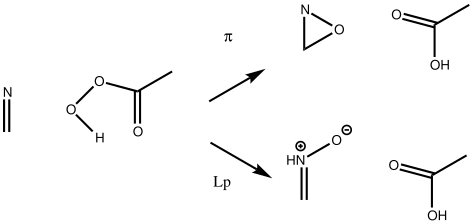
Nucleophiles are species that seek to react with an electron deficient centre by donating a lone or a π-bond pair of electrons. The ambident variety has two or more such possible sources in the same molecule, an example of which might be hydroxylamine or H2NOH. I previously discussed how for this example, the energetics allow the nitrogen lone pair (Lp) to win out over the O Lp. Here, I play a similar game, but this time setting an NLp up against a π-pair.

oxaziridine

Before exploring this computationally,  a reality check using measured crystal structures. Below is the search query used to explore the ability of the imine π-bond (the more novel or unusual of the two possibilities) to hydrogen bond to a proton as the model electrophile (see [1] for anther example of using this as a probe).

imine1

DIST1 is the distance from a hydrogen to the mid-point of the C=N bond (set to be in the range 1.8-2.7Å, the latter being shorter than the combined van der Waals radii of the atoms). The torsion is set to |70-110|° to restrict the approach of the hydrogen to above or below the π-bond. The usual no errors, no disorder, R < 0.05 and H-positions normalised applies. Some 2501 hits for intermolecular approaches closer than the van der Waals contact are found, with one hot-spot at a distance of 2.65Å and a torsion of ~100°. There is of course a continuum between a hydrogen bond and a dispersion attraction, but this plot shows there to be a fair few examples at distances of 2.4Å, a shortening which is normally taken as a hydrogen bond rather than a dispersion mode. 

imine2

Using a simple imine as the nucleophile and a peracid as electrophile,[2] ωB97XD/Def2-TZVPP/SCRF=dichloromethane calculations (N[3][4]) reveal the N barrier to be 16.2 kcal/mol lower in free energy (ΔG298) than π. The normal explanation is that a Lp is bound only to a single nucleus, whereas a two-centre bonded pair is attracted to two nuclei. The means that the former therefore is more readily “available” to donate to an electrophile, by apparently 16.2 kcal/mol.

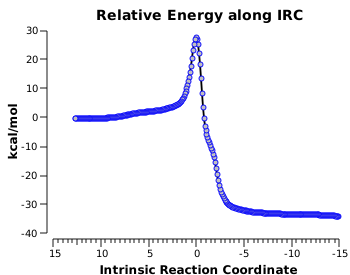
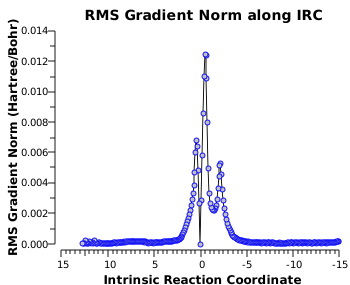
The IRC energy profile[5] for Nlp as a σ-nucleophile is shown below, with a relatively reasonable thermal barrier to reaction. The feature at IRC = 2 is in fact the proton transfer, which occurs only after the transition state has been passed. This behaviour was noted previously for the reaction of ethene with peracid, as verified experimentally by the measurement of kinetic isotope effects.

neng

n1

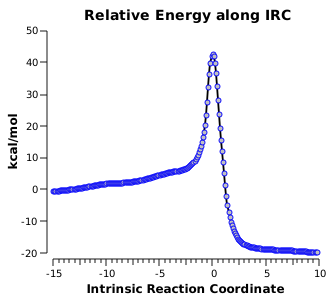
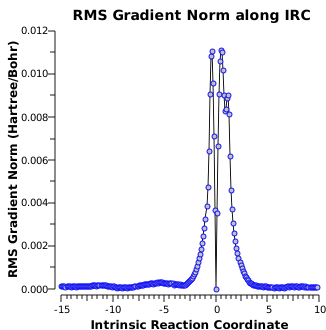
The π-nucleophilic route is shown below.[6] Note the higher barrier and the greater synchrony between the oxygen transfer and the proton transfer.piepig

pi1

This leaves us with something of a problem. According to the literature,[2] the balance between σ or π is very even for the reaction between a peracid and an imine. For an aryl substituted imine, the proportion of the two products changes from 0% N (nitrone) and 100% π (oxaziridine) to 100% N and 0% π simply by changing the nature of the substituent. To achieve what is often referred to as 100% selectivity (normally understood as the minor isomer being <1% of the formed products) takes a free energy difference of ~2.7 kcal/mol (in fact ~RT ln 100/1), and a complete inversion is therefore ~5.4 kcal/mol. The computed difference of 16.2 kcal/mol is far too large to achieve such an inversion (substituent effects are rarely if ever of this magnitude). When faced with such a mismatch between experiment and computation, the explanation is normally because the modelled mechanism is the wrong one. So in this case, time to hunt for an alternative way of forming the oxaziridine. If I find a solution, I will update this post.

References

  1. H.S. Rzepa, "Discovering More Chemical Concepts from 3D Chemical Information Searches of Crystal Structure Databases", Journal of Chemical Education, vol. 93, pp. 550-554, 2015. https://doi.org/10.1021/acs.jchemed.5b00346
  2. D.R. Boyd, P.B. Coulter, N.D. Sharma, W. Jennings, and V.E. Wilson, "Normal, abnormal and pseudo-abnormal reaction pathways for the imine-peroxyacid reaction", Tetrahedron Letters, vol. 26, pp. 1673-1676, 1985. https://doi.org/10.1016/s0040-4039(00)98582-4
  3. H.S. Rzepa, "C 3 H 7 N 1 O 3", 2016. https://doi.org/10.14469/ch/195458
  4. https://doi.org/
  5. H. Rzepa, "Imine + peracetic acid,N attack IRC", 2016. https://doi.org/10.14469/hpc/1658
  6. H. Rzepa, "Imine + peracetic acid, pi attack IRC", 2016. https://doi.org/10.14469/hpc/1659

What’s in a name? Stabilised “nitrenes”.

Monday, September 19th, 2016

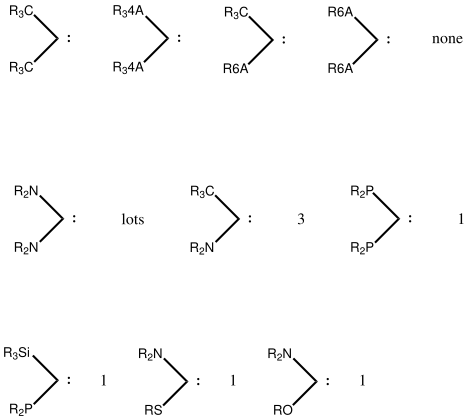
I previously explored stabilized “carbenes” with the formal structures (R2N)2C:, concluding that perhaps the alternative ionic representation R2N+=CNR2 might reflect their structures better. Here I take a broader look at the “carbene” landscape before asking the question “what about nitrenes?”

carbenes

The top row shows the compounds for which no crystal structure could be found. This includes the traditional carbon-substituted unstabilized carbenes, as well as those substituted with either group 4A or 6A elements (Si, S, etc). Isolated hits were however found as follows for other combinations (all interesting, but I do not discuss them here).

  1. R2N-C-CR[1],[2],[3],[4],[5],[6]
  2. R2P-C-Si [7],[8]
  3. R2P-C-PR2 [9],[10]
  4. R2N-C-OR [11]
  5. R2N-C-SR [12]

At this point I turned to nitrenes. As with unstabilised carbenes, the nitrogen is described as having one covalent bond, one unshared spin-paired lone pair of electrons and two further unpaired electrons to give a total valence shell count of six (and in fact a triplet spin state). Are there any examples? Just one, formally corresponding to R2P-N (DEGSEP[13]). To explore what the nature of the single P-N bond is, I did a search for the P-N bond lengths of all P-N compounds in the CSD (of any bond type). The distribution shows ~1.48Å as the shortest and ~1.8Å as the longest.There is no sign of a multimodal distribution indicating partitioning into e.g. single, double or triple bonds.

p-n-distances

So what about our nitrene? The P-N bond is 1.456Å, which is very much at the short end of the spectrum above, and so pretty far from the formal simple definition of a nitrene given above. So now for a ωB97XD/Def2-TZVPP calculation of the singlet wavefunction[14] (the triplet state is 22 kcal/mol higher in energy[15]) for a model compound with calculated CN distance 1.493Å and from which an ELF-based localisation and integration of the electron basins can be derived. The total basin integration for the N can be taken as 7.77e (close to the octet) if basins 15 and 16 are assumed to be shared (covalent) and this gives the P-N bond double bond character. If basins 15 and 16 are not included (and taken as localised just on the P), the N has 5.81e and an associated single bond. 

nitrene1

A search of the CSD specifying P≡N as the search query returns lengths in the range 1.47-1.56Å, which our example certainly conforms to. So perhaps we can tentatively conclude that the only example thus far reported of a crystalline nitrene in fact sustains a very short bond to the nitrogen. It could be considered as the N having a filled octet in its valence shell, and certainly a bond order higher than one, if not actually triple.


For the search query, see [16]

References

  1. Marchenko, Anatoliy., Koidan, Heorgyi., Hurieva, Anastasiya., Kurpiieva, Olena., Vlasenko, Yurii., Kostyuk, Aleksandr., Tubaro, Cristina., Lenarda, Anna., Biffis, Andrea., and Graiff, Claudia., "CCDC 997216: Experimental Crystal Structure Determination", 2014. https://doi.org/10.5517/cc12gp8h
  2. A. Marchenko, H. Koidan, A. Hurieva, O. Kurpiieva, Y. Vlasenko, A. Kostyuk, C. Tubaro, A. Lenarda, A. Biffis, and C. Graiff, "N-phosphanyl-imidazolin-2-ylidenes: Novel stable carbenes as bidentate ligands for late transition metals", Journal of Organometallic Chemistry, vol. 771, pp. 14-23, 2014. https://doi.org/10.1016/j.jorganchem.2014.05.036
  3. Lavallo, V.., Mafhouz, J.., Canac, Y.., Donnadieu, B.., Schoeller, W.W.., and Bertrand, G.., "CCDC 236934: Experimental Crystal Structure Determination", 2004. https://doi.org/10.5517/cc7yk1r
  4. V. Lavallo, J. Mafhouz, Y. Canac, B. Donnadieu, W.W. Schoeller, and G. Bertrand, "Synthesis, Reactivity, and Ligand Properties of a Stable Alkyl Carbene", Journal of the American Chemical Society, vol. 126, pp. 8670-8671, 2004. https://doi.org/10.1021/ja047503f
  5. Lavallo, V.., Frey, G.D.., Kousar, S.., Donnadieu, B.., and Bertrand, G.., "CCDC 651272: Experimental Crystal Structure Determination", 2008. https://doi.org/10.5517/ccpvpsz
  6. V. Lavallo, G.D. Frey, S. Kousar, B. Donnadieu, and G. Bertrand, "Allene formation by gold catalyzed cross-coupling of masked carbenes and vinylidenes", Proceedings of the National Academy of Sciences, vol. 104, pp. 13569-13573, 2007. https://doi.org/10.1073/pnas.0705809104
  7. Marsh, R.E.., and Clemente, D.A.., "CCDC 625624: Experimental Crystal Structure Determination", 2008. https://doi.org/10.5517/ccp00f3
  8. R.E. Marsh, and D.A. Clemente, "A survey of crystal structures published in the Journal of the American Chemical Society", Inorganica Chimica Acta, vol. 360, pp. 4017-4024, 2007. https://doi.org/10.1016/j.ica.2007.02.050
  9. Martin, D.., Baceiredo, A.., Gornitzka, H.., Schoeller, W.W.., and Bertrand, G.., "CCDC 252551: Experimental Crystal Structure Determination", 2005. https://doi.org/10.5517/cc8gst9
  10. D. Martin, A. Baceiredo, H. Gornitzka, W.W. Schoeller, and G. Bertrand, "A Stable P‐Heterocyclic Carbene", Angewandte Chemie International Edition, vol. 44, pp. 1700-1703, 2005. https://doi.org/10.1002/anie.200462239
  11. R.W. Alder, C.P. Butts, and A.G. Orpen, "Stable Aminooxy- and Aminothiocarbenes", Journal of the American Chemical Society, vol. 120, pp. 11526-11527, 1998. https://doi.org/10.1021/ja9819312
  12. A.J. Arduengo, J.R. Goerlich, and W.J. Marshall, "A Stable Thiazol‐2‐ylidene and Its Dimer", Liebigs Annalen, vol. 1997, pp. 365-374, 1997. https://doi.org/10.1002/jlac.199719970213
  13. Dielmann, F.., Back, O.., Henry-Ellinger, M.., Jerabek, P.., Frenking, G.., and Bertrand, G.., "CCDC 884586: Experimental Crystal Structure Determination", 2013. https://doi.org/10.5517/ccyph14
  14. H. Rzepa, "DEGSEP", 2016. https://doi.org/10.14469/hpc/1625
  15. H. Rzepa, "DEGSEP triplet", 2016. https://doi.org/10.14469/hpc/1626
  16. H. Rzepa, "CSD Search query for carbenes", 2016. https://doi.org/10.14469/hpc/1624

What’s in a name? Stabilised "nitrenes".

Monday, September 19th, 2016

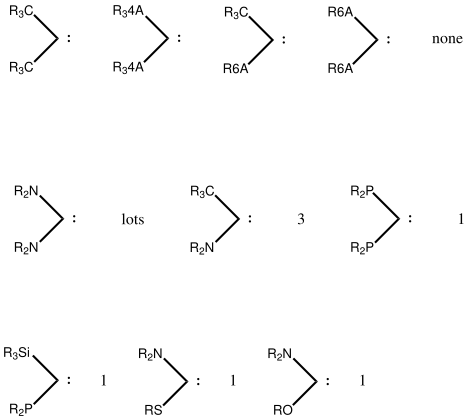
I previously explored stabilized “carbenes” with the formal structures (R2N)2C:, concluding that perhaps the alternative ionic representation R2N+=CNR2 might reflect their structures better. Here I take a broader look at the “carbene” landscape before asking the question “what about nitrenes?”

carbenes

The top row shows the compounds for which no crystal structure could be found. This includes the traditional carbon-substituted unstabilized carbenes, as well as those substituted with either group 4A or 6A elements (Si, S, etc). Isolated hits were however found as follows for other combinations (all interesting, but I do not discuss them here).

  1. R2N-C-CR[1],[2],[3],[4],[5],[6]
  2. R2P-C-Si [7],[8]
  3. R2P-C-PR2 [9],[10]
  4. R2N-C-OR [11]
  5. R2N-C-SR [12]

At this point I turned to nitrenes. As with unstabilised carbenes, the nitrogen is described as having one covalent bond, one unshared spin-paired lone pair of electrons and two further unpaired electrons to give a total valence shell count of six (and in fact a triplet spin state). Are there any examples? Just one, formally corresponding to R2P-N (DEGSEP[13]). To explore what the nature of the single P-N bond is, I did a search for the P-N bond lengths of all P-N compounds in the CSD (of any bond type). The distribution shows ~1.48Å as the shortest and ~1.8Å as the longest.There is no sign of a multimodal distribution indicating partitioning into e.g. single, double or triple bonds.

p-n-distances

So what about our nitrene? The P-N bond is 1.456Å, which is very much at the short end of the spectrum above, and so pretty far from the formal simple definition of a nitrene given above. So now for a ωB97XD/Def2-TZVPP calculation of the singlet wavefunction[14] (the triplet state is 22 kcal/mol higher in energy[15]) for a model compound with calculated CN distance 1.493Å and from which an ELF-based localisation and integration of the electron basins can be derived. The total basin integration for the N can be taken as 7.77e (close to the octet) if basins 15 and 16 are assumed to be shared (covalent) and this gives the P-N bond double bond character. If basins 15 and 16 are not included (and taken as localised just on the P), the N has 5.81e and an associated single bond. 

nitrene1

A search of the CSD specifying P≡N as the search query returns lengths in the range 1.47-1.56Å, which our example certainly conforms to. So perhaps we can tentatively conclude that the only example thus far reported of a crystalline nitrene in fact sustains a very short bond to the nitrogen. It could be considered as the N having a filled octet in its valence shell, and certainly a bond order higher than one, if not actually triple.


For the search query, see [16]

References

  1. Marchenko, Anatoliy., Koidan, Heorgyi., Hurieva, Anastasiya., Kurpiieva, Olena., Vlasenko, Yurii., Kostyuk, Aleksandr., Tubaro, Cristina., Lenarda, Anna., Biffis, Andrea., and Graiff, Claudia., "CCDC 997216: Experimental Crystal Structure Determination", 2014. https://doi.org/10.5517/cc12gp8h
  2. A. Marchenko, H. Koidan, A. Hurieva, O. Kurpiieva, Y. Vlasenko, A. Kostyuk, C. Tubaro, A. Lenarda, A. Biffis, and C. Graiff, "N-phosphanyl-imidazolin-2-ylidenes: Novel stable carbenes as bidentate ligands for late transition metals", Journal of Organometallic Chemistry, vol. 771, pp. 14-23, 2014. https://doi.org/10.1016/j.jorganchem.2014.05.036
  3. Lavallo, V.., Mafhouz, J.., Canac, Y.., Donnadieu, B.., Schoeller, W.W.., and Bertrand, G.., "CCDC 236934: Experimental Crystal Structure Determination", 2004. https://doi.org/10.5517/cc7yk1r
  4. V. Lavallo, J. Mafhouz, Y. Canac, B. Donnadieu, W.W. Schoeller, and G. Bertrand, "Synthesis, Reactivity, and Ligand Properties of a Stable Alkyl Carbene", Journal of the American Chemical Society, vol. 126, pp. 8670-8671, 2004. https://doi.org/10.1021/ja047503f
  5. Lavallo, V.., Frey, G.D.., Kousar, S.., Donnadieu, B.., and Bertrand, G.., "CCDC 651272: Experimental Crystal Structure Determination", 2008. https://doi.org/10.5517/ccpvpsz
  6. V. Lavallo, G.D. Frey, S. Kousar, B. Donnadieu, and G. Bertrand, "Allene formation by gold catalyzed cross-coupling of masked carbenes and vinylidenes", Proceedings of the National Academy of Sciences, vol. 104, pp. 13569-13573, 2007. https://doi.org/10.1073/pnas.0705809104
  7. Marsh, R.E.., and Clemente, D.A.., "CCDC 625624: Experimental Crystal Structure Determination", 2008. https://doi.org/10.5517/ccp00f3
  8. R.E. Marsh, and D.A. Clemente, "A survey of crystal structures published in the Journal of the American Chemical Society", Inorganica Chimica Acta, vol. 360, pp. 4017-4024, 2007. https://doi.org/10.1016/j.ica.2007.02.050
  9. Martin, D.., Baceiredo, A.., Gornitzka, H.., Schoeller, W.W.., and Bertrand, G.., "CCDC 252551: Experimental Crystal Structure Determination", 2005. https://doi.org/10.5517/cc8gst9
  10. D. Martin, A. Baceiredo, H. Gornitzka, W.W. Schoeller, and G. Bertrand, "A Stable P‐Heterocyclic Carbene", Angewandte Chemie International Edition, vol. 44, pp. 1700-1703, 2005. https://doi.org/10.1002/anie.200462239
  11. R.W. Alder, C.P. Butts, and A.G. Orpen, "Stable Aminooxy- and Aminothiocarbenes", Journal of the American Chemical Society, vol. 120, pp. 11526-11527, 1998. https://doi.org/10.1021/ja9819312
  12. A.J. Arduengo, J.R. Goerlich, and W.J. Marshall, "A Stable Thiazol‐2‐ylidene and Its Dimer", Liebigs Annalen, vol. 1997, pp. 365-374, 1997. https://doi.org/10.1002/jlac.199719970213
  13. Dielmann, F.., Back, O.., Henry-Ellinger, M.., Jerabek, P.., Frenking, G.., and Bertrand, G.., "CCDC 884586: Experimental Crystal Structure Determination", 2013. https://doi.org/10.5517/ccyph14
  14. H. Rzepa, "DEGSEP", 2016. https://doi.org/10.14469/hpc/1625
  15. H. Rzepa, "DEGSEP triplet", 2016. https://doi.org/10.14469/hpc/1626
  16. H. Rzepa, "CSD Search query for carbenes", 2016. https://doi.org/10.14469/hpc/1624

What’s in a name? Carbenes: a reality check.

Sunday, September 11th, 2016

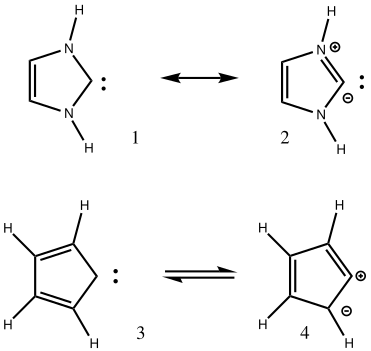
To quote from Wikipedia: in chemistry, a carbene is a molecule containing a neutral carbon atom with a valence of two and two unshared valence electrons. The most ubiquitous type of carbene of recent times is the one shown below as 1, often referred to as a resonance stabilised or persistent carbene. This type is of interest because of its ability to act as a ligand to an astonishingly wide variety of metals, with many of the resulting complexes being important catalysts. The Wiki page on persistent carbenes shows them throughout in form 1 below, thus reinforcing the belief that they have a valence of two and by implication six (2×2 shared + 2 unshared) electrons in the valence shell of carbon. Here I consider whether this name is really appropriate.

carbenes

Let us start by counting the electrons in the 2p atomic orbitals on the ring atoms of 1, forming what we call a π-system. There are six; two from the carbons shown connected by a double bond, C=C and a further four from the two nitrogen lone pairs. Now in benzene, we also have six π-electrons in a ring and this molecule is of course famously aromatic due to the diatropic ring current created by the circulation of these six electrons. Moreover, all the C-C bonds are equal in length, ~1.4Å long (although the reasons for this equality are subtle).

So does 1 behave similarly? A ωB97XD/Def2-TZVPP calculation[1] shows the following calculated structure, in which all the bonds are clearly intermediate between single and double. The N-C(“carbene”) length of 1.357Å in particular is much shorter than a C-N single bond (~1.44AÅ), which tends to suggest that the resonance form 2 is a better representation than 1. This form is also pretty similar to pyrrole, itself a well-known hetero-aromatic species.nhc1

An alternative reality check is crystal structures. There are 42 examples (no errors, no disorder, R < 0.05) in the Cambridge structure database (CSD) and the distribution of C-N bond lengths below is indeed quite similar to the calculation shown above for the unsubstituted parent, with the lhs “hot-spot” almost exactly coincident. The C-C length similarly corresponds.

nhc2

nhc3

Let us try a technique for explicitly counting electrons, the ELF (electron localisation method), which works directly on a function of the electron density to identify the centroids of localized “basins” containing the integrated density. The three surrounding the “carbene” atom sum to 7.54e (with small seepage also into the carbon 1s core; 2.08e). A “normal” carbon on the C=C bond is 7.65e. The localization below turns out to closely resemble resonance structure 2 above.

nhc4

Further in-silico experiments can be carried out with species 3 and 4, in which a carbon atom replaces each of the nitrogens. This reduces the total electron count by two and now this poor molecule has a difficult choice to make. Should it be the π-system that sacrifices these two electrons, or could it be the σ-lone-pair found on the two-coordinate carbon? We will let the quantum mechanical solution decide[2] (with a constraint that the molecule be planar). The electrons arrange themselves to resemble the resonance form 4, choosing to retain the six π-electrons and sacrifice the carbene “unshared pair”. The 2-coordinate carbon as a vinyl cation now does have ~6 valence electrons (ELF indicates 5.23e). nhc5

What about the other choice? By promoting two electrons from HOMO to LUMO one can also calculate 3 (again constrained to planarity)[3] which finally does correspond to the classical description of a carbene.

nhc6

The arrow connecting 3 and 4 in the scheme at the top is NOT in this case an electronic resonance, but a a real equilibrium between two different species separated by an energy barrier. With only four π-electrons in a cycle it is also antiaromatic, and so the two localised alkene bonds avoid any conjugation with each other. This form has a free energy some 5.7 kcal/ml higher than the aromatic form. In fact, the molecule is very keen to avoid all antiaromaticity and hence if the planar constraint is lifted, it will distort with no activation to a non-planar diene (just as cyclo-octatetraene does to a non-planar tetra-ene). And to complete the tale, even though 4 is aromatic, it too distorts without activation to an odd-looking non-planar form with no symmetry[4],[5],[6] (but that is another story).

The final word should be that the naming of these types of persistent carbene does need a reality check; they should not be called this at all! They are really dipolar species or carbon-ylides as shown in 2. As it happens, a very closely related species in which one sulfur replaces one nitrogen is a very familiar compound, vitamin B1 or thiamine. The only example of a stable deprotonated thiamine derivative is referred to as a carbene[7], perhaps because with an acid catalyst it can dimerise in the manner expected of a real carbene. Significantly however, without acid catalyst this does not happen; a true carbene would not require such a catalyst.

References

  1. H. Rzepa, "NHC wfn", 2016. https://doi.org/10.14469/hpc/1473
  2. H. Rzepa, "butadiene carbene aromatic -192.700746", 2016. https://doi.org/10.14469/hpc/1581
  3. H. Rzepa, "butadiene carbene antiaromatic guess=alter -192.691607", 2016. https://doi.org/10.14469/hpc/1582
  4. H. Rzepa, "C5H4 non-planar, Cs symmetry", 2016. https://doi.org/10.14469/hpc/1583
  5. H. Rzepa, "C5H4 non-planar, C2 symmetry", 2016. https://doi.org/10.14469/hpc/1584
  6. H. Rzepa, "C5H4 non-planar, no symmetry", 2016. https://doi.org/10.14469/hpc/1585
  7. A.J. Arduengo, J.R. Goerlich, and W.J. Marshall, "A Stable Thiazol‐2‐ylidene and Its Dimer", Liebigs Annalen, vol. 1997, pp. 365-374, 1997. https://doi.org/10.1002/jlac.199719970213

What's in a name? Carbenes: a reality check.

Sunday, September 11th, 2016

To quote from Wikipedia: in chemistry, a carbene is a molecule containing a neutral carbon atom with a valence of two and two unshared valence electrons. The most ubiquitous type of carbene of recent times is the one shown below as 1, often referred to as a resonance stabilised or persistent carbene. This type is of interest because of its ability to act as a ligand to an astonishingly wide variety of metals, with many of the resulting complexes being important catalysts. The Wiki page on persistent carbenes shows them throughout in form 1 below, thus reinforcing the belief that they have a valence of two and by implication six (2×2 shared + 2 unshared) electrons in the valence shell of carbon. Here I consider whether this name is really appropriate.

carbenes

Let us start by counting the electrons in the 2p atomic orbitals on the ring atoms of 1, forming what we call a π-system. There are six; two from the carbons shown connected by a double bond, C=C and a further four from the two nitrogen lone pairs. Now in benzene, we also have six π-electrons in a ring and this molecule is of course famously aromatic due to the diatropic ring current created by the circulation of these six electrons. Moreover, all the C-C bonds are equal in length, ~1.4Å long (although the reasons for this equality are subtle).

So does 1 behave similarly? A ωB97XD/Def2-TZVPP calculation[1] shows the following calculated structure, in which all the bonds are clearly intermediate between single and double. The N-C(“carbene”) length of 1.357Å in particular is much shorter than a C-N single bond (~1.44AÅ), which tends to suggest that the resonance form 2 is a better representation than 1. This form is also pretty similar to pyrrole, itself a well-known hetero-aromatic species.nhc1

An alternative reality check is crystal structures. There are 42 examples (no errors, no disorder, R < 0.05) in the Cambridge structure database (CSD) and the distribution of C-N bond lengths below is indeed quite similar to the calculation shown above for the unsubstituted parent, with the lhs “hot-spot” almost exactly coincident. The C-C length similarly corresponds.

nhc2

nhc3

Let us try a technique for explicitly counting electrons, the ELF (electron localisation method), which works directly on a function of the electron density to identify the centroids of localized “basins” containing the integrated density. The three surrounding the “carbene” atom sum to 7.54e (with small seepage also into the carbon 1s core; 2.08e). A “normal” carbon on the C=C bond is 7.65e. The localization below turns out to closely resemble resonance structure 2 above.

nhc4

Further in-silico experiments can be carried out with species 3 and 4, in which a carbon atom replaces each of the nitrogens. This reduces the total electron count by two and now this poor molecule has a difficult choice to make. Should it be the π-system that sacrifices these two electrons, or could it be the σ-lone-pair found on the two-coordinate carbon? We will let the quantum mechanical solution decide[2] (with a constraint that the molecule be planar). The electrons arrange themselves to resemble the resonance form 4, choosing to retain the six π-electrons and sacrifice the carbene “unshared pair”. The 2-coordinate carbon as a vinyl cation now does have ~6 valence electrons (ELF indicates 5.23e). nhc5

What about the other choice? By promoting two electrons from HOMO to LUMO one can also calculate 3 (again constrained to planarity)[3] which finally does correspond to the classical description of a carbene.

nhc6

The arrow connecting 3 and 4 in the scheme at the top is NOT in this case an electronic resonance, but a a real equilibrium between two different species separated by an energy barrier. With only four π-electrons in a cycle it is also antiaromatic, and so the two localised alkene bonds avoid any conjugation with each other. This form has a free energy some 5.7 kcal/ml higher than the aromatic form. In fact, the molecule is very keen to avoid all antiaromaticity and hence if the planar constraint is lifted, it will distort with no activation to a non-planar diene (just as cyclo-octatetraene does to a non-planar tetra-ene). And to complete the tale, even though 4 is aromatic, it too distorts without activation to an odd-looking non-planar form with no symmetry[4],[5],[6] (but that is another story).

The final word should be that the naming of these types of persistent carbene does need a reality check; they should not be called this at all! They are really dipolar species or carbon-ylides as shown in 2. As it happens, a very closely related species in which one sulfur replaces one nitrogen is a very familiar compound, vitamin B1 or thiamine. The only example of a stable deprotonated thiamine derivative is referred to as a carbene[7], perhaps because with an acid catalyst it can dimerise in the manner expected of a real carbene. Significantly however, without acid catalyst this does not happen; a true carbene would not require such a catalyst.

References

  1. H. Rzepa, "NHC wfn", 2016. https://doi.org/10.14469/hpc/1473
  2. H. Rzepa, "butadiene carbene aromatic -192.700746", 2016. https://doi.org/10.14469/hpc/1581
  3. H. Rzepa, "butadiene carbene antiaromatic guess=alter -192.691607", 2016. https://doi.org/10.14469/hpc/1582
  4. H. Rzepa, "C5H4 non-planar, Cs symmetry", 2016. https://doi.org/10.14469/hpc/1583
  5. H. Rzepa, "C5H4 non-planar, C2 symmetry", 2016. https://doi.org/10.14469/hpc/1584
  6. H. Rzepa, "C5H4 non-planar, no symmetry", 2016. https://doi.org/10.14469/hpc/1585
  7. A.J. Arduengo, J.R. Goerlich, and W.J. Marshall, "A Stable Thiazol‐2‐ylidene and Its Dimer", Liebigs Annalen, vol. 1997, pp. 365-374, 1997. https://doi.org/10.1002/jlac.199719970213

A periodic table for anomeric centres.

Saturday, August 6th, 2016

In the last few posts, I have explored the anomeric effect as it occurs at an atom centre X. Here I try to summarise the atoms for which the effect is manifest in crystal structures.

The effect is defined by X bearing two substituents, one of which Z is a centre bearing a “lone pair” of electrons (or two electrons in a π-bond), and another Y in which the X-Y bond has a low-lying acceptor or σ* empty orbital into which the lone pair can be donated. This donation will only occur if the Z-lone pair and the X-Y bond vectors align antiperiplanar. Here is the summary so far.

X Blog entry
B 16601
C 14508,8898
N this one
O 16646
Si 16601
P 16601
S this one

As required of a good periodic table, it has gaps that need completing, in this case X=N and X=S. Firstly N, for which the small molecule below is known (FUHFAP).

FUHFAP

A ωB97XD/Def2-TZVPP calculation[1] yields an electron density distribution, which can be collected into monosynaptic basins using the ELF technique. There are two oxygen lone pairs (17 and 20) that are close to antiperiplanar to the adjacent N-O bond, having E(2) interaction energies obtained using the NBO method of 15.1 and 15.8 kcal/mol, typical of the anomeric range. The basin labelled 13 on X=N1 below is also perfectly aligned antiperiplanar with the adjacent O3-C2 bond, but its E(2) interaction energy is only 7.3 kcal/mol. Thus a strong anomeric interaction on the anomeric atom itself does not seem to occur. The same effect was noted for X=O in the previous post; the explanation remains unidentified.

FUHFAP

With the X=S gap, we have lots of opportunity with polysulfide compounds, a good example of which is the C2-symmetric and helical S8 dianion TEGWAF[2]

TEGWAF

Each of the 8 sulfur atoms exhibits antiperiplanar orientation of an S lone pair with an adjacent S-S acceptor σ* orbital;
1:2-3=23.7 kcal/mol;
2:3-4=18.5;
3:4-8=11.7, 3:2-1=7.4;
4:8-7=11.4, 4:3-2=9.2.

This just surveys the central main group elements, and it is possible that this little mini-periodic table may yet grow.

References

  1. H.S. Rzepa, "C 2 H 7 N 1 O 2", 2016. https://doi.org/10.14469/ch/195294
  2. Rybak, W.K.., Cymbaluk, A.., Skonieczny, J.., and Siczek, M.., "CCDC 880780: Experimental Crystal Structure Determination", 2012. https://doi.org/10.5517/ccykj88

Stereoelectronic effects galore: bis(trifluoromethyl)trioxide.

Thursday, August 4th, 2016

Here is a little molecule that can be said to be pretty electron rich. There are lots of lone pairs present, and not a few electron-deficient σ-bonds. I thought it might be fun to look at the stereoelectronic interactions set up in this little system.

Trioxide

Known as ZEYDOW in the crystal structure database[1] (this species has a melting point of -138C, and its no trivial matter to measure x-ray diffraction of such a crystal!); a ωB97XD/Def2-TZVPP calculation is used to quantify the electron density [2] and this is then subjected to localisation using the ELF function. The little purple spheres represent so-called monosynaptic electron basins, or lone pairs as we might rather loosely call them (pair is not always an accurate term). 

zeydow

How these “lone pairs” act as electron donors into empty σ* acceptors can be quantified using NBO theory. The following table shows as many as 24 strong interactions (> 10 kcal/mol).  This now augments my previous post on “Anomeric effects at carbon involving lone pairs originating from one or two nitrogens” and represents an example of “Anomeric effects at oxygen involving lone pairs originating from oxygen”.

The final two entries originate from lone pairs on the central oxygen, donating approximately antiperiplanar (~160°) into the O-CF3 antibonds, but with only a low value of the E(2) interaction energy. These two lone pairs are curiously inert.

Lone pair donor σ-acceptor NBO E(2) energy
On F: 16,17,18,19,25,35,36,39,40,41,43,45 C-F 18-20
On F: 26,34,37,39,42,44 C-O 11-18
On O: 27,28,24,33 C-F 13-16
On O: 27,33 C-O 13
On O: 30,31 C-O 3.5

Apart from this curious molecule, there are few other examples of the R-O-O-O-R functional group,[3] but this one did catch my eye,[4] largely because it was retrieved from a search specification of R-O-O-O-R. The central oxygen apparently supports six O-O bonds, as well as three hydrogens. It is nothing of the sort of course. Reading the text reveals it is really three O…H-O bonds, disordered into two equally probable positions. There are no O-O bonds present at all, which reminds us we must always subject structures derived from x-ray crystallography to a chemical reality check.
yocsis

References

  1. K.I. Gobbato, H. Oberhammer, M.F. Klapdor, D. Mootz, W. Poll, S.E. Ulic, and H. Willner, "Bis(trifluoromethyl)trioxide: First Structure of a Straight‐Chain Trioxide", Angewandte Chemie International Edition in English, vol. 34, pp. 2244-2245, 1995. https://doi.org/10.1002/anie.199522441
  2. H.S. Rzepa, "C 2 F 6 O 3", 2016. https://doi.org/10.14469/ch/195291
  3. Pernice, H.., Berkei, M.., Henkel, G.., Willner, H.., Arguello, G.A.., McKee, M.L.., and Webb, T.R.., "CCDC 224327: Experimental Crystal Structure Determination", 2004. https://doi.org/10.5517/cc7jfcj
  4. J.L. Atwood, S.G. Bott, P.C. Junk, and M.T. May, "Liquid clathrate media containing transition metal halocarbonyl anions; formation and crystal structures of [K+ · 18-crown-6][Cr(CO)5Cl], [H3O+ · 18-crown-6][W(CO)5Cl], [H3O+ · 18-crown-6][W(CO)4Cl3], and [H2O · bis-aza-18-crown-6 · (H+)2][W(CO)4Cl3]2", Journal of Organometallic Chemistry, vol. 487, pp. 7-15, 1995. https://doi.org/10.1016/0022-328x(94)05072-j

Anomeric effects at carbon involving lone pairs originating from one or two nitrogens.

Friday, July 8th, 2016

The previous post looked at anomeric effects set up on centres such as B, Si or P, and involving two oxygen groups attached to these atoms. Here I vary the attached groups to include either one or two nitrogen atoms.[1]

.aminol-sq

The plot below shows aminols, C(NHR)(OR”). A torsion along either the C-O or C-N bond of ~60° implies that (at two coordinate oxygen or three coordinated nitrogen) there may be a lone pair with a torsion of 180°, which would set up an antiperiplanar alignment between that lone pair and the adjacent C-O or C-N bond (the anomeric effect). The clear hotspot is at angles of ~80°, which does raise the issue of why it deviates from 60°. Only a location of the lone pair centroid (using eg the ELF quantum mechanical technique) would cast light on that. There is a less distinct region for which the C-N torsion is 60° and the C-O torsion 180°, and an even less distinct region for the reverse (C-O torsion is 60° and the C-N torsion 180°). This tends to imply that a nitrogen lone pair is a better donor into a C-O bond than the reverse. Electronegativity suggests this should indeed be so, with the N lone pair less bound by the N nucleus and hence easier to release into a C-Oσ* orbital which is a better acceptor than then equivalent C-Nσ* orbital. aminol This plot is where both heteroatoms are nitrogen (geminal diamines). There are about twice as many examples, resulting in more distinct clustering. The anomeric hotspot is now around 70°  and there are equally populated clusters where only one torsion is ~70°. There is another cluster for which both torsions are 180° (no stereoelectronic alignment of lone pairs) and three small clusters where the torsions are either 180° or 0°. There is finally an intriguing cluster for which both torsions at ~120° (again no stereoelectronics). diamine

Searches like this seem to be good at creating more questions than they answer. Clearly, the origins of the various hotspots need to be investigated, ideally using quantum mechanics to quantify the stereoelectronic interactions involved. So this sort of (ten minute) exercise is very good at raising research project investigations.

References

  1. H. Rzepa, "Anomeric effects at carbon, involving lone pairs originating from one or two nitrogens", 2016. https://doi.org/10.14469/hpc/936