Archive for the ‘General’ Category
Thursday, July 3rd, 2014
Increasingly, our access to scientific information is becoming a research topic in itself. Thus an analysis of big deal journal bundles[1] has attracted much interesting commentary (including one from a large scientific publisher[2]). In the UK, our funding councils have been pro-active in promoting the so-called GOLD publishing model, where the authors (aided by grants from their own institution or others) pay the perpetual up-front publication costs (more precisely the costs demanded by the publishers, which is not necessarily the same thing) so that their article is removed from the normal subscription pay wall erected by the publisher and becomes accessible to anyone. As the proportion of GOLD content increases, it was anticipated (hoped?) that the costs of accessing the remaining non-GOLD articles via a pay-walled subscription would decrease.
But as was shown[1], the publishers have hitherto arranged for the prices of these subscriptions to be covered by non-disclosure clauses. Which makes it quite difficult for us (the readers of these journals, and of course the main sources of their content as well) to find out if this model is (starting) to actually work. Certainly, the entire system does not yet appear to be in any sort of steady state equilibrium; perhaps it never will achieve this in the current model? For example, although extra funds have been made available to promote GOLD publishing, these cover only a small fraction of the total output of a typical research university. One could respond to this in several ways:
- Find the missing funds from somewhere else, which probably means less money for the research itself. This of course is the model that maintains or increases a publisher’s incomes.
- Decrease the costs of GOLD publishing. Currently a typical article processing charge ranges from £500-5000 depending on the prestige of the journal. Is it beyond the realm of possibility that this range could change to eg £50-500?
- Simply persuade everyone to publish less. Perhaps ten times less? Every group might be restricted to one or two block-buster articles a year, and the rest of their output goes into open repositories? Or indeed into blogs! These two options of course are unlikely to increase publishers’ incomes.
Well, after 350 years of scientific publishing, we appear to have arrived at a critical point. A cross-roads if you like. But who should be in charge of deciding what direction is now taken? Should it not be the very people who create and then “consume” scientific information and knowledge!
References
- T.C. Bergstrom, P.N. Courant, R.P. McAfee, and M.A. Williams, "Evaluating big deal journal bundles", Proceedings of the National Academy of Sciences, vol. 111, pp. 9425-9430, 2014. https://doi.org/10.1073/pnas.1403006111
- C. Woolston, "Secret publishing deals exposed", Nature, vol. 510, pp. 447-447, 2014. https://doi.org/10.1038/510447f
Tags:GBP, typical article processing charge ranges, United Kingdom
Posted in Chemical IT, General | 8 Comments »
Thursday, June 26th, 2014
The Bürgi–Dunitz angle describes the trajectory of an approaching nucleophile towards the carbon atom of a carbonyl group. A colleague recently came to my office to ask about the inverse, that is what angle would an electrophile approach (an amide)? Thus it might approach either syn or anti with respect to the nitrogen, which is a feature not found with nucleophilic attack. 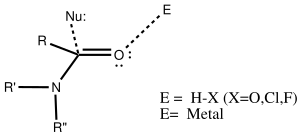 My first thought was to calculate the wavefunction and identify the location and energy (= electrophilicity) of the lone pairs (the presumed attractor of an electrophile). But a better more direct approach soon dawned. A search of the crystal structure database. Here is the search definition, with the C=O-E angle, the O-E distance and the N-C=O-E torsion defined (also specified for R factor < 5%, no errors and no disorder).
  The first plot is of the torsion vs the distance, for E = H-X (X=O,F, Cl)
- The first observation is to note the prominent “hotspot” at a torsion of 180° and a (hydrogen bonding) distance of ~1.60-1.65Å. Amides, so it seems, prefer the electrophile (a proton) to approach anti to the nitrogen
- There is a smaller hotspot at a torsion of 0° and a rather longer distance of ~1.8Å corresponding to syn approach.
- And finally a barely discernible (but real) one at ~90°, corresponding to the proton attaching itself to the carbonyl π-bond.
- A plot of the angles involved reveals that the anti hotspot occurs at ~100° whilst the syn hotspot is about 120°.

- whilst replacing the proton as electrophile by any metal results in a distinct change.


- Syn approach now holds the (red) hotspot, and the angle opens up to ~135°, whilst the anti approach covers a wider angle range of 130-150°
- A third hotspot region occurs for the 90° torsion, again metal-π-bond interactions.
The above is a very general statistical survey. As with most bonding effects, one really should investigate every example to discover any perturbing circumstances or structural motifs that might distort the outcome. But for a ten minute exercise in response to a fascinating question from a colleague, it’s not bad! And it certainly nicely inverts the usual Bürgi–Dunitz view of carbonyl groups.
Tags:electronics, energy, metal results, metal-π-bond interactions, search definition
Posted in crystal_structure_mining, General, Interesting chemistry | No Comments »
Wednesday, June 18th, 2014
I was reminded of this article by Michelle Francl[1], where she poses the question “What anchor values would most benefit students as they seek to hone their chemical intuition?” She gives as common examples: room temperature is 298.17K (actually 300K, but perhaps her climate is warmer than that of the UK!), the length of a carbon-carbon single bond, the atomic masses of the more common elements.
Well, one of my own personal favourites is anchoring chemical timescales. From 10-18 s (that of electron dynamics, and presumably the fastest processes in chemistry) to 10+18 (approximately the age of the universe). And (for a unimolecular process) this can be reduced to this equation: Ln(k/T) = 23.76 – ΔG‡/RT I quoted this equation in a recent post, since it gives you the fastest possible chemical reaction if ΔG‡ is set to zero (which of course is not a reaction but a vibration), but which gives you a good estimate of how fast a process will be for any given value of a barrier. It can of course also be solved for e.g. the required barrier to achieve a half-life equivalent to the age of the universe. So, perhaps in increments of orders of 3 magnitudes (of which there are 13 covering the above span) would anyone like to contribute either:
- Their own favourite chemical anchor, or
- Their own favourite example of a chemical timescale bounded by the above limits?
(I did start a list of the latter for our own students, but it is still pretty sparse!)
References
- M. Francl, "Take a number", Nature Chemistry, vol. 5, pp. 725-726, 2013. https://doi.org/10.1038/nchem.1733
Tags:/RT, chemical intuition, chemical timescale, chemical timescales, favourite chemical anchor, Michelle Francl, possible chemical reaction, United Kingdom
Posted in General | 2 Comments »
Friday, May 2nd, 2014
This is rather cranking the handle, but taking my previous post and altering the search definition of the crystal structure database from 4- to 5-coordinate metals, one gets the following.

Fe …

Co …

Ni …

Cu …
Trigonal bipyramidal coordination has angles of 90, 120 and 180°. Square pyramidal has no 120° angles, and the 180° angles might be somewhat reduced. Thus the Fe and Co series have plenty of 120, whereas the Ni and Cu series hardly any. The Ni series has many 160° values. It is clearly a serious issue that attempting any correlation with the spin states is going to be a lot of really hard work (I might next do another simple search where bond lengths can be shown to very closely correlate with low/medium/high spin states). I will not be trying a more finely grained analysis of the above plots; I just wanted to point out how very simple and quick they are to generate.
Tags:Fe and Co, search definition
Posted in Chemical IT, crystal_structure_mining, General | 1 Comment »
Wednesday, April 30th, 2014
I love experiments where the insight-to-time-taken ratio is high. This one pertains to exploring the coordination chemistry of the transition metal region of the periodic table; specifically the tetra-coordination of the series headed by Mn-Ni. Is the geometry tetrahedral, square planar, or other? One can get a statistical answer in about ten minutes.
 The (CCDC database) search definition required is shown above. The central atom defines the column of the period table, it is specified to have precisely four other atoms bonded to it, which can be any other element. These four bonds are specified as acyclic (to avoid any bias introduced by rings). And two angles are defined subtending the central atom. And off we go, defining on the way that the hits must be refined to an R-factor of < 0.05, have no disorder, and no errors.

Mn, (Tc), Re

Fe, Ru, Os

Co, Rh, Ir

Ni, Pd, Pt
Square planar coordination will manifest with pairs of angles of either 90° or 180°, whilst tetrahedral coordination will reveal only 109°.
- Both the Mn and the Fe series show a (red) hotspot at the tetrahedral value.
- The Co series shows a tetrahedral hot spot AND a somewhat less abundant square planar double-hot spot for the combination 90/180 and 180/90.
- The Ni series reveals the hottest spots to correspond to square planar, but with a significant tetrahedral cluster.
This quick survey can be followed up by more detailed explorations of the clusters. For example, can one go to the literature and find out the typical spin state for e.g. the Ni series in each of the geometries. Unfortunately, the CCDC database does not record what the spin state of any individual compound is; one will have to go to the original literature to find out. What a shame that the linkage between two quite different properties is (as far as I know) not available in any easily searchable form. Alternatively, one can narrow down the searches to individual searches of row 1, 2 or 3 of the transition series and then compare the behaviour. The possibilities are considerable.
Then there are the outliers in each plot. Some (many?) may prove to be due to faulty data (whilst we have specified no errors, they can still occur) but others may be due to an unusual structural feature, or perhaps even an as yet unrecognized phenomenon! Set as a student experiment, one might ask each student to explore say 3 outliers and express an opinion as to what causes them to deviate. Enjoy!
Tags:data, Pt[/caption] Square, search definition, transition metal region
Posted in Chemical IT, crystal_structure_mining, General | No Comments »
Sunday, April 6th, 2014
In the previous post, I showed how modelling of unbranched alkenes depended on dispersion forces. When these are included, a bent (single-hairpin) form of C58H118 becomes lower in free energy than the fully extended linear form. Here I try to optimise these dispersion forces by adding further folds to see what happens.

I had noted a small kink in the bent single-hairpin form (above, red circle). What about making a full bend at that point? Such forms have been previously investigated using OPLS-AA mechanics[1], with the finding that such a triple-hairpin conformation (below) was 9.7 kcal/mol higher in energy than the single hairpin (above). OK, its got eight gauche-turns more (four per bend, and which do cost energy), but it also has three rather than just one row of close dispersion-stabilising contacts to compensate. Using quantum rather than molecular mechanics (B3LYP+D3/TZVP), I found that this triple-hairpin folded form was 3.2 kcal/mol higher in free energy than the single hairpin.[2]

Click for 3D
One folded at a slightly different point (below) was in fact higher 4.7 kcal/mol in energy that the single hairpin,[3] indicating that there is an optimum position for the bend.

Click for 3D
I was convinced better folds could be found. So how about this double-hairpin, but in three dimensions to form a prism so that each chain has just as many contacts as the triple-hairpin, but is achieved with two-fewer gauche-turns? Its free energy[4] is 1.6 2.5 kcal/mol lower than the single-hairpin. It did not feature in the previous report[1] and hence represents a new lowest-energy folding (the colour indicates three ribbons of attractive non-covalent interactions, using the NCI technique). I would point out that such “manual” searching for better folds is not really sustainable; a statistical method would normally be used (MD or Monte-Carlo).

Click for 3D
A similarly folded version of the triple-hairpin can be made (below), with more opportunity for five rows of close dispersion contacts. This time however, the free energy is 1.9 kcal/mol higher than the single hairpin[5] (but the position of the fold does need to be optimised and perhaps a better one can be found). This result does imply that there is an optimum balance between the energy penalty of creating four gauche-turns per fold and the additional energy stabilisation of the dispersion. Perhaps the triple hair-pin above is close to that optimum?

Click for 3D
Unfortunately no crystal structures for the higher linear alkanes have been reported that would give us a reality check on any of these models. Can it really be that difficult to crystallise such molecules?
References
- L.L. Thomas, T.J. Christakis, and W.L. Jorgensen, "Conformation of Alkanes in the Gas Phase and Pure Liquids", The Journal of Physical Chemistry B, vol. 110, pp. 21198-21204, 2006. https://doi.org/10.1021/jp064811m
- H.S. Rzepa, "Gaussian Job Archive for C58H118", 2014. https://doi.org/10.6084/m9.figshare.988335
- H.S. Rzepa, "Gaussian Job Archive for C58H118", 2014. https://doi.org/10.6084/m9.figshare.988334
- H.S. Rzepa, "Gaussian Job Archive for C58H118", 2014. https://doi.org/10.6084/m9.figshare.988771
- H.S. Rzepa, "Gaussian Job Archive for C58H118", 2014. https://doi.org/10.6084/m9.figshare.988333
Tags:energy, energy penalty, energy stabilisation, free energy, lowest-energy folding
Posted in General | No Comments »
Saturday, March 29th, 2014
By about C17H36, the geometry of “cold-isolated” unbranched saturated alkenes is supposed not to contain any fully anti-periplanar conformations. [1] Indeed, a (co-crystal) of C16H34 shows it to have two-gauche bends.[2]. Surprisingly, the longest linear alkane I was able to find a crystal structure for, C28H58 appears to be fully extended[3],[4] (an early report of a low quality structure for C36H74[5] also appears to show it as linear).‡ Here I explore how standard DFT theories cope with these structures.
I start with noting the use of a TZVP basis set. In a recent article[6] we noted that the basis-set-superposition-errors for this basis were about a quarter of that for the standard Pople-type 6-311G(d,p) basis that I tend to use for modelling in this blog. This matters, since the relative energy of a folded-conformation vs an extended linear one might depend on the quality of the basis set and its inherent BSSE. The DFT method is the classical B3LYP. I also modelled C58H118 as the hydrocarbon as being well beyond the region anticipated above for folding of the chain to have started (no, there is no crystal structure). The geometries of linear and bent forms are shown below.


The relative free energy of the V-shaped bent form[7] emerges as 3.5 kcal/mol higher than the linear form[8]. Now, to add a Grimme-D3 dispersion correction to the energies. The V-shape of the bent form now adopts the hairpin mode,[9] and its energy is now 2.5 kcal/mol lower than the linear form.[10]
Note in the above the very slight strange oscillation (kink) that appears about 11 atoms away from the hairpin bend. I repeated this with the wB97XD DFT procedure (in which dispersion is implicit) and found the same result.
As triple-ζ basis quality modelling of molecules with >100 atoms becomes increasingly common, it is worth repeating yet again that the model should always contain dispersion (and solvent if appropriate) corrections as default. Indeed, it is probably also worth re-investigating much early modelling (by this I mean modelling done ten or more years ago) to see if such corrections significantly influence the conclusions.[6]
‡The searches cannot be carried out according to the formula CnH2n+2, but must be done individually for the value of n. I gave up at C50.
References
- N.O.B. Lüttschwager, T.N. Wassermann, R.A. Mata, and M.A. Suhm, "The Last Globally Stable Extended Alkane", Angewandte Chemie International Edition, vol. 52, pp. 463-466, 2012. https://doi.org/10.1002/anie.201202894
- N. Cocherel, C. Poriel, J. Rault‐Berthelot, F. Barrière, N. Audebrand, A. Slawin, and L. Vignau, "New 3π‐2Spiro Ladder‐Type Phenylene Materials: Synthesis, Physicochemical Properties and Applications in OLEDs", Chemistry – A European Journal, vol. 14, pp. 11328-11342, 2008. https://doi.org/10.1002/chem.200801428
- S.C. Nyburg, and A.R. Gerson, "Crystallography of the even <i>n</i>-alkanes: structure of C<sub>20</sub>H<sub>42</sub>", Acta Crystallographica Section B Structural Science, vol. 48, pp. 103-106, 1992. https://doi.org/10.1107/s0108768191011059
- R. Boistelle, B. Simon, and G. Pèpe, "Polytypic structures of n-C28H58 (octacosane) and n-C36H74 (hexatriacontane)", Acta Crystallographica Section B Structural Crystallography and Crystal Chemistry, vol. 32, pp. 1240-1243, 1976. https://doi.org/10.1107/s0567740876005025
- H.M.M. Shearer, and V. Vand, "The crystal structure of the monoclinic form of n-hexatriacontant", Acta Crystallographica, vol. 9, pp. 379-384, 1956. https://doi.org/10.1107/s0365110x5600111x
- A. Armstrong, R.A. Boto, P. Dingwall, J. Contreras-García, M.J. Harvey, N.J. Mason, and H.S. Rzepa, "The Houk–List transition states for organocatalytic mechanisms revisited", Chem. Sci., vol. 5, pp. 2057-2071, 2014. https://doi.org/10.1039/c3sc53416b
- H.S. Rzepa, "Gaussian Job Archive for C58H118", 2014. https://doi.org/10.6084/m9.figshare.978501
- H.S. Rzepa, "Gaussian Job Archive for C58H118", 2014. https://doi.org/10.6084/m9.figshare.978502
- H.S. Rzepa, "Gaussian Job Archive for C58H118", 2014. https://doi.org/10.6084/m9.figshare.978832
- H.S. Rzepa, "Gaussian Job Archive for C58H118", 2014. https://doi.org/10.6084/m9.figshare.978833
Tags:dispersion, energy, relative energy, relative free energy
Posted in General | No Comments »
Wednesday, March 12th, 2014
A short post this, to remind that today is officially the 25th birthday of the World-Wide-Web, in March 1989. It took five years for a conference around the theme to be organised and below is a photo from that event.

(C) CERN Photo
From my perspective and perhaps from the 200 or so others present at that closing session, I went back home and told my young children that the world had changed that week. So it has.
And one personal anecdote. In January 1994, a colleague in my department mentioned that they knew the producer of a BBC science program called Tomorrow’s World. He suggested I send him an email describing what the WWW was, and its potential. I did, and he responded a little time later with a link to the very first Web site produced within the BBC (British Broadcasting Corporation). To my regret ever since, I did not capture that site as it was then. Of course, it eventually grew to the one we now know (and read about TimBL’s call for a Web Magna Carta on that very site today).
Here is another momento, although very sadly not in good condition (it was dropped in the garden, and spent some time buried!). A genuine first WWW conference badge.

Tags:BBC, British Broadcasting Corporation, producer, Tomorrow's World, Web Magna Carta
Posted in General | 2 Comments »
Sunday, February 9th, 2014
This is the time of year when I deliver two back-2-back lecture courses, and yes I do update and revise the content! I am always on the look-out for nice new examples that illustrate how concepts and patterns in chemistry can be joined up to tell a good story. My attention is currently on conformational analysis; and here is an interesting new story to tell about it.
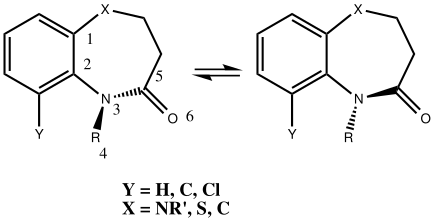
Above is a seven-membered ring benzolactam[1]‡, and it caught my eye because of the number of concepts (the semantic density if you like) contained in its chemistry.
- The title contains the phrase amide-based axial chirality
- and active
- conformation
- recognised by enzymes and receptors
All the above also implies:
- chirality is associated with configurations, whilst conformation is associated with isomerism about single bonds
- when conformational analysis is transplanted into a cyclic ring, it can morph magnificently into the land of configuration, via a process known as atropisomerism.
- Amides themselves sit in the land between conformation and configuration. Pauling famously used this transition to help devise his helical structures for peptides by deducing that the apparent single N-C bond in an amide (= conformation?) is actually a partial double bond by resonance (= configuration).
- The difference between a conformation and a configuration is simply kinetics. An approximate guideline is that if a particular pose in a system is prevented from exchanging with another pose by a half life of at least 1000 seconds, it is classified as a configuration, and if its half-life is less it is a conformation.
- Of course enzymes and receptors recognise individual configurations, and hence respond differently. Again the vexed issue of lifetime rears its head. Thus the configuration of thalidomide turned out to have a very short half-life, and so in vivo, the enzymes were exposed to both configurations (one of which turned out to be toxic).
The enantiomeric equilibrium shown above for the benzolactam in fact qualifies as that for configurations, since both enantiomers can be isolated (their half-life is clearly > 1000s) and separately tested for recognition by enzymes.
How can I add any value to the above chemistry? Well, I decided to perform a search of the crystal structure database, and I added two geometric parameters;
- The torsion about the 2-3 bond (1-2-3-4)
- the torsion about the 3-5 bond (4-3-5-7).
The sign of the first is critical, since the two possible atropisomers have opposite torsion angles. The value of the second relates to Pauling’s assertion that rotation about the amide bond is indeed restricted to two values, either 0 or 180°. So these two concisely blend atropisomerism and configuration. I start with a search of the above system using just the first torsion angle. It shows a nice clustering into those with strongly -ve and those with strongly +ve values; configurational atropisomers! Of course, it does not tell us what the barrier to interconvert them is; that has to be measured (or calculated) separately.

Next, I am showing a 2D map of both torsion angles. This shows again the first distribution, but reminds us that the torsion 4-3-5-6 stays resolutely at ~0 for all the compounds (the amide in other words is planar). 
Oh, a practical point. I mentioned a calculation could be done to estimate the barrier to enantiomerising the two atropisomers. This takes hours, and days if the transition state is awkward (and atropisomers can be so). But the above plots literally took perhaps 2 minutes each! Very cheap insight!
‡Note the use of the word conformation in its title. It could equally validly be configuration! Which is better?
References
- H. Tabata, "Chemistry of Amide-based Axial Chirality: Elucidation of the Active Conformation Recognized by Enzymes and Receptors", YAKUGAKU ZASSHI, vol. 133, pp. 857-866, 2013. https://doi.org/10.1248/yakushi.13-00169
Tags:General, Interesting chemistry
Posted in General, Interesting chemistry | 2 Comments »
Thursday, January 16th, 2014
So much to do, so little time to do it. That is my excuse at least. Right from my first post on this blog in 2008 I have tried to enhance it using Jmol, a Java-based applet (normally indicated with the caption Click for 3D). This has been pretty stable for some five years now, but a recent spate of security-based releases of the JRE (Java runtime environment) for desktop computers has impacted, the latest of which was released yesterday (Java 7, V 51). Put simply, when I started, an unsigned applet was fine. Now to run, it can only be a properly signed applet. Fortunately, there are two solutions:
- Install such a signed applet, and then invoke it correctly
- Replace the use of Java applets with one not dependent on Java. In the last 18 months an amazing effort to do this has resulted in JSmol, which uses only JavaScript (which has nothing to do with Java despite the name).
I will shortly start the process of implementing solution 2 on this blog. Meanwhile I have started to implement solution 1 (which has the advantage that many of the surfaces I have included here, such as orbitals or NCI analyses, will render very much more quickly than with JSmol). It involves replacing all instances of
jmolInitialize(‘../Jmol/’,'JmolApplet.jar’);
or
jmolInitialize(‘../Jmol/’,'JmolAppletSigned0.jar’);
with
jmolInitialize(‘../Jmol/’,'JmolAppletSigned.jar’);
I have identified 935 such instances, and am pondering how to automate this. Meanwhile, if you have a particular page which you would like to be processed quickly, do please get in touch.
PS. This is a classic (ugly) hack, but it might save me time. I uploaded JmolAppletSigned.jar V 14.0.5 and renamed it JmolApplet.jar (having moved the old one). Then I made one change to the script that invokes it (Jmol.js), changing the instance of "JmolAppletSigned" : "JmolApplet") + "0.jar"); to "JmolAppletSigned" : "JmolApplet") + ".jar");. Sorry to spill the guts of this blog onto this page, but one does occasionally need to tinker under the hood, and it might be of interest to anyone else trying to do this. Meanwhile, there are instructions here on how to install JSmol.
Tags:Java
Posted in General | 5 Comments »


