More record breakers for the anomeric effect involving C-N bonds.

September 4th, 2021

An earlier post investigated large anomeric effects involving two oxygen atoms attached to a common carbon atom.
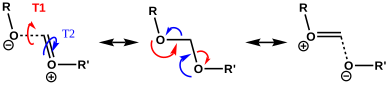
A variation is to replace one oxygen by a nitrogen atom, as in N-C-O. Shown below is a scatter plot of the two distances to the common carbon atom derived from crystal structures.

You can see some entries for which the C-O bond length is shorter than normal and the C-N distance very much longer than normal; an example of a highly asymmetric anomeric effect operating in just one direction rather than the two shown in the top diagram (red/blue arrows).

One example is LOFPON[1] (DOI: 10.5517/cc121rsn) with bond lengths shown calculated at the ωB97XD/def2svpp level (Calculation DOI: 10.14469/hpc/8682) and is rationalised by the nitrogen being a quaternary cation and hence an excellent leaving group which biases the electron flow towards it. Anomeric effects can be quantified using a technique known as NBO analysis, which uses perturbation theory to estimate the interaction energy between a donor orbital (the oxygen lone pair in this case) and an acceptor orbital (the C-N σ* unoccupied orbital). Populating the C-N σ* antibonding orbital causes the C-N length to increase and the interaction energy in this example is 36.4 kcal/mol. This is around twice the normal value for anomeric effects and so is unusually large.

LOFPON

The other prominent example is NAWNUV (Data DOI: 10.5517/cc93pkm) where the bond length asymmetry is slightly larger and so is the perturbation energy (E2) is 41.0 kcal/mol (ωB97XD/def2svpp calculation DOI: 10.14469/hpc/8378). 

NAWNUV

In the opposite direction, NUQKAM[2] is an example of a lengthened C-O bond and a shortened C-N bond, with the crystal structure (DOI: 10.5517/ccv3ln5) shown below.

In this instance, a ωB97XD/def2svpp calculation (Data DOI: 10.14469/hpc/8806) does not bear this structure out, with CN and CO bond lengths of 1.422 (vs 1.369) and 1.434 (vs 1.529)Å and a final E(2) of 22.1 kcal/mol (which is close to normal). This is an example of how mining the crystal structure can yield results that can be checked by a different (quantum computational) technique, which in this instance reveals a probable issue in the crystal structure refinement which is probably causing the apparently large anomeric effect in the crystal structure to manifest.

Another entry is ANUVUD[3] with a crystal structure (data DOI: 10.5517/ccdc.csd.cc24zxdg) shown below and CN and CO lengths of 1.391 and 1.559Å, which in this case ARE reasonably replicated by calculation (1.402, 1.499). This effect is promoted by the good leaving group ability of the carboxylate anion and the antiperiplanar orientation of the nitrogen lone pair with respect to the C-O bond, E(2)=35.2 kcal/mol (DOI: 10.14469/hpc/8807)

I end with FEHYOG, a relatively old structure[4] showing a very long C-N distance (1.673Å) but a normal associated C-O distance (1.423Å). This rings an alarm bell. Indeed, the respective computed distances are 1.482 and 1.425Å, a significant discrepancy (DOI: 10.14469/hpc/8769). The NBO interaction energy is an umremarkable 12.5 kcal/mol.

Data mining of the crystal structure database has revealed a number of abnormally large bond length asymmetries around the N-C-O unit. Some of these are true record breakers, but two have been identified where calculations cannot reproduce the observed bond lengths. One might indeed ask whether a quantum computation of the structure might not be added to the curation checks made by the CCDC of their database. It might improve the quality of the data even further!

References

  1. N. Mercadal, S.P. Day, A. Jarmyn, M.B. Pitak, S.J. Coles, C. Wilson, G.J. Rees, J.V. Hanna, and J.D. Wallis, "<i>O</i>-<i>vs. N</i>-protonation of 1-dimethylaminonaphthalene-8-ketones: formation of a<i>peri</i>N–C bond or a hydrogen bond to the pi-electron density of a carbonyl group", CrystEngComm, vol. 16, pp. 8363-8374, 2014. https://doi.org/10.1039/c4ce00981a
  2. A. Rivera, J.J. Rojas, J. Ríos-Motta, M. Dušek, and K. Fejfarová, "3,3′-Ethylenebis(3,4-dihydro-6-chloro-2<i>H</i>-1,3-benzoxazine)", Acta Crystallographica Section E Structure Reports Online, vol. 66, pp. o1134-o1134, 2010. https://doi.org/10.1107/s1600536810014248
  3. Y. Wang, D. Sun, Y. Chen, J. Xu, Y. Xu, X. Yue, J. Jia, H. Li, and L. Chen, "Alkaloids of Delphinium grandiflorum and their implication to H2O2-induced cardiomyocytes injury", Bioorganic & Medicinal Chemistry, vol. 37, pp. 116113, 2021. https://doi.org/10.1016/j.bmc.2021.116113
  4. N. Paillous, S.F. Forgues, J. Jaud, and J. Devillers, "[2 + 2] Cycloaddition of two CN double bonds. First structural evidence for head-to-tail photodimerization in the 2-phenylbenzoxazole series", J. Chem. Soc., Chem. Commun., pp. 578-579, 1987. https://doi.org/10.1039/c39870000578

Tetra-isopropylmethane and tetra-t-butylmethane.

August 17th, 2021

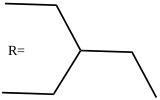
The homologous hydrocarbon series R4C is known for R=Me as neopentane and for R=Et as 3,3-diethylpentane. The next homologue, R=iPr bis(3,3-isopropyl)-2,4-dimethylpentane is also a known molecule[1] for which a crystal structure has been reported (DOI: https://doi.org/10.5517/cc4wvnh). The final member of the series, R= tbutyl is unknown. Here I have a look at some properties of the last two of these highly hindered hydrocarbons.

First the non-covalent-interactions (NCI) analysis, for a ωB97XD/Def2-SVPP/SCRF=dichloromethane wavefunction. This explores the properties of the weak electron density in the regions in between bonds, ie the non-bonded regions. In the presentation below, if that region is stabilizing, the surface is coloured cyan or dark green whereas if it is destabilising, it is pale green, yellow or orange. 

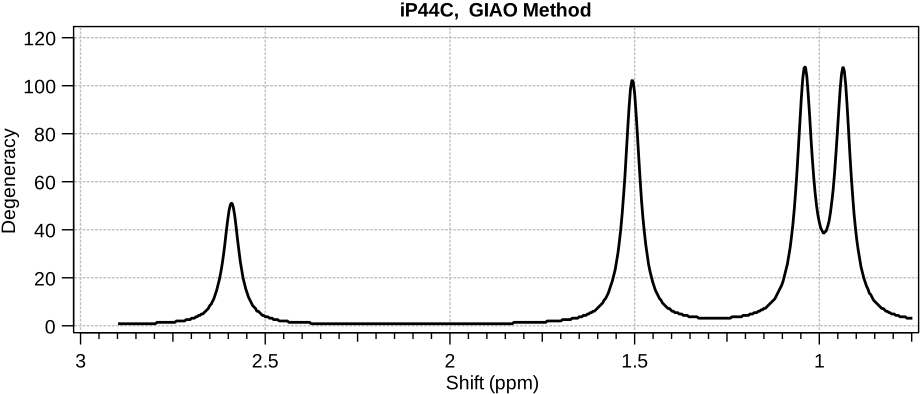
The above for R=iPr shows extensive but disconnected regions with NCI properties, with the pale cyan/green ones stabilizing and the regions verging on yellow repulsive. It would not be easy to conclude that this molecule overall is stabilised by dispersion! The predicted 1H NMR spectrum shows only one methine environment (2.59 ppm) but three methyl ones at 1.51, 1.04 and 0.94 (1.16 av/obs 2.23 and 1.04) ppm. The C-C bond lengths are 1.581Å (obs 1.599).

The NCI for R = tbutyl shows that the entire NCI surface is connected within the regions of the molecule, with far more green/yellow than stabilizing cyan. This molecule, which has an unusual T chiral symmetry is certainly sterically strained. The predicted C-C bond lengths of 1.668Å are unusually long (wB97XD/Def2-TZVPP).

The optical rotation (589nm) is -179°, which raises the question of whether it would be configurationally stable? The predicted 1H NMR shows three methyl environments (2.21, 1.92 and 0.44 ppm), averaging to 1.52ppm, which is significantly different from the isopropyl analogue.

Tetra t-butylmethane is often cited as the smallest branched hydrocarbon that cannot be made.[2],[3],[4] Certainly it looks far more strained than the isopropyl version. Its preparation is a challenge that might never be achieved!

References

  1. S.I. Kozhushkov, R.R. Kostikov, A.P. Molchanov, R. Boese, J. Benet-Buchholz, P.R. Schreiner, C. Rinderspacher, I. Ghiviriga, and A. de Meijere, "Tetracyclopropylmethane: A Unique Hydrocarbon with S4 Symmetry", Angewandte Chemie International Edition, vol. 40, pp. 180-183, 2001. https://doi.org/10.1002/1521-3773(20010105)40:1<180::aid-anie180>3.0.co;2-k
  2. K.M. Nalin de Silva, and J.M. Goodman, "What Is the Smallest Saturated Acyclic Alkane that Cannot Be Made?", Journal of Chemical Information and Modeling, vol. 45, pp. 81-87, 2004. https://doi.org/10.1021/ci0497657
  3. M. Cheng, and W. Li, "Structural and Energetics Studies of Tri- and Tetra-<i>tert</i>-butylmethane", The Journal of Physical Chemistry A, vol. 107, pp. 5492-5498, 2003. https://doi.org/10.1021/jp034879r
  4. N.L. Allinger, J. Lii, and H.F. Schaefer, "Molecular Mechanics (MM4) Studies on Unusually Long Carbon–Carbon Bond Distances in Hydrocarbons", Journal of Chemical Theory and Computation, vol. 12, pp. 2774-2778, 2016. https://doi.org/10.1021/acs.jctc.5b00926

Sterically stabilized cyclopropenylidenes. An example of Octopus publishing?

August 15th, 2021

Whilst I was discussing the future of scientific publication in the last post, a debate was happening behind the scenes regarding the small molecule cyclopropenylidene. This is the smallest known molecule displaying π-aromaticity, but its high reactivity means that it is unlikely to be isolated in the condensed phase. A question in the discussion asked if substituting it with a large sterically hindering group such as R=Et3C might help prevent its dimerisation and hence allow for isolation of the monomer so that its properties can be studied.

But first, a crystal structure search for this interesting group, Et3C, which is one step up in steric size from the very much better known Me3C or t-butyl. As it happens 34 examples emerge, and the dihedral angle distribution of the three ethyl groups is shown below. The three clusters all correspond to conformations with two gauche and one anti ethyl group. 

Whilst on the topic of crystal structures, I note that there are 5 examples known of the next steric homologue, i-Pr3C and a surprising 18 of t-Bu3C. I will discuss these groups elsewhere.

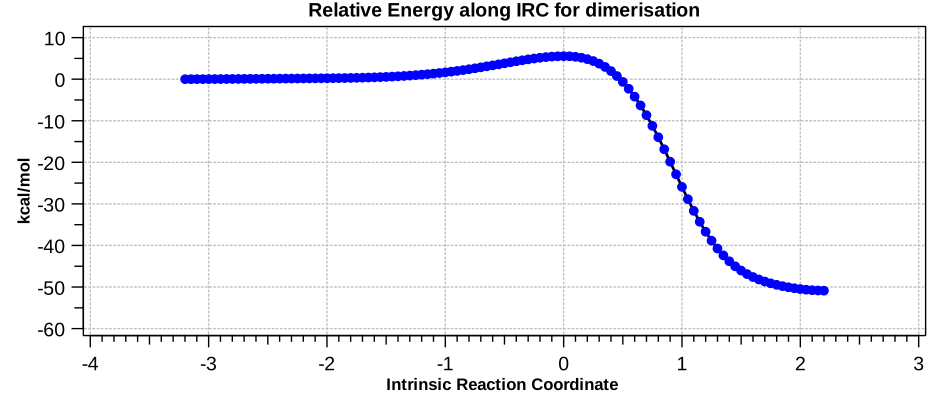
Next, a protocol for modelling the dimerisation: ωB97XD/Def2-SVPP/SCRF=dichloromethane. The IRC for R=H is shown at DOI: 10.14469/hpc/8705 and here I show that for R=Me3 showing a slightly larger barrier.

The results for three substituents are summarised in the table below which show that the barrier is a maximum for the t-butyl group and then decreases slightly for the apparently “larger” Et3C group.

R ΔG FAIR Data DOI
H 14.4 10.14469/hpc/8470
10.14469/hpc/8495
Me3C 16.0 10.14469/hpc/8706
10.14469/hpc/8707
Et3C 15.4 10.14469/hpc/8712
10.14469/hpc/8724
iPr3C* 25.5 10.14469/hpc/8722
tBu3C* 101.7 10.14469/hpc/8768
10.14469/hpc/8743

The analysis of this result is as noted in the discussion alluded to above, which is that these large groups, bristling with exposed hydrogen atoms, are strong dispersion attractors, at the right interatomic distances. The t-butyl group must be slightly sterically repulsive for the dimerisation reaction, but those dispersion attractions stabilise the slightly larger Et3C group. This could be tested further with R=i-Pr3C and t-Bu3C*.

I wanted to end this by going back to the opening line of this post. It struck me that the three posts here on the topic of cyclopropenylidene and the discussion they induced is not dissimilar from the “octopus” publishing modelling I had previously looked at.

  1. It started with setting out the initial seeding publication, in this case by noting that cyclopropenylidene had recently been reported in the atmosphere of Saturn’s moon Titan.[1].
  2. The hypothesis was that this molecule might be π-aromatic, an observation not noted in the original report (DOI: 10.14469/hpc/8716)
  3. A protocol for testing this hypothesis was to look at the occupied molecular orbitals of this molecule using a DFT-based quantum method (DOI: 10.14469/hpc/8716)
  4. The data resulting from this protocol is published (DOI: 10.14469/hpc/8714).
  5. Visual analysis showed two π-electrons (4n+2, n=0) i0n a molecular orbital fully delocalised around the three membered ring, which itself implies charge asymmetry in the molecule (DOI: 10.14469/hpc/8716)
  6. The original hypothesis of ring aromaticity was thus confirmed.
  7. A real-world problem then arose in the discussion relating to the dipole moment of this species resulting from the charge asymmetry.
  8. The review in this case was by comments posted to the blog posts here (a form of non-anonymous review).
  9. These reviews then spawned a new hypothesis, that a molecule based on cyclopropenylidene might support a record-large dipole moment (DOI: 10.14469/hpc/8717)
  10. This idea started a new cycle in which cyclopropenylidene might react with a source of dicarbon to give the desired molecule (DOI: 10.14469/hpc/8717)
  11. This cycle in turn spawned the current discussion, which relates to whether cyclopropenylidene might have a sufficiently long bimolecular lifetime to react with another molecule in preference to reacting with itself (DOI: 10.14469/hpc/8715)
  12. With a fork into crystal structure mining of steric groups beyond t-butyl.
  13. The latter resulting in a further cycle likely to be started relating to the hypothesis of R = i-Pr3C as an interesting steric group.

So we see here what might map to three cycles of “octopus publishing”. Those cycles were however non-linear, in that they did not happen in quite the sequence outline above; the discussions forked and split out from the original cycle, re-entering at different points in the cycle. My point being that scientific research is indeed very often cyclical and non-linear, albeit traditionally its reporting taking place in a form where many of the individual aspects of this process are bundled together in the form of a research article, a box-set if you will, which you can binge on if you wish. The concept of Octopus publishing is to fragment this model into smaller, stand-alone episodes, linked perhaps by a metadata-based DOI crumb trail. Lets see if the perceived benefits of publishing in this way catch on in chemistry.


*Further entries added to table.

References

  1. C.A. Nixon, A.E. Thelen, M.A. Cordiner, Z. Kisiel, S.B. Charnley, E.M. Molter, J. Serigano, P.G.J. Irwin, N.A. Teanby, and Y. Kuan, "Detection of Cyclopropenylidene on Titan with ALMA", The Astronomical Journal, vol. 160, pp. 205, 2020. https://doi.org/10.3847/1538-3881/abb679

Octopus publishing: dis-assembling the research article into eight components.

August 13th, 2021

In 2011, I suggested that the standard monolith that is the conventional scientific article could be broken down into two separate, but interlinked components, being the story or narrative of the article and the data on which the story is based. Later in 2018 the bibliography in the form of open citations were added as a distinct third component.[1] Here I discuss an approach that has taken this even further, breaking the article down into as many as eight components and described as “Octopus publishing” for obvious reasons. These are;

  1. The problem being addressed
  2. An original hypothesis/theoretical Rationale for the problem
  3. A method or protocol for testing the hypothesis in the form of experiments or modelling
  4. The data resulting from these experiments
  5. Analysis of this data
  6. Interpretation of the analysis in terms of the original hypothesis
  7. Translation/application to a real world problem (an extrapolation if you like of the original problem)
  8. A review of any of the previous seven items.

Items 1-3, 5-6 and probably 7 are the dis-assembled components of the standard concept of a scientific publication and item 4 is the data component I refer to in my introduction above. Interestingly, the article bibliography is not separated out into these components, and is presumably distributed throughout the resulting fragments. The essential concept behind this dis-assembly is that each component can rest on its own, provided it is contextually and bi-directionally linked into the others. The author(s) of any individual component will get credit/recognition for that component. A conventional mapping would be that the same author set would be responsible for all the individual items, whilst recognising that each component could in fact have its separate authorship. Thus one might get credit for just suggesting a problem, or for suggesting a protocol for its testing, for acquiring just the data, or for proposing an original analysis or interpretation. Any author’s reputation would then be established by the integrated whole of their contributions across the whole range of article components (leaving aside how the weightings of each individual contribution would be decided). 

I decided to try to give it a go via a prototype at https://science-octopus.org/publish which as you can see is one of the eight above. The process starts with the prospective author providing their ORCID credentials, against which unique metadata is presumably generated.

The next stage however is more interesting; Unlike any other publication platform, Octopus requires all publications to be linked to others that already exist. At the current stage of development, the prototype only has a few entries linked to COVID-19 as a topic, which I did not feel able to add to. Selecting one of those at random, one is asked to link any associated data via a DOI, then the optional indication of appropriate keywords, followed by standard questions about funding sources, conflicts of interest and license declaration. I wanted to use CC0, but this was not an option.

Finally at this stage a question about any other related publications, with the list known to Octopus being offered as suggestions. Next came the main opportunity to insert prose related to the information already provided (this part constituting the conventional article component). This is also the only opportunity to add a bibliography, and the citations would be part of that document, albeit not identified as a citation for the inner workings of the Octopus system. Then comes a Publish now button. No persistent identifier (DOI) is generated in this prototype system, but will be in the production system. A final screen that has four options, including to write a review (of one’s own work?) or to Red Flag the item. The latter can eg arise from plagiarism or any other expression of concern.

Many questions arise about this new approach and I will only note only three. One relates to “Why would I want to publish in Octopus” in the FAQ section. I quote “The traditional system is not only slow and expensive, but the concept of “papers” is not a good way of disseminating scientific work in the 21st century and “Publish it now and establish priority – once it”s out in Octopus it”s yours“. There are many experiments that strive to address this generic issue that the conventional research paper is no longer entirely fit for purpose. One I can supply here is that of “Preprint servers” such as ChemRxiv where one significant motivation is also to “establish priority”.

An aspect of interest to myself is how the metadata for all these eight components will be expressed. Presumably when mature, all eight components will have their own DOI or persistent identifier (PID) and hence all eight will also have a metadata record. These records will formally establish the relationships between the components, and ultimately could be used to construct a PID Graph not only between those components but to the rest of the PID “multiverse” of articles, data, citations and other research objects. Will Octopus join in this PID graph world?

And finally, the greatest challenge to a new paradigm such as Octopus is how quickly will the existing established culture of “publish a blockbuster article in one of the top ten (chemistry) journals” to establish your career evolve into the dis-assembled approach described here? It has taken preprint servers the best part of 25 years to really get going in e.g. chemistry where there are now around 9600 preprints on a variety of topics. I suspect some subject disciplines may be harder to crack than others (and chemistry may well be amongst these!).


Around 2009 or so I ran a student experiment using a Wiki which had some aspects of this approach. Students were asked to do a project on the topic of either a molecule from a suggested list of around 30, or a molecule entirely of their own choosing. The students spontaneously split themselves into three groups. The first were students who wrote the story entirely by themselves, submitted it for credit and did not welcome others as co-authors. The second (largest) group where those that contributed to multiple topics, very much in the manner of Wikipedia itself. Their credit was the sum of their contributions. The final group chose not to tell a story about a molecule, but to help everyone else with the infrastructure of doing so (the protocol if you like) by writing templates which simplified authoring, or correcting errors in existing stories etc.

Arguably a measure of the impact of these 9600 preprints is how many of them have eventually appeared in fully peer reviewed form in journals. That statistic may not be known. Also of interest would be some analysis for those that did end up in journals of how they evolved between eg V1 of the preprint and the final “version of record”. 

Metadata is structured according to a specified schema. Currently, journal publishers use the CrossRef schema for this purpose, which contains a full description of e.g. the bibliography of an article. Data publishers use the DataCite Schema, which has less focus on bibliography. It will be of interest to see how such schemas are applied to the eight components of an Octopus scientific record.


References

  1. D. Shotton, "Funders should mandate open citations", Nature, vol. 553, pp. 129-129, 2018. https://doi.org/10.1038/d41586-018-00104-7

Another very large anomeric effect – with a twist.

July 22nd, 2021

In the earlier post on the topic of anomeric effects, I identified a number of outliers associated with large differences in the lengths of two carbon-oxygen bonds sharing a common carbon atom.

Here is another of these outliers (MUZZIS[1]) which shows equally unusual properties. This is an oxyanion (counterion is trimethylbenzylammonium) which is part of a very strong O-H-O hydrogen bond in which the O…O distance is 2.44Å and the O-H distances are each indicated as 1.23Å, suggesting the hydrogen is symmetrically disposed about the two oxygens. The anomerically lengthened C-O bonds (shown in red below) are 1.513/1.516Å, which is indeed long for a C-O bond.

A ωB97XD/Def2-SVPP/SCRF=chloroform calculation reveals a less symmetrical hydrogen bonding system, with calculated O-H distances of 1.046/1.434 (mean 1.24Å) and an O-O distance of 2.48Å. The anomerically lengthened C-O distances are 1.479/1.582Å. There are several reasons for these differences:

  1. The temperature at which the X-ray data were recorded was 173K and it remains possible that the data represent an averaged position for the atoms at this temperature rather than a truly symmetrical hydrogen bond.
  2. The basis set/DFT method for the calculation may itself favour unsymmetrical hydrogen bonds.

The two NBO energy perturbation terms for one lone pair on the oxygens interacting with the empty C-O σ* orbital are 31.6 and 57.5 kcal/mol. If the hydrogen bond is in reality entirely symmetric, then the NBO term would be expected to be approximately the average of these two values.

Click image to obtain 3D model

The earlier record anomeric holder achieved this by virtue of charge relocation involving an oxenium cation rather than the normal effect of charge separation. Here we have a similar effect, this time involving oxy-anionic charge relocation. Both are therefore special cases.

References

  1. R. Bengiat, M. Gil, A. Klein, B. Bogoslavsky, S. Cohen, and J. Almog, "Bis(benzyltrimethylammonium) bis[(4<i>SR</i>,12<i>SR</i>,18<i>RS</i>,26<i>RS</i>)-4,18,26-trihydroxy-12-oxido-13,17-dioxaheptacyclo[14.10.0.0<sup>3,14</sup>.0<sup>4,12</sup>.0<sup>6,11</sup>.0<sup>18,26</sup>.0<sup>19,24</sup>]hexacosa-1,3(14),6,8,10,15,19,21,23-nonaene-5,25-dione] sesquihydrate: dimeric structure formation<i>via</i>[O—H—O]<sup>−</sup><i>negative charge-assisted hydrogen bonds (–CAHB)</i>with benzyltrimethylammonium counter-ions", Acta Crystallographica Section E Crystallographic Communications, vol. 72, pp. 399-402, 2016. https://doi.org/10.1107/s2056989016002899

Dimerisation of cyclopropenylidene: what are the correct “curly arrows” for this process?

July 21st, 2021

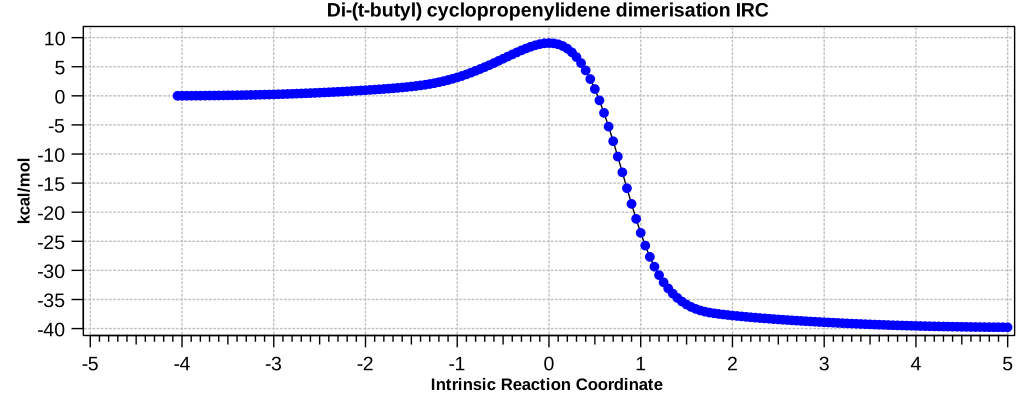
In another post, a discussion arose about whether it might be possible to trap cyclopropenylidene to form a small molecule with a large dipole moment. Doing so assumes that cyclopropenylidene has a sufficiently long lifetime to so react, before it does so with itself to e.g. dimerise. That dimerisation has an energy profile shown below, with a free energy of activation of 14.4 kcal/mol, so a facile reaction that will indeed compete with reaction with Ph-I+-CC.

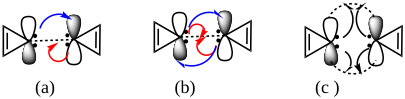
The schematic above shows some arrow pushing schemes for this reaction. In (a), one pair of electrons in the reacting carbene will have to be elevated into the π-system to form the π covalent bond, whilst the other pair of electrons will remain as σ and form a C-C σ-bond. One could do this in two stages. Firstly the double excitation of a carbene lone pair into the p-orbital and then the reaction between the two different electronic states of this species. In fact the IRC above shows no sign at all of a two-stage process; the reaction is entirely synchronous. An NBO analysis at the transition state for the reaction shows two equivalent carbene lone pairs each overlapping with one of the two empty p-orbitals on the original carbene. Click on the diagrams below to obtain rotatable 3D models of this overlap.

So perhaps representation (b) of this reaction might be as follows, in which each electron of the carbene lone pair does something different, one becoming π and one remaining σ. This reminds of how proton-coupled electron transfers are represented, in which the two electrons of an electron pair each do different things.[1]

Another way of thinking about it is not to form one σ- and one π-bond but to form two “banana bonds” as in (c), in which each of these bonds is equivalent. Banana bonds have rather gone out of vogue, largely because they do not illustrate why an alkene has different reactivity to an alkane. There will also be those who would dismiss these attempts on the grounds that “curly arrows” are merely a qualitative representation/book-keeping of the reaction and should not be used for implying quantum mechanical results. I happen to think otherwise, but the above does serve to illustrate that sometimes, the “curly arrows” for a reaction do need some thinking about!

References

  1. J.E.M.N. Klein, and G. Knizia, "cPCET versus HAT: A Direct Theoretical Method for Distinguishing X–H Bond‐Activation Mechanisms", Angewandte Chemie International Edition, vol. 57, pp. 11913-11917, 2018. https://doi.org/10.1002/anie.201805511

Molecules with very large dipole moments: cyclopropenium acetylide

July 11th, 2021

Occasionally, someone comments about an old post here, asking a question. Such was the case here, when a question about the dipole moment of cyclopropenylidene arose. It turned out to be 3.5D, but this question sparked a thought about the related molecule below.

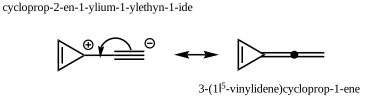
Of the two resonance forms show above, the one on the left is a zwitterion resulting in the formation of an aromatic cyclopropenium ring, with the charge balanced by the acetylide anion. The calculated structure (ωB97XD/Def2-TZVPP/SCRF=chloroform, Data DOI 10.14469/hpc/8399 ) shows a short terminal CC bond which indicates a significant degree of delocalisation of the three membered ring.

Molecular electrostatic potential

The molecular electrostatic potential (above) agrees with a large dipole moment of 11.9D. This is certainly up there with the molecule suggested in 2016 as being the most polar molecule neutral compound synthesised[1] and is a fair bit smaller than that candidate. A brief search of the literature (Scifinder) suggest that the molecule is currently unknown. Anybody fancy making it?

The Data DOI by the way gives you access to the other outputs from the calculation, which would include the molecular orbitals and the molecular vibrations which I have not shown here.


Such zwitterions are known as unstable intermediates. See e.g. [2] for examples.

References

  1. J. Wudarczyk, G. Papamokos, V. Margaritis, D. Schollmeyer, F. Hinkel, M. Baumgarten, G. Floudas, and K. Müllen, "Hexasubstituted Benzenes with Ultrastrong Dipole Moments", Angewandte Chemie International Edition, vol. 55, pp. 3220-3223, 2016. https://doi.org/10.1002/anie.201508249
  2. H.S. Rzepa, "Routes involving no free C <sub>2</sub> in a DFT-computed mechanistic model for the reported room-temperature chemical synthesis of C <sub>2</sub>", Physical Chemistry Chemical Physics, vol. 23, pp. 12630-12636, 2021. https://doi.org/10.1039/d1cp02056k

Two record breakers for the anomeric effect; one real, the other not.

July 1st, 2021

The classic anomeric effect operates across a carbon atom attached to oxygens. One (of the two) lone pairs on the oxygen can donate into the σ* orbital of the C-O of the other oxygen (e.g. the red arrows) tending to weaken that bond whilst strengthening the donor oxygen C-O bond. Vice versa means e.g. the blue arrows weakening the other C-O bond. This effect tends to increase charge separation and the question then arises: how large can this effect get? To try to find out, we are going to do some crystal structure mining in this post!

I need to list the parameters defining this crystal mining.

  1. Firstly, we note that the donating lone pair has to overlap in an anti-periplanar fashion with the C-O bond that is going to weaken. To get a handle on this overlap we are going to define the absolute value of the two torsion angles, T1 and T2 (minimum value 0° and maximum value 180°). Since a lone pair has no defined position in crystallographic coordinates, we will have to infer the angle of the lone pair from that of the torsion angles RO-CO and R’O-CO, which will then constitute a measure of how the oxygen lone pairs are oriented.
  2. If T1 or T2 have values of ~60° we might infer that one lone pair torsion may have a value of 60+120° = 180° and therefore that it is indeed antiperiplanar to a C-O bond.
  3. Next we define the two C-O distances. If BOTH the oxygen lone pairs are oriented at ~180° to the C-O bond, then both the red and the blue resonances can occur more or less equally and so each C-O bonds is both strengthened and weakened. The anomeric effect operates in both directions, meaning the two C-O bond lengths are more or less equal in length.
  4. If however only one of the lone pair torsions is 180° and not the other, a bond length inequality will be set up, which can be detected crystallographically.

Now for a search of the Cambridge crystal structure database. The definition is shown below, and included constraining the central carbon to 4-coordination (R = C or H), no errors and R < 0.05. 

Firstly the result for the two C-O distances. The point ringed in red is clearly an error, but the two ringed in green are real (IFJIO and IFEJUA) for which extreme inequality of the two C-O bond lengths appears. But before discussing this, I note that there is a double “hot spot” (red) for which the two C-O distances are more or less equal.

By constraining one of the R groups to R=H, a single hot spot is obtained showing unequal bond lengths (~1.395, 1.430Å) whilst the double hot spot only appears when both R are C. Something  interesting  going  on  there?

Next, a torsion plot is more directly revealing of an operating anomeric effect. The hot spot appears at values of each torsion of 60° which suggests that the most common conformation for these molecules is to have both oxygen atoms aligning with one lone pair antiperiplanar to the other C-O bond. This would not result in bond length inequality.

However, the remaining distribution shows both a vertical and a horizontal distribution in which only one of the oxygen atoms aligns a lone pair antiperiplanar to the C-O bond. According to the argument presented above, these should show bond length inequality. To check that the distribution above is not due to constraints of rings, a search in which both C-O bonds are specified as acyclic (i.e. not part of a ring) reveals the same effect.

Next, we combine both the distance and the torsion values as below. The mean of both torsion angles at 60° is again a hot-spot and this is associated with no difference in the two bond lengths. Conversely, the maximum difference in the bond lengths occurs at a mean torsion of ~ 90°, which can occur when the individual torsions are 60 and 120°, the former of which implies a lone pair is antiperiplanar to the  C-O bond. The rings again correspond to those identified above. 

Now to investigate those ringed molecules. The red one is SUCROS35[1] which was reported in 2012 as a high pressure polymorph of sucrose in which the hydrogen bonding pattern of regular sucrose has been substantially modified. Could application of pressure really induce an enormous anomeric effect?

SUCROS35

One way of applying a “reality check” is to calculate the geometry at a high level DFT level (ωB97XF/Def2-TZVPPD) which reveals that the three C-O bond lengths annotated above are predicted as 1.400, 1.416 and 1.392Å (FAIR Data DOI: 10.14469/hpc/8374). These are regular C-O lengths and exhibit nothing unusual. We might conclude that the crystal data for this specific set of coordinates is in error and should certainly be re-investigated. 

The two real examples of large bond length difference are both related[2] and the larger of which is the version with R=H,C rather than R=C,C. The example with  R=H is certainly augmented because of the hydrogen bond set up to the triflate group, which tends to forming an oxyanion, which is a stronger electron donor than e.g. methoxy.

IFEJIO

IFEJUA

The reason for these record breakers is that the anomeric effect in this case induces not so much charge separation as charge relocation. One way of quantifying the effect is to calculate the NBO E(2) interaction term between the donating oxygen lone pair and the accepting C-O σ* orbital. Click on the image below to view this interaction (blue = magenta; red = orange).

The values are 60.8 (IFEJIO, structure at DOI: 10.5517/cc111jxj), 46.5 (IFEJUA, structure at DOI: 10.5517/cc111jyk) and 20.8 (SUCROS35, structure at DOI: 10.5517/ccx16sx) kcal/mol. The latter in fact corresponds to a “normal” anomeric effect, which shows that our two record breakers are more than twice as large!

I conclude by noting that in the above distribution plots, there are five or so other “outliers” which need verifying and which may also prove interesting.  We have yet to find the largest anomeric effect exhibiting charge separation rather than relocation.

References

  1. E. Patyk, J. Skumiel, M. Podsiadło, and A. Katrusiak, "High‐Pressure (+)‐Sucrose Polymorph", Angewandte Chemie International Edition, vol. 51, pp. 2146-2150, 2012. https://doi.org/10.1002/anie.201107283
  2. G. Gunbas, W.L. Sheppard, J.C. Fettinger, M.M. Olmstead, and M. Mascal, "Extreme Oxatriquinanes: Structural Characterization of α-Oxyoxonium Species with Extraordinarily Long Carbon–Oxygen Bonds", Journal of the American Chemical Society, vol. 135, pp. 8173-8176, 2013. https://doi.org/10.1021/ja4032715

A closer look at that fourth bond in C2.

June 2nd, 2021

From the last few posts here, you might have noticed much discussion about how the element carbon might sustain a quadruple bond. The original post on this topic from some years ago showed the molecular orbitals of the species CN+, which included two bonding π-types and a low lying nodeless bonding σ-orbital, all with double occupancies and adding up to a triple bond. Discussing now C2 itself, there are two remaining orbitals for consideration which we will for the purpose here call the highest occupied σ-MO or HOσMO (Σu) and the lowest unoccupied σ-MO or LUσMO (Σg) and which are more mysterious.

The HOσMO itself has one node (the lowest unoccupied or LUσMO has a further second node) bisecting the centre of the C-C bond, which makes it anti-bonding. This is emphasised by squaring the orbital (below), which shows a clear void of electron density in the C-C region. For this reason, many text books illustrating the main group diatomic molecules represent C2 with two bonds: 3-1 = 2.

CASSCF(8,6) “HOMO”/”LUMO” orbitals and densities of C2
(HOσMO)@0.02au (LUσMO)@0.02au
(HOσMO2)@0.0004au (LUσMO2)@0.0004au

Now to a MCSCF(8,6)/Def2-SVPD calculation (FAIR DOI: 10.14469/hpc/8307) which means a multi-configuration calculation. Regular e.g. DFT methods assume only a single electronic configuration in which one set of doubly-occupied orbitals is variationally optimized. Thankfully, for the vast majority of molecules, this is actually a very good approximation. However for some species, and C2 is one such, this is no longer true. A CASSCF(8,6) calculation uses the 105 different electronic configurations generated by using eight electrons in an active space of six orbitals and variationally optimises them all for a self-consistent-field. The orbitals corresponding to the erstwhile single-configurational HOσMO and LUσMO are the ones shown above. Their squares are shown underneath, the latter as noted above relating to the electron density distribution in the molecule.

The MCSCF calculation for C2 shows that primarily two different electronic configurations contribute significantly to the total wavefunction, the one with two electrons in the original HOσMO (now of course a misnomer) having a weight of 1.573e and the configuration with two electrons promoted to the now similarly misnamed LUσMO orbital by virtue of having a weight of 0.427e. This shows that this final 2e really must be described by two electronic configurations rather than one (and which reminds that the terms HOσMO and LUσMO really only apply to single-configuration methods). What difference does that make to the picture? The scaled linear combination of the two orbitals deriving from the two dominant electronic configurations for C2 below shows that each now has an “extrusion” of the original orbital creeping along the C-C axis.

(1.573*HOσMO + 0.427*LUσMO)@0.02au (1.573*HOσMO – 0.427*LUσMO)@0.02au

Squaring and weighted adding shows us what is happening to the electron density. That void in the density along the C-C axis apparent in the HOσMO above has now been nicely filled with density from those extrusions deriving from the partially occupied “LUσMO”. As a result, the node in the density along the bond has now vanished. By elevating 0.427 of the electrons from the original anti-bonding HOσMO into the complementary LUσMO, a new weakly-bonding “baby” orbital with ~two-electron occupancy replaces the original antibonding HOσMO. There is however relatively little additional density placed into the C-C region because of only 0.427e transfer into the “LUσMO”. The weak bonding character also matches the “bond dissociation energy” of this fourth bond of ~17 kcal/mol as inferred by experimental measurement of the energies of the two reactions HC≡CH → HC≡C + H; HC≡C → CC + H.

(1.573*(HOσMO)2 + 0.427*(HOσMO)2)@0.0004au
The (Σg)2@0.0004au conventional σ-bond for comparison
g)2 – (1.573*(HOσMO)2 + 0.427*(HOσMO)2)@0.0004au

So by combining the appropriate occupancies of the HOσMO and LUσMO in a multi-configurational approach to C2, a new weak bond emerges, which when added to the three existing bonds referred to above gives a representation of four rather than two bonds for this molecule.


The DOI of this post is https://doi.org/gf9s


The weights for a CASSCF(12,12) calculation with 427350 configurations are 1.568 and 0.426. Conversely, a CASSCF(8,5) calculation on 15 configurations yields 1.533 and 0.467. The optimised geometries also show an interesting trend. Thus 8,5 = 1.198Å, 8,6 = 1.230 and 12,12 = 1.262Å. As the active space decreases, so the weight of the configuration with a populated Σg orbital increases by “concentration” into this orbital and hence the C-C bond length also decreases as the amount of density injected into the C-C region increases.

A reality-based suggestion for a molecule with a metal M⩸N quadruple bond.

May 13th, 2021

I noted in an earlier post the hypothesized example of (CO)3Fe⩸C[1] as exhibiting a carbon to iron quadruple bond and which might have precedent in known five-coordinate metal complexes where one of the ligands is a “carbide” or C ligand. I had previously mooted that the Fe⩸C combination might be replaceable by an isoelectronic Mn⩸N pair which could contain a quadruple bond to the nitrogen. An isoelectronic alternative to FeC could also be FeN+. Here I explore the possibility of realistic candidates for such bonded nitrogen.

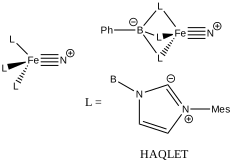
So I follow the strategy set in the previous post of conducting a crystal structure search of molecules containing the sub-structure L3-MN or L4-MN. Of the 85 hits for the former (FAIR DOI 10.14469/hpc/8196), I focus on those where N has only one bonded atom (to the metal M) and the ligand L is non-anionic connecting to the metal via e.g. carbon or phosphorus. This reduces to 11 hits, which in fact contain something similar to the Arduengo “carbene” ligand L shown below, this being known as a phosphine replacement. Here I look at one of these molecules, the internal ion-pair where the positive charge on the N is balanced by a four-coordinate negative boron, as in HAQLET.[2] (Data DOI: 10.5517/ccdc.csd.cc1p0mp0).

As with (CO)3Fe⩸C, L3Fe⩸N+ has a filled 18-electron metal valence shell. A ωB97XD/Def2-SVPD calculation on a simplified model (with aryl groups replaced by H) reveals the following NBO localised orbitals.

M-N, r = 1.475Å.
NBO 72, Occupied, Non-bonding d-orbital NBO 71, Occupied, Non-bonding d-orbital
NBO 67 π bond NBO 66 π bond
NBO 59 σ bond NBO 27 σ bond

There are two σ-bonds and two π-bonds between the Fe and the N. The molecule is presumably inhibited from reaction such as e.g. dimerising, because the iron-bonded nitrogen atom sits in a well created by the mesityl groups, thus sterically preventing any N…N approach close enough and at the appropriate angle to unite the two units. The free energy of dimerisation of the unhindered model used above is -49.7 kcal/mol.

I remind that the NBO method being used to ascertain the nature of the bonding here is a binary method, giving localised NBO orbitals with ~2e occupancies that contain an integer number of bonding orbitals between any pair of atoms. In this case, these can point to either a triple or a quadruple M…N bond for such systems and do not allow for a continuum approach where the weight of each localised bond might not be close to an integer. The purpose here is to flag this system for further analysis rather than as a definitive declaration of its quadruple-bonded nature.

References

  1. A.J. Kalita, S.S. Rohman, C. Kashyap, S.S. Ullah, and A.K. Guha, "Transition metal carbon quadruple bond: viability through single electron transmutation", Physical Chemistry Chemical Physics, vol. 22, pp. 24178-24180, 2020. https://doi.org/10.1039/d0cp03436c
  2. L. Bucinsky, M. Breza, W. Lee, A.K. Hickey, D.A. Dickie, I. Nieto, J.A. DeGayner, T.D. Harris, K. Meyer, J. Krzystek, A. Ozarowski, J. Nehrkorn, A. Schnegg, K. Holldack, R.H. Herber, J. Telser, and J.M. Smith, "Spectroscopic and Computational Studies of Spin States of Iron(IV) Nitrido and Imido Complexes", Inorganic Chemistry, vol. 56, pp. 4751-4768, 2017. https://doi.org/10.1021/acs.inorgchem.7b00512