A suggestion for a molecule with a M⩸C quadruple bond with trigonal metal coordination.

May 13th, 2021

The proposed identification of molecules with potential metal to carbon quadruple bonds, in which the metal exhibits trigonal bipyramidal coordination rather than the tetrahedral modes which have been proposed in the literature[1],[2],[3] leads on to asking whether simple trigonal coordination at the metal can also sustain this theme?

The rational for doing this is the observation for the trigonal bipyramidal molecules that repulsions between a non-bonding occupied d-orbital on the metal and one of the two putative metal to carbon σ-bonds resulted in the two electrons localising into a lone pair on carbon. By removing the electrons in this metal d-orbital or by increasing its size, the C σ-lone pair was encouraged to abandon some of its lone pair character and participate in a quadruple bond.

Another way of achieving this result is explored here, with the molecule shown above. Two of the trigonal carbon ligands are pinned back by the ring to reduce any potential repulsions. As before, this complex constitutes a filled 18-valence shell metal. The calculated orbitals (ωB97XD/Def2-SVPD, FAIR DOI: 10.14469/hpc/8206) are shown below.

M=Co, r = 1.493Å.
NBO 26, π bond NBO 24, non-bonding d-orbital
NBO 23 σ bond, 0.02 au NBO 23 σ bond, 0.01 au
NBO 22 π bond NBO 14 σ bond

Despite the appearance of a bond between Co and C along the C⩸Co axis in the representations above (inserted off its own bat by the JSmol program), no such bond exists in the NBO list. No precedent for this kind of structure appears in the crystal structure database. As before, the NBO 23 σ bond at low isosurface thresholds expands to add a second layer along the Co⩸C axis, in which the nodal surface exists between the two layers rather than along the bond itself. It therefore constitutes a bonding orbital.

These quadruple bond motifs involving carbon are certainly starting to emerge in unexpected places and I do wonder how many more variations on this theme will be identified.

References

  1. A.J. Kalita, S.S. Rohman, C. Kashyap, S.S. Ullah, and A.K. Guha, "Transition metal carbon quadruple bond: viability through single electron transmutation", Physical Chemistry Chemical Physics, vol. 22, pp. 24178-24180, 2020. https://doi.org/10.1039/d0cp03436c
  2. A.J. Kalita, S.S. Rohman, C. Kashyap, S.S. Ullah, I. Baruah, L.J. Mazumder, P.P. Sahu, and A.K. Guha, "Is a transition metal–silicon quadruple bond viable?", Physical Chemistry Chemical Physics, vol. 23, pp. 9660-9662, 2021. https://doi.org/10.1039/d1cp00598g
  3. L.F. Cheung, T. Chen, G.S. Kocheril, W. Chen, J. Czekner, and L. Wang, "Observation of Four-Fold Boron–Metal Bonds in RhB(BO<sup>–</sup>) and RhB", The Journal of Physical Chemistry Letters, vol. 11, pp. 659-663, 2020. https://doi.org/10.1021/acs.jpclett.9b03484

What does a double σ-bond along a bond axis look like?

May 10th, 2021

Introductory chemistry will tell us that a triple bond between say two carbon atoms comprises just one bond of σ-axial symmetry and two of π-symmetry. Increasingly mentioned nowadays is the possibility of a quadruple bond between carbon and either itself or a transition metal, as discussed in the previous post. Such a bond comprises TWO bonds of σ-axial symmetry. Since most people are unfamiliar with such double bonds and in particular with how that second σ-bond sits with the first, I thought it would be interesting to show such an orbital. This one is a localised orbital 41, selected from the previous post for the molecule (PH3)2(CN)2Mo⩸C.

NBO 41, threshold 0.040 au NBO 41, threshold 0.018
NBO 41, threshold 0.016 NBO 41, threshold 0.014
NBO 41, threshold 0.012 NBO 41, threshold 0.007

The above shows how the orbital changes with the isosurface threshold. At high values, it looks very similar to the normal σ-bond but as the threshold gradually decreases, a second “sheath” starts to surround the inner orbital until the latter is entirely enclosed. This orbital has a node not so much along the bond itself, but between the inner and outer layers of the bond, which is how the two σ-bonds are differentiated. This effect was first noted in 2016 in terms of the compound CH3F2-, in which an expanded carbon valence shell creates a second σ-bond.

Certainly not a representation that has ever appeared in a text book I think! But perhaps one that chemists may have increasingly to become familiar with.


Appendix Here are some superimposed orbitals to facilitate comparisons. Firstly orbital 41 (the higher energy σ-orbital) with orbital 22 (the lower energy σ-orbital). The first has yellow/green for the two phases, the second has red/blue.

Next, σ-orbital 22 (yellow/green) with orbital 42 (red/blue) surrounding it, revealing the avoided overlaps (Pauli repulsions) between the two by virtue of having orbital 42 unoccupied.

Next, σ-orbital 41 (yellow/green) with orbital 42 (red/blue) surrounding it, revealing the reduced overlap between these two.

Appendix 2 A “pure” form of the double-layered σ-bond can be seen with the diatomic molecule Ti2, contoured at 0.0225 au. The red phase is about to join in the middle.

The electron density from this orbital is shown below and shows clearly the two layers of density comprising the σ-bond, with the outer layer at this isosurface value (0.00052 au) about to join up in the middle to complete the outer sheath. I have left it unjoined so that you can see “inside layer”, since translucency does not always get the message across.

Two new reality-based suggestions for molecules with a metal M⩸C quadruple bond.

May 8th, 2021

Following from much discussion over the last decade about the nature of C2, a diatomic molecule which some have suggested sustains a quadruple bond between the two carbon atoms, new ideas are now appearing for molecules in which such a bond may also exist between carbon and a transition metal atom. A suggested, albeit hypothetical example was C⩸Fe(CO)3[1]. Iron has a [Ar].3d6.4s2 electronic configuration and if we ionise to balance a C4- ligand, the iron becomes formally FeVI or [Ar].3d4. By adding 14 electrons deriving from the seven “bonds” to the 3d4, including a quadruple count from carbon, the Fe formally completes its 18-electron valence shell, as also found in e.g. Ferrocene.

A search for crystal structures containing the very simple query structure shown below, where C is defined as having one atom only attached, TR is any transition metal and the structure is non-polymeric, was undertaken to see if any examples of this motif might already exist. 

Zero hits with 4-coordinate metal atoms, but 11 real examples were found (FAIR DOI 10.14469/hpc/8190), all of which exhibit a five-coordinate transition metal centre, where X is a mono-anionic ligand (CN, halogen, etc) and L is a neutral ligand (PR3 etc). The most common metal was M = Ru, the electronic configuration of which is [Kr].4d75s1, becoming [Kr].4d2 by ionising to balance a C4- ligand and the two X ligands. There are now 16 electrons from the eight “bonds” surrounding the atom, including again a quadruple one from the carbon and forming a filled 18-electron valence shell around the metal.

So could these 11 constitute known examples of quadruple bonds from a transition metal to carbon? I will investigate using M=Ru, L = PH3 and X = CN, which represents a simplified form of one of the 11 examples[2] using the following electronic model: ωB97XD/Def2-SVPD. The focus will be on five localised NBO orbitals (the procedure I used previously to count the number of bonds at carbon for C⩸Fe(CO)3).

For M=Ru, the NBOs emerge as follows (click on any orbital thumbnail to convert to a 3D rotatable model).

M=Ru, r = 1.624Å.
NBO 42, Occupied, Non-bonding d-orbital NBO 41 π bond
NBO 36 π bond NBO 35 σ bond
NBO 34 non-bonding carbon lone pair Overlap of orbitals 42 and 34

This reveals only a triple Ru≡C bond plus a non-bonding lone pair on carbon. It turns out that bonding σ-orbital 34 is “surrounded” by the non-bonding Ru d-orbital 42. The electron-electron repulsions between the pair causes the electrons in orbital 34 to locate onto the carbon to form a non-bonding lone pair, as thus:

So might it be possible to persuade this carbon lone pair to instead donate into the M-C bond to form that fully-fledged quadruple bond?

One simple strategy is to remove the two electrons in orbital 42, preventing the Pauli repulsions from occuring and this can be done by using Mo instead of Ru.

M=Mo, r = 1.673Å
NBO 42 unoccupied Non-bonding d-orbital NBO 41 σ bond
NBO 40 π bond NBO 39 π bond
NBO 22 σ bond

By removing the repulsions to the non-bonding d-orbital, we have now transformed the erstwhile carbon lone pair into a fully fledged bond as in orbital 22, thus forming the quadruple motif. There are two electrons less, so this time the Mo valence shell is a 16-electron system.

So, SUGGESTION 1:

The second possibility is to increase the size of the non-bonding d-orbital 42 by changing from Ru to Os. Here again, orbital 22 is less repelled by the electrons in orbital 42 due to the larger size of the latter and so can again become C-Os bonding rather than non-bonding carbon lone pair.

M=Os, r = 1.679Å
NBO 42 Occupied Non-bonding d-orbital NBO 41 π bond
NBO 40 σ bond NBO 35 π bond
NBO 22 σ bond

So, SUGGESTION 2

This approach also reveals the binary decision in the NBO analysis, either an orbital is classified as “LP” and hence is not considered a bond, or it is classified as “BD” and is a bond. Reality is certainly more nuanced, with weights needing to be assigned to each valence bond representation (rather than just 1.0 or 0.0). Probably also these weights will depend on a number of factors, such as basis set quality and the method applied (e.g. the DFT procedure used). So the binary terms “triple” or “quadruple” do not carry the full measure of the bonding behaviour, which may be a continuum between these two extremes. But the two molecules shown above do represent molecules that could be realistically synthesized, since they are but small variations of already known molecules. Once made, they could then be subjected to appropriate experimental analysis to test the bonding hypotheses made here.


This post has DOI: https://doi.org/gbq3


References

  1. A.J. Kalita, S.S. Rohman, C. Kashyap, S.S. Ullah, and A.K. Guha, "Transition metal carbon quadruple bond: viability through single electron transmutation", Physical Chemistry Chemical Physics, vol. 22, pp. 24178-24180, 2020. https://doi.org/10.1039/d0cp03436c
  2. T.J. Morsing, A. Reinholdt, S.P.A. Sauer, and J. Bendix, "Ligand Sphere Conversions in Terminal Carbide Complexes", Organometallics, vol. 35, pp. 100-105, 2015. https://doi.org/10.1021/acs.organomet.5b00803

Dimethyl ketal hydrolysis catalysed by hydroxide and hydronium ions

April 7th, 2021

In the preceding post, I looked at a computed mechanism for the hydrolysis of a ketal by water. Of course, pure water consists of three potential catalysts, water itself or [H2O], and the products of autoionisation, [OH] and [H3O+]. The latter are in much smaller concentration, equivalent to a penalty of ~11.9 kcal/mol on any free energy barrier. Here I take a look at these ion-catalysed routes to see if that penalty can be overcome.

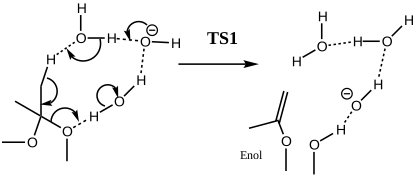
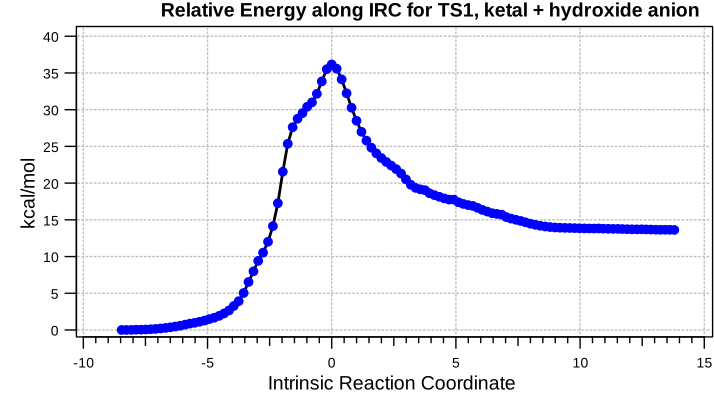
The calculations can be found at FAIR DOI: 10.14469/hpc/8071. The hydroxyl anion route is shown below, and has a computed free energy barrier of 34.1 kcal/mol. Only the first TS is shown here, since already we know that the barrier must be at least that high regardless of subsequent steps. This means that hydroxide anion catalysis must be insignificant.

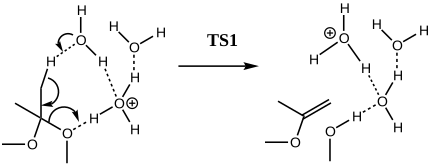
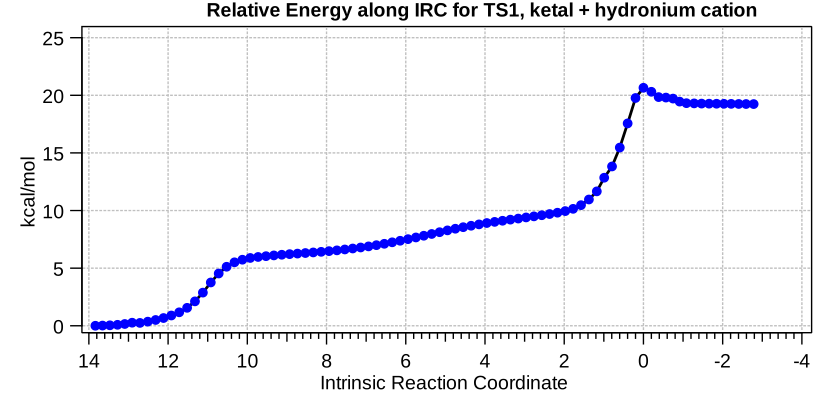
Next, the acid catalysed route, which is a two-stage path.

Firstly one methoxy group is protonated from the hydronium cation and the C-O bond cleaves (IRC 14 to 8). In the second stage, a water molecule abstracts the C-H hydrogen, regenerating the hydronium cation (IRC 2 to -2), during which process the transition state occurs to form an enol. This transition state has a free energy barrier of 16.2 kcal/mol. Both the second TS (13.4 kcal/mol) which reverses this to form a hemiacetal and TS3, which eliminates the second methanol to form a ketone (-3.5 kcal/mol) are lower in energy.

So we conclude that the hydronium cation catalysed route is easily accessible at ambient temperatures. Adding ~11.9 kcal/mol to account for the [H3O+]-7 concentration of this ion in water gives a “pure water” barrier of ~28 kcal/mol, which corresponds to a rather slow but viable hydrolysis (ie ~days half life) at ambient temperatures. Armed with this information, we can now start to address the hydrolysis of a bio-active ketal-based herbicide in water.

A computational mechanism for the aqueous hydrolysis of a ketal to a ketone and alcohol.

April 1st, 2021

The previous post was about an insecticide and made a point that the persistence of both insecticides and herbicides is an important aspect of their environmental properties. Water hydrolysis will degrade them, a typical residency time being in the order of a few days. I noted in passing a dioxepin-based herbicide[1] which contains a ketal motif and which in water can hydrolise to a ketone and alcohol. The reverse (acid catalysed) formation of a ketal is a staple of the taught organic chemistry curriculum. Here as a prelude to looking at the hydrolysis of that dioxepin, I take a look at a possible computational mechanism for the hydrolysis of 2,2-dimethoxypropane using pure water, without the help of acid or base.

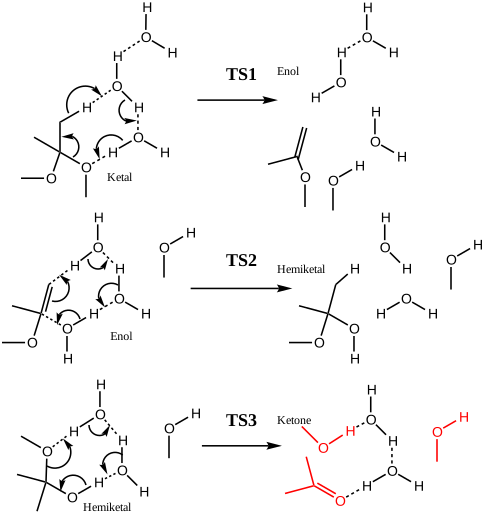
The model includes up to three water molecules acting as proton transfer agents in eight-membered ring cyclic transition states (ωB97XD/Def2-SVP/SCRF=water, FAIR DOI: 10.14469/hpc/8043). One point of interest is the anomeric effects that are set up in the various species.

The proposed model for the mechanism is shown above, involving elimination/re-addition at a C-C bond.

Species Relative energy
kcal/mol, Def2-SVP

Relative energy,
Def2-TSVPPD

DOI
Ketal+3H2O 0.0 0.0 8042,8054
TS1: ketal to enol 40.6 36.8 8037,8053
Enol 16.7 8039
TS2: Enol to hemiketal 42.8 38.6 8032,8050
Hemiketal 1.7 5.0 8049,8052
TS3: hemiketal to ketone 22.8 → 18.6 28.4 → 8030,8051
Ketone+2MeOH+2H2O 1.0 8041

The initial ketal species is shown below. Note particularly how the oxygen about to become protonated shows a longer O-C bond than that remaining in situ. This is because of how the lone pairs on oxygen align with the adjacent C-O bond, the “anomeric effect”. It predisposes one of the methoxy groups to removal by this partial weakening of the bond. The effect is also seen later in the mechanism for the hemiketal, with the methoxy group having the longer C-O bond, again preparing it for removal by protonation via TS3 rather than the hydroxy group.

Reactant. Click to load 3D model

The TS1 that results from this protonation shows a relatively high free energy barrier of ~41 kcal/mol and the typical flat region of the transition state typical of highly ionic mechanisms.

TS1: Click to view 3D model

The first part of the mechanism involves a late proton transfer from water to the oxygen of one methyl group at the transition state with departure of methanol, to form an oxenium cation-like structure with solvated hydroxide anion as the counter ion. Then in the second phase of the reaction, the hydroxide anion removes the hydrogen from a methyl group to form the first intermediate, an enol and methanol. The reaction is however concerted, albeit highly asynchronous.

Next, a water donates a proton to the sp2 carbon of the enol to reform a methyl group to form a temporary oxenium cation/hydroxide anion ion pair. Finally a water molecule attacks at the carbon of the oxenium cation to collapse the ion pair by one more proton transfer back to the hydroxide anion to form a hemiketal. The overall effect of these two steps is to perform in effect an SN2 substitution, with water replacing methanol.

TS2: click to view 3D model

The hemiketal formed shows a very strong asymmetric anomeric effect, in which the remaining C-OMe bond is already strongly pre-disposed to cleavage.

Hemiketal: Click to view 3D model

To complete the reaction, water abstracts the proton from the hemiketal OH group and via a relay places another proton on the oxygen on the remaining methoxy group, causing it to cleave the C-O bond. Result: ketone + two methanols + two catalytic waters as the end product.

TS3: Click to view 3D model

Armed with a model for the aqueous hydrolysis of a ketal, one can now apply this model to isomeric ketals, one of which is known to hydrolize faster than the other, to see if this model can replicate the observation. One must also be aware that it will never be easy to disentangle the rate of hydrolysis by “pure water”, ie H2O, from the rate of acid or base catalysed hydrolysis. Recollect that even in “pure water”,  autoionisation means that [OH] and [H3O+] are both 10-7M and so both these species could also contribute to the catalytic rate. The ratio of [H2O]/[OH] in water corresponds to a free energy difference of 11.9 kcal/mol. So if the free energy barrier to either the hydroxide or hydronium ion catalysis is at least 11.9 kcal/mol lower that of the free water energy barrier, the predominant hydrolytic contribution will be from these ionic species and not from water itself. With these thoughts in mind, watch this space!

References

  1. P. Camilleri, D. Munro, K. Weaver, D.J. Williams, H.S. Rzepa, and A.M.Z. Slawin, "Isoxazolinyldioxepins. Part 1. Structure–reactivity studies of the hydrolysis of oxazolinyldioxepin derivatives", J. Chem. Soc., Perkin Trans. 2, pp. 1265-1269, 1989. https://doi.org/10.1039/p29890001265

Deltamethrin – a polymorphed insecticide.

March 24th, 2021

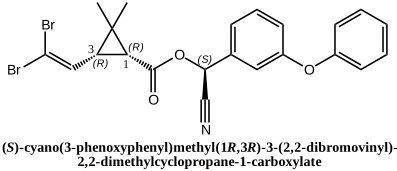
Deltamethin is a pyrethroid insecticide for control of malaria which has been used for a little while. Perhaps inevitably, mosquitoes are developing resistance to it. So what could be done about countering this? Well, perhaps surprisingly, form a polymorph![1] These crystal structure isomers are often highly undesirable; thus Ritonavir, which changed its polymorphic form during manufacture to become far less active (due it has to be said to insolubility). Now a polymorph of Deltamethin has been discovered, which when applied as a powder, increases its effectiveness more than 10 times against Anopheles mosquitoes and provides a potentially new affordable malaria control solution for countries that are loosing protection.

You can view this new polymorph at DOI: 10.5517/ccdc.csd.cc24mrxg and 10.5517/ccdc.csd.cc24mryh. The two structures differ in the torsion angle around the O-C(CN) bond, resulting in differing anomeric interactions between the ester oxygen and the C-CN group.

The anomeric effect can be quantified by the dihedral angle between a donor oxygen lone pair and the accepting (in this case C-CN) bond. The position of the lone pair itself can be localised using the ELF (electron localisation function) method. For one polymorph, this has a torsion angle of 127° and O-C and C-CN lengths of 1.455 and 1.480Å. The other form has an almost orthogonal (i.e. non-interacting) torsion of 79° with lengths of 1.461 and 1.477Å. The first form exhibits some electron pair donation into the C-O bond, shortening it slightly, accompanied by transfer of C-CN bond electrons onto the N, weakening the C-N bond. A very similar effect was noted for a herbicide[2] which resulted in very differing stabilities for two stereoisomers in water.

Just such aqueous hydrolytic stability was indeed reported for Deltamethrin[3] and its other 7 stereoisomers in water (3 stereocentres, 23 = 8). Persistence of any chemical applied to the soil is a very important aspect of its properties; recollect that a now banned insecticide, DDT, suffered from very long soil persistence. The article[3] looks at what happens to Deltamethrin (labelled compound 1) in water in the dark. As it goes, a new isomer labelled 2′ appears and then too decays, all in a period of ~5 days. This new isomer was found to be inactive as an insecticide.

So what is 2′? Well here is a table of all 8 stereoisomers, where 1 is labelled as α-S,1R cis and 2′ is labelled as α-S,1S cis. Here we have only one of the three stereocentres labelled using Cahn-Ingold-Prelog (CIP) notation, the 1-R/S carbon (the convention is to use italics for CIP). The cis designation implies that the 3-position is also S and the cyano carbon remains S. This cis label however conflicts with the abstract to the article, which indicates that the dark water isomerisation is subject to cis/trans isomerisation. So we have a water-induced isomerisation which inverts the configuration of 1R,3R in molecule 1 to apparently 1S,3S in molecule 2′?  

Changes in stereochemistry in Deltamethrin are likely to be the result of forming planar enols and so one might judge the hydrolytic stability by the ease of forming such an enol. Just such a process was the topic of a post on the undesired epimerisation of thalidomide in water. Time for calculations (FAIR data doi: 10.14469/hpc/8020 ) at the B3LYP+GD3+BJ/Def2-TZVPP/SCRF=water computational level. Firstly, the free energy of the enol form on the cyclopropane by relocation of the proton at C-1 is 32.0 kcal/mol higher. However, forming the enol by relocating the proton on the carbon bearing the CN group to the nitrogen is only 20.0 kcal/mol higher in energy. With a small further barrier for the TS for proton removal expected, this latter enol is within an accessible energy range for room temperature reaction, whereas the previous enol is not. So the hypothesis is that 2′ is actually the stereoisomer labelled 2 in Table 1, ie R,R,R and not S,S,S. The free energy of this R,R,R diastereoisomer is calculated 1.1 kcal/mol higher than 1 itself, which would represent about 13% of this isomer at equilibrium.

I have shown here how uncertainty caused by how to reconcile the stereochemistry of eg  Figure 4 and Table 1[4] in modern terms can perhaps be lessened by performing “reality check” calculations on possible multiple interpretations to reduce them to the most probable. We also find that a relatively old and much used bioactive compound can have surprises lurking around the corner, in this case by a simple recrystallisation that results in a new form being discovered without having to do any other chemistry.  Still, how much longer will pyrethroid insecticides be used?

References

  1. J. Yang, B. Erriah, C.T. Hu, E. Reiter, X. Zhu, V. López-Mejías, I.P. Carmona-Sepúlveda, M.D. Ward, and B. Kahr, "A deltamethrin crystal polymorph for more effective malaria control", Proceedings of the National Academy of Sciences, vol. 117, pp. 26633-26638, 2020. https://doi.org/10.1073/pnas.2013390117
  2. P. Camilleri, D. Munro, K. Weaver, D.J. Williams, H.S. Rzepa, and A.M.Z. Slawin, "Isoxazolinyldioxepins. Part 1. Structure–reactivity studies of the hydrolysis of oxazolinyldioxepin derivatives", J. Chem. Soc., Perkin Trans. 2, pp. 1265-1269, 1989. https://doi.org/10.1039/p29890001265
  3. R.J. Maguire, "Chemical and photochemical isomerization of deltamethrin", Journal of Agricultural and Food Chemistry, vol. 38, pp. 1613-1617, 1990. https://doi.org/10.1021/jf00097a039

The small-molecule antiviral compound Molnupiravir: an exploration of its tautomers.

March 14th, 2021

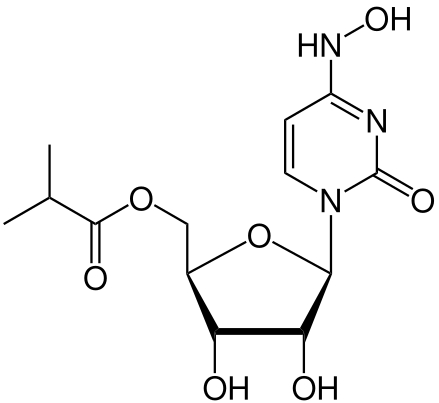
For obvious reasons, anti-viral molecules are very much in the news at the moment. Thus Derek Lowe highlights Molnupiravir which is shown as a hydroxylamine, the representation originating from the Wikipedia page on the molecule.

I like stereocentres more clearly identified using eg R/S notation and so I went to another source of information, SciFinder, which represents the molecule in a different way. There you get the stereocentres unambiguously identified for you, but the hydroxylamine is now replaced by an oxime! 

The Reaxys database renders it differently again as below (note the different rotamer for the hydroxylamine):

Are they all talking about the same molecule? Well yes, since the hydroxylamine and the oxime are related by tautomerism, but it takes a bit of effort to fully reconcile these three representations with each other. So the next question is does it matter which tautomer is selected to represent a molecule? Since they differ by proton transfers between acidic atoms (N,O) the presumption is that the equilibrium between the tautomers is fast and so the predominant species is determined by the position of the equilibrium. The tautomer matters in another sense. This molecule clearly interacts with DNA, and very probably by paired hydrogen bonding. It is this hydrogen bonding that was crucial in helping Watson and Crick to postulate the first successful model of DNA itself,[1] famously enabled by them using the correct tautomeric form of the component DNA bases! So the tautomers do matter!

Time for some calculations (B3LYP+GD3BJ/Def2-TZVPP/SCRF=water, using integral=(acc2e=14,grid=superfinegrid). The FAIR DOI for the collection is 10.14469/hpc/7990

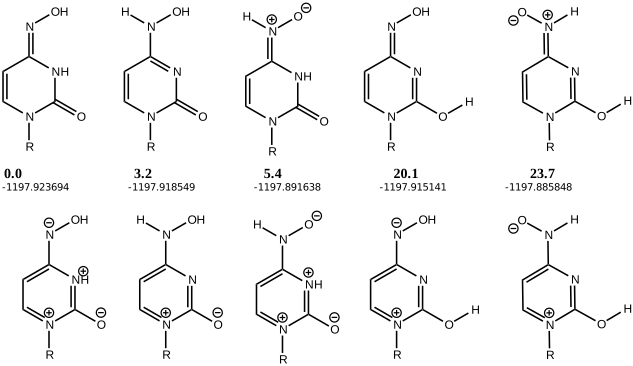
In the diagram above, the non-aromatic valence representation is shown at the top, followed by a reorganisation of the electrons into an aromatic form below. These aromatic forms are all ionic with charge separation and so the question here arises: does the aromatic stabilisation energy outweigh the destabilisation caused by charge separation? 

The calculated free energies (ΔG298) show that the oxime is 3.2 kcal/mol more stable than the next most stable, the hydroxylamine tautomer (calculated for a water continuum solvation model).The third tautomer is not far behind, being a nitrone! A 3D model is shown below illustrating the internal hydrogen bonds (I hope it is clear why I wanted the four stereocentres unambiguously identified, and why the simple perspective diagram shown on the Wikipedia page is not definitive). This model was obtained after also experimenting with hydroxyl rotamers to ensure the lowest energy was obtained.

Click to load 3D model

So how “aromatic” are the two lowest energy species? The oxime has two sets of charge separation, whilst the hydroxylamine only one. One measure of aromaticity is the NICS magnetic index. For the oxime it is -0.1ppm, very clearly non-aromatic. Separating two sets of charges clearly is not compensated by aromatic stabilisation. The next most stable hydroxylamine has NICS -1.8ppm, which shows slightly more signs of aromaticity (benzene on this scale is ~ -10 ppm), perhaps because it only separates one pair of charges. 

What about crystal structures? NETGEY is a model which removes the sugar unit and with an N-Me replacing the NH (thus preventing tautomerism and locking the molecule into the oxime form). MHCYTC protonates the hydroxylamine on the imine nitrogen OR the oxime on its imine nitrogen thus rendering the two tautomers identical.

NETGEY MHCYTC

The crystal structure of Molnupiravir itself has not been reported, so there is no definitive answer to the most stable tautomer in the solid state. But the calculation above does suggest that it is the oxime (and hence SciFinder’s representation) that is the probable dominant form in aqueous solutions. If one is trying to build a model to show how this small molecule interacts with DNA, this might be useful information (in the same way that picking the correct tautomer of the original DNA bases worked for Watson and Crick!). 

References

  1. J.D. WATSON, and F.H.C. CRICK, "Molecular Structure of Nucleic Acids: A Structure for Deoxyribose Nucleic Acid", Nature, vol. 171, pp. 737-738, 1953. https://doi.org/10.1038/171737a0

The chemistry of scents: Vetifer oil.

February 28th, 2021

I have occasionally covered the topic of colours here, such as those of flowers and minerals, since it is at least possible to illustrate these using photographs or colour charts to illustrate the theme. But when Derek Lowe took a break from his remarkable coverage of the COVID pandemic to highlight a recent article on the active smelling principle in Vetifer oil[1] I could not resist adding a tiny amount to his must-read story.

It would be great to illustrate this with an example of the scent, but digital scent technology has not yet taken off to the point of delivering these to the home.‡  So we will have to make do with a 3D model of the most active ingredient in Vetifer oil, which is species 10 in the scheme below[1]

But first a bit of history. I wrote about one of my chemical heroes William Perkin, whose factory first produced synthetic dyes in quantities that reduced the cost of colourful fabrics to the point of affordability by most people. Less well known is that when he retired from running his factory, he devoted much of the rest of his life to experimenting in his home laboratory, where he discovered a simple and cheap synthesis of coumarin. This substance is an essential component of the so-called fougère genre of perfume and as with his discovery of synthetic dyes, the introduction of synthetic coumarin was to revolutionise the scent industry (although in this case, for other reasons, synthetic components did not reduce the price of perfumes as much as they did that of colourful clothes).

If you read Derek’s blog on the topic and peruse the diagram above, you will appreciate that Vetifer grass is the source of many essential oils and forms the basis of more than ⅓ of all fragrances. So, like Perkin, to have a synthesis of the most odiferous component, species 10 above, is a major breakthrough and one can only wonder whether new entirely synthetic variants might produce entirely new perfumes! As with flowers, changing a methyl group here or a stereochemistry there can have profound effects on the resulting properties!

2-epi-ziza-6(13)-en-3-one. Click for 3D model

The absolute configuration of 10 is not in doubt in any way, but it was done indirectly via another compound. As as an additional check (and because it is very quick to do) I add here the calculated optical rotation (at 589nm; a ωB97XD/Def2-TZVPP/SCRF=chloroform calculation) as being +106°. The measured value is +132° which is considered reasonably good agreement and certainly confirms the absolute configuration. For good measure, the calculated 13C spectrum (mpw1pw91/aug-cc-pVDZ/SCRF=choroform calculation) also matches that reported (For FAIR data of this analysis, see 10.14469/hpc/7965).

So as I noted, its a shame that the scent of 10 cannot be delivered here. But perhaps there would be health and safety issues if that were to be possible!


Around 1993 I was interested in how information about digital scents might be delivered to computers using the Media (or MIME) standard and went as far as informally proposing it be added to the seven existing primary Media types. Rather too tongue-in-cheek I fear, and as far as I know, no olefactory media type has been added to this day! However, an article relating to all of this has recently appeared.[2] The John Bright collection illustrates the colourful aspects of clothes over the ages. Colours were not absent during e.g. the Victorian era as the collection shows, but one may presume that they were also not affordable by most of the population. In the same manner that in earlier times, eg Tyrian Purple was available only to Roman Emperors and other elites.

References

  1. J. Ouyang, H. Bae, S. Jordi, Q.M. Dao, S. Dossenbach, S. Dehn, J.B. Lingnau, C. Kanta De, P. Kraft, and B. List, "The Smelling Principle of Vetiver Oil, Unveiled by Chemical Synthesis", Angewandte Chemie International Edition, vol. 60, pp. 5666-5672, 2021. https://doi.org/10.1002/anie.202014609
  2. A.B. Wiltschko, "Building an interdisciplinary team set on bringing the sense of smell to computers", iScience, vol. 24, pp. 102136, 2021. https://doi.org/10.1016/j.isci.2021.102136

Non-covalent-interaction (NCI) surfaces for two large annulenes (revisited).

February 7th, 2021

The last post addressed the concept of “steric clashes” in a pericyclic reaction transition state as an extension of the time honoured practice of building molecular models to analyse reaction outcomes. A modern computer generated model might express this in terms of a NCI (non-covalent-interaction) surface. A few posts ago, I had looked at some “molecules of the year” for 2020, one of which was a “figure-eight” twisted dodecaporphyrin in which an aspect of the reported[1] geometry had struck me as potentially lacking features due to the so-called non-covalent dispersion or van der Waals attractions. So I am revisiting here by adding the NCI surface for this molecule and one other.

The molecule in question has 720 atoms and can be regarded as a [162]-annulene (4n+2, n=40) with a linking number Lk =2π.[2] The NCI surface is ideally computed from a “self-consistent-field or SCF density” and so in this instance I used the PM7 SCF-density, which is derived from the valence shell only and does not include the core shells. That hardly matters since the non-covalent NCI surface does not use the core shells!

Click for 3D model

You can see from the above that the porphyrin-stacking region has a very dense NCI green surface (arrow), indicating a lot of stabilisation is originating there; something lacking in the original proposed structure. There are lots of other features and so I do encourage you to explore the 3D model.

The second (hypothetical) molecule is a simpler CH-based [144]-annulene,[3] comprising a twisted coil of 144 CH= units with a linking number Lk = 18π (the largest such ever proposed for a molecule!). The SCF-NCI surface (derived from an ωB97XD/6-31G(d,p) calculation) is contiguous all the way around the circuit and must be the ultimate π-π stacked molecule!

144-annulene. Click for 3D

153-annulene. Click for 3D

I should end with a brief tutorial on how to generate these surfaces. You need a density matrix (e.g. DOI: 10.14469/ch/16967). In programs such as Gaussian 16, this can be obtained from the checkpoint file, which contains it. A progam called cubgen is used by (e.g.) Gaussian to create a 3D cube of electron density values (as well as other interesting properties). To get good resolution (~ 0.044Å) the file will be between 500 – 800 Mbyte in size. If a resolution of ~ 0.088Å is used it will be eight times smaller. For cube files less than ~105 Mbyte in size, you can use this Web-based tool (DOI: 10.14469/hpc/7864) to get the NCI surface. For the larger files you will need the Jmol application which can sustain files up to ~1 Gbyte (or larger, but I have not tested) and where you will run the following script: 

load density.cub;isosurface parameters [0.5 1 0.0005 0.05 0.95 1.00] NCI "";color isosurface "bgyor" range -0.04 0.04;write density.xyz;write density.jvxl;

(where this script assumes that the file density.cub file is in the same folder as the Jmol.java application).


Postscript: The NCI analysis is based on computing the total density of the molecule. Close inspection of the top molecule as computed using the semi-empirical method PM7 reveals some interesting features extending beyond the C-H bonds. Analysis of this reveals it to be an artefact of the computed density, itself traced back to differences in how overlaps are handled in computing the density for this particular method. This error is not present for the MNDO semi-empirical method. When evaluated using MNDO, but at the geometry computed by PM7, these artefacts are removed. The NCI feature in the π-π stacking shown above however remains and hence is not an artefact.

References

  1. M. Rickhaus, M. Jirasek, L. Tejerina, H. Gotfredsen, M.D. Peeks, R. Haver, H. Jiang, T.D.W. Claridge, and H.L. Anderson, "Global aromaticity at the nanoscale", Nature Chemistry, vol. 12, pp. 236-241, 2020. https://doi.org/10.1038/s41557-019-0398-3
  2. S.M. Rappaport, and H.S. Rzepa, "Intrinsically Chiral Aromaticity. Rules Incorporating Linking Number, Twist, and Writhe for Higher-Twist Möbius Annulenes", Journal of the American Chemical Society, vol. 130, pp. 7613-7619, 2008. https://doi.org/10.1021/ja710438j
  3. R.J.F. Berger, "Prediction of a Cyclic Helical Oligoacetylene Showing Anapolar Ring Currents in the Magnetic Field", Zeitschrift für Naturforschung B, vol. 67, pp. 1127-1131, 2012. https://doi.org/10.5560/znb.2012-0189

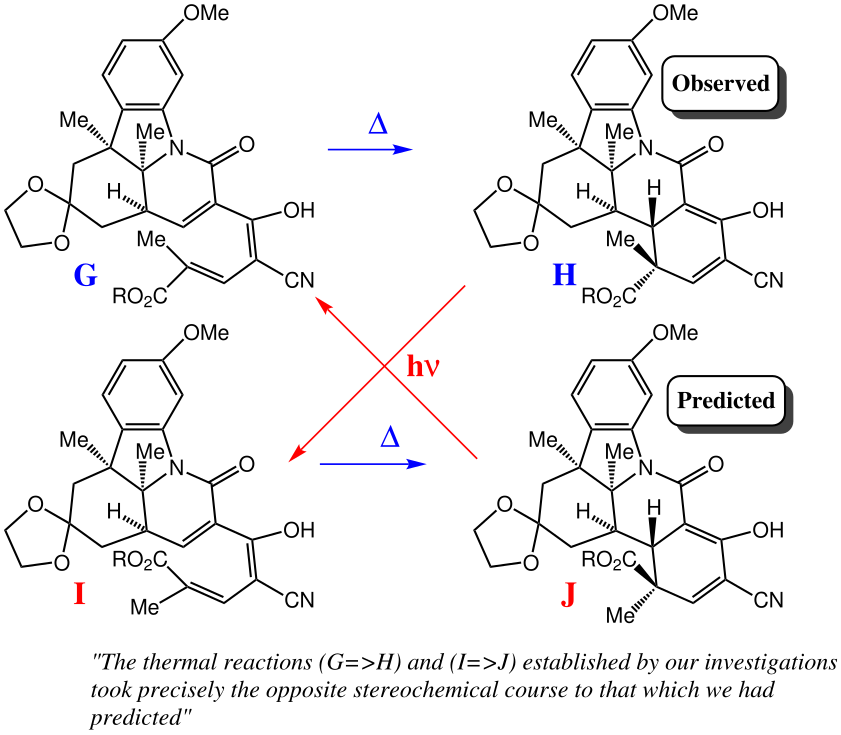
The thermal reactions … took precisely the opposite stereochemical course to that which we had predicted. A non-covalent-interaction view of the model.

February 3rd, 2021

Another foray into one of the more famous anecdotal chemistry “models”, the analysis of which led directly to the formulation of the WoodWard-Hoffmann (stereochemical) rules for pericyclic reactions. Previously, I tried to produce a modern computer model of what Woodward might have had to hand when discovering that the stereochemical outcome of a key reaction in his vitamin B12 synthesis was opposite to that predicted using his best model of the reaction.

Vitamin B12 synthesis

Such computer models generate quite accurate 3D coordinates of the transition state for the reaction and this can be most simply analysed for finding e.g. steric clashes. These are when two atoms (mostly hydrogen) approach too close to one another. But we now know that in the region 1.9 – 2.4Å these close approaches can be attractive as well as repulsive and so distances alone are not the complete story. Here I analyse these models using a technique known as non-covalent-interactions (NCI). This is based on the electron density and its reduced density gradients and it explores not merely simply distances between atoms but the non-bonded or weakly interacting regions of a molecule, generating a colour coded surface of interaction rather than pairwise distances. The colour coding goes from red (strongly destabilising, or repulsive regions) to blue (stabilising or attractive regions), with green representing weakly stabilising and yellow weakly destabilising. It gives a much more rounded picture of the entire molecule.

Disrotatory TS for G to H, Click for 3D

Conrotatory “TS” for G to J, Click for 3D

The NCI surfaces are shown above and are best expanded into a rotatable 3D model by clicking on either image. Regions of interest are shown with arrows. The region of the “steric clash” identified for the (thermal) transition state G to H (the one actually found by experiment) can be seen with the arrow in the top right. It is colour coded light blue (attractive; note the very attractive dark blue for the O…HO hydrogen bond in the system), but it is immediately next to a yellow/orange region (repulsive). This again reminds us that “stabilising” and “destabilizing” regions of a molecule can be adjacent to each other, something that physical models cannot convey. The steric clash for the “transition state” G to J (in quotes because it is actually a transition state calculated for the excited triplet state and not the ground state) is indicated with the arrow, being a clash of two methyl groups. It is coded green, indicating weak NCI stabilization.

So, in this analysis, steric clashes become more complex as indicators of reaction outcomes, since it is the overall balance of stabilisation and destabilisation that determines this. You might argue that Woodward would have found this modern analysis far too woolly to be useful in the sense he used, which is as an alert for the possibility of a new principle in organic reaction mechanisms and certainly a Nobel prize for his collaborator Hoffmann!


The region of the C-C bond which is forming in this transition state has a very non-standard electron density, to which this analysis cannot really be applied. So that region should be disregarded for the “non-covalent” analysis being done here. Plots a reduced density isosurface, colour mapped with ABS(ρ)*SIGN(λ2), where λ2 is the middle eigenvalue of the Hessian matrix of the electron density. A web page for generating such surfaces can be found at DOI: ftkt.