The Stevens rearrangement: how history gives us new insights.

January 29th, 2021

In a recent post, I told the story of how in the early 1960s, Robert Woodward had encountered an unexpected stereochemical outcome to the reaction of a hexatriene, part of his grand synthesis of vitamin B12. He had constructed a model of the reaction he wanted to undertake, perhaps with the help of a physical model, concluding that the most favourable of the two he had built was not matched by the actual outcome of the reaction. He was thus driven to systematise such (Pericyclic) reactions by developing rules for them with Roald Hoffmann. This involved a classification scheme of “allowed” and “forbidden” pericyclic reactions and his original favoured model in fact corresponded to the latter type. When physical model building in the 1960s was gradually replaced by models based on quantum mechanical calculations from the 1970s onwards, the term “allowed” morphed into “a relatively low energy transition state for the reaction can be located” and very often “no transition state exists for a forbidden reaction”. The famous quote “there are no exceptions” (to this rule) was often interpreted that if a “forbidden reaction” did apparently proceed, its mechanism was NOT that of a pericyclic reaction. Inspired by all of this, I recollected a famous “exception” to the rules which is often explained by such non-pericyclic character, the Stevens rearrangement[1],[2],[3] by a 1,2-shift.
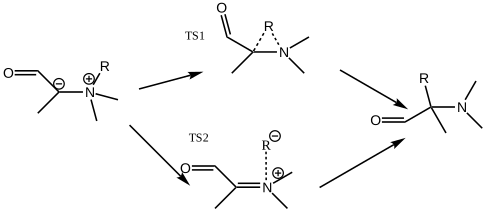
Here, R = benzyl (in the original experiment). The crucial point here is that the reaction readily proceeds at moderate temperatures and that if the R group is chiral, it proceeds with retention of configuration. Why was this remarkable? Because if this is indeed a four electron 1,2-sigmatropic pericyclic reaction, it is predicted to proceed with inversion of configuration at the R group. So 1,2-migration with retention would be an exception to the Woodward-Hoffmann rules and to avoid being an exception, it clearly cannot be a pericyclic reaction! Time for some calculations, at the B3LYP+GD3BJ/Def2-SVP/SCRF=water level (FAIR Data DOI: 10.14469/hpc/7855)
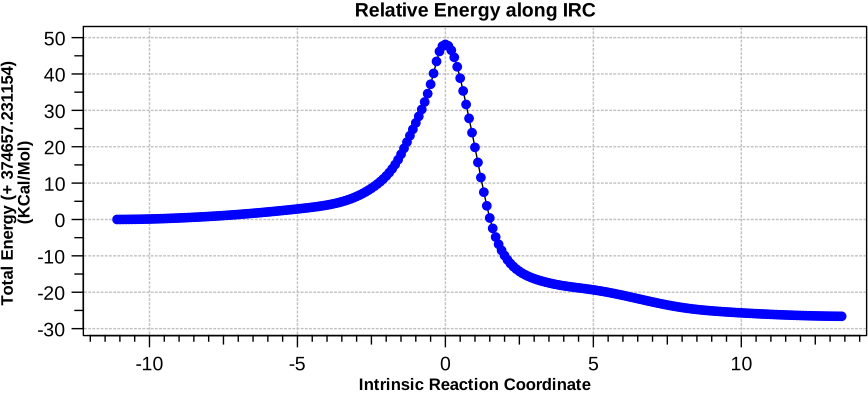
The above is the classic 1,2-sigmatropic migration of a benzyl group from N to C, proceeding with retention of configuration. Hey, look at the barrier (TS1, ΔG 48.2 kcal/mol), which is way too high to be a viable reaction. This teaches us the first lesson; it can be possible to locate the transition state for “forbidden” thermal reactions, but it is likely they will be very high in energy. Forbidden in this case means in terms of energy; sometimes it can mean in terms of orbital symmetry, or even transition state anti-aromaticity.

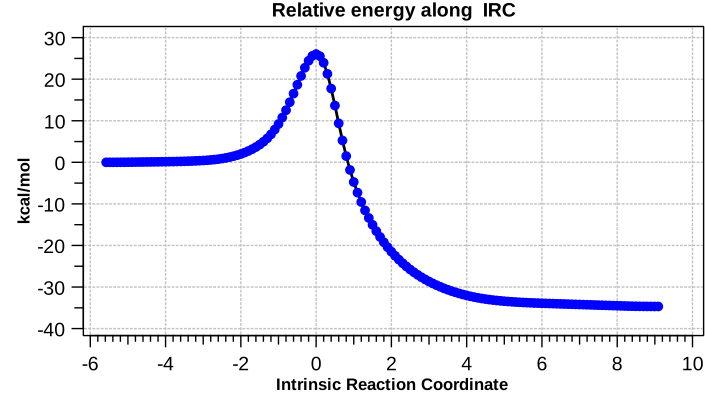
Now we have to do something clever with the keywords for the calculation. This involves adding guess(mix.always) and running a spin unrestricted version, ub3lyp. This does a very simple CI (configuration interaction), mixing the HOMO and LUMO to allow an open-shell biradical as a solution for the wavefunction. In effect we are mixing an excited state into the wavefunction, which reflects the Woodward-Hoffmann observation that a “forbidden” thermal reaction can proceed as an “allowed” photochemical, i.e. excited state, reaction! Now one gets an entirely different outcome, with an activation free energy of TS2, ΔG 13.9 kcal/mol, a facile thermal reaction. 
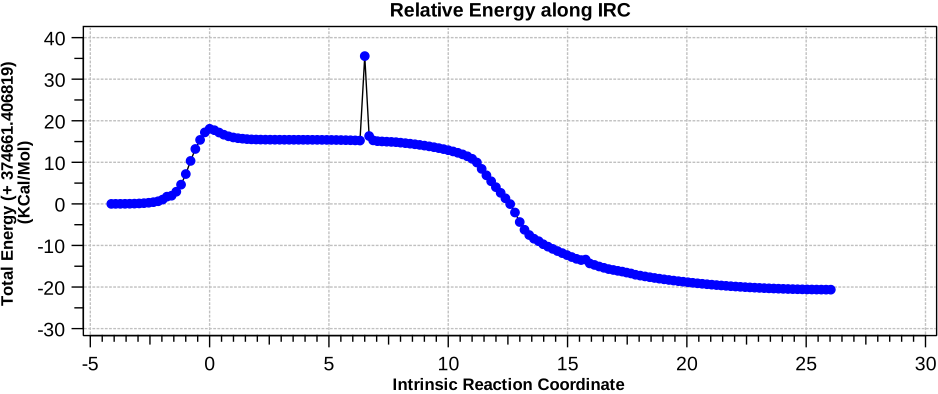
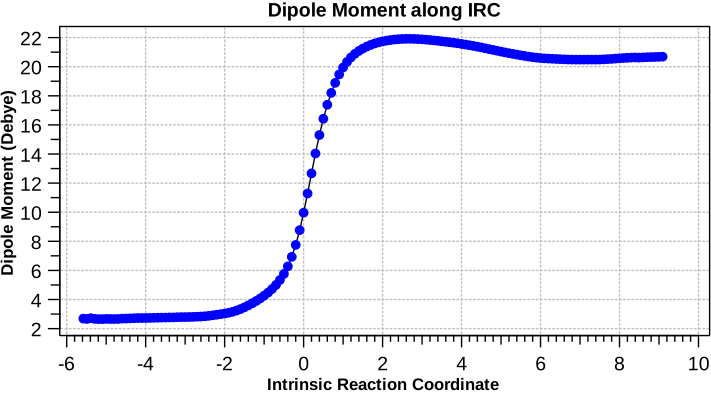
At IRC values of -1 to zero, simple C-N bond cleavage occurs. The closed shell reactant has  a value for the spin expectation operator <S**2>= 0.0000, but by the TS, it has acquired the value  <S**2>= 0.4214. To give you an idea of what this means, a “pure” biradical has a value of <S**2>= 1.0000. So this is half way to becoming a pure biradical, and in effect also half way from a pure closed shell ion-pair (which would again have <S**2>= 0.00000). From IRC = +1 to IRC = +10, this continues to evolve, reaching a maximum value of <S**2>= 1.0084 at ~IRC 11 (a pure biradical). Then the value of <S**2> collapses rapidly to 0.000, indicating formation of an ion pair, but only well after the transition state is passed. This ion pair then recombines to form a C-C bond and the final product. 

Spin density at TS2. Click to view 3D model

So to summarise, the Stevens 1,2-rearrangement is a very asymmetrical process, breaking the C-N bond long before the C-C bond starts to form. In this sense it is really not a pericyclic reaction! At the transition state, it has character of both a biradical and an ion-pair, very much a Janus-like mechanism with two faces to it.

But what of the stereochemistry? Well, here is a suggestion. As it progresses on its way, first to acquire biradical character and then to lose that in favour of ion-pair character, the phenyl group retains its involvement with the rest of the molecule via dispersion attractions. So these dispersion terms may well be strong enough to prevent the phenyl group from any rotations that would be required to produce stereochemical inversion rather than the observed retention. I do not believe that the role of dispersion attractions in the Stevens mechanism has been proposed before. A colleague who works with fluorinated compounds has suggested that perhaps fluorinated substrates may show different dispersion behaviours, maybe leading to stereochemical scrambling. An experiment worth doing?

References

  1. T.S. Stevens, E.M. Creighton, A.B. Gordon, and M. MacNicol, "CCCCXXIII.—Degradation of quaternary ammonium salts. Part I", J. Chem. Soc., vol. 0, pp. 3193-3197, 1928. https://doi.org/10.1039/jr9280003193
  2. T.S. Stevens, "CCLXX.—Degradation of quaternary ammonium salts. Part II", J. Chem. Soc., vol. 0, pp. 2107-2119, 1930. https://doi.org/10.1039/jr9300002107
  3. T.S. Stevens, W.W. Snedden, E.T. Stiller, and T. Thomson, "CCLXXI.—Degradation of quaternary ammonium salts. Part III", J. Chem. Soc., vol. 0, pp. 2119-2125, 1930. https://doi.org/10.1039/jr9300002119
The chemical synthesis of C2: another fascinating twist to the story.

January 20th, 2021

Last May, I wrote an update to the story sparked by the report of the chemical synthesis of C2.[1] This species has a long history of spectroscopic observation in the gas phase, resulting from its generation at high temperatures.[2] The chemical synthesis however was done in solution at ambient or low temperatures, a game-changer as they say. Here I give another update to this unfolding story.

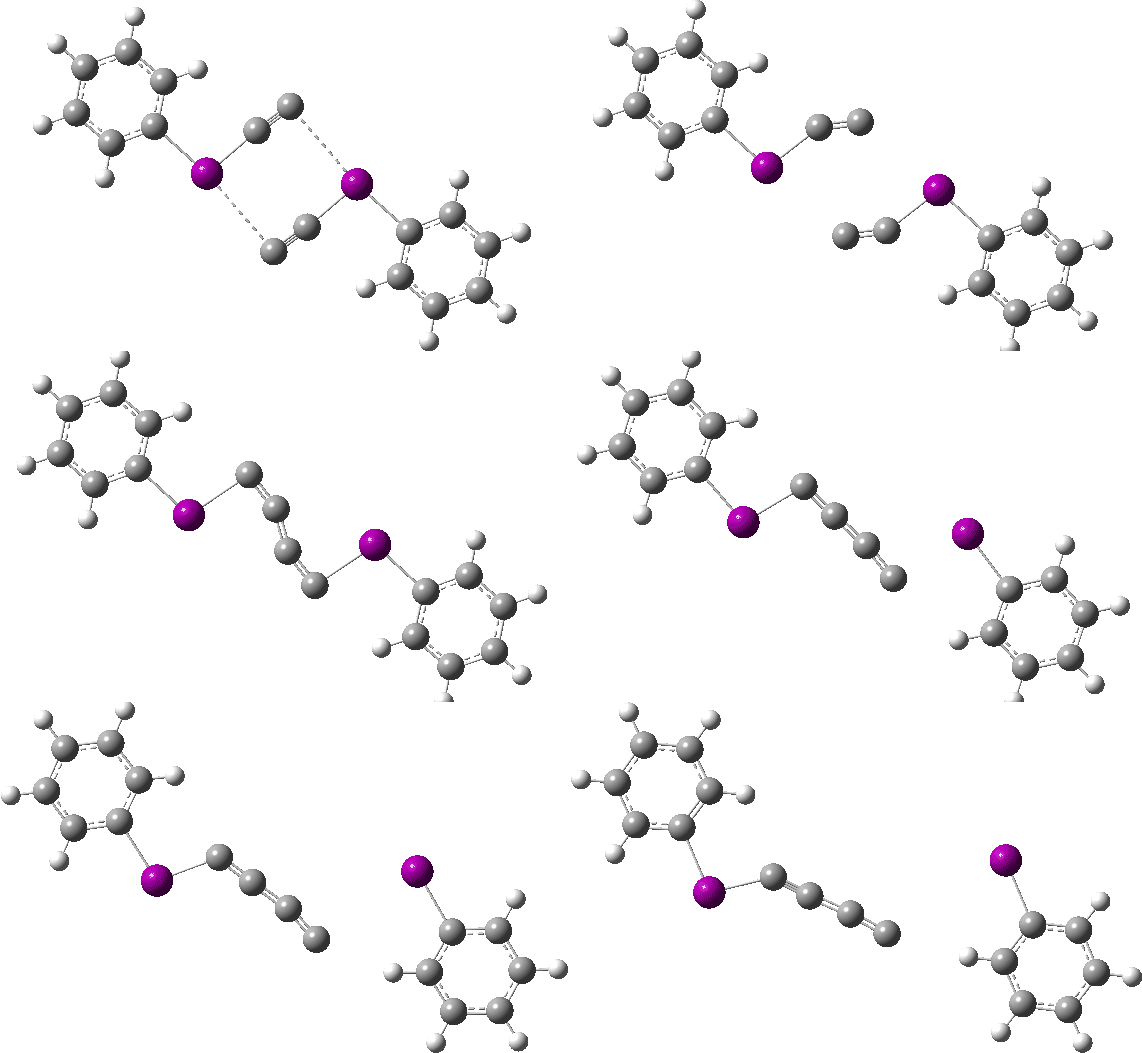
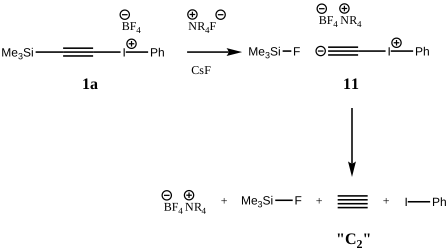
Key to the story is the precursor labelled 11 in the scheme above and the suggestion[1] that it is unimolecular decomposition of 11 that results in C2. A question that had not been posed however was whether 11 itself could participate in any bimolecular reactions and whether these could be lower in free energy than its unimolecular decomposition. That has now been addressed in a recent pre-print, DOI: 10.26434/chemrxiv.13560260.v1[3] Here I will show just one of the possible bimolecular reactions investigated, that of 11 with itself. 


The reaction has a low barrier (ΔG 15.4 kcal/mol for a standard state of 0.044 molar, approximately the concentration the original experiments were conducted for) which means it will be very rapid at room temperatures. The product of this reaction can itself react with more 11 ((ΔG 16.9 kcal/mol) and so on to form polymeric chains or clusters of carbon, eventually resulting in C60 and other forms of carbon. Low energy barriers for a number of other possible bimolecular reactions of 11 with species such as the chemical traps used in the original experiment are also reported,[3] most of which are lower in free energy than that predicted for the unimolecular fragmentation of 11, despite the entropic penalty.

So the enigma is thus: Does species 11 truly fragment to C2, or are the products of this reaction really bimolecular reactions of 11? It does seem as if 11 itself can have a rich and fascinating room temperature chemistry, the scope of which has only started to be explored.


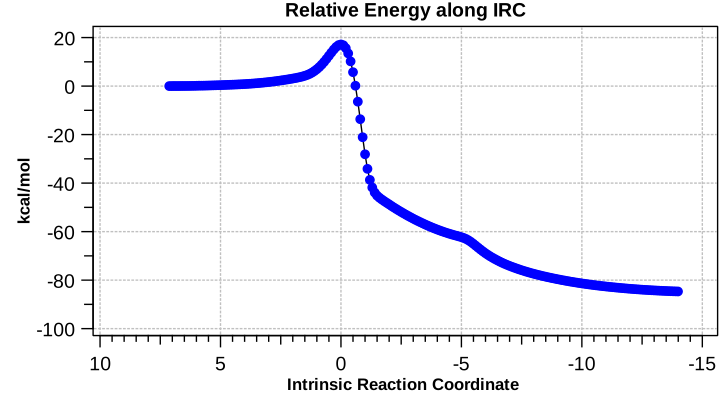
The potential energy surface is unusual, in that initially two products are possible, depending on where the C4 unit ends up attached. The potential energy valley only bifurcates into two valleys resulting in the final product at a late stage (~ IRC -5). Put another way, the initial symmetry is C2h, but this breaks/bifurcates into two valleys each leading to different outcomes for the C4 unit. This is very much like the famous potential energy surface for the dimerisation of cyclopentadiene.

References

  1. K. Miyamoto, S. Narita, Y. Masumoto, T. Hashishin, T. Osawa, M. Kimura, M. Ochiai, and M. Uchiyama, "Room-temperature chemical synthesis of C2", Nature Communications, vol. 11, 2020. https://doi.org/10.1038/s41467-020-16025-x
  2. T.W. Schmidt, "The Spectroscopy of C<sub>2</sub>: A Cosmic Beacon", Accounts of Chemical Research, vol. 54, pp. 481-489, 2021. https://doi.org/10.1021/acs.accounts.0c00703
  3. H. Rzepa, "No Free C2 Is Involved in the DFT-Computed Mechanistic Model for the Reported Room-Temperature Chemical Synthesis of C2.", 2021. https://doi.org/10.26434/chemrxiv.13560260.v1

The thermal reactions … took precisely the opposite stereochemical course to that which we had predicted

January 20th, 2021

The quote of the post title comes from R. B. Woodward explaining the genesis of the discovery of what are now known as the Woodward-Hoffmann rules for pericyclic reactions.[1] I first wrote about this in 2012, noting that “for (that) blog, I do not want to investigate the transition states”. Here I take a closer look at this aspect.

Vitamin B12 synthesis

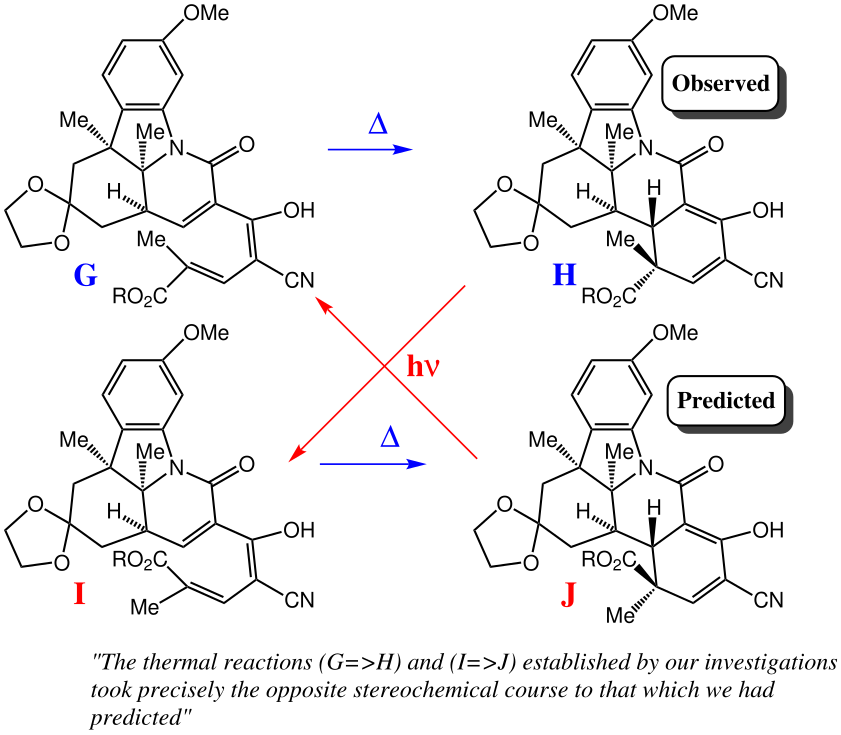
I will start by explaining my then reluctance to discuss transition states. Woodward in describing this discovery (in Chem. Soc. Special Publications (Aromaticity), 1967, 21, 217; a historic article which unfortunately remains off-line) notes the “steric preference for attack below the plane for C-5 and a gentle spiral for the cyclization to achieve the required stereochemistry at C-6″. In reference to the diagram above, he is talking about the reaction G to J which he thought was favoured over G to H on steric grounds. We must now try to judge what criteria might have been used to establish these steric grounds. He might have been referring to the relative thermodynamic stabilities of H vs J, which is the aspect I addressed in my earlier blog. But it has now been pointed out to me that Woodward is more likely to have been thinking about the transition state for the reaction, in referring to a “gentle spiral” for the reaction path as inferred by model building. So why my reluctance in 2012 to look at this aspect? As Woodward himself quickly came to realise, the transition state for G to H is electronically “allowed” but the transition state for G to J is electronically “forbidden”. Let me qualify that. The latter is only forbidden on the ground state electronic surface, but it is allowed on an open shell excited state (photochemical) surface. It is very difficult (if not impossible) to directly compare the energies of these two electronic states for any steric differences that might be hidden or embedded within them. So how did Woodward initially infer a “steric preference” between these two reactions?

Model building reached its peak as an essential tool for understanding chemistry in the 1950s, with the likes of Pauling and Watson + Crick making Nobel-prize winning discoveries using this technique. By the 1960s, one could buy commercial model building kits, such as Dreiding stereomodels (1958) which focused on the bonds themselves and CPK or spacefilling models (~1952[2]) based on the size of the atom (a technique pioneered by Loschmidt as long ago as 1860). I would point out that such models are constructed for molecules in their presumed ground electronic state! So Woodward must have been constructing models for G to H and G to J with the implicit assumption that they were in the ground electronic state. Clearly he noticed something which led him to conclude that these models predicted G to J over G to H. I do not know if his models have survived to posterity and are now in a museum somewhere; the chances are we will never know exactly what it was that alerted him that the formation of G to H was so unexpected that it triggered a Nobel-prize winning theory!

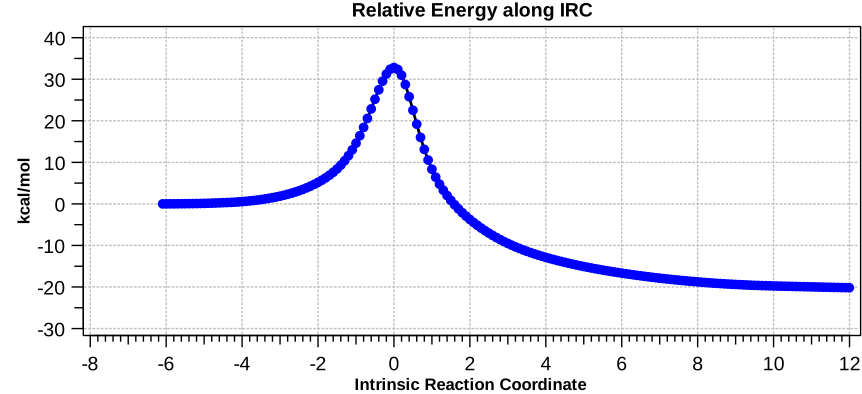
Having declined to build TS models in my original musings on this topic, I now decided to bite the bullet and try to now locate at least approximate models for both possible stereochemical outcomes. The disrotatory transition state for G to H is relatively trivial. Here I used the PM7 method, which I noted previously nicely absorbs dispersion corrections which may be important! It also allows a full IRC for the reaction path to be constructed in just a few hours (a DFT approach would take quite a lot longer). The FAIR data for my models can be found at DOI: 10.14469/hpc/7806

I then realised that the electronically “forbidden” transformation G to J (something that makes locating a transition state on the ground state surface unlikely) was in fact allowed for an open shell triplet state (a excited state). In this state, transition state location actually proceeds without issue to find a nice conrotatory transition state.

The two key transition state models are each shown below in two representations. The clashes noted are approaches of two atoms closer than the sum of the van der Waals radii. First, I note that transition state G to H clashes a hydrogen with the adjacent methyl group (H…H contact 1.937Å using the PM7 semi-empirical method, 1.942Å using the ωB97XD/6-311G(d,p) density functional method).

G to H, ball and stick representation. Click to view 3D

G to H, spacefilling representation

G to J also exhibits a clash, albeit a lesser one, between the hydrogens of two methyl groups (2.01Å for PM7, 2.03Å for ωB97XD/6-311G(d,p)). So one could argue that G to J is indeed favoured on steric grounds over G to H, but only by about 0.07Å in the close approach of pairs of non-bonded hydrogen atoms. I also note that Woodward’s gentle spiral or spiral of low pitch is in fact a left-handed one!

G to J, ball and stick representation. Click to view 3D

G to J, spacefilling representation.

To get another perspective on what this means in reality, I conducted a search of the CSD (Cambridge structure database) for the sub-structure shown below:

The results show H…H contacts down to about 2.03Å, which suggests that the steric clash for G to H probably is slightly repulsive, whilst that for G to J could be on the verge of being attractive.

We might conclude that there is probably only a small steric difference between the two quantitative reaction models G to H and G to J as evaluated here, probably favouring the latter and assuming that the sterics are expressed entirely by van der Waals distances and have not been absorbed into bond angles etc. Of course much of what I have done and explained here was not common in the 1960s. The details of how Woodward’s models were actually constructed and how quantitative they were may never be discovered. It matters not of course, since the surprise of finding the actual product was H and not J went on to catalyse one of the great theories of organic chemistry!


My thanks to Jeff Seeman and Dean Tantillo for contacting me about this, inspiring the above revisitation and much interesting discussion; J. Seeman and D. Tantillo, “On the Structural Assignments Underlying R. B. Woodward’s Most Personal Data Point That Led to the Woodward-Hoffmann Rules. Related Research by E. J. Corey and Alfred G. Hortmann.”, Chem. Euro. J., 2021, in press. As noted elsewhere on this blog, H…H contacts as short as 1.5Å have been measured experimentally. To turn the 3D view of the molecule into a spacefill model, right-click in the model window and invoke Scheme/CPK Spacefill as shown below:

References

  1. R.B. Woodward, and R. Hoffmann, "Stereochemistry of Electrocyclic Reactions", Journal of the American Chemical Society, vol. 87, pp. 395-397, 1965. https://doi.org/10.1021/ja01080a054
  2. R.B. Corey, and L. Pauling, "Molecular Models of Amino Acids, Peptides, and Proteins", Review of Scientific Instruments, vol. 24, pp. 621-627, 1953. https://doi.org/10.1063/1.1770803

Dispersion attraction effects on the computed geometry of a leminscular dodecaporphyrin.

January 1st, 2021

In the previous post, I showed the geometries of three large cyclic porphyrins, as part of an article[1] on exploring the aromaticity of large 4n+2 cyclic rings. One of them had been induced into a “figure-eight” or lemniscular conformation, as shown below.

c-P12[b12]_T6f optimised with LC-ωhPBE

Any initial inspection of the geometries of these systems suggests they have a high level of symmetry, and the molecule above does have the potential for D2 symmetry, typical of such leminscates.[2] The coordinates provided as part of the article however[1] had no symmetry and in the previous post, I asked myself if the coordinates could be symmetrised. That proved possible for the first two molecules shown, and here I ask myself it it can be done for the molecule shown above. My method for symmetrising was to use the PM7 semi-empirical method.[3] For the first time in the PM-series, this latest extension includes a Grimme-style dispersion attraction correction, one that grows in magnitude with the size of the molecule. Since this is a large molecule (720) atoms, dispersion might well have an important role to play. The coordinates provided[1] were obtained using the LC-ωhPBE/6-31G* method, a functional which in its latest form does not include a built-in dispersion term, although one can be added to the earlier LC-ωPBE version of the functional. We may presume that the calculation used to obtain the coordinates shown above does not include such a dispersion term.

Here is the PM7 optimised version. Firstly, it has C2-symmetry only and not the higher D2. The reason is that the four porphyrin rings at the point of the ring crossover, which in the original version show no ring-ring stacking, now indeed show stacking of a pair of porphyrin rings when dispersion is included in the calculation.

c-P12b12_T6f optimized with PM7


Whether such stacking, which does significantly perturb the overall geometry has any impact on the inferred aromaticity, remains to be established. But it reinforces the conclusion that when dealing with large molecules, it is absolutely essential to include a good quality dispersion correction, otherwise the geometries so obtained may differ significantly from reality.

References

  1. M. Rickhaus, M. Jirasek, L. Tejerina, H. Gotfredsen, M.D. Peeks, R. Haver, H. Jiang, T.D.W. Claridge, and H.L. Anderson, "Global aromaticity at the nanoscale", Nature Chemistry, vol. 12, pp. 236-241, 2020. https://doi.org/10.1038/s41557-019-0398-3
  2. H.S. Rzepa, "A Double-Twist Möbius-Aromatic Conformation of [14]Annulene", Organic Letters, vol. 7, pp. 4637-4639, 2005. https://doi.org/10.1021/ol0518333
  3. J.J.P. Stewart, "Optimization of parameters for semiempirical methods VI: more modifications to the NDDO approximations and re-optimization of parameters", Journal of Molecular Modeling, vol. 19, pp. 1-32, 2012. https://doi.org/10.1007/s00894-012-1667-x

Global aromaticity at the nanoscale.

December 31st, 2020

Here is another of the “large” molecules in the c&e news shortlist for molecule-of-the-year, 2020. This one is testing the Hückel 4n+2 rule out to a value never before seen (n = 40, or 162 π-electrons).[1] The take-home message is that this rule seems to behave well in predicting global aromaticity even at this sort of scale!

The smallest and largest of the 34 examples for which coordinates are provided are shown below. The smallest example has “only” 300 atoms, whilst the largest has 1008, which is certainly something for which the wavefunction would be analysed for its NICS aromaticity indices.

c-P6e6_neutral

c-P12b12_T6ef

A point of interest is the symmetry of these systems. My attempt to “symmetrise” the provided coordinates did not succeed, probably because the structure provided was insufficiently symmetric to succumb to this. Initially at least it seems the larger “bicycle-wheel” structure might have as much as twelve-fold symmetry, with twelve zinc porphyrin units in the outer ring. But with the coordinates displayed in a rotatable 3D model, I quickly noticed one pyridyl ring acting as a spoke and ringed in red. Its orientation is different from all the others! Is this significant? You decide for yourself by clicking on either of the images above to load the 3D coordinates.

I also include a fascinating Möbius “lemniscular” version, which has a linking number Lk=2 and so also follows the 4n+2 rule.[2],[3]

c-P12[b12]_T6f

Postscript A note on symmetrization. If a geometry is approaching symmetry, one can try an automatic algorithm in the molecular display programs to complete the process. But if the symmetry is still some way off, other methods based on energy minimisation must be tried. Molecular Mechanics in this instance is problematic, since all the bond types for the force field to be used must be set, and symmetrically at that. That is a big task. Far better to use a quantum mechanical method, which does not rely on bond types. Given the sizes of the molecules, I here select the PM7 semi-empirical procedure. It can handle in excess of 1000 atoms with no real difficulty and this version of the AM/PM series has the added advantage that it contains a dispersion attraction correction. This might be expected to be important in these types of molecule. Firstly c-P6e6_neutral, for which C6-symmetry can be achieved. A full PM7 optimisation takes ~10 minutes. This reveals that the distance between adjacent ortho-hydrogen atoms on the pyridyl spoke is 2.21Å, which is typical of a dispersion attraction (and a distance for which inclusion of a dispersion term is vital). The original coordinates have values ranging from 2.7 – 3.4Å.

c-P6e6_neutral with six-fold symmetry

The symmetrisation of c-P12b12_T6ef to C6 is also possible using prior PM7 optimisation, with non-bonded H…H contacts now all as pairs of 2.504 and 2.352Å each originating from a different central dendrimer unit. The original coordinates had H…H contacts as short as 1.6Å, which is very unreasonable.

C6-symmetric c-P12b12_T6ef


A common format for expressing coordinates is the so-called MDL Molfile. This has one advantage over the much more simple XYZ file as provided in the supplementary information of the article in that it defines atom and bond types. This in turn sets the coordinates up for a molecular mechanics optimisation of the geometry. But the molfile, which originated decades ago, does not work for molecules with 1000 atoms or more! Why? Because at the top of the file are two indices, the number of atoms and the number of connected bonds. For this molecule, these strings look like 10081128. In other words because each can carry only three integers, they flow together without an intervening space and end up confusing programs. I used the Sybyl Mol2 format for these coordinates, which does not have this issue. The non-bonded closed H…H contacts are now shown as labels on the 3D model, and you can see for yourself the asymmetry.

References

  1. M. Rickhaus, M. Jirasek, L. Tejerina, H. Gotfredsen, M.D. Peeks, R. Haver, H. Jiang, T.D.W. Claridge, and H.L. Anderson, "Global aromaticity at the nanoscale", Nature Chemistry, vol. 12, pp. 236-241, 2020. https://doi.org/10.1038/s41557-019-0398-3
  2. S.M. Rappaport, and H.S. Rzepa, "Intrinsically Chiral Aromaticity. Rules Incorporating Linking Number, Twist, and Writhe for Higher-Twist Möbius Annulenes", Journal of the American Chemical Society, vol. 130, pp. 7613-7619, 2008. https://doi.org/10.1021/ja710438j
  3. C.S.M. Allan, and H.S. Rzepa, "Chiral Aromaticities. AIM and ELF Critical Point and NICS Magnetic Analyses of Möbius-Type Aromaticity and Homoaromaticity in Lemniscular Annulenes and Hexaphyrins", The Journal of Organic Chemistry, vol. 73, pp. 6615-6622, 2008. https://doi.org/10.1021/jo801022b

Tying different knots in a molecular strand.

December 30th, 2020

The title derives from an article[1] which was shortlisted for the annual c&en molecule of the year 2020 awards (and which I occasionally cover here). In fact this year’s overall theme is certainly large molecules, the one exception being a smaller molecule with a quadruple bond to boron, a theme I have already covered here.

To illustrate a main theme of many of these award-winning molecules, I often look to showing either a computed property (such as each of the localised orbitals for the quadruple bond to boron) or the actual 3D coordinates. In this example, they were there in the supporting information and are presented here as rotatable 3D models without any further transformation. The authors of the article encourage the reader to spot the different types of knot that can be tied in the three molecules reported, but to show how difficult it can be to get a good perception of this, I illustrate the standard journal presentation of a static 2D projection of the 3D structure. It can be a nightmare to try to find the optimum such projection for larger molecules and so often they are reduced to much simpler schematics to get the message across. Well, below you can see three (unoptimized) projections, but you can covert them to 3D form by clicking on the scheme and then select your own projection.

(52)-1-CuLu

(52)-L1-CuLu

(52)-1-CuLu

Synthesized molecules with knots and the like have been around since about 1967, but they have certainly come on a pace since then. It would be interesting to see if any have properties unique to knots that have seen spectacular uses!

References

  1. D.A. Leigh, F. Schaufelberger, L. Pirvu, J.H. Stenlid, D.P. August, and J. Segard, "Tying different knots in a molecular strand", Nature, vol. 584, pp. 562-568, 2020. https://doi.org/10.1038/s41586-020-2614-0

Is cyanogen chloride (fluoride) a source of C⩸N(+)? More mechanistic insights.

December 4th, 2020

I asked the question in my previous post. A computational mechanism revealed that AlCl3 or its dimer Al2Cl6 could catalyse a concerted 1,1-substitution reaction at the carbon of Cl-C≡N, with benzene displacing chloride which is in turn captured by the Al. Unfortunately the calculated barrier for this simple process was too high for a reaction apparently occuring at ~room temperatures. Comments on the post suggested using either a second AlCl3 or a proton to activate the carbon of the C≡N group by coordination on to nitrogen. A second suggestion was to involve di-cationic electrophiles. Here I report the result of implementing the N-coordinated model below.

Click on image for  3D model

The free energy barrier ΔG298 is 20.8 kcal/mol (FAIR Data DOI: 10.14469/hpc/7584), which corresponds to a facile reaction at room temperatures. There does not seem to be any need to invoke super-reactive di-cationic electrophiles in this instance. This is yet another illustration that computational modelling nowadays is good enough to flag unviable mechanisms, and hence to instigate a search for a better model.

Is cyanogen chloride (fluoride) a source of C⩸N(+)?

November 28th, 2020

In 2010 I recounted the story of an organic chemistry tutorial, in which I asked the students the question “how would you synthesize 3-nitrobenzonitrile“.

The expected answer was to generate a nitronium ion to nitrate benzonitrile, but can one invert this by generating a C⩸N+ ion to cyanate nitrobenzene? The students were then invited to generate a valence bond structure for C⩸N+ and I showed them the possibility that it might contain a quadruple bond to the carbon. Ten years later, Mike Turner in a comment on that post revealed an article dating from 1960[1] in which cyanogen fluoride was studied. There, in an innocuous comment, they state “Cyanogen fluoride, like cyanogen chloride, re-acted with benzene in the presence of aluminum chloride to form benzonitrile in 20% conversion“. Here I explore whether this reagent really can be a source of free C⩸N+.

Calculations at the ωB97XD/Def2-TZVPP/SCRF=water level (FAIR Data DOI: 10.14469/hpc/7584) were conducted to explore the possible energetics of using ClCN to electrophilically cyanate benzene. Firstly, the energy of the separated ion pair AlCl4.C⩸N+ is 190.9 kcal/mol higher than the neutral reagents AlCl3.ClCN, which makes the formation of free C⩸N+ unlikely. So what about a concerted process, in which benzene as a nucleophile attacks ClCN with the help of AlCl3? This would be a 1,1-substitution reaction at an sp-carbon centre.

The free energy barrier for this bimolecular process is 46.4 kcal/mol. It is along the right lines, but still about 20 kcal/mol too high for a facile thermal process.

In an effort to improve the model and hence reduce this barrier, the dimeric reagent Al2Cl6 was tried instead. The final free energy barrier was 48.5 kcal/mol.

So to conclude, generating free C⩸N+ is very unlikely. But cyanogen chloride can act as a C⩸N+ “delivery agent” via a bimolecular route. There remains a mystery however. The free energy barriers for our two models are too high to accomplish facile cyanation of benzene. There must be another mechanism, as of yet unexplored, which must be found to finish off this study!

References

  1. F.S. Fawcett, and R.D. Lipscomb, "CYANOGEN FLUORIDE", Journal of the American Chemical Society, vol. 82, pp. 1509-1510, 1960. https://doi.org/10.1021/ja01491a064

An interesting aromatic molecule found in Titan’s atmosphere: Cyclopropenylidene

November 7th, 2020

Cyclopropenylidene must be the smallest molecule to be aromatic due to π-electrons, with just three carbon atoms and two hydrogen atoms. It has now been detected in the atmosphere of Titan, one of Saturn’s moons[1] and joining benzene, another aromatic molecule and the protonated version of cyclopropenylidene, C3H3+ there.

The molecule has two π-electrons in the three membered ring and a carbene lone pair in the σ-framework. As with the cyclopropenium cation (C3H3+), these two electrons make it π-aromatic, as indicated by Hückel’s 4n+2 rule (n=0). I thought it might be fun to show the molecular orbitals containing these two pairs of electrons and then to show the result of a double excitation of the carbene lone pair into the π-system to make a anti-aromatic isomer with four π-electrons. This species is a whopping 209.3 kcal/mol higher in free energy, made up of the double electronic excitation energy topped up by conversion of the stabilizing aromaticity into destabilizing anti-aromaticity. Because of this antiaromaticity, the excited state is in fact a second order saddle point, avoiding anti-aromaticity by asymmetric distortion back down to the ground state and resymmetrisation.

Ground state of Cyclopropenylidene

Click to view 3D model of NBO 10

Click to view 3D model of NBO 8

Doubly excited anti-aromatic state of Cyclopropenylidene

Click to view 3D model of NBO 10

Click to view 3D model of NBO 8

It might be a tiny molecule, but to chemists at least it is very interesting in a historical sense at least. Curiously, the astrophysicists describe it as a “complex molecule”!

References

  1. C.A. Nixon, A.E. Thelen, M.A. Cordiner, Z. Kisiel, S.B. Charnley, E.M. Molter, J. Serigano, P.G.J. Irwin, N.A. Teanby, and Y. Kuan, "Detection of Cyclopropenylidene on Titan with ALMA", The Astronomical Journal, vol. 160, pp. 205, 2020. https://doi.org/10.3847/1538-3881/abb679

An interesting aromatic molecule found in Titan’s atmosphere: cyclopropylidene.

November 7th, 2020

Cyclopropylidene must be the smallest molecule to be aromatic due to π-electrons, with just three carbon atoms and two hydrogen atoms. It has now been detected in the atmosphere of Titan, one of Saturn’s moons[1] and joining benzene, another aromatic molecule and the protonated version C3H3+ there.

The molecule has two π-electrons in the three membered ring and a carbene lone pair in the σ-framework. As with the cyclopropenium cation (C3H3+), these two electrons make it π-aromatic, as indicated by Hückel’s 4n+2 rule (n=0). I thought it might be fun to show the molecular orbitals containing these two pairs of electrons and then to show the result of a double excitation of the carbene lone pair into the π-system to make a anti-aromatic isomer with four π-electrons. This species is a whopping 209.3 kcal/mol higher in free energy, made up of the double electronic excitation energy topped up by conversion of the stabilizing aromaticity into destabilizing anti-aromaticity. Because of this antiaromaticity, the excited state is in fact a second order saddle point, avoiding anti-aromaticity by asymmetric distortion back down to the ground state and resymmetrisation.

Ground state of cyclopropylidene

Click to view 3D model of NBO 10

Click to view 3D model of NBO 8

Doubly excited anti-aromatic state of cyclopropylidene

Click to view 3D model of NBO 10

Click to view 3D model of NBO 8

It might be a tiny molecule, but to chemists at least it is very interesting in a historical sense at least. Curiously, the astrophysicists describe it as a “complex molecule”!

References

  1. C.A. Nixon, A.E. Thelen, M.A. Cordiner, Z. Kisiel, S.B. Charnley, E.M. Molter, J. Serigano, P.G.J. Irwin, N.A. Teanby, and Y. Kuan, "Detection of Cyclopropenylidene on Titan with ALMA", The Astronomical Journal, vol. 160, pp. 205, 2020. https://doi.org/10.3847/1538-3881/abb679