Diatomics with eight valence-electrons: formation by radioactive decay.

June 2nd, 2019

This is a follow up to my earlier post about C⩸N+, itself inspired by this ChemRxiv pre-print[1] which describes a chemical synthesis of singlet biradicaloid C2 and its proposed identification as such by chemical trapping.

First row diatomics based on the iso-electronic principle of eight valence electrons include both C⩸N+ and C⩸C, as well as species such as B⩸N, C⩸O2+ and even the unlikely N⩸O3+. The diatomic bond is represented here by which carries the message of six electrons pairing to form a conventional triple bond and the remaining two valence electrons more weakly spin-pairing to form overall a singlet biradicaloid species with a quadruple bond. The “BDE” (bond dissociation energy) of the 4th pair is around 20 kcal/mol for C⩸C,[2]  which arguably entitles it to be called a weak bond.[3]

Here I am going to explore B⩸N+ and isoelectronic C⩸C via formation by radioactive decay of tritium into helium (Table, FAIR data DOI: 10.14469/hpc/5691).

Entry system ΔΔG ΔΔH
1 [Li-C≡C-T →] Li-C≡C-He+ + e → Li+ + C⩸C + He  -44.9 -27.6
2 [(-)C≡C-T →] (-)C≡C-He+ + e → C⩸C + He  -42.2 -31.9
3 [Li-N≡B-T →] Li-N≡B-He+ + e → Li+ + B⩸N+ + He  -9.0 +2.9

The thermochemistry includes a significant contribution from entropy, which favours the reaction. At its simplest, this involves the replacement of a X-He (X=C,B) bond by the 4th C⩸X bond. The BDEs (bond dissociation energies) of the X-He bond are very small (< 20 kcal/mol) and hence the reaction is driven largely by the enthalpy of forming the final C⩸X bond, together with entropy increase. Contrast this with the reaction reported above involving cleavage of a CIPh bond,[1] where the CI BDE is larger (~70-80 kcal/mol; > 20 kcal/mol). This makes the reported trapping of C2 from this reaction all the more intriguing.

References

  1. K. Miyamoto, S. Narita, Y. Masumoto, T. Hashishin, M. Kimura, M. Ochiai, and M. Uchiyama, "Room-Temperature Chemical Synthesis of C2", 2019. https://doi.org/10.26434/chemrxiv.8009633.v1
  2. D. Danovich, P.C. Hiberty, W. Wu, H.S. Rzepa, and S. Shaik, "The Nature of the Fourth Bond in the Ground State of C<sub>2</sub>: The Quadruple Bond Conundrum", Chemistry – A European Journal, vol. 20, pp. 6220-6232, 2014. https://doi.org/10.1002/chem.201400356
  3. S. Shaik, D. Danovich, B. Braida, and P.C. Hiberty, "The Quadruple Bonding in C<sub>2</sub> Reproduces the Properties of the Molecule", Chemistry – A European Journal, vol. 22, pp. 4116-4128, 2016. https://doi.org/10.1002/chem.201600011

Startling bonds: revisiting C⩸N+, via the helium bond in N≡C-He+.

May 27th, 2019

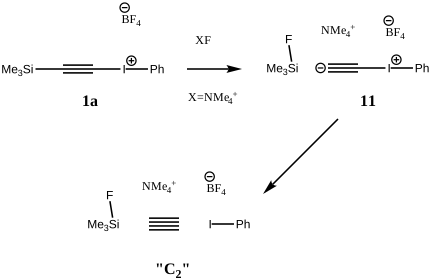
Although the small diatomic molecule known as dicarbon or C2 has been known for a long time, its properties and reactivity have really only been determined via its very high temperature generation. My interest started in 2010, when I speculatively proposed here that the related isoelectronic species C⩸N+ might sustain a quadruple bond. Shortly thereafter, a torrent of theoretical articles started to appear in which the idea of a quadruple bond to carbon was either supported or rejected. Clearly more experimental evidence was needed. The recent appearance of a Chemrxiv pre-print entitled “Room-temperature chemical synthesis of C2“.[1] claims to provide just this! Using the synthetic scheme outlined below, they trapped “C2” with a variety of reagents (see Figure 2A in their article), concluding that the observed reactivity best matched that of singlet “biradicaloid” C2 sustaining a quadruple bond.

Inspired by the report of this chemical synthesis, I thought I would revisit C⩸N+ to speculate how it too might be made. A colleague (thanks Ed!) had alerted me to a probably ultimate method for generating cations using tritium.[2] Radioactive decay loses an electron by β emission and forms He+, which is followed by expulsion of a helium atom to leave behind a cationic centre; in this example at the sp-carbon of an alkyne.

So on to explore the energetics of generating cationic C⩸N+ by this synthetic/nuclear-decay method. The thermochemistry of the reaction (N≡C-T →) N≡C-He+ + e → N≡C+ + He ⟺ C⩸N+ will be calculated using the CCSD(T)/Def2-TZVPP method. Firstly the geometry of N≡C-He+, which is bent and not linear.. This species sustains a short C-He bond, which has a calculated Wiberg bond order of 0.67. Recollect the excitement when a report appeared of bonded helium, which has a computed bond order of just 0.15! The C-He stretch in N≡C-Heis 907 cm-1 with the bend being 193 cm-1 and the C≡N stretch 2116 cm-1.

Click image to view 3D animated model

A He atom is then lost, resulting in an exo-energic ΔΔG298 of -12.6 kcal/mol (see FAIR data DOI: 10.14469/hpc/5691). Despite all that energy injected by a nuclear decay process, together with the supercharged leaving group, the reaction is only moderately exo-energic.

Is this experiment a viable method for generating C⩸N+ cations? Since the half-life of T, aka 3H, is ~11 years, any experiment must be run for months to generate detectable amounts of products (six months as reported here[2]). The C⩸N+ must therefore be trapped as soon as it is formed. The selection of the chemical traps (avoiding HCN itself?) which could demonstrate the nature of this species will therefore be an interesting challenge, should anyone wish to try this experiment.


A similar procedure was used to generate the hitherto elusive perbromic acid by β decay of 83Se into 83Br. The thermochemistry for the method reported here[1] will be explored separately. The second of the two consecutive experimental C-H BDEs (bond dissociation energies) for the reaction H-C≡C-H → H-C≡C• and then H-C≡C• → C⩸C is known experimentally to be about 20 kcal/mol lower than the first. This observation is most simply explained by the formation of a 4th bond, here represented by ⩸. If you are interested in how to invoke this and other chemically useful glyphs, see here. Such thermochemistry was previously evaluated using correlated methods[3] such as CCSD(T) and MRCI (multi-reference configuration interaction, used specifically for C2); procedures which reproduced well these relative experimental BDEs.[3] Here (see FAIR data DOI: 10.14469/hpc/5684) I found that using single reference CCSD(T)/Def2-TZVPP throughout also gives a similar result, the second BDE being ~22 kcal/mol less than the first. Accordingly, this method is here used to estimate the geometry and energy of N≡CHe+ and its carbon-helium bond-dissociation to give C⩸N+ + He. I recognise that ultimately, multi-reference methods should also be used to check these results.

References

  1. K. Miyamoto, S. Narita, Y. Masumoto, T. Hashishin, M. Kimura, M. Ochiai, and M. Uchiyama, "Room-Temperature Chemical Synthesis of C2", 2019. https://doi.org/10.26434/chemrxiv.8009633.v1
  2. G. Angelini, M. Hanack, J. Vermehren, and M. Speranza, "Generation and trapping of an alkynyl cation", Journal of the American Chemical Society, vol. 110, pp. 1298-1299, 1988. https://doi.org/10.1021/ja00212a052
  3. D. Danovich, P.C. Hiberty, W. Wu, H.S. Rzepa, and S. Shaik, "The Nature of the Fourth Bond in the Ground State of C<sub>2</sub>: The Quadruple Bond Conundrum", Chemistry – A European Journal, vol. 20, pp. 6220-6232, 2014. https://doi.org/10.1002/chem.201400356

Startling bonds: revisiting C⩸N+, via the helium bond in N≡CHe+.

May 27th, 2019

Although the small diatomic molecule known as dicarbon or C2 has been known for a long time, its properties and reactivity have really only been determined via its very high temperature generation. My interest started in 2010, when I speculatively proposed here that the related isoelectronic species C⩸N+ might sustain a quadruple bond. Shortly thereafter, a torrent of theoretical articles started to appear in which the idea of a quadruple bond to carbon was either supported or rejected. Clearly more experimental evidence was needed. The recent appearance of a Chemrxiv pre-print entitled “Room-temperature chemical synthesis of C2“.[1] claims to provide just this! Using the synthetic scheme outlined below, they trapped “C2” with a variety of reagents (see Figure 2A in their article), concluding that the observed reactivity best matched that of singlet “biradicaloid” C2 sustaining a quadruple bond.

Inspired by the report of this chemical synthesis, I thought I would revisit C⩸N+ to speculate how it too might be made. A colleague (thanks Ed!) had alerted me to a probably ultimate method for generating cations using tritium.[2] Radioactive decay loses an electron by β emission and forms He+, which is followed by expulsion of a helium atom to leave behind a cationic centre; in this example at the sp-carbon of an alkyne.

So on to explore the energetics of generating cationic C⩸N+ by this synthetic/nuclear-decay method. The thermochemistry of the reaction (N≡C-T →) N≡C-He+ + e → N≡C+ + He ⟺ C⩸N+ will be calculated using the CCSD(T)/Def2-TZVPP method. Firstly the geometry of N≡C-He+, which is bent and not linear.. This species sustains a short C-He bond, which has a calculated Wiberg bond order of 0.67. Recollect the excitement when a report appeared of bonded helium, which has a computed bond order of just 0.15! The C-He stretch in N≡C-Heis 907 cm-1 with the bend being 193 cm-1 and the C≡N stretch 2116 cm-1.

Click image to view 3D animated model

A He atom is then lost, resulting in an exo-energic ΔΔG298 of -12.6 kcal/mol (see FAIR data DOI: 10.14469/hpc/5691). Despite all that energy injected by a nuclear decay process, together with the supercharged leaving group, the reaction is only moderately exo-energic.

Is this experiment a viable method for generating C⩸N+ cations? Since the half-life of T, aka 3H, is ~11 years, any experiment must be run for months to generate detectable amounts of products (six months as reported here[2]). The C⩸N+ must therefore be trapped as soon as it is formed. The selection of the chemical traps (avoiding HCN itself?) which could demonstrate the nature of this species will therefore be an interesting challenge, should anyone wish to try this experiment.


A similar procedure was used to generate the hitherto elusive perbromic acid by β decay of 83Se into 83Br. The thermochemistry for the method reported here[1] will be explored separately. The second of the two consecutive experimental C-H BDEs (bond dissociation energies) for the reaction H-C≡C-H → H-C≡C• and then H-C≡C• → C⩸C is known experimentally to be about 20 kcal/mol lower than the first. This observation is most simply explained by the formation of a 4th bond, here represented by ⩸. If you are interested in how to invoke this and other chemically useful glyphs, see here. Such thermochemistry was previously evaluated using correlated methods[3] such as CCSD(T) and MRCI (multi-reference configuration interaction, used specifically for C2); procedures which reproduced well these relative experimental BDEs.[3] Here (see FAIR data DOI: 10.14469/hpc/5684) I found that using single reference CCSD(T)/Def2-TZVPP throughout also gives a similar result, the second BDE being ~22 kcal/mol less than the first. Accordingly, this method is here used to estimate the geometry and energy of N≡CHe+ and its carbon-helium bond-dissociation to give C⩸N+ + He. I recognise that ultimately, multi-reference methods should also be used to check these results.

References

  1. K. Miyamoto, S. Narita, Y. Masumoto, T. Hashishin, M. Kimura, M. Ochiai, and M. Uchiyama, "Room-Temperature Chemical Synthesis of C2", 2019. https://doi.org/10.26434/chemrxiv.8009633.v1
  2. G. Angelini, M. Hanack, J. Vermehren, and M. Speranza, "Generation and trapping of an alkynyl cation", Journal of the American Chemical Society, vol. 110, pp. 1298-1299, 1988. https://doi.org/10.1021/ja00212a052
  3. D. Danovich, P.C. Hiberty, W. Wu, H.S. Rzepa, and S. Shaik, "The Nature of the Fourth Bond in the Ground State of C<sub>2</sub>: The Quadruple Bond Conundrum", Chemistry – A European Journal, vol. 20, pp. 6220-6232, 2014. https://doi.org/10.1002/chem.201400356

An Ambimodal Trispericyclic Transition State: the effect of solvation?

May 2nd, 2019

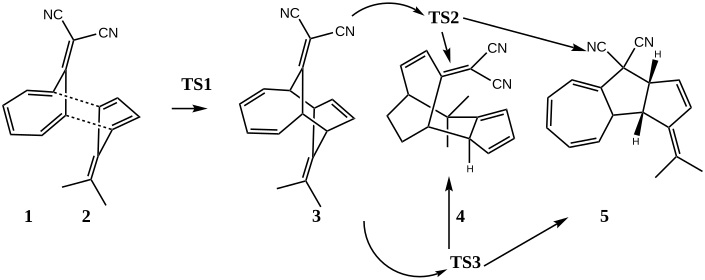
Ken Houk’s group has recently published this study of cycloaddition reactions, using a combination of classical transition state location followed by molecular dynamics trajectory calculations,[1] and to which Steve Bachrach’s blog alerted me. The reaction struck me as being quite polar (with cyano groups) and so I took a look at the article to see what both the original[2] experimental conditions were and how the new simulations compared. The reaction itself is shown below.


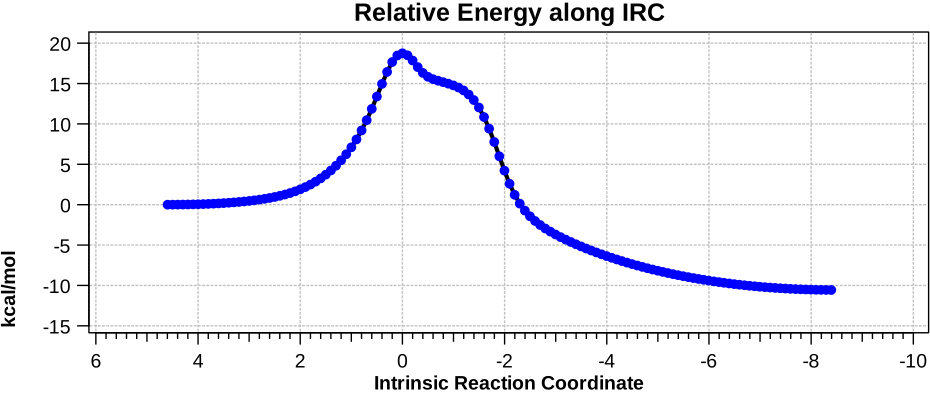
Turns out that chloroform was used as solvent (also benzene), whilst the transition state calculations and the subsequent molecular dynamics trajectories were modelled for the gas phase. The key observation is that if TS1 is used as the starting point for trajectory calculations, only 87% lead to the product predicted by classical transition state theory (3), as revealed by a classical intrinsic reaction coordinate (IRC) calculation. The remaining 13% lead to 4 and 5, the ambimodal effect. So here, I want to explore what effect including a continuum solvent on the computation of TS1 and its IRC might have on the classical (non-dynamic) model.

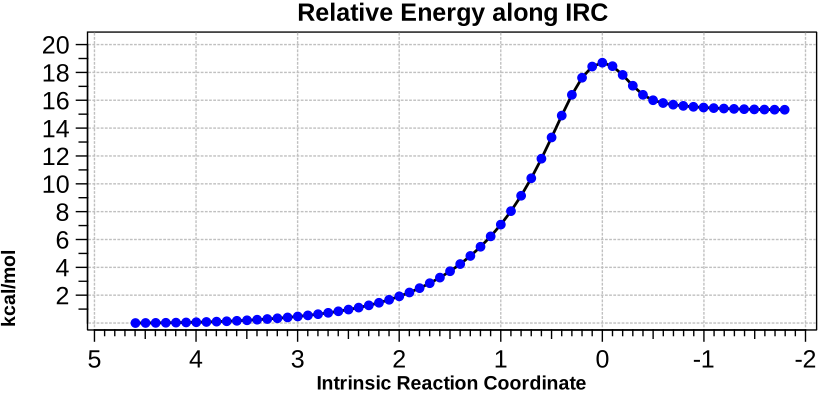
Firstly, the model for TS1 as reported[3], ωB97XD/6-31G(d) (FAIR data at DOI: 10.14469/hpc/5590). The basis set is modest by today’s standards, but is largely imposed by the need to use it for very large numbers of trajectory calculations. I was able to copy/paste the coordinates from the reported supporting information and then to replicate the IRC at this level (gas phase), also shown in the SI.

There is a feature in this IRC I want to expand upon (red arrow above). It occurs at an IRC value of ~-0.9 on the axis below.

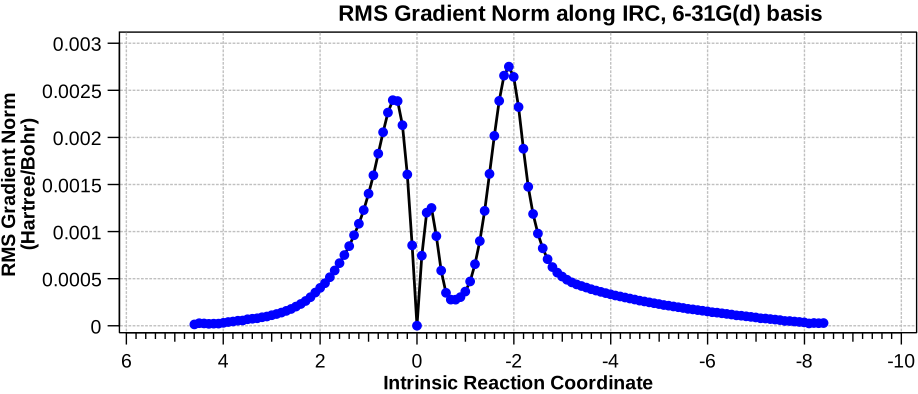
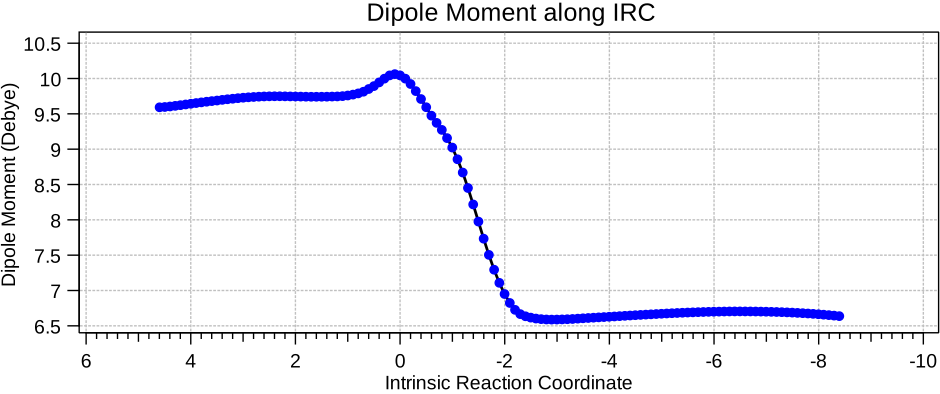
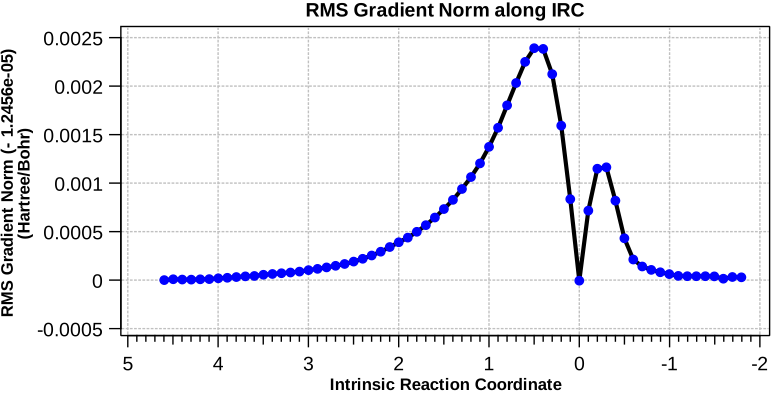
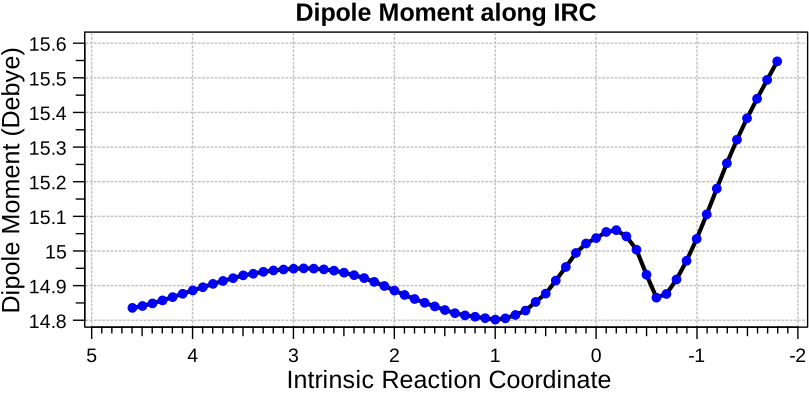
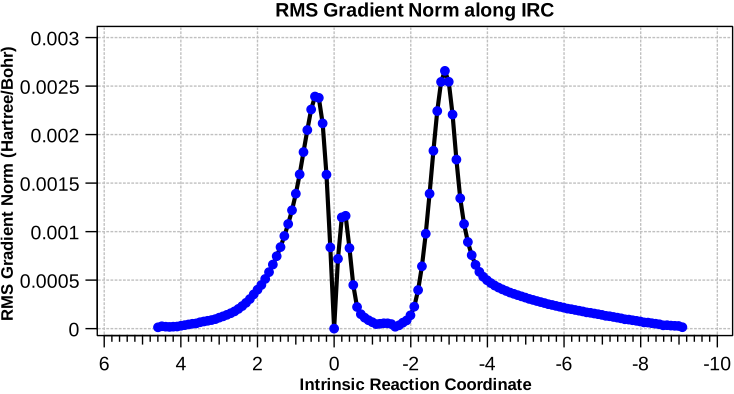
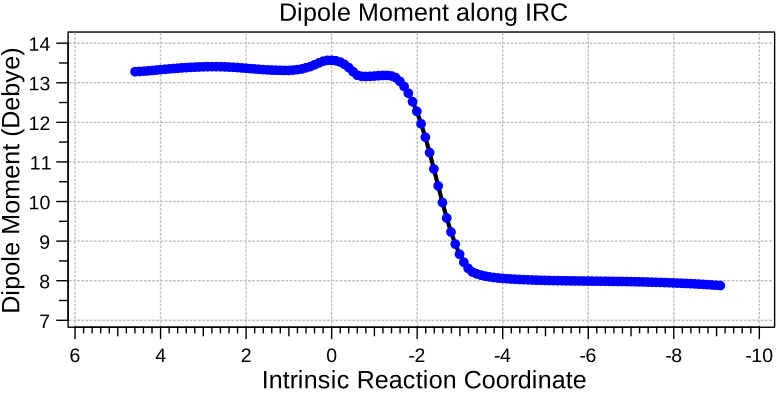
It can be seen more clearly if the RMS gradient norm is plotted, the value of which drops to almost zero at IRC -0.9. Had it reached exactly 0.0, we would have had an intermediate formed. As it is we have what is called a hidden intermediate. The origins of this intermediate can be more readily inferred from this dipole moment plot along the IRC. At TS1, the dipole moment is > 10D. A rule of thumb I have often used is that if a TS has a DM > 10, then one cannot ignore solvation any more and a gas phase model must be augmented.

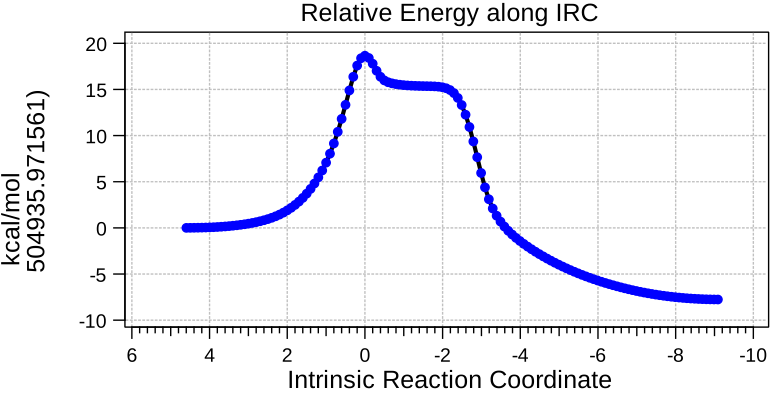
Here are the same plots, but now with an added solvent field for water, an extreme polarity.

The IRC now stops at -2, being a high energy true (ionic) intermediate (rather than a hidden one). The IRC stops because gradient norm has now reached 0.0 at IRC -2, again an indication of a true intermediate.

The dipole moment has been increased from 10 in the gas phase to around 15 at TS1 and it continues to increase until the ionic intermediate is reached. These differences from the gas phase plots are induced entirely by applying a continuum solvent model.

Next an intermediate solvent, chloroform, being one of the solvents used for the actual reaction. This time the gradient norm almost reaches a value of 0.0, avoiding it only by a whisker! A barely hidden intermediate.

The dipole moment totters around 13.5D, before finally collapsing as the ionic intermediate itself collapses to a neutral molecule again. Benzene as solvent (not shown here) reaches an intermediate dipole moment of about 12D. It too can stabilize an ionic intermediate noticeably even though it is not ionic itself.

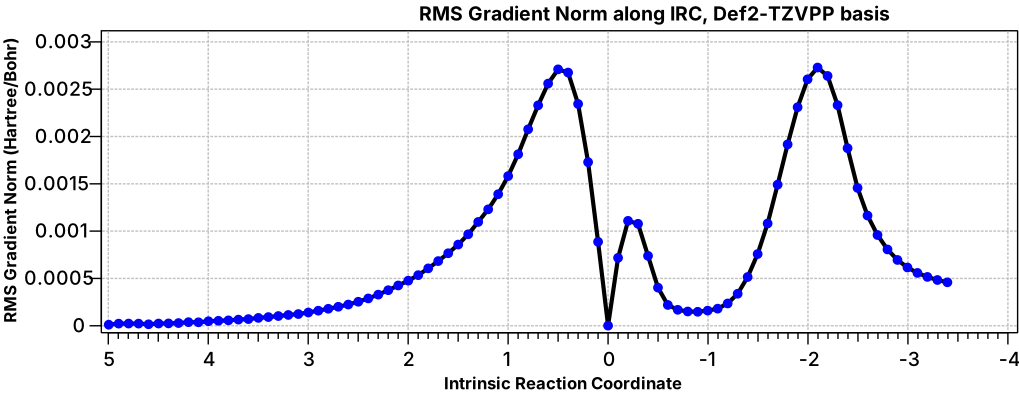
I want to also briefly explore what effect if any the use of a relatively small basis set (6-31G(d)) has on the shape of the IRC. Below is a repeat of the gas phase IRC using the Def2-TZVPP basis, which is about twice the size of the smaller one (and hence is around 16 times slower to compute). The gradient norm shows that the “hidden intermediate” region around IRC -1 is a little more prominent (flatter).

So we see that both a solvent model (as a continuum field) and a larger basis set can increase the degree of “hidden intermediate” character in the classical reaction coordinate for this cycloaddition reaction, to the extent that if water is used as model solvent an actual discrete albeit shallow ionic intermediate forms. As Houk puts it, solvation induces a conversion from an entropic intermediate to an enthalpic one.[4] Molecular dynamics trajectories however have a propensity for not settling into quite shallow intermediates (those with escape barriers of < 3 kcal/mol, as would be the case here).

It will indeed be interesting to see the extent, if any, that either of the augmented models shown above affect the calculated distribution of molecular dynamics trajectories compared to those obtained using a gas phase model.

References

  1. X. Xue, C.S. Jamieson, M. Garcia-Borràs, X. Dong, Z. Yang, and K.N. Houk, "Ambimodal Trispericyclic Transition State and Dynamic Control of Periselectivity", Journal of the American Chemical Society, vol. 141, pp. 1217-1221, 2019. https://doi.org/10.1021/jacs.8b12674
  2. C.Y. Liu, and S.T. Ding, "Cycloadditions of electron-deficient 8,8-disubstituted heptafulvenes to electron-rich 6,6-disubstituted fulvenes", The Journal of Organic Chemistry, vol. 57, pp. 4539-4544, 1992. https://doi.org/10.1021/jo00042a039
  3. https://doi.org/
  4. O.M. Gonzalez-James, E.E. Kwan, and D.A. Singleton, "Entropic Intermediates and Hidden Rate-Limiting Steps in Seemingly Concerted Cycloadditions. Observation, Prediction, and Origin of an Isotope Effect on Recrossing", Journal of the American Chemical Society, vol. 134, pp. 1914-1917, 2012. https://doi.org/10.1021/ja208779k

Imaging normal vibrational modes of a single molecule of CoTPP: a mystery about the nature of the imaged species.

April 25th, 2019

Previously, I explored (computationally) the normal vibrational modes of Co(II)-tetraphenylporphyrin (CoTPP) as a “flattened” species on copper or gold surfaces for comparison with those recently imaged[1]. The initial intent was to estimate the “flattening” energy. There are six electronic possibilities for this molecule on a metal surface. Respectively positively, or negatively charged and a neutral species, each in either a low or a high-spin electronic state. I reported five of these earlier, finding each had quite high barriers for “flattening” the molecule. For the final 6th possibility, the triplet anion, the SCF (self-consistent-field) had failed to converge, but for which I can now report converged results.

charge

Spin

Multiplicity

ΔG, Twisted Ph,
Hartree
ΔG, “flattened”,
Hartree

ΔΔG,

kcal/mol

-1 Triplet -3294.68134 (C2) -3294.64735 (C2v) 21.3
-3294.60006 (Cs) 51.0
-3294.37012 (D2h) 195.3
Singlet -3294.67713 (S4) -3294.39418 (D4h) 175.6
-3294.39321 (D2h) 178.2
-3294.56652 (D2) 69.4
FAIR data at DOI: 10.14469/hpc/5486

I am exploring the so-called “flattened” mode, induced by the voltage applied at the tip of the STM (scanning-tunnelling microscope) probe and which causes the phenyl rings to rotate as per above. This rotation in turn causes the hydrogen atom-pair encircled above to approach each other very closely. To avoid these repulsions, the molecule buckles into one of two modes. The first causes the phenyl rings to stack up/down/up/down. The second involves an all-up stacking, as shown below. Although these are in fact 4th-order saddle points as isolated molecules, the STM voltage can inject sufficient energy to convert these into apparently stable minima on the metal surface.

All syn mode, Triplet anion

The up/down/up/down “flattened” form (below) shows a much more modest planarisation energy than all the other charged/neutral states reported in the previous post, whereas the all-up isomer (which on the face of it looks a far easier proposition to come into close contact with a metal surface) is far higher in free energy.

The caption to Figure 3 in the original article[1] does not explicitly mention the nature of the metal surface on which the vibrations were recorded, but we do get “The intensity in the upper right corner of the 320-cm−1 map is from a neighbouring Cu–CO stretch” which suggests it is in fact a copper surface. Coupled with the other observation that in “contrast to gold, the Kondo resonance of cobalt disappears on Cu(100), suggesting that it acquires nearly a full electron from the metal (see Extended Data Fig. 2),” the model below of a triplet-state anion on the Cu surface seems the most appropriate.

Syn/anti mode, Triplet anion with C2v symmetry

There is one final remark made in the article worth repeating here: “This suggests that the vibronic functions are complex-valued in this state, as expected for Jahn–Teller active degenerate orbitals of the planar porphyrin.26” Orbital degeneracy can only occur if the molecule has e.g. D4h point group symmetry, whereas the triplet anion stationary-point shown in the figure above has only C2v symmetry for which no orbital degeneracies (E) are expected. Enforcing D4h symmetry on Co(II) tetraphenylporphyrin results in eight pairs of H…H contacts of 1.34Å, which is an impossibly short distance (the shortest known is ~1.5Å). Moreover this geometry has an equally impossible free energy 176 kcal/mol above the relaxed free molecule. Visually from Figure 3, the H…H contact distance looks even shorter (below, circled in red)! A D2h form (with no E-type orbitals) can also be located.

Singlet, Calculated with D4h symmetry. Click for vibrations.

Singlet, Calculated with D2h symmetry. Click for vibrations.

Taken from Figure 3 (Ref 1).

These totally flat species are calculated to be at 13 or 12th-order saddle points, with the eight most negative force constants having vectors which correspond to up/down avoidance motions of the proximate hydrogen pairs encircled above and the remaining being buckling modes of the entire ring.

So to the mystery, being the nature of the “flattened” CoTPP on the copper metal surface, as represented in Figure 3 of the article.[1] Is it truly flat, as implied by the article? If so, the energy of such a species would be beyond the limits of what is normally considered feasible. Moreover, it would represent a species with truly mind-blowing short H…H contacts. Or could it be a saddle-shaped geometry, where the phenyl rings are not lying flat in contact with the metal but interacting via the phenyl para-hydrogens? That geometry has not only a much more reasonable energy above the unflattened free molecule, but also acceptable H…H contacts (~2.0.Å) However, would such a shape correspond to the visualised vibrational modes also shown in Figure 3? I have a feeling that there must be more to this story.


These convergence problems were solved by improving the basis set via adding “diffuse” functions, as in (u)ωB97XD/6-311+G(d,p). If the crystal structure for these species is flattened without geometry optimisation, the H-H distance is around 0.8Å

References

  1. J. Lee, K.T. Crampton, N. Tallarida, and V.A. Apkarian, "Visualizing vibrational normal modes of a single molecule with atomically confined light", Nature, vol. 568, pp. 78-82, 2019. https://doi.org/10.1038/s41586-019-1059-9

Imaging vibrational normal modes of a single molecule.

April 18th, 2019

The topic of this post originates from a recent article which is attracting much attention.[1] The technique uses confined light to both increase the spatial resolution by around three orders of magnitude and also to amplify the signal from individual molecules to the point it can be recorded. To me, Figure 3 in this article summarises it nicely (caption: visualization of vibrational normal modes). Here I intend to show selected modes as animated and rotatable 3D models with the help of their calculation using density functional theory (a mode of presentation that the confinement of Figure 3 to the pages of a conventional journal article does not enable).

I should start by quoting some pertinent aspects obtained from the article itself. The caption to Figure 3 includes assignments, which I presume were done with the help of Gaussian calculations. Thus in the Methods section, we find … The geometry of a free CoTPP molecule is optimized under tight convergence criteria using Gaussian 09 (ref. 33). The orientationally averaged Raman spectrum and vibrational normal modes are calculated with the geometry of a free molecule … All the calculations mentioned above are performed at the B3LYP/6-31G* level with the effective core potential at the cobalt centre. Armed with this information, I looked at the data included with the article (the data supporting the findings of this study are available within the paper. Experimental source data for Figs. 1–4 are provided with the paper) but did not spot any data specifically relating to those Gaussian 09 calculations; in particular any data that would allow me to animate some vibrational normal modes for display here. No matter, it is easy to re-calculate, although I had to obtain the basic 3D coordinates from the Cambridge crystal data base (e.g. entry IKUDOH, DOI: 10.5517/cc6hj4b) since they were unavailable from the article itself. At this point some decisions about molecular symmetry needed to be made (the symmetry is not mentioned in the article), since it is useful to attach the irreducible representations (IR) of each mode as a label (lacking in Figure 3). The crystal structure I picked has idealised S4 symmetry, but it could be higher at D2d or lower at C2.

The next issue to be solved is how many electrons to associate with the molecule. Tetraphenylporphyrin has 347 electrons and the free molecule would be expected to be a doublet spin state (with the quartet as an excited state). Were the vibrational modes calculated for this state? Perhaps not since I then found this statement: The physisorbed CoTPP is positively charged on gold, as demonstrated through TERS measurements using CO-terminated tips24 and through the Smoluchowski effect29…. In contrast to gold, the Kondo resonance of cobalt disappears on Cu(100), suggesting that it acquires nearly a full electron from the metal (see Extended Data Fig. 2). So it seems worth calculating both the cation and the anion singlets as well as the neutral doublet. But at this stage we do not know for certain what spin state the Gaussian 09 assignments in Figure 3 were done for, since there is no data associated with the article to tell us, only that they were done for the free molecule (nominally a doublet).

There is one more remark made in the article we need to take into account: After lowering the sample bias to approach the molecule and scanning at close range, the molecule flattens. Its phenyl rings, which in the free molecule assume a dihedral angle of 72°, rotate to become coplanar (see Extended Data Fig. 1b). Evidently, the binding energy of the phenyl groups to copper overcomes the steric hindrance in the planar geometry. So it might be useful to calculate this “flattened” form to see how much steric repulsion energy needs to be overcome by that binding of the phenyl groups to the surface of the metal. 

Finally, I decided to not try to replicate exactly the reported calculations (B3LYP/6-31G(d)) since this type of DFT mode does not include any dispersion attraction terms; moreover by today’s standards the basis set is also rather small. So here you have an ωB97Xd/6-311G(d,p) calculation, with tight convergence criteria (integral accuracy 10-14 and SCF 10-9; again we do not know what values were used for the article). To ensure that my data is as FAIR as possible, here is its DOI: 10.14469/hpc/5461

charge Multiplicity ΔG, Twisted Ph
Hartree
ΔG, Co-planar Ph
Hartree
ΔΔG, kcal/mol
0 Doublet -3294.58693 -3294.48867 61.7
0 Quartet -3294.58777 -3294.51985 42.6
+1 Singlet -3294.35473 -3294.24973 65.9
+1 Triplet -3294.40821 -3294.33092 48.5
-1 Singlet -3294.67713 -3294.56652 69.4

Starting with a singlet cation as a model, the intent is to compare the “free molecule” energy with that of a flattened version where the dihedral angles of the phenyl rings relative to the porphyrin ring are constrained to ~0° rather than ~72°. This emerges as a 4th order saddle point (a stationary point with four negative roots for the force constant matrix). Such a property means that each co-planar phenyl group is independently a transition state for rotation. The calculated geometry overall is far from planar, having S4 symmetry. The image below in (a) shows how non-planar the molecule still is; (b) an attempt to orient it into the same position as is displayed in Figure 3 of the article.[1]

Singlet cation. Click on the image to get a rotatable model.

The free energy ΔG is 65.9 kcal/mol higher than the twisted form, which means that according to the model proposed, the binding energy of the phenyl groups to copper must recover at least this much energy. If we consider a cationic porphyrin interacting with an anionic metal surface as an ion-pair, then this is perhaps feasible. It is difficult however to see how more than two of the phenyl rings can simultaneously interact with a flat metal surface.

Next, the triplet state of the cation, again a 4th-order saddle point with a rotational barrier of ΔG48.5 kcal/mol; the triplet being 33.6 kcal/mol lower than the singlet using this functional (singlet-triplet separations can be quite sensitive to the DFT functional used).

Triplet cation. Click on the image to get a rotatable model.

Next, the neutral doublet, another 4th-order saddle point and below it the quartet state, which this time is just a 2nd-order saddle point (an interesting observation in itself).

Neutral Doublet

Neutral Quartet

Finally, the “flattened” singlet anion, which also emerges as a 4th-order saddle point (the triplet state has SCF convergence issues which I am still grappling with).

Singlet anion

To inspect the vibrational modes of any of these species, click on the appropriate image to open a JSmol display. Then right-click in the molecule window, navigate to the 3rd menu down from the top (Model – 48/226), where the frames/vibrations are ordered in sets of 25. Open the appropriate set and select the vibration you want from the list of wavenumbers shown. The preselected normal mode is the one identified in Figure 3 as 388 cm-1, the symmetric N-Co stretch (I note the figure 3 caption refers to them as vibrational frequencies; they are of course vibrational wavenumbers!). You can also inspect the four modes shown as negative numbers (correctly as imaginary numbers) to see how the phenyl groups rotate. If you want to analyze the vibrational modes using other tools (the free Avogadro program is a good one), then download the appropriate log or checkpoint file from the FAIR data archives at 10.14469/hpc/5461.

I conclude by noting that the aspect of this article which I presume reports the Gaussian normal vibrational mode calculations (Figure 3, caption Bottom, assigned vibrational normal modes), has been a challenging one to analyse. Neither the charge state nor the spin state of these calculations is clearly indicated in the article (unless I missed it somewhere). The barriers to flattening out the molecule by twisting all four phenyl groups are unreported in the article, but emerge as substantial from the calculations here. The various species I calculated (summarised in the table and figures above) are all predicted to be non-planar. In the absence of provided coordinates with the article, the visual appearances (bottom row, Figure 3) are the only information available. These certainly appear flat and rather different from my projections shown above or below.

All of which amounts to a plea for more data and especially FAIR data to be submitted, providing information such as the charge and spin states used for the calculations, along with a full listing of all the normal mode vectors and wavenumbers. The article is only a letter at this stage; perhaps this information will appear in due course!


As noted above I have not attempted a direct replication, not least because there is no reported data to which any replication could be compared. The IRs of each vibrational mode are displayed along with the wavenumber when the 3D JSmol display is shown with a right-mouse-click.

References

  1. J. Lee, K.T. Crampton, N. Tallarida, and V.A. Apkarian, "Visualizing vibrational normal modes of a single molecule with atomically confined light", Nature, vol. 568, pp. 78-82, 2019. https://doi.org/10.1038/s41586-019-1059-9
A search of some major chemistry publishers for FAIR data records.

April 12th, 2019

In recent years, findable data has become ever more important (the F in FAIR). Here I test that F using the DataCite search service.

Firstly an introduction to this service. This is a metadata database about datasets and other research objects. One of the properties is relatedIdentifier which records other identifiers associated with the dataset, being say the DOI of any published article associated with the data, but it could also be pointers to related datasets.

One can query thus:

  1. https://search.datacite.org/works?query=relatedIdentifiers.relatedIdentifier:*
    which retrieves the very healthy looking 6,179,287 works.
  2. One can restrict this to a specific publisher by the DOI prefix assigned to that publisher:
    ?query=relatedIdentifiers.relatedIdentifier:10.1021*
    which returns a respectable 210,240 works.
  3. It turns out that the major contributor to FAIR currently are crystal structures from the CCDC. One can remove them from the search to see what is left over:
    ?query=(relatedIdentifiers.relatedIdentifier:10.1021*)+NOT+(identifier:*10.5517*) 
    and one is down to 14,213 works, of which many nevertheless still appear to be crystal structures. These may be links to other crystal datasets.

I have performed searches 2 and 3 for some popular publishers of chemistry (the same set that were analysed here).

Publisher Search 2 Search 3
ACS 210,240 14,213
RSC 138,147 1,279
Elsevier 185,351 56,373
Nature 12,316 8,104
Wiley 135,874 9,283
Science 3,384 2,343

These publishers all have significant numbers of datasets which at least accord with the F of FAIR. A lot of data sets may not have metadata which in fact points back to a published article, since this can be something that has to be done only when the DOI of that article appears, in other words AFTER the publication of the dataset. So these numbers are probably low rather than high.

How about the other way around? Rather than datasets that have a journal article as a related identifier, we could search for articles that have a dataset as a related identifier?

  1. ?query=(identifier:*10.1039*)+AND+(relatedIdentifiers.relatedIdentifier:*)
    returns rather mysterious nothing found. It might also be that there is no mapping of this search between the CrossRef and DataCite metadata schemas.
  2. And just to show the searches are behaving as expected:
    ?query=(relatedIdentifiers.relatedIdentifier:10.1021*)+AND+(identifier:*10.5517*)
    returns 196,027 works.

It will also be of interest to show how these numbers change over time. Is there an exponential increase? We shall see.

Finally, we have not really explored adherence to eg the AIR of FAIR.  That is for another post.