Posts Tagged ‘Matthias Bickelhaupt’

The Sn2 reaction and the anomaly of carbon.

Thursday, September 6th, 2012

It was three years ago that I first blogged on the topic of the Sn2 reaction. Matthias Bickelhaupt had suggested that the Sn2 reaction involving displacement at a carbon atom was an anomaly; the true behaviour was in fact exhibited by the next element down in the series, silicon. The pentacoordinate species shown below (X=Si) is naturally a minimum, and the fact that for carbon (X=C) one gets instead a transition state resulting in a significant thermal barrier (~ 20 kcal/mol) was a manifestation of abnormal behaviour.
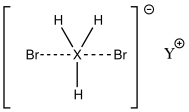
The argument was that carbon as an atom was too small to fit snugly into a box of width ~5Å defined by the positions of two e.g. bromine atoms at more or less their closest possible approach, and instead rattled around between the two halogens, needing to surmount a barrier at the midpoint of the box. Silicon on the other hand being larger, fitted nicely into this box at the centre, and thus being unable to rattle around represented instead a minimum in the potential energy surface. I note (parenthetically) that a similar reason is often used to explain why hydrogen bonds to F are both rare and weak, whereas those to O are common and strong.

As part of a project to create a library of reaction mechanism animations, I calculated the IRC for the reaction above (X=C). This one is slightly different from those one may find in the research literature and textbooks; the counter-ion (Y=Na+) is also included so as to create a neutral system overall. The method is the usual ωB97XD/6-311+G(d,p)/SCRF=water.

If you watch carefully, you will see that at the early and late stages of the reaction, the bromine moves, but during the middle part of the reaction both bromine atoms are absolutely stationary and it is the carbon now that adopts the motion, rattling between the two bromine atoms. This aspect can also be seen very clearly in the two plots below:
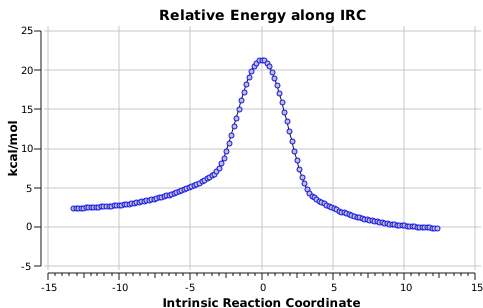
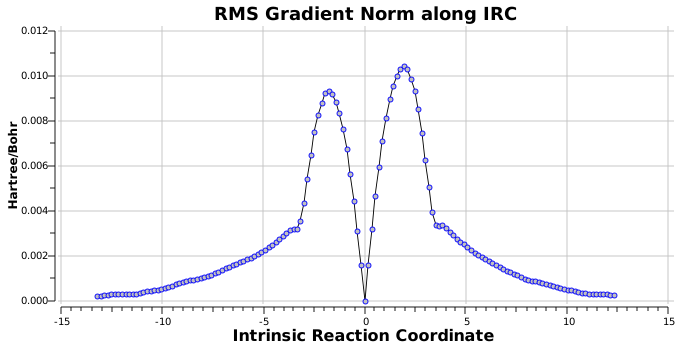
Note in particular how the gradient norm plot changes in character at IRC ± 3; the central region represents motion of carbon inside the “box”, the region outside of the box that of the bromine. I think its fascinating how such an apparently simple reaction can carry such insight into molecular behaviour.

It's Hexa-coordinate carbon Spock – but not as we know it!

Friday, October 2nd, 2009

Science is about making connections. And these can often be made between the most unlikely concepts. Thus in the posts I have made about pentavalent carbon, one can identify a series of conceptual connections. The first, by  Matthias Bickelhaupt and co, resulted in the suggestion of a possible frozen SN2 transition state. They used astatine, and this enabled a connection to be made between another good nucleophile/nucleofuge, cyclopentadienyl anion. This too seems to lead to a frozen Sn2 transition state.  The cyclopentadienyl theme then asks whether this anion can coordinate a much simpler unit, a C2+ dication (rather than Bickelhaupt’s suggestion of a (NC)3C+ cation/radical) and indeed that complex is also frozen, again with 5-coordinate carbon, and this time with five equal C-C bonds. So here, the perhaps inevitable progression of ideas moves on to examining the properties of this complex, the outcome being a quite counter-intuitive suggestion which moves us into new territory.

The journey starts with the previous observation that the HOMO of the carbyliumylidene cation, shown in the previous post, has prominent electron density along the five-fold symmetry axis of the molecule;

The HOMO orbital

The HOMO orbital. Click for 3D

This suggests that the apical 5-coordinate carbon might actually be basic, and hence coordinate a proton to form a di-cation (below). So adding a proton results in the following stable (in the sense of having all positive force constants) structure, with apical C-C bond lengths of 1.7Å (compared to 1.8Å for the unprotonated system) and the bouncing castle/trampoline mode of  875 cm-1 (DOI: 10042/to-2435) is likewise increased (for the pentamethyl derivative of the structure shown below). The apical C-H stretch has the highest value of all the CHs in the molecule, 3208 cm-1. The calculated proton affinity of the parent compound is 134.2 kcal/mol. To put this into context, we can compare this value with a range of first and second proton affinities reported for carbon bases by Frenking (DOI: 10.1002/cphc.200800208). The highest second proton affinity there reported (ie protonation of an already positive system) is around 106 kcal/mol, which is a good deal less than that found here! So we might conclude that our value  must be a candidate for highest second proton affinity ever proposed for a carbon base.

Hexa-coordinate  Carbon?

Hexa-coordinate Carbon?

The value of ρ(r) for the AIM bond critical point located for each of the five apical C-C bonds is 0.156 au, again up from the value for the unprotonated species. As before, the Cp ring itself shows no ring critical point. An ELF analysis (below) shows five disynaptic basins in the  C-C bond region, with the basin integrating to  0.75 electrons each. Together with the electrons in the apical C-H bond, 6.09 electrons are associated with basins surrounding this carbon atom. Both the AIM and the ELF concur in describing this carbon as not only hexa-coordinated, but hexavalent (although the bonds are not the conventional two-electron type, but perhaps more akin to a six-centre-four-electron interaction).

ELF Basins

ELF Basins. Click for 3D

So I suggest that simple protonation of a highly basic cation has resulted in a six-coordinate carbon atom, which exhibits six strong bonds coordinated around it. I suppose it is inevitable again that one ends this post with the question whether this species too might one day be made.

It’s Hexa-coordinate carbon Spock – but not as we know it!

Friday, October 2nd, 2009

Science is about making connections. And these can often be made between the most unlikely concepts. Thus in the posts I have made about pentavalent carbon, one can identify a series of conceptual connections. The first, by  Matthias Bickelhaupt and co, resulted in the suggestion of a possible frozen SN2 transition state. They used astatine, and this enabled a connection to be made between another good nucleophile/nucleofuge, cyclopentadienyl anion. This too seems to lead to a frozen Sn2 transition state.  The cyclopentadienyl theme then asks whether this anion can coordinate a much simpler unit, a C2+ dication (rather than Bickelhaupt’s suggestion of a (NC)3C+ cation/radical) and indeed that complex is also frozen, again with 5-coordinate carbon, and this time with five equal C-C bonds. So here, the perhaps inevitable progression of ideas moves on to examining the properties of this complex, the outcome being a quite counter-intuitive suggestion which moves us into new territory.

The journey starts with the previous observation that the HOMO of the carbyliumylidene cation, shown in the previous post, has prominent electron density along the five-fold symmetry axis of the molecule;

The HOMO orbital

The HOMO orbital. Click for 3D

This suggests that the apical 5-coordinate carbon might actually be basic, and hence coordinate a proton to form a di-cation (below). So adding a proton results in the following stable (in the sense of having all positive force constants) structure, with apical C-C bond lengths of 1.7Å (compared to 1.8Å for the unprotonated system) and the bouncing castle/trampoline mode of  875 cm-1 (DOI: 10042/to-2435) is likewise increased (for the pentamethyl derivative of the structure shown below). The apical C-H stretch has the highest value of all the CHs in the molecule, 3208 cm-1. The calculated proton affinity of the parent compound is 134.2 kcal/mol. To put this into context, we can compare this value with a range of first and second proton affinities reported for carbon bases by Frenking (DOI: 10.1002/cphc.200800208). The highest second proton affinity there reported (ie protonation of an already positive system) is around 106 kcal/mol, which is a good deal less than that found here! So we might conclude that our value  must be a candidate for highest second proton affinity ever proposed for a carbon base.

Hexa-coordinate  Carbon?

Hexa-coordinate Carbon?

The value of ρ(r) for the AIM bond critical point located for each of the five apical C-C bonds is 0.156 au, again up from the value for the unprotonated species. As before, the Cp ring itself shows no ring critical point. An ELF analysis (below) shows five disynaptic basins in the  C-C bond region, with the basin integrating to  0.75 electrons each. Together with the electrons in the apical C-H bond, 6.09 electrons are associated with basins surrounding this carbon atom. Both the AIM and the ELF concur in describing this carbon as not only hexa-coordinated, but hexavalent (although the bonds are not the conventional two-electron type, but perhaps more akin to a six-centre-four-electron interaction).

ELF Basins

ELF Basins. Click for 3D

So I suggest that simple protonation of a highly basic cation has resulted in a six-coordinate carbon atom, which exhibits six strong bonds coordinated around it. I suppose it is inevitable again that one ends this post with the question whether this species too might one day be made.