Posts Tagged ‘Möbius’

A pericyclic dichotomy.

Friday, November 30th, 2012

A dichotomy is a division into two mutually exclusive, opposed, or contradictory groups. Consider the reaction below. The bicyclic pentadiene on the left could in principle open on heating to give the monocyclic [12]-annulene (blue or red) via what is called an electrocyclic reaction as either a six (red) or eight (blue) electron process. These two possibilities represent our dichotomy; according to the Woodward-Hoffmann (WH) pericyclic selection rules, they represent contradictory groups. Depending on the (relative) stereochemistry at the ring junctions, if one reaction is allowed by the WH rules, the other must be forbidden, and of course vice-versa. It is a nice challenge to ask students to see if the dichotomy can be reconciled.
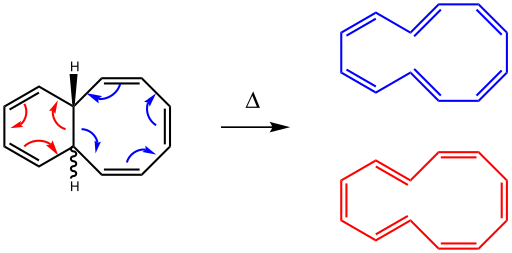
I start the process by pondering the relationship between the two forms of the [12]annulene shown on the right. Are the representations shown in red or blue just resonance isomers (analogous to the Kekule forms of benzene), or something else? If the former, then they truly represent the same species; they are just different ways of representing the contributions to the wavefunction, and the dichotomy stands. But if they are in fact different species, then we can start to eliminate the apparent contradiction by stating that the red and the blue arrows actually represent different reactions, leading to different (albeit isomeric) products. In this scenario, the red and blue forms of the [12]-annulene are NOT resonance isomers but distinct valence bond isomers, with a positive energy activation barrier to their interconversion. To find out, let us start with the transition states for both processes:

C2 symmetry Cs symmetry

Transition state for blue arrows. Click for 3D.

Transition state for red arrows. Click for 3D.

  1.  The blue arrows (representing 4n,n=2 electrons) result in a transition state with an axis of symmetry
  2. with the bond forming/cleaving from the bottom face of one terminus of the rhs-conjugated system to the top face of the other terminus, in other words an antarafacial bond, 
  3. with conrotation of the groups at the termini, resulting in
  4. all the bonds in the 8-ring being approximately 1.4Å in length (other than the central bond), whilst those in the 6-ring alternate strongly. The 8-ring is (Möbius) aromatic and the 6-ring is (Möbius) anti-aromatic.
  5. Contrary-wise, the red arrows (representing 4n+2,n=1 electrons) result in a transition state with a plane of symmetry
  6. with the bond forming from the same bottom face of the lhs-conjugated termini, in other words a suprafacial bond, 
  7. with disrotation of the groups at the termini, resulting in 
  8. all the bonds in the 6-ring being approximately 1.4Å in length, whilst those in the 8-ring alternate strongly. The 6-ring is now (Hückel) aromatic and the 8-ring is (Hückel) anti-aromatic.
  9. The transition state with C2 symmetry is in fact 10.1 kcal/mol lower in free energy than the one with Cs symmetry.
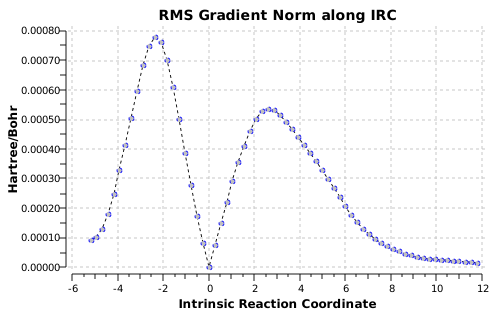
So the arrows follow the aromaticity (or vice versa), and this determines the stereochemistry (axis or plane of symmetry) and ultimately the nature of the product of each reaction. Are these annulenes indeed different? Shown below are the final outcomes of following an IRC (intrinsic reaction coordinate) from the transition state of the red and the blue reaction downhill to the [12]-annulenes. Not only is the outcome valence bond isomers, but they are also atropisomers.
Product, C2 (axis) Product, Cs (plane)

So at the end we see that there is no actual dichotomy. The reactions above (red or blue arrows) give different products, with different symmetries, and differently aromatic transition states. But in doing so, they encapsulate the selection rules for pericyclic reactions very nicely indeed. For more details of this, see this citation [1].

References

  1. H.S. Rzepa, "The Aromaticity of Pericyclic Reaction Transition States", Journal of Chemical Education, vol. 84, pp. 1535, 2007. https://doi.org/10.1021/ed084p1535

The stereochemistry of [8+2] pericyclic cycloadditions.

Sunday, July 10th, 2011

Steve Bachrach has blogged on the reaction shown below. If it were a pericyclic cycloaddition, both new bonds would form simultaneously, as shown with the indicated arrow pushing. Ten electrons would be involved, and in theory, the transition state would have 4n+2 aromaticity. In fact Fernandez, Sierra and Torres have reported that they can trap an intermediate zwitterion 2, and in this sense therefore, the reaction is not pericyclic but nucleophilic addition from the imine lone pair to the carbonyl of the ketene (it finds the half way stage convivial). But this got me thinking. Does this reaction have any pericyclic character at all? And if so, could it be enhanced by design?

A formal 8+2 cycloaddition.

Steve as usual provided the coordinates of the transition state, and I had a good look at the 3D structure (in fact, his post brilliantly illustrates the point of providing coordinates, because playing with them may always enable new aspects to be spotted). My annotation of the transition state (labelled TS1in Steve’s post) is shown below.

8+2 transition state. Click for 3D.

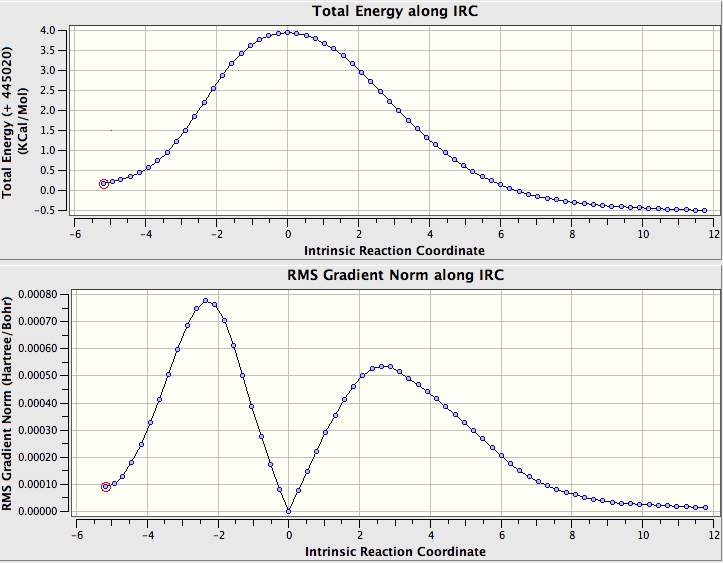
The 8π component has bonds forming on the nitrogen (and if it were pericyclic, on the ring carbon as well). If you load the 3D coordinates by clicking on the above graphic, you will see these two bonds appear to be forming from opposite faces of the 8π system. The term for this is antarafacial. The 2π component of the ketene is also twisted, and one can observe at least a hint that the two bonds to it are also from opposite faces (for more details, see this article we published in 1993), again antarafacial. It was only in 2005 that it was recognised that a transition state with two antarafacial components would be 4n+2 aromatic (equivalent to a doubly twisted Möbius system), and it has to be said no good examples of this mode have yet to be observed experimentally. In fact, in the present example, that second bond does not go on to form in a concerted manner with the first, so the reaction is in fact stepwise and not pericyclic. But it does seems to at least initially have some features of a doubly twisted Möbius cycloaddition. The IRC (intrinsic reaction coordinate) for TS1 which reveals the stepwise nature is in fact a classic (the lhs forms the zwitterion, typically with a small reverse barrier).

Intrinsic reaction coordinate for TS1.

  1. So on to the design. Attempt one is to remove the nucleophilic nitrogen lone pair, and the electrophilic carbonyl, thus suppressing the desire of the reaction to form a stable ionic intermediate. The cycloaddition between an octatetraene (the 8π component) and ethene (the 2π component), formally labelled as a π8a+π2a cycloaddition, looks as below.

A Di-antarafacial 2+8 cycloaddition. Click for 3D.

In fact, this too is not a proper concerted transition state for a pericyclic reaction, since it has a second (albeit small) imaginary mode of 84 cm-1 corresponding to desymmetrisation so that one bond forms before the other. Ethene, it seems, is not fond of cycloadding bonds antarafacially. The transition state is however aromatic, with all the ring bonds of the correct length (~1.4Å). In the interests of balance, I do have to note that a competing π8s+π2reaction is likely to be lower in energy.

  • The design is now to try to convert that second negative force constant to a positive one. Let us try replacing ethene with O=C=C=O, which might object less to an antarafacial mode across the central C=C bond. No luck there, the second mode is still imaginary (92i). The pericyclic mode is also unusual, involving breaking the central OC-CO bond.

    8+2 cycloaddition involving carbon suboxide.

  • One more go, this time to replace ethene with cyclopropene (the double bond might be expected to be more reactive now). Still no luck (126i cm-1).
  • In fact, a more complete exploration reveals that all these various combinations exhibit the same behaviour; π6a+π4a, π10a+π4a, π8a+π6a and the triple-twist Möbius π4a+π4a+π4a.

This post attempts to show how one can take an experimental observation, couple it with some calculations, and see if anything out of the ordinary might emerge. One might then try to tweak the reaction to amplify any effects one might observe. In this case, it does seem that trying to coerce two antarafacial modes onto simple alkenes may not be possible.

Valentine chemistry

Sunday, February 13th, 2011

The Möbius band is an experimental delight. In its original forms, it came flat-packed as below. The one shown on the left is related to the international symbol for recycling (if we denote the number of half twists imparted as m, this one has m=3). The middle one (m=4) shows a 4-twisted variant, and the one on the right has a 5-twist (m=5). These all come from Möbius’ original sketches, found amongst his belongings when he died. In this post they will form the basis for some experiments in molecular chirality.

Flat-packed Möbius bands

These Möbius bands are all chiral, which means they cannot be superimposed upon their mirror image. We may in fact give the two forms labels, M and P (similar to the left and right handed helical forms for DNA noted in a previous post). Armed with a selection of these rings, I list below some experiments in paper cutting that you could try. I will use the notation Mm or Pm to denote the handedness and twistedness of each strip and + to denote glueing.

  1. Build two strips, each m=1 and glue them together orthogonally, then cut down the middle of each strip with a pair of scissors. The process is already illustrated with lots of nice photos (using pink-coloured strips) on this blog and the outcome below is transcluded here from the original post. If the strips are flat-packed first, then they will fit into an envelope, and all that would be needed for the recipient to complete the valentine is the preceding instructions (plus some glue and scissors)!
  2. My purpose here is to take this basic experiment and to suggest variations, using the following variables; the chirality M or P, the number of twists m in each, and the total number of strips used N. As is noted in the original instructions, a valentine is only produced if one M1 and one P1 strip is so joined (N=2), what chemists would call a heterochiral pair. What happens when a homochiral pair is used instead? The chemical term is that we end up with diastereomers, in other words M1+P1 and M1+M1 have a diastereomeric relationship, and P1+P1 and M1+M1 would have an enantiomeric relationship (as of course do M and P themselves).
  3. One repeats experiments 1 and 2 using heterocoloured strips rather than the same colour as above. How are the two colours distributed?
  4. Experiments 1-3 are then repeated for M2 and P2
  5. Experiment 4 is then repeated for M3 and P3
  6. One can now move on to N>2. For N=3, one might construct a isotactic polymer P1+P1+P1 or a heterotactic polymer P1+M1+P1.
  7. The cutting down the centre of each strip does not have direct chemical analogy you might think, but in fact if you relate the cut to the node in a p-atomic orbital, one can quickly move into Möbius conjugation and aromaticity. One might ask whether any of the preceding experiments might relate to the molecular trefoil I described in another post? Or these lemniscular octaphyrins?
  8. There are other variations. Thus N=2 dimers constructed with dissimilar twists as P1+P3 or perhaps even P1+M2. I will not try to list all the permutations.
  9. If your head is not yet swimming, consider a tetramer N=4, but now complete a second supercycle by joining the first band to the fourth.
  10. And as a final flourish, is it possible to give the supercycle described in experiment 9 a twist before you join the ends together? Would it matter if that twist were M or P? Would it matter if N were even or odd?  The chemical analogy here of course is to cyclic (and supercoiled) RNA molecules, which are increasingly implicated in the transition from pre-biotic to post-biotic chemistry.

I have to confess I have not tried the majority of the above experiments myself! If anyone does and gets anything interesting, do tell. What I hope I have illustrated here is how these simple experiments in twisting, gluing and cutting simple strips of paper may actually tell us something about molecules and their polymers and perhaps life itself.