Posts Tagged ‘Birch reduction’

A new way of exploring the directing influence of (electron donating) substituents on benzene.

Friday, April 17th, 2015

The knowledge that substituents on a benzene ring direct an electrophile engaged in a ring substitution reaction according to whether they withdraw or donate electrons is very old.[1] Introductory organic chemistry tells us that electron donating substituents promote the ortho and para positions over the meta. Here I try to recover some of this information by searching crystal structures.

I conducted the following search:
xray

  1. Any electron donating group as a ring substituent, defined by any of the elements N, O, F, S, Cl, Br.
  2. A distance from the H of an OH fragment (as a hydrogen bonder to the aryl ring) to the ortho position relative to the electron donating group.
  3. A similar distance to the meta position.
  4. The |torsion angle| between the aryl plane and the C…H axis to be constrained to 90° ± 20.
  5. Restricting the H…C contact distance to the van der Waals sum of the radii -0.3Å (to capture only the stronger interactions)
  6. The usual crystallographic requirements of R < 0.1, no disorder, no errors and normalised H positions.

The result of such a search is seen below. The red line indicates those hits where the distance from the H to the ortho and meta positions is equal. In the top left triangle, the distance to ortho is shorter than to meta (and the converse in the bottom right triangle). You can see that both the red hot-spot and indeed the majority of the structures conform to ortho direction (of π-facial ) hydrogen bonding.

benzene-xrayHere is a little calculation, optimising the position that HBr adopts with respect to bromobenzene. You can see that the distance discrimination towards ortho is ~ 0.17Å, a very similar value to the “hot-spot” in the diagram above.

benzene-HBr

This little search of course has hardly scratched the surface of what could be done. Changing eg the OH acceptor to other electronegative groups. Restricting the wide span of N, O, F, S, Cl, Br. Probing rings bearing two substituents. What of the minority of points in the bottom right triangle; are they true exceptions or does each have extenuating circumstances? Why do many points actually lie on the diagonal? Can one correlate the distances with the substituent? Is there a difference between intra and intermolecular H-bonds? What of electron withdrawing groups?

The above search took perhaps 20 minutes to define and optimise, and it gives a good statistical overview of this age-old effect. It is something every new student of organic chemistry can try for themselves! If you run an introductory course in organic aromatic chemistry, or indeed a laboratory, try to see what your students come up with!

References

  1. H.E. Armstrong, "XXVIII.—An explanation of the laws which govern substitution in the case of benzenoid compounds", J. Chem. Soc., Trans., vol. 51, pp. 258-268, 1887. https://doi.org/10.1039/ct8875100258
The mechanism of the Birch reduction. Part 3: reduction of benzene

Tuesday, December 4th, 2012

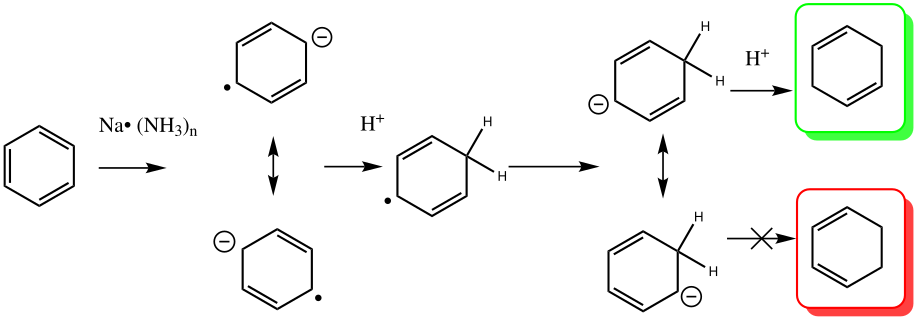
Birch reduction of benzene itself results in 1,4-cyclohexadiene rather than the more stable (conjugated) 1,3-cyclohexadiene. Why is this?

The mechanism, as elaborated in the previous two posts, involves a one-electron transfer from a sodium atom to form the radical anion, which is then protonated in a second step, and this is again reduced to form a pentadienyl anion in the penultimate step.[1] The question now becomes why does this anion protonate to give predominantly the less stable diene product? The answer involves the actual structure of this anion. A calculation at the ωB97XD/6-311+G(d,p)/SCRF=acetonitrile level for the ion pair comprising the cyclohexadienyl anion and a Na(NH3)3+ counterion is shown below.

Structure of the cyclohexadienyl ion pair. Click for 3D.

From this, it appears that the sodium cation is η2 coordinated to each of two relatively localised double bonds (1.37Å), resulting in the negative charge accumulating on just the one carbon (red arrow), this being the carbon that then exclusively receives a final proton. The highest energy (-0.115 au) natural bond orbital (NBO) also emerges as being located on this carbon (the next two highest energy NBOs only come in at -0.303 au, and reside on each of the localised alkene bonds).

The highest energy NBO orbital. Click for 3D.

The molecular electrostatic potential in effect integrates over all the electrons (not just those in the highest orbital), resulting in a function that measures the attractiveness of any point to a proton (red). It too shows that the most attractive region (red) for a proton is again on this carbon.

Molecular electrostatic potential. Click for 3D.

There is even evidence from crystal structures that this sort of motif is possible. Thus the dianion of 1,4-diphenylbenzene (with two Na(thf)3+ counter-ions) reveals[2] this type of coordination.  The buckling seen in the above mono-anion is inhibited by the presence of cations on both sides of the di-anion, but the pattern of short/long bonds seen above also manifests in the crystal structure.

Crystal model. Click for 3D.

So the take home message is that the counter-ion (solvated sodium cations) in the Birch reduction  of benzene itself may coordinate to the anionic intermediates in the reductive process, and the resulting geometry of this ion-pair determines the eventual product of protonation.

References

  1. H.E. Zimmerman, and P.A. Wang, "Regioselectivity of the Birch reduction", Journal of the American Chemical Society, vol. 112, pp. 1280-1281, 1990. https://doi.org/10.1021/ja00159a078
  2. J.H. Noordik, H.M. Doesburg, and P.A.J. Prick, "Structures of the sodium–<i>p</i>-terphenyl ion pairs: disodium terphenylide–tetrahydrofuran (1/6) and disodium diterphenylide terphenyl–1,2-dimethoxyethane (1/6)", Acta Crystallographica Section B Structural Crystallography and Crystal Chemistry, vol. 37, pp. 1659-1663, 1981. https://doi.org/10.1107/s0567740881006833

The mechanism of the Birch reduction. Part 2: a transition state model.

Monday, December 3rd, 2012

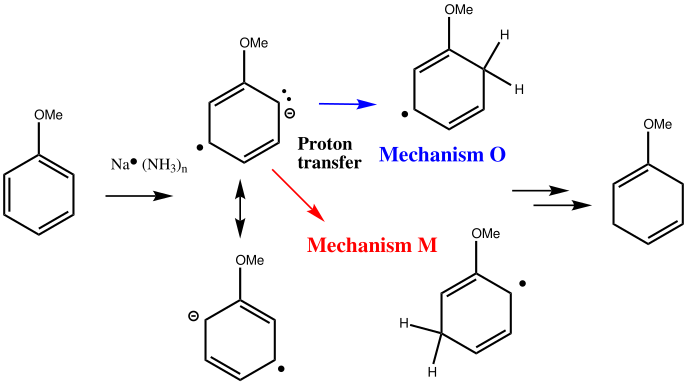
I promised that the follow-up to on the topic of Birch reduction would focus on the proton transfer reaction between the radical anion of anisole and a proton source, as part of analysing whether the mechanistic pathway proceeds O or M.

To add some context, Hammond’s postulate [1] states that “the structure of a transition state resembles that of the species nearest to it in free energy.” If the structure of the transition state for proton transfer above resembles that of the radical anion precursor we would call this an early transition state and it would be a reasonable approximation to infer properties of the reaction from the properties of that radical anion. The previous post explored those properties via the computed molecular electrostatic potential (MEP) and the highest energy NBO (natural bond orbitals, which are used here instead of molecular orbitals). Unfortunately, they did not agree with each other. Remember that Hammond’s postulate dates from 1955, an era when it was not practical to compute the structure of a transition state directly using quantum mechanics (certainly not so for such a complex reaction as that shown above). Indeed, one might argue that such a structure has only become computable in a practical sense very recently! As I showed previously, the radical ion-pair resulting from a 1-electron transfer from sodium to anisole has a dipole moment of ~11.6D, and the reaction is conducted in a solvent of medium polarity. This combination means that one really is obliged to take into account the dielectric of the solvent, and indeed any strong explicit hydrogen bonds that might be present. The codes for doing this have really only recently become robust enough to tackle such an endeavour[2], which might explain why such calculations are not yet abundant, or ubiquitously cited in the text books.

Proton transfer for M mechanism. Click for 3D.

The proton transfer via one M mechanism is shown above. The proton source is ammonia, which is known from experiment to lead to sluggish reactions (the more acidic t-butanol is often added to speed up the reaction), but we can see that the transition state is very late, νi 423.8 cm-1. The N…H bond is largely broken, and the C-H bond is mostly formed. The dipole moment is 7.7D, also different from that of the reactant. Perhaps, knowing this, it is not too surprising that inferences based on Hammond’s postulate as applied to the reactant are not reliable. The value of ΔG298computed from this model is 22.8 kcal/mol, which is on the high-ish side for a reaction to occur readily at room temperatures or below.[3] This nevertheless nicely conforms what we already know, that a more acidic proton donor is needed to achieve a fast reaction.

Proton transfer for O mechanism. Click for 3D.

The proton transfer via one O mechanism is similar, but a tad less “late”. This already raises doubts about application of Hammond’s postulate to this system; one cannot really compare two reactions in which each reactant differs in its resemblance to its transition state. The dipole moment of this alternative transition state is also 7.7D, but the transition imaginary mode is much higher at νi 869 cm-1. The free energy barrier is 21.0, some 1.8 kcal/mol lower than the barrier for the M mechanism. This corresponds to a rate about 21 times faster for O over M (at 298K).

To conclude, we characterise two (of the four) isomeric transition states for protonation of the radical anion intermediate in the Birch reduction of anisole. These two transition states are actually different in several subtle regards, differences which would not have manifested if only the properties of the reactant had been considered. The final word must be that the text books are likely correct on this one, although a little more work is still needed to tidy up loose ends.  

References

  1. G.S. Hammond, "A Correlation of Reaction Rates", Journal of the American Chemical Society, vol. 77, pp. 334-338, 1955. https://doi.org/10.1021/ja01607a027
  2. J. Kong, P.V.R. Schleyer, and H.S. Rzepa, "Successful Computational Modeling of Isobornyl Chloride Ion-Pair Mechanisms", The Journal of Organic Chemistry, vol. 75, pp. 5164-5169, 2010. https://doi.org/10.1021/jo100920e
  3. H.E. Zimmerman, and P.A. Wang, "Regioselectivity of the Birch reduction", Journal of the American Chemical Society, vol. 112, pp. 1280-1281, 1990. https://doi.org/10.1021/ja00159a078