Archive for the ‘Uncategorized’ Category

Transition state models for Baldwin dig(onal) ring closures.

Sunday, June 10th, 2012

This is a continuation of the previous post exploring the transition state geometries of various types of ring closure as predicted by  Baldwin’s rules. I had dealt with bond formation to a trigonal (sp2) carbon; now I add a digonal (sp) example (see an interesting literature variation). 
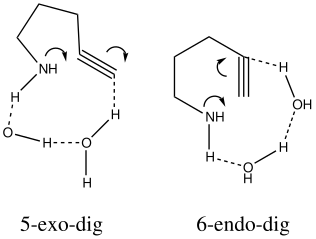
As before, I have added two solvent (water) molecules to the model, since the immediate product of the closure is a zwitterionic intermediate, which is likely to be stabilised by the solvent. I also used the same nucleophile as before to facilitate comparison.

5-exo-dig transition state. Click for 4D.

6-endo-dig transition state. Click for 4D.

The digonal angle of attack is 121° for the  exo form, and 116° for the endo, both larger than was the case in the trig systems. The relative free energies of the two transition states is 3.6 kcal/mol in favour of the exo isomer. The hydrogen bond network is somewhat strained, since two solvent molecules cannot quite reach the forming carbanion at the optimal angle to form a good hydrogen bond to it. Instead, the water has to content itself with a π-facial hydrogen bond between the alkyne and the H-O. As a result, proton transfer to the carbon requires a separate activation step (or a stronger acid than water). 

5-exo-dig transition state
6-endo-dig transition state

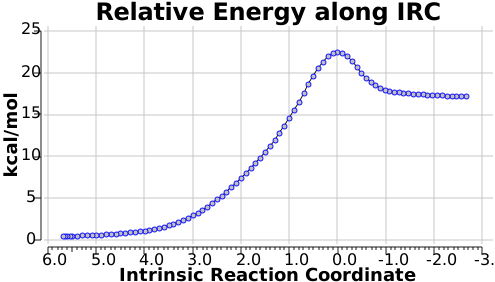
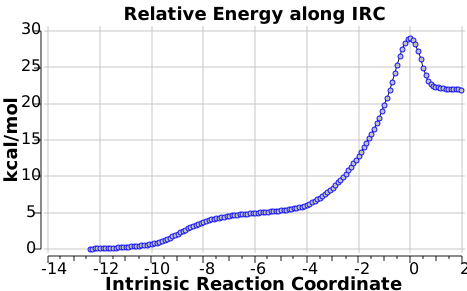
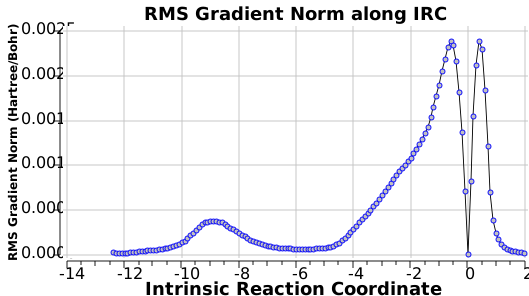
The IRC for the 6-endo-dig pathway has features worth commenting upon.

  1. At IRC -12, the two solvent molecules form a triangular network with the nucleophilic amine.
  2. By IRC -9, one of the water molecules has split itself off from this triangle, and started to move towards the triple bond, which is gradually becoming a better acceptor of a hydrogen bond.
  3. At IRC -3, this water molecule is now forming a  π-facial hydrogen bond to the alkyne, which is still largely in place at the end of this step of the mechanism.

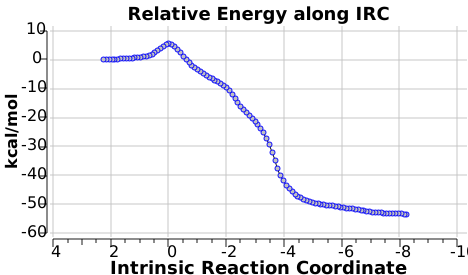
To complete the mechanism, I have added the final step in the reaction, a proton transfer from the amine to the carbon recipient, as facilitated by the bridge of solvent molecules connecting the start and end of the process. The free energy of this transition state is 0.3 kcal/mol higher than the N-C bond forming reaction, making it (just) the rate determining step.

Proton transfer

Transition state for proton transfer. Click for 4D

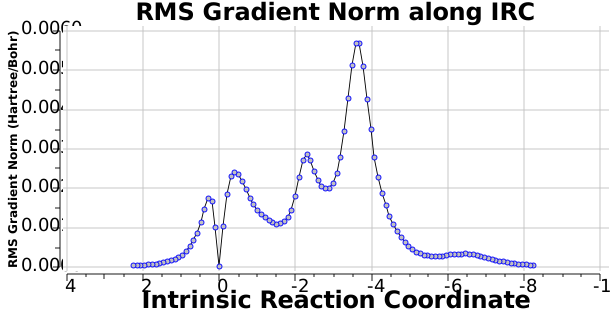
  1. The feature at IRC = 0.0 (the transition state) is the first proton transfer, from  C to O.
  2. The second feature at  IRC -2.5 is an O to O proton transfer
  3. At IRC -4, the third and final proton transfer can be seen, from O to N.
  4. At IRC -6.5, a weak π-OH hydrogen bond forms.

There is one more common type of cyclisation covered by Baldwin’s rules, this time involving tet(rahedral) or sp3 centres. This turns out to be the most interesting of the lot; reporting on this will have to wait a little!
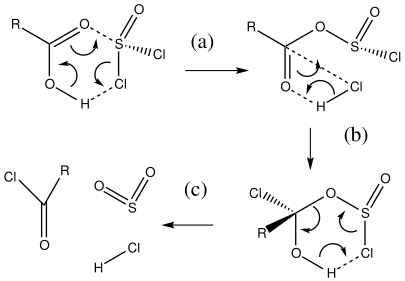
The mechanism (in 4D) of the reaction between thionyl chloride and a carboxylic acid.

Friday, May 25th, 2012

If you have not previously visited, take a look at Nick Greeves’ ChemTube3D , an ever-expanding gallery of reactions and their mechanisms. The 3D is because all molecules are offered with X, Y and z coordinates. You also get arrow pushing in 3D. Here, I argue that we should adopt Einstein, and go to the space-time continuum! By this, I mean one must also include the order in which things happen. To my knowledge, no compendium of (organic) reaction mechanisms incorporates this 4th dimension. My prelude to this post nicely illustrated this latter aspect. Here I continue with an exploration of the mechanism of forming an acyl chloride from a carboxylic acid using thionyl chloride. The mechanism shown at ChemTube3D is as below and will now be tested for its reasonableness using quantum mechanics.

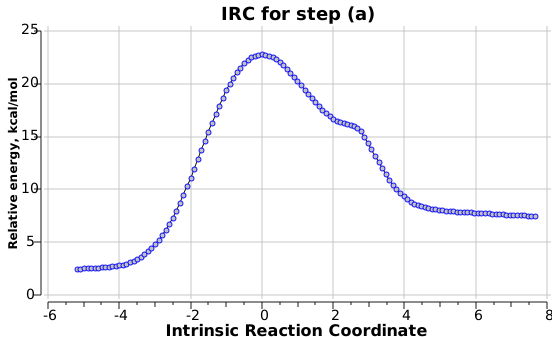
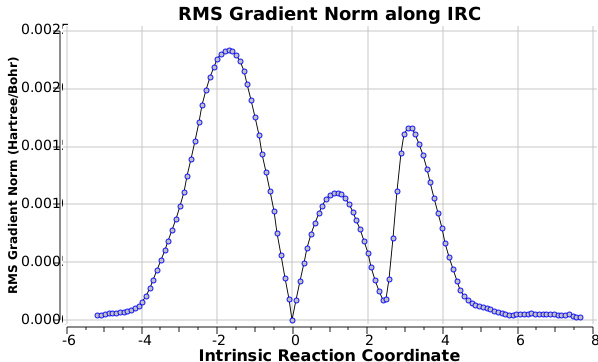
Step (a, R=Me) is shown below (ωB97XD/6-311G(d,p)/SCRF=acetic acid);

  1. From IRC -6 to -2, the oxygen of the acid carbonyl approaches the sulfur. 
  2. IRC -2 then shows one chlorine to start move towards the OH, and the sulfur now adopts a “figure T” coordination.
  3. By IRC +2, the O…H…Cl angle has become almost linear, which is the optimum geometry for a proton transfer
  4. At IRC +3, the proton transfer from O to Cl is about half complete…
  5. A process largely complete by IRC +4.5
  6. Some residual activity takes place on the methyl group, which reorients itself with respect to the adjacent C-O bonds.
  7. The free energy barrier ΔG is 21.9 kcal/mol, which perhaps might be lowered if a solvation model including explicit hydrogen bonds were to be used.
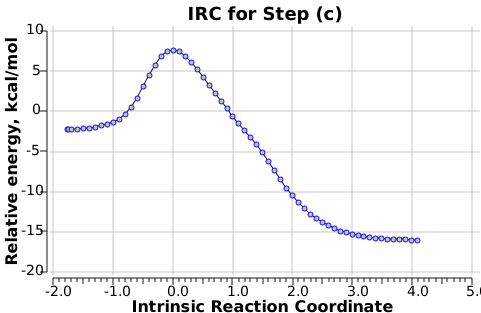
Step (b) is related to the mechanism shown in the previous post, differing only in one aspect. Step (c, R=Me) completes the reaction:
  1. The initial feature (IRC -2 to 0.0) is the cleavage of the C-O bond (1.862Å at the transition state)
  2. This point is 28.7 kcal higher in ΔG than the initial reactants, and is the highest energy point in the mechanism. As noted earlier, additional solvation-stabilisation involving discrete hydrogen bonds from e.g. acetic acid, is likely to lower this energy.
  3. This is followed (IRC +1.0 to +2.0) by a proton transfer from oxygen to chlorine.
Overall then, the scheme shown in ChemTube3D is reflected in reasonable energies calculated using quantum mechanics. The latter of course adds that fourth dimension, and gives us more insight into the order in which things happen. And I should add of course that simply because the mechanism shown here is reasonable, it does not exclude pathways which might be even lower in energy; it is indeed difficult to prove there is no other mechanism of (global) lower energy.

I have discussed elsewhere the conventions used in arrow pushing. Nick uses the “American system” , whereas in this blog, I use a system I will call the Charles Rees method. I prefer this one, since it nicely maps onto more elaborate ways of identifying electron pairs in molecules, such as ELF and QTAIM, which themselves are based on quantum mechanics. Nick’s system differs mostly in the end-point for the arrows which he directs towards atoms whereas I direct them towards bonds. It might also be an interesting discussion point as to what criteria should be used to define three-dimensional arrow pushing; in effect the path that the arrow takes and what (pedagogic) meaning this might have.

Following the initial proton transfer from Cl to oxygen, a very shallow minimum ion-pair is formed as a prelude to forming the C-Cl bond in a second step. This is because the additional oxygen present in a carboxylic acid stabilises the intermediate oxenium cation.

The hydroboration-oxidation mechanism: An updated look.

Sunday, February 26th, 2012

One thing almost always leads to another in chemistry. In the last post, I described how an antiperiplanar migration could compete with an antiperiplanar elimination. This leads to the hydroboration-oxidation mechanism, the discovery of which resulted in Herbert C. Brown (at least in part) being awarded the Nobel prize in 1979.

This reaction represents a fairly steep learning curve for new students of organic chemistry. Actually, it turns out its a pretty steep learning curve for most of us.

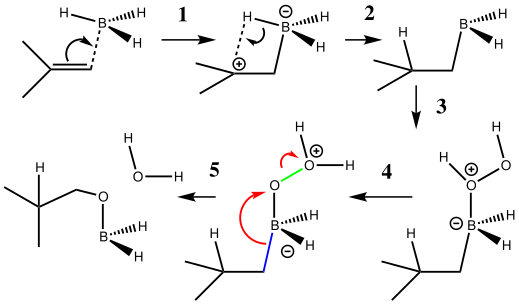
  1. Firstly, it is often described as an anti-Markovnikov  reaction, with the hydroxyl group attaching to the less-substituted carbon (as above). Unfortunately, the mechanism is revealed as following Markovnikov, rather than being an anti example! Confusing?
  2. One possible way of representing the mechanism is to show the (nucleophilic) π-bond attacking the (electrophilic) boron centre of a BH3 molecule (itself presumed to be generated from a suitable reagent such as BH3.SMe2 in a pre-equilibrium step) to form a carbocation (step 1 above). The regiospecificity proceeds so as to form the most stable such carbocation (a tertiary one above). This of course follows the Markovnikov rule and not its negation. The overall reaction might be anti-Markovnikov  but its mechanism is not!
  3. An updated interpretation (not for the faint hearted!) is nicely explained on this blog. This shows that the above “arrow pushing” mechanism, itself based on something called transition state theory, is in fact an over-simplification. Instead, it is necessary to resort to molecular dynamics[1] rather than transition state theory to explain why the boron attaches to the least substituted carbon of the alkene.
  4. I think I had better return to more conventional arrow pushing before I loose whatever audience I have. Step 2 above transfers a hydrogen from the boron to the carbocation to form an alkyl borane
  5. In step 3, this species is reacted with hydrogen peroxide.
  6. In step 4, a proton is transferred in the resulting peroxyalkylborane. Such a step, often simply labelled as PT, is regarded as a freely available equilibrium. In other words, one can move protons around a structure to where-ever is deemed as convenient for the next step (well, within reason).
  7. Step 5 is the key step, and to highlight this, I have shown the arrow pushing using red arrows.
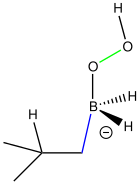
    1. This step now requires the donating bond (shown in blue) and the accepting (anti)bond, shown in green) to be aligned in an antiperiplanar manner. The O-O bond is a very good acceptor, the C-B bond an effective donor, quantified by the E(2) interaction energy in an NBO analysis of 35.5 kcal/mol and an overlap that looks as below:

      Overlap between the C-B donor and the O-O acceptor. Click for 3D.

    2. Note how the bonding part of the C-B bond (purple) overlaps with the blue of the O-O antibonding orbital, thus forming a new C-O bond. The (blue-red) node along the O-O leads to an entirely cleaved O-O bond, but you can see the genesis of a new B-O bond in the  orange-red overlap.
  8. An intrinsic reaction coordinate computed for the reaction is shown below. Note how the evicted water molecule changes direction at the end and makes a bee-line for the boron atom. The end result of this reversal is of course boric acid.

As often happens, it is worth taking a look at a tradition text-book mechanism to see what a modern slant might give it.

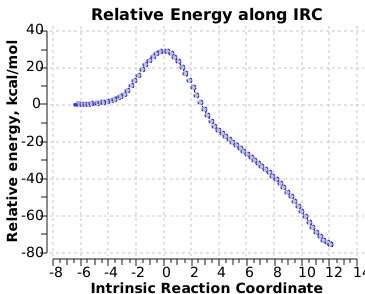
POSTSCRIPT:   You will notice from the comments on this post below, the observation that the hydroboration-oxidation reaction is normally carried out in basic solution. I have therefore repeated the calculations using a deprotonated starting point (ωB97XD/6-311+G(d,p)/SCRF=water) as shown below.

Intrinsic reaction coordinate for deprotonated reactant

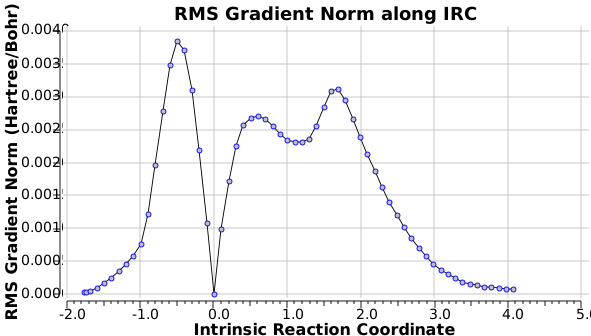
This is best viewed as below, showing both the energy and the energy gradients as a function of the proceeding reaction.

  1. Note first the barrier to the migration, which is  ~30 kcal/mol. This is because OH is an inferior leaving group to H2O (for which the barrier is ~2 kcal/mol). This would make it a very slow reaction at room temperature.
  2. Notice how the first prominent action is a rotation of the OH group.
  3. The O-O bond starts to break before the C-B bond starts to migrate
  4. At an IRC of +6, a second feature appears, which is the reversal of the trajectory of the evicted OH group in re-attaching itself to the boron (as before).
As noted in the comments below, the kinetics are a balance between the slow reaction of a deprotonated species in high concentration, and the much faster reaction of a protonated species in lower concentration.

References

  1. Y. Oyola, and D.A. Singleton, "Dynamics and the Failure of Transition State Theory in Alkene Hydroboration", Journal of the American Chemical Society, vol. 131, pp. 3130-3131, 2009. https://doi.org/10.1021/ja807666d

E2 elimination vs ring contraction: anti-periplanarity in action.

Monday, February 20th, 2012

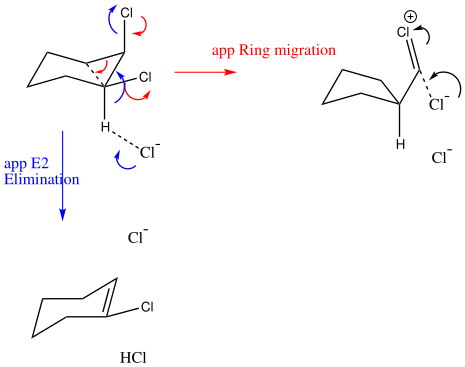
The anti-periplanar principle permeates organic reactivity. Here I pick up on an example of the antiperiplanar E2 elimination (below, blue) by comparing it to a competing reaction involving a [1,2] antiperiplanar migration (red).

The relative rates of these two processes will depend on several factors such as the ability of Cl to donate electrons (red) vs the basicity of the chloride anion (blue) and of course solvent polarity. It is the balance between these two mechanisms that caught Barton’s eye and helped him formulate his ideas about conformational analysis. Calculations (ωB97XD/6-311G(d,p)/SCRF=water) help reveal the basic features of the competition; details can be found for the ring contraction and E2 elimination.

Ring contraction E2 Elimination

Ring contraction. Click for 3D.

E2 elimination. Click for 3D.

If you focus on the dashed bonds, you can easily identify the anti-periplanar components for each reaction. In this specific example, the E2 reaction wins out over the ring contraction/migration by ΔΔG298 = 17.6 kcal/mol. (One of) the orbital interactions responsible for the antiperiplanar migration is shown below.

The orbital overlap in the app migration. Click for 3D

The Intrinsic reaction coordinates for the E2 elimination and migration are shown below, oriented to demonstrate their app nature.

You might notice that via these posts, I am gradually building up a library of transition states for taught reactions. Still a few to go however!

An exothermic E2 elimination: an unusual intrinsic reaction coordinate.

Monday, February 6th, 2012

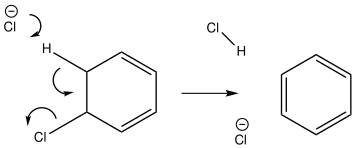
The previous post explored why E2 elimination reactions occur with an antiperiplanar geometry for the transition state. Here I have tweaked the initial reactant to make the overall reaction exothermic rather than endothermic as it was before. The change is startling.


The exothermicity is of course due to the aromatisation of the ring. The IRC is however quite different from before.

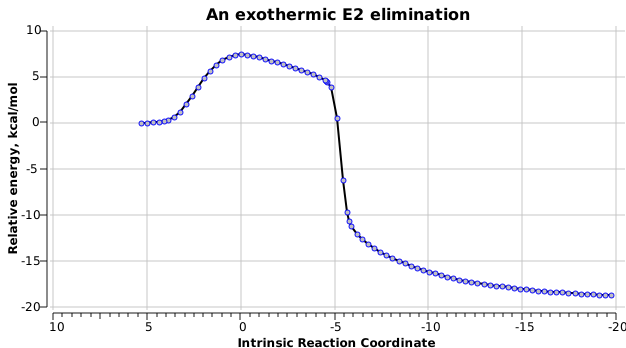
IRC for E2 elimination. Click for 3D

  1. The transition state (IRC=0.0) is reached early, and the initial movement is of the chlorine on the right. This in fact resembles an E1 elimination to form an intermediate carbocation. This, being a resonance stabilised (Wheland) type of cation, is particularly favoured.
  2. At this point, the H-C bond has scarcely started breaking (1.13Å).
  3. When IRC of -5 is reached, the C-Cl bond is essentially broken (3.05Å). At this point the energy is still higher than the reactant.
  4. A sudden abrupt change occurs resulting from rapid proton transfer at IRC -6, and the energy plummets to become exothermic.

So, like the SN1 reaction discussed in another post, this E2 reaction occurs in distinct stages, the first resembling an E1 mechanism, followed by a second phase leading to elimination. It is still a concerted reaction, but the proton transfer occurs only AFTER the transition state. The simple designation  E2/E1  is clearly not a fully adequate description of such mechanisms.

Secrets of a university tutor: dissection of a reaction mechanism. Part 2, the stereochemistry.

Monday, January 30th, 2012

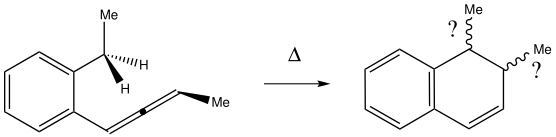
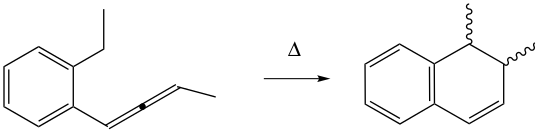
In the previous post, I went over how a reaction can be stripped down to basic components. That exercise was essentially a flat one in two dimensions, establishing only what connections between atoms are made or broken. Here we look at the three dimensional arrangements. It all boils down to identifying what the stereochemistry of the bonds marked with a wavy line are.

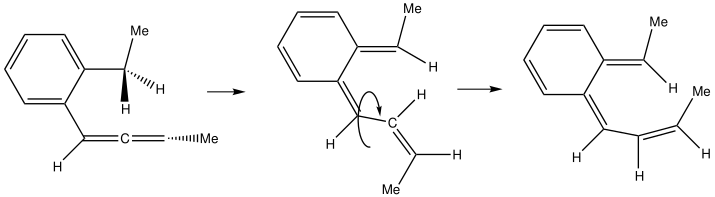
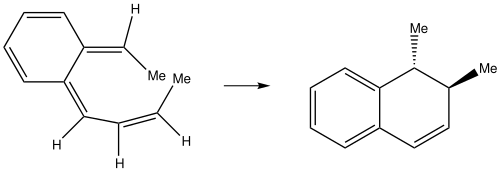
To make it simple, let us start with the molecule shown on the left. The calculated transition state for the hydrogen shift is shown below. Click on the graphic to see a 3D model. You should notice how the hydrogen flies from the top face of the carbon (marked R below) to the top face of the accepting carbon. This is described as a suprafacial transfer, and it is the mode predicted by the pericyclic selection rule for a 4n+2 electron pericyclic reaction.

A 1,5 hydrogen shift. Click for 3D.

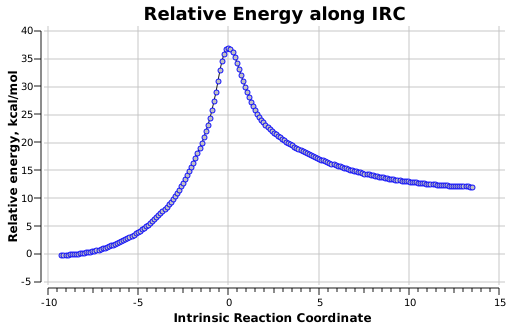
The energy profile for the reaction looks as below (ωB97XD/6-311G(d,p) calculation). It is a reaction that needs a fair bit of heating. Notice it is ~ 12 kcal/mol endothermic, and this is because the aromaticity of the benzo ring is destroyed in the resulting intermediate.

You can also inspect the animation of the intrinsic reaction coordinate, as below. Note the relatively initial slow movement of the atoms, and how in contrast the hydrogen atom shoots over quite quickly.


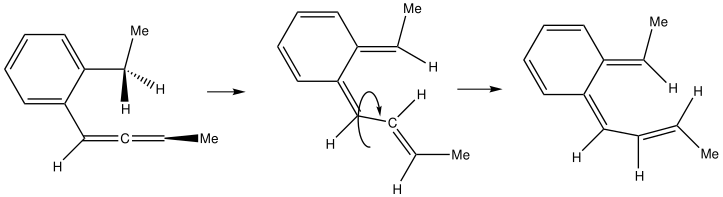
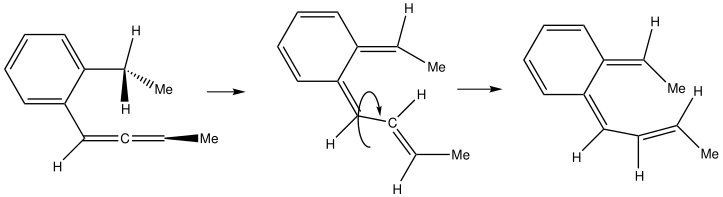
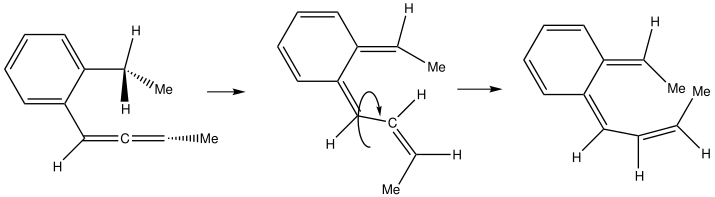
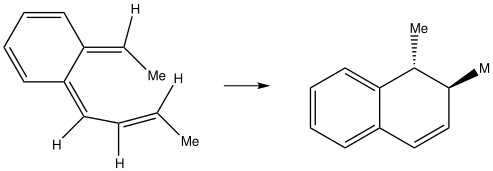
We can now repeat this for the four possible stereoisomers, as shown below. Another four appear possible in which the hydrogen migrates from the bottom face, but in fact these are identical to the first four. Of these, the first (the one shown above) is the lowest in free energy, and this can largely be attributed not so much to pericyclic selection rules, but to the steric bulk of the two methyl groups and their propensity to avoid each other.

Stereochemistry ΔΔG [1,5]
0.0 
1.2  
0.6 
1.5 

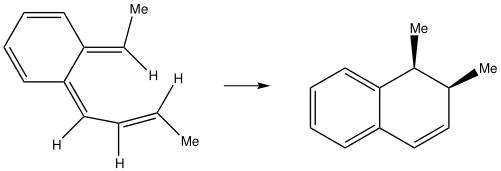
Now to the second step. For this to happen, one of the chains has to rotate about the bond shown above, this being a low energy process and this now sets up the formation of the C-C bond between the termini of the hexatriene.

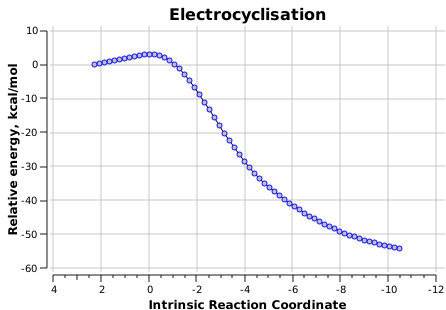
The barrier for forming this last bond is very small, since it is encouraged to do so by the re-formation of an aromatic ring. Notice also how the benzo group appears to re-aromatise before the C-C bond formation has progressed much. The final stereochemisty has both methyl groups pointing up because the forming C-C bond again does so suprafacially along the top face of the system. This again is as it should be for a 4n+2 electron pericyclic reaction.

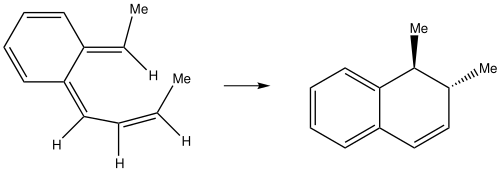
What about the alternatives, which are shown below. Notice how, as the two methyl groups are forced closer and closer together, the energy of this second step starts to go up.

Stereochemistry ΔΔG Electro
-6.7 
-2.4 
-0.2 
+20.1 

Take for example the second example in the series above. Notice how the initial geometry of the hexatriene adopts a helical shape to ensure that the methyl groups avoid each other, with the result that the two termini of the hexatriene present an antarafacial motif.

Helical (antarafacial) initial shape for the hexatriene

As the reaction starts up, one end of the hexatriene starts up a rotation, and ends up presenting its other face, resulting in a suprafacial addition after pretending it might go antarafacial.

The final fourth example is the oddest. The initial hexatriene geometry is again helical, to avoid the two methyl groups approaching each other too closely. Whereas before, the molecule had time to rearrange itself to present a suprafacial aspect to the forming bond, this time it does not. The transition state ends up forming the bond antarafacially after all, and of course, this is  a forbidden 4n+2 thermal pericyclic reaction.

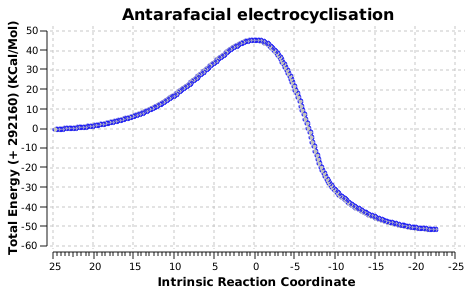
Antarafacial electrocyclisation.

The IRC shows the antarafacial component more clearly. There is a penalty to be paid; the energy now shoots up and is 20 kcal/mol higher than the first step. There is one other oddity. Normally in most pericyclic reactions where a C-C bond forms, its length is ~2.2Å at the transition state. Not so this particular example, where the length is closer to 3.2Å.  Presumably, by making the reaction an early one, the molecule avoids the worst ravages of the 4n+2 antarafacially induced antiaromaticity.

So to summarise, you can see by now that explaining the stereochemistry of a reaction necessitates looking at two aspects; the orbital controlled supra/antarafacial aspects, and the simple steric effects of two groups approaching too closely. This example nicely combines the aspects of stereo-electronic control and conformational analysis.

Secrets of a university tutor: dissection of a reaction mechanism.

Wednesday, January 25th, 2012

Its a bit like a jigsaw puzzle in reverse, finding out to disassemble a chemical reaction into the pieces it is made from, and learning the rules that such reaction jigsaws follow. The following takes about 45-50 minutes to follow through with a group of students.

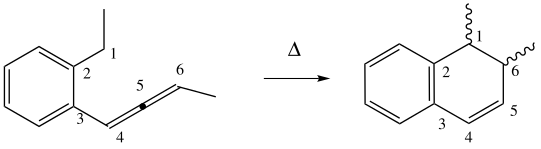
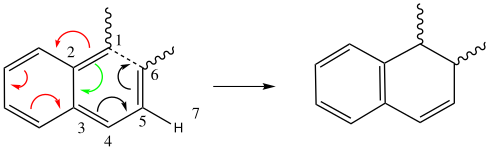
The problem is initially posed as the above (ignore the wavy bonds for now). The challenge is to identify the basic components that the reaction is built from and the rules these follow. It can be usefully salami-sliced as follows

  1. You are told the puzzle may consist of one or more (consecutive) pericyclic reactions. This should load up in your mind (from lecture notes) the various basic types of such reactions (the basic shapes of the jigsaw puzzle if you like).
  2. Rules from other areas of chemistry may be needed. Thus from your knowledge of the chemistry of benzene and its aromaticity, you need to remind yourself that there are two resonance forms (the Kekule forms) which are entirely equivalent. Problems such as the above may however be posed using either one or both of these forms. We will find out if this matters or not shortly.
  3. We need to clearly identify exactly what changes when the reaction occurs. To do this, it is useful to number what you think might be the key atoms.
  4. Notice that some atoms are not numbered. It keeps things simple, but in fact numbering them all will not do any damage. The atoms not numbered are the methyl groups (it does seem as if they emerge from the reaction unchanged) and the benzo group on the left. Only time will tell if this scheme needs changing.
  5. And now we are in a position to create a checklist of changes that occur during the reaction.
    1. A σ-bond between 1-6 clearly forms
    2. A π-bond between 5-6 decreases to a σ
    3. The π-bonds in the (un-numbered) benzo group rotate. We recognise this as a benzene resonance rather than a (pericyclic) reaction.
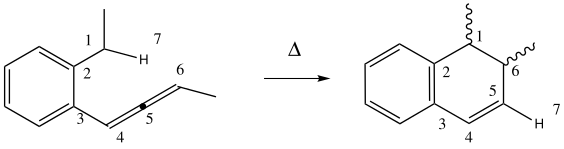
    4. And now for the elephant in the room, the atoms that we (as chemists) know are there, but which are not explicitly shown. These are the hydrogens. We know a rule for this, which is that any structure shown without hydrogens is assumed to have as many attached as are required to achieve a four valent carbon. This is in fact a fuzzy rule, because some carbons can be divalent (carbenes) and some trivalent (carbocations). Normally the former have a : glyph appended to them, and the latter a + charge, and we can see neither here so our rule stands. Time to count the elephants, and to draw the significant hydrogens explicitly (drawing them all would only clutter). We only select those hydrogens that appear to have moved during the reaction. Thus:
    5. A σ-bond between 5-7 clearly forms
    6. A σ-bond between 1-7 clearly breaks
  6. We have four significant bonds that change, 1-6, 5-6, 5-7 and 1-7. The task now is to partition them into groups that might correspond to one of the basic types of pericyclic reaction, and these tend to be defined by how many σ-bonds make or break during the reaction
    1. Thus an electrocyclic reaction either forms or breaks just one σ-bond
    2. A cycloaddition forms two (or more) σ-bonds and its reverse, a cyclo-elimination breaks two (or more) σ-bonds
    3. A sigmatropic reaction forms one σ-bond and breaks another.
    4. Ene reactions break at least one σ-bond and form at least one other, but in unequal numbers that distinguish them from a sigmatropic reaction.
  7. Juggling with these pieces soon reveals that items 5.5 and 5.6 above can comprise a sigmatropic reaction, and that item 5.1 above constitutes an electrocyclic reaction. Item 5.2 above, involving only a π-bond is not counted.
  8. The next task is to decide which comes first! To do this, we need to again recollect carbon tetravalency, and the sacrosanct need not to exceed it. Clearly forming the 1-6 bond as our first action would violate this rule by creating a pentavalent carbon atom. So this leaves 5-7/1-7 as our first action, which is going to be a sigma tropic reaction.
  9. We might recognise at this point that 5-7/1-7 share a common atom (7). We can probably pencil in that this sigma tropic reaction is going to be of the type [1,?] from this observation. From the numbering above (which in fact was deliberately chosen to achieve this effect) we infer that hydrogen 7 moves along a chain of 5 carbon atoms, and so our nomenclature is complete; it is going to be a [1,5] hydrogen migration or sigmatropic shift. Had the numbering been different, we would have had to spot that the non-common bonds differed by five atoms.
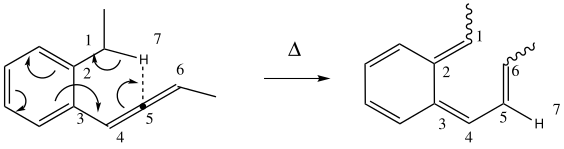
  10. The arrow pushing to achieve this transformation is shown below. Notice that the arrows rotate anti-clockwise. It is a feature of pericyclic reactions that it does not matter which clock-direction they rotate in (mostly). Hence pushing them the other way would achieve exactly the same result.
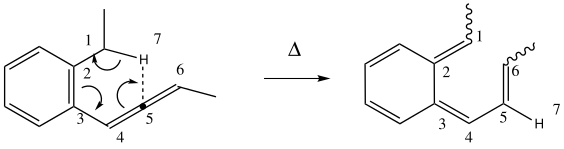
  11. This brings a surprise; we needed five arrows, or ten electrons. Is that a unique solution? Well no. Had we remembered point 5.3 above, then another initial resonance form for the benzo-ring is possible, and this form requires us to push only three arrows, or six electrons.
  12. Is there a common factor between 6 and 10 electrons? Yes, it is the famous Hückel aromaticity 4n+2 rule, for which n =1 or 2. So we get the result we really wanted, which is does not matter which of the two resonance forms for the benzo group we start with, we end up with arrow pushing that either way merely conforms to the 4n+2 rule. In other words, the transition state for this first reaction is aromatic. The stereochemistry implied by this result is going to be deferred to a second tutorial on this topic (and this is where the wavy lines will also come in).
  13. There is another observation we can make. The product of the [1,5] sigmatropic hydrogen shift no longer carries an aromatic ring on the left. We might infer that it will only be a transient intermediate, and will be very inclined to restore the aromaticity at the first opportunity.
  14. We are now in a position to create the 1-6 bond without violating the valency of either atom.
  15. The arrows shown above are two (black) to which can be followed either one more (green) or three more (red), making two possibilities carrying either 6 or 10 electrons. Again, both conform to the 4n+2 rule and so it does not matter which set is followed; the electrocyclic reaction will have an aromatic transition state (again we ignore stereochemistry for the time being).
  16. And hey, we have also recovered the aromaticity of our benzo group on the left.
Well, it is now time to finish up this first tutorial on the topic. In the follow up, I will show these aromatic transition state I have referred to here, and also include discussion of the stereochemistry.


Violations. There are none!

Sunday, December 11th, 2011

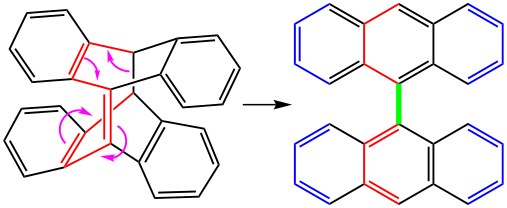
Thus famously wrote Woodward and Hoffmann (WH) in their classic monograph about the conservation of orbital symmetry in pericyclic reactions. But they also note that the “fantastic” hydrocarbon (number 85 in their review) shown below presents a situation of great interest in having a half life of ~30 minutes at 353K (a free energy barrier of ~ 26.2 kcal/mol). Here I investigate if it might actually be such a violation.

I should first note that WH expect that violating reactions are likely to comport themselves via a non-concerted reaction path involving discrete intermediates.1 Which in the above case would be a biradical. But why is it an interesting example? Because, as a 4n (n=2) electron electrocyclic reaction (involving the bonds shown in red above), it must involve one antarafacial component. This is apparently rendered impossible (so WH claim) by the very rigid geometry of the system. However, an alternative, and geometrically more viable reaction involving only suprafacial components would indeed be be a violation according to their definition, if it were to be concerted, without (biradical) intermediates. So if a concerted pathway with no antarafacial components could be found, it would constitute a violation.

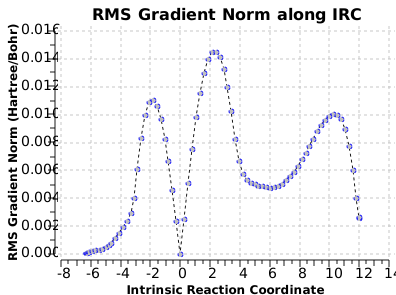
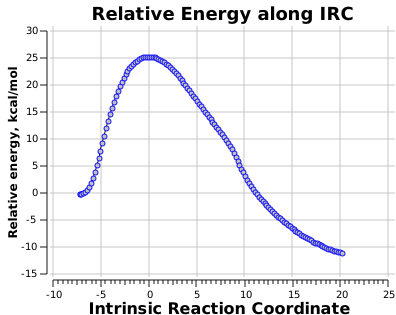
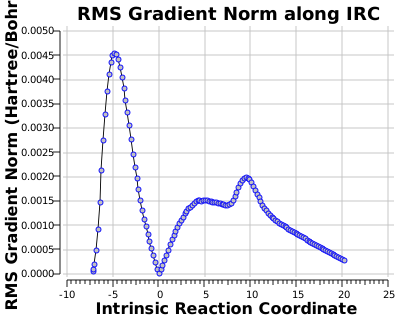
To model this system, the benzo groups (blue) are first removed. A transition state for the reaction is found [ωB97XD/6-311g(d)] with ΔG 21.5 kcal/mol and an intrinsic reaction coordinate (IRC) that shows a concerted profile, albeit one with quite unusual features revealed in the gradient norm along the IRC.

  1. One might first note that the calculated barrier is similar to that measured for the real reaction (albeit with benzo groups). Although this does not prove that a lower energy process (such as involving biradicals) does not occur, it does at least suggest that the concerted pathway is not unreasonable given the observed kinetics of the reaction.
  2. The geometry up to the transition state (IRC=0.0 above) retains a plane of symmetry, and there is no hint of any axis of symmetry developing that might be associated with twisting due to an antarafacial component (click on the graphic below to inspect this geometry). However, the length of the cleaving bond (2.85Å) is unusually long for a transition state involving C-C cleavage, and the double bond (green above) is still intact (1.33Å). There is however an asymmetry developing, in which one of the 6-rings is moving faster than the other.
  3. At an IRC value of +5 (well past the transition state), something unexpected starts to happen; it is best seen as a very prominent feature in the gradient norm. Only now does the C=C bond start to lengthen to that typical of a pericyclic transition state (~1.40Å).
  4. By IRC +8, the erstwhile C=C bond has reached 1.43Å, but the geometry still retains most of its plane of symmetry. At IRC +10, this suddenly and abruptly breaks, and one trans alkene starts to form in the rhs ring. You can see this in the animation below, where one hydrogen suddenly accelerates its motion to fully assimilate the trans position (this phenomenon is a feature of so-called valley-ridge inflection points) and the other reverses its own motion. Prior to this, the trans component had been divided amongst two C=C bonds in the forming product, thus preserving the plane of symmetry.

    Animation of the geometry along the IRC. Click for 3D.

  5. The product of this IRC is thus a biphenyl where one of the phenyl rings sustains a trans component, a Möbius benzene in fact! Appropriately, the bond lengths in this (antiaromatic) ring alternate, whereas they are all equal in the other (aromatic) ring.
    Click to invoke Jmol Rotate with mouse

    A Möbius benzene. Click for 3D

  6. Well, what a journey, in which most of the interesting action occurred AFTER the transitions state, controlled by the subsequent forces (dynamics) acting on the potential. It turned out to be a concerted reaction with a reasonable barrier. At the transition state itself, it was looking as if it might actually be a violation in the WH sense. But the requisite – better late than never – antarafacial component was indeed incorporated into the final product
The above is only a model of the real molecule 85, which has additional benzo groups. At the transition state, these benzo groups might still be added without the need for any severe geometrical distortions. Of course the resulting twisting after the transition state to form a Möbius ring would be inhibited by their presence. It is clear that the final word is not yet said about what WH called the fantastic hydrocarbon.

WH argued that violations of their rules would be avoided by the reacting system adopting a stepwise, non-concerted pathway. It may be that the dynamics of reactions would also allow avoidance to occur by adopting concerted, but asynchronous geometrical distortions such as those seen here.2


1 “When I use a word,” Humpty Dumpty said in rather a scornful tone, “it means just what I choose it to mean – neither more nor less.” I add this quote, since the WH approach is based on an orbital picture deriving from a single determinantal SCF solution of the Schroedinger equation. In so-called multi-configurational treatments (MCSCF), molecular orbitals for a single configuration no longer occupy such a central position in the theory.

2 For example, it could be argued that a violation of the WH rules for 2πs + 2πs thermal cycloadditions can be avoided by a trapezoidal distortion, DOI: 10.1039/A805668D.

A modern take on pericyclic sigmatropic migrations.

Tuesday, November 29th, 2011

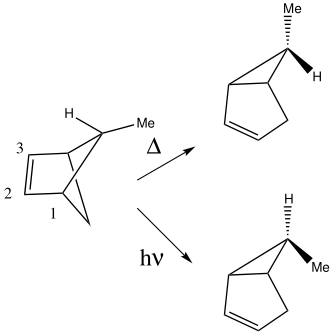
Another common type of pericyclic reaction is the migration of hydrogen or carbon along a conjugated chain, as in the [1,3] migration of a carbon as shown below. As before, I explore the stereochemistry of the thermal and photochemical reactions.

The reaction is known to proceed thermally with inversion of configuration at the migrating carbon, and constitutes a 4n-electron reaction involving one antarafacial component (at that carbon). As usual, the thermal reaction can be rationalised by its transition state and an accompanying IRC.

IRC for the thermal migration of a carbon. Click for 3D.

The photochemical reaction (not hitherto studied as far as I know) has a conical intersection between the S1 and S0 states which clearly displays migration of the carbon with retention (suprafacially).

Photochemically induced 1,3 migration with retention of configuration. Click for 3D

I conclude this trio of pericyclic reactions with a re-affirmation of the general rules for such reactions, which state that changing the reaction conditions from heat to light is likely invert one suprafacial or antarafacial stereochemical component,  located either on the transition state (for the thermal reaction) or the conical intersection (for the photochemical equivalent). A caveat is necessary, in that the pathways for photochemical reactions are generally more complex than thermal ones, and so exceptions to this broad statement may well be easy to find.

A modern take on pericyclic cycloaddition. Dimerisation of cis-butene

Monday, November 28th, 2011

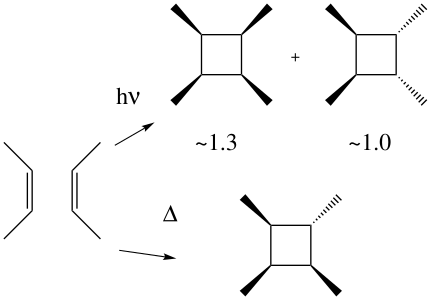
The π2 + π2 cyclodimerisation of cis-butene is the simplest cycloaddition reaction with stereochemical implications. I here give it the same treatment as I did previously for electrocyclic pericyclic reactions.


The photochemical reaction is known to give a mixture of two tetramethylcyclobutanes in the ratio of 1.3:1.0, with the all-cis isomer apparently predominating. The key geometry is the conical intersection, at which the energies of the S1 and S0 states coincide. This geometry has a typical trapezoidal appearance, with suprafacial addition accross both components. The exo addition is calculated to be about 1 kcal/mol lower in total energy than the endo (at the CASSCF(12,8)/6-31G(d) level), which implies that the latter should be the minor and not the major form. However, these CASSCF energies are not corrected for thermal (entropic) or dynamic correlation components, and moreover the active space orbitals are probably not identical either (I demonstrated in another post how the orbitals of the alkene interact with those of the methyl groups, and its quite likely that the endo and exo orientations will result in slightly different interactions) which makes such comparisons non trivial. These calculations do support the idea that both isomers should form (which at first sight might be counter-intuitive given the apparent steric constraints of the endo isomer).

2+2 exo addition. click for 3D

2+2 endo addition. Click for 3D.

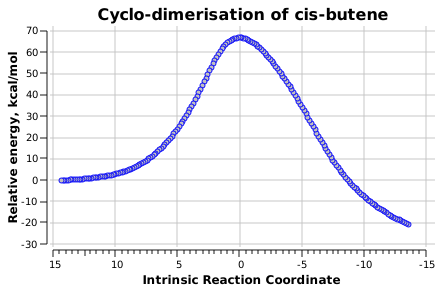
The thermally activated reaction is not known for this alkene, and the calculations support this with an enormous barrier to reaction (> 68 kcal/mol).

As a 4n-electron pericyclic, the selections rules require there to be one antarafacial component present, and the IRC for this reaction illustrates this very nicely. The formation of two pairs of C-C bonds is very asynchronous. Only when the first bond is almost complete does the second C=C start to rotate. The second C-C bond only starts to form after this rotation (the antarafacial component) is essentially complete, forming a product where one methyl group is on the opposite face of the ring to the other three. Note in particular that the rhs alkene has the two C-H hydrogens synplanar to start with, but that they are exactly antiperiplanar in the product.

2a + 2s cycloaddition showing IRC. Click for 3D

For this small system the two critical points, a conical intersection and a transition state, could not be more different. But they do capture the essential features of pericyclic reactions and their selection rules.