Posts Tagged ‘Baldwins rules’

Transition state models for Baldwin dig(onal) ring closures.

Sunday, June 10th, 2012

This is a continuation of the previous post exploring the transition state geometries of various types of ring closure as predicted by  Baldwin’s rules. I had dealt with bond formation to a trigonal (sp2) carbon; now I add a digonal (sp) example (see an interesting literature variation). 
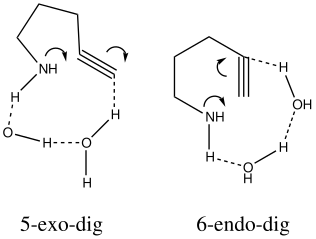
As before, I have added two solvent (water) molecules to the model, since the immediate product of the closure is a zwitterionic intermediate, which is likely to be stabilised by the solvent. I also used the same nucleophile as before to facilitate comparison.

5-exo-dig transition state. Click for 4D.

6-endo-dig transition state. Click for 4D.

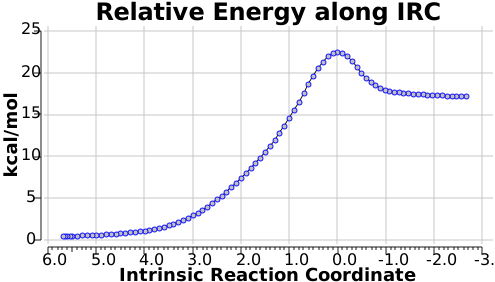
The digonal angle of attack is 121° for the  exo form, and 116° for the endo, both larger than was the case in the trig systems. The relative free energies of the two transition states is 3.6 kcal/mol in favour of the exo isomer. The hydrogen bond network is somewhat strained, since two solvent molecules cannot quite reach the forming carbanion at the optimal angle to form a good hydrogen bond to it. Instead, the water has to content itself with a π-facial hydrogen bond between the alkyne and the H-O. As a result, proton transfer to the carbon requires a separate activation step (or a stronger acid than water). 

5-exo-dig transition state
6-endo-dig transition state

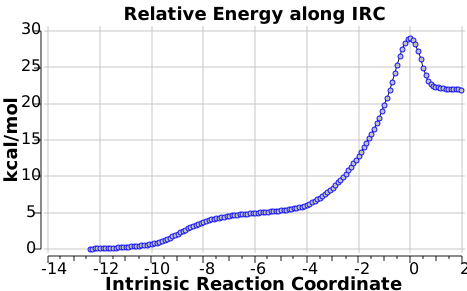
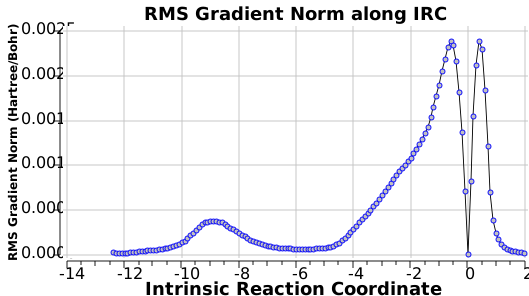
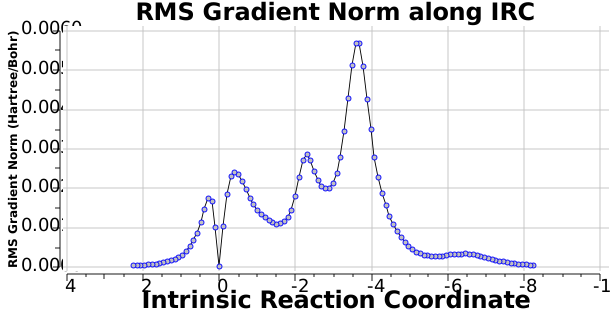
The IRC for the 6-endo-dig pathway has features worth commenting upon.

  1. At IRC -12, the two solvent molecules form a triangular network with the nucleophilic amine.
  2. By IRC -9, one of the water molecules has split itself off from this triangle, and started to move towards the triple bond, which is gradually becoming a better acceptor of a hydrogen bond.
  3. At IRC -3, this water molecule is now forming a  π-facial hydrogen bond to the alkyne, which is still largely in place at the end of this step of the mechanism.

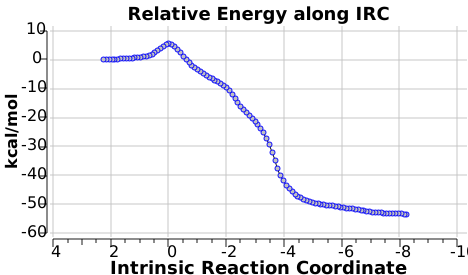
To complete the mechanism, I have added the final step in the reaction, a proton transfer from the amine to the carbon recipient, as facilitated by the bridge of solvent molecules connecting the start and end of the process. The free energy of this transition state is 0.3 kcal/mol higher than the N-C bond forming reaction, making it (just) the rate determining step.

Proton transfer

Transition state for proton transfer. Click for 4D

  1. The feature at IRC = 0.0 (the transition state) is the first proton transfer, from  C to O.
  2. The second feature at  IRC -2.5 is an O to O proton transfer
  3. At IRC -4, the third and final proton transfer can be seen, from O to N.
  4. At IRC -6.5, a weak π-OH hydrogen bond forms.

There is one more common type of cyclisation covered by Baldwin’s rules, this time involving tet(rahedral) or sp3 centres. This turns out to be the most interesting of the lot; reporting on this will have to wait a little!
Transition state models for Baldwin’s rules of ring closure.

Saturday, June 2nd, 2012

The Baldwin rules for ring closure follow the earlier ones by Bürgi and Dunitz in stating the preferred angles of nucleophilic (and electrophilic) attack in bond forming reactions, and are as famous for the interest in their exceptions as for their adherence. Both sets of rules fundamentally explore the geometry of the transition states involved in the reaction, as reflected in the activation free energies. Previous posts exploring the transition states for well-known reactions have revealed that the 4th dimension (the timing of the bond formations/breakings) can often spring surprises. So this post will explore a typical Baldwin ring formation in the same way.

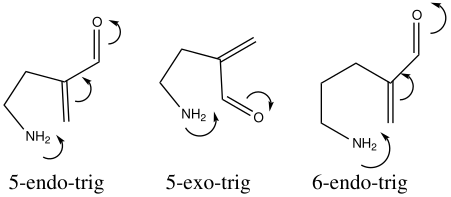
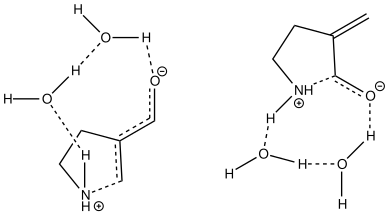
If you study the consequence of the mechanistic arrows shown above, you will see that the immediate product of the cyclisation is an internal ion-pair, a zwitterion. To get a realistic transition state geometry for a reaction where reaction of a neutral molecule creates charge separation, we need to build a slightly more elaborate system. The quantum mechanical model will include a continuum solvent (ωB97XD/6-311G(d,p)/SCRF=water) and because hydrogen bonds to charged donors or acceptors are often 2-3 times stronger than neutral ones, we need to include explicit solvent as well, as below.

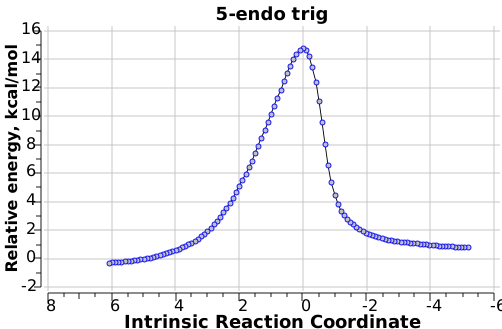
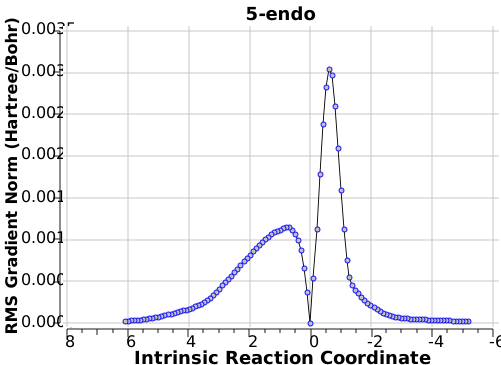
This resembles the strategy used for studying the Baeyer-Villiger reaction I showed previously, and also permits the system to transfer protons as appropriate. The 5-endo-trig transition state does indeed have such strong hydrogen bonds across the solvent bridge connecting the ionic centres. The angle of attack N-C-C is 92°. The IRC shows a barrier, which as ΔG is 17.8 kcal/mol.

5-endo transition state. Click for 4D.

The 6-endo transition state, according to Baldwin, makes the transition from unfavourable to favourable, since the angle of attack by the (nitrogen) nucleophile on the double bond can now adopt the more favourable angle of 101° (although rather less than the conventionally assumed angles of 106-109°), and ΔG is reduced to 12.4 kcal/mol, a reduction of 5.4 kcal/mol over the 5-endo analogue, more than enough to turn a dis-allowed into an allowed reaction! The transition state adopts a beautiful chair-like shape.

6-endo transition state. Click for 4D

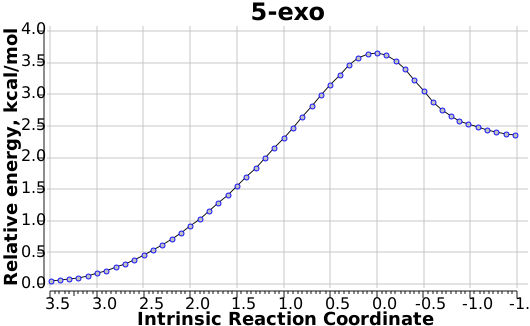
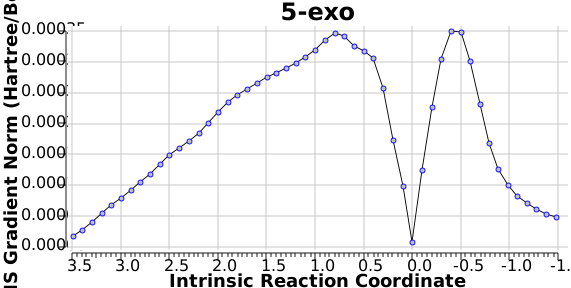
To complete the comparisons, the 5-exo transition state and its IRC is shown below, revealing again a very strong network of hydrogen bonds connecting the zwitterion. The angle of attack is 112°, quite different from (and more favourable than) the 5-endo isomer, as is the (much lower) free energy barrier of ΔG 5.7 kcal/mol. It is worth noting that this transition state does not exist on the potential energy surface computed without the inclusion of two solvent molecules!

5-exo transition state. Click for 4D

5-exo transition state.

Because Baldwin’s rules are in fact a generalisation of transition state geometry, one might expect that the specific nature of each transition state must be considered, and that exceptions therefore could easily be contrived. What I wanted to show here is that constructing a realistic transition state for any specific reaction is in fact nowadays not that much more onerous than applying the rule! For a few hours more effort, one can have a much better analysis of any specific system.

Transition state models for Baldwin's rules of ring closure.

Saturday, June 2nd, 2012

The Baldwin rules for ring closure follow the earlier ones by Bürgi and Dunitz in stating the preferred angles of nucleophilic (and electrophilic) attack in bond forming reactions, and are as famous for the interest in their exceptions as for their adherence. Both sets of rules fundamentally explore the geometry of the transition states involved in the reaction, as reflected in the activation free energies. Previous posts exploring the transition states for well-known reactions have revealed that the 4th dimension (the timing of the bond formations/breakings) can often spring surprises. So this post will explore a typical Baldwin ring formation in the same way.

If you study the consequence of the mechanistic arrows shown above, you will see that the immediate product of the cyclisation is an internal ion-pair, a zwitterion. To get a realistic transition state geometry for a reaction where reaction of a neutral molecule creates charge separation, we need to build a slightly more elaborate system. The quantum mechanical model will include a continuum solvent (ωB97XD/6-311G(d,p)/SCRF=water) and because hydrogen bonds to charged donors or acceptors are often 2-3 times stronger than neutral ones, we need to include explicit solvent as well, as below.

This resembles the strategy used for studying the Baeyer-Villiger reaction I showed previously, and also permits the system to transfer protons as appropriate. The 5-endo-trig transition state does indeed have such strong hydrogen bonds across the solvent bridge connecting the ionic centres. The angle of attack N-C-C is 92°. The IRC shows a barrier, which as ΔG is 17.8 kcal/mol.

5-endo transition state. Click for 4D.

The 6-endo transition state, according to Baldwin, makes the transition from unfavourable to favourable, since the angle of attack by the (nitrogen) nucleophile on the double bond can now adopt the more favourable angle of 101° (although rather less than the conventionally assumed angles of 106-109°), and ΔG is reduced to 12.4 kcal/mol, a reduction of 5.4 kcal/mol over the 5-endo analogue, more than enough to turn a dis-allowed into an allowed reaction! The transition state adopts a beautiful chair-like shape.

6-endo transition state. Click for 4D

To complete the comparisons, the 5-exo transition state and its IRC is shown below, revealing again a very strong network of hydrogen bonds connecting the zwitterion. The angle of attack is 112°, quite different from (and more favourable than) the 5-endo isomer, as is the (much lower) free energy barrier of ΔG 5.7 kcal/mol. It is worth noting that this transition state does not exist on the potential energy surface computed without the inclusion of two solvent molecules!

5-exo transition state. Click for 4D

5-exo transition state.

Because Baldwin’s rules are in fact a generalisation of transition state geometry, one might expect that the specific nature of each transition state must be considered, and that exceptions therefore could easily be contrived. What I wanted to show here is that constructing a realistic transition state for any specific reaction is in fact nowadays not that much more onerous than applying the rule! For a few hours more effort, one can have a much better analysis of any specific system.