Archive for November, 2012

A pericyclic dichotomy.

Friday, November 30th, 2012

A dichotomy is a division into two mutually exclusive, opposed, or contradictory groups. Consider the reaction below. The bicyclic pentadiene on the left could in principle open on heating to give the monocyclic [12]-annulene (blue or red) via what is called an electrocyclic reaction as either a six (red) or eight (blue) electron process. These two possibilities represent our dichotomy; according to the Woodward-Hoffmann (WH) pericyclic selection rules, they represent contradictory groups. Depending on the (relative) stereochemistry at the ring junctions, if one reaction is allowed by the WH rules, the other must be forbidden, and of course vice-versa. It is a nice challenge to ask students to see if the dichotomy can be reconciled.
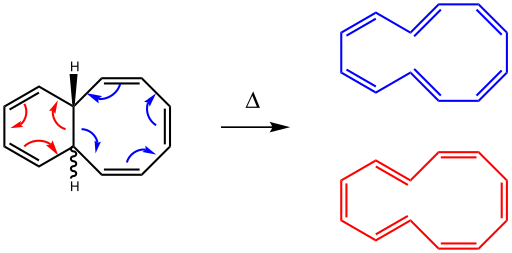
I start the process by pondering the relationship between the two forms of the [12]annulene shown on the right. Are the representations shown in red or blue just resonance isomers (analogous to the Kekule forms of benzene), or something else? If the former, then they truly represent the same species; they are just different ways of representing the contributions to the wavefunction, and the dichotomy stands. But if they are in fact different species, then we can start to eliminate the apparent contradiction by stating that the red and the blue arrows actually represent different reactions, leading to different (albeit isomeric) products. In this scenario, the red and blue forms of the [12]-annulene are NOT resonance isomers but distinct valence bond isomers, with a positive energy activation barrier to their interconversion. To find out, let us start with the transition states for both processes:

C2 symmetry Cs symmetry

Transition state for blue arrows. Click for 3D.

Transition state for red arrows. Click for 3D.

  1.  The blue arrows (representing 4n,n=2 electrons) result in a transition state with an axis of symmetry
  2. with the bond forming/cleaving from the bottom face of one terminus of the rhs-conjugated system to the top face of the other terminus, in other words an antarafacial bond, 
  3. with conrotation of the groups at the termini, resulting in
  4. all the bonds in the 8-ring being approximately 1.4Å in length (other than the central bond), whilst those in the 6-ring alternate strongly. The 8-ring is (Möbius) aromatic and the 6-ring is (Möbius) anti-aromatic.
  5. Contrary-wise, the red arrows (representing 4n+2,n=1 electrons) result in a transition state with a plane of symmetry
  6. with the bond forming from the same bottom face of the lhs-conjugated termini, in other words a suprafacial bond, 
  7. with disrotation of the groups at the termini, resulting in 
  8. all the bonds in the 6-ring being approximately 1.4Å in length, whilst those in the 8-ring alternate strongly. The 6-ring is now (Hückel) aromatic and the 8-ring is (Hückel) anti-aromatic.
  9. The transition state with C2 symmetry is in fact 10.1 kcal/mol lower in free energy than the one with Cs symmetry.
So the arrows follow the aromaticity (or vice versa), and this determines the stereochemistry (axis or plane of symmetry) and ultimately the nature of the product of each reaction. Are these annulenes indeed different? Shown below are the final outcomes of following an IRC (intrinsic reaction coordinate) from the transition state of the red and the blue reaction downhill to the [12]-annulenes. Not only is the outcome valence bond isomers, but they are also atropisomers.
Product, C2 (axis) Product, Cs (plane)

So at the end we see that there is no actual dichotomy. The reactions above (red or blue arrows) give different products, with different symmetries, and differently aromatic transition states. But in doing so, they encapsulate the selection rules for pericyclic reactions very nicely indeed. For more details of this, see this citation [1].

References

  1. H.S. Rzepa, "The Aromaticity of Pericyclic Reaction Transition States", Journal of Chemical Education, vol. 84, pp. 1535, 2007. https://doi.org/10.1021/ed084p1535
Di-imide reduction with a twist: A Möbius version.

Monday, November 26th, 2012

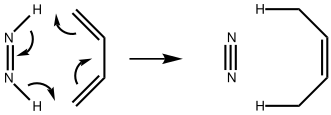
I was intrigued by one aspect of the calculated transition state for di-imide reduction of an alkene; the calculated NMR shieldings indicated an diatropic ring current at the centre of the ring, but very deshielded shifts for the hydrogen atoms being transferred. This indicated, like most thermal pericyclic reactions, an aromatic transition state. Well, one game one can play with this sort of reaction is to add a double bond. This adds quite a twist to this classical reaction!

The original di-imide reduction can be viewed as a six-electron process; one that fits the 4n+2 aromaticity rule. In fact, this is a specific instance of a more general topological rule, first proposed in 2008, which suggests that for 4n+2 electron thermal reactions, the electronic topology conforms to that of a Möbius link, for which the so-called linking number Lk is even (o, 2, 4, etc). For systems in which 4n electrons participate, such as the homologated example above, the rule changes to the topology of a Möbius knot, for which the linking number is odd (1, 3, etc)[1]. One interesting consequence of all this topology is that all the systems for which Lk > 0 are chiral (achiral benzene is thus seen as an exception rather than the norm of aromaticity)[2].

Transition state for 8-electron di-imide reduction. Click for 3D.

The calculated transition state for this reaction is shown above. As befits a torus knot, the two hydrogen atoms are transferred to opposite faces of the butadiene; an antarafacial mode. Now, to be fair the alternative mode in which the hydrogens are delivered suprafacially to just a single alkene is 26.1 kcal/mol lower in free energy. We might conclude that di-imide does not reduce butadiene in this manner, and that getting an experimental example of such stereochemistry might be a challenge!

What of the aromaticity of this Möbius version? The NICS(0) at the ring critical point is -15.7 ppm, whilst the shieldings of the transferring hydrogens are +14.0 ppm. So just like its 4n+2 electron counterpart, this Möbius di-hydrogen transfer reaction also proceeds through an aromatic transition state.

References

  1. S.M. Rappaport, and H.S. Rzepa, "Intrinsically Chiral Aromaticity. Rules Incorporating Linking Number, Twist, and Writhe for Higher-Twist Möbius Annulenes", Journal of the American Chemical Society, vol. 130, pp. 7613-7619, 2008. https://doi.org/10.1021/ja710438j
  2. C.S. Wannere, H.S. Rzepa, B.C. Rinderspacher, A. Paul, C.S.M. Allan, H.F. Schaefer, and P.V.R. Schleyer, "The Geometry and Electronic Topology of Higher-Order Charged Möbius Annulenes", The Journal of Physical Chemistry A, vol. 113, pp. 11619-11629, 2009. https://doi.org/10.1021/jp902176a

The regiospecificity of di-imide reduction of an alkene.

Sunday, November 25th, 2012

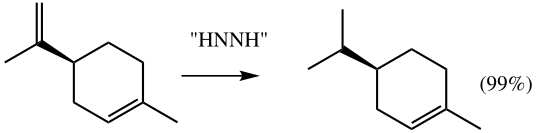
Not a few posts on this blog dissect the mechanisms of well known text-book reactions. But one reaction type where there are few examples on these pages are reductions. These come in three types; using electrons, using a hydride anion and using di-hydrogen. Here I first take a closer look at the third type, and in particular di-hydrogen as delivered from di-imide.

This reagent tends to be specific for terminal (less highly substituted) double bonds[1]. Two ωB97XD/6-311G(d,p) calculations predicts a free energy discrimination of 2.85 kcal/mol for the two double bonds in the system above, which works out as a ratio of 125:1 in favour of the less substituted system. The Wiberg bond orders of the two forming C-H bonds indicate that at the transition state the one to the less substituted terminal carbon is more highly formed (0.234) than the one to the more substituted carbon (0.198). The NICS(0) magnetic index of aromaticity at the ring critical point  (centroid) of the pericyclic participating atoms has a value of -22.2 ppm, which indicates a significant diamagnetic ring current indicative of a (σ-aromatic) transition state. The two transferring hydrogens have predicted “aromatic” shifts of 11.6 and 10.5 ppm.

Transition state for di-hydrogen transfer. Click for 3D.

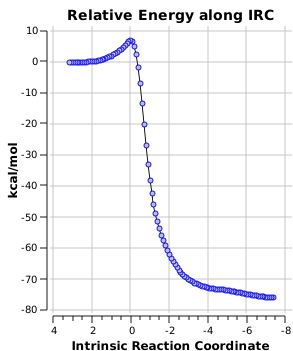
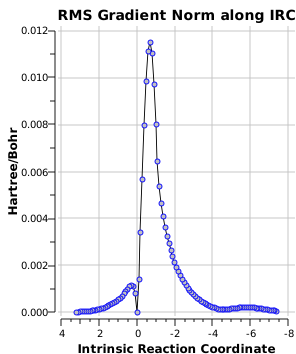
The intrinsic reaction coordinate (IRC) shows two distinct phases:

  1. From IRC 3 to -3, it represents a pericyclic process, involving an (aromatic) transition state in which the six atoms involved are all co-planar.
  2. From IRC -4 however, the newly reduced C-C bond starts to rotate to change the conformation from syn-planar to gauche. This rotation only comes at the very end of the reaction.

No real surprises here then, but it is useful to know that the regiospecificity of such reactions can apparently be well predicted.

References

  1. C. Smit, M.W. Fraaije, and A.J. Minnaard, "Reduction of Carbon−Carbon Double Bonds Using Organocatalytically Generated Diimide", The Journal of Organic Chemistry, vol. 73, pp. 9482-9485, 2008. https://doi.org/10.1021/jo801588d

A chiral molecular wire.

Tuesday, November 20th, 2012

More than 60 million molecules are known, and many are fascinating. But beauty is in the eye of the beholder. Thus it was that I came across the attached molecule[1]. It struck me immediately as, well, beautiful!

GOCTOH. Click for 3D.

This is one that comes to life in 3D and I strongly urge you to inspect it as such by clicking on the above. Why is it so interesting? Well, it has as its backbone a linear array of seven Nickel atoms. The Ni…Ni distances are around 2.2-2.3Å, and this “wire” is wrapped with a square planar arrangement of nitrogen atoms deriving from the ligand.

But that is not just where I perceived its beauty. The molecule has D4 symmetry, and is therefore dissymetric (chiral). The ligands wrap themselves around the metal wire in a helical arrangement. Oddly, the original authors who reported this lovely molecule make little (nothing?) of this aspect. Can it be resolved for example? Can it recognise other chiral molecules? What are its chiroptical properties (optical rotation, circular dichroism spectra etc)? Anyway enough from me; just go and enjoy this gem! 

References

  1. S. Lai, T. Lin, Y. Chen, C. Wang, G. Lee, M. Yang, M. Leung, and S. Peng, "Metal String Complexes:  Synthesis and Crystal Structure of [Ni<sub>4</sub>(μ<sub>4</sub>-phdpda)<sub>4</sub>] and [Ni<sub>7</sub>(μ<sub>7</sub>-teptra)<sub>4</sub>Cl<sub>2</sub>] (H<sub>2</sub>phdpda = <i>N</i>-Phenyldipyridyldiamine and H<sub>3</sub>teptra = Tetrapyridyltriamine)", Journal of the American Chemical Society, vol. 121, pp. 250-251, 1998. https://doi.org/10.1021/ja982065w

The "unexpected" mechanism of peroxide decomposition.

Sunday, November 18th, 2012

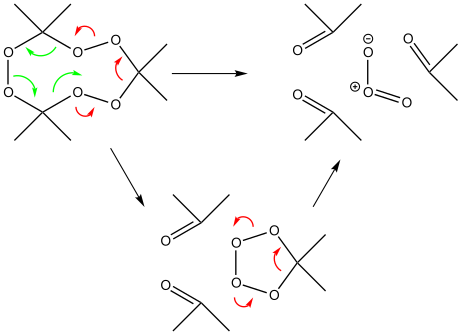
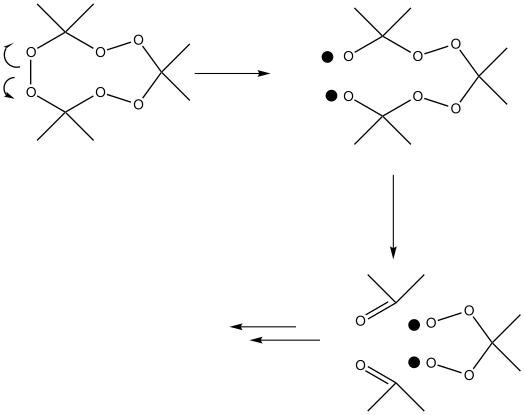
A game chemists often play is to guess the mechanism for any given reaction. I thought I would give it a go for the decomposition of the tris-peroxide shown below. This reaction is known to (rapidly, very rapidly) result in the production of three molecules of propanone, one of ozone and a lot of entropy (but not heat).[1]

The conventional approach might be to try to push some sensible arrows (an approach not always followed up it has to be said, by a reality check using quantum mechanics). I found the arrows that emerged from my playing interesting for the following reasons. 

  1. One scheme might be a process involving six arrows (twelve electrons), which leads directly to the products.
  2. Or, one might try to group the arrows into two sets of three (shown in green and red above). A moment’s consideration suggests that the green set has to precede the red set (if not concurrent), resulting in the initial production of two molecules of propanone and the tetraoxapentane derivative shown. This new molecule then suffers a simple 2+4 pericyclic cycloelimination as the second stage.
  3. It is possible of course that the process may simply consist of homolytic O-O cleavages via biradicals. I will defer discussing this point until later. 

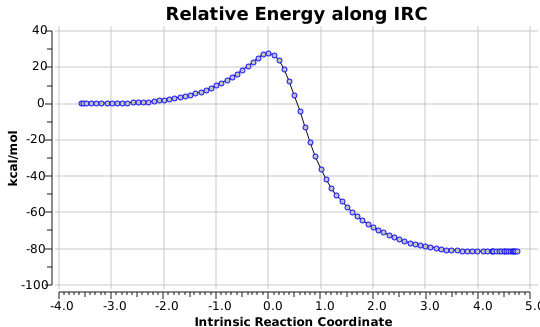
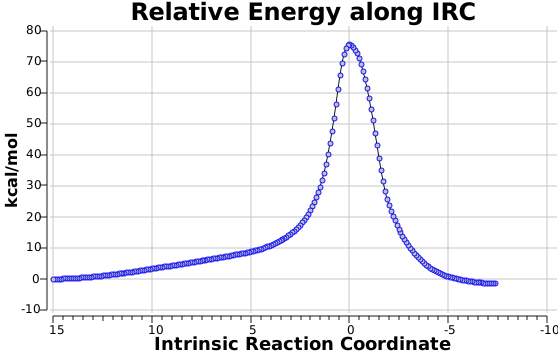
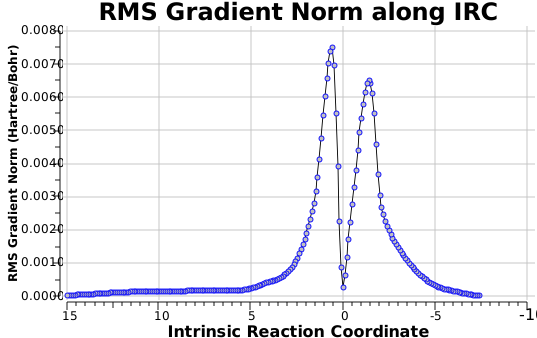
The reality check would then consider whether the two processes are consecutive or concurrent. The following is computed at the wB97XD/6-311G(d,p) level, and corresponds clearly to the three green arrows shown above (no motion corresponding to the red arrows is discernible) and hence would be a consecutive process with a distinct intermediate on the path. The IRC seems to support this.

Saddle point for decomposition. Click for first imaginary vibration.

Saddle point for decomposition. Click for second imaginary vibration.

IRC for apparent concerted decomposition.

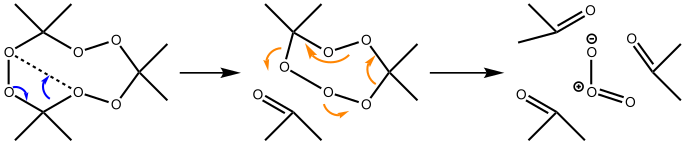
The diagram is shown twice above, because this geometry is in fact not a transition state but a second-order saddle point, with two imaginary vibrations. The first corresponds to the green arrows, but the second represents an asymmetric diversion to a quite different path. This second imaginary vibration can be followed in two directions, each potentially leading to a new lower energy saddle point. I was only able to locate one of these, shown below (if I track down the other,  I will append it).

Transition state for initial fragmentation. Click for 3D.

IRC for blue arrows. Click for 3D

IRC for orange arrows. Click for 3D.

As it happens, this corresponds to a rather different partitioning of the electron arrows, into a group of two first (blue) followed by four (orange). The first (proper) transition state is 5.0 kcal/mol lower in ΔG than the second order saddle point. The second transition state is 16.3 kcal/mol lower than the first. The intermediate in this process is actually different from the one shown earlier, but it can also eliminate ozone and two molecules of propanone.

What have we shown thus far? That one’s naive arrow pushing may in fact not come up with the goods. But how about that reality check? Whoops! Look at that activation barrier. The free energy (which is lower than the barrier itself because of the large +ve entropy of the reaction) is still a whopping 70 kcal/mol. 

So the conclusion from all of this? Well, that homolytic pathways, involving a cleavage of an O-O bond to produce a biradical, are very probably the real mechanism after all. Something like the below perhaps? (OK, so you might have told me that at the outset!).


As milestones go, this is my 250th post.


References

  1. F. Dubnikova, R. Kosloff, J. Almog, Y. Zeiri, R. Boese, H. Itzhaky, A. Alt, and E. Keinan, "Decomposition of Triacetone Triperoxide Is an Entropic Explosion", Journal of the American Chemical Society, vol. 127, pp. 1146-1159, 2005. https://doi.org/10.1021/ja0464903

The “unexpected” mechanism of peroxide decomposition.

Sunday, November 18th, 2012

A game chemists often play is to guess the mechanism for any given reaction. I thought I would give it a go for the decomposition of the tris-peroxide shown below. This reaction is known to (rapidly, very rapidly) result in the production of three molecules of propanone, one of ozone and a lot of entropy (but not heat).[1]

The conventional approach might be to try to push some sensible arrows (an approach not always followed up it has to be said, by a reality check using quantum mechanics). I found the arrows that emerged from my playing interesting for the following reasons. 

  1. One scheme might be a process involving six arrows (twelve electrons), which leads directly to the products.
  2. Or, one might try to group the arrows into two sets of three (shown in green and red above). A moment’s consideration suggests that the green set has to precede the red set (if not concurrent), resulting in the initial production of two molecules of propanone and the tetraoxapentane derivative shown. This new molecule then suffers a simple 2+4 pericyclic cycloelimination as the second stage.
  3. It is possible of course that the process may simply consist of homolytic O-O cleavages via biradicals. I will defer discussing this point until later. 

The reality check would then consider whether the two processes are consecutive or concurrent. The following is computed at the wB97XD/6-311G(d,p) level, and corresponds clearly to the three green arrows shown above (no motion corresponding to the red arrows is discernible) and hence would be a consecutive process with a distinct intermediate on the path. The IRC seems to support this.

Saddle point for decomposition. Click for first imaginary vibration.

Saddle point for decomposition. Click for second imaginary vibration.

IRC for apparent concerted decomposition.

The diagram is shown twice above, because this geometry is in fact not a transition state but a second-order saddle point, with two imaginary vibrations. The first corresponds to the green arrows, but the second represents an asymmetric diversion to a quite different path. This second imaginary vibration can be followed in two directions, each potentially leading to a new lower energy saddle point. I was only able to locate one of these, shown below (if I track down the other,  I will append it).

Transition state for initial fragmentation. Click for 3D.

IRC for blue arrows. Click for 3D

IRC for orange arrows. Click for 3D.

As it happens, this corresponds to a rather different partitioning of the electron arrows, into a group of two first (blue) followed by four (orange). The first (proper) transition state is 5.0 kcal/mol lower in ΔG than the second order saddle point. The second transition state is 16.3 kcal/mol lower than the first. The intermediate in this process is actually different from the one shown earlier, but it can also eliminate ozone and two molecules of propanone.

What have we shown thus far? That one’s naive arrow pushing may in fact not come up with the goods. But how about that reality check? Whoops! Look at that activation barrier. The free energy (which is lower than the barrier itself because of the large +ve entropy of the reaction) is still a whopping 70 kcal/mol. 

So the conclusion from all of this? Well, that homolytic pathways, involving a cleavage of an O-O bond to produce a biradical, are very probably the real mechanism after all. Something like the below perhaps? (OK, so you might have told me that at the outset!).


As milestones go, this is my 250th post.


References

  1. F. Dubnikova, R. Kosloff, J. Almog, Y. Zeiri, R. Boese, H. Itzhaky, A. Alt, and E. Keinan, "Decomposition of Triacetone Triperoxide Is an Entropic Explosion", Journal of the American Chemical Society, vol. 127, pp. 1146-1159, 2005. https://doi.org/10.1021/ja0464903

Thalidomide. The role of water in the mechanism of its aqueous racemisation.

Saturday, November 10th, 2012

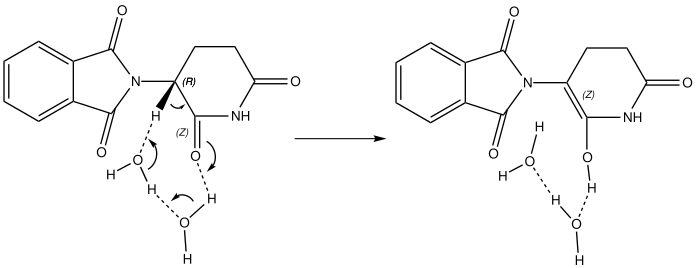
Thalidomide is a chiral molecule, which was sold in the 1960s as a sedative in its (S,R)-racemic form. The tragedy was that the (S)-isomer was tetragenic, and only the (R) enantiomer acts as a sedative. What was not appreciated at the time is that interconversion of the (S)- and (R) forms takes place quite quickly in aqueous media. Nowadays, quantum modelling can provide good in-silico estimates of the (free) energy barriers for such processes, which in this case is a simple keto-enol tautomerism. In a recently published article[1], just such a simulation is reported. By involving two explicit water molecules in the transition state, an (~enthalpic) barrier of 27.7 kcal/mol was obtained. The simulation was conducted just with two water molecules acting as solvent, and without any additional continuum solvation applied. So I thought I would re-evaluate this result by computing it at the ωB97XD/6-311G(d,p)/SCRF=water level (a triple-ζ basis set rather than the double-ζ used before[1]), and employing a dispersion-corrected DFT method rather than B3LYP.

Keto-enol tautomerisation occupies a unique position in the history of mechanistic chemistry[2]. In 1889, Beckmann got the whole field rolling by proposing an inferred enol intermediate (which he did not observe) to explain the isomerism of menthone to iso-menthone in conc. sulfuric acid. In modelling the enolisation of thalidomide, I have used both implicit and explicit solvents acting in a self-consistent manner. This approach is not yet much adopted in the wider literature[3]. I have deployed it extensively in this blog as an encouragement to others (selected examples are listed at the bottom of this post). It is worth noting at the outset that the transition state reported previously[1] has a computed dipole moment of ~10D. My experience[3] suggests that any geometry with a dipole moment of this magnitude (or greater) is likely to relax when placed into a continuum field, and this relaxation becomes an important perturbation of both the computed geometry of the transition state and the intrinsic reaction coordinate profile computed from that starting point.

The (re)computed geometry of the aqueous transition state for enolisation of thalidomide is shown below, and for which the entropy-corrected ΔG298 is 31.0 kcal/mol (the barrier for the prototypical enolisation of propanone is computed as 34.4 kcal/mol). The value in the literature[1] is given as 27.7 kcal/mol for the zero-point-energy corrected total energy barrier, but this value notably does NOT include any entropic corrections. The measured literature value for ΔG298 is reported as 24.3 kcal/mol at pH 8, a value which probably also includes contributions from both the pure water catalysed route and those from hydroxide anion catalysis (see below). At this point, I should remind that the free energy of activation for a bi- or termolecular reaction in solution must be obtained by correcting the value obtained for a standard state of 1 atmosphere (the state used for the value quoted above). According to Alvarez-Idaboy and co-workers[4], this amounts to a total correction of -4.5 kcal/mol for a bimolecular reaction, and -8.73 kcal/mol for a termolecular reaction. Where one of the components of a termolecular reaction is also the solvent, these corrections probably need to be themselves reduced. But this does achieve a reduction in the computed value of 31.0 kcal/mol to something quite close to the experimental value! 

Aqueous transition state for enolisation of thalidomide. Click for 3D.

Next, I want to consider the base-catalysed enolisation pathway. As with the reaction of dichlorobuteneone with tolyl-thiolate about which I wrote in another post, the authors of the thalidomide study[1] modelled this route by introducing a solvated hydroxide anion, “OH·H2O” into the structure without any accompanying counter-ion. In other words, their total system has an overall negative charge. I argued before, and I argue again here, that there is no real need to have to do this. Why not for example introduce NaOH•H2O instead? One might argue that the cationic counter-ion so introduced cannot be properly modelled, but the combination of explicit first-sphere water molecules coupled with a continuum model actually handles these counter-ions reasonably well. So may I introduce you to my version of the base-catalysed reaction, involving a contact-ion-pair:

Base-catalysed (NaOH) enolisation of thalidomide. Click for 3D.

This has ΔG298 4.7 kcal/mol, much lower than the neutral water catalysed reaction. This value is of course for a standard state for [Na+OH] (1 atm). At pH 8, [OH] is at least six orders of magnitude less, which may rationalise why the experimental rate is so much slower than this barrier might imply. The IRC corresponds to proton transfer.

I would like to end by noting that many mechanisms which would otherwise involve the development of charge-separation may well borrow a protic solvent molecule in the manner shown here to reduce the degree of charge-separation needed.  Further examples of this are listed below.


  1. Oxime formation from hydroxylamine and ketone. Part 2: Elimination.
  2. Oxime formation from hydroxylamine and ketone: a (computational) reality check on stage one of the mechanism.
  3. Transition state models for Baldwin dig(onal) ring closures.
  4. Transition state models for Baldwin’s rules of ring closure.
  5. The mechanism (in 4D) of the reaction between thionyl chloride and a carboxylic acid.
  6. Mechanism of the diazomethane alkylation of a carboxylic acid.
  7. The mechanism of the Baeyer-Villiger rearrangement.
  8. Stereoselectivities of Proline-Catalyzed Asymmetric Intermolecular Aldol Reactions.
  9. Secrets of a university tutor: tetrahedral intermediates.

References

  1. C. Tian, P. Xiu, Y. Meng, W. Zhao, Z. Wang, and R. Zhou, "Enantiomerization Mechanism of Thalidomide and the Role of Water and Hydroxide Ions", Chemistry – A European Journal, vol. 18, pp. 14305-14313, 2012. https://doi.org/10.1002/chem.201202651
  2. E. Beckmann, "Untersuchungen in der Campherreihe", Justus Liebigs Annalen der Chemie, vol. 250, pp. 322-375, 1889. https://doi.org/10.1002/jlac.18892500306
  3. J. Kong, P.V.R. Schleyer, and H.S. Rzepa, "Successful Computational Modeling of Isobornyl Chloride Ion-Pair Mechanisms", The Journal of Organic Chemistry, vol. 75, pp. 5164-5169, 2010. https://doi.org/10.1021/jo100920e
  4. J.R. Alvarez-Idaboy, L. Reyes, and J. Cruz, "A New Specific Mechanism for the Acid Catalysis of the Addition Step in the Baeyer−Villiger Rearrangement", Organic Letters, vol. 8, pp. 1763-1765, 2006. https://doi.org/10.1021/ol060261z

Secrets revealed for conjugate addition to cyclohexenone using a Cu-alkyl reagent.

Sunday, November 4th, 2012

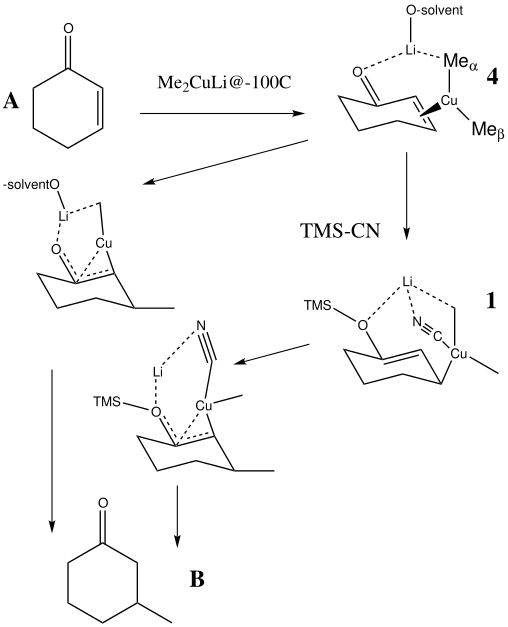
The text books say that cyclohexenone A will react with a Grignard reagent by delivery of an alkyl (anion) to the carbon of the carbonyl (1,2-addition) but if dimethyl lithium cuprate is used, a conjugate 1,4-addition proceeds, to give the product B shown below. The standard explanation is that the alkyl copper is a “soft” nucleophile attacking the soft conjugate carbon, whereas the alkyl magnesium is a “hard” nucleophile attacking the hard carbonyl carbon. Is this the best explanation? 

In 2007, one of those wonderfully simple experiments was done[1]. The dimethyl lithium cuprate reagent (dissolved in THF) was injected into an NMR sample tube at -100°C containing A, and the spectrum measured immediately. The species identified as 4 (the numbering as used in the reference) has two 1H methyl resonances[2] at ~ -0.04 to – 0.23 ppm (assigned to Meβ) and -1.08 to -1.11ppm (assigned to Meα), and the copper coordinates to the alkene as a π-complex. If TMS cyanide is added, 4 is immediately converted to complex 1, in which the π-complex is replaced by a simple C-Cu σ-bond. Compound 4 upon heating gives B, whilst 1 gives the silyl enol ether of B.

How does this match quantum simulation[3]? First, the 1H NMR result for 4 (at the wB97XD/6-31G(d,p)/SCRF=THF level and with the lithium coordinated to an ether solvent) comes out as -1.4 ppm (Meα) and -0.31 ppm (Meβ). The 13C is 76.4 and 60.6 ppm for the vinyl carbons (positions 3 and 4, obs) and 64.5/56.7 (calc). These latter values are affected by spin-orbital coupling to the metal, which can shift the values by up to about 10 ppm[4], but the relative values are also in good agreement. So the reaction must proceed starting from this π-copper complex.

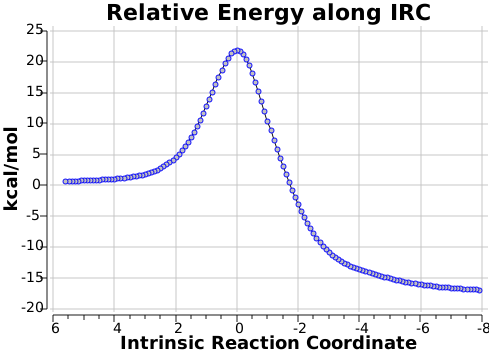
The IRC reveals a concerted transfer of  Meβ to the conjugate 4-position of B, with a reasonable barrier to reaction which indicates that on warming to room temperatures, the complex 4 will readily react. Formally at least, this corresponds to reductive elimination from the Cu(III) species to form a Cu(I) complex (in which however the metal now coordinates to the enol double bond rather than the alkene).

IRC for methyl transfer. Click for 3D transition state.

I will deal with the case of methyl transfer from 1 in a later post. With 4, we can directly see that the origins of conjugate 1,4-addition an α,β-unsaturated ketone are that the Cu reagent forms a π-complex to the alkene, which positions one of the alkyl groups on the metal in the ideal position to attack in conjugate manner. Regarding the different behaviour of the magnesium Grignard reagent, it boils down to asking why it does NOT form a π-complex in this situation (I would note here that Mg-π-complexes are indeed known).

References

  1. S.H. Bertz, S. Cope, M. Murphy, C.A. Ogle, and B.J. Taylor, "Rapid Injection NMR in Mechanistic Organocopper Chemistry. Preparation of the Elusive Copper(III) Intermediate", Journal of the American Chemical Society, vol. 129, pp. 7208-7209, 2007. https://doi.org/10.1021/ja067533d
  2. S.H. Bertz, C.M. Carlin, D.A. Deadwyler, M.D. Murphy, C.A. Ogle, and P.H. Seagle, "Rapid-Injection NMR Study of Iodo- and Cyano-Gilman Reagents with 2-Cyclohexenone:  Observation of π-Complexes and Their Rates of Formation", Journal of the American Chemical Society, vol. 124, pp. 13650-13651, 2002. https://doi.org/10.1021/ja027744s
  3. H. Hu, and J.P. Snyder, "Organocuprate Conjugate Addition:  The Square-Planar “Cu<sup>III</sup>” Intermediate", Journal of the American Chemical Society, vol. 129, pp. 7210-7211, 2007. https://doi.org/10.1021/ja0675346
  4. D.C. Braddock, and H.S. Rzepa, "Structural Reassignment of Obtusallenes V, VI, and VII by GIAO-Based Density Functional Prediction", Journal of Natural Products, vol. 71, pp. 728-730, 2008. https://doi.org/10.1021/np0705918

Mechanisms of carbon monoxide insertion reactions: A reality check on carbonylation of methyl manganese pentacarbonyl

Sunday, November 4th, 2012

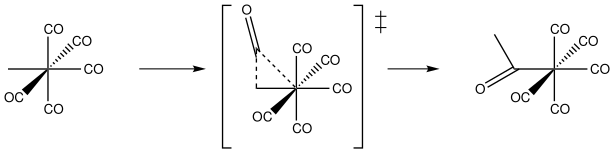
When methyl manganese pentacarbonyl is treated with carbon monoxide in e.g. di-n-butyl ether, acetyl manganese pentacarbonyl is formed. This classic experiment conducted by Cotton (of quadruple bond fame) and Calderazzo in 1962[1] dates from an era when chemists conducted extensive kinetic analyses to back up any mechanistic speculations. Their suggested transition state is outlined below. Here I subject their speculations to a quantum mechanical “reality check“.

The mechanism as above, formally at least is a pericyclic insertion of a carbene into a C-Mn bond. As the preamble to studying the mechanism, the following related reactions are of some interest:

  1. The addition of dichlorocarbene to ethene (see this blog for IRC)
  2. The addition of dichlorocarbene to butadiene (see this blog for IRC)
  3. The addition of carbon monoxide to ethene, for which the IRC is shown below
  4. The even simpler insertion of carbon monoxide to H2, for which the IRC is shown below
  5. And finally the insertion of carbon monoxide to methane, which is the closest analogy for us here.
  6. Notice that all of these reactions are asymmetric, and that the two new bonds forming to the carbon do so very asymmetrically/asynchronously, albeit in a concerted manner.

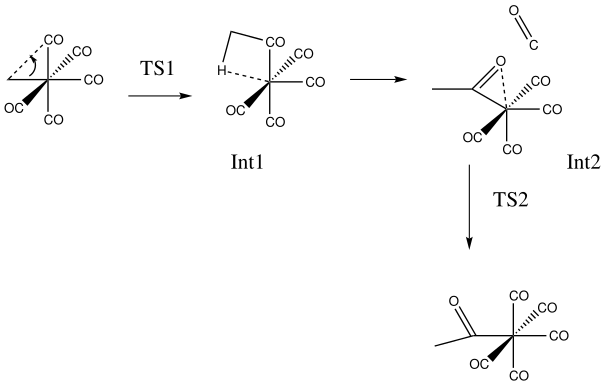
You might conclude from the above that extending this to identifying the transition state for insertion of carbon monoxide into a C-Mn bond is almost bound to reveal something interesting. Well, I was not able to locate (at the ωB97XD/6-311G(d,p)SCRF=di-n-butyl ether level) the carbon monoxide insertion transition state proposed by Cotton and Calderazzo (which of course does not mean it does not exist). But my efforts instead led to the following different course for the reaction (which is actually covered by the original authors with the statement “a mechanism involving a rapid pre-equilibrium to form MeCOMn(CO)4 cannot be ruled out at this stage“). Thus TS1 expresses that pre-equilibrium.

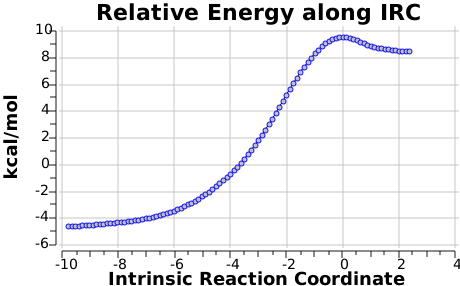
  1. The first stage involves the migration of the methyl group from Mn to an adjacent carbonyl group via TS1 to form Int1.

    TS1. Click for 3D animation of transition mode.

  2. As the methyl group migrates to the adjacent carbonyl, it creates a putative vacant coordination site on the metal. This is re-occupied by the concerted formation of a C-H agostic interaction, exhibited by  Int1. This new interaction now blocks any attempt by free carbon monoxide to insert into that erstwhile vacant site.
    Mn-TS1-IRC
  3. Int1 now rearranges to form an isomer, Int2, in which the agostic C-H interaction is replaced by a Mn-π-interaction from the acetyl group. This creates trigonal bipyramidal coordination at the Mn. Int2 is 6.9 kcal/mol lower in free energy than Int1.

    Int2. Click for 3D.

  4. A free carbon monoxide now attacks this intermediate via TS2 to coordinate onto the metal to reform octahedral coordination and complete the carbonylation reaction, and in the process converting the C=O π-complex into a Mn-C σ-complex.

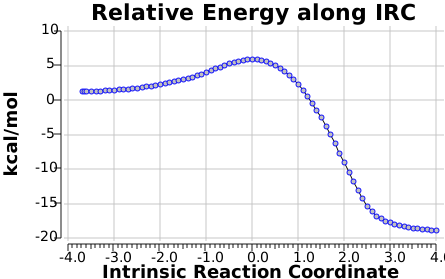
    TS2. Click for 3D.

  5. TS2, as with the transition state for alkene metathesis, reveals that bond formation between the incoming carbon of the carbon monoxide and the Mn has not yet started (3.05Å). Instead the barrier is largely induced by the need to reorganise the ligands present on the metal before new bonds can form.
  6. Which of TS1 (+ CO) or TS2 is higher in free energy? Using di-n-butyl ether as the simulated solvent, TS2 emerges as the higher by 4.2 kcal/mol.It is so in part because of the greater loss of entropy at the transition state for this latter geometry. In fact, the kinetics reported by Cotton and Calderazzo (ΔG303 20.6 kcal/mol, ΔS -21.1 cal/mol) indicate the reaction is first order in [CO], which indeed implies that TS2 must be higher in energy (since TS1 does not depend on [CO]). The theory indicates ΔG298 16.4 kcal/mol, ΔS -7.5 cal/mol for TS1 and ΔG298 20.6 kcal/mol, ΔS -30.9 cal/mol for TS2. This level of agreement strongly supports the migration/addition pathway over the direct C-Mn insertion route.

I hope that by adding a layer of quantum mechanical interpretation to the original synthetic and kinetic study, we can learn a bit more about what sounds like a very simple reaction, but which has turned out to have wonderful and subtle twists and turns.

References

  1. F. Calderazzo, and F.A. Cotton, "Carbon Monoxide Insertion Reactions. I. The Carbonylation of Methyl Manganese Pentacarbonyl and Decarbonylation of Acetyl Manganese Pentacarbonyl", Inorganic Chemistry, vol. 1, pp. 30-36, 1962. https://doi.org/10.1021/ic50001a008