March 31st, 2017
Nowadays, data supporting most publications relating to the synthesis of organic compounds is more likely than not to be found in associated “supporting information” rather than the (often page limited) article itself. For example, this article[1] has an SI which is paginated at 907; almost a mini-database in its own right! Here I ponder whether such dissemination of data is FAIR (Findable, accessible, interoperable and re-usable).[2]
I am going to use this article as my starting point.[3] One of the compounds discussed there is shown below; it is not explicitly discussed in the main body of the article. So how findable is it?

- A search of Scifinder (Chemical abstracts) using the structure above reveals one hit, the source being the expected one.[3]
- A search of Reaxys (used to be Beilstein) reveals no hits in their own database, but one hit is noted in …
- Pubchem, where it occurs as substance 163835830. The source is again cited correctly[3]. One of the properties reported is the InChI key: JSLVVAICXSKSEQ-UHFFFAOYSA-N. This is the same key generated from the structure drawing programs Chemdraw or ChemDoodle.
- Google on the other hand finds nothing for JSLVVAICXSKSEQ-UHFFFAOYSA-N.[4]
- I also tried Google Scholar but again with no luck.
So supporting information does appear to be indexed by both Chemical Abstracts and Pubchem; it is thankfully not a graveyard![5] The chemical databases do return valuable additional information about the molecule, such as e.g. its InChI key and much else besides. Given that presumably the open PubChem resource IS indexed by Google, it must be a policy somewhere that prevents e.g. JSLVVAICXSKSEQ-UHFFFAOYSA-N from being found.
I suppose the next question might be Supporting information: chemical graveyard or invaluable resource for chemical spectra? I confess here that this post was in fact inspired by a previous one on the topic of the provenance of NMR spectra. And perhaps also with some input from the concept of sonification of spectra, in which an instrumental spectrum is converted into a sound signature to allow blind people access to such information.‡ I wonder whether a sonified unique digital signature could be used to search for spectra, somewhat in the manner that InChI helped in tracking down (or not) the molecule above? I think it would be reasonable to say that e.g. NMR spectra as embedded in say a 907 page supporting information document are likely to be very much less FAIR[2]. The solution there of course is better provenance and better metadata, as I previously mulled.
‡I cannot help but wonder what a carbonyl group sounds like!
References
- J.M. Lopchuk, K. Fjelbye, Y. Kawamata, L.R. Malins, C. Pan, R. Gianatassio, J. Wang, L. Prieto, J. Bradow, T.A. Brandt, M.R. Collins, J. Elleraas, J. Ewanicki, W. Farrell, O.O. Fadeyi, G.M. Gallego, J.J. Mousseau, R. Oliver, N.W. Sach, J.K. Smith, J.E. Spangler, H. Zhu, J. Zhu, and P.S. Baran, "Strain-Release Heteroatom Functionalization: Development, Scope, and Stereospecificity", Journal of the American Chemical Society, vol. 139, pp. 3209-3226, 2017. https://doi.org/10.1021/jacs.6b13229
- M.D. Wilkinson, M. Dumontier, I.J. Aalbersberg, G. Appleton, M. Axton, A. Baak, N. Blomberg, J. Boiten, L.B. da Silva Santos, P.E. Bourne, J. Bouwman, A.J. Brookes, T. Clark, M. Crosas, I. Dillo, O. Dumon, S. Edmunds, C.T. Evelo, R. Finkers, A. Gonzalez-Beltran, A.J. Gray, P. Groth, C. Goble, J.S. Grethe, J. Heringa, P.A. ’t Hoen, R. Hooft, T. Kuhn, R. Kok, J. Kok, S.J. Lusher, M.E. Martone, A. Mons, A.L. Packer, B. Persson, P. Rocca-Serra, M. Roos, R. van Schaik, S. Sansone, E. Schultes, T. Sengstag, T. Slater, G. Strawn, M.A. Swertz, M. Thompson, J. van der Lei, E. van Mulligen, J. Velterop, A. Waagmeester, P. Wittenburg, K. Wolstencroft, J. Zhao, and B. Mons, "The FAIR Guiding Principles for scientific data management and stewardship", Scientific Data, vol. 3, 2016. https://doi.org/10.1038/sdata.2016.18
- G.M.S. Yip, Z. Chen, C.J. Edge, E.H. Smith, R. Dickinson, E. Hohenester, R.R. Townsend, K. Fuchs, W. Sieghart, A.S. Evers, and N.P. Franks, "A propofol binding site on mammalian GABAA receptors identified by photolabeling", Nature Chemical Biology, vol. 9, pp. 715-720, 2013. https://doi.org/10.1038/nchembio.1340
- S.J. Coles, N.E. Day, P. Murray-Rust, H.S. Rzepa, and Y. Zhang, "Enhancement of the chemical semantic web through the use of InChI identifiers", Organic & Biomolecular Chemistry, vol. 3, pp. 1832, 2005. https://doi.org/10.1039/b502828k
- M. Karthikeyan, and R. Vyas, "ChemEngine: harvesting 3D chemical structures of supplementary data from PDF files", Journal of Cheminformatics, vol. 8, 2016. https://doi.org/10.1186/s13321-016-0175-x
Tags: Carbon, chemical databases, chemical graveyard, chemical spectra, Chemistry, digital signature, Nature, Organic, Organic chemistry, Organic compound, Organic food, search engines, Technology/Internet
Posted in Chemical IT | 3 Comments »
March 31st, 2017
Occasionally one comes across a web site that manages to combine being unusual, interesting and also useful. Thus www.molinsight.net is I think a unique chemistry resource for blind and visually impaired students.
If you think perhaps that it might be a little too specialised to be useful for you, go visit it first. It does not overwhelm, but contains much valuable information about topics such as open source chemical structure editors, property calculators and stereochemical utilities. Some topics really stand out. For example, Sonification of IR spectra describes the technique for converting an infrared spectrum into non-speech sounds of varying tones. I wonder if they have plans for sonified NMR spectra?

The project has been around for a little while and it’s really nice to see it well curated and up to date. In an era where $billions seems to be focused on augmented visual reality as the future means of delivering information, its nice to know that enabling chemistry via other senses is not forgotten.
Tags: Chemistry, Electromagnetic radiation, Infrared, Infrared spectroscopy, Multimodal interaction, Nuclear magnetic resonance, open source chemical structure editors, Sonification, spectroscopy, stereochemical utilities
Posted in Interesting chemistry | No Comments »
March 30th, 2017
In an era when alternative facts and fake news afflict us, the provenance of scientific data becomes ever more important. Especially if that data is available as open access and exploitable by others for both valid scientific reasons but potentially also by those with other motives. Here I consider the audit trail that might serve to establish data provenance in one typical situation in chemistry, the acquisition of NMR instrumental data.
Here I describe how such data is generated in my department; details may vary elsewhere.
- The prospective user of the NMR service is allocated a service ID. In our case, that ID relates to the research group rather than to individual researchers. This ID is parochial, it does not reference any other information about the user in the institute. Only the service manager has the information to associate this ID with real users and this information is normally not distributed.
- When a sample is submitted, this ID is used to create a new folder containing the data as a sub-folder of the group ID and located on the NMR data servers.
- The dataset itself‡ contains a number of files that contain an audit trail (names such as audita.txt, auditp.txt) with the fields: ##AUDIT TRAIL= $$ (NUMBER, WHEN, WHO, WHERE, PROCESS, VERSION, WHAT). Typically, none of these files have propagated the original user ID under which the data was collected; to do so would require a programmatic connection between the local authentication systems and the spectrometer software used, a connection that is normally missing. Thus the first break in the provenance trail.
- In principle other audit trails can be inferred from these files, such as the unique identity of the instrument provided by its manufacturer. Further information such as e.g. the probe used to collect the data (probes can be readily changed over) or any calibration data used in setting up the instrument for the data collection are by and large not recorded. To my knowledge, although an instrument can have a unique serial number, such serial numbers of swappable components such as probes are not recorded by the collection software. Thus the second break in the provenance trail.
- This data then needs to be processed by further software. In this case we use the MestreNova system for this task. Each dataset has editable assigned properties; below I show those that can be associated with the spectrum (accessed with MestreNova using Edit/Properties). All this comes from the information collected by the instrument. The user’s identity can be inserted into the “title” field, the display of which is off by default.

- There is also a section for parameters, a synonym for which might be metadata and accessed using this program from View/Tables/Parameters. If Author was entered as a parameter in the dataset by the spectrometer software, the Mnova document would retrieve that information. Equally, an ORCID identifier for the author entered at the time of data collection and thus stored in the dataset could be read by Mnova, stored and displayed if configured to do so. It would be fair to say however that this option is rarely if indeed ever systematically implemented by NMR instrument data collection software and so is never propagated to the data processing software (as highlighted in red below). Thus a third break in the provenance trail.
 This is also an alternative and this time formal metadata field that can be populated, by default as shown below with the type of spectrum and nucleus. These properties are not controlled in the sense of only allowing those terms that are present in a specified dictionary. The jargon for such control is a metadata schema. This is not used here, since dissemination of this information is not intended; the software accepts whatever information it is given.
 There are thus several opportunities to collect the identity of the experimenter and thus attribute provenance to the collected data, but this does very much depend on the will of researchers, institutions or publishers to enforce specific policies around this. The fourth break in the provenance trail.
- The dataset can then be uploaded (DOI: 10.14469/hpc/1291), at which stage provenance can finally be added using the ORCID credentials of the person publishing the dataset, who of course may or may not be the person who actually recorded the data! The full metadata for this specific collection can be seen at data.datacite.org/10.14469/hpc/1291. Or to put it another way, this is the first point in the provenance chain where the metadata is controlled by a schema and is also discoverable in a standard programmatic manner, i.e. the preceding link. The provenance is now formally associated with the ORCID identifier using the DataCite metadata schema. You should be aware that a local policy† is that access to the repository at https://data.hpc.imperial.ac.uk is only allowed by cross-authentication with http://orcid.org/ using the user’s ORCID. This identifier is then automatically propagated to the metadata held at e.g. data.datacite.org/10.14469/hpc/1095. Currently however, none of any metadata originally recorded in either the instrumental file set or the processed MestreNova file is forwarded on to the metadata record held at DataCite; again loss of information and potentially of provenance.
- The peer-reviewed article resulting from the interpretation of this data however can be associated with the provenance introduced in the previous stage; see data.datacite.org/10.14469/hpc/1267 and the IsReferencedBy property.
Now imagine if there was a common thread in all the stages of acquiring, processing and publishing this scientific data based on the ORCID.
- Providing an ORCID could be made an essential requirement of access to the instrument.
- This information would be propagated to the dataset …
- by inclusion in one or more of the audit trail files.
- At this stage, further persistent identifiers associated with the instrument manufacturer could be added, which help identify not only the instrument used, but sub-components such as the changeable probe. This would allow access to any calibration curves or probe sensitivity and other aspects.
- The ORCID and other relevant information could be picked up by the software used to convert the data into spectra and propagated into the metadata containers for this software …
- where its use is controlled by a specified schema.
- At this stage, the ORCID and information such as the nucleus recorded, the sample temperature etc can be propagated on to the final metadata records.
- And the reader of the article describing this work would have a formally defined provenance audit trail they could follow back to the start of the experiment or forward to a published article. In this case, the data claims provenance (acquired from peer review) from the article, but it should also work in reverse with the article claiming provenance from the data on which it is based. The indexing of this bidirectional exchange is one of the exciting features that we should see emerging from CrossRef (holders of metadata about articles) and DataCite (holders of metadata about research data) in the near future.
We are clearly a little way from having the infrastructures described above for establishing such data audit trails. To do so will require cooperation from instrument manufacturers, at least in the example as charted above, as well as researchers, institutions, publishers, peer-reviewers and funding bodies. The first step would be to ensure that all scientists who intend collecting, processing and publishing data should claim an ORCID. That remark is directed specifically at undergraduate, postgraduate and post-doctoral researchers, not just at their supervisor or their PI (principal investigator). At a point when the discussion about alternate facts and perhaps even alternate data risks a general loss of confidence in science, we should be pro-active in establishing trust in the scientific processes.
‡ You can see an example obtained by this process at DOI: 10.14469/hpc/1095
† This requirement is a strong driver for the uptake of ORCID amongst our student population.
Tags: Acquisition, Archival science, author, collection software, Company: NMR, data, Data management, data processing software, Evidence law, instrument data collection software, local authentication systems, Mestrenova, MestreNova system, Nuclear magnetic resonance, principal investigator, Provenance, Scientific method, service manager, spectrometer software, supervisor, Technology/Internet, Terminology
Posted in Chemical IT | 2 Comments »
March 25th, 2017
The previous post demonstrated the simple iso-electronic progression from six-coordinate carbon to five coordinate nitrogen. Here, a further progression to oxygen is investigated computationally.
The systems are formally constructed from a cyclobutadienyl di-anion and firstly the HO5+ cation, giving a tri-cationic complex. There are no examples of the resulting motif in the Cambridge structure database. A ωB97XD/Def2-TZVPP calculation (DOI: 10.14469/hpc/2350) shows it is again a stable minimum, with a Kekule mode of 1203 cm-1.
A QTAIM topological analysis of the electron density shows it differs from the nitrogen analogue in now having the ring topological feature for the basal four carbons, which in turn gives rise to a cage critical point (blue dot). The values of the electron density are lower than for N.
The ELF basin analysis shows the C-C bonds are regular single ones (2.01e), whereas the C-O bonds have a slightly greater electron population than the C-N bonds discussed in the previous post.

I suspect the prospects of making a stable tri-cation in such a small molecule are lower than the crystal di-cation achieved with carbon as the apical atom. But the charge can be reduced to a di-cation by replacing the HO5+ above with S–-O5+; the animation below showing the Kekule mode (1140 cm-1, DOI: 10.14469/hpc/2356).


And for some (negative) loose ends.
- The P equivalent constructed from cyclobutadienyl di-anion and HP4+ is now unremarkably 5-coordinate. But in fact it is not a stable minimum (DOI: 10.14469/hpc/2357), having two negative force constants.
- as does the system from cyclobutadienyl di-anion and O=P4+(DOI: 10.14469/hpc/2358)
- and the system from cyclobutadienyl di-anion and HS5+(DOI: 10.14469/hpc/2360).
- Transposition of S/O to give O–-S5+ likewise (DOI: 10.14469/hpc/2359).
So the family of hyper-coordinate 2nd row main group elements now comprises the experimentally verified C, with N and O now open to such verification.
Tags: animation, Chemical bond, Chemistry, Matter, Nitrogen, Quantum chemistry
Posted in Bond slam, Hypervalency | 4 Comments »
March 25th, 2017
A few years back I followed a train of thought here which ended with hexacoordinate carbon, then a hypothesis rather than a demonstrated reality. That reality was recently confirmed via a crystal structure, DOI:10.5517/CCDC.CSD.CC1M71QM[1]. Here is a similar proposal for penta-coordinate nitrogen.
First, a search of the CSD (Cambridge structure database) for such nitrogen. There are only three hits[2], [3], [4] all of which relate to RN bonded to four borons as part of a boron cage. There are none which relate to RN bonded to four carbon atoms.
The original argument was based on cyclopentadienyl anion and its symmetric coordination to RC3+ to achieve six coordination for one carbon. Morphing C to the iso-electronic N+ gets one to the ligand RN4+ and this can now be coordinated to the di-anion of cyclobutadiene, also iso-electronic in the 6π sense to cyclopentadienyl mono-anion.

The optimised structure of the methylated system (ωB97XD/Def2-TZVPP) as shown below (DOI: 10.14469/hpc/2348) is a true minimum and reveals a 5-coordinate nitrogen. It is the dication of an isomer of pentamethyl pyrrole.

One of the normal modes for this molecule is the so-called Kekule vibration, which elongates two C-C bonds and shortens the other two. The value (1266 cm-1) is typical of aromatic systems.

A QTAIM analysis shows four line (bond) critical points (LCP, magenta) connecting the 4-carbon base of the system and four further LCPs connecting each carbon to the nitrogen. Significantly, the four carbons are not themselves characterised by a ring critical point (RCP, green), these being confined to the rings formed between two carbons and the nitrogen. The value of the electron density ρ(r) at the basal bond is typical of a single bond; the value to the nitrogen indicates the bond has a smaller order.

An ELF (electron localisation function) analysis is similar, showing basal C-C electron basins of 2.12e and C-N basins of 1.25e.

In hunting for examples of hyper-coordination in the second row of the periodic table, the focus has tended largely towards identifying carbon examples. Perhaps that might now right-shift to the adjacent element nitrogen?
References
- M. Malischewski, and K. Seppelt, "Crystal Structure Determination of the Pentagonal‐Pyramidal Hexamethylbenzene Dication C<sub>6</sub>(CH<sub>3</sub>)<sub>6</sub><sup>2+</sup>", Angewandte Chemie International Edition, vol. 56, pp. 368-370, 2016. https://doi.org/10.1002/anie.201608795
- U. Doerfler, J.D. Kennedy, L. Barton, C.M. Collins, and N.P. Rath, "Polyhedral azadirhodaborane chemistry. Reaction of [{RhCl2(η5-C5Me5) }2] with [EtH2NB8H11NHEt] to give contiguous ten-vertex [1-Et-6,7-(η5-C5Me5)2- closo-6,7,1-Rh2NB7H7 ]", Journal of the Chemical Society, Dalton Transactions, pp. 707-708, 1997. https://doi.org/10.1039/a700132k
- L. Schneider, U. Englert, and P. Paetzold, "Die Kristallstruktur von Aza‐<i>closo</i>‐decaboran NB<sub>9</sub>H<sub>10</sub>", Zeitschrift für anorganische und allgemeine Chemie, vol. 620, pp. 1191-1193, 1994. https://doi.org/10.1002/zaac.19946200711
- M. Mueller, U. Englert, and P. Paetzold, "X-ray Crystallographic Structure of a 7-Aza-nido-undecaborane Derivative: (NB2tBu3H)NB10H12", Inorganic Chemistry, vol. 34, pp. 5925-5926, 1995. https://doi.org/10.1021/ic00127a034
Tags: aromatic systems, Chemistry, Hexacoordinate, Hypotheses, Matter, Molecular geometry, Stereochemistry
Posted in Bond slam, crystal_structure_mining, Hypervalency, Interesting chemistry | 1 Comment »
March 23rd, 2017
It is not only the non-classical norbornyl cation that has proved controversial in the past. A colleague mentioned at lunch (thanks Paul!) that tri-coordinate group 14 cations such as R3Si+ have also had an interesting history.[1] Here I take a brief look at some of these systems.

Their initial characterisations, as with the carbon analogues, was by 29Si NMR. The first (of around 25) crystal structures appeared in 1994 (below) and they continue to fascinate to this day. I decided to focus on searching the Cambridge structure database (CSD), using the search query shown below (NM = non-metal). For a planar system the three angles subtended at the Si would of course total to 360°.

The first such structure, published in 1994[2] is shown in 2D representation below

However, the three angles subtended at the Si are 113, 115 and 114°. Could it be that these types of cation are not planar but pyramidal (a ωB97XD/Def2-TZVPP calculation of SiH3+ certainly gives it as planar). Below is a plot of the three angles:

Ringed in red are two systems where all three angles are ~120° (the ones with red dots). The blue circle contains examples where all three angles are <110°. So I took a closer look at the first of these published[2] and known by the code HAGCIB10 (angles of 113, 115 and 114°). The Si appears to be connected to a toluene present in the crystals via an Si-C bond (blue arrow). If correct, that would account for the angles around Si being <120° and indeed closer to tetrahedral, but it would also mean that the species was actually an arenium cation, otherwise known as a “Wheland intermediate”. That extra bond means that it is not a tri-coordinate silicon, but a four-coordinate silicon and that perhaps the indexing in the CSD needs correcting (as was done here).
Looking further, quite a few of the 25 examples contain so-called “N-heterocyclic carbene” ligands, as below (DOI for 3D model: 10.5517/CC12FWM0[3]).

Again one might question the location of the formal +ve charge. Perhaps it might instead reside on the nitrogen as per below, in which case we again do not have a true tri-coordinate silicon cation for systems with such ligands.
 This cannot be the whole story, although I would note that Si=C bonds can contain pyramidalised Si. The bonding clearly needs more investigation!
Very probably each of the 25 examples identified by this search as a silylium or silyl cation has its own story to tell. But in unravelling these stories, one should always perhaps take the 2D representations shown in both the CSD and the original publications with a pinch of salt until other possibly better representations such as the one above are excluded.
References
- J.B. Lambert, Y. Zhao, H. Wu, W.C. Tse, and B. Kuhlmann, "The Allyl Leaving Group Approach to Tricoordinate Silyl, Germyl, and Stannyl Cations", Journal of the American Chemical Society, vol. 121, pp. 5001-5008, 1999. https://doi.org/10.1021/ja990389u
- J.B. Lambert, S. Zhang, and S.M. Ciro, "Silyl Cations in the Solid and in Solution", Organometallics, vol. 13, pp. 2430-2443, 1994. https://doi.org/10.1021/om00018a041
- T. Agou, N. Hayakawa, T. Sasamori, T. Matsuo, D. Hashizume, and N. Tokitoh, "Reactions of Diaryldibromodisilenes with N‐Heterocyclic Carbenes: Formation of Formal Bis‐NHC Adducts of Silyliumylidene Cations", Chemistry – A European Journal, vol. 20, pp. 9246-9249, 2014. https://doi.org/10.1002/chem.201403083
Tags: 2-Norbornyl cation, Carbocations, chemical bonding, Chemistry, metal, Physical organic chemistry, Reactive intermediates, search query, tri-coordinate
Posted in crystal_structure_mining | 8 Comments »
March 20th, 2017
The example a few posts back of how methane might invert its configuration by transposing two hydrogen atoms illustrated the reaction mechanism by locating a transition state and following it down in energy using an intrinsic reaction coordinate (IRC). Here I explore an alternative method based instead on computing a molecular dynamics trajectory (MD).
I have used ethane instead of methane, since it is now possible to envisage two outcomes:

An animation of the IRC starting from the located transition state is shown below (DOI: 10.14469/hpc/2331). This is based purely on the computed potential energy surface of the molecule. The IRC is computed from the forces experienced on the atoms as they are displaced from an initial set of coordinates corresponding to the located transition state and then following the direction indicated by the eigenvectors of the negative force constant required of a transition state. Importantly, there is no time component; the path is based entirely on energies and forces.
Next, a molecular dynamics simulation (ωB97XD/6-31G(d,p), DOI: 10.14469/hpc/2330). This uses the ADMP method, which requests a classical trajectory calculation using the “atom-centered density matrix propagation molecular dynamics model”. This integrates kinetic energy contributions from the molecular vibrations and so explicitly now includes a time component. In this example the evolution of the system from the transition state is charted over a period of 100 femtoseconds (1000 integrated steps). As it happens this is a relatively short period of evolution; sometimes periods of picoseconds may be required to get a realistic model, especially if one is also dealing with explicit solvent molecules (of which perhaps 500 might be required).
Such explicit inclusion of the kinetic energy from molecular vibrations in effect allows the molecule to “jump” over shallow barriers. In this case, the barrier for a [1,2] hydrogen shift from the methyl group to the adjacent carbene (watch atom 8). Simultaneously, the path taken by two hydrogens no longer corresponds to their transposition but to their elimination as a hydrogen molecule. So this quite different outcome from the IRC is very probably also a much more realistic one.
If the MD method is so much more realistic than the IRC, then why is it not always used? The simple answer is computational time! For this very small molecule and using quite a modest basis set (6-31G(d,p)), the relatively short 1000 time steps took about three times as long to compute as the IRC. The factor gets worse as the size of the molecule increases and the number of time steps for a realistic result increases. Perhaps, as technology gets better and new computer architectures emerge, MD simulations of ever increasingly complex reactions will become far more common. In ten years time, I expect most of the examples on this blog will use this method!
Tags: animation, chemical reaction, Chemistry, computational chemistry, computed potential energy surface, energy, Gaseous signaling molecules, Hydrogen, kinetic energy, kinetic energy contributions, Methane, Molecular dynamics, Physical chemistry, Quantum chemistry, Reaction coordinate, simulation, Theoretical chemistry
Posted in reaction mechanism | 2 Comments »
March 19th, 2017
The Wikipedia entry on peroxydisulfate is quite short (as of today). But I suspect this article may change things.[1].
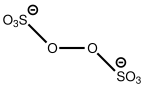
A search of the Cambridge structure database reveals around 18 high quality crystal structures containing this species are known, many as metal salts.

The article[1] reports that “in the presence of sulfate radicals generated from peroxydisulfate, the (Krebs cycle) intermediates underwent 24 interconversion reactions” covering “the critical topology of the oxidative Krebs cycle, the glyoxylate shunt and the succinic-semialdehyde pathway“. The suggestion therefore is that these crucial metabolic reactions may have existed before life itself absorbed them into the oxidative Krebs cycle. The challenge now is to explain how or if the more ancient reductive Krebs cycle (which fixes carbon dioxide) might have arisen prebiotically. More exciting stuff to come I fancy.
References
- M.A. Keller, D. Kampjut, S.A. Harrison, and M. Ralser, "Sulfate radicals enable a non-enzymatic Krebs cycle precursor", Nature Ecology & Evolution, vol. 1, 2017. https://doi.org/10.1038/s41559-017-0083
Tags: metal salts, Peroxydisulfate
Posted in crystal_structure_mining, Interesting chemistry | No Comments »
March 19th, 2017
The Wikipedia entry on peroxydisulfate is quite short (as of today). But I suspect this article may change things.[1].
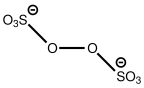
A search of the Cambridge structure database reveals around 18 high quality crystal structures containing this species are known, many as metal salts.

The article[1] reports that “in the presence of sulfate radicals generated from peroxydisulfate, the (Krebs cycle) intermediates underwent 24 interconversion reactions” covering “the critical topology of the oxidative Krebs cycle, the glyoxylate shunt and the succinic-semialdehyde pathway“. The suggestion therefore is that these crucial metabolic reactions may have existed before life itself absorbed them into the oxidative Krebs cycle. The challenge now is to explain how or if the more ancient reductive Krebs cycle (which fixes carbon dioxide) might have arisen prebiotically. More exciting stuff to come I fancy.
References
- M.A. Keller, D. Kampjut, S.A. Harrison, and M. Ralser, "Sulfate radicals enable a non-enzymatic Krebs cycle precursor", Nature Ecology & Evolution, vol. 1, 2017. https://doi.org/10.1038/s41559-017-0083
Tags: metal salts, Peroxydisulfate
Posted in crystal_structure_mining, Interesting chemistry | No Comments »
March 19th, 2017
A pyrophoric metal is one that burns spontaneously in oxygen; I came across this phenomenon as a teenager doing experiments at home. Pyrophoric iron for example is prepared by heating anhydrous iron (II) oxalate in a sealed test tube (i.e. to 600° or higher). When the tube is broken open and the contents released, a shower of sparks forms. Not all metals do this; early group metals such as calcium undergo a different reaction releasing carbon monoxide and forming calcium carbonate and not the metal itself. Here as a prelude to the pyrophoric reaction proper, I take a look at this alternative mechanism using calculations.

There are ~60 crystal structures of metal oxalates, of which several are naturally occurring minerals (Fe, humboldtine[1], Ca, Weddellite[2], Li[3], Na[4], K[5], Cs[6]. The natural geometry of the oxalate di-anion is planar (torsion 0 or 180°) but a small number are twisted such as the caesium oxalate.

The kinetics of pyrolysis of a number of metal oxalates were studied some years ago (Ca[7], Li[8]) indicating barriers ranging from 53-68 kcal/mol. One proposed mechanism is as shown in this article.[7]

It was surmised from the kinetic analysis that the k1 activation step (rotation about the C-C bond from planar to twisted) was ~12 ± 20 kcal/mol, whilst steps k2 or k3 had the much higher activation energy noted above. A search (of Scifinder) for quantum mechanical “reality checks” of this mechanism revealed a blank and so I apply such a check here using Mg as the metal.
The carbonyl extrusion step (ωB97XD/Def2-TZVPPD/SCRF=water, DOI: 10.14469/hpc/2320) was studied with a water solvent field applied in an effort to mimic the solid state crystal structure of the species as a better representation of the ionic lattice than a pure vacuum calculation.
 An IRC (intrinsic reaction coordinate, DOI: 10.14469/hpc/2324) reveals the start-point geometry still has a very small negative force constant (-38 cm-1, DOI: 10.14469/hpc/2321) which now corresponds to a small rotation about the C-C bond to give a C2-symmetric conformation:
 But the barrier for this process is tiny and nothing like the ~12 ± 20 kcal/mol inferred from the kinetic analysis. Perhaps most of the incentive to pack into a totally planar geometry comes from the interactions in the ionic lattice. The calculated free energy barrier (ΔG298‡ 54.7 kcal/mol, ΔG755‡ 55.1 kcal/mol) is within the reported measured range.

The mechanism for production of pyrophoric metal itself is likely to be far more complex, involving (inter alia) electron transfer from oxygen to metal. If I find anything I will report back here.
References
- T. Echigo, and M. Kimata, "Single-crystal X-ray diffraction and spectroscopic studies on humboldtine and lindbergite: weak Jahn–Teller effect of Fe2+ ion", Physics and Chemistry of Minerals, vol. 35, pp. 467-475, 2008. https://doi.org/10.1007/s00269-008-0241-7
- C. Sterling, "Crystal structure analysis of weddellite, CaC2O4.(2+x)H2O", Acta Crystallographica, vol. 18, pp. 917-921, 1965. https://doi.org/10.1107/s0365110x65002219
- https://doi.org/
- G.A. Jeffrey, and G.S. Parry, "The Crystal Structure of Sodium Oxalate", Journal of the American Chemical Society, vol. 76, pp. 5283-5286, 1954. https://doi.org/10.1021/ja01650a007
- Dinnebier, R.E.., Vensky, S.., Panthofer, M.., and Jansen, M.., "CCDC 192180: Experimental Crystal Structure Determination", 2003. https://doi.org/10.5517/cc6fzcy
- Dinnebier, R.E.., Vensky, S.., Panthofer, M.., and Jansen, M.., "CCDC 192182: Experimental Crystal Structure Determination", 2003. https://doi.org/10.5517/cc6fzf0
- F.E. Freeberg, K.O. Hartman, I.C. Hisatsune, and J.M. Schempf, "Kinetics of calcium oxalate pyrolysis", The Journal of Physical Chemistry, vol. 71, pp. 397-402, 1967. https://doi.org/10.1021/j100861a029
- D. Dollimore, and D. Tinsley, "The thermal decomposition of oxalates. Part XII. The thermal decomposition of lithium oxalate", Journal of the Chemical Society A: Inorganic, Physical, Theoretical, pp. 3043, 1971. https://doi.org/10.1039/j19710003043
Tags: Aluminium, calculated free energy barrier, Carbon monoxide, Chemical elements, Chemistry, higher activation energy, Iron, Matter, metal, metal oxalates, Oxide, pyrophoric metal, Pyrophoricity, Reducing agents
Posted in crystal_structure_mining, reaction mechanism | 1 Comment »
