A tutorial problem in stereoelectronic control. The Tiffeneau-Demjanov rearrangement as part of a prostaglandin synthesis.

November 23rd, 2015

This reaction emerged a few years ago (thanks Alan!) as a tutorial problem in organic chemistry, in which students had to devise a mechanism for the reaction and use this to predict the stereochemical outcome at the two chiral centres indicated with *.  It originates in a brief report from R. B. Woodward’s group in 1973 describing a prostaglandin synthesis,[1] the stereochemical outcome being crucial. Here I take a look at this mechanism using computation.

TD

The amino group is firstly converted to a diazonium chloride by nitrous acid and the resulting group is then easily eliminated. The problem is easy once you spot that either of the coloured bonds in the reactant is approximately antiperiplanar to the diazonium group, and might migrate to contract the ring. The green bond has a dihedral angle of ~174° with respect to the C-N≡N bond whilst the red bond has a less optimal value of ~166°. This alignment can also be viewed using orbital overlaps, in this case the (localised) NBO corresponding to the green or red bond and the empty antibonding NBO for the C-N bond. Below, the blue phase of the C-C bond is presumed to overlap constructively with the purple phase of the C-N anti bond, and likewise for the red/orange phases for the red bond.

Click for  3D

Click for 3D

Click  for  3D

Click for 3D

A transition state (ωB97XD/6-311G(d,p)/SCRF=dichloromethane) can be located[2] and this yields[3] the reaction animation shown below;

Ta

This has lots of interesting features, itemised below. The essence of the mechanism is that the green bond is induced to migrate by the proton removal from the OH bond by the chloride group. The red bond, although also aligned more or less correctly, has no such assistance.

  1. Plot 1 of energy shows a small activation energy (7 kcal/mol), leading to an exothermic reaction by about 34 kcal/mol.
  2. The gradient plot 2 (the derivative of the energy with respect to the geometry) shows several interesting features
    1. The reaction starts at IRC = 1.5 with zero gradients.
    2. It reaches the transition state very early (IRC=0.0), at which point the gradients are again zero.
    3. and then the gradients (almost but not quite) reach zero again (IRC ~-2). This is called a hidden reaction intermediate and corresponds to the cations noted above (as an ion pair, with chloride anion). Because the ion pair has a large dipole moment, one might expect the reaction to be sensitive to the polarity of any solvent, and these hidden intermediates might become real ones in highly polar solvents.
    4. At IRC -5, the gradients become large as the carbon starts to migrate.
    5. The migration (with retention of stereochemistry, it is a cationic [1,2] sigmatropic shift) is induced by the chloride anion starting to abstract the proton from the OH group, in synchrony with the carbon migration.
    6. After IRC -8, we see only conformational changes occurring, which may also be interesting to analyse.
  3. Plot 3 shows the length of the breaking (migrating) C-C (green) bond. It hardly changes up to the transition state; it is only afterwards that it really starts to break/migrate. Curiously, the red bond actually lengthens more than the green one at this stage (watch the animation above carefully) before changing its mind and reforming.
  4. Plot 4 the length of the newly forming (migrating) C-C bond. Note how initially, up to the transition state, this bond also lengthens (rather more than the green one does), before slowly reversing itself to contract at the transition state after IRC -3.
  5. Plots 5 and 6 show the lengths of the O…H and Cl…H bonds as the proton transfer proceeds. This mostly occurs AFTER the transition state is passed, and so the reaction should not exhibit any primary kinetic isotope effect induced by e.g. deuterium substitution.
  6. Plot 7 shows the dipole moment evolving along the reaction. At the start the species is an ion pair (diazonium chloride), but as the reaction proceeds HCl is formed and the dipole moment decreases to that of a less ionic compound.

TSE

TSG

TSBL12

TSBL13

TSBLOH

TSBLClH

TSDM

As a learning tool, I find such animations carry a lot of information about reactions and their mechanism and it does not take more than a day or so to chart their course in the manner above.

References

  1. R.B. Woodward, J. Gosteli, I. Ernest, R.J. Friary, G. Nestler, H. Raman, R. Sitrin, C. Suter, and J.K. Whitesell, "Novel synthesis of prostaglandin F2.alpha.", Journal of the American Chemical Society, vol. 95, pp. 6853-6855, 1973. https://doi.org/10.1021/ja00801a066
  2. H.S. Rzepa, "C 8 H 13 Cl 1 N 2 O 4", 2015. https://doi.org/10.14469/ch/191625
  3. H.S. Rzepa, "C8H13ClN2O4", 2015. https://doi.org/10.14469/ch/191626

The roles of water in the hydrolysis of an acetal.

November 18th, 2015

In the previous post, I pondered how a substituent (X below) might act to slow down the hydrolysis of an acetal. Here I extend that by probing the role of water molecules in the mechanism of acetal hydrolysis.

acetal1

Water molecules can participate in three ways:

  1. One water acts as a nucleophile to replace one of the oxygen atoms of the acetal
  2. n waters in total participate in a proton transfer relay, in which a proton from the acid used to protonate one oxygen in the acetal is counterbalanced by another removed by a cooperating water.
  3. m waters serve as a stabilizer via hydrogen bonding. 
  4. Water can also be modelled as a continuum dielectric solvent.

My previous model included just one explicit water molecule (n=1) participating in 1 and 2 above (but not via 3) + the continuum model 4; the objective then being to study variation in X. I noted that the resulting barriers to reaction were too high for a facile thermal reaction; the model had to be incomplete. Here the objective is to probe the consequences of various deployments of up to four water molecules in this mechanism (X=R=H) to see if the model can be improved.

n m ΔE, kcal/mol ΔG DataDOI
1 0 38.4 38.2 [1]
2 0 36.5 34.1 [2],[3],[3]
3 0 32.1 30.4 [4],[5][6]
4 0 28.1 29.9 [7],[8],[5]

3 1 29.8 29.5 [9],[8],[10]
2 2 30.5 31.3 [11],[8],[12]
1 3 26.9 29.7 [13],[8],[14]

The energies shown above generally show that water molecules are almost as happy when participating in a (cyclic) proton relay as when (passively) solvating the acid. This is probably in part at least because a cyclic proton transfer relay cross-polarises adjacent waters, increasing their own hydrogen bond strengths. Nevertheless, with four water molecules, the possible arrangements in the table above are all in fact quite similar in energy, suggesting that the actual system is a complex dynamic one involving many states of similar energy. A proper molecular-dynamics based sampling of these and other states is probably needed to construct the most realistic model. The extended four-water model results in a lowering of the predicted barrier by ~9-10 kcal/mol to become a more reasonable value for a thermal reaction, perhaps appropriate for catalysis by a relatively weak acid such as acetic. The improvement in part may be because the linear requirement for an Sn2 displacement is more easily accommodated by the larger rings created by using more water molecules.

Click for  3D

Click for 3D

An intrinsic reaction coordinate (IRC) is also instructive, shown as the gradient normal along the IRC. The features are as follows:

  1. IRC ~8, the water molecules are reorganising themselves ready for the proton relay
  2. IRC 2, a dip in the gradient norm reveal a hidden intermediate corresponding to the first proton transfer to the oxygen of the acetal.
  3. IRC 0 is of course the transition state
  4. IRC -2 corresponds to a dip for the second proton transfer
  5. IRC -3 to -4 the third and fourth proton transfers occur, showing that they are sequential rather than synchronous.

3+0G

3+0a

This examples shows how modelling using transition state theory can yield reasonably realistic answers, but also that the next step in computational modelling, reaction dynamics, is probably needed to properly explore the statistical aspects of mechanism.

References

  1. H.S. Rzepa, "C 6 H 14 O 5", 2015. https://doi.org/10.14469/ch/191581
  2. H.S. Rzepa, and H.S. Rzepa, "C 6 H 16 O 6", 2015. https://doi.org/10.14469/ch/191599
  3. H.S. Rzepa, "C6H16O6", 2015. https://doi.org/10.14469/ch/191600
  4. H.S. Rzepa, "C 6 H 18 O 7", 2015. https://doi.org/10.14469/ch/191601
  5. https://doi.org/
  6. H.S. Rzepa, "C 6 H 20 O 8", 2015. https://doi.org/10.14469/ch/191606
  7. H.S. Rzepa, and H.S. Rzepa, "C 6 H 20 O 8", 2015. https://doi.org/10.14469/ch/191607
  8. H.S. Rzepa, "C 6 H 20 O 8", 2015. https://doi.org/10.14469/ch/191604
  9. H.S. Rzepa, "C6H20O8", 2015. https://doi.org/10.14469/ch/191610
  10. H.S. Rzepa, "C 6 H 20 O 8", 2015. https://doi.org/10.14469/ch/191603
  11. H.S. Rzepa, "C6H20O8", 2015. https://doi.org/10.14469/ch/191605
  12. H.S. Rzepa, "C 6 H 20 O 8", 2015. https://doi.org/10.14469/ch/191609
  13. H.S. Rzepa, "C6H20O8", 2015. https://doi.org/10.14469/ch/191621

How to stop (some) acetals hydrolysing.

November 12th, 2015

Derek Lowe has a recent post entitled “Another Funny-Looking Structure Comes Through“. He cites a recent medchem article[1] in which the following acetal sub-structure appears in a promising drug candidate (blue component below). His point is that orally taken drugs have to survive acid (green below) encountered in the stomach, and acetals are famously sensitive to hydrolysis (red below). But if X=NH2, compound “G-5555” is apparently stable to acids.[1] So I pose the question here; why?

acetal

This reminded me of some work we did a few years ago on herbicides containing such an acetal substructure, where one diastereoisomer was very unstable to hydrolysis (and hence did not have the lifetime required of a herbicide) whereas the other diastereomer was far less labile and hence more suitable.[2],[3] Crystal structures (below) revealed that the two C-O bond lengths of the labile form were very unequal in length (Δ0.043Å), whereas the stable form had two equal C-O lengths (1.408Å, Δ=0.0Å).

Click for 3D

KAWYOW, Click for 3D

Click for 3D

KAWYEM, Click for 3D

A search of the Cambridge structure database (CSD) surprisingly reveals no hits for molecules containing the (blue) substructure in which X=NH2, but there is one example[4],[5] of an orthoformate in which the group equivalent to X is protonated as Me2NH+. For this example, all three C-O lengths are shorter than even the hydrolytically stable herbicide above (1.405, 1.402, 1.396Å). The distribution for 6-ring acetals in general shows hot-spots at ~1.415Å and 1.43Å (but sadly it is not possible to e.g. use this database to correlate these lengths with the aqueous stability of the entries).

OCO

Is this tentative further evidence that a group X = NH2 positioned as above in an acetal can inhibit its hydrolysis?

HUZKEZ, click for 3D

HUZKEZ, click for 3D

Time for calculations. A model (X=R=H) for the hydrolysis was constructed as above in which proton transfer from an acid (ethanoic) is achieved via a cyclic 8-ring transition state and which includes a continuum solvent field as ωB97XD/6-311G(d,p)/SCRF=water and one explicit water in the proton relay. The IRC looks thus:

acetalH

This shows that the first event is protonation of an oxygen, closely followed by cleavage of the associated C-O bond, and ending with deprotonation of the erstwhile water molecule.

acetalha

The value of ΔG298 is 38.2 kcal/mol (38.4 in relative total energy). Although rather high for a facile thermal reaction (perhaps the 8-ring TS is a bit too strained; possibly adding a second active water molecule to form a 10-ring might lead to a lower barrier?), we are more interested in the effect upon this barrier of group X (Table below).

X ΔE ΔG DataDOI,TS DataDOI,IRC
H 38.4 38.2 [6] [7]
NH2,eq 39.8 38.8 [8] [9]
NH3.Cl,eq 45.1 43.1 [10] [11]
NH3.Cl,ax 42.6 41.5 [12] [13]
CF3,eq 41.9 40.1 [14] [15]
SF5,eq 43.6 42.4 [16] [17]

Introduction of X=NH3+.Cl into an (equatorial) position which is antiperiplanar to the C-O bonds of the acetal produces a modified IRC profile. The barrier measured at a point IRC = -10 is ~41 kcal/mol, which is noticeably higher than for X=H. In fact the final barrier is even higher, since the reactant goes on to form a hydrogen bond between the water molecule and the Cl, an extra stabilisation not present with X=H (and so not really appropriate to include in the comparison).

acetal-NH3Cl

acetalnh3cl-eqa

Placing the X=NH3+.Cl into an (axial) position which is not antiperiplanar to the C-O bonds shows a lower barrier compared to the equatorial isomer. This difference can also be illustrated by the NBO localised orbital energies of the two reactants. With X=NH3+.Cl axial, the lone pair on the oxygen being protonated by the acid has an energy of -0.464 au, whereas the equatorial equivalent is a “less reactive” -0.471 au (a difference in energy of 4.4 kcal/mol, which is VERY approximately related to the effects being discussed).

I conclude that the inhibition of acetal solvolysis is induced by the presence of an electron withdrawing group X, via antiperiplanar effects on the basicity of the acetal oxygen. In moderately low pH, X=NH2 is likely to be fully protonated; in this state, X=NH3+.Cl is an even better electron withdrawing group. The effect is also much stronger if X = equatorial. So one can predict here that if the alternate stereoisomer with X = axial were to be synthesised, it would hydrolyse more quickly. Other groups (X=F, CN etc) would probably show similar behaviour.


I have added two further entries, X=CF3 and X=SF5 in the table above, showing the latter to be more effective at inhibiting hydrolysis.

References

  1. C.O. Ndubaku, J.J. Crawford, J. Drobnick, I. Aliagas, D. Campbell, P. Dong, L.M. Dornan, S. Duron, J. Epler, L. Gazzard, C.E. Heise, K.P. Hoeflich, D. Jakubiak, H. La, W. Lee, B. Lin, J.P. Lyssikatos, J. Maksimoska, R. Marmorstein, L.J. Murray, T. O’Brien, A. Oh, S. Ramaswamy, W. Wang, X. Zhao, Y. Zhong, E. Blackwood, and J. Rudolph, "Design of Selective PAK1 Inhibitor G-5555: Improving Properties by Employing an Unorthodox Low-p <i>K</i> <sub>a</sub> Polar Moiety", ACS Medicinal Chemistry Letters, vol. 6, pp. 1241-1246, 2015. https://doi.org/10.1021/acsmedchemlett.5b00398
  2. P. Camilleri, D. Munro, K. Weaver, D.J. Williams, H.S. Rzepa, and A.M.Z. Slawin, "Isoxazolinyldioxepins. Part 1. Structure–reactivity studies of the hydrolysis of oxazolinyldioxepin derivatives", J. Chem. Soc., Perkin Trans. 2, pp. 1265-1269, 1989. https://doi.org/10.1039/p29890001265
  3. P. Camilleri, D. Munro, K. Weaver, D.J. Williams, H.S. Rzepa, and A.M.Z. Slawin, "Isoxazolinyldioxepins. Part 1. Structure–reactivity studies of the hydrolysis of oxazolinyldioxepin derivatives", J. Chem. Soc., Perkin Trans. 2, pp. 1929-1933, 1989. https://doi.org/10.1039/p29890001929
  4. Beckmann, C.., Jones, P.G.., and Kirby, A.J.., "CCDC 209989: Experimental Crystal Structure Determination", 2003. https://doi.org/10.5517/cc71hvl
  5. C. Beckmann, P.G. Jones, and A.J. Kirby, "<i>N,N,N</i>′,<i>N</i>′-Tetramethylstreptamine 2,4,6-orthoformate hydrochloride", Acta Crystallographica Section E Structure Reports Online, vol. 59, pp. o566-o568, 2003. https://doi.org/10.1107/s1600536803006287
  6. H.S. Rzepa, "C 6 H 14 O 5", 2015. https://doi.org/10.14469/ch/191581
  7. H.S. Rzepa, "Gaussian Job Archive for C6H14O5", 2015. https://doi.org/10.6084/m9.figshare.1599751
  8. H.S. Rzepa, "C 6 H 15 N 1 O 5", 2015. https://doi.org/10.14469/ch/191582
  9. H.S. Rzepa, "C6H15NO5", 2015. https://doi.org/10.14469/ch/191586
  10. H.S. Rzepa, "C 6 H 16 Cl 1 N 1 O 5", 2015. https://doi.org/10.14469/ch/191584
  11. H.S. Rzepa, "C6H16ClNO5", 2015. https://doi.org/10.14469/ch/191588
  12. H.S. Rzepa, "C 6 H 16 Cl 1 N 1 O 5", 2015. https://doi.org/10.14469/ch/191590
  13. H.S. Rzepa, "Gaussian Job Archive for C6H16ClNO5", 2015. https://doi.org/10.6084/m9.figshare.1601891
  14. H.S. Rzepa, "C 7 H 13 F 3 O 5", 2015. https://doi.org/10.14469/ch/191592
  15. H.S. Rzepa, "Gaussian Job Archive for C7H13F3O5", 2015. https://doi.org/10.6084/m9.figshare.1603088
  16. H.S. Rzepa, "C 6 H 13 F 5 O 5 S 1", 2015. https://doi.org/10.14469/ch/191595
  17. H.S. Rzepa, "Gaussian Job Archive for C6H13F5O5S", 2015. https://doi.org/10.6084/m9.figshare.1603420

Interactions responsible for the lowest energy structure of the trimer of fluoroethanol.

October 23rd, 2015

Steve Bachrach on his own blog has commented on a recent article[1] discussing the structure of the trimer of fluoroethanol. Rather than the expected triangular form with three OH—O hydrogen bonds, the lowest energy form only had two such bonds, but it matched the microwave data much better. Here I explore this a bit more.

The stability of the lowest energy form, as is evident from the title of the article, was attributed to unusual H-Bond topology and bifurcated H-bonds as teased out from bond critical points in the QTAIM analysis of the topology of the electron density. Here I add to this analysis by displaying the computed NCI (non-covalent-interaction)[2] surfaces, as you might see in the comment I posted on Steve’s blog. In essence, the QTAIM had revealed bond paths connecting an oxygen to a H-C and also a bifurcation from an F to two H-C atoms, shown with orange lines in the diagram there. What might an NCI analysis reveal? The analysis[3] is shown below, where I have added orange arrows to indicate the location of these bond paths. The arrows point to an NCI feature which corresponds to a weak dispersion-like stabilisation.

Click for 3D

Click for 3D

However, as you can spot from the diagram above (and inspect in a 3D sense if you click on the diagram above to load a 3D Jmol model), there are many more regions where NCI features appear. The most obvious are the blue-coded ones, which in fact represent the conventional O…HO hydrogen bonds, but there are plenty of others as well, including a cyan one which is not part of the published attributions. I will recapitulate my comment on Steve’s blog; the point I make here is that apart from the two regions which have been picked out in the article as responsible for stabilisation of the low energy structure, there are around 4-5 OTHER regions that also may be stabilising but for which there is no corresponding critical point in the density. So whilst the above origins are not incorrect, they may well be very incomplete!.

There is a tendency to only highlight features which can be named, and perhaps to ignore or pay less attention to those which have no name. The latter may in fact be more common than we imagine, and cumulatively they can often have a big impact.


Postscript: A structure has recently been reported[4],[5] illustrating an exceptionally strong OH…F interaction of 1.52Å. This is noteworthy because such hydrogen bonds are rarely strong and indeed even their very existence is controversial. The cyan NCI region mentioned above is just such an interaction (of length ~2.0Å).


References

  1. J. Thomas, X. Liu, W. Jäger, and Y. Xu, "Unusual H‐Bond Topology and Bifurcated H‐bonds in the 2‐Fluoroethanol Trimer", Angewandte Chemie International Edition, vol. 54, pp. 11711-11715, 2015. https://doi.org/10.1002/anie.201505934
  2. J. Contreras-García, W. Yang, and E.R. Johnson, "Analysis of Hydrogen-Bond Interaction Potentials from the Electron Density: Integration of Noncovalent Interaction Regions", The Journal of Physical Chemistry A, vol. 115, pp. 12983-12990, 2011. https://doi.org/10.1021/jp204278k
  3. H.S. Rzepa, and H.S. Rzepa, "C 6 H 15 F 3 O 3", 2015. https://doi.org/10.14469/ch/191558
  4. M.D. Struble, C. Kelly, M.A. Siegler, and T. Lectka, "Search for a Strong, Virtually “No‐Shift” Hydrogen Bond: A Cage Molecule with an Exceptional OH⋅⋅⋅F Interaction", Angewandte Chemie International Edition, vol. 53, pp. 8924-8928, 2014. https://doi.org/10.1002/anie.201403599
  5. Struble, Mark D.., Kelly, Courtney., Siegler, Maxime A.., and Lectka, Thomas., "CCDC 991440: Experimental Crystal Structure Determination", 2014. https://doi.org/10.5517/cc128nyy

Pierre and Marie Curie.

October 23rd, 2015

I have previously shown the grave of  William Perkin, a great british organic chemist. On a recent visit to  Paris, I went to see the crypt in the Panthéon, the great french secular necropolis. What a contrast to Perkin! 

curie2

The Curies have a crypt all to themselves (VII), and other great french scientists such as Bertholet and Langevin as well as mathematicians such as Lagrange who are also interred in other crypts. It is surprising in fact how exclusive admission to the Pantheon is (and how much space for new tombs there still is); whilst many of the graves relate to famous soldiers dating from the french revolution and not a few politicians of course as well as famous literary figures, science and chemistry are very well represented! The French have even named a metro station after the Curies …

curie1

with a  caption that makes nice reading for the passengers whilst waiting for a train.

curie3

A highly readable description of their work can be found in Oliver Sacks’ book Uncle Tungsten. And if you ever visit Paris, remember to ask to go to Gay-Lussac’s lab (who is not interred in the Panthéon), preserved in a time-warp from 100 years ago.

Impressions of China 2: The colour of porcelain.

October 14th, 2015

In Jingdezhen an Imperial Kiln was built in 1369 to produce porcelain that was “white as jade, thin as paper, bright as a mirror and tuneful as a bell”. It’s the colours of the glazes that caught my eye, achieved by a combination of oxidative and reductive firing in the kiln, coupled with exquisite control of the temperature.

The photo below represents the glaze master weighing out the transition metal salts required to produce the colours, with abacus to hand! The labels on the bottles are not translated (I forgot to load up the camera-based translator onto my iPad, which I am using to write this post). Question: what colours does oxidative or reductive firing with vanadium salts produce?

image

image

And in Tunxi in the old village of Xidi the bridge made famous by the film Crouching Tiger, Hidden Dragon. image

Impressions of China. New units of speed and old ways of counting.

October 9th, 2015

This comes to you from China, and the city of Suzhou. To set the scene, cities in China have a lot of motorbikes. Electric ones. With their own speed units, a % of Panda speed. image

Msny msny people ride bikes such as these; some even manage three passengers, or several boxes of shopping. And the streets will have dedicated lanes for them, although you do need eyes in the back of your head to spot their silent (often 15 kph) approach. image

The chinese pharmacy also has separate lanes, for the modern tablets, pills and lotions familiar in the West but with equal prominence to traditional herbal medicines.

image

image

The duality also extends to the checkout!

image

We are here to visit the gardens, both formal snd botsnical. And to exercise our reaction times (see above).

Yes, no, yes. Computational mechanistic exploration of (nickel-catalysed) cyclopropanation using tetramethylammonium triflate.

October 1st, 2015

A fascinating re-examination has appeared[1] of a reaction first published[2] in 1960 by Wittig and then[3] repudiated by him in 1964 since it could not be replicated by a later student. According to the new work, the secret to a successful replication seems to be the presence of traces of a nickel catalyst (originally coming from e.g. a nickel spatula?). In this recent article[1] a mechanism for the catalytic cycle is proposed. Here I thought I might explore this mechanism using calculations to see if any further insights might emerge.

cyclopropanation

In the mechanism above (I have retained the original numbering shown in the article itself), Ln is set to 2PH3 as an initial approximation and the solvent thf is approximated only by a continuum solvation field, with no explicit thf molecules involved at this stage. At this level and using ωB97XD/Def2-SVPD/SCRF=thf free energies, one can explore the cycle quite quickly (~2-3 days). It is also interesting that this reaction unusually involved nine different elements (I wonder what the record is? Not much greater I suspect).

Species ΔΔG298 DataDOI
4+CH2NMe3+LiOTf + ethene +23.9 [4],[5]
5 0.0 [6]
TS (5→ 9) 12.7 [7],[8]
9 + LiOTf + NMe3 0.2 [9]
TS (9 + ethene → 6) 7.2 [10],[11]
6 4.8 [12]
TS (6 → 7) 11.2 [13],[14]
7 -36.3 [15]
TS (7 → 4+8) -18.8 [16],[17]
4+8 + LiOTf + NMe3 -29.7 [4]

The structure of the complex 5 is more or less as shown in the article. The mean single bonded Ni-C length in the Cambridge structure database (CSD) is ~1.9Å, and (formally at least) Ni=C lengths are shorter at ~1.80-1.85. There is one reasonable analogy to the sub-structure shown below[18],[19] with a C-Ni length of 1.90, Ni-Li = 2.51 and Li-C = 2.40 which is reasonably similar to what is shown below. 

T

Click for  3D

Click for 3D

The elimination of NMe3 reveals a reasonable thermal barrier, resulting in the formation of the nickel-carbene product and the complex between NMe3 and LiOTf. 

5a5-9

The Ni-carbene then reacts with alkene (modelled here by ethene) to form a Ni-alkene π-complex, with a very low barrier to the exo-energic reaction.

9-6a9-6

This complex then rearranges, again with a small barrier, to the metallocyclobutane, with considerable release of energy.

6-7a6-7

Finally, the metallocyclobutane extrudes the nickel to form cyclopropane bound to the Ni(PH3)2 as a pseudo-π/agostic complex, with this step of the reaction being somewhat endo-energic (+6.6 kcal/mol). As modelled, it produces a low-coordination Ni product 4, which also causes the initial reactants to be relatively high in energy (+23.9 relative to 5). This suggests that the entire cycle should optimally be repeated by including say two explicit thf solvent molecules, which could coordinate to 4, thus lowering its energy relative to the rest of the cycle. 

7-4a7-4

Below is shown the NCI (non-covalent-interactions) surface for the Ni-cyclopropane complex, revealing the relatively high density between the Ni and the edge of the cyclopropane (high enough indeed to be considered on the verge of being covalent density). No examples of this motif are found in the CSD.

Click for  3D

Click for 3D


Overall, the reaction as shown shows entirely reasonable energetics and activation free energy barriers (with the caveat that inclusion of explicit solvent molecules might improve things, see above). We might conclude from this that the catalytic cycle as proposed is entirely reasonable. What we cannot comment on of course is the relative energetics of any of the competing side reaction shown in the original scheme,[1] but it would be really easy to include them in a more complete analysis if needed. I wanted to show here that a simple reality check on a proposed reaction mechanism can be quick to perform, and perhaps nowadays should be regarded as a sine qua non of mechanistic speculation.

References

  1. S.A. Künzi, J.M. Sarria Toro, T. den Hartog, and P. Chen, "Nickel‐Catalyzed Cyclopropanation with NMe<sub>4</sub>OTf and <i>n</i>BuLi", Angewandte Chemie International Edition, vol. 54, pp. 10670-10674, 2015. https://doi.org/10.1002/anie.201505482
  2. V. Franzen, and G. Wittig, "Trimethylammonium‐methylid als Methylen‐Donator", Angewandte Chemie, vol. 72, pp. 417-417, 1960. https://doi.org/10.1002/ange.19600721210
  3. G. Wittig, and D. Krauss, "Cyclopropanierungen bei Einwirkung von <i>N</i>‐Yliden auf Olefine", Justus Liebigs Annalen der Chemie, vol. 679, pp. 34-41, 1964. https://doi.org/10.1002/jlac.19646790106
  4. H.S. Rzepa, "C 4 H 9 F 3 Li 1 N 1 O 3 S 1", 2015. https://doi.org/10.14469/ch/191545
  5. H.S. Rzepa, "C 5 H 11 F 3 Li 1 N 1 O 3 S 1", 2015. https://doi.org/10.14469/ch/191553
  6. H.S. Rzepa, and H.S. Rzepa, "C 5 H 17 F 3 Li 1 N 1 Ni 1 O 3 P 2 S 1", 2015. https://doi.org/10.14469/ch/191554
  7. H.S. Rzepa, "C 5 H 17 F 3 Li 1 N 1 Ni 1 O 3 P 2 S 1", 2015. https://doi.org/10.14469/ch/191536
  8. H.S. Rzepa, "C5H17F3LiNNiO3P2S", 2015. https://doi.org/10.14469/ch/191550
  9. H.S. Rzepa, and H.S. Rzepa, "C 5 H 17 F 3 Li 1 N 1 Ni 1 O 3 P 2 S 1", 2015. https://doi.org/10.14469/ch/191555
  10. H.S. Rzepa, "C 3 H 12 Ni 1 P 2", 2015. https://doi.org/10.14469/ch/191547
  11. H.S. Rzepa, "C3H12NiP2", 2015. https://doi.org/10.14469/ch/191546
  12. H.S. Rzepa, "C 3 H 12 Ni 1 P 2", 2015. https://doi.org/10.14469/ch/191541
  13. H.S. Rzepa, "C 3 H 12 Ni 1 P 2", 2015. https://doi.org/10.14469/ch/191540
  14. H.S. Rzepa, "C3H12NiP2", 2015. https://doi.org/10.14469/ch/191548
  15. H.S. Rzepa, "C 3 H 12 Ni 1 P 2", 2015. https://doi.org/10.14469/ch/191542
  16. H.S. Rzepa, "C 3 H 12 Ni 1 P 2", 2015. https://doi.org/10.14469/ch/191537
  17. H.S. Rzepa, "C3H12NiP2", 2015. https://doi.org/10.14469/ch/191538
  18. Buchalski, P.., Grabowska, I.., Kaminska, E.., and Suwinska, K.., "CCDC 650794: Experimental Crystal Structure Determination", 2008. https://doi.org/10.5517/ccpv6c2
  19. P. Buchalski, I. Grabowska, E. Kamińska, and K. Suwińska, "Synthesis and Structures of 9-Nickelafluorenyllithium Complexes", Organometallics, vol. 27, pp. 2346-2349, 2008. https://doi.org/10.1021/om701275u

Isoelectronic games: the CO analogue of diazirines as an intriguing species?

September 24th, 2015

How does an anaesthetic work? Surprisingly, it is only recently[1] that the possible binding sites of the anaesthetic propofol (2,6-di-isopropylphenol) have been identified using a technique known as photoaffinity labelling.[2] A propofol analogue was constructed[1] by replacing one of the isopropyl groups with a trifluoromethyl diazirine group (R=CF3, X=Y=N below). Upon photolysis, this species looses nitrogen and forms a carbene as a reactive species, which with further chemistry binds covalently[2] to adjacent amino acids in the binding pocket.These modified segments could then be analysed by mass spectrometry.[1] An isomer of  diazirine is diazomethane, which is some 11 kcal/mol lower in free energy, but fortunately the diazirene is preventing from thermally isomerising to this species by a large kinetic barrier. That was the intro; now for a connection. I recently attended a presentation on another medical topic, the therapeutic uses of carbon monoxide.[3] In higher concentrations it is notoriously lethal, but with appropriate delivery it can be therapeutic. So, intertwingling, I asked myself what the properties of the carbon monoxide isoelectronic analogue of a diazirine might be (X=C, Y=O below). 

diazirene

Firstly, a search using Scifinder. More than 102 million molecules and substances are reported there. Of course, that does not mean the molecule actually exists, since many structures are only known by calculation! But I could not find the CO analogue using a sub-structure search. So this simple isoelectronic analogue of a very well-known molecule type is not apparently well-known then (although I feel sure that a theoretical chemist must have calculated it at some stage, even if the results were not reported and abstracted by CAS). Here is a ωB97XD/6-311G(d,p)/SCRF=nitromethane set of calculations (kcal/mol).

Species ΔΔG298 ring ΔΔG298 linear ΔG XY extrusion ΔG ring opening
X=Y=N 0.0[4]   -11.0[5] 36.1[6]
X=C, Y=O 0.0[7] -63.3[8] 27.3[9] 46.8[10]

We learn the following:

  1. The CO analogue is far less stable as a ring than the NN equivalent, but it is a clear-cut minimum in the energy surface.
  2. In the absence of any other conditions (for example protons), the free energy barrier for extruding CO is actually quite high, being only a little lower than the diazirine itself. The latter is thermally reasonably stable and not a fragile molecule at all. At face value therefore if made, such a cyclo-oxenium ylid might have a long enough “shelf life” to be detectable or trappable, certainly at lower temperatures. 
  3. It shows an even higher barrier to ring opening to form the far more stable ketene. This barrier is high enough that this reaction probably involves e.g. biradicals or other pathways.

ro-co1

ro-co

ex-co1

ex-co

The question arises how such a CO analogue of diazirines might be made. The very high relative energy does tend to suggest it might have to be a photochemical approach. This would be a challenge, given that photochemistry is also likely to promote CO extrusion. Most likely this species is destined to join the (increasing) collection of molecules known to science only by their computed properties! 


Such connectedness in human knowledge has been termed intertwingularity by Ted Nelson.

Scifinder by and large only abstracts articles published in journals, along with some of the data found there. Most calculations never make it to such articles. The newly topical area of Research Data Management strives to put in place an infrastructure that addresses such issues.[11]


References

  1. G.M.S. Yip, Z. Chen, C.J. Edge, E.H. Smith, R. Dickinson, E. Hohenester, R.R. Townsend, K. Fuchs, W. Sieghart, A.S. Evers, and N.P. Franks, "A propofol binding site on mammalian GABAA receptors identified by photolabeling", Nature Chemical Biology, vol. 9, pp. 715-720, 2013. https://doi.org/10.1038/nchembio.1340
  2. L. Dubinsky, B.P. Krom, and M.M. Meijler, "Diazirine based photoaffinity labeling", Bioorganic & Medicinal Chemistry, vol. 20, pp. 554-570, 2012. https://doi.org/10.1016/j.bmc.2011.06.066
  3. R. Motterlini, and L.E. Otterbein, "The therapeutic potential of carbon monoxide", Nature Reviews Drug Discovery, vol. 9, pp. 728-743, 2010. https://doi.org/10.1038/nrd3228
  4. H.S. Rzepa, "C 2 H 1 F 3 N 2", 2015. https://doi.org/10.14469/ch/191529
  5. H.S. Rzepa, "C 2 H 1 F 3 N 2", 2015. https://doi.org/10.14469/ch/191530
  6. H.S. Rzepa, "C2HF3N2", 2015. https://doi.org/10.14469/ch/191534
  7. H.S. Rzepa, "C 3 H 1 F 3 O 1", 2015. https://doi.org/10.14469/ch/191531
  8. H.S. Rzepa, "C 3 H 1 F 3 O 1", 2015. https://doi.org/10.14469/ch/191535
  9. H.S. Rzepa, "C3HF3O", 2015. https://doi.org/10.14469/ch/191532
  10. H.S. Rzepa, "C3HF3O", 2015. https://doi.org/10.14469/ch/191533
  11. H. Rzepa, "Workshop presentation on Research Data Management at Imperial College London, 29th September, 2015.", 2015. https://doi.org/10.14469/hpc/143

Deviations from planarity of trigonal carbon and from linearity of digonal carbon.

September 13th, 2015

Previously, I explored deviation from ideal tetrahedral arrangements of four carbon ligands around a central (sp3) carbon using crystal structures. Now it is the turn of digonal (sp1) and trigonal (sp2) carbons. 

Firstly, the digonal C≡C case. Attached to each carbon of the C≡C unit are two saturated carbon ligands; this to prevent conjugation from influencing our result. 

Scheme

The result of a search (R-factor < 5%, no errors, no disorder) shows the hotspot at the expected ~180°, but then a fascinating curve as the angle subtended at the digonal carbon angle decreases down to ~110°, with the C≡C bond length gradually increasing. This apparently non-linear behaviour would be interesting to replicate using quantum mechanics.

Scheme

Next, the trigonal case. Again, the substituents are 4-coordinate carbons to prevent complicating conjugations.

Scheme

A plot of the C=C distance vs the C-C=C angle brings a surprise. There are four clusters centered at angles of ~132°, 123°, 110° and 94° (cyclobutenes) and a small cluster at ~150°. The C=C distance stays constant at around 1.335Å or shorter, a clear difference with the sp-case. There is perhaps a small outlier collection where the angle is ~108° and the distance ~1.4Å.

Scheme

This plots the dihedral angle subtended at one of the trigonal carbon atoms and measures how non-planar that atom is. There is again no real evidence that the C=C bond length changes as the trigonal centre becomes bent.

Scheme

This dihedral angle measures the twist about the C=C bond; up to about 30° is tolerated, but again there is no clear indication of a systematic change in the C=C length.

Scheme

These analyses reveal general trends on bond lengths induced by distorting the normal coordination around trigonal and digonal carbon atoms. It is only the start of the story of course, since there are plenty of isolated outliers that really should be explored; some may be simply due to undetected crystallographic errors, whilst with others there may lurk interesting or even new chemical phenomena. 


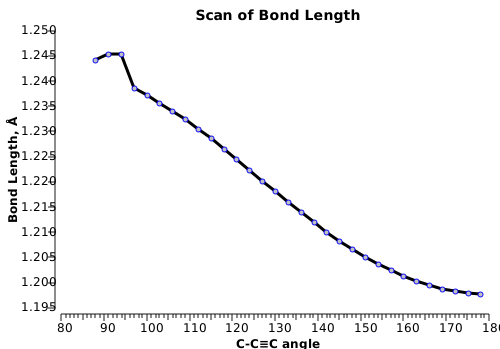
Below, the crystal structure result (with the axes transposed) is compared to a closed shell single reference ωB97XD/6-311+G(2df) calculation. Whilst the trend is replicated, it is not quantitative. This is probably because many of the crystal structures are perturbed by other effects, most probably by coordination of a metal and hence back-donation of π-electrons into vacant metal orbitals. The CSD indexing of the structures however retains the C≡C bond notation, even though the bond is no longer truly a triple one. This reinforces the observation I made in the previous post that when searching the CSD, one can stipulate a bond type to constrain the search. But that bond type may be purely nominal and bear little resemblance to the actual electronic structure of the species. There are other issues;  the wave function was constrained to closed shell single determinant. At low angles, the calculation itself is probably not accurate (as can be seen from a kink in the plot, indicating instability).

Scheme

Scheme