How many water molecules does it take to ionise HF and HBr?

February 27th, 2015

No doubt answers to the question posed in the previous post are already being obtained by experiment. Just in case that does not emerge in the next day or so, I offer a prediction here.

The methodology is the same as before, and I have not tried to look for new isomeric forms compared with the structures found with HCl. The method as before is DFT-based: ωB97XD/6-311++G(2d,2p). In the table below, I am recording the halogen-H distance and the distance from the same H to oxygen. You might also observe a more general principle here; first calibrate the method you intend to use with a system where there is an experimental answer. If the two match, use the same method to predict (extrapolate) to systems as yet unmeasured.

F Cl Br
n F-H, Å H-O Cl-H H-O Br-H H-O
1 0.937 1.702[1] 1.300 1.857 1.438 1.912[2]
2 0.951 1.631[3] 1.322 1.728 1.463 1.754[4]
3 0.967 1.532[5] 1.351 1.579 1.506 1.554[6]
4 0.972 1.504[7] 1.387 1.470 2.032 1.028[8]
5 1.043 1.329[9] 1.841 1.034 2.039 1.021[10]
6 1.067 1.283[11] 1.880 1.023 2.073 1.013[12]

From the bond distances, one notices that “ionisation” is an abrupt discontinuous event, happening for four molecules with HBr, five molecules with HCl and more than six molecules with HF. This nicely parallels the pka values: HBr (pKa = -9.0) < HCl (pKa = -6.0) << HF (pKa = +3.1).

It is good to see that such a process modelled on the nanoscale using just a few discrete molecules can map onto the macroscopic scale of solutions.


Postscript: If you check on the structures of these systems (click on the pictures in the previous post) you will see that the discontinuous ionisation event occurs in a bicyclic system, with the water forming two separate rings. Evidence that this really is the structure of microsolvated species has recently been put forward[13].

hf5h2o


References

  1. H.S. Rzepa, "H 3 F 1 O 1", 2015. https://doi.org/10.14469/ch/190911
  2. H.S. Rzepa, "H 3 Br 1 O 1", 2015. https://doi.org/10.14469/ch/190907
  3. H.S. Rzepa, "H 5 F 1 O 2", 2015. https://doi.org/10.14469/ch/190910
  4. H.S. Rzepa, "H 5 Br 1 O 2", 2015. https://doi.org/10.14469/ch/190909
  5. H.S. Rzepa, "H 7 F 1 O 3", 2015. https://doi.org/10.14469/ch/190912
  6. H.S. Rzepa, "H 7 Br 1 O 3", 2015. https://doi.org/10.14469/ch/190913
  7. H.S. Rzepa, "H 9 F 1 O 4", 2015. https://doi.org/10.14469/ch/190915
  8. H.S. Rzepa, "H 9 Br 1 O 4", 2015. https://doi.org/10.14469/ch/190916
  9. H.S. Rzepa, "H 11 F 1 O 5", 2015. https://doi.org/10.14469/ch/190918
  10. H.S. Rzepa, "H 11 Br 1 O 5", 2015. https://doi.org/10.14469/ch/190919
  11. H.S. Rzepa, "H 13 F 1 O 6", 2015. https://doi.org/10.14469/ch/190928
  12. H.S. Rzepa, "H 13 Br 1 O 6", 2015. https://doi.org/10.14469/ch/190917
  13. C. Pérez, J.L. Neill, M.T. Muckle, D.P. Zaleski, I. Peña, J.C. Lopez, J.L. Alonso, and B.H. Pate, "Water–Water and Water–Solute Interactions in Microsolvated Organic Complexes", Angewandte Chemie International Edition, vol. 54, pp. 979-982, 2014. https://doi.org/10.1002/anie.201409057

How many water molecules does it take to ionise HCl?

February 14th, 2015

According to Guggemos, Slavicek and Kresin, about 5-6![1]. This is one of those simple ideas, which is probably quite tough to do experimentally. It involved blasting water vapour through a pinhole, adding HCl and measuring the dipole-moment induced deflection by an electric field. They found “evidence for a noticeable rise in the dipole moment occurring at n56“.

Modelling the structures takes little time. So here are some ωB97XD/6-311++G(2d,2p) gas phase models. I state at the outset that these are not dynamic-stochastic models, averaged over many conformations, but a static picture of individual poses. As usual, click on individual images to obtain an interactive 3D model (Java required).

n=1.[2] Dipole moment 3.7D

hcl+1h2o

n=2.[3] Dipole moment 2.4D. Note how the O…H bond becomes shorter.

hcl+2h2o

n=3.[4] Dipole moment 2.5D. Note how the key O..H bond is contracting rapidly, as are the other H-bond interactions. This is the cyclic polarisation effect, where each bond influences the others. We are starting to approach the formation of H3O+ and Cl!

hcl+3h2o

n=4.[5] Dipole moment 2.3 D, We have two ways to add the next water molecule, firstly to try to stabilise the H3O+. Nope.

hcl+4h2o

n=4,[5] Dipole moment 1.1 D. Better by solvating the Cl! The proton originally attached to the Cl is now starting its transfer to the water to form that hydronium cation, but the dipole moment is not yet large.

hcl+4h2o1

n=5.[6] Dipole moment 4.7D. The ionisation is almost complete and the dipole moment is on the increase.

5

n=6.[7] The dipole moment is up to 8.2D and the three H-O bonds of the hydronium cation are almost all equal in length.

6

A cautionary observation though. The isomer below for n=6[8] is lower in energy by ΔG -1.2 kcal/mol, and its dipole moment is only 2.5D! The charges (summed onto heavy atoms) show the chloride to have -0.88 and the hydronium cation +0.88, so it is a true ion-pair, despite its dipole moment.

6a

So these calculations do indeed appear to confirm that 5-6 water molecules are required to ionise HCl. But it does raise the interesting issue that even for n=6, there are poses for the assembly which have low dipole moments. Clearly of course the observed dipole moment is a dynamic average over many conformations of similar energy but the prediction that some of these may have low dipole moments should be noted.


If you right-click in the 3D model area, you can bring down a list of vibrational modes for each complex from the first item of the pop-up menu that appears (labelled model). You might wish to e.g. explore how the H-Cl stretch vibration changes as the ionisation increases.


References

  1. N. Guggemos, P. Slavíček, and V.V. Kresin, "Electric Dipole Moments of Nanosolvated Acid Molecules in Water Clusters", Physical Review Letters, vol. 114, 2015. https://doi.org/10.1103/physrevlett.114.043401
  2. H.S. Rzepa, "H 3 Cl 1 O 1", 2015. https://doi.org/10.14469/ch/189758
  3. H.S. Rzepa, "H 5 Cl 1 O 2", 2015. https://doi.org/10.14469/ch/189760
  4. H.S. Rzepa, "H 7 Cl 1 O 3", 2015. https://doi.org/10.14469/ch/189759
  5. H.S. Rzepa, "H 9 Cl 1 O 4", 2015. https://doi.org/10.14469/ch/189763
  6. H.S. Rzepa, "H 11 Cl 1 O 5", 2015. https://doi.org/10.14469/ch/189756
  7. H.S. Rzepa, "H 13 Cl 1 O 6", 2015. https://doi.org/10.14469/ch/189761
  8. H.S. Rzepa, "H 13 Cl 1 O 6", 2015. https://doi.org/10.14469/ch/189764

How-open-is-it?

February 12th, 2015

The title of this post refers to the site http://howopenisit.org/  which is in effect a license scraper for journal articles. In the past 2-3 years in the UK, we have been able to make use of grants to our university to pay publishers to convert our publications into Open Access (also called GOLD). I thought I might check out a few of my recent publications to see what http://howopenisit.org/ makes of them.

This was catalysed by an article which revealed that UK universities spent £9M in 2014 on the purchase of such openness. One of the “challenges” identified is the difficulty in converting such payment into an article that actually is open. Apparently, publishers make not a few mistakes in their quality controls in ensuring it is so, relying on irate authors informing them of such mistakes. This can be quite tedious to do, and so a tool that largely automates this checking is most useful. So here we go.

  1. doi: 10.1039/C3SC53416B[1] This is a good start. The output looks like thus. Green is GOLD so to speak. Well done the Royal Society of Chemistry.
    10.1039:C3SC53416B
  2. doi: 10.1021/ci500302p[2] from the ACS this time. Pink, but at least free to read. Quite what that means is less certain. There is an adage, “the right to read means the right to mine” presumably means this article is OK to mine, but then why does it not say so?10.1021:ci500302p
  3. doi: 10.1002/anie.201405238[3]. Pink again, but the colour now simply means no information about the license could be obtained from the publisher (Wiley). 10.1002:anie.201405238

I ran a few more and sadly the third of the above, “no information” was the most common response. And the legal response is invariably that if no information can be obtained, the answer is NO, it is not free to read. In other words, not providing a license is just as bad as saying it’s not free to read.

Article aggregators such as Symplectic do not yet perform the service above (which to be fair is still in beta), and so I cannot yet check how many GOLD articles there are to my name. I think it should be about 8, and I might add that the time I have to spend in arranging for this to happen is not negligible. Hell, I could probably have found a few more reactions mechanism in the time I have spent on achieving GOLD. This is one of those topics which would be interesting to revisit say in five years time to see how the world has changed. So I leave this little time capsule and will update it then!

References

  1. A. Armstrong, R.A. Boto, P. Dingwall, J. Contreras-García, M.J. Harvey, N.J. Mason, and H.S. Rzepa, "The Houk–List transition states for organocatalytic mechanisms revisited", Chem. Sci., vol. 5, pp. 2057-2071, 2014. https://doi.org/10.1039/c3sc53416b
  2. M.J. Harvey, N.J. Mason, and H.S. Rzepa, "Digital Data Repositories in Chemistry and Their Integration with Journals and Electronic Notebooks", Journal of Chemical Information and Modeling, vol. 54, pp. 2627-2635, 2014. https://doi.org/10.1021/ci500302p
  3. A. Jana, I. Omlor, V. Huch, H.S. Rzepa, and D. Scheschkewitz, "N‐Heterocyclic Carbene Coordinated Neutral and Cationic Heavier Cyclopropylidenes", Angewandte Chemie International Edition, vol. 53, pp. 9953-9956, 2014. https://doi.org/10.1002/anie.201405238

Chiroptical spectroscopy of the natural product Steganone.

February 10th, 2015

Steganone is an unusual natural product, known for about 40 years now. The assignment of its absolute configurations makes for an interesting, on occasion rather confusing, and perhaps not entirely atypical story. I will start with the modern accepted stereochemical structure of this molecule, which comes in the form of two separately isolable atropisomers.
steganone
The first reported synthesis of this system in 1977 was racemic, and no stereochemistry is shown in the article (structure 2).[1] Three years later an “Asymmetric total synthesis of (-)steganone and revision of its absolute configuration” shows how the then accepted configuration (structure 1 in this article) needs to be revised to the enantiomer shown as structure 12 in the article[2] and matching the above representation. The system has continued to attract interest ever since[3],[4],[5],[6], not least because of the presence of axial chirality in the form of atropisomerism. Thus early on it was shown that the alternative atropisomer, the (aS,R,R) configuration initially emerges out of several syntheses, and has to be converted to the (aR,R,R) configuration by heating[3]. One could easily be fooled by such isomerism!

Absolute configurations can be established in several ways.

  1. From precursors of known absolute configuration. This was the most common method until relatively recently, but it is very expensive since asymmetric syntheses are often much more complex and longer than racemic ones. There is always a small residual doubt that any transformation in the synthesis might have altered the configuration in an unexpected manner.
  2. From an X-ray of the final configuration (Bijvoet). Very often the structure is determined on a derivative of the target compound (the original may not form suitable crystals). There is also the doubt that the selected crystals may in fact be a minor form and do not represent the bulk of the system in solution. This is especially true where atropisomerism is concerned, since the solid state structure may not represent the same atropisomer present in solution.
  3. In the last decade or so, it has become more common to make use of the computation of measured chiroptical spectroscopies to see if they match. It turns out that this method appears never to have been applied to Steganone, and here I attempt to rectify this.

First, let us compute the optical rotation. The (aR,R,R) stereoisomer is also known as (-)-Steganone, because the measured specific rotation is [α]589 -170° ± 30.[3] It is computed (MN12L/6-311++G(d,p)/SCRF=chloroform) as -240°, [α]365 -2251[7]. The other atropisomer (aS,R,R) is computed to be 4.5 kcal/mol higher in free energy with [α]589 +408°[8], and measured as +150.[3] There is some uncertainty in the computed values, since the rotations can be dependent on the conformation not only of the rings, but the substituents. You might imagine that the conformation of eg a -OMe group is unimportant, but this is not so. In this case, I have used a crystal structure of a related species to serve as the start point for optimising the MeO conformations. The greater mismatch between computation and experiment for the (aS,R,R) stereoisomer probably needs an exploration of more conformations of the -OMe groups. At least in both cases the signs match between computation and measurement.

Next, the electronic circular dichroism (ECD), which has also been measured[3] for the (aR,R,R) isomer as Δε 201nm (-ve Cotton effect), 218 (+ve), 244 (-ve), 276 (+ve) 304 (-ve) and 337 (-ve). Bearing in mind that the baselines in ECD spectra are notoriously difficult to define (moving it up or down can easily invert a Cotton effect), the agreement with the calculated spectrum MN12L/6-311++G(d,p)/SCRF=chloroform, nstates=200)[9] might seem reasonable, although the calculated version has more peaks in the region 225-265 than are reported (e.g. 235, +ve, 265, -ve).
(R,R)-steganone-9
The (aS,R,R) isomer seems a less good fit. The +ve peak at 218 is missing, the +ve 276 peak matches better than the other isomer, but the 337nm peak is again the wrong sign.
(aS,R,R)-steganone

Of course, in such a game it may be the DFT functional used for the simulation that itself might be misleading, MN12L in this case. Just to check, I also include the results using M062X[10] to see how variable these simulations might be. The measured peaks at 201, 218, 244 and 337nm match, but the ones at 276 and 304nm do not.

s-m062x

Although matching computed with measured ECD spectra is commonly used to assign absolute configurations of molecules, you can see from these results that the technique is not a cast iron one! Even scanning through myriad DFT procedures to find the one that fits best is probably not a complete solution either. Can anything be done to further increase confidence?

How about Vibrational Circular Dichroism (VCD) predictions?[11],[12]. Like ECD, VCD is also sensitive to conformation, which is why some modern instruments have low temperature probes operating at close to 0K which strive to capture only a single lowest energy conformation (although of course in any simulation, you have to identify that conformation reliably!). At some stage in the future, the VCD spectra of steganone might indeed be measured, and hence compared with the below. It might serve to increase confidence in the chiroptical methods as a means of assigning configuration.

(aR,R,R)-steganone (aS,R,R)-steganone

We might conclude from this short exploration of chiroptical spectroscopy that no one single measured or computed value can be absolutely definitive; rather it is the accumulation from various sources that builds up the case for a particular configuration. But at least the above simulations do serve to add some useful additional data for the record.

References

  1. D. Becker, L.R. Hughes, and R.A. Raphael, "Total synthesis of the antileukaemic lignan (±)-steganacin", J. Chem. Soc., Perkin Trans. 1, pp. 1674-1681, 1977. https://doi.org/10.1039/p19770001674
  2. J. Robin, O. Gringore, and E. Brown, "Asymmetric total synthesis of the antileukaemic lignan precursor (-)steganone and revision of its absolute configuration", Tetrahedron Letters, vol. 21, pp. 2709-2712, 1980. https://doi.org/10.1016/s0040-4039(00)78586-8
  3. E.R. Larson, and R.A. Raphael, "Synthesis of (–)-steganone", J. Chem. Soc., Perkin Trans. 1, pp. 521-525, 1982. https://doi.org/10.1039/p19820000521
  4. A. Bradley, W.B. Motherwell, and F. Ujjainwalla, "A concise approach towards the synthesis of steganone analogues", Chemical Communications, pp. 917-918, 1999. https://doi.org/10.1039/a900743a
  5. M. Uemura, A. Daimon, and Y. Hayashi, "An asymmetric synthesis of an axially chiral biaryl via an (arene)chromium complex: formal synthesis of (–)-steganone", J. Chem. Soc., Chem. Commun., vol. 0, pp. 1943-1944, 1995. https://doi.org/10.1039/c39950001943
  6. B. Yalcouye, S. Choppin, A. Panossian, F.R. Leroux, and F. Colobert, "A Concise Atroposelective Formal Synthesis of (–)‐Steganone", European Journal of Organic Chemistry, vol. 2014, pp. 6285-6294, 2014. https://doi.org/10.1002/ejoc.201402761
  7. H.S. Rzepa, "C 22 H 20 O 8", 2015. https://doi.org/10.14469/ch/189647
  8. H.S. Rzepa, "C 22 H 20 O 8", 2015. https://doi.org/10.14469/ch/189646
  9. H.S. Rzepa, "C 22 H 20 O 8", 2015. https://doi.org/10.14469/ch/189649
  10. H.S. Rzepa, "C 22 H 20 O 8", 2015. https://doi.org/10.14469/ch/189657
  11. https://doi.org/
  12. H.S. Rzepa, "C 22 H 20 O 8", 2015. https://doi.org/10.14469/ch/189651

Mechanism of the solvatochromic reaction of a spiropyran.

February 4th, 2015

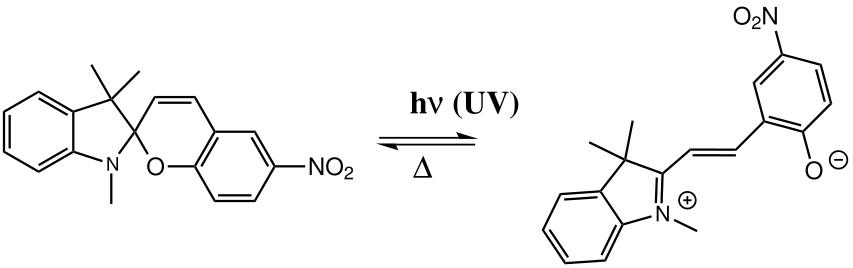
The journal of chemical education has many little gems providing inspiration for laboratory experiments. Jonathan Piard reports one based on the reaction below[1]; here I investigate the mechanism of this transformation.

spiropyran
There are two things going on here; an electrocyclic ring opening involving breaking the C-O bond, with a cis/trans isomerism of the alkene (concurrent or consecutive). A crystal structure of the dinitro analogue establishes the trans stereochemistry[2]. This product zwitterion is highly coloured (blue-purple) unlike the colourless reactant. The rate at which this colour clears can be easily measured in a UV/visible spectrometer, and from this activation parameters are inferred as a function of the solvent.

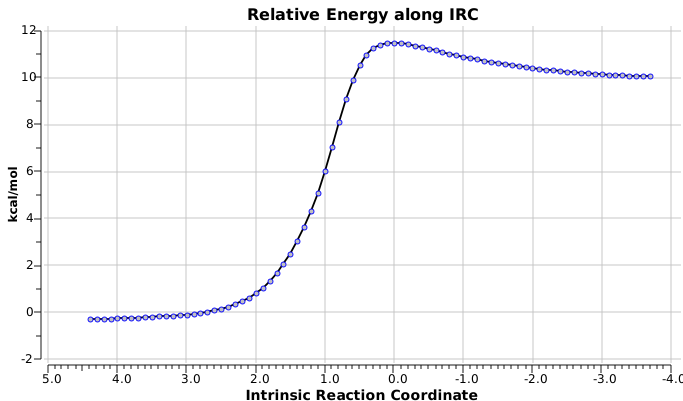
Photochemically, this reaction is too complex to study quickly using computation, but the thermal back reaction is much easier. Applying the ωB97XD/6-311G(d,p)/SCRF=solvent procedure and using the C-O bond as a reaction coordinate results in the following transition state[3] IRC profile[4] for DMSO as solvent, here connecting to the cis-alkene. The thermal forward barrier for the C…O cleaving is ~12 kcal/mol. More significantly, the back reaction is only <2 kcal mol, which is very much lower than that reported[1] (~22 kcal/mol) and makes the cis-alkene very much a transient species and therefore not the coloured species being measured.

C-O-cleave

A second transition state involving C=C bond rotation is located[5] and this yields the following IRC[6] to form the trans-alkene, with activation parameters listed below. It is entirely probable however that the forward photochemical reaction follows a different course involving conical intersections; an interesting study in its own right, but beyond the scope of this post.

cis-trans

Measured and computed activation parameters for the thermal back reaction
Solvent ΔG298, kcal mol-1 ΔH, kcal mol-1 ΔS, cal K-1 mol-1
DMSO, measured 22.0 26.4 +14.6
toluene, measured 19.0 14.3 -15.6
DMSO, calc[5] 21.2 20.4 +2.6
toluene, calc[7] 18.6 19.1 +1.8

The next issue surrounds the effect of solvent. Most spectacular are those of the activation parameters for the thermal back-reaction. The measured activation entropy ΔS changes with solvent by Δ30.2 cal, and the enthalpy ΔH by Δ12.1 kcal, which are enormous solvent effects. Are they in fact real? It is reassuring at least that the calculated free energy agrees pretty closely with the measured values. So too does the decrease in ΔG in changing the solvent from DMSO to toluene (3.0 kcal/mol measured, 2.6 calculated).

There is little sign of a large solvent effect in the calculated values. This could be for three reasons.

  1. The first is that adding explicit, hydrogen-bonded solvent molecules to the system is essential. As the zwitterionic character is lost when the trans-alkene starts to rotate, the system will become less ionic, and hence shed solvent molecules and gain entropy. If the solvent is not capable of hydrogen bonding, as say toluene, these will not be shed and the entropy will not increase at the transition state. It is difficult however to reconcile this picture with the apparent large loss of entropy for toluene as solvent.
  2. The second reason is because of a complete change in mechanism, one not modelled here.
  3. For completeness, one should also mention that the measured values might simply be in error, either due to typographical mistakes or indeed in numerical analysis.

I will conclude with the colour. It is possible to compute the electronic excitations across the range 180-580nm, and I show below a difference spectrum (for DMSO as solvent) with the product +ve and the reactant  -ve. You can see the spectacular red-shift for the highly conjugated zwitterion! The absolute value of λmax is not red-shifted enough (by about 65 nm), but the effect remains real.
spiro

The above experiment is for undergraduate chemistry laboratories. I suggest that a computational reality check could also easily be included into such a lab, and would certainly help give students a broader perspective.

References

  1. J. Piard, "Influence of the Solvent on the Thermal Back Reaction of One Spiropyran", Journal of Chemical Education, vol. 91, pp. 2105-2111, 2014. https://doi.org/10.1021/ed4005003
  2. J. Hobley, V. Malatesta, R. Millini, L. Montanari, and W. O Neil Parker, Jr, "Proton exchange and isomerisation reactions of photochromic and reverse photochromic spiro-pyrans and their merocyanine forms", Physical Chemistry Chemical Physics, vol. 1, pp. 3259-3267, 1999. https://doi.org/10.1039/a902379h
  3. H.S. Rzepa, "C 19 H 18 N 2 O 3", 2015. https://doi.org/10.14469/ch/189540
  4. H.S. Rzepa, "C19H18N2O3", 2015. https://doi.org/10.14469/ch/189573
  5. H.S. Rzepa, "C 19 H 18 N 2 O 3", 2015. https://doi.org/10.14469/ch/189546
  6. H.S. Rzepa, "C19H18N2O3", 2015. https://doi.org/10.14469/ch/189648
  7. H.S. Rzepa, "C 19 H 18 N 2 O 3", 2015. https://doi.org/10.14469/ch/189579

Fine-tuning a (hydrogen) bond into symmetry.

January 23rd, 2015

Sometimes you come across a bond in chemistry that just shouts at you. This happened to me in 1989[1] with the molecule shown below. Here is its story and, 26 years later, how I responded.

JAZCOC

To start at the beginning, there was a problem with the measured 1H NMR spectrum; specifically (Y=H, Z=O) there are supposedly 16 protons, but only 15 could be located. What had happened to the 16th? To understand how one proton had been “lost”, you should appreciate that on most FT-NMR instruments, one has to specify a spectral window to collect data, and normally for protons, that window ranges from ~14 to -2 ppm. So the standard response to lost signals is to expand the window. When that was done, the offending proton appeared at 19 ppm! You should understand that this is an unusual chemical shift for a proton, and is normally taken as indicating very high acidity. But carboxylic acid protons are not regarded as particularly acidic? The mystery was resolved by recording the crystal structure at low temperatures, and this revealed that this hydrogen was (almost) symmetrically disposed between the oxygen and the nitrogen. The N-H distance was 1.32Å and the OH 1.17Å. Whilst such symmetric disposition is not that unusual between two atoms of the same type (O-H-O or N-H-N) it was quite unexpected between two different heteroatoms. And such symmetry alone is sufficient to induce very high chemical shifts; acidity per se does not come into it.

That bond clearly shouted at me; so much so that in the text of the original article, we wrote “it is interesting to speculate whether these characteristics could be fine tuned by modification of the pKa values with suitable ring substitution“. What I had in mind was whether the position of the H could be made perfectly symmetric by adjusting the substituents. But for 26 years this idea lay dormant. Until this post! Rather than make lot of compounds (1-3 years!) I will do it with (lots of) computation (2 days!!).

So to start we need a reality check. I am using the pbe1pbe/tzvp/scrf=chloroform method (this functional is often used for hydrogen bonds) and the collected results are shown in the table below.

  1. For Y=H, Z=O, the calculation predicts single minimum, with the hydrogen closer to O. Starting from an NH bound hydrogen ends with it on O. It is what is called a single well potential. The disposition of that H is not quite correct, but the computed 1H NMR shift is pretty close to experiment, and so I will take this method as reasonably good.
  2. With Y=Li, the polarisation of the N-Li bond enhances the basicity of the second N, and the H now ends up on this atom rather than O (even if it starts on O). Another single well potential. We now know that any symmetric species must occur somewhere between Y=H and Y=Li in terms of the electronegativity of the substituent Y.
  3. Unsurprisingly, Y=Na does not bracket Y=H/Li and the H moves even closer to the N. Again a single well potential.
  4. Y=Li.1H2O or 2H2O do not help either (surprisingly?)
  5. Y=BeH brackets Y=H/Li, but we also see new behaviour with a double-well potential; the H can be attached to either O or N and the former is slightly more stable by 0.22 kcal/mol in ΔG. The barrier is tiny, well below the energy of the first vibrational level, and so experimentally this system will manifest as the average of these two isomers and the H will similarly manifest with its most probable position being at the average of the two minima, N-H ~1.30, O-H ~1.3Å. Success!  At this point, the NMR shift is at its greatest.
  6. Y=BH2 continues the trend as a double minimum, this time with the H-O species the more stable by ΔG 0.68 kcal/mol; we are now past the symmetric point.
  7. By Y=SiH3, the single-well minimum (with H-O) is restored and we emerge with the same result as Y=H.
  8. And to complete the scan, Y=H, Z=S is the same as Z=O.
  9. Some second order tuning can be tried by changing the substituent on Y=BeH to Y=BeF, again a double minimum with HO more stable than NH by 0.30 kcal/mol in ΔG, and with a ΔG298 barrier from O to N of only 0.02 kcal/mol! The fine-tuning is again towards symmetrisation.

I will stop at that point. Unfortunately of course the Y=BeF derivative is unfeasible synthetically and hence unlikely to be tested.

Y N-H, Å O-H, Å δ, ppm FAIR Data Citation
H (expt) 1.32 1.17 19.0 [1]
H (calc) 1.48 1.04 18.6 [2]
Li 1.06 1.52 16.5 [2]
Na 1.05 1.55 15.6 [3]
Li.H2O 1.06 1.52 16.6 [4]
Li.2H2O 1.06 1.52 16.6 [5]
BeH 1.11 1.39 20.6 [6]
BeH 1.49 1.04 18.7 [7]
BH2 1.06 1.56 16.6 [8]
BH2 1.53 1.03 17.6 [7]
SiH3 1.48 1.04 18.8 [9]
Z=S 1.50 1.03 18.8 [10]
BeF 1.12 1.38 20.9 [11]
BeF (TS) 1.15 1.32 22.5 [12]
BeF 1.48 1.04 18.7 [13]

Another reality check, a search of crystal structures. DIST2 = OH, DIST1 = NH, for structures recorded below 140K, R < 0.05%, no errors, no disorder. The structure above is shown as a blue dot. They do tend to show asymmetry, but it is interesting how many such structures have emerged since our own 1989 report; the effect is not that rare any more.
H-bond

The above plot shows lots more systems that might be subjected to the sort of tuning above, and who knows one of them may even yield to experimental validation.

References

  1. P. Camilleri, C.A. Marby, B. Odell, H.S. Rzepa, R.N. Sheppard, J.J.P. Stewart, and D.J. Williams, "X-Ray crystallographic and NMR evidence for a uniquely strong OH ? N hydrogen bond in the solid state and solution", Journal of the Chemical Society, Chemical Communications, pp. 1722, 1989. https://doi.org/10.1039/c39890001722
  2. H.S. Rzepa, "C 13 H 14 Li 1 N 3 O 3", 2015. https://doi.org/10.14469/ch/189475
  3. H.S. Rzepa, "C 13 H 14 N 3 Na 1 O 3", 2015. https://doi.org/10.14469/ch/189477
  4. H.S. Rzepa, "C 13 H 16 Li 1 N 3 O 4", 2015. https://doi.org/10.14469/ch/189478
  5. H.S. Rzepa, "C 13 H 18 Li 1 N 3 O 5", 2015. https://doi.org/10.14469/ch/189480
  6. H.S. Rzepa, "C 13 H 15 Be 1 N 3 O 3", 2015. https://doi.org/10.14469/ch/189476
  7. H.S. Rzepa, "C 13 H 15 Be 1 N 3 O 3", 2015. https://doi.org/10.14469/ch/189492
  8. H.S. Rzepa, "C 13 H 16 B 1 N 3 O 3", 2015. https://doi.org/10.14469/ch/189479
  9. H.S. Rzepa, "C 13 H 17 N 3 O 3 Si 1", 2015. https://doi.org/10.14469/ch/189481
  10. J.S. Dawson, "Cl 4 Ni 1 -2", 2016. https://doi.org/10.14469/ch/193726
  11. H.S. Rzepa, "C 13 H 14 Be 1 F 1 N 3 O 3", 2015. https://doi.org/10.14469/ch/189489
  12. C. Townsend, "Cl 4 Ni 1 -2", 2016. https://doi.org/10.14469/ch/193727

A convincing example of the need for data repositories. FAIR Data.

January 15th, 2015

Derek Lowe in his In the Pipeline blog is famed for spotting unusual claims in the literature and subjecting them to analysis. This one is entitled Odd Structures, Subjected to Powerful Computations. He looks at this image below, and finds the structures represented there might be a mistake, based on his considerable experience of these kinds of molecules. I expect he had a gut feeling within seconds of seeing the diagram.

Indeed, so, you will now find that the authors have apparently acknowledged a mistake[1]. My interest piqued, I went to the article, and immediately tracked down the supplementary information. Surely, if these molecules had been subjected to powerful computation, this supporting information should contain coordinates of some kind that would allow a correlation with the 2D structural representation shown above. I have just returned from FORCE2015, a three-day event in Oxford. From the detailed agenda, you can see that a lot of the conference centered around what is called FAIR Data. FAIR stands for:

  1. Findable
  2. Accessible
  3. Interoperable
  4. Re-usable

So I then set out to find if the supplementary information WAS FAIR. Well, check for yourself (unlike the narrative article, the data should be accessible outside of the paywall, i.e. you should not need a subscription to access it). It is certainly big, running out to 45 pages, in the form of a paginated PDF file (the norm). The table of contents does not refer to data as such, but it does quote 25 figures, from which you might just be able to extract some data. But no molecules as such! So:

  1. No data is findable, although the  PDF which might contain it is reasonably so.
  2. The data is not easily accessible,
  3. let alone interoperable (thus many of the charts were probably created using spreadsheet software, but the source files for these are not available),
  4. and not-reusable (certainly not without loss and possible error in any attempt at capture).

I think it fair to say that the data for these powerful computations are not FAIR. Had we had at least some coordinates (the computations involved molecular mechanics based dynamics simulations, which certainly involve manipulating atom coordinates in some form) then the structures shown in the figure above could be checked, and perhaps even the apparent error would have been quickly spotted.

Derek does not make the point about FAIR data (to be fair, he was not at FORCE2015) and so I will make the case. If you are reporting a computational model or simulation, there is no excuse for not supplying FAIR data to accompany it. If the data is FAIR it will be inter-operable and re-usable. And this will instantly allow anyone to check e.g. the structures above. You would not need to have Derek’s vast experience and instinct (although having it is also helps). And of course we might presume that there were 2-3 referees that also looked at the article, and presumably none of them requested FAIR data.

Oh, if you are interested in my take on FAIR data, I gave a talk about that at FORCE2015, which you are welcome to view; I hope it constitutes a FAIR talk!

References

  1. K.J. Kohlhoff, D. Shukla, M. Lawrenz, G.R. Bowman, D.E. Konerding, D. Belov, R.B. Altman, and V.S. Pande, "Cloud-based simulations on Google Exacycle reveal ligand modulation of GPCR activation pathways", Nature Chemistry, vol. 6, pp. 15-21, 2013. https://doi.org/10.1038/nchem.1821

The demographics of a blog readership – updated

January 8th, 2015

About two years ago, I posted on the distribution of readership of this blog. The passage of time has increased this from 144 to 176 countries. There are apparently between 189-196 such, so not quite yet complete coverage! 2015
Of course, it is the nature of the beast that whilst we can track countries, very little else is known about such readerships. Is the readership young or old, student or professor, chemist or not (although I fancy the latter is less likely). Another way of keeping tabs on some of the activity are aggregators such as Chemical Blogspace, which has been rather quiet recently. Perhaps we have become too obsessed by metrics, and with the Internet-of-things apparently the “next-big-thing”, the metrics are only likely to increase. This will only encourage “game playing“, and I urge you to see a prime example of this in the UK REF (research excellence framework), the measure which attempts to rank UK universities in terms of their “excellence”.

Ah well, I had better leave this blog and go off and check on my h-index just in case it has notched up another integer.

Chemistry in the early 1960s: a reminiscence.

December 22nd, 2014

I started chemistry with a boxed set in 1962. In those days they contained serious amounts of chemicals, but I very soon ran out of most of them. Two discoveries turned what might have been a typical discarded christmas present into a lifelong career and hobby.

The first was 60 Stoke Newington High Street in north London, the home of Albert N. Beck, Chemist (or his son; my information comes from a historical listing of the shops present on the high street in 1921). I would set out from our home in London SW6 on the #73 bus route (top deck) and it would take about an hour to arrive. On entering the shop, I ventured down a set of stairs into the basement to replenish the chemicals with sensible stocks, and purchase the odd glassware, filter paper, etc. And then venture back across London carrying the proceeds of many weeks, possibly months worth of hoarded pocket-money (apart that is from 1 shilling every two weeks which I reserved for football at Craven Cottage). At some stage, health and safety legislated against 12-year-old boys (and certainly also girls) purchasing chemicals in this manner! However, I can assure you all that I never came to any harm with anything I purchased at A. N. Beck and Sons. Apart that is from giving my parents a good fright.

The second was coming across this book by A. J. Mee. I had thought it was well and truly lost; imagine my delight when I recently found it at home, complete with chemical stains, and dated as from a reprint in 1959.

IFOn the inside cover, I found one shopping list from my expeditions to A. N. Beck and Sons. The price 1/6 is the representation of one shilling and six pence (more than the price of a football match, or perhaps £50 in today’s money? I think football was much cheaper then! Oh, 1/6 is 7.5p in the decimal currency of today, or £0.075). Note that iodine was one of the items purchased. And note the wish list at the bottom! I was clearly starting to do organic chemistry.

shopping-list

The pages of this book list 289 experiments, and I assiduously recorded a tick against all the ones I actually did. This is a typical page (click to expand).

IFThus expt 205 is the preparation of 1,3,5-tribromobenzene from 1,3,5-tribromoaniline (ticked), followed by that of o-cresol from o-toluidine (ticked). You can see how all the aromatic rings are still represented by what now looks like cyclohexane. This book gave me many hours of delightful recreation (I have not counted the ticks, but I think I attempted around half the experiments). Note in particular the huge scale these experiments were done at; 18g of product (I suspect I must have scaled them down a fair bit in order to preserve pocket money). Expt 198 was that of benzidine, of which I do recollect preparing  ~2g. No warnings then about the extremely carcinogenic nature of this substance! Chemistry has certainly changed since then.

Lost unfortunately is the laboratory book where I recorded my results, but one or two samples still exist!


Data discoverability

December 17th, 2014

I have written earlier about the Amsterdam Manifesto. That arose out of a conference on the theme of “beyond the PDF“, with one simple question at its heart: what can be done to liberate data from containers it was not designed to be in? The latest meeting on this topic will happen in January 2015 as FORCE2015.

The format is suitably modern, starting with a Hackathon, and then two days of talks, posters and demos. We will be presenting both a talk and a demo. In the spirit of emancipated data, we have placed the latter into a container that is most certainly not a PDF. That demo has been archived, and there assigned a DOI[1] and for good measure transcluded into this post in its entirety. We hope this demonstrates that such “containers” can be usefully moved around to where they might be needed. I should say that the core of this demo is not just the data, but the metadata associated with it. Metadata renders that data discoverable (mineable) and its usage measurable.

I hope to report here on anything interesting happening at the FORCE2015 event.


The format of this blog is a tiny bit too narrow for the demo to fit comfortably. Go see it here[1] and “enlarge” the view for a better experience.

Full details of this are in preparation.

References

  1. H.S. Rzepa, N. Mason, A. Mclean, and M. Harvey, "Interoperability for Data Repositories. Machine Methods for Retrieving Data for Display or Mining Utilising Persistent (data-DOI) Identifiers", 2014. https://doi.org/10.6084/m9.figshare.1266197