Archive for the ‘crystal_structure_mining’ Category
Saturday, July 25th, 2015
I recently followed this bloggers trail; link1 → link2 to arrive at this delightful short commentary on atom-atom bonds in crystals[1] by Jack Dunitz. Here he discusses that age-old question (to chemists), what is a bond? Even almost 100 years after Gilbert Lewis’ famous analysis,[2] we continue to ponder this question. Indeed, quite a debate on this topic broke out in a recent post here. My eye was caught by one example in Jack’s article: “The close stacking of planar anions, as occurs in salts of croconic acid …far from producing a lowering of the crystal energy, this stacking interaction in itself leads to an increase by several thousand kJ mol−1 arising from Coulombic repulsion between the doubly negatively charged anions” I thought I might explore this point a bit further in this post.
A search query of the Cambridge structure database was defined as below. Two non-bonded oxygen atoms are each attached to one carbon, each oxygen was defined as having one bonded atom (to carbon) and each assigned one negative charge. Addition of the usual constraints of R < 0.05, no errors, no disorder and specifying an intermolecular search produced 103 hits with the distance distribution shown below.


Firstly, you should be aware that the van der Waals radius for oxygen is ~1.5Å, and so any contacts less than 3.0Å become interesting. What becomes particularly exciting is the distinct cluster at ~2.5Å. Could these be ~30 examples of close encounters of the type noted by Dunitz? Well, a control search has to be done, this time for O-H-O motifs, with each OH distance plotted as below:

The hot-spot occurs when both OH distances are equal at ~1.22Å, or an O…O separation close to 2.45Å. Time to quote Dunitz again “This large destabilization is, of course, more than compensated in the overall energy balance by the large stabilization arising from Coulombic interactions of the croconate anions with the surrounding cations.” In this case of course, the cation is a proton, residing at the half way point between the two oxygens. So two oxygens can indeed approach ~0.5Å closer than the sum of the vdw radii if a proton sits in-between them.
What do we learn? Well, firstly that one should always have a reality check of the results of any crystal structure search. The search did specify that the oxygens be non-bonded but also that they should both carry a negative charge and that both should only have one bonded atom. That should in theory at least have excluded any C-O-H-O-C structures, so why were about 30 such examples found? I can only speculate here, but recollect that 50 years ago when the CSD was founded, hydrogen atoms were rarely identified from the electron density. They were instead placed or “idealised” to where they might be expected. Nowadays any contentious hydrogens are almost always located rather than idealised, but clearly their status as bona-fide atoms is not quite so strong as the rest of the periodic table. So in at least some of these 30 examples with short O…O contacts, we might expect there to lurk a (possibly unrecognised) proton. But one never knows, there may be some real examples of O…O contacts with no such proton intervening. Now these really would be interesting.
Postscript. F is isoelectronic with O(-); below is the same search as defined above, but for non-bonded CF…FC approaches. 
The vdw radius of F is 1.45Å hence any non-bonded contact <2.9Å is worth taking a look at. But notice the small cluster of about 10 compounds for which the value is ~2.15Å. The F-H-F plot shows a hot spot at ~2.3 for the F…F separation, but there are zero hits for CF-H-FC. So these ten hits are indeed tantalising.
References
- J.D. Dunitz, "Intermolecular atom–atom bonds in crystals?", IUCrJ, vol. 2, pp. 157-158, 2015. https://doi.org/10.1107/s2052252515002006
- G.N. Lewis, "THE ATOM AND THE MOLECULE.", Journal of the American Chemical Society, vol. 38, pp. 762-785, 1916. https://doi.org/10.1021/ja02261a002
Tags:Carbon, Cations, Chemical bond, control search, Croconic acid, crystal energy, crystal structure search, Gilbert Lewis, intermolecular search, Jack Dunitz, overall energy balance, Proton
Posted in Chemical IT, crystal_structure_mining, Interesting chemistry | 1 Comment »
Saturday, May 30th, 2015
I am on a mission to persuade my colleagues that the statistical analysis of crystal structures is a useful teaching tool. One colleague asked for a demonstration and suggested exploring the classical Jahn-Teller effect (thanks Milo!). This is a geometrical distortion associated with certain molecular electronic configurations, of which the best example is illustrated by octahedral copper complexes which have a d9 electronic configuration. The eg level shown below is occupied by three electrons and which can therefore distort in one of two ways to eliminate the eg degeneracy by placing the odd electron into either a x2-y2 or a z2 orbital. Here I explore how this effect can be teased out of crystal structures.

The search is set up with Cu specified as precisely 6-coordinate, and X=oxygen. The six X-Cu distances are defined as DIST1-DIST6. The R-factor is specified as < 0.05 (no disorder, no errors). The problem now is how to plot what is in effect a six-dimensional set of data, from which we are exploring whether four of the distances are different from the other two, and whether those four are the longer or the shorter. This requires analysis beyond the capability (as far as I know) of the Conquest program, and so here I will show sets of plots showing just the relationship between any two distances at a time. Of the 15 possible combinations of two distances, only four are shown below.
Some obvious patterns can already be spotted in the 400 or so compounds which satisfy the search criteria.
- The largest clustering occurs at ~1.95Å, with two clusters each of fewer hits at ~2.5Å. The Wikipedia page notes that for Cu(OH2)6 the Jahn-Teller distortion favours four short bonds at ~1.95Å and two long ones at ~2.38Å, which agrees approximately with the positions and sizes of the centroids of these clusters.†
- Plots 1 and 2 show very little along the diagonals, where the two plotted distances have the same value. This probably means that one of the distances relates to an equatorial ligand and the other to an axial ligand.
- Plots 3 and 4 show a strong diagonal trend, and so these distances both relate to either axial or equatorial, but not one of each.
- All four plots show a hot spot at ~1.95Å, which hints that the Jahn-Teller distortion is four short bonds/two long.
- Plot 4 also shows a green spot at ~2.5Å which is a tantalising suggestion of examples of four long bonds/two short.‡


Clearly this analysis can be followed up by a visual inspection of individual molecules in each cluster (as well as the outliers which appear to follow no pattern!), together with a more bespoke analysis of the six distances. Unfortunately, the spin state of the complexes cannot be quickly checked (are they all doublets?) since the database does not record these. But the basic search described above takes only a few minutes to do, and it is surprising at how quickly the Jahn-Teller effect can be statistically tested with real experimental data obtained for ~400 molecules. Of course, here I have only explored X=O but this can easily be extended to X=N or X=Cl, to other metals or to alternative coordination numbers such as e.g. 4 where the Jahn-Teller effect can also in principle operate.
‡ One genuine example of this type, also called compressed octahedral coordination, was reported for the species CuFAsF6 and CsCuAlF6[1]
† The measured geometry of Cu(H2O)6 may in fact manifest with six equal Cu-O bond lengths due to the dynamic Jahn-Teller effect, because the kinetic barrier separating one Jahn-Teller distorted form and another (equivalent) isomer is small and hence averaged atom positions are measured which mask the effect. Thus the Jahn-Teller effects shown in the plots above may be under-estimated because of this dynamic masking. Reducing the temperature of the sample at which data was collected would reduce this dynamic effect. Indeed, Cu(D2O)6 collected at 93K shows a very clear Jahn-Teller distortion[2] with four long bonds ranging from 1.97-1.99Å and two long bonds 2.37-2.39Å.[3] Another example measured at 89K with dimethyl formamide replacing water and coordinated via oxygen[4] shows four short (1.97-1.98Å) and two long (2.315Å) bonds. This latter example is also noteworthy because this analysis is as yet unpublished in a journal, but the data itself has a DOI via which it can be acquired. A nice example of modern research data management!
References
- Z. Mazej, I. Arčon, P. Benkič, A. Kodre, and A. Tressaud, "Compressed Octahedral Coordination in Chain Compounds Containing Divalent Copper: Structure and Magnetic Properties of CuFAsF<sub>6</sub> and CsCuAlF<sub>6</sub>", Chemistry – A European Journal, vol. 10, pp. 5052-5058, 2004. https://doi.org/10.1002/chem.200400397
- W. Zhang, L. Chen, R. Xiong, T. Nakamura, and S.D. Huang, "New Ferroelectrics Based on Divalent Metal Ion Alum", Journal of the American Chemical Society, vol. 131, pp. 12544-12545, 2009. https://doi.org/10.1021/ja905399x
- Zhang, Wen., Chen, Li-Zhuang., Xiong, Ren-Gen., Nakamura, T.., and Huang, S.D.., "CCDC 755150: Experimental Crystal Structure Determination", 2010. https://doi.org/10.5517/cctbspl
- M.M. Olmstead, D.S. Marlin, and P.K. Mascharak, "CCDC 1053817: Experimental Crystal Structure Determination", 2015. https://doi.org/10.5517/cc14cl36
Tags:basic search, Chemical bond, chemical bonding, Chemistry, classical Jahn-Teller, clear Jahn-Teller, Coordination chemistry, Coordination complex, Copper(II) nitrate, dynamic Jahn-Teller, Edward Teller, Inorganic chemistry, Jahn-Teller, Jahn–Teller effect, Metal ions in aqueous solution, search criteria, Technology/Internet, Transition metals
Posted in Chemical IT, crystal_structure_mining | 1 Comment »
Tuesday, May 12th, 2015
The Bürgi–Dunitz angle is one of those memes that most students of organic chemistry remember. It hypothesizes the geometry of attack of a nucleophile on a trigonal unsaturated (sp2) carbon in a molecule such as ketone, aldehyde, ester, and amide carbonyl. Its value obviously depends on the exact system, but is generally taken to be in the range 105-107°. A very good test of this approach is to search the crystal structure database (this was how it was originally established[1]).
 The search is defined as follows
- R can be either H or C
- The carbon is constrained to 3-coordinate
- The carbonyl oxygen is constrained to 1-coordinate
- QA can be any of N, O, S, Cl, F.
- QB can be any of H (aldehyde), C (ketone), N (amide), O (ester) or S (thioester).
- The distance QA…C is constrained to any intermolecular non-bonded contact ≤ the sum of the van der Waals radii of the two atoms involved and the angle QA…C=O is the Bürgi–Dunitz angle.
- I have also added a torsion constraint to specify that Nu has got to be ± 20° from orthogonality to the plane of the carbonyl to allow it to attack the π* orbital.
- The crystallographic R factor must be < 0.05, no disorder, no crystallographic errors and the temperature is either any or < 120K.
With no temperature specified, 6994 hits are obtained as below. So the most probable angle (red spot) is ~90°.

One important change to the search is to decrease the temperature to 120K, since structures will have less vibrational noise. The number of hits decreases to 1279, but the most probable angle if anything reduces slightly.

So we have something of a mystery; this crystallographic data shows an angle of approach about 15° less than the oft quoted value. Here are some thoughts:
- This search is the average for all types of carbonyl, whereas the original suggestion was constrained to four types of nucleophiles and simple ketones.
- This search extends the interacting distance of the nucleophile and the carbon out to 3.5Å which is significantly longer than the normally considered length of ~2.85Å. The hotspots occur at about 3.15Å and not 2.85Å.
- There is obviously considerably more data available in 2015 than in 1974, and in particular at low temperature.
- The Bürgi–Dunitz angle is in fact one of two defining the trajectory, the other being the Flippin–Lodge angle which defines the displacement towards R or QB. The search above gives no direct information about this angle, but the torsion is related since it is constrained to bisect the C=O to within ± 20° and hence bisect the groups R and QB.
- An angle of ≤ 90° does not match to the normal explanation, which is that the nucleophile attacks the π* orbital, each lobe of which “leans out” from the centre at about 105° rather than leaning in at ≤ 90°.
- Decreasing the torsion range to ± 5° at 120K gives 592 hits with a hot spot at 95°
- Also constraining the distance QA…C to be 0.3Å less than the van der Waals sum at 120K gives 59 hits with a hot spot at 95° and 2.9Å.
Well, to get to the bottom of this will require reducing the scope of both QA and QB, to find which if any of discrete values for these two variables can indeed give an angle of 105-107°. This would make for quite a good student group project; I expect a group of 8 students could sort this out quite quickly!
References
- H. B:urgi, J. Dunitz, J. Lehn, and G. Wipff, "Stereochemistry of reaction paths at carbonyl centres", Tetrahedron, vol. 30, pp. 1563-1572, 1974. https://doi.org/10.1016/s0040-4020(01)90678-7
Tags:alkene, Bürgi–Dunitz angle, Carbonyl, Chemistry, Functional groups, Group of Eight, Ketone, Organic chemistry, Organic compounds, Stall
Posted in Chemical IT, crystal_structure_mining | 3 Comments »
Friday, April 17th, 2015
The knowledge that substituents on a benzene ring direct an electrophile engaged in a ring substitution reaction according to whether they withdraw or donate electrons is very old.[1] Introductory organic chemistry tells us that electron donating substituents promote the ortho and para positions over the meta. Here I try to recover some of this information by searching crystal structures.
I conducted the following search:

- Any electron donating group as a ring substituent, defined by any of the elements N, O, F, S, Cl, Br.
- A distance from the H of an OH fragment (as a hydrogen bonder to the aryl ring) to the ortho position relative to the electron donating group.
- A similar distance to the meta position.
- The |torsion angle| between the aryl plane and the C…H axis to be constrained to 90° ± 20.
- Restricting the H…C contact distance to the van der Waals sum of the radii -0.3Å (to capture only the stronger interactions)
- The usual crystallographic requirements of R < 0.1, no disorder, no errors and normalised H positions.
The result of such a search is seen below. The red line indicates those hits where the distance from the H to the ortho and meta positions is equal. In the top left triangle, the distance to ortho is shorter than to meta (and the converse in the bottom right triangle). You can see that both the red hot-spot and indeed the majority of the structures conform to ortho direction (of π-facial ) hydrogen bonding.
 Here is a little calculation, optimising the position that HBr adopts with respect to bromobenzene. You can see that the distance discrimination towards ortho is ~ 0.17Å, a very similar value to the “hot-spot” in the diagram above.

This little search of course has hardly scratched the surface of what could be done. Changing eg the OH acceptor to other electronegative groups. Restricting the wide span of N, O, F, S, Cl, Br. Probing rings bearing two substituents. What of the minority of points in the bottom right triangle; are they true exceptions or does each have extenuating circumstances? Why do many points actually lie on the diagonal? Can one correlate the distances with the substituent? Is there a difference between intra and intermolecular H-bonds? What of electron withdrawing groups?
The above search took perhaps 20 minutes to define and optimise, and it gives a good statistical overview of this age-old effect. It is something every new student of organic chemistry can try for themselves! If you run an introductory course in organic aromatic chemistry, or indeed a laboratory, try to see what your students come up with!
References
- H.E. Armstrong, "XXVIII.—An explanation of the laws which govern substitution in the case of benzenoid compounds", J. Chem. Soc., Trans., vol. 51, pp. 258-268, 1887. https://doi.org/10.1039/ct8875100258
Tags:above search, Aromatic compounds, aromaticity, Birch reduction, Chemistry, electron donating, Electrophile, Electrophilic aromatic substitution, Ether, Functional groups, little search, Organic chemistry, Physical organic chemistry, Substitution reactions
Posted in Chemical IT, crystal_structure_mining | 1 Comment »
Sunday, December 7th, 2014
Continuing my hunt, here is a candidate for a strong(est?) halogen bond, this time between Se and I.[1].

The features of interest include:
- The six-membered ring is in the chair conformation.
- The (relatively enormous) I…I substituent is axial!
- It is attached to the Se rather than the O.
- The Se…I distance is 2.75Å, some 1.13Å shorter than the combined atom ver der Waals radii (1.90 + 1.98 = 3.88)
- The Wiberg bond index is 0.42 for the Se-I bond and 0.63 for the I-I bond (at the crystal geometry). It is tending towards a symmetrical disposition of the central iodine (a feat also achieved by the iodine in the NI3 complex).
- The NBO E(2) perturbation involving donation from the Se lone pair into the I-I antibond is 77 kcal/mol, almost twice the value of the one involving DABCO…I-I and way above the values found for the related hydrogen bond.
- The B3LYP+D3/Def2-TZVPP+PP(I) optimised structure expands the Se-I bond distance to 3.04 and contracts the I-I distance to 2.81Å indicating (as with DABCO…I-I) that there may be compression of this bond induced by the lattice.
- The NCI surface shows a classical “strong” interaction between Se and I (blue), but significant additional features arising from the axial hydrogens that might account for the axial orientation of the Se…I-I group.

Click for 3D
- For good measure, here is the complete crystal structure search, defining any non-bonded contact between any element of group six and group seven that is <0.5Å shorter than the van del Waals contact. Our candidate is on the left hand edge of the plot.

References
- H. Maddox, and J.D. McCullough, "The Crystal and Molecular Structure of the Iodine Complex of 1-Oxa-4-selenacyclohexane, C<sub>4</sub>H<sub>8</sub>OSe.I<sub>2</sub>", Inorganic Chemistry, vol. 5, pp. 522-526, 1966. https://doi.org/10.1021/ic50038a006
Tags:chair, crystal structure search
Posted in crystal_structure_mining, Interesting chemistry | 7 Comments »
Saturday, November 29th, 2014
Halogen bonds are less familiar cousins to hydrogen bonds. They are defined as non-covalent interactions (NCI) between a halogen atom (X, acting as a Lewis acid, in accepting electrons) and a Lewis base D donating electrons; D….X-A vs D…H-A. They are superficially surprising, since both D and X look like electron rich species. In fact the electron distribution around X-X (A=X) is highly anisotropic, with the electron rich distribution (the “donor”) being in a torus encircling the bond, and an electron deficient region (the “acceptor”) lying along the axis of the bond.
I will start this simple exploration of halogen bonds by a crystal structure search, defined as below, where A in the above definition is also any halogen, the donor D is a tri-alkyl nitrogen donating via a lone pair, the green contact is defined as an intermolecular distance equal to or shorter than the sum of the van der Waals radii together with an angle subtended as N…7A…7A.

The result of such a search is shown below:

There are surprises.
- The sparsity of hits. If the search is repeated with A = N, O or S, only six further hits are obtained, all with A=N and X=I with one example of X=Br.
- There is a hot-spot at an N…I distance of 2.37Å, a massive 1.2Å shorter than the combined van der Waals radii of N and I, and with a linear N…I-I angle.
This next search replaces A with a carbon instead of a halogen. The hot-spot moves to ~2.8Å, still much shorter than the combined van der Waals radii, and there are rather more hits this time.‡

I will next start with a simple exploration of how the electron density on I2 changes when it accepts an electron from a donor D (ωB97XD/Def2-TZVPP-PP calculation). The following is an electron density difference isosurface (0.002au) showing how the density changes. The red phase is increased density, which adds exo to the bond, and the blue is decreased density, mostly at the iodine atom but also in the centre of the bond. These changes have axial symmetry along the axis of the I-I bond.

As usual, if you want to view a 3D model of this surface, click on the graphic above.
This next difference map shows the inverse, i.e. what happens when an electron is removed from I2 to form a radical cation. Again blue shows decreased density, and this is not axially symmetric, coming from the π-system (more specifically just one of the π-MOs; the orthogonal π-manifold actually gains red density). This is a nice way of showing that I2 accepts electrons into the σ-manifold and looses them from the π-manifold. In other words, the density responds in a very anisotropic way to addition or loss of electrons.†

In part 2, I will focus on one of the examples, HEKZOO[1] as published in 2012[2]. This is a complex between the base DABCO and molecular iodine, in which the DABCO donates electrons into that I2 σ-manifold.
‡There are only three significant hits with D=di-alkyloxygen rather than nitrogen. The first two[3],[4] involve X-A=I-I with a D…X distance of 2.8Aring; and the third X-A=Cl-Cl.
†I have now added also the density difference map for the base DABCO as a model for the donor D. Note that for this base, when an electron is lost to form the radical cation, the density reduces not just at the nitrogen lone pairs, but also the adjacent C-C bonds.

This post is the first I have written since hearing the very sad news about the death of Paul Schleyer. He was a frequent commentator on these posts, and his towering presence over the last sixty years in chemistry will be sorely missed.
References
- Peuronen, A.., Valkonen, A.., Kortelainen, M.., Rissanen, K.., and Lahtinen, M.., "CCDC 879935: Experimental Crystal Structure Determination", 2013. https://doi.org/10.5517/ccyjn03
- A. Peuronen, A. Valkonen, M. Kortelainen, K. Rissanen, and M. Lahtinen, "Halogen Bonding-Based “Catch and Release”: Reversible Solid-State Entrapment of Elemental Iodine with Monoalkylated DABCO Salts", Crystal Growth & Design, vol. 12, pp. 4157-4169, 2012. https://doi.org/10.1021/cg300669t
- H. Bock, and S. Holl, "CCDC 147854: Experimental Crystal Structure Determination", 2001. https://doi.org/10.5517/cc4yvhd
- Walbaum, C.., Pantenburg, I.., and Meyer, G.., "CCDC 837899: Experimental Crystal Structure Determination", 2012. https://doi.org/10.5517/ccx3x0x
Tags:crystal structure search, D. Note, frequent commentator, Paul Schleyer
Posted in crystal_structure_mining, Interesting chemistry, reaction mechanism | No Comments »
Saturday, November 1st, 2014
We are approaching 1 million recorded crystal structures (actually, around 716,000 in the CCDC and just over 300,00 in COD). One delight with having this wealth of information is the simple little explorations that can take just a minute or so to do. This one was sparked by my helping a colleague update a set of interactive lecture demos dealing with stereochemistry. Three of the examples included molecules where chirality originates in stereogenic centres with just three attached groups. An example might be a sulfoxide, for which the priority rule is to assign the lone pair present with atomic number zero. The issue then arises as to whether this centre is configurationally stable, i.e. does it invert in an umbrella motion slowly or quickly. My initial intention was to see if crystal structures could cast any light at all on this aspect.

Central atom has three bonded atoms as C, of which either all three must themselves have four attached atoms, or one can have just three attached atoms as shown above, along with acyclic character for the three bonds attached to the central atom, R ≤ 0.1, not disordered and no errors.
Using the search definition above for R3N one gets the result below. It shows a hot spot for an angle subtended at the nitrogen of ~111°, indicating a pyramidal nitrogen. But how easily is that perturbed? (which is almost like asking how easily can it invert its configuration?).

A perturbation can be applied by changing just one of the attached carbons as having three attached atoms of its own (sp2 hybridised). The response is that the hot spot moves to 120° (below). Of course now this includes compounds such as amides and the like. But we have learnt that it takes just one such attached sp2 hybridised carbon to planarize an adjacent nitrogen.

The control experiment will now be to apply the same test to a P. The hot spot moves from ~99° (P with three sp3 carbons attached) to ~103° (P with two sp3 and one sp2). This reminds us that the overlap and energy-match between a p-orbital on carbon to an adjacent p-orbital on nitrogen is good, whereas the same overlap/energy match to a p-orbital on P is significantly less so.


One gets the same result when the central atom is S; the hotspot moves from ~102° to ~105°. Unfortunately, not enough compounds are known for a tri-substituted oxygen compounds to see how this element responds.


My point in illustrating these statistics is to show how much text-book chemistry can be recovered simply by a few quick explorations of crystal structures. One could even argue that much introductory chemistry could be taught by reference to the statistics of such structures.
Tags:energy, overlap/energy match, search definition
Posted in Chemical IT, crystal_structure_mining | No Comments »
Thursday, June 26th, 2014
The Bürgi–Dunitz angle describes the trajectory of an approaching nucleophile towards the carbon atom of a carbonyl group. A colleague recently came to my office to ask about the inverse, that is what angle would an electrophile approach (an amide)? Thus it might approach either syn or anti with respect to the nitrogen, which is a feature not found with nucleophilic attack. 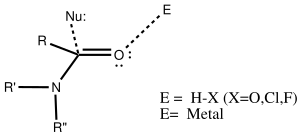 My first thought was to calculate the wavefunction and identify the location and energy (= electrophilicity) of the lone pairs (the presumed attractor of an electrophile). But a better more direct approach soon dawned. A search of the crystal structure database. Here is the search definition, with the C=O-E angle, the O-E distance and the N-C=O-E torsion defined (also specified for R factor < 5%, no errors and no disorder).
  The first plot is of the torsion vs the distance, for E = H-X (X=O,F, Cl)
- The first observation is to note the prominent “hotspot” at a torsion of 180° and a (hydrogen bonding) distance of ~1.60-1.65Å. Amides, so it seems, prefer the electrophile (a proton) to approach anti to the nitrogen
- There is a smaller hotspot at a torsion of 0° and a rather longer distance of ~1.8Å corresponding to syn approach.
- And finally a barely discernible (but real) one at ~90°, corresponding to the proton attaching itself to the carbonyl π-bond.
- A plot of the angles involved reveals that the anti hotspot occurs at ~100° whilst the syn hotspot is about 120°.

- whilst replacing the proton as electrophile by any metal results in a distinct change.


- Syn approach now holds the (red) hotspot, and the angle opens up to ~135°, whilst the anti approach covers a wider angle range of 130-150°
- A third hotspot region occurs for the 90° torsion, again metal-π-bond interactions.
The above is a very general statistical survey. As with most bonding effects, one really should investigate every example to discover any perturbing circumstances or structural motifs that might distort the outcome. But for a ten minute exercise in response to a fascinating question from a colleague, it’s not bad! And it certainly nicely inverts the usual Bürgi–Dunitz view of carbonyl groups.
Tags:electronics, energy, metal results, metal-π-bond interactions, search definition
Posted in crystal_structure_mining, General, Interesting chemistry | No Comments »
Friday, May 2nd, 2014
This is rather cranking the handle, but taking my previous post and altering the search definition of the crystal structure database from 4- to 5-coordinate metals, one gets the following.

Fe …

Co …

Ni …

Cu …
Trigonal bipyramidal coordination has angles of 90, 120 and 180°. Square pyramidal has no 120° angles, and the 180° angles might be somewhat reduced. Thus the Fe and Co series have plenty of 120, whereas the Ni and Cu series hardly any. The Ni series has many 160° values. It is clearly a serious issue that attempting any correlation with the spin states is going to be a lot of really hard work (I might next do another simple search where bond lengths can be shown to very closely correlate with low/medium/high spin states). I will not be trying a more finely grained analysis of the above plots; I just wanted to point out how very simple and quick they are to generate.
Tags:Fe and Co, search definition
Posted in Chemical IT, crystal_structure_mining, General | 1 Comment »
Wednesday, April 30th, 2014
I love experiments where the insight-to-time-taken ratio is high. This one pertains to exploring the coordination chemistry of the transition metal region of the periodic table; specifically the tetra-coordination of the series headed by Mn-Ni. Is the geometry tetrahedral, square planar, or other? One can get a statistical answer in about ten minutes.
 The (CCDC database) search definition required is shown above. The central atom defines the column of the period table, it is specified to have precisely four other atoms bonded to it, which can be any other element. These four bonds are specified as acyclic (to avoid any bias introduced by rings). And two angles are defined subtending the central atom. And off we go, defining on the way that the hits must be refined to an R-factor of < 0.05, have no disorder, and no errors.

Mn, (Tc), Re

Fe, Ru, Os

Co, Rh, Ir

Ni, Pd, Pt
Square planar coordination will manifest with pairs of angles of either 90° or 180°, whilst tetrahedral coordination will reveal only 109°.
- Both the Mn and the Fe series show a (red) hotspot at the tetrahedral value.
- The Co series shows a tetrahedral hot spot AND a somewhat less abundant square planar double-hot spot for the combination 90/180 and 180/90.
- The Ni series reveals the hottest spots to correspond to square planar, but with a significant tetrahedral cluster.
This quick survey can be followed up by more detailed explorations of the clusters. For example, can one go to the literature and find out the typical spin state for e.g. the Ni series in each of the geometries. Unfortunately, the CCDC database does not record what the spin state of any individual compound is; one will have to go to the original literature to find out. What a shame that the linkage between two quite different properties is (as far as I know) not available in any easily searchable form. Alternatively, one can narrow down the searches to individual searches of row 1, 2 or 3 of the transition series and then compare the behaviour. The possibilities are considerable.
Then there are the outliers in each plot. Some (many?) may prove to be due to faulty data (whilst we have specified no errors, they can still occur) but others may be due to an unusual structural feature, or perhaps even an as yet unrecognized phenomenon! Set as a student experiment, one might ask each student to explore say 3 outliers and express an opinion as to what causes them to deviate. Enjoy!
Tags:data, Pt[/caption] Square, search definition, transition metal region
Posted in Chemical IT, crystal_structure_mining, General | No Comments »


Halogen bonds: Part 1.
Saturday, November 29th, 2014Halogen bonds are less familiar cousins to hydrogen bonds. They are defined as non-covalent interactions (NCI) between a halogen atom (X, acting as a Lewis acid, in accepting electrons) and a Lewis base D donating electrons; D….X-A vs D…H-A. They are superficially surprising, since both D and X look like electron rich species. In fact the electron distribution around X-X (A=X) is highly anisotropic, with the electron rich distribution (the “donor”) being in a torus encircling the bond, and an electron deficient region (the “acceptor”) lying along the axis of the bond.
I will start this simple exploration of halogen bonds by a crystal structure search, defined as below, where A in the above definition is also any halogen, the donor D is a tri-alkyl nitrogen donating via a lone pair, the green contact is defined as an intermolecular distance equal to or shorter than the sum of the van der Waals radii together with an angle subtended as N…7A…7A.
The result of such a search is shown below:
There are surprises.
This next search replaces A with a carbon instead of a halogen. The hot-spot moves to ~2.8Å, still much shorter than the combined van der Waals radii, and there are rather more hits this time.‡
I will next start with a simple exploration of how the electron density on I2 changes when it accepts an electron from a donor D (ωB97XD/Def2-TZVPP-PP calculation). The following is an electron density difference isosurface (0.002au) showing how the density changes. The red phase is increased density, which adds exo to the bond, and the blue is decreased density, mostly at the iodine atom but also in the centre of the bond. These changes have axial symmetry along the axis of the I-I bond.
As usual, if you want to view a 3D model of this surface, click on the graphic above.
This next difference map shows the inverse, i.e. what happens when an electron is removed from I2 to form a radical cation. Again blue shows decreased density, and this is not axially symmetric, coming from the π-system (more specifically just one of the π-MOs; the orthogonal π-manifold actually gains red density). This is a nice way of showing that I2 accepts electrons into the σ-manifold and looses them from the π-manifold. In other words, the density responds in a very anisotropic way to addition or loss of electrons.†
In part 2, I will focus on one of the examples, HEKZOO[1] as published in 2012[2]. This is a complex between the base DABCO and molecular iodine, in which the DABCO donates electrons into that I2 σ-manifold.
‡There are only three significant hits with D=di-alkyloxygen rather than nitrogen. The first two[3],[4] involve X-A=I-I with a D…X distance of 2.8Aring; and the third X-A=Cl-Cl.
†I have now added also the density difference map for the base DABCO as a model for the donor D. Note that for this base, when an electron is lost to form the radical cation, the density reduces not just at the nitrogen lone pairs, but also the adjacent C-C bonds.
This post is the first I have written since hearing the very sad news about the death of Paul Schleyer. He was a frequent commentator on these posts, and his towering presence over the last sixty years in chemistry will be sorely missed.
References
Tags:crystal structure search, D. Note, frequent commentator, Paul Schleyer
Posted in crystal_structure_mining, Interesting chemistry, reaction mechanism | No Comments »