Archive for the ‘General’ Category

Refactoring my lecture notes on pericyclic reactions.

Sunday, December 29th, 2013

When I first started giving lectures to students, it was the students themselves that acted as human photocopiers, faithfully trying to duplicate what I was embossing on the lecture theatre blackboard with chalk. How times have changed! Here I thought I might summarise my latest efforts to refactor the material I deliver in one lecture course on pericyclic reactions (and because my notes have always been open, you can view them yourself if you wish).

When I first started this course, I created notes using a typewriter, and used stencils to draw the chemical diagram (with a french curve for smooth lines). Now of course, for most (organic chemistry) lecturers, it’s a combination of a chemical drawing software tool (which we first saw around 1985) and a visual presentation package such as Powerpoint (although we do still have one lecture theatre with a real chalk board which many lecturers still use, albeit probably to slow their presentation down and avoid “death by Powerpoint” for the students). I never endorsed this combination, having avoided PPT for many years. Instead, I do it this way, and here I will list some of the aspects of my newly refactored notes.

  1. I am at ease writing HTML(5). Because it is native markup, it has stood me in good stead for many years, since it adapts to new technologies very well and is not dependent on proprietary software. One example might be when I first refactored such notes into an e-book format (EPUB) using Calibre. It converts HTML delightfully easily. I should say that one does have to use HTML “properly”. By this I mean ensuring that style is implemented using CSS, that meta-data is appropriately entered into the document header, and that the resulting document is checked using the HTML syntax checker Tidy. This latter is actually built into the software editor I have used for many years (BBedit), but the same validation can be achieved via sites such as http://www.dirtymarkup.com/
  2. The diagrams can be created using the usual tools (ChemDraw, ChemDoodle), but I convert the end product to the SVG format. Chemdoodle saves as this natively; Chemdraw can save as EPS, and then I convert this without issue to SVG using Scribus.  I adopted this approach quite a few years ago (in 2000 in fact), since I felt that scalable graphics (which is what SVG is) had a sounder future than raster graphics. So it has proved, since SVG is now natively supported in most new Web browsers (IE being the prominent exception). 
  3. I decided about six years ago to augment my pericyclic lectures with properly computed transition states. After all, the essence of this topic is the properties of the reaction transition state (my approach is to consider its aromaticity), and so a quantitative model for this seems desirable. Mine have all been computed using the ωB97XD/6-311G(d,p) method (also extensively employed on this blog).
  4. About three years ago, starting from these transition states, I computed intrinsic reaction coordinates for all the reactions. These are now deployed as animations in my notes. I use animated GIFs for this, since it is widely supported. A bonus was to discover that conversion of such diagrams into EPUB format preserves the animation, and many e-book readers that support this format honour the animation (but not all). 
  5. When my transition state library (now including around 100 in number) was expanding, I put some thought into how to express these models in my notes. Initially, I used Jmol to do so, and wrote some Javascript for the notes that would “pop-up” a separate window to display the Jmol model. Not surprisingly, this feature does not condense down into an EPUB book at all. Nor does it work if the notes are displayed on a tablet browser (most such devices do not support the Java that Jmol requires). There is some prospect on the horizon that the EPUB3 format might be capable of supporting such interactivity, but not quite yet. In refactoring my notes for the next lecture delivery, I pondered how to handle this aspect. A natural was JSmol, a recent evolution of Jmol which does not depend on Java, instead using the very different technology Javascript (implemented natively in the Web browser, just like SVG). If you are interested, some of the early evolution of this new approach can be seen in an article I wrote about 18 months ago, and which contains very early working examples.[1] The pop-up window approach does not work very well on tablets, and so a hideable insert into the main window was adopted. The reader can show/hide this display readily, and its position stays fixed whilst the notes scroll around it.toolbarMaking this window come and go itself requires a control toolbar and my current design (which may change!) is shown above. It clearly indicates to the reader that the notes they are reading have interactive components. I cannot resist also directing you to chemagic.com/ochem/ochem.htm which is a particularly good example of how to create interactive teaching notes. Into this inset window, all my transition states, molecular orbitals and other relevant surfaces can appear on demand.
  6. Notice that the notes are indexed (by Google) and so are text-searchable (I cannot help but note that my institution uses a commercial content-management system for most lectures except mine, and where text-search of materials is not possible for obscure reasons). The transition state models can be indexed using InChI key generated when the molecule is deposited into a repository (see below), but sub-structure searching is a trickier issue!
  7. If any student wants to follow-up on any one entry in my transition state library, I have helped them do so by linking each one to a digital repository. This is addressed by a persistent digital object identifier (DOI), and from there anyone interested can branch off and start doing their own modelling. 
  8. On the subject of the DOI, I decided to allocate the notes themselves with such a handle. It is http://doi.org/10042/a3uxp[2] You might imagine that allocating such persistent identifiers is something only publishers can do (and that it costs money). In fact, a so-called handle server comes with our digital repository, and a clever programmer (thanks Matt!) was able to extract the relevant code and make it a stand-alone resource. I will not list the URL here, since we really only want handles allocated using it to be associated with my department!
  9. The transition states are also allocated handles, and it is perfectly possible to combine JSmol with handles to create interactive windows that retrieve the relevant files using the data DOI and render them. We are writing an article on how to do this, so look out for it.
  10. I pondered printing long and hard! Having sweated to get interactive components and animations into the notes, I felt that destroying this feature by what I will call 2D printing was an oxymoron. But students like printing (about 20 million print copies are made at my institution each year). In fact, some more Javascript resulted in a small link in my toolbar above, which first hides all the interactive boxes (including the toolbar itself!) before printing the page, and then returning the screen back to normal. I feel bad in a sense about doing this, but printed notes do have one nice feature, one can write notes in the margin!
  11. So can one replicate note taking electronically, using say a tablet? This it has to be said remains a somewhat unsolved problem, especially in chemistry. One has vexed issues to confront such as whether to use a stylus for the purpose (either passive, or palm-rejecting active) and whether the stylus is compatible with whatever note taking software one wants to use. And how should any notes take be stored? One chemical solution is www.cambridgesoft.com/land/flick-to-share.aspx where a ChemDraw diagram can be “flicked” to another student, or indeed an instructor, and also stored in the cloud. But I think I am going to have to work hard to convince most students that e-notes are better than just printing the notes onto paper and using a ball-point pen. I do however, expect interesting things to happen in this regard in the next year or two, so a space to watch most certainly.
  12. I have added 3D printing to my list. It is not yet on demand from the models built into the notes, but our small library of 3D-printable molecular orbitals and transition states is growing, and perhaps in the near future, a student can simply press another link entitled “3D print” to produce a model for themselves. If you have never held a 3D-printed molecular orbital in your hands, try it! You might discover something new.
  13. Templates? I have tried to package the distracting “behind-the-scenes” stuff into scripts and stylesheets, so that an author need only write the fairly simple HTML. Perhaps there are excellent commercial packages out there that might make the task easier. But just like convincing students to abandon using paper to carry notes is a tough nut to crack, so too I suspect will be convincing my colleagues to adopt this format. Most are very wedded indeed to the traditional word processor and the traditional presentation package.

Well, the refactored lecture materials described above will be exposed to real students (and real tutors) in a few weeks time, and feedback will no doubt be received. But if anyone reading this blog wishes to comment on any aspect, I most certainly welcome it. 


In what I initially regarded as an unusual 15th birthday present, my father gave me a mechanical typewriter, along with a small booklet on how to learn to touch-type. In retrospect, this gift was very far-sighted. Rather than just playing football with my friends, I also learned to touch-type. This blog has just been written employing this skill.

Internet Explorer for Microsoft Windows 8.0 and 8.1 displays these components well.

References

  1. H.S. Rzepa, "Chemical datuments as scientific enablers", Journal of Cheminformatics, vol. 5, 2013. https://doi.org/10.1186/1758-2946-5-6
  2. "Organic Pericyclic Reactions", 2014. http://doi.org/10042/a3uxp

A curly-arrow pushing manual

Wednesday, December 4th, 2013

I have several times used arrow pushing on these blogs. But since the rules for this convention appear to be largely informal, and there appears to be no definitive statement of them, I thought I would try to produce this for our students. This effort is here shared on my blog. It is what I refer to as the standard version; an advanced version is in preparation. Such formality might come as a surprise to some; arrow-pushing is often regarded as far too approximate to succumb to any definition, although it is of course often examined.

  • How the conventions arose
    1. These were established largely by textbook authors. The first with a noticeably modern look was Hunter (1934). Here he is explaining using his notation why an ester group is meta-directing towards aromatic electrophilic substitution. The convention of the time was to represent benzene as a simple hexagon, without the additional bonds
      180px-Hunter
    2. Gould in 1959 (“Mechanism and structure in organic chemistry”, reviewed[1] adopted a clearly modern form. In this example, we have a curly arrow starting at the mid-point of a C-H (hydride) bond, and ending at the nucleus of (an electrophilic) carbon atom. His arrows also start at lone pairs rather than negative charges, but at some stage the convention has evolved to dispense with the : indicating a lone pair, and to start the arrow at the charge instead.300px-Gould
    3. Sykes (“A guidebook to mechanism in organic chemistry” in 1961, reviewed [2] is very similar to Gould, but in his example he shows a nitrogen lone pair heading towards the mid-point of a N-N forming bond, rather than ending at the nucleus of the (electrophilic) nitrogen atom as Gould would have done. Nowadays, we clarify Sykes convention a bit further by adding a dotted line to the forming bond so that the arrow can both start and end on either a lone pair or a line. This dotted line is distinct from dotted or dashed lines used to represent resonance.300px-Sykes
  • The rules :This set can be referred to as following the Sykes convention, and its main points are summarised here:
    1. There are two main types of mechanistic arrows, linear and cyclic (there is a very rare third type[3]. The former have a one clear start and end, the latter can circulate in two directions (clockwise or anticlockwise).
      1. Some reactions may involve using a combination of linear and cyclic arrows (for example the bromination of an alkene or alkene epoxidation by peracid).
    2. The most common mechanism (non-radical) involves just a single arrow either originating or ending at a bond/atom. Normally, no pair of atoms undergo a bond order change between them of more than one.
      1. There are rare exceptions involving two, or even three arrows starting or ending at a bond). The bond order for these can involve changes of 2 or even 3.
    3. Arrows will start at a centre with readily released electrons (nucleophilic for linear reactions). Types of readily released (nucleophilic or nucleus seeking) electron pairs are:
      1. Lone pairs ( : ) associated with an atom. Here, the order of nucleophilicity is C > N > O > F for the first row. The arrow by convention starts at the :.
      2. Bonds. We have to take into account the type of bond.
        1. σ-bonds. Such electron pairs are relatively non-nucleophilic (the s-character of the bond orbital is high) and so only bonds to less electronegative elements can release electrons. Thus a B-H bond can release an electron pair more readily than a C-H bond (in both cases this is called a hydride transfer). Another type of σ-bond which can more easily release electrons is that of cyclopropane (largely because the degree of s-character is lower than a normal σ-bond).
        2. π-bonds. Because these involve only p-AOs (no s-character) they can release electrons relatively easily. Again, this release is easier with less electronegative elements; (B=B) > C=C > C=N > C=O.
        3. δ-bonds, as found in high-bond order metal-metal bonds. Very rarely used in arrow pushing.
    4. Arrows will end at electron accepting sites (electrophiles), to either form a lone pair or a new bond.
      1. The arrow can end at an : associated with an atom. The order of electrophilicity is Halogen > O > N > C > B.
      2. The arrow can end at a bond. Again, a new σ-bond (with high s-character) is a better acceptor of electrons than a π-bond (no s-character), and new bonds associated with more electronegative atoms are the better acceptors. A (formal) positive charge on an atom helps make it a good acceptor (such as a carbocation).
    5. There are four potential combinations of the above rules:
      1. Bond → bond
      2. Bond → lone pair
      3. Lone pair → bond
      4. Lone pair → lone pair. This latter is very rare.
    6. The symmetry of the electrons involved must conform to group theory/symmetry. For example, if the reactant and product of a reaction maintain a plane of symmetry which allows one to distinguish between π- and σ-electrons, one cannot convert a π-pair into a σ-pair during the reaction (or vice versa) if its group-theoretical symmetry has to change. An example of falling foul of this rule is in fact the very first arrows ever pushed in the literature! An elaboration of this rule is used to define whether any particular pericyclic reaction (a reaction with cyclic arrows) is allowed or forbidden.
      1. The convention above makes no attempt to imply symmetry, and as such therefore can result in incorrect mechanisms, as noted above. There are no plans at the moment to add symmetry notation to arrow pushing.
    7. The coordinates of the arrows. This has in the past been very imprecisely defined, but having a precisely defined start and end for each (double-headed, electron pair) arrow could be regarded as being helpful. It is also ascertainable:
      1. Arrows starting or ending at bonds. These coordinates can be computed from the topology of the electron density of either the reactant (the starting point) or the product (the arrow endpoint). Electron density is an experimental observable (using e.g. crystallography) as well as a computable property using quantum mechanics. Its topology (curvatures if you like) can be obtained by appropriate analysis. The key topological property is the bond-critical-point or BCP, which generally can be located at approximately the mid-point of the line connecting the two nuclei (its precise position depends on the relative electronegativities).
      2. Arrows starting or ending at lone pairs (:). Here too topological analysis of the electron density can result in defining the centroid of a lone pair, with again precise coordinates.
      3. Practically, no-one is ever going to perform topological analysis of the electron density in order to push arrows! So a good approximation is to assume that a BCP is located at the mid-point of a bond and a lone pair is located at an atom (mindful this is NOT coincident with the nucleus, since we know a lone pair has p-character). This approximation leads directly to the Sykes convention.Arrows
    8. These points can be summarised in the diagram above, involving reaction between butene (as the electron releasing molecule) and HBr (as the electron accepting molecule).
      1. The green dots represent mid-points of bonds (either breaking or making), and more formally correspond to the BCPs described above.
      2. The green : represents a lone pair being formed, more formally corresponding to the lone pair centroid.
      3. A dotted line is drawn to the forming bond. This is not strictly part of the Sykes convention; it can be optionally omitted and left as implied (in much the same way that most hydrogen atoms in molecules are implied).
      4. There are two (optional) red dots also shown. These are another convention which here is explicit, but is often left implicit. One can regard the red dots as the location of hinges, and regard the arrows as rotating about these hinges. A metaphor might be a hinged door, which is opening (bond breaking) by rotating around one hinge, and closing (bond or lone pair forming) by rotating about the next hinge. In this metaphor a covalent bond is a closed-door and a lone pair is an open door. Adding these hinges allows one to define a simple checking-rule.
        1. For reactions where no atom undergoes a valency change, the hinges MUST be located on alternating atoms. No two adjacent atoms can have hinges.
          1. An exception might be where linear and cyclic arrows are mixed.
        2. For reactions where one atom undergoes a valency change (the most common examples are 4-valent carbon changing to 2-valent carbon, ie a carbene, or 3-valent nitrogen forming 1-valent nitrene, but it also includes changes in oxidation states of transition metals etc), there must be one occurrence of adjacent atoms (ie bonded atoms) each having a hinge.
    9. Most reactions involve more than one arrow (electron pair). The question can then arise as to the relative timing of the various arrows.
      1. If no explicit intermediate is involved, the arrows are said to be concerted, they all operate at the same time.
      2. Any concerted reaction however need not be synchronous, ie the arrows need not all occur at exactly the same time. Sometimes, the arrows can occur in phases.
      3. To determine either the concertedness or synchronicity of any arrow pushing mechanism is however way beyond our current ability to measure (although there are prospects of doing so). Such properties can be computed, but again doing so requires a very sophisticated calculation. Even if these properties can be ascertained, representing them in the convention shown above is also going to be a challenge. So these attributes are currently not attempted using the conventions above.
    10. Radical reactions. These differ from the electron pair reactions since one arrow is assigned to each electron.
      1. Normally, all the arrows used are single-electron fish-books, but there are some rare cases where both fish-book and normal arrows can be combined (the Birch reduction for example).
      2. In general two fish-hook arrows from different sources will both head off to a bond-mid-point (the BCP of the forming bond).
      3. Although the fish-hook implies an electron spin, there is no convention to ensure that the spin-pairing in any formed new bond is correct (strictly, two fish-hooks of opposite spin should combine).
      4. Because two fish-hook arrows derive from an electron pair, there is no sense of direction (the two arrows head off in opposite directions). Radical arrows tend not to be nucleophilic/electrophilic.
    11. Arrows for reactions involving excited states (photochemistry). These are by and large regarded as beyond the scope of arrow pushing, although one could regard them as triplet state reactions involving fish-hook arrows.

The rules above are terse, and in particular I have not tried to add more than one example, although quite a number are sprinkled throughout this blog.

References

  1. W.M. Schubert, "Mechanism and Structure in Organic Chemistry (Gould, Edwin S.)", Journal of Chemical Education, vol. 37, pp. 379, 1960. https://doi.org/10.1021/ed037p379.2
  2. D.F. Detar, "A guidebook to mechanism in organic chemistry (Sykes, Peter)", Journal of Chemical Education, vol. 40, pp. A224, 1963. https://doi.org/10.1021/ed040pa224.1
  3. B.S. Young, R. Herges, and M.M. Haley, "Coarctate cyclization reactions: a primer", Chemical Communications, vol. 48, pp. 9441, 2012. https://doi.org/10.1039/c2cc34026g

Blasts from the past and present: altmetrics.

Sunday, October 13th, 2013

I reminisced about the wonderfully naive but exciting Web-period of 1993-1994. This introduced the server-log analysis to us for the first time, and hits-on-a-web-page. One of our first attempts at crowd-sourcing and analysis was to run an electronic conference in heterocyclic chemistry and to look at how the attendees visited the individual posters and presentations by analysing the server logs.

all_accesses

You can read all about that analysis here. This is one interesting graphic below, showing the 24-hour distribution of accesses. Remember, this was before Google and its analytics even existed (and yes, we were also doing Google-like searches before they did).

hourly-accesses

But let me get to the actual point of this post. A decade or so ago, all universities in the UK were asked to undertake a quality review exercise of their research outputs. One of the metrics of such outputs is the scientific publication, and each research group leader had to collect their most important four articles published in the previous few years and submit them (as paper) to a review panel. This poor panel was faced with a mountain of paperwork (literally!) when they arrived to do their job. It was soon decided that a better (electronic) system had to be devised. So now we have a product called Symplectic (which as it happens originated in the physics department here at Imperial College), which tirelessly gathers such outputs. More accurately, it gathers the meta-data for research publications, since most publishers do not allow actual reprints to be so harvested! And when it finds a new article, it informs its author, and asks them to check that the meta-data is accurate.

So it was a few days ago that I received such an alert. I checked the meta-data (adding in fact some which associates the scientific work with a particular resource, our High-Performance-Computing unit, and also the NMR systems here) but then the following thumbnail caught my eye. The wonderful Symplectic system had computed this for me. 

altmetrics3

This I had to see. Expanded, it shows as follows. An altmetric measures  attention. And attention (however transient) is apparently itself measured by tweets, facebook, news outlets, science blogs, Mendeley and CiteULike

altmetrics1

Well, things have certainly moved on from the days of analysing server-logs! Now, would an aspiring tenure-track young scientist, presenting an altmetric score of 28 to their head of department expect to get their tenure on this basis? Of course, we are back to the old hoary chestnut. Is attention necessarily good? You cannot tell from the above if we have indeed produced worthy science, or science to be scorned.

Well, the above represents a 20 year period in the evolution of science and how it is communicated. Whether this represents positive progress I leave you to decide. And if one of your altmetric scores is > 28, you have done better than us!


Does the icon look familiar? See here.

The demographics of a blog readership.

Sunday, January 20th, 2013

With metrics in science publishing controversial to say the least, I pondered whether to write about the impact/influence a science-based blog might have (never mind whether it constitutes any measure of esteem). These are all terms that feature large when an (academic) organisation undertakes a survey of its researchers’ effectiveness. WordPress (the organisation that provides the software used for this blog) recently enhanced the stats it offers for its users, and one of these caught my eye.

impact-factor

The above represents the demographics for the readership of this blog over the last ten months. In no particular order, I noted the following aspects:

  1. The total number of countries listed was 144.
  2. The country coming third was India.
  3. China came 51st. I noted this since it was recently announced in the news that China leads the world by a significant margin in patents granted for e.g. graphene research, with South Korea third. It would also be fair to say that China also heads the field for the number of chemists with a Ph.D. degree.
  4. There are some interesting gaps in the world map, from where not a single hit was recorded. I really must crack Greenland! 
  5. WordPress does not provide a demographic breakdown for individual posts, which would be an interesting one to see.

One does not get such statistics from conventional scientific publishers, where the number of citations of an article is considered far more important than the demographics of its readership. However, I cannot help but note that access to journals is largely controlled by paid-for subscriptions (the GOLD-OA model has yet to make a big impact in chemistry I fear), whereas blogs in contrast are almost entirely open (although access to them may be restricted in some countries). 


‡  I once listened to a talk by a manager whose mantra was the three e’s:  effective, efficient and economic.  

Transition state models for Baldwin's rules of ring closure.

Saturday, June 2nd, 2012

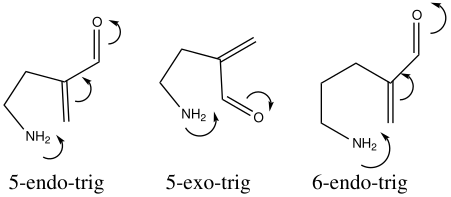
The Baldwin rules for ring closure follow the earlier ones by Bürgi and Dunitz in stating the preferred angles of nucleophilic (and electrophilic) attack in bond forming reactions, and are as famous for the interest in their exceptions as for their adherence. Both sets of rules fundamentally explore the geometry of the transition states involved in the reaction, as reflected in the activation free energies. Previous posts exploring the transition states for well-known reactions have revealed that the 4th dimension (the timing of the bond formations/breakings) can often spring surprises. So this post will explore a typical Baldwin ring formation in the same way.

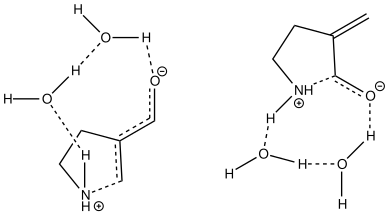
If you study the consequence of the mechanistic arrows shown above, you will see that the immediate product of the cyclisation is an internal ion-pair, a zwitterion. To get a realistic transition state geometry for a reaction where reaction of a neutral molecule creates charge separation, we need to build a slightly more elaborate system. The quantum mechanical model will include a continuum solvent (ωB97XD/6-311G(d,p)/SCRF=water) and because hydrogen bonds to charged donors or acceptors are often 2-3 times stronger than neutral ones, we need to include explicit solvent as well, as below.

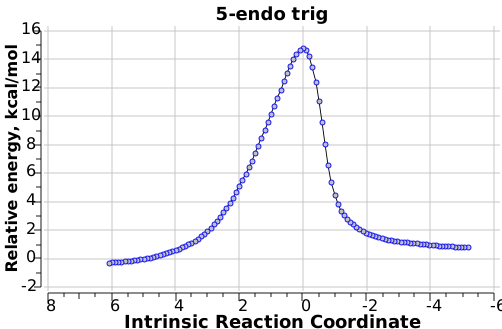
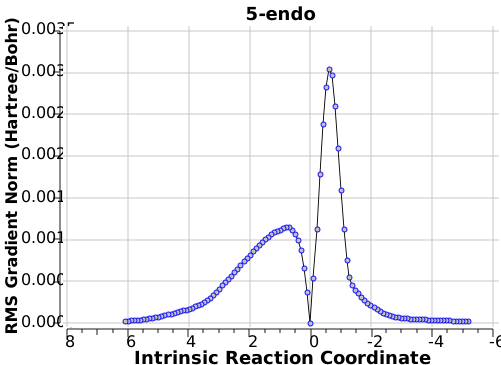
This resembles the strategy used for studying the Baeyer-Villiger reaction I showed previously, and also permits the system to transfer protons as appropriate. The 5-endo-trig transition state does indeed have such strong hydrogen bonds across the solvent bridge connecting the ionic centres. The angle of attack N-C-C is 92°. The IRC shows a barrier, which as ΔG is 17.8 kcal/mol.

5-endo transition state. Click for 4D.

The 6-endo transition state, according to Baldwin, makes the transition from unfavourable to favourable, since the angle of attack by the (nitrogen) nucleophile on the double bond can now adopt the more favourable angle of 101° (although rather less than the conventionally assumed angles of 106-109°), and ΔG is reduced to 12.4 kcal/mol, a reduction of 5.4 kcal/mol over the 5-endo analogue, more than enough to turn a dis-allowed into an allowed reaction! The transition state adopts a beautiful chair-like shape.

6-endo transition state. Click for 4D

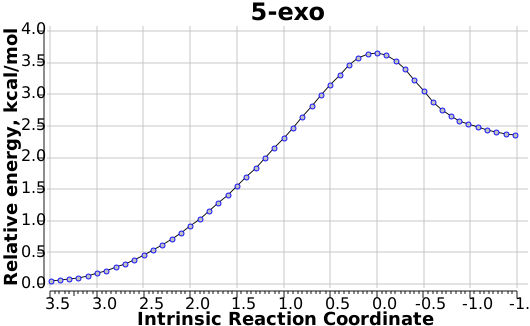
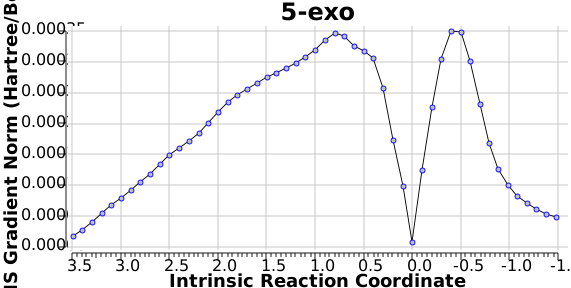
To complete the comparisons, the 5-exo transition state and its IRC is shown below, revealing again a very strong network of hydrogen bonds connecting the zwitterion. The angle of attack is 112°, quite different from (and more favourable than) the 5-endo isomer, as is the (much lower) free energy barrier of ΔG 5.7 kcal/mol. It is worth noting that this transition state does not exist on the potential energy surface computed without the inclusion of two solvent molecules!

5-exo transition state. Click for 4D

5-exo transition state.

Because Baldwin’s rules are in fact a generalisation of transition state geometry, one might expect that the specific nature of each transition state must be considered, and that exceptions therefore could easily be contrived. What I wanted to show here is that constructing a realistic transition state for any specific reaction is in fact nowadays not that much more onerous than applying the rule! For a few hours more effort, one can have a much better analysis of any specific system.

Transition state models for Baldwin’s rules of ring closure.

Saturday, June 2nd, 2012

The Baldwin rules for ring closure follow the earlier ones by Bürgi and Dunitz in stating the preferred angles of nucleophilic (and electrophilic) attack in bond forming reactions, and are as famous for the interest in their exceptions as for their adherence. Both sets of rules fundamentally explore the geometry of the transition states involved in the reaction, as reflected in the activation free energies. Previous posts exploring the transition states for well-known reactions have revealed that the 4th dimension (the timing of the bond formations/breakings) can often spring surprises. So this post will explore a typical Baldwin ring formation in the same way.

If you study the consequence of the mechanistic arrows shown above, you will see that the immediate product of the cyclisation is an internal ion-pair, a zwitterion. To get a realistic transition state geometry for a reaction where reaction of a neutral molecule creates charge separation, we need to build a slightly more elaborate system. The quantum mechanical model will include a continuum solvent (ωB97XD/6-311G(d,p)/SCRF=water) and because hydrogen bonds to charged donors or acceptors are often 2-3 times stronger than neutral ones, we need to include explicit solvent as well, as below.

This resembles the strategy used for studying the Baeyer-Villiger reaction I showed previously, and also permits the system to transfer protons as appropriate. The 5-endo-trig transition state does indeed have such strong hydrogen bonds across the solvent bridge connecting the ionic centres. The angle of attack N-C-C is 92°. The IRC shows a barrier, which as ΔG is 17.8 kcal/mol.

5-endo transition state. Click for 4D.

The 6-endo transition state, according to Baldwin, makes the transition from unfavourable to favourable, since the angle of attack by the (nitrogen) nucleophile on the double bond can now adopt the more favourable angle of 101° (although rather less than the conventionally assumed angles of 106-109°), and ΔG is reduced to 12.4 kcal/mol, a reduction of 5.4 kcal/mol over the 5-endo analogue, more than enough to turn a dis-allowed into an allowed reaction! The transition state adopts a beautiful chair-like shape.

6-endo transition state. Click for 4D

To complete the comparisons, the 5-exo transition state and its IRC is shown below, revealing again a very strong network of hydrogen bonds connecting the zwitterion. The angle of attack is 112°, quite different from (and more favourable than) the 5-endo isomer, as is the (much lower) free energy barrier of ΔG 5.7 kcal/mol. It is worth noting that this transition state does not exist on the potential energy surface computed without the inclusion of two solvent molecules!

5-exo transition state. Click for 4D

5-exo transition state.

Because Baldwin’s rules are in fact a generalisation of transition state geometry, one might expect that the specific nature of each transition state must be considered, and that exceptions therefore could easily be contrived. What I wanted to show here is that constructing a realistic transition state for any specific reaction is in fact nowadays not that much more onerous than applying the rule! For a few hours more effort, one can have a much better analysis of any specific system.

Mechanism of the diazomethane alkylation of a carboxylic acid.

Saturday, May 19th, 2012

Many reaction mechanisms involve a combination of bond formation/cleavage between two non-hydrogen atoms and those involving reorganisation of proximate hydrogens. The Baeyer-Villiger discussed previously illustrated a complex dance between the two types. Here I take a look at another such mechanism, the methylation of a carboxylic acid by diazomethane.

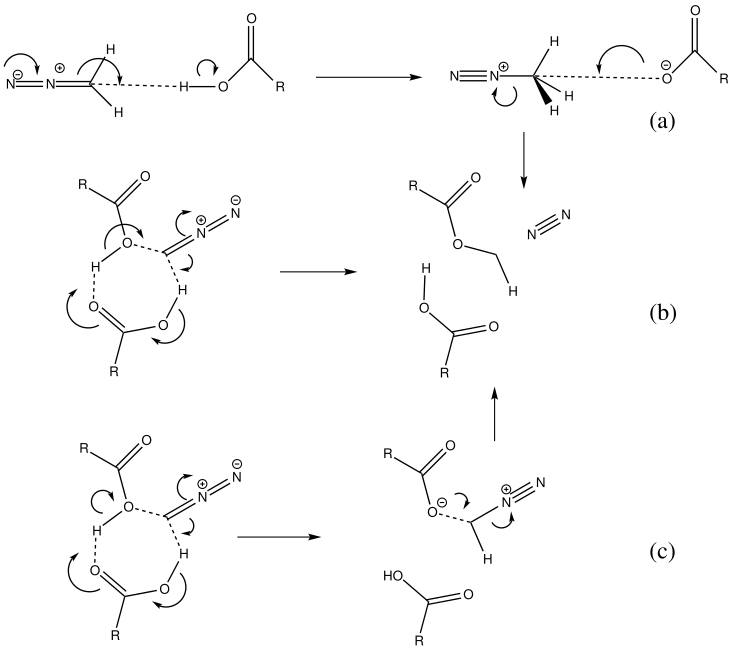
Text-books (or e-books) invariably show path (a). But the Baeyer-Villiger showed us that involvement of an additional acid as a proton transfer agent via a cyclic (7 or 11-membered) transition state was possible. So how about path (b, R=H), calculated using wB97XD/6-311G(d,p)/SCRF=dichloromethane?

Path (b) in the diazomethane alkylation of a carboxylic acid. Click for 3D animation.

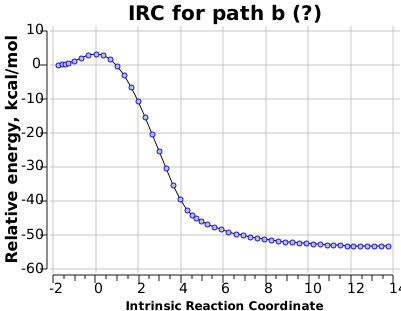
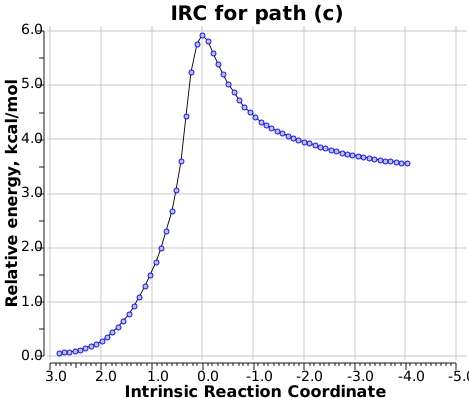
The IRC (intrinsic reaction coordinate) shows us the more detailed steps in the mechanistic dance. This tells us that the transition state shown above corresponds to the final stage of the reaction, path (c) in fact. The requisite reorganisation of the protons has already happened, and the reaction is happening from the zwitterionic intermediate shown in (c), with a barrier of only ~ 4 kcal/mol from that species.

The transition state for the formation of the zwitterionic intermediate is itself shown below. One proton is clearly moving (to the carbon), but is the other? Again, an IRC is needed to tell us. 

Transitions state for proton transfer, path (c). Click for 3D animation.

It seems that the two acid molecules do not co-operate with each other. The mechanism really does simply involve a protonation of the diazomethane by a molecule of acid to form a zwitterionic intermediate, following by attack by the anion of the acid on the diazonium cation to displace the nitrogen, path (a). 

"Text" Books in a (higher) education environment.

Friday, May 18th, 2012

Text books (is this a misnomer, much like “papers” are in journals?) in a higher-educational chemistry environment, I feel, are at a cross-roads. What happens next?

Faced with the ever-increasing costs of course texts, the department where I teach introduced a book-bundle about five years ago. The bundle included all the recommended texts for an appreciable discount over individual purchase. In their first week at Uni, students were encouraged to acquire the bundle. As it happened, I met them for a tutorial shortly after this acquisition. The bundle weighed some 9 kg, and came shrink-wrapped into a strapless plastic sheath, posing a rather slippery and weighty challenge for the student to get back to their residency. A few months later, I asked the students how they were getting on reading their newly acquired texts. You must appreciate that it does take a few months for students to start getting “street-wise” about their uni experience. One savvy student recounted they had learnt that if one did not remove the plastic outer layer from the bundle, it would retain much of its resale value to the next generation of incoming students.

Now, I will not mention the publisher of this particular bundle, but its cost is in the region of £50 per text. And for some students, the 1500 or so pages of each volume remain largely unread. Rarely if ever do I see these texts brought into tutorials, and I expect the margins remain blank, un-annotated with any questions or notes (it affects the resale value if you do that). Which is a stark contrast to how the students nowadays annotate their lecture note hand-outs often (but not invariably) issued to them at the start of a lecture. I also observe that increasingly my tutorials are effectively annotated by the students attending (2-4 pages of notes can be taken during a 50 minute discussion. The unit can be declared as pages, since this is also done on paper).

Despite these trends, pedagogic usage of tablet devices such as Kindles and iPads remains relatively low. It is a chicken-and-egg situation. The aforementioned book bundle is not available for these devices, and if it were, then in the current business model, it would be DRM (digital-rights-management) protected to prevent resale, and would also probably retain (if not exceed) the cost of the printed version. Hardly attractive to a student. The lecture notes we distribute (as printed handouts) do indeed come as PDF versions which can be placed on a mobile tablet, but this advantage alone has not sufficed to promote rapid uptake of tablet here. Few materials are specifically optimised to take advantage of the unique features of a tablet, and so the printed lecture notes are considered acceptable. Perhaps this comes to the core of what such tablets are supposed to be. Are they devices for “content consumption”, or should we also expect them to be capable of “content creation”? Lecture (and tutorial) annotation is of course content creation (or perhaps augmentation). 

I might also take a look at the situation from the point of view of the textbook author. Unless you are a big name, you might expect to redeem about 10% royalties from one of the traditional publishers of academic texts. It might take you a year or so to write it, and you would expect to issue a further edition five years down the line if the book is successful. Two generations ago, every academic might be expected to write at least one book. I suspect that aspect has reduced nowadays; authors can hardly be encouraged to write if they think there is a prospect that the shrink-wrapping might not even be removed! If you are intending to write a text about, lets say stereochemistry, you also have to accept the 2D limitations of a printed book, or the inability to say animate a reaction path.

Where are these thoughts leading? Well, I do have to give an explicit example; Steve Jobs’ vision of the educational text-book, re-invented along the lines of what he famously introduced for music distribution. There, he recognised that the (presumed illegal) sharing of music via download sites that preceded the iTunes store was not a sustainable model. The $.99 download was conspicuously cheaper than the price of a physical music CD (excepting classical music, which did become absurdly cheap in this form), and a compromise on sharing stipulated only on devices owned by you rather than more widely amongst your friends. The same model was introduced for the iBook store. Here, the author of an eBook (I am no longer calling it a textbook) can if they wish retain 70% of whatever income it generates (it can also be free of course). The unit price was a fraction of the traditional paper-based book, low enough that the DRM-imposed inability to resell it was less of an issue.

What are the downsides of moving on from paper?

  1. Well, unlike a paper book which is instantly useable, the reader has to purchase a device. This device can cost more than the book bundle referred to above, although at its cheapest, the device is actually only about half the cost of the book bundle. And one might expect that device to last only 2-4 years before it becomes obsolete.
  2. It can be lost or damaged, although unlike a paper book, the online content can be readily restored at zero cost .
  3. If you purchase an eBook for one (proprietary) device, you cannot transfer it to another such device (say Kindle to iPad or vice versa), although if the content is free, that would not matter.
  4. Authors of such texts will have to retrain themselves to produce ebooks; it is not just a matter of using a standard word processor any more. I suspect writing/imaging/styling/scripting/widgeting (a verb for this collective process is needed; how about to flow?) an ebook takes a lot longer than word processing a text-book.
  5. You might have to consider the ongoing cost of using an ebook. By this I mean the data-plan that you might need in place to download components which are not actually part of the book (see below).

The upsides? Well, rather than my producing a list at this point, you might want to take a look at the first two examples below, both created by Bob Hanson, and think about how such inclusion in an ebook might enhance it:

  1. A device-sensitive page for display (try this out on an iPad or Android tablet; the Kindle might be more of a challenge).
  2. A page for building and minimising a molecular model
  3. This example is included, since it belongs to a chemistry text book, but actually would exist on a mobile device in functional form, if not actually a component of an ebook.

So an ebook becomes an environment where you can download a model from public databases, and annotate it with properties etc. Or you could use your ebook to build a model from scratch, then minimise its (molecular mechanics) energy, to say explore conformational analysis in the context of a chapter on the topic.

Well, at the start I posed the question what happens next? The two above examples give possible answers. An equally interesting question might then be who makes it happen? Will that be the evolutionary role of the traditional publishing houses? Will a new generation of skilful author capable of “flowing” an ebook emerge? Will students instead favour retaining their dependency on paper? Watch this space.

“Text” Books in a (higher) education environment.

Friday, May 18th, 2012

Text books (is this a misnomer, much like “papers” are in journals?) in a higher-educational chemistry environment, I feel, are at a cross-roads. What happens next?

Faced with the ever-increasing costs of course texts, the department where I teach introduced a book-bundle about five years ago. The bundle included all the recommended texts for an appreciable discount over individual purchase. In their first week at Uni, students were encouraged to acquire the bundle. As it happened, I met them for a tutorial shortly after this acquisition. The bundle weighed some 9 kg, and came shrink-wrapped into a strapless plastic sheath, posing a rather slippery and weighty challenge for the student to get back to their residency. A few months later, I asked the students how they were getting on reading their newly acquired texts. You must appreciate that it does take a few months for students to start getting “street-wise” about their uni experience. One savvy student recounted they had learnt that if one did not remove the plastic outer layer from the bundle, it would retain much of its resale value to the next generation of incoming students.

Now, I will not mention the publisher of this particular bundle, but its cost is in the region of £50 per text. And for some students, the 1500 or so pages of each volume remain largely unread. Rarely if ever do I see these texts brought into tutorials, and I expect the margins remain blank, un-annotated with any questions or notes (it affects the resale value if you do that). Which is a stark contrast to how the students nowadays annotate their lecture note hand-outs often (but not invariably) issued to them at the start of a lecture. I also observe that increasingly my tutorials are effectively annotated by the students attending (2-4 pages of notes can be taken during a 50 minute discussion. The unit can be declared as pages, since this is also done on paper).

Despite these trends, pedagogic usage of tablet devices such as Kindles and iPads remains relatively low. It is a chicken-and-egg situation. The aforementioned book bundle is not available for these devices, and if it were, then in the current business model, it would be DRM (digital-rights-management) protected to prevent resale, and would also probably retain (if not exceed) the cost of the printed version. Hardly attractive to a student. The lecture notes we distribute (as printed handouts) do indeed come as PDF versions which can be placed on a mobile tablet, but this advantage alone has not sufficed to promote rapid uptake of tablet here. Few materials are specifically optimised to take advantage of the unique features of a tablet, and so the printed lecture notes are considered acceptable. Perhaps this comes to the core of what such tablets are supposed to be. Are they devices for “content consumption”, or should we also expect them to be capable of “content creation”? Lecture (and tutorial) annotation is of course content creation (or perhaps augmentation). 

I might also take a look at the situation from the point of view of the textbook author. Unless you are a big name, you might expect to redeem about 10% royalties from one of the traditional publishers of academic texts. It might take you a year or so to write it, and you would expect to issue a further edition five years down the line if the book is successful. Two generations ago, every academic might be expected to write at least one book. I suspect that aspect has reduced nowadays; authors can hardly be encouraged to write if they think there is a prospect that the shrink-wrapping might not even be removed! If you are intending to write a text about, lets say stereochemistry, you also have to accept the 2D limitations of a printed book, or the inability to say animate a reaction path.

Where are these thoughts leading? Well, I do have to give an explicit example; Steve Jobs’ vision of the educational text-book, re-invented along the lines of what he famously introduced for music distribution. There, he recognised that the (presumed illegal) sharing of music via download sites that preceded the iTunes store was not a sustainable model. The $.99 download was conspicuously cheaper than the price of a physical music CD (excepting classical music, which did become absurdly cheap in this form), and a compromise on sharing stipulated only on devices owned by you rather than more widely amongst your friends. The same model was introduced for the iBook store. Here, the author of an eBook (I am no longer calling it a textbook) can if they wish retain 70% of whatever income it generates (it can also be free of course). The unit price was a fraction of the traditional paper-based book, low enough that the DRM-imposed inability to resell it was less of an issue.

What are the downsides of moving on from paper?

  1. Well, unlike a paper book which is instantly useable, the reader has to purchase a device. This device can cost more than the book bundle referred to above, although at its cheapest, the device is actually only about half the cost of the book bundle. And one might expect that device to last only 2-4 years before it becomes obsolete.
  2. It can be lost or damaged, although unlike a paper book, the online content can be readily restored at zero cost .
  3. If you purchase an eBook for one (proprietary) device, you cannot transfer it to another such device (say Kindle to iPad or vice versa), although if the content is free, that would not matter.
  4. Authors of such texts will have to retrain themselves to produce ebooks; it is not just a matter of using a standard word processor any more. I suspect writing/imaging/styling/scripting/widgeting (a verb for this collective process is needed; how about to flow?) an ebook takes a lot longer than word processing a text-book.
  5. You might have to consider the ongoing cost of using an ebook. By this I mean the data-plan that you might need in place to download components which are not actually part of the book (see below).

The upsides? Well, rather than my producing a list at this point, you might want to take a look at the first two examples below, both created by Bob Hanson, and think about how such inclusion in an ebook might enhance it:

  1. A device-sensitive page for display (try this out on an iPad or Android tablet; the Kindle might be more of a challenge).
  2. A page for building and minimising a molecular model
  3. This example is included, since it belongs to a chemistry text book, but actually would exist on a mobile device in functional form, if not actually a component of an ebook.

So an ebook becomes an environment where you can download a model from public databases, and annotate it with properties etc. Or you could use your ebook to build a model from scratch, then minimise its (molecular mechanics) energy, to say explore conformational analysis in the context of a chapter on the topic.

Well, at the start I posed the question what happens next? The two above examples give possible answers. An equally interesting question might then be who makes it happen? Will that be the evolutionary role of the traditional publishing houses? Will a new generation of skilful author capable of “flowing” an ebook emerge? Will students instead favour retaining their dependency on paper? Watch this space.

Shared space (in science).

Friday, January 6th, 2012

I thought I would launch the 2012 edition of this blog by writing about shared space. If you have not come across it before, it is (to quote Wikipedia), “an urban design concept aimed at integrated use of public spaces.” The BBC here in the UK ran a feature on it recently, and prominent in examples of shared space in the UK was Exhibition Road. I note this here on the blog since it is about 100m from my office.

Shared space is the Mornington Crescent of urban design, where you have to work out the rules of the game by in effective participating in it. Thus the new “rules” of travelling down Exhibition Road (by either foot, car, bike, bus or indeed motorbike as I do each day) are not declared, and each participant works them out on the fly. This is supposed to lead to fewer misunderstandings, although the practice does seem rather different (at least at the moment). But where is the chemistry? Well, these thoughts were triggered by two colleagues independently asking me about how chemists use metaphors, and how chemists use representations. I have in fact touched upon both of these previously, and it struck me that this last example, of arrow pushing in organic chemistry, was in fact a nice example of a shared space in chemistry. The rules of arrow pushing are not formally set out (in an IUPAC rule book or similar) but are worked out on the hoof so to speak. Except that the space is shared only by organic chemists. I have observed over the years that e.g. physical or inorganic chemists will mostly not dare venture into that shared space; they often give a rather good impression of not understanding the rules. I also know from experience that mathematicians and physicists regard arrow pushing as anything other than a shared (scientific) space.

Yet the modern scope and ethos of science is that we should all venture into shared spaces (whether they are in or out of our comfort zones). Perhaps, in science, the problem is that so much of what we do has what I refer to as “implicit semantics” (its part of our DNA of e.g. being a chemist). Take for example the diagram below (which I used previously) which sets out four possible sets of rules for this particular shared space. Even so, without further explanation, you might be struggling to infer what message is carried by this diagram. That is because so much of it contains implicit semantics, and unless you recognise the missing features, how can you go about finding out what is invisible?

Curly arrow pushing

My concluding thought would be that shared space is what the semantic web is surely striving for. And if Exhibition Road is anything to go by, it is clearly quite a challenge. But if I (and particularly the pedestrians I encounter there each day) end up surviving 2012, perhaps the Semantic Web may one day come about as well!