Posts Tagged ‘Interesting chemistry’

A connected world (journals and blogs): The benzene dication.

Thursday, April 10th, 2014

Science is rarely about a totally new observation or rationalisation, it is much more about making connections between known facts, and perhaps using these connections to extrapolate to new areas (building on the shoulders of giants, etc). So here I chart one example of such connectivity over a period of six years.

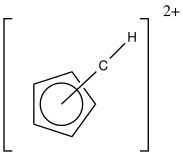
The story starts with this article[1], a preview talk about which (Hypervalent Carbon Atom: “Freezing” the SN2 Transition State) I actually saw at an ACS conference a year or so earlier. When the article was published, Steve Bachrach blogged about it, noting the claim for pentavalent carbon. The semantics of a valency vs a coordination are subtle, and I was not convinced that this frozen transition state deserved its elevation from penta-coordinate to pentavalent. After some discussion on Steve’s blog, I built upon these ideas with a few thoughts of my own on the present blog and then wondered whether they could be finally distilled into a more formal publication (testing the precedent in some ways of whether collaborative and public discussions of ideas could be published formally, or whether they would be rejected as having been already “published”). Well, these final distilled thoughts were indeed published in 2010[2], including their genesis in Steve’s blog (I wanted to put blogs more firmly into the acceptable scientific circle). This article included one species (numbered 5 in that article in 2010[2]) and pointed out an analogy to replacing CH2+ by e.g the isoelectronic BH1+, in as much as an example of the latter is indeed known as a stable crystalline compound.[3]. Iso-electronics is a very fruitful source of connections in chemistry!
5

Matters rested there until yesterday, when I spotted this on Steve’s blog where he discusses this recent article on the structure of the benzene dication.[4] Hey presto, there is that molecule again, but now there is firm experimental evidence of its existence! It was I think rather too much to expect the authors of this article to have spotted the connection to mine (although as it happens, both address the issue of complexes to He). The relationship between CH2+ and BH1+ is a little more subtle. From my point of view, it is always worth trawling through the crystal structure database in favour of evidence for hypothetical species (or their isoelectronic substitutions), and so it proved in this case!

There are other connections possible. Thus the dication of benzene has a (higher energy) isomer which is in fact a 4π antiaromatic species which avoids this antiaromaticity by a geometric distortion, with two C-H bonds bending above and below the ring. Such avoided antiaromaticity has been noted elsewhere here.

There is one final connection for me to make. My 2010 article[2] contained one of my interactive tables containing the data for the various structures (yes, although its data, you will need to have a subscription to the journal to access it). As it happens, last year we wished to reprise this style of publication, but as I blogged at the time, the journal had changed its production processes, and they could no longer offer me that opportunity. Some quick thinking came up with a replacement, which we now use extensively.[5] So the chain of connections resulting from that original talk some six years ago continues.

<

p>As for that chain, it arose distressingly randomly. I do not routinely read the entire ToC of JACS and so would not have discovered[4] the connection by that route. Fortunately, Steve Bachrach does and helped me make that connection to the molecule shown above. Although I did spend a few minutes thinking to myself “does that structure ring any bells?”. Fortunately, one did (eventually) ring. But for every connection made in this wonderfully human manner, I cannot help but think how many are not! However, if connections were much easier to make, could we as humans cope with the overwhelming deluge of new ideas?

References

  1. S. Pierrefixe, S. van Stralen, J. van Stralen, C. Fonseca Guerra, and F. Bickelhaupt, "Hypervalent Carbon Atom: “Freezing” the S<sub>N</sub>2 Transition State", Angewandte Chemie International Edition, vol. 48, pp. 6469-6471, 2009. https://doi.org/10.1002/anie.200902125
  2. H.S. Rzepa, "The rational design of helium bonds", Nature Chemistry, vol. 2, pp. 390-393, 2010. https://doi.org/10.1038/nchem.596
  3. C. Dohmeier, R. Köppe, C. Robl, and H. Schnöckel, "Kristallstruktur von [Cp★BBr][AlBr4]", Journal of Organometallic Chemistry, vol. 487, pp. 127-130, 1995. https://doi.org/10.1016/0022-328x(94)05089-t
  4. J. Jašík, D. Gerlich, and J. Roithová, "Probing Isomers of the Benzene Dication in a Low-Temperature Trap", Journal of the American Chemical Society, vol. 136, pp. 2960-2962, 2014. https://doi.org/10.1021/ja412109h
  5. A. Armstrong, R.A. Boto, P. Dingwall, J. Contreras-García, M.J. Harvey, N.J. Mason, and H.S. Rzepa, "The Houk–List transition states for organocatalytic mechanisms revisited", Chem. Sci., vol. 5, pp. 2057-2071, 2014. https://doi.org/10.1039/c3sc53416b
A connected world (journals and blogs): The benzene dication.

Thursday, April 10th, 2014

Science is rarely about a totally new observation or rationalisation, it is much more about making connections between known facts, and perhaps using these connections to extrapolate to new areas (building on the shoulders of giants, etc). So here I chart one example of such connectivity over a period of six years.

The story starts with this article[1], a preview talk about which (Hypervalent Carbon Atom: “Freezing” the SN2 Transition State) I actually saw at an ACS conference a year or so earlier. When the article was published, Steve Bachrach blogged about it, noting the claim for pentavalent carbon. The semantics of a valency vs a coordination are subtle, and I was not convinced that this frozen transition state deserved its elevation from penta-coordinate to pentavalent. After some discussion on Steve’s blog, I built upon these ideas with a few thoughts of my own on the present blog and then wondered whether they could be finally distilled into a more formal publication (testing the precedent in some ways of whether collaborative and public discussions of ideas could be published formally, or whether they would be rejected as having been already “published”). Well, these final distilled thoughts were indeed published in 2010[2], including their genesis in Steve’s blog (I wanted to put blogs more firmly into the acceptable scientific circle). This article included one species (numbered 5 in that article in 2010[2]) and pointed out an analogy to replacing CH2+ by e.g the isoelectronic BH1+, in as much as an example of the latter is indeed known as a stable crystalline compound.[3]. Iso-electronics is a very fruitful source of connections in chemistry!

5

Matters rested there until yesterday, when I spotted this on Steve’s blog where he discusses this recent article on the structure of the benzene dication.[4] Hey presto, there is that molecule again, but now there is firm experimental evidence of its existence! It was I think rather too much to expect the authors of this article to have spotted the connection to mine (although as it happens, both address the issue of complexes to He). The relationship between CH2+ and BH1+ is a little more subtle. From my point of view, it is always worth trawling through the crystal structure database in favour of evidence for hypothetical species (or their isoelectronic substitutions), and so it proved in this case!

There are other connections possible. Thus the dication of benzene has a (higher energy) isomer which is in fact a 4π antiaromatic species which avoids this antiaromaticity by a geometric distortion, with two C-H bonds bending above and below the ring. Such avoided antiaromaticity has been noted elsewhere here.

There is one final connection for me to make. My 2010 article[2] contained one of my interactive tables containing the data for the various structures (yes, although its data, you will need to have a subscription to the journal to access it). As it happens, last year we wished to reprise this style of publication, but as I blogged at the time, the journal had changed its production processes, and they could no longer offer me that opportunity. Some quick thinking came up with a replacement, which we now use extensively.[5] So the chain of connections resulting from that original talk some six years ago continues.

<

p>As for that chain, it arose distressingly randomly. I do not routinely read the entire ToC of JACS and so would not have discovered[4] the connection by that route. Fortunately, Steve Bachrach does and helped me make that connection to the molecule shown above. Although I did spend a few minutes thinking to myself “does that structure ring any bells?”. Fortunately, one did (eventually) ring. But for every connection made in this wonderfully human manner, I cannot help but think how many are not! However, if connections were much easier to make, could we as humans cope with the overwhelming deluge of new ideas?

References

  1. S. Pierrefixe, S. van Stralen, J. van Stralen, C. Fonseca Guerra, and F. Bickelhaupt, "Hypervalent Carbon Atom: “Freezing” the S<sub>N</sub>2 Transition State", Angewandte Chemie International Edition, vol. 48, pp. 6469-6471, 2009. https://doi.org/10.1002/anie.200902125
  2. H.S. Rzepa, "The rational design of helium bonds", Nature Chemistry, vol. 2, pp. 390-393, 2010. https://doi.org/10.1038/nchem.596
  3. C. Dohmeier, R. Köppe, C. Robl, and H. Schnöckel, "Kristallstruktur von [Cp★BBr][AlBr4]", Journal of Organometallic Chemistry, vol. 487, pp. 127-130, 1995. https://doi.org/10.1016/0022-328x(94)05089-t
  4. J. Jašík, D. Gerlich, and J. Roithová, "Probing Isomers of the Benzene Dication in a Low-Temperature Trap", Journal of the American Chemical Society, vol. 136, pp. 2960-2962, 2014. https://doi.org/10.1021/ja412109h
  5. A. Armstrong, R.A. Boto, P. Dingwall, J. Contreras-García, M.J. Harvey, N.J. Mason, and H.S. Rzepa, "The Houk–List transition states for organocatalytic mechanisms revisited", Chem. Sci., vol. 5, pp. 2057-2071, 2014. https://doi.org/10.1039/c3sc53416b

A connected world (journals and blogs): The benzene dication.

Thursday, April 10th, 2014

Science is rarely about a totally new observation or rationalisation, it is much more about making connections between known facts, and perhaps using these connections to extrapolate to new areas (building on the shoulders of giants, etc). So here I chart one example of such connectivity over a period of six years.

The story starts with this article[1], a preview talk about which (Hypervalent Carbon Atom: “Freezing” the SN2 Transition State) I actually saw at an ACS conference a year or so earlier. When the article was published, Steve Bachrach blogged about it, noting the claim for pentavalent carbon. The semantics of a valency vs a coordination are subtle, and I was not convinced that this frozen transition state deserved its elevation from penta-coordinate to pentavalent. After some discussion on Steve’s blog, I built upon these ideas with a few thoughts of my own on the present blog and then wondered whether they could be finally distilled into a more formal publication (testing the precedent in some ways of whether collaborative and public discussions of ideas could be published formally, or whether they would be rejected as having been already “published”). Well, these final distilled thoughts were indeed published in 2010[2], including their genesis in Steve’s blog (I wanted to put blogs more firmly into the acceptable scientific circle). This article included one species (numbered 5 in that article in 2010[2]) and pointed out an analogy to replacing CH2+ by e.g the isoelectronic BH1+, in as much as an example of the latter is indeed known as a stable crystalline compound.[3]. Iso-electronics is a very fruitful source of connections in chemistry!

5

Matters rested there until yesterday, when I spotted this on Steve’s blog where he discusses this recent article on the structure of the benzene dication.[4] Hey presto, there is that molecule again, but now there is firm experimental evidence of its existence! It was I think rather too much to expect the authors of this article to have spotted the connection to mine (although as it happens, both address the issue of complexes to He). The relationship between CH2+ and BH1+ is a little more subtle. From my point of view, it is always worth trawling through the crystal structure database in favour of evidence for hypothetical species (or their isoelectronic substitutions), and so it proved in this case!

There are other connections possible. Thus the dication of benzene has a (higher energy) isomer which is in fact a 4π antiaromatic species which avoids this antiaromaticity by a geometric distortion, with two C-H bonds bending above and below the ring. Such avoided antiaromaticity has been noted elsewhere here.

There is one final connection for me to make. My 2010 article[2] contained one of my interactive tables containing the data for the various structures (yes, although its data, you will need to have a subscription to the journal to access it). As it happens, last year we wished to reprise this style of publication, but as I blogged at the time, the journal had changed its production processes, and they could no longer offer me that opportunity. Some quick thinking came up with a replacement, which we now use extensively.[5] So the chain of connections resulting from that original talk some six years ago continues.

<

p>As for that chain, it arose distressingly randomly. I do not routinely read the entire ToC of JACS and so would not have discovered[4] the connection by that route. Fortunately, Steve Bachrach does and helped me make that connection to the molecule shown above. Although I did spend a few minutes thinking to myself “does that structure ring any bells?”. Fortunately, one did (eventually) ring. But for every connection made in this wonderfully human manner, I cannot help but think how many are not! However, if connections were much easier to make, could we as humans cope with the overwhelming deluge of new ideas?

References

  1. S. Pierrefixe, S. van Stralen, J. van Stralen, C. Fonseca Guerra, and F. Bickelhaupt, "Hypervalent Carbon Atom: “Freezing” the S<sub>N</sub>2 Transition State", Angewandte Chemie International Edition, vol. 48, pp. 6469-6471, 2009. https://doi.org/10.1002/anie.200902125
  2. H.S. Rzepa, "The rational design of helium bonds", Nature Chemistry, vol. 2, pp. 390-393, 2010. https://doi.org/10.1038/nchem.596
  3. C. Dohmeier, R. Köppe, C. Robl, and H. Schnöckel, "Kristallstruktur von [Cp★BBr][AlBr4]", Journal of Organometallic Chemistry, vol. 487, pp. 127-130, 1995. https://doi.org/10.1016/0022-328x(94)05089-t
  4. J. Jašík, D. Gerlich, and J. Roithová, "Probing Isomers of the Benzene Dication in a Low-Temperature Trap", Journal of the American Chemical Society, vol. 136, pp. 2960-2962, 2014. https://doi.org/10.1021/ja412109h
  5. A. Armstrong, R.A. Boto, P. Dingwall, J. Contreras-García, M.J. Harvey, N.J. Mason, and H.S. Rzepa, "The Houk–List transition states for organocatalytic mechanisms revisited", Chem. Sci., vol. 5, pp. 2057-2071, 2014. https://doi.org/10.1039/c3sc53416b
A congruence of concepts: conformations, configurations, amides and enzymes

Sunday, February 9th, 2014

This is the time of year when I deliver two back-2-back lecture courses, and yes I do update and revise the content! I am always on the look-out for nice new examples that illustrate how concepts and patterns in chemistry can be joined up to tell a good story. My attention is currently on conformational analysis; and here is an interesting new story to tell about it.

atrop

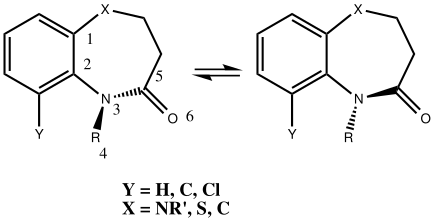
Above is a seven-membered ring benzolactam[1], and it caught my eye because of the number of concepts (the semantic density if you like) contained in its chemistry.

  1. The title contains the phrase amide-based axial chirality
  2. and active
  3. conformation
  4. recognised by enzymes and receptors

All the above also implies:

  1. chirality is associated with configurations, whilst conformation is associated with isomerism about single bonds
  2. when conformational analysis is transplanted into a cyclic ring, it can morph magnificently into the land of configuration, via a process known as atropisomerism.
  3. Amides themselves sit in the land between conformation and configuration. Pauling famously used this transition to help devise his helical structures for peptides by deducing that the apparent single N-C bond in an amide (= conformation?) is actually a partial double bond by resonance (= configuration).
  4. The difference between a conformation and a configuration is simply kinetics. An approximate guideline is that if a particular pose in a system is prevented from exchanging with another pose by a half life of at least 1000 seconds, it is classified as a configuration, and if its half-life is less it is a conformation.
  5. Of course enzymes and receptors recognise individual configurations, and hence respond differently. Again the vexed issue of lifetime rears its head. Thus the configuration of thalidomide turned out to have a very short half-life, and so in vivo, the enzymes were exposed to both configurations (one of which turned out to be toxic).

The enantiomeric equilibrium shown above for the benzolactam in fact qualifies as that for configurations, since both enantiomers can be isolated (their half-life is clearly > 1000s) and separately tested for recognition by enzymes.

How can I add any value to the above chemistry? Well, I decided to perform a search of the crystal structure database, and I added two geometric parameters;

  1. The torsion about the 2-3 bond (1-2-3-4)
  2. the torsion about the 3-5 bond (4-3-5-7).

The sign of the first is critical, since the two possible atropisomers have opposite torsion angles. The value of the second relates to Pauling’s assertion that rotation about the amide bond is indeed restricted to two values, either 0 or 180°. So these two concisely blend atropisomerism and configuration. I start with a search of the above system using just the first torsion angle. It shows a nice clustering into those with strongly -ve and those with strongly +ve values; configurational atropisomers! Of course, it does not tell us what the barrier to interconvert them is; that has to be measured (or calculated) separately.

7-ring-amides

Next, I am showing a 2D map of both torsion angles. This shows again the first distribution, but reminds us that the torsion 4-3-5-6 stays resolutely at ~0 for all the compounds (the amide in other words is planar). 7-ring-amides-heat

Oh, a practical point. I mentioned a calculation could be done to estimate the barrier to enantiomerising the two atropisomers. This takes hours, and days if the transition state is awkward (and atropisomers can be so). But the above plots literally took perhaps 2 minutes each! Very cheap insight!


Note the use of the word conformation in its title. It could equally validly be configuration! Which is better?

References

  1. H. Tabata, "Chemistry of Amide-based Axial Chirality: Elucidation of the Active Conformation Recognized by Enzymes and Receptors", YAKUGAKU ZASSHI, vol. 133, pp. 857-866, 2013. https://doi.org/10.1248/yakushi.13-00169

Three-for-one: a pericyclic brain teaser.

Sunday, January 12th, 2014

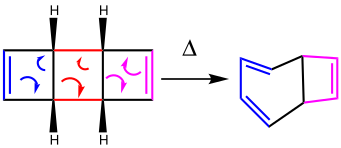
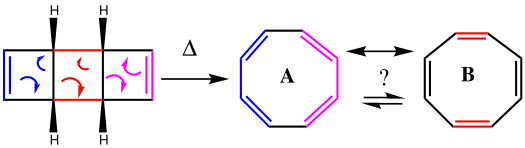
A game one can play with pericyclic reactions is to ask students to identify what type a given example is. So take for example the reaction below.

p34c

The alternatives are:

  1. A cyclo-elimination reaction (red arrows).
  2. Two concurrent electrocyclic ring openings (blue and magenta arrows)
  3. Two consecutive electrocyclic ring openings
  4. Or could it be a hybrid with characteristics of both the first two?

All the first three are four electron thermal processes; all should occur with involvement of one antarafacial mode (a Möbius transition state). But where are those antarafacial modes? Or do all or any of these pericyclic reactions not follow the standard rules? And the rules have nothing to say about whether two separate processes can be concurrent or must be consecutive.

The solution is to concede the limitations of simple electron counting rules, and evaluate the reaction using a quantum mechanical method (ωB97XD/6-311G(d,p))

  1. The first attempt is to locate a stationary point with symmetry, C2 in this case. Here it is.[1]p34c
    2+2E
    • Points of interest include the formation of the cyclo-octatetraene in the valence bond form B rather than A. This points to it being a cyclo-elimination rather than an electrocyclic reaction. For this product, little change occurs for the terminal alkenes (blue or magenta in the reactant), and indeed the C-C length at the stationary point is 1.349Å, only slightly longer than a normal alkene, and not at all the value of ~1.40Å expected for an aromatic transition state expected of an electrocyclic.
    • The stereochemistry of this elimination is entirely suprafacial, as evidenced by the formation of cis-alkenes. The formal pericyclic rule that disallows such stereochemistry for a 4n-electron thermal reaction is however over-turned by the transition state adopting a trapezoidal character.
    • The initial sense of rotation of the two pairs of hydrogens show above is however conrotatory (a consequence of the trapezoidal motions), as in fact required of a thermal 4n-electron electrocyclic reaction. It is only well after the transition state is passed that the motion of one pair of these hydrogens reverses itself, and we end up with a cis-alkene after all.
    • So at the transition state, we see features of both a cycloelimination (trapezoidal geometry) but ALSO of two concurrent electrocyclic ring openings (conrotation). In other words, one gets the characteristics of three pericyclic reactions in one! Very much a chimera!
    • There is only one fly in the ointment. This stationary point is in fact a second-order saddle-point and not a transition state.[2] There are two imaginary frequencies, and the smaller of the two corresponds to desymmetrising the two C-C breaking central bonds
  2. So we turn to the proper transition states in this reaction, the first of which corresponds to the initial of two consecutive electrocyclic ring openings.[3] p34c
    • This looks very different from the preceding pathway. As the (blue) arrows take effect, an antarafacial mode takes hold, ending in the formation of an intermediate bicyclic system with a trans-alkene forming. This proper transition state is 8.1 kcal/mol lower in free energy than the earlier second-order point. The C=C bond length at the transition state becomes 1.392Å, now a typical aromatic value.
    • This transition state leads to an intermediate which is 12.7 lower than the preceding transition state, and is then followed by …p34d
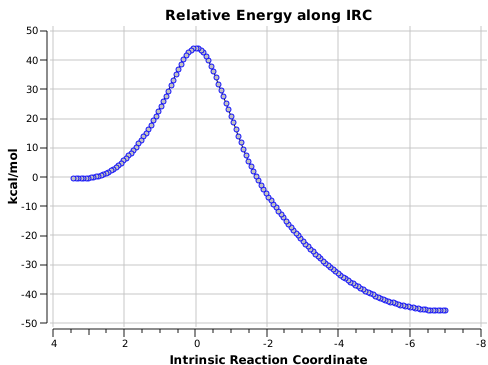
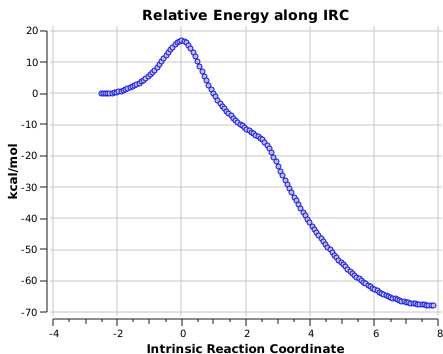
    • a second transition state, with an energy 2.5 kcal/mol higher than the first (but still 5.6 kcal/mol lower than the second-order saddle). The IRC for this step (below) in effect opens up the second ring in a follow-up electrocyclic. The C=C bond in the second cyclobutene now becomes 1.338Å, which is not characteristic of a cyclobutene ring-opening. Notice how again the initial motion of the two hydrogens of the second ring tentatively try a conrotatory motion as before, but this antarafacial motion in fact is soon taken over by rotation of the trans-alkene formed in the second step! This reverses the first antarafacial mode, and the net result is that none of these modes survive into the final product cyclo-octatetraene which is now in the valence bond form A rather than B.[4]p34c2+2-step2E
      2+2-step2G
    • This second reaction is clearly part of a pericyclic sequence, but quite unlike any I have ever come across previously. In particular, the morphing of the antarafacial mode away from the cyclobutene ring and onto the trans-alkene is indeed quite a novel feature!
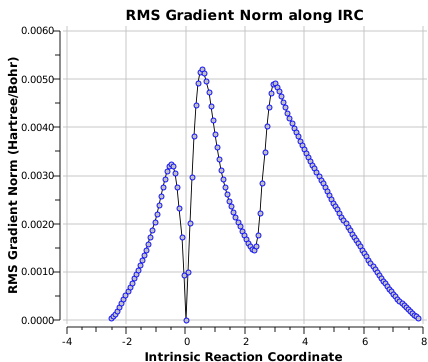
    • The IRC (above) shows the clear presence of a hidden intermediate (IRC = 2.3), which corresponds to the following (C2-symmetric) species (which might have biradical or zwitterionic character). The central bond threatens to form, but ultimately does not!2+2-step2G

So to answer the question posed at the start. Quantum mechanics (but not simply electron counting) suggests the reaction comprises two consecutive electrocyclic ring openings. But the second of these has most unusual features, which perhaps could not have been anticipated. It is not really an electrocyclic, so one could reasonably argue that the answer to the first question posed is in fact none of the above (and I might add that biradical mechanisms have not been considered either).

Perhaps indeed we should start contemplating that the era of simplistic arrow-pushing is coming to an end, and instead we should more routinely start replacing it with quantum mechanical computations. Just a thought! 


It is perfectly possible that substituents could alter the balance between the cyclo-elimination mode and the two-fold electrocyclic, and resulting in the former being in fact the preferred mode. For example, replacing H by thioformyl (HC=S) flips the mechanism to the 2+2 elimination (it removes that second imaginary frequency).[5]2+2S

References

  1. H.S. Rzepa, "Gaussian Job Archive for C8H8", 2014. https://doi.org/10.6084/m9.figshare.899759
  2. H.S. Rzepa, "Gaussian Job Archive for C8H8", 2014. https://doi.org/10.6084/m9.figshare.899760
  3. H.S. Rzepa, "Gaussian Job Archive for C8H8", 2014. https://doi.org/10.6084/m9.figshare.899763
  4. H.S. Rzepa, "Gaussian Job Archive for C8H8", 2014. https://doi.org/10.6084/m9.figshare.899762
  5. H.S. Rzepa, "Gaussian Job Archive for C10H8S2", 2014. https://doi.org/10.6084/m9.figshare.899809

The butterfly effect in chemistry: bimodal bond angles.

Thursday, July 18th, 2013

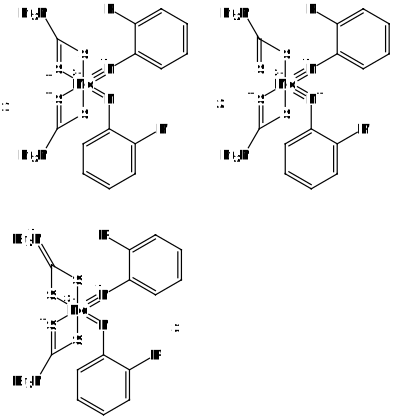
This potential example of a molecule on the edge of chaos was suggested to me by a student (thanks Stephen!), originating from an inorganic tutorial. It represents a class of Mo-complex ligated by two dithiocarbamate ligands and two aryl nitrene ligands (Ar-N:).Mo

I focus on two specific examples[1], where R=R’ = H or Me, with crystal structures available for both. The reason for its appearance in a tutorial is that it provides a nice example of electron counting. Relocated to a tutorial on organic chemistry, it might also provide an interesting challenge for drawing a Lewis structure. So before we deal with the edge of chaos, let me start with the electron counting/Lewis structure. I have set out three possibilities for these above.

  1. This one is drawn with nine bonds (= 9 electron pairs = 18 electrons) associated with the Mo. This is the 18-electron valence shell rule for transition elements, originally set out by Langmuir. Of these nine bonds, six are normal, nominally covalent, shared electron bonds formed from the six valence electrons of the Mo (ground state electronic configuration [Kr].4d5.5s1) and six electron from the ligands (two from a S- pair , and four from a N= pair). Three more bonds are formed by donation of electron pairs, two from S and one from N. This last results in the creation of (nominal) positive charges on each of the S atoms and on ONE of the nitrogen atoms (note not BOTH). In particular, one of the nitrene ligands now becomes sp-hybridised and hence linear, whilst the other remains sp2 hybridized and hence bent. As a result, the Mo formally assumes a charge of  3-.
  2. This Lewis resonance form returns one S-Mo covalent electron pair to having lone pair status, and replaces the shared electron pair with a Mo-N bond formed from the remaining nitrogen lone pair. Both nitrogen atoms are now sp-hybridized, and hence linear. 
  3. This form removes an electron pair from one C=S double bond, and replaces it with a N=C double bond formed from the lone pair on the Et2N group.
  4. Structures 1 and 3 each show the nitrogen ligands to contribute a total of five bonds (ten shared electrons) to the Mo-N bonding. In the forms shown above, one N contributes 6, the other 4. But equally one might imagine a situation where partial bond orders of 2.5 allow each nitrogen to in effect contribute 5 electrons equally. This would result in the angle at each nitrogen being “half-bent” rather than having one fully bent and the other not bent at all. So now we have set up our molecule on the edge of chaos, where it might exist in a form best described by the resonance structures 1-3, and an alternative form where the two nitrogen atoms are “half-bent”. 

We can now apply the reality check of inspecting the crystal structure.

  1. For R=H, one Mo-N-C angle is 171° and the other is 141°, a difference of 30°.
  2. The consequence of the differentiated nitrogens is that the Mo-S bond immediately co-linear with the Co-N bond is 2.61A for the linear nitrogen and 2.76 for the bent nitrogen. The lone pair on the bent nitrogen can stereoelectronically align with the Mo-S bond to lengthen it. But the p-orbital on the linear sp-nitrogen is precisely orthogonal to the Mo-S bond, and hence does not interact with it.
Click for c3D

Click for 3D

What happens with R=Me? The two angles are now 167 and 175°, a mere 8° different. The system appears to have “flipped” from 6+4 bonding heading to 5+5 bonding, all because of an apparently innocuous change on the two aryl groups.

click for 3D

click for 3D

With this sort of behaviour, one has to ask if it might in fact be a crystallographic artefact. One way of checking this is to calculate the geometries of the two molecules, at the ωB97XD/Def2-TZVPD level in this instance. Any errors are at least systematic, and not subject to crystallographic effects. For R=H,[2] the two angles subtended at N are 175.1 and 146.6, a difference of 28.5°, in good agreement with the crystallographic value of 30°. For R=Me, the values are 169 and 152°, a difference of 17°. It is certainly less than for R=H, but a bit more than is apparently measured (8°).

On balance, I think we probably can assign these two Mo complexes to the category of molecules on the edge of chaos, where the mere replacement of an o-H by an o-Me can have a big change on the angles at N. 

References

  1. P. Barrie, T.A. Coffey, G.D. Forster, and G. Hogarth, "Bent vs. linear imido ligation at the octahedral molybdenum(VI) dithiocarbamate stabilised centre", Journal of the Chemical Society, Dalton Transactions, pp. 4519-4528, 1999. https://doi.org/10.1039/a907382e
  2. H.S. Rzepa, "Gaussian Job Archive for C22H30MoN4S4", 2013. https://doi.org/10.6084/m9.figshare.746899

The butterfly effect in chemistry: aromaticity on the edge of chaos.

Thursday, July 11th, 2013

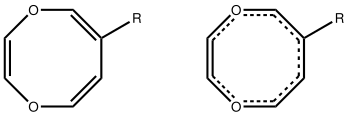
The butterfly effect summarises how a small change to a system may result in very large and often unpredictable (chaotic) consequences. If the system is merely on the edge of chaos, the consequences are predictable, but nevertheless finely poised between e.g. two possible outcomes. Here I ask how a molecule might manifest such behaviour.

chaos

Two examples of the molecule above are known, differing only in the nature of the R group.

Click for  3D.

CUWWEW. Click for 3D.

Click for  3D.

CUWWIA. Click for 3D.

CUWWEW is strongly buckled and shows no sign of cyclic conjugation, with the double bonds localised. On the other hand the very similar CUWWIA is essentially planar, being so because it contains ten π-electrons in a planar ring and so is 4n+2 aromatic (n=2) and becomes delocalised. However, neither form is entirely happy; CUWWEW relieves ring string (in a flat 8-ring the internal angles are ~140°, a significant departure from that preferred for sp2 hydridisation) but looses any stabilisation from aromaticity. For CUWWIA the reverse is true.

Clearly these two effects are finely balanced for this system and the result is a pair of molecules on the edge of chaos, where a small change to the R group can tip the molecule over from one state to another.[1],[2] I may return to this particular theme in future posts, whereby two molecules which differ perhaps only in substituents, nevertheless adopt quite different geometries and properties.

References

  1. H.S. Rzepa, and N. Sanderson, "Aromaticity on the edge of chaos: An ab initio study of the bimodal balance between aromatic and non-aromatic structures for 10π-dihetero[8]annulenes", Phys. Chem. Chem. Phys., vol. 6, pp. 310-313, 2004. https://doi.org/10.1039/b312724a
  2. H.S. Rzepa *, and N. Sanderson, "Aromaticity on the edge of chaos: an<i>Ab initio</i>CCSD(T) study of the bimodal balance between aromatic and non-aromatic structures for 10-π-diheterocins and heteronins", Molecular Physics, vol. 103, pp. 401-405, 2005. https://doi.org/10.1080/00268970512331317796

Molecular Matryoshka dolls

Tuesday, September 20th, 2011

A Matryoshka doll is better known as a Russian nesting doll. They can have up to eight layers. Molecules can only emulate two layers, although see here for a good candidate for making a three-layered example (the inside layer is C60, which itself might encapsulate a small molecule. See also  DOI: 10.1021/ja991747w). These molecular dolls can be created out of quite simple molecules. Here I explore just one, and focus on what is happening inside!

The basic component of a molecular capsule.

The above represents the “tennis ball” component of a molecule first made by Branda, Wyler and Rebek (DOI: 10.1126/science.8122107) in 1994. It has four pairs of carbonyl/NH units, and two of these molecules can stitch together to form an almost spherical capsule. Into this can pop smaller molecules, and in this case methane was persuaded to enter (highlighted with a magenta arrow below).

A molecular Russian doll with methane inside. Click for 3D

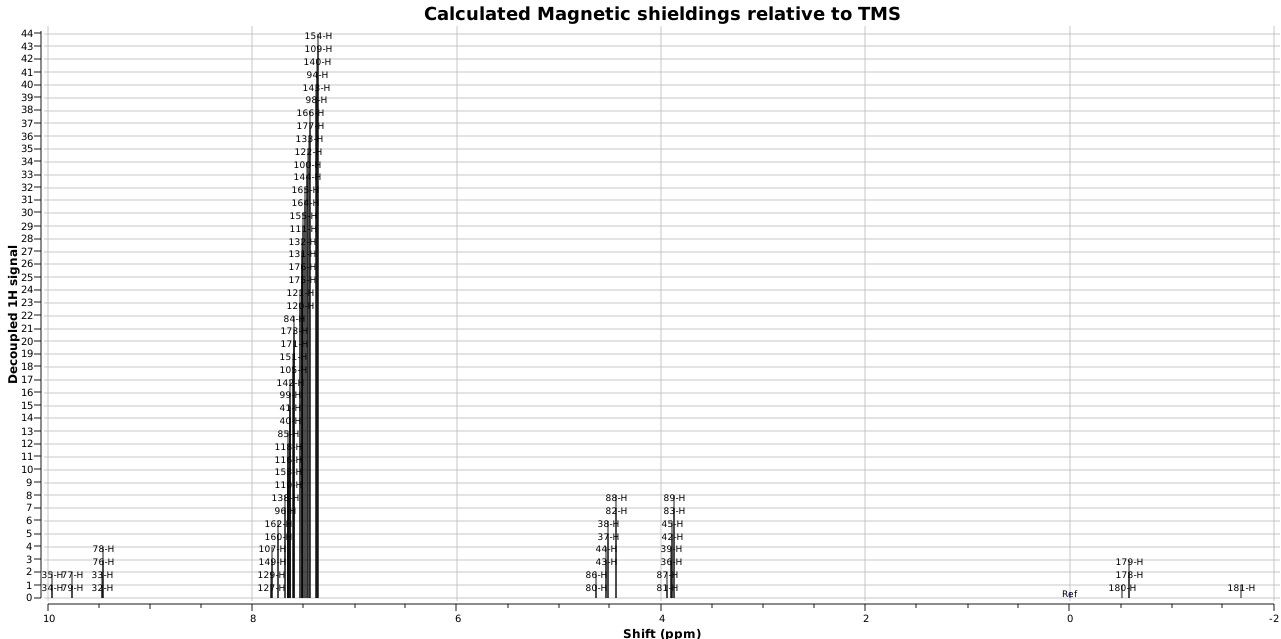
Finding out the structure of these dolls can be a tricky business. More often than not, they do not crystallise nicely enough to determine this by X-ray analysis (the structure of this one has never been reported, the structure above is a calculation), and even if the basic container could be analysed, the small molecules inside often rattle around too much (i.e. they are disordered) for their optimum position to be identified. Rebek and co resorted to 1H NMR spectroscopy. If you read their paper, you will find that the chemical shift of the four methane protons comes at -0.91 ppm if inside the cavity, and at +0.23 outside. These sorts of induced shifts (they can be very much larger) makes the identification of more complex molecules which may be inside the cavity a fraught business. Is there another method? Here I suggest that the 1H NMR spectrum can be calculated to sufficient accuracy to be able to comment on that internal structure.

The above is a ωB97XD/6-311G(d,p)/SCRF=dichloromethane calculation (under optimum conditions, this can predict the shifts of protons to an accuracy of < 0.1 ppm!). So it is here, with the calculated methane chemical shift being -0.84 ppm (averaged over the four protons). In fact, the spectrum above is amazingly like the real thing (which can be seen at the DOI above), excepting of course proton couplings. Oh, if you cannot see a spectrum, it is because your browser does not support SVG. Why did I use this format? So that you can expand the view above (zoom in using your browser), and the SVG will rescale the drawing without loss of resolution!

We might presume then that the calculated structure must be a good model for the real thing (the structure of which Rebek and Co were never able to obtain). If you click on the model above, you may notice that the methane is not located exactly in the centre of the cavity, but it is displaced towards the face of one of the benzene rings, and away from the other. Thus these internal dolls do have a preference for where they sit, a phenomenon by the way which Rebek has termed social (molecular) isomerism (DOI: 10.1021/ja020607a).This system has 181 atoms. I estimate that this sort of calculation can readily be done for molecules with up to about 250 atoms nowadays, which would cover a fair sprinkling of these molecular Matryoshka dolls.

Postscript:  Professor Rebek has kindly sent me the spectrum of both encapsulated methane and ethane which is reproduced below. The NMR of ethane calculated by the same procedure as above is -0.41 ppm.

The 1H NMR spectrum of encapsulated methane and ethane.


Archived on 2011-09-26. URL:http://www.ch.imperial.ac.uk/rzepa/blog/?p=4930. Accessed: 2011-09-26. (Archived by WebCite® at http://www.webcitation.org/61zSZeG7P)

(anti)aromaticity avoided: a tutorial example

Tuesday, December 7th, 2010

More inspiration from tutorials. In a lecture on organic aromaticity, the 4n+2/4n Hückel rule was introduced (in fact, neither rule appears to have actually been coined in this form by Hückel himself!). The simplest examples are respectively the cyclopropenyl cation and anion. The former has 2 π-electrons exhibiting cyclic delocalisation, and the 4n+2 (n=0) rule predicts aromaticity. Accordingly, all three C-C distances are the same (1.363Å).

Cyclopropenium cation and anion

The anion however appears to have 4 π-electrons, and must therefore belong to the 4n (n=1) rule and exhibit antiaromaticity. Pretty straight forward thus far. But students have a knack of asking apparently simple, but quite thought provoking questions. This one was “does one count lone pairs of electrons“? Perhaps a different way of putting it would be “does the lone pair really count as π-electrons?”

So, time for a calculation. Well, it turns out there are two isomers of the anion. The first has two C-C bond lengths of 1.383Å and one of 1.841Å; two short and one (very) long. Moreover, the whole system is very much non planar.

Cyclopropenium anion, first isomer

This isomer turns out to be really a 4π-allyl anion in disguise. To avoid any danger of cyclic conjugation (and hence antiaromaticity), the groups at the end of the allyl fragment rotate. So yes, this IS a 4π-electron system, but the molecule has cleverly distorted to avoid antiaromaticity as best it can.

Cyclopropenium anion. Isomer 2.

What about the second isomer? This now has one short (1.293Å) and two long (1.598Å) C-C lengths. The carbon bearing the two long bonds is now highly non planar. It is best described as an isolated double bond (2 π-electrons) trying to get as far away as possible, and to avoid as much overlap as it can, with a lone pair (NOT π) on the third carbon. Now, the lone pair really does NOT count, since it is too far from the other 2 π-electrons, and inclined at the wrong angle, to overlap effectively with them. The two isomers are almost the same in energy (the first being the lower in free energy by ~1 kcal/mol).

So what kind of answer would one give to the inquisitive tutee? Firstly, as the name implies, antiaromaticity is not good for a molecule. If it possibly can, it will avoid it. For the cyclopropenium anion, there are two quite effective ways of avoiding antiaromaticity. It is not, as a result, actually a good example of an antiaromatic system. Because molecules can be very clever at avoiding antiaromaticity, remarkably few examples of genuine antiaromatics actually exist!

I end with another way of looking at this problem using group theory. The cyclopropenium cation has D3h symmetry, and the LUMO (lowest unoccupied) molecule orbital in fact belongs to the E” irreducible representation. This means it is doubly degenerate. To form the anion from it, two electrons must be placed in one of these orbitals (but unless an open shell is formed, one cannot place one electron in each). Whichever orbital receives the two electrons is now stabilised, the degeneracy must break, and the resulting geometry must reflect this. The two symmetry-broken geometries are precisely those shown above.

Cyclopropenium cation, E" LUMO orbital 11. Click for 3D

Cyclopropenium cation, E" LUMO orbital 12. Click for 3D

Morphing an arrow-pushing tutorial into a dihydrogen bond

Thursday, December 2nd, 2010

My university tutorial yesterday covered selective reductions of functional groups in organic chemistry. My thoughts on that topic have now morphed into something rather different. Scientific research has a habit of having this sort of thing happen.

After I completed the blog post (deliberately done whilst the memory of the tutorial was fresh on my mind), a thought then struck me. I appended a new idea to the post in the form of a comment (the actual posts themselves I feel should remain resolutely unmorphed; I tend to correct only typographical and minor errors). I had spotted that the adduct between ethanoic acid and borane had a very short H…H distance. So the obvious thing to do is to see if one might tweak the structure to further enhance the interaction. Hence below.

Acyloxy-beryllium hydride. Click for 3D

The interaction of interest is between an acidic hydrogen and the hydridic one. The former can be acidified further by employing trifluoroethanoic acid. The latter can be tweaked by replacing boron with beryllium. This newly designed molecule now exhibits a H…H distance of 1.278Å (ωB97XD/6-311G(d,p) calculation), which as these so-called dihydrogen bonds go is pretty short (H2 itself is ~0.74Å). Normal dihydrogen bonds (see for example my lecture course) are in the region of 2.0-2.2Å, although  a few crystal structures (e.g. WAGBAH in the Cambridge database) have  shorter B-H…H-O distances of around  1.76Å. A typical  H…H van der Waals distance is  ~2.4Å.  So it appears that H…H interactions can be almost continuously tuned across the whole range of short covalent, to short and medium  dihydrogen and long dispersion lengths. The AIM analysis (below), shows ρ(r) to be ~0.07 au for the bond-critical-point spanning the H…H region. Normal hydrogen bonds rarely exceed 0.04, although it’s still some way off a covalent H-H bond value (0.26).

AIM analysis.

Could the molecule above be made and characterised? Well, it is probably the case that as the H…H distance gets shorter, so the activation barrier for actually eliminating covalent H2 will get smaller and smaller. Probably, distances of  ~1.7Å represent the shortest that actually has a reasonable barrier preventing such eliminations. With the current interest in devising materials capable of storing  H2 (and absorbing/releasing it on demand), these types of molecule may perhaps prove useful. Quite a way to come starting from a tutorial on diborane reductions.